Posted in Africa, Elephants, Nature, Nonfiction, Photography, Travel, Writing

Deja Vu

Jabu & the tree b&w


It’s an ancient feeling, this memory of a moment I’ve never had before, this exact smell of scuffed dust, this slant of light, the slightly spicy taste of sand, the warm brush of sunrays across my cheeks, the squint my eyes adopt as if they’ve always looked into the African sun.  It’s the way my bones melt, the acceptance in my mind and nerves that tells me not to run when a monster materializes from a clump of brush and moves to an arm’s length, breathing so quietly I wonder if it’s sleepwalking, I wonder if I’m sleepwalking, because everything that is happening, this monster, this place, my fog of serenity, must be made from dreams.

The monster moves closer.

A familiar monster.  One with a shape.  One with a name.

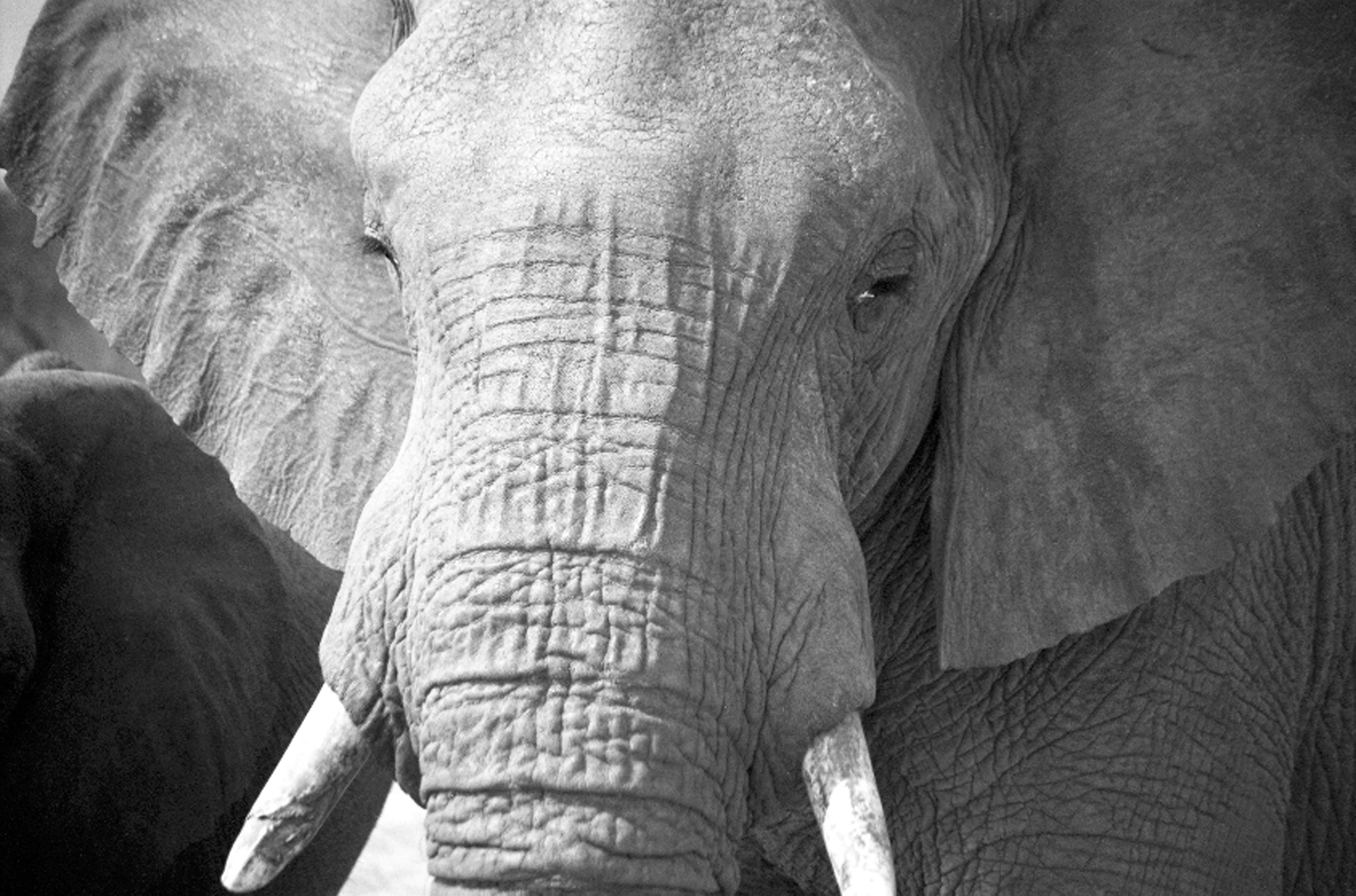
His eye, a huge topaz oval, stares down at me.  He’s motionless, concentrating.  I can’t even hear him breathing.

Like us, like all mammals, an elephant’s eye has one large lens, its aperture always open, except for a blink, or in sleep.  Like us, like all mammals, Jabu’s round iris controls the amount of light that enters his pupil.  And like us, the lens of his eye focuses light images on his retinas, where they convert into chemical and electrical impulses and whisk along the optic nerve directly to his brain.

What would it be like to think without words and recognize shapes without names?

Both of us, human and elephant, witness only a small portion of what is out there to be seen.  Francolins, mambas, tsessebees, zebras and lions – everything that crawls, swims or walks – witness the world in ways I cannot even imagine.

Even in the womb the eye of a fetus moves through its amniotic dreams.  Does it dream about the glories of a life to come?

“Hello,” I whisper.


The light from his eye just now reaches mine.


Posted in Africa, Elephants, Nature, Nonfiction, Photography, Travel

Pilgrimage

The Face

(After a trip to Africa in 1999):

I’m nearly asleep, lying across several seats at Heathrow, dreaming of elephants, my body suspended at its origin eight time zones away.  It’s neither night nor day in my dreams.  I see fluorescent lights through the lids of my eyes, hear polite announcements for flights, smell the faint barnyard dust of Africa, sense a great presence looming towards me.

Step by step she comes closer.  She is confident, unafraid.  She looks me directly in the eye.  Her eyelashes are long and straight, her deep brown eyes are dark, dark pools.

She stops less than five feet away, just beyond the reach of an outstretched arm, should I be foolish enough to do so.  She is wild, in charge.  I am on her terms and she knows it.  She knows that people sit motionless on smelly, noisy, moveable rocks.  She knows the small sneezing sounds of the devices they carry in their hands and point at her.

She stares into my eyes, then shakes her head sideways in a movement that would say “no” in my language.  Her ears flap once, twice, and great clouds of dust rise from them.  She raises her head, looks down the top of her long trunk.  It’s an imperious, don’t-mess-with-me look, but that again is my language, not hers.  A rumble like a promise for distant rain fills my ears.  Then she sidesteps, turns and vanishes without another sound into a thicket of brush, her great presence subtracted, a void of air where she stood.

I am on a pilgrimage to that place.  I am waiting for my flight, asleep at Heathrow.  I am nearly, virtually there, in my dreams.  

Posted in Africa, Elephants, Nature, Nonfiction, Photography, Travel, Writing

Mud Wrestling

Image

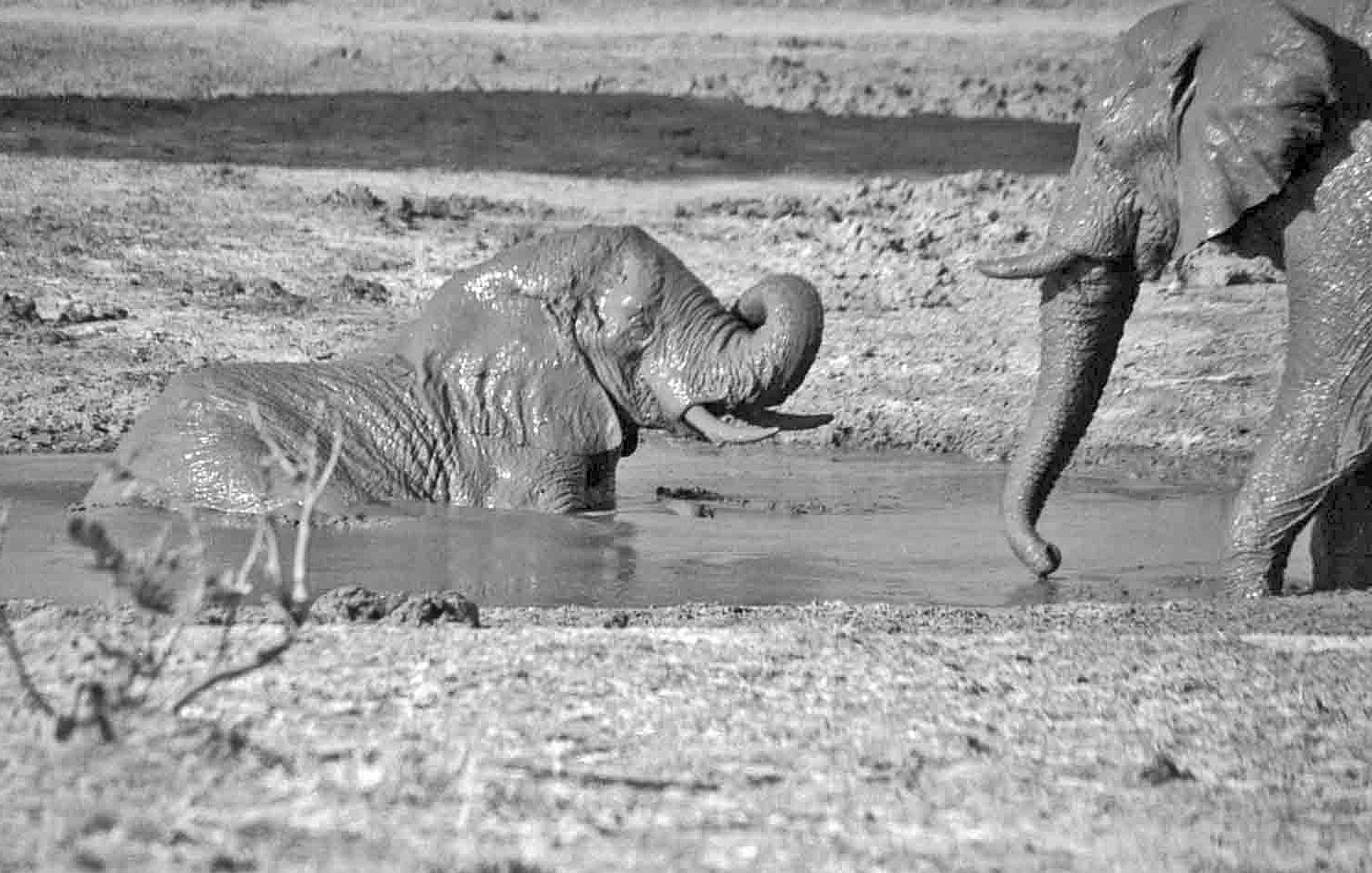
It’s a mucky, slimy, gloppy mud.  A young elephant snorkels on his side, the tip of his trunk swiveling above the surface, as he slides towards the other elephant, a brother or cousin.  His days are filled with heat and dust.  It’s winter in Botswana, the sun is relentless, and mud will soothe his scorched skin.  He lifts his head from the muck, curls his trunk and closes his eyes.  This feels good, his body language says, this feels really good.    

If we could imagine ourselves weighing four tons and think of gravity’s effect on those four tons, then maybe we could imagine wallowing in such mud, pushing and shoving like giant sumo wrestlers, reveling and rolling in the sheer pleasure of warm gunk.  We would inhale a slimy trunk-full of ooze, squirt it like a water gun in any direction, even at each other.  We would rub our eyes clear with a curled fist at the end of our trunks.  We would arise glistening and bright as a metallic statue.  We would be cooled, refreshed, gigantic, gentle beings. . . . if we could imagine such a thing.

Posted in Africa, Elephants, Nature, Nonfiction, Photography, Travel, Writing

How Much of the World Are We Missing?

Listening, really listening.


Just at the edge of darkness, where the light of our fire does not penetrate, an elephant thunders by, trumpeting the whole way, like a locomotive off track in a dry forest, a classic illustration of the Doppler Effect, sound that condenses, rises in pitch, crescendos, blows by, drops pitch, recedes. 

We lift our heads in surprise.  Waves of sound undulate away from us, kin to ripples on a pond.  We use pulsed sound waves, Doppler Radar, to see rain, to know when we should run for cover.  There is no such radar for an incoming elephant.

Eventually his outrage is extinguished in our ears, but elephants a mile away are just beginning to hear it.  Resonance fills the night air around us, yet we are deaf to it, to the sounds just below our range of hearing.

How much of the world are we missing, circle upon circle?  Perhaps instead of placing ourselves at the center we should move to the edges where our skills are low and our learning curve high.  We should extinguish our fire and sit in the darkness listening, really listening.

Posted in Africa, Elephants, Morula, Nonfiction, Photography, Pleistocene

Footprints

Footprints

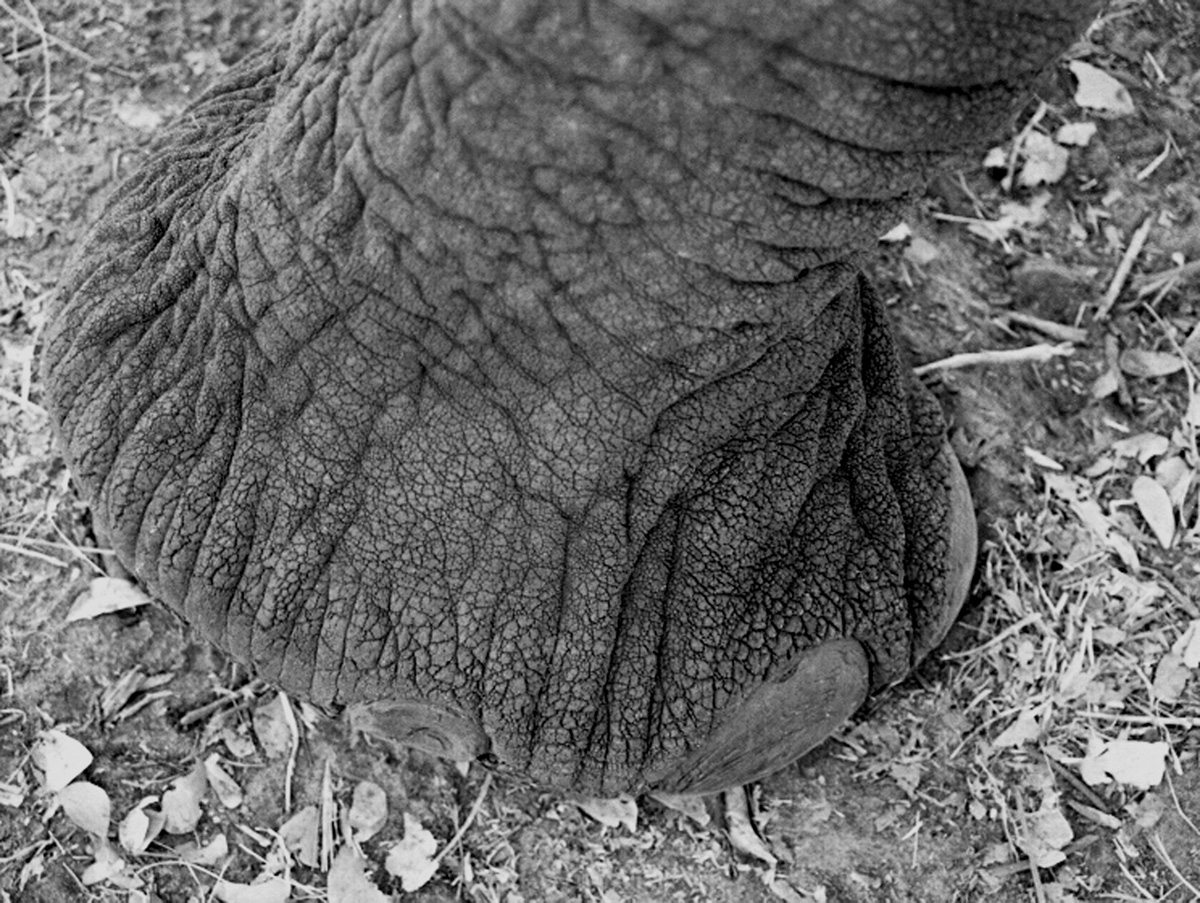
Our feet anchor us to the ground.  Just as my Pleistocene ancestors could read the tracks of mastodons, so I now gaze down at an elephant’s prints in the dust.  Her back feet are oval and her front feet round.  City slicker that I am, even I can tell the direction she is going.

 The sand beneath our feet  is the color of a lion’s coat, studded with brittle leaf litter.  Morula walks through it without making a sound.  Shock-absorbing pads on the soles of her feet cushion each footstep, smother crushed leaves.

I step on a dry leaf and it crackles into powder.

The brand name of my boots imprints within the outline of my soles; a clever advertisement made with each step.  All of my weight concentrates in two small points of contact with the earth, so I make deeper impressions than Morula’s footprints.  Each one of my steps applies more pressure per square inch; Morula’s weight spreads over four large footpads the size of a medium pizza pan.

She can step on a snake and not kill it.

Morula lifts her foot and grains of sand roll down slope into the crater of her footprint.

Following two paths, the one beneath her feet and the one in her mind, Morula strolls on.  Dust rises, a half shadow that marks her passage, before it collapses again to the ground.

There is a before and an after to each moment of our lives, paths we follow and paths we do not.

Posted in Nature, Writing, Zoos

Solitary Confinement

Jabu eye 2 b&w

Alone,

alone,

two steps forward, two steps back,

the elephant sways to a rhythm no one, not even she, can hear.  Two steps forward, two steps back.  Swaying, her head dips to one side, then the other.  Her motions are born from a numb brain, from uncut boredom, from the measurement of a life by that which does not happen.

Beyond the barriers that surround her, a jerky stream of humans flows past, day after day.  Their powerful odors overwhelm her, and she touches her temporal gland, samples her urine, the only familiar smells left to her.  At the end of each day, after the humans are gone, she hears a multitude of rumbles, but none have resonances she can recognize.

Sometimes she will lie down on the huge square stone into which she is entombed and sleep.  There are no stars over her head.

She ceased calling out to her kin a long time ago.

As near as she knows, she is the only elephant left on earth.


Note:  There are 284 elephants in 79 accredited zoos in the United States.  Most zoos have more than one elephant, because elephants are social creatures who need companions from their own species.  I originally wrote this piece when I learned of Maggie, who lived at the Alaska Zoo in Anchorage for 24 years, the last eleven of those years alone.  In 2008 she was transported to the PAWS sanctuary in California, where she now lives with other African elephants.  Here are the remaining zoos that keep just one elephant:

  1. San Antonio Zoo – “Lucky”
  2. Double M. Ranch, New York – “Reba”
  3. T.I.G.E.R.S., South Carolina – “Bubbles”
  4. Natural Bridge Zoo, Virgina – “Asha”
  5. Wild Adventures, Georgia – “Shirley”  – Shirley is age 69 and has been in captivity since 1946.

Sources:  verified independently, using the database from http://www.elephant.se

Posted in Africa, Elephants, Nature, Travel

The Most Useful Appendage That Ever Evolved

An excerpt from my book-in-progress:

Trunk in face


The tip of Jabu’s trunk hovers in front of my eyes, wet with mucous, dotted with sand, nostril hairs visible.

He blows into my face, gently.  I blow back, gently.  We exchange breath, distillations of our own personal atmospheres, particle-swarms of changed, exchanged air, brewed though all the cells of our bodies.

My lungs fill with the fragrance of crushed leaves, with saproots and spearmint-scented bark, all lightly fermented.  I think of the stagnant air that surrounds my daily life, air that is conditioned, filtered, deodorized, air that is bland.  Elephant’s breath is said to cure headaches.  And it just might, if I had one.

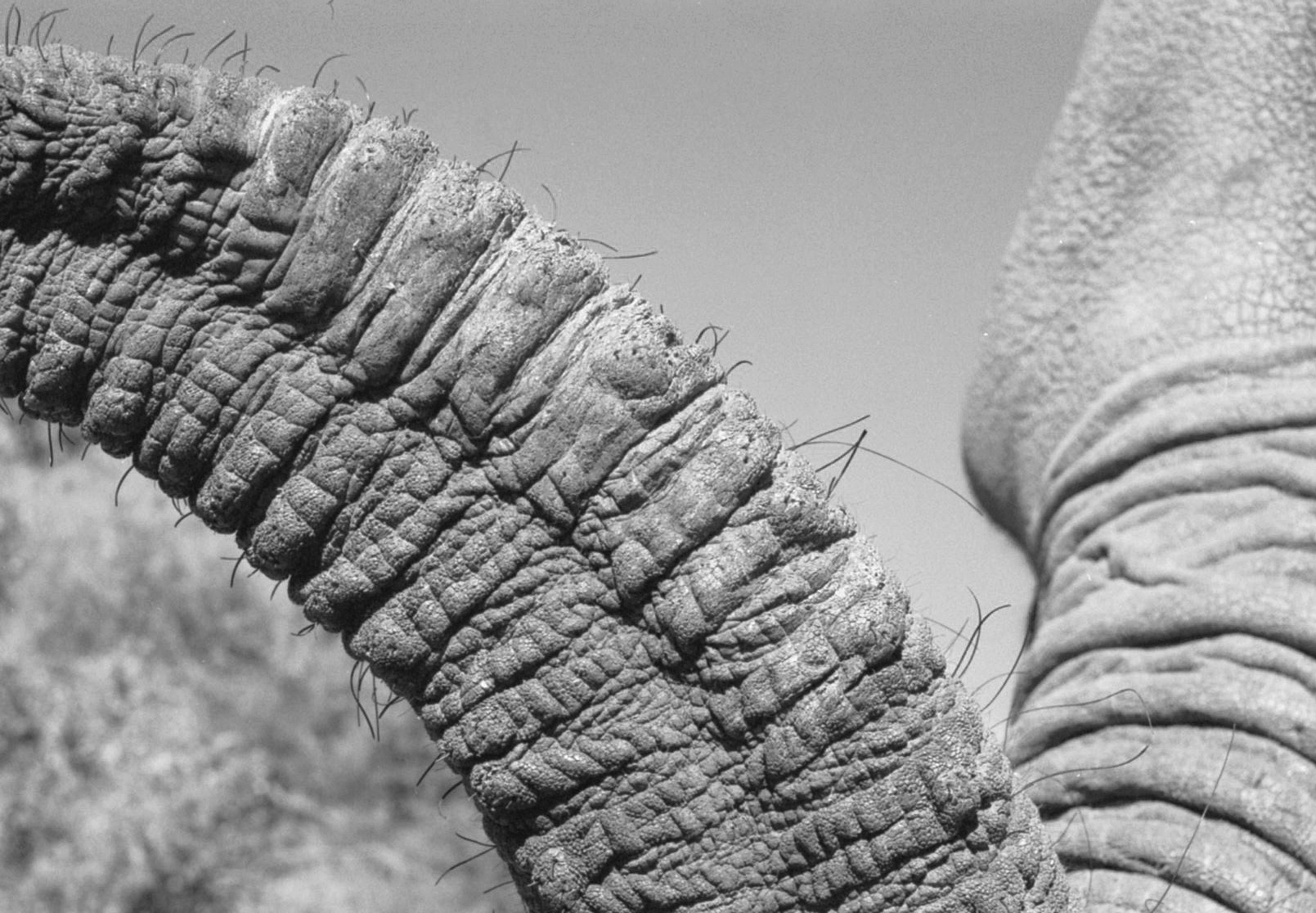
Jabu’s trunk tip investigates my right boot tip.  The scents I’ve picked up while walking tumble up two seven-foot-long nostrils – nostrils surrounded by nerves, arteries, veins and a staggering array of longitudinal and transverse muscles, the world’s biggest, longest and certainly most flexible schnozz.

A trunk is the most useful appendage that ever evolved.  Imagine having an arm in place of your nose, an arm long enough to reach to the top of a tree, and pluck a single leaf from its crown.  Imagine having a nose with which you could rip, tear, excavate, whack, and blow bubbles.  You could steal with your nose, suck on it, squeal, swat, poke and siphon with it.  You could take a shower, or reach over your shoulder and scratch your back with it.  You could even arm wrestle with your nose.

He chuffs, a hot gust of air directed at my feet.  Wet mist covers one boot top momentarily, then evaporates.


Posted in Africa, Elephants, Nature, Travel

Trunk Show

Morula trunk underside b&w


Funky jazzy trombone trunk.  Snaking snorkeling vacuuming trunk.  Showerhead.  Backhoe.  Slinky.  Shimmying sucking swigging trunk.  Empty pipe.  Water gun.  Periscope.  Plucking siphoning tenacious trunk.  Kazoo.  Tweezers.  Tentacle.  Affectionate handshaking pickpocket trunk.  Python.  Air hose.  Question mark.  Whistling snorting sneezing trunk.


Breathtaking

trunk.


Posted in Africa, Doug, Elephants, Jabu, Lions, Morula, Thembi, Travel

Lions, Part One

While standing in the shade of my tent, I look out over a lagoon of bent grass to the trees at its far shoreline.  A few of the stalks shiver and crosshatch in the lagoon as a mouse or grasshopper nibble at their stems.  Otherwise, the grass is motionless.

I stick my hands in my pocket and scuff dust with the toe of my boot.

Something rustles in the underbrush.  My sleepy senses come to full alert.  It’s an ancient world out there  – full of primitive memories storied at the bottom of our brains.  i spot one of the honorary camp staff, a francolin, scratching around a clump of buffalo grass.

We are all afraid of something.  Thembi gets in a tizzy over bees.  (Imagine bees up your nose!)  Eggshells horrify Jabu.  For Morula, it’s the fear of not belonging.

Are elephants afraid of mice?  No, but quick small things moving around their feet startle them.  I consider that a prudent reaction in a world full of snakes.

My fears are primitive, hard-wired into the base of my brain from the time when humans were prey to huge fanged predators – cats as large as grizzlies, bears as large as elephants.  My primitive brain is not comfortable when there are carnivores around, especially when I can’t see them.

Just last night a lion’s roar ripped me awake from a deep sleep: WAAA-AH-UNGHHH   UNGH  UNGH  UNGH  ungh  ungh. . . .It ended with those deep grunts lions cough up from their bellies.

A lion’s roar can be heard for five miles.  This one was incredibly loud and incredibly close, right at the edge of camp.

A cold set of fingers wrapped around my heart.  In the darkness my heart threw itself repeatedly against my ribs, then slowly backed into a corner of my chest.  Wary, it waited there for another roar, which never came.  I knew I was safe – no lion has ever dragged someone out of a zippered tent in Botswana.    But tell that to my primitive brain.

Four days ago, as I waited for Doug to pick me up from Stanley’s Camp, I had enough time before his arrival to join an evening game drive.  A young couple on their first trip to Africa climbed into the tier of seats behind me in the Landcruiser and held hands.  They were on their honeymoon.  John, our driver and guide, explained that two other vehicles from camp had found a pride of lions on the other side of the reserve – but it was too far away for us to join them and be back before dinner.
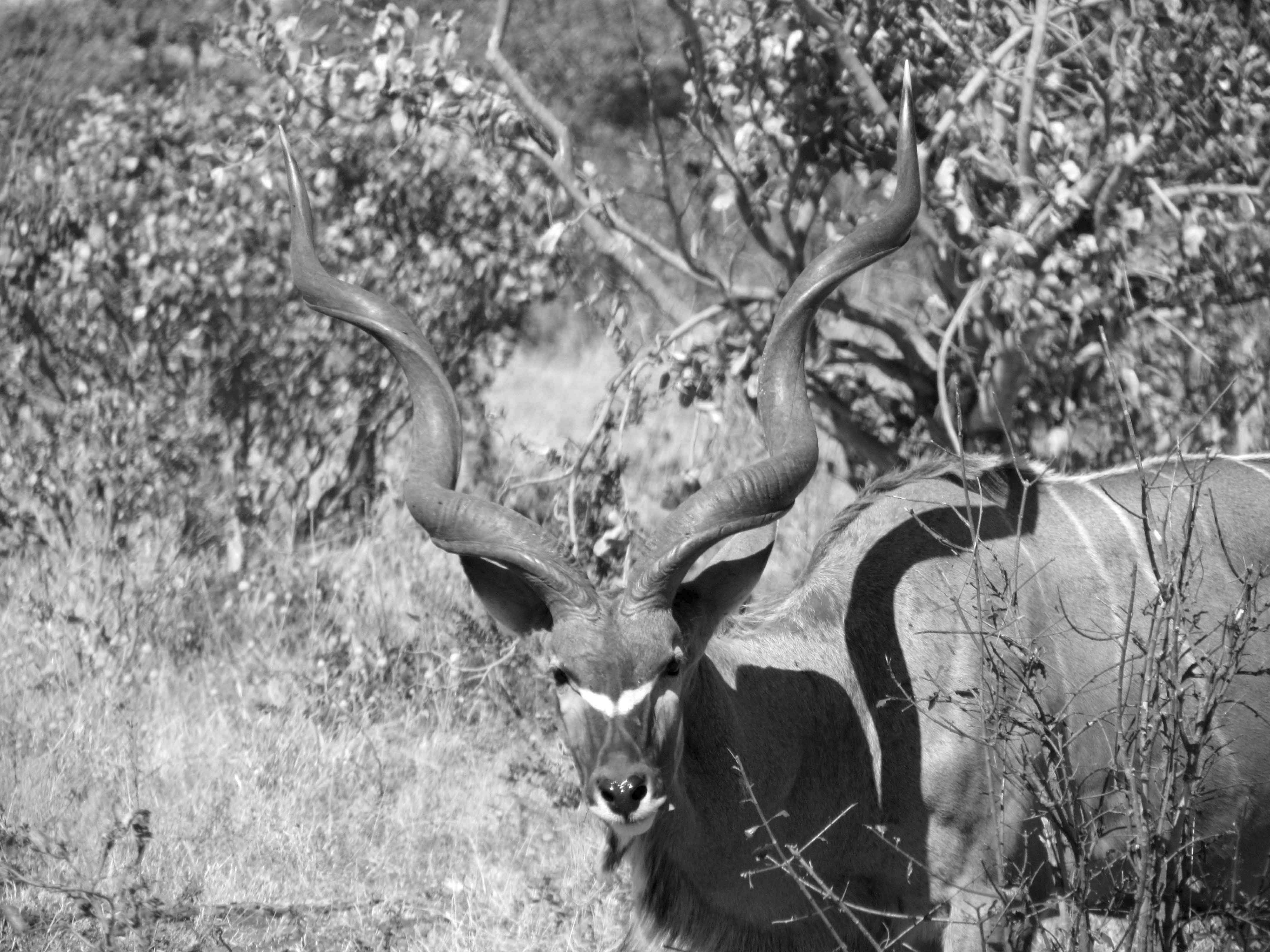
Kudu horns b&wSo we headed off in the opposite direction.  The young couple happily snapped photographs of zebras and impalas and baboons, giddy with the realization they were in the midst of their dream vacation.  A male kudu with magnificent horns kept us in one place for nearly a half hour as the couple peppered John with questions and marveled over the graceful curl of the kudu’s horns.

At dusk John parked at the top of a knoll.  With open grassland all around us it was safe to descend from the vehicle.  He prepared traditional sundowners – gin and tonics – and handed them around.

As I take my first sip a lion roared in the near distance.  “That’s not very far,” I said and looked at John.

“We could get lucky,” he looked at the couple with us.

They nodded, so we dashed our drinks on the ground, stashed our glasses back in their basket, and scrambled back into the Landcruiser.

Just down the road, where we’d been half an hour earlier, four large males lounged in the tall grass alongside our tracks.  One lifted his chin and roared, loud enough to rattle our hearts:  WAAUNNNNNNGH, UNGH, UNGH, ungh, ungh, ungh.

John sent a radio message to the other vehicles.  They will detour to join us on their way back to Stanley’s.

As we watched the four males, light faded from the sky and disappeared.  Blue became purple, then black.  Stars appeared, each one of them a cold clear diamond.

John switched on a spotlight.   A male sat in front of us, looking to our right, listening.

Spotlight off.  The couple behind me murmured to each other and tried to become small blobs, rather than humans with discernable arms and legs and heads.

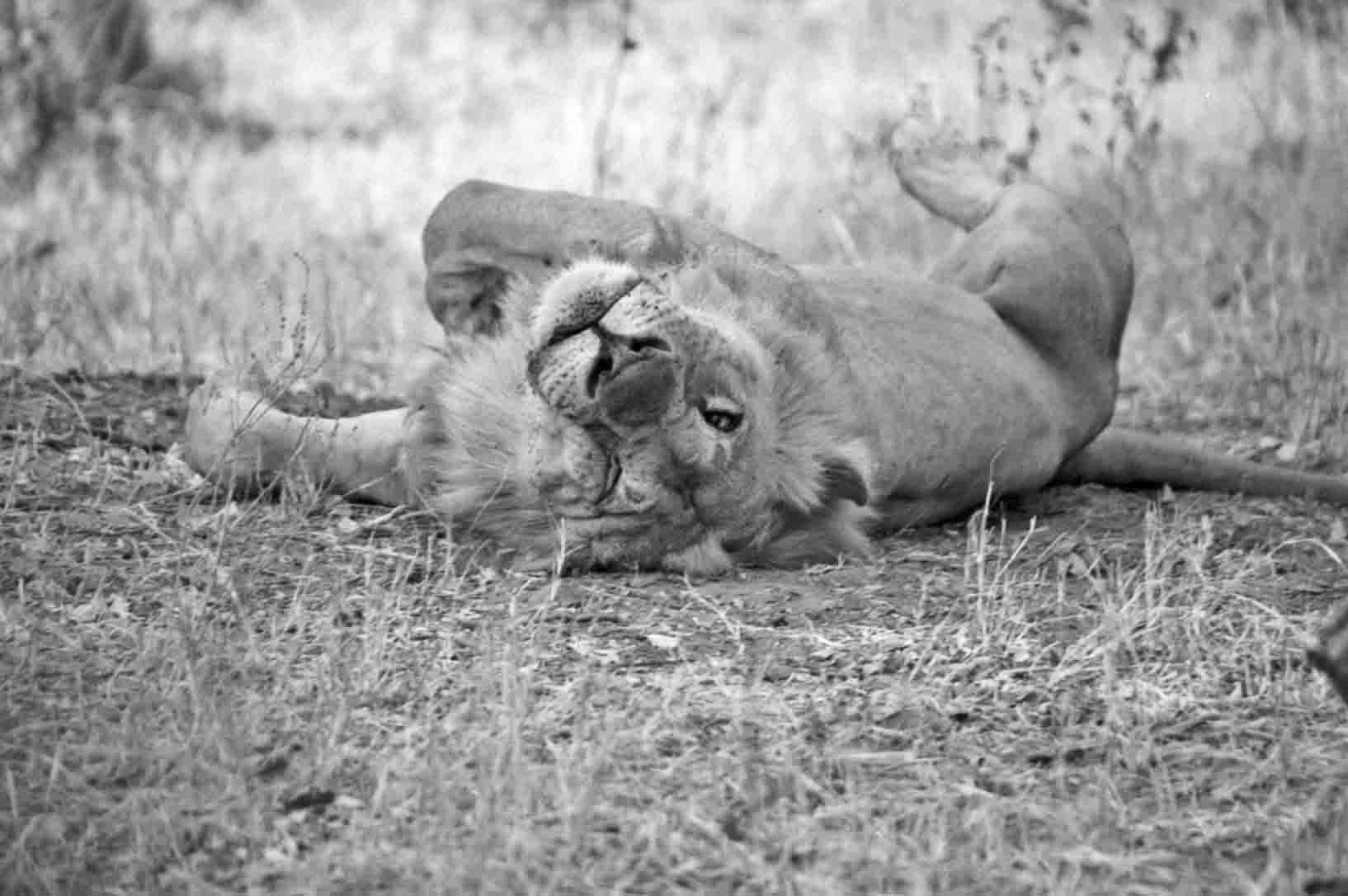
Spotlight on.  Another male, on the left, folded into the grass, on his side, with a barely audible ufff.B&W male lion
Spotlight off.

A distant contact roar from one of the lions on the other side of the reserve.

Spotlight on.  The male in front of us headed to a wall of brush and trees, disappeared.

Spotlight off.  Shallow breaths through my open mouth.  A commotion to our left.

Spotlight on.  Another male, who was sitting off to our right, had moved across the road and was now rubbing the side of his face against the lion inert in the grass.  When he couldn’t get his companion to rise, he also slid into the bush.  A fourth lion, just up the road, ghostly in the spotlight’s shadow, followed the first two, disappeared.

Spotlight off.  Silence.

Then a faint roar, in the distance again.

The hair on my arm rose before I even thought about it, as I realized that next to me the grass hissed, hisss zissh, hisss zissh, as something large walked by.

“He’s right beside me,” I whisper without moving my lips.

Spotlight on.

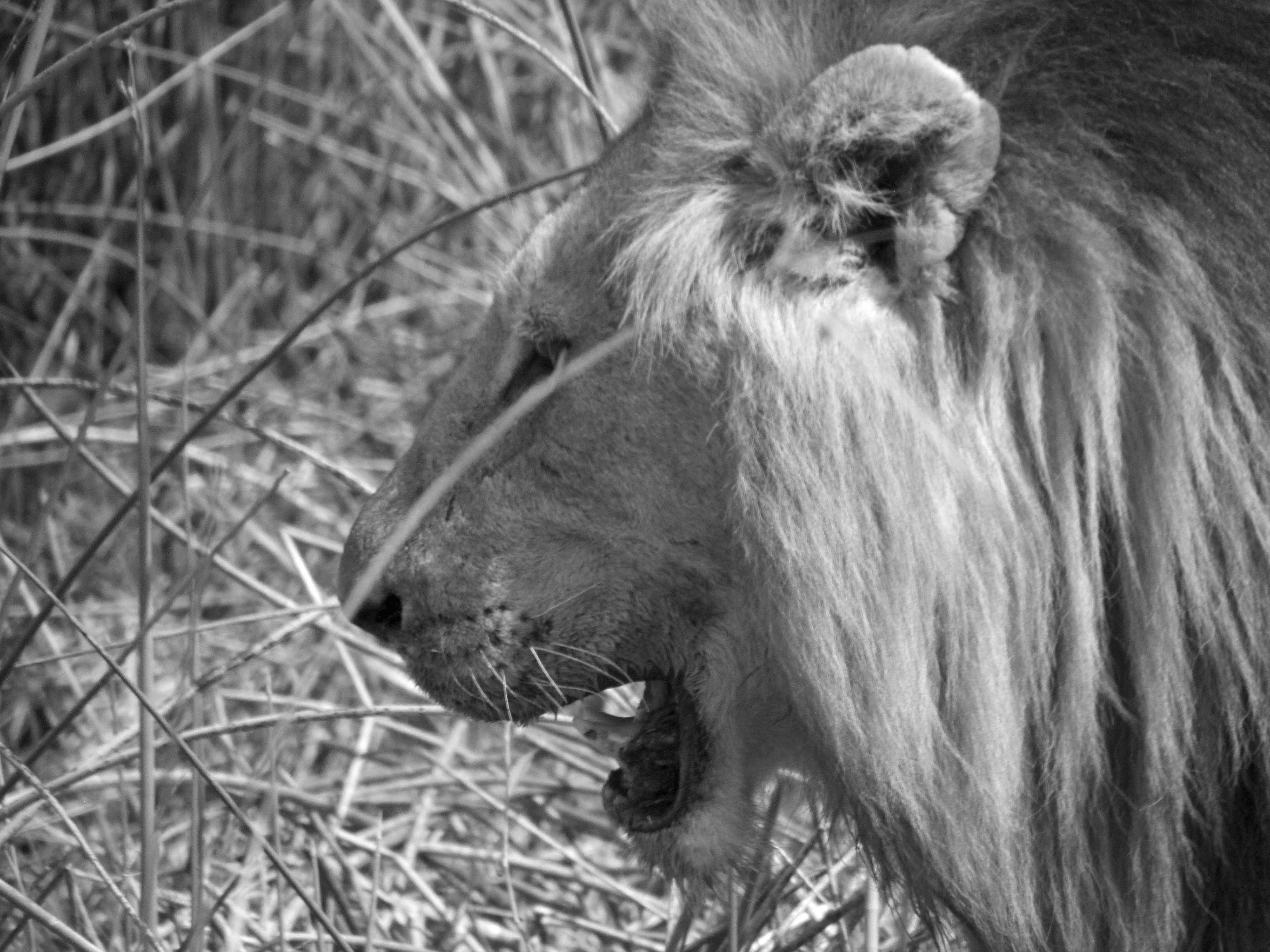
The inert lion was gone.  John twisted his hand over his shoulder and the light caught the back of a lion just passing the front tire on my side of the vehicle.  His great head swung back and forth as he walked hisss zissh, hisss zissh through the tall grass.  The lion had walked around the back end of the vehicle without us hearing him until he was right next to me.  The skin on the back of my neck tried to crawl up to the top of my head.A Lion Walks By b&w
The lion turned his head toward the light.  The pupils in his yellow eyes shrank to pinpoints.

He was that close.  I saw his pupils shrink to pinpoints.

He huffed and swung around to follow his three brothers into the bush.  I exhaled.  Had I been holding my breath that long?

The two other vehicles appeared just in time to catch a glimpse of his back in waist-high grass.  They followed him, bouncing through the brush, their headlights tapping the tops of trees.

John turned in his seat and looked at us.  The spotlight in his lap illuminated his face and glinted from the eyes of the young couple, eyes that were now nearly the size of  their open mouths.

“I think it is enough,” he said.  “Let’s go to the hyena’s den before the others get there.”

Posted in Africa, Elephants, Jabu, Morula, Thembi, Travel

The Tree of Life, Part One

An excerpt from the book I’m writing about elephants:

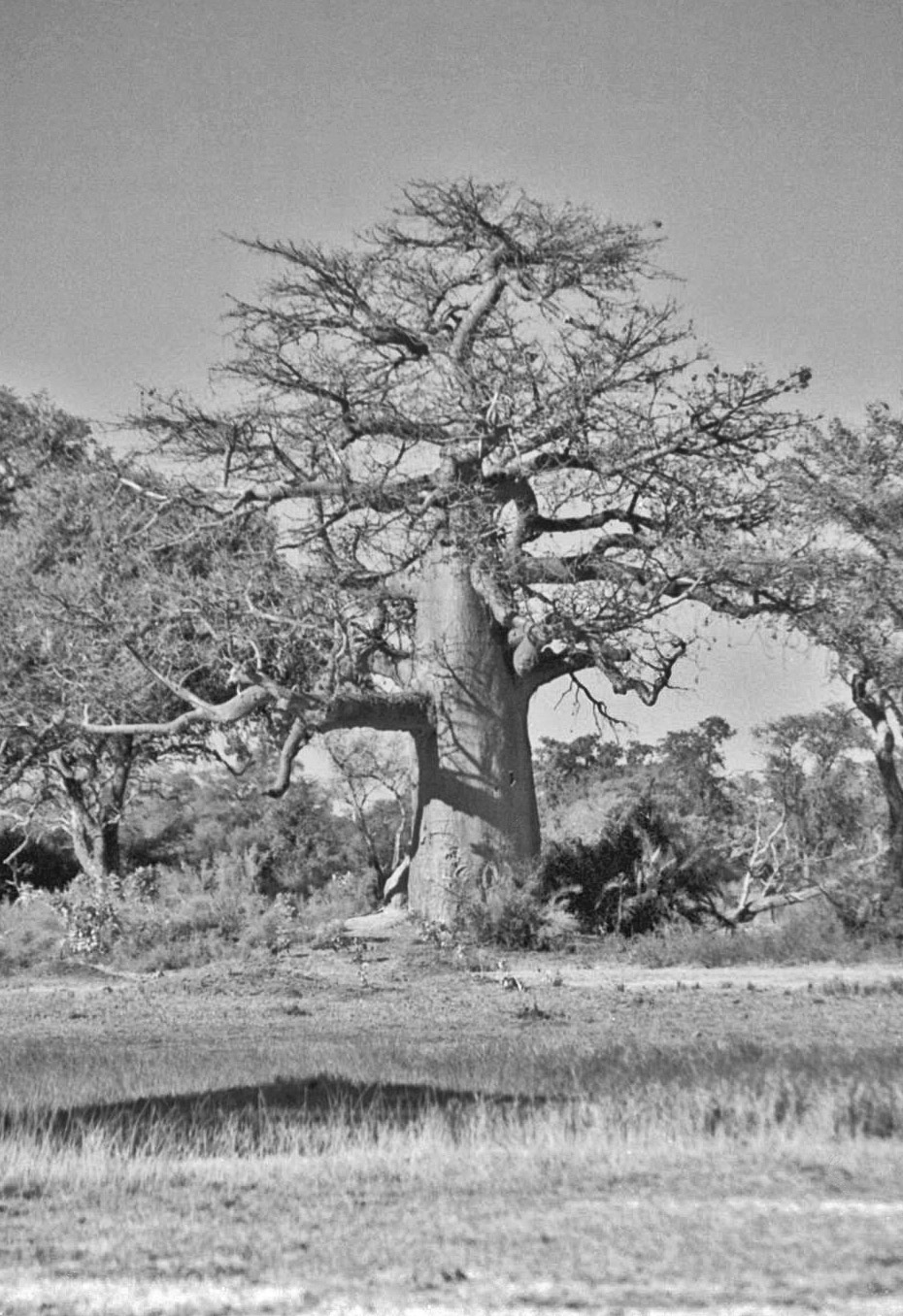
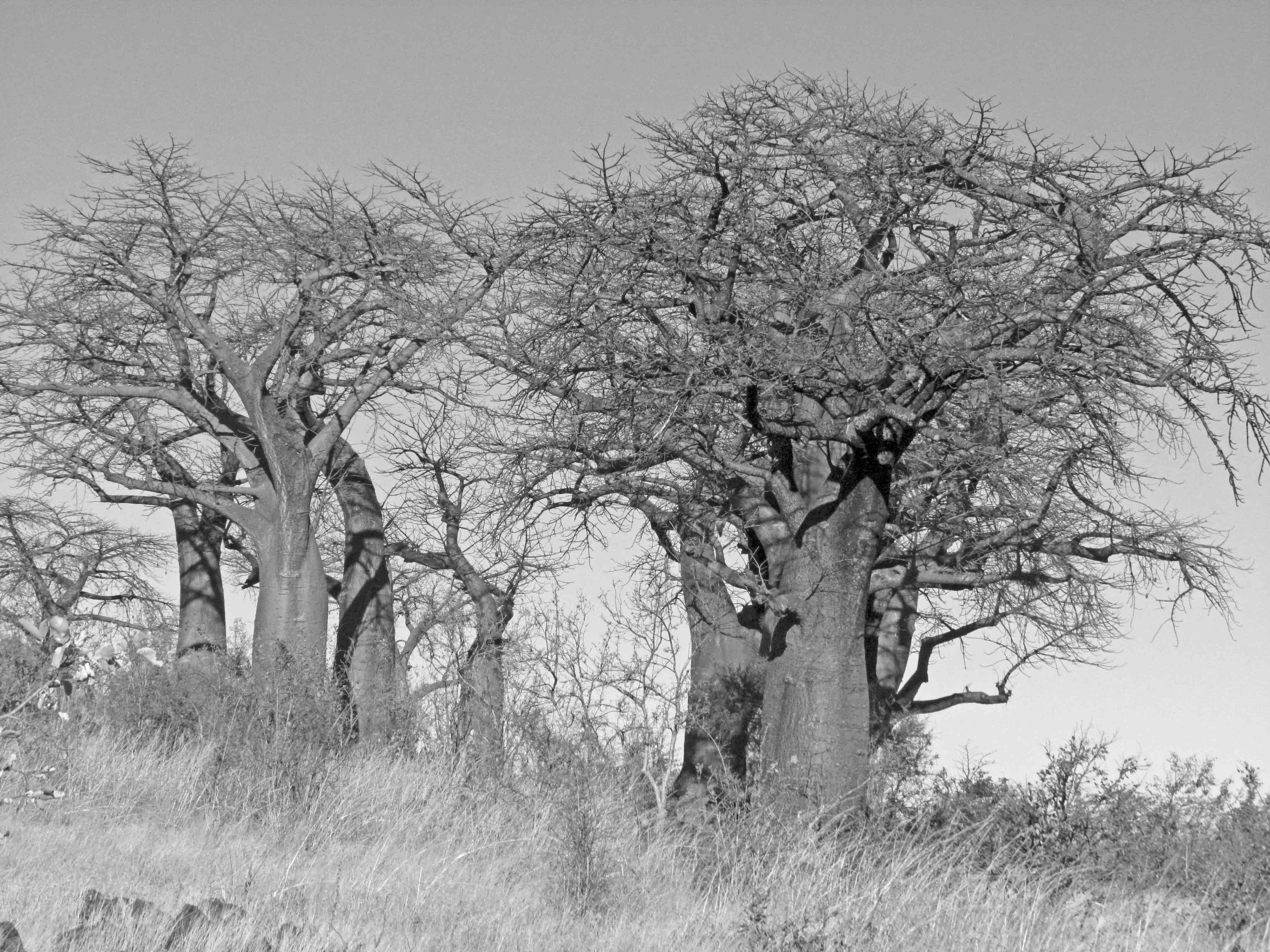
Baobob in winterJabu, Morula and Thembi slowly browse through the brush on one of the islands stranded after last year’s Okavango flood.  Opposite of us, across a dried lagoon filled with grass, is a rare tree species for this part of the Delta: an African baobab, Adansonia digitata – digitata for the five leaves it has per stem.  The baobab is deciduous, naked this time of year.  Its prehistoric appearance conjures up primeval landscapes full of odd plants and crawling creatures that existed in the ages before the dinosaurs.

There are eight species of baobabs, six found in the dry deciduous forests of Madagascar, one in Australia, and digitata, which grows in West, East and Southern Africa.  Baobabs are also found on the Arabian Peninsula, spread there by the movement of human settlements.

Adansonias are named after the French naturalist, Michel Adanson (1727-1806), who spent five years in Senegal, brought home a huge plant collection, and published a paper on digitata after his return.  Adanson also wrote a masterwork of natural history, an encyclopedic l’Ordre Universel de la Nature, but it was based on his own system of classification, distinct from that of his contemporary, Linnaeus (1707-1788).  Linnaeus’s Systema Naturae, introduced binomial nomenclature – using an organism’s Genus, Adansonia, followed by a descriptive modifier such as digitataSystema Naturae classified 4,400 species of animals and 7,700 species of plants.

In contrast to Linnaeus’s system based on structures, Adanson proposed a “natural” system that took many features of the plant into account, which included structure along with function, growth, evolution and distribution.  His system was ignored in his time because he refused to use binomial nomenclature.  However, the publication in 1789 of Genera Plantarum, by Antoine Laurent de Jussieu, combined Adanson’s use of multiple structures with Linnaeus’s binomial classifications – a methodology widely accepted and still in use.

Adanson’s masterwork was huge, just like the baobab: 27 large volumes with a 150-volume index that contained an alphabetical treatment of 40,000 species, a vocabulary listing 200,000 words, 40,000 drawings and 30,000 specimens.  It was never published.  It is, however, preserved in the Hunt Institute for Botanical Documentation, at Carnegie Mellon University in Pittsburgh, Pennsylvania.

Elephants love the bark of the baobab because of its moisture content.  As insurance against harsh drought, the swollen trunk of a single baobab stores up to 32,000 gallons of water, making its wood soft, spongy and fibrous.  A plank cut from this tree will decrease in volume by 40% and shrink in length by 15% while it dries.  Sometimes, during these times of drought, elephants will completely gird a tree, leaving it standing as if standing on its own pedestal, and yet the baobab will still survive.

The bark on the baobab across the lagoon is smooth and pinkish gray – untouched by elephants, probably due to its proximity to the Okavango’s permanent water channels.  I estimate this tree to be about 22 feet in diameter and 70 feet tall.  Mature baobabs have trunk diameters of twenty-three to thirty-six feet and reach heights of sixteen to ninety-eight feet.  The Glencoe baobab, near Hoedspruit in the Limpopo Province of South Africa, is considered the largest specimen alive.  Up to recent times it had a circumference of 154 feet.  In 2009 it split into two still-living parts, revealing an enormous hollow in the middle.  The date 1893 is carved into its trunk.

Found mostly in seasonally arid areas, baobabs grow very slowly as they age.  However, in its first years of life, a baobab grows relatively quickly.  A tree planted in Kruger National Park in South Africa grew 65 feet tall with an eleven-foot diameter in just 38 years.  In contrast, an older tree described by Livingstone in 1858 grew only two feet in circumference in 110 years.  Despite their early exuberance, baobabs can be cultivated as bonsai trees.

Baobab forest b&wAlthough the Glencoe baobab is thought to be two thousand years old, baobab wood does not produce annual growth rings and it actually shrinks during times of drought, so its size is not an indicator of its age.  The baobab across the grass lagoon is probably – my best guess – around 600 years old, or older, taking root about the time Eric the Red colonized Greenland (985), or later – perhaps the year Gutenberg invented the printing press (1439).  This tree, this timepiece, first dropped its leaves during the Middle Ages, and will continue dropping them, annually, for several thousand years more.

Just twenty days after leaving England, the Beagle anchored at the Cape Verde Islands on Jan 16th, 1832.  As Charles Darwin surveyed the islands with ship’s captain Robert Fitzroy, they measured a baobab that was 45 feet tall and thirteen feet in diameter, and rumored to be a thousand years old.  Darwin remarked in his diary that Adanson supposed some “celebrated baobabs” to be 6,000 years old.  The enormous tree “with its great thickness” impressed Darwin, and he wrote in his diary, “This one bears on its bark the signs of its notoriety – it is as completely covered with initials & dates as any one (tree) in Kensington Gardens.”

The Glencoe baobab has never been subjected to radiocarbon dating, but another in the Limpopo area has been carbon-dated at over 6,000 years, older than the pyramids at Giza (2560 BC).  Several other trees in the region have also been dated  – at about two-to-three thousand years old.

As I look at the baobab across the grass lagoon, I wish I could slip sideways into the life of this nearly eternal tree, and time-lapsed, witness the swirl of life around it as it fattened and grew.  And why not wish also for the future, for another one or two thousand years more?

I turn at the sound of a branch breaking behind me, squint against the sun, and cup a hand at my forehead to shade my eyes. The elephants are great gray silhouettes, haloed all around in bright, bright light.  My watch ticks on my wrist, its hands pointing to meaningless numbers.