Our feet anchor us to the ground. Just as my Pleistocene ancestors could read the tracks of mastodons, so I now gaze down at an elephant’s prints in the dust. Her back feet are oval and her front feet round. City slicker that I am, even I can tell the direction she is going.
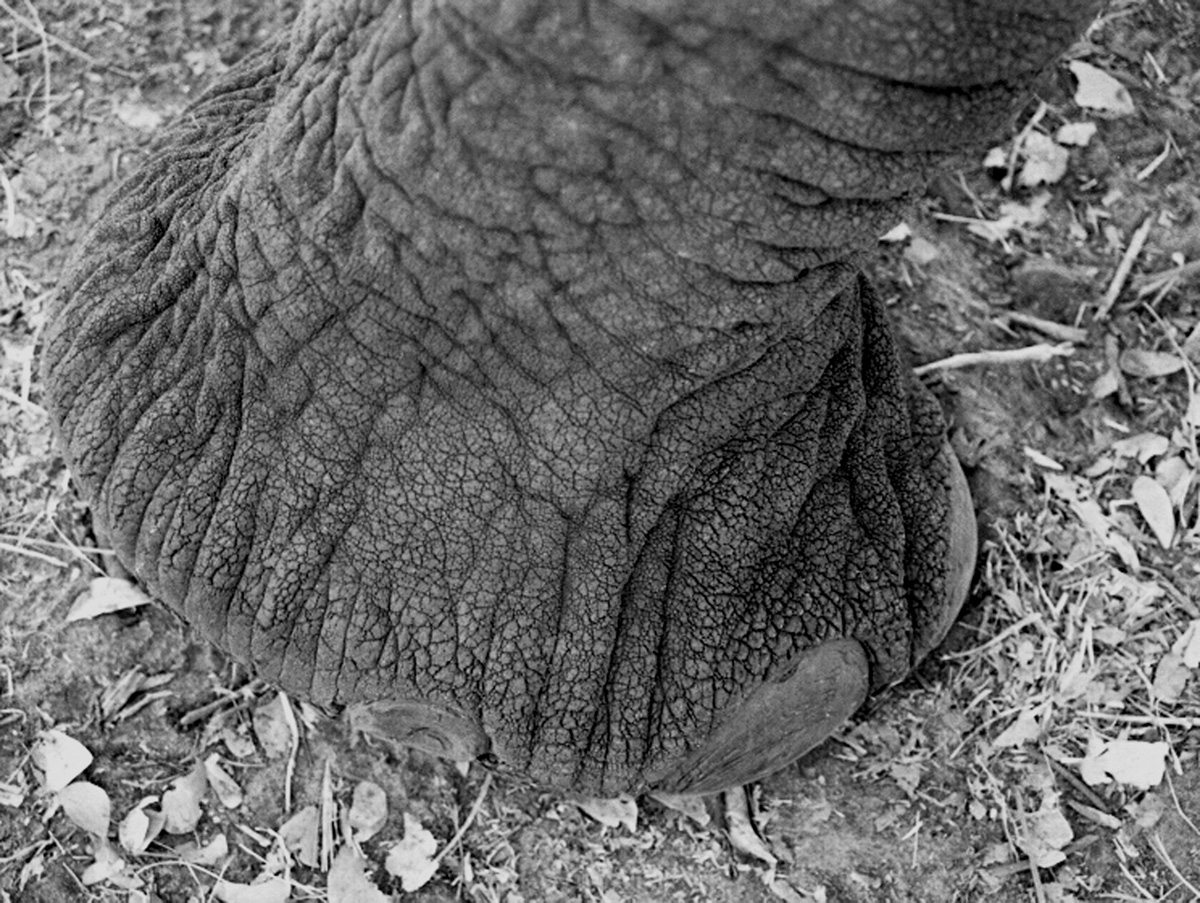
The sand beneath our feet is the color of a lion’s coat, studded with brittle leaf litter. Morula walks through it without making a sound. Shock-absorbing pads on the soles of her feet cushion each footstep, smother crushed leaves.
I step on a dry leaf and it crackles into powder.
The brand name of my boots imprints within the outline of my soles; a clever advertisement made with each step. All of my weight concentrates in two small points of contact with the earth, so I make deeper impressions than Morula’s footprints. Each one of my steps applies more pressure per square inch; Morula’s weight spreads over four large footpads the size of a medium pizza pan.
She can step on a snake and not kill it.
Morula lifts her foot and grains of sand roll down slope into the crater of her footprint.
Following two paths, the one beneath her feet and the one in her mind, Morula strolls on. Dust rises, a half shadow that marks her passage, before it collapses again to the ground.
There is a before and an after to each moment of our lives, paths we follow and paths we do not.
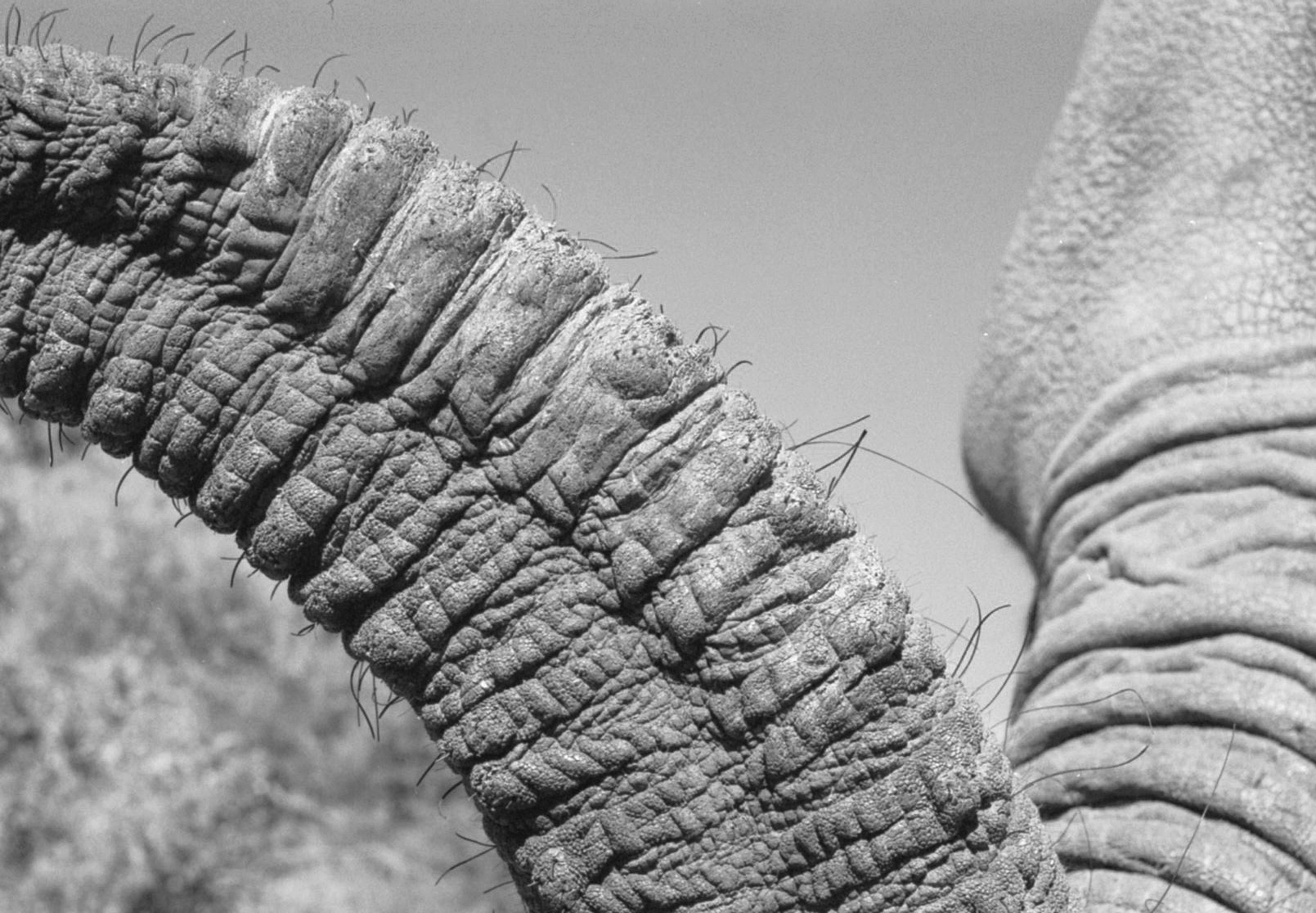
The tip of Jabu’s trunk hovers in front of my eyes, wet with mucous, dotted with sand, nostril hairs visible.
He blows into my face, gently. I blow back, gently. We exchange breath, distillations of our own personal atmospheres, particle-swarms of changed, exchanged air, brewed though all the cells of our bodies.
My lungs fill with the fragrance of crushed leaves, with saproots and spearmint-scented bark, all lightly fermented. I think of the stagnant air that surrounds my daily life, air that is conditioned, filtered, deodorized, air that is bland. Elephant’s breath is said to cure headaches. And it just might, if I had one.
Jabu’s trunk tip investigates my right boot tip. The scents I’ve picked up while walking tumble up two seven-foot-long nostrils – nostrils surrounded by nerves, arteries, veins and a staggering array of longitudinal and transverse muscles, the world’s biggest, longest and certainly most flexible schnozz.
A trunk is the most useful appendage that ever evolved. Imagine having an arm in place of your nose, an arm long enough to reach to the top of a tree, and pluck a single leaf from its crown. Imagine having a nose with which you could rip, tear, excavate, whack, and blow bubbles. You could steal with your nose, suck on it, squeal, swat, poke and siphon with it. You could take a shower, or reach over your shoulder and scratch your back with it. You could even arm wrestle with your nose.
He chuffs, a hot gust of air directed at my feet. Wet mist covers one boot top momentarily, then evaporates.
While standing in the shade of my tent, I look out over a lagoon of bent grass to the trees at its far shoreline. A few of the stalks shiver and crosshatch in the lagoon as a mouse or grasshopper nibble at their stems. Otherwise, the grass is motionless.
I stick my hands in my pocket and scuff dust with the toe of my boot.
Something rustles in the underbrush. My sleepy senses come to full alert. It’s an ancient world out there – full of primitive memories storied at the bottom of our brains. i spot one of the honorary camp staff, a francolin, scratching around a clump of buffalo grass.
We are all afraid of something. Thembi gets in a tizzy over bees. (Imagine bees up your nose!) Eggshells horrify Jabu. For Morula, it’s the fear of not belonging.
Are elephants afraid of mice? No, but quick small things moving around their feet startle them. I consider that a prudent reaction in a world full of snakes.
My fears are primitive, hard-wired into the base of my brain from the time when humans were prey to huge fanged predators – cats as large as grizzlies, bears as large as elephants. My primitive brain is not comfortable when there are carnivores around, especially when I can’t see them.
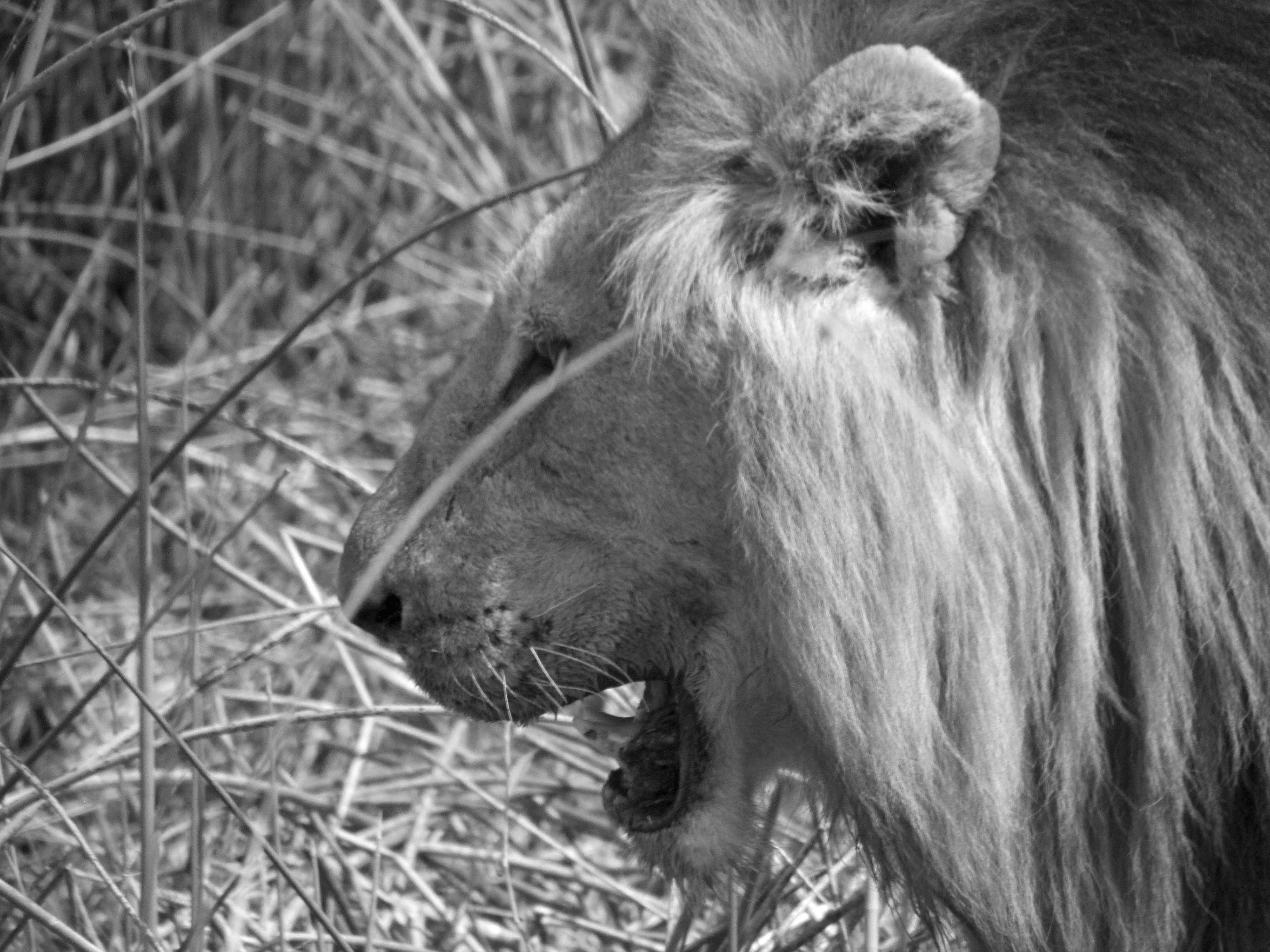
Just last night a lion’s roar ripped me awake from a deep sleep: WAAA-AH-UNGHHH UNGH UNGH UNGH ungh ungh. . . .It ended with those deep grunts lions cough up from their bellies.
A lion’s roar can be heard for five miles. This one was incredibly loud and incredibly close, right at the edge of camp.
A cold set of fingers wrapped around my heart. In the darkness my heart threw itself repeatedly against my ribs, then slowly backed into a corner of my chest. Wary, it waited there for another roar, which never came. I knew I was safe – no lion has ever dragged someone out of a zippered tent in Botswana. But tell that to my primitive brain.
Four days ago, as I waited for Doug to pick me up from Stanley’s Camp, I had enough time before his arrival to join an evening game drive. A young couple on their first trip to Africa climbed into the tier of seats behind me in the Landcruiser and held hands. They were on their honeymoon. John, our driver and guide, explained that two other vehicles from camp had found a pride of lions on the other side of the reserve – but it was too far away for us to join them and be back before dinner.
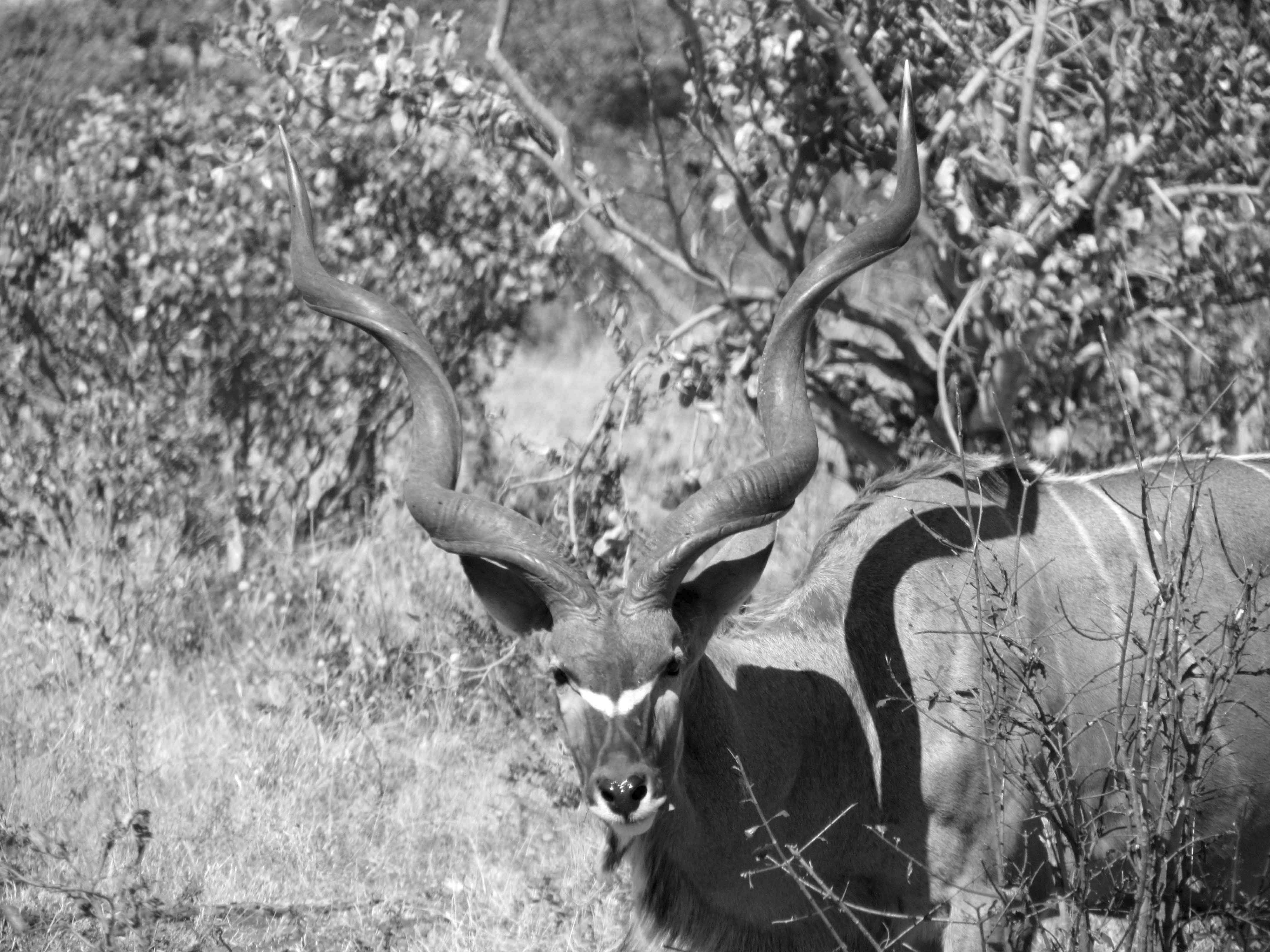
So we headed off in the opposite direction. The young couple happily snapped photographs of zebras and impalas and baboons, giddy with the realization they were in the midst of their dream vacation. A male kudu with magnificent horns kept us in one place for nearly a half hour as the couple peppered John with questions and marveled over the graceful curl of the kudu’s horns.
At dusk John parked at the top of a knoll. With open grassland all around us it was safe to descend from the vehicle. He prepared traditional sundowners – gin and tonics – and handed them around.
As I take my first sip a lion roared in the near distance. “That’s not very far,” I said and looked at John.
“We could get lucky,” he looked at the couple with us.
They nodded, so we dashed our drinks on the ground, stashed our glasses back in their basket, and scrambled back into the Landcruiser.
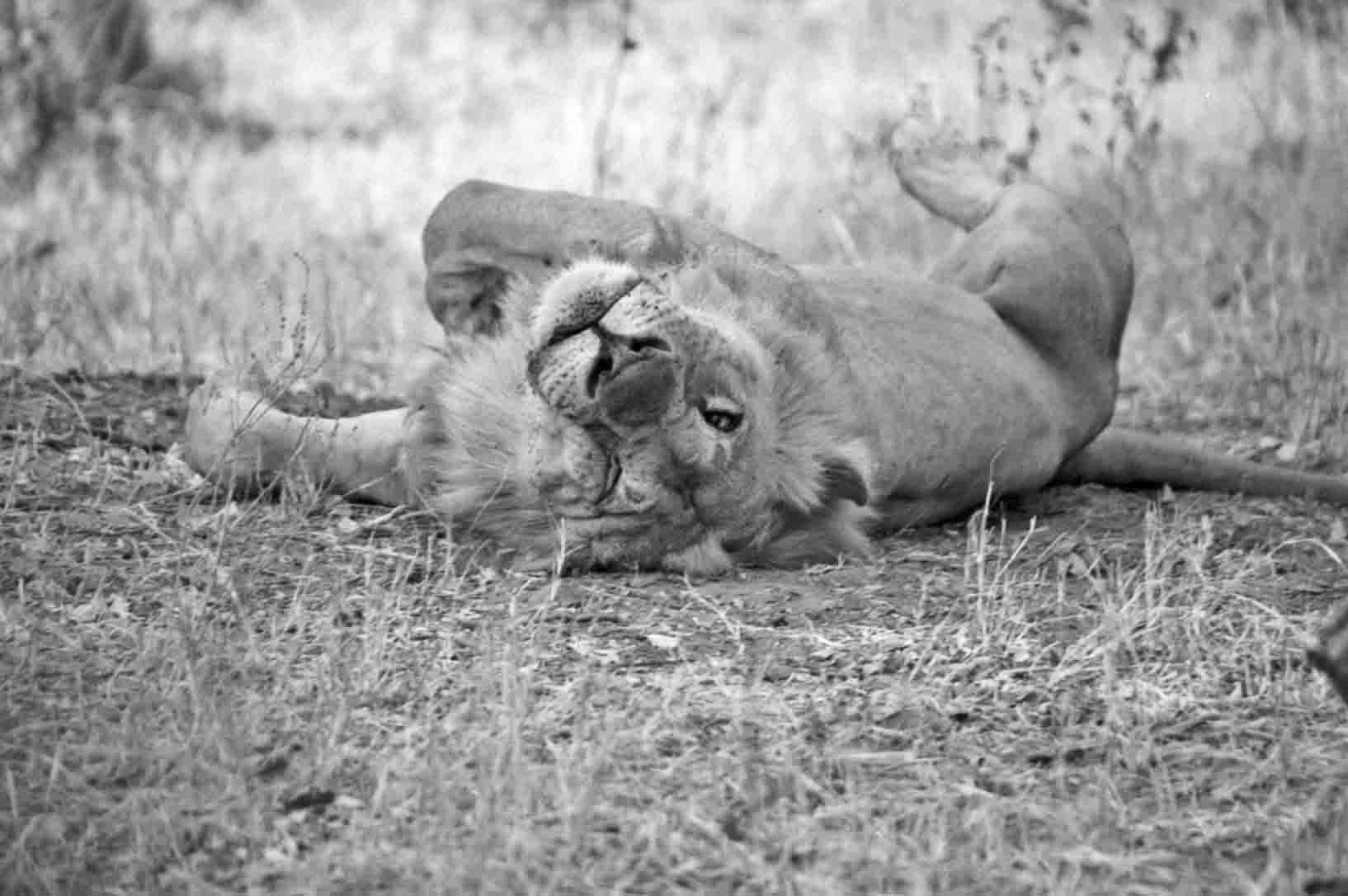
Just down the road, where we’d been half an hour earlier, four large males lounged in the tall grass alongside our tracks. One lifted his chin and roared, loud enough to rattle our hearts: WAAUNNNNNNGH, UNGH, UNGH, ungh, ungh, ungh.
John sent a radio message to the other vehicles. They will detour to join us on their way back to Stanley’s.
As we watched the four males, light faded from the sky and disappeared. Blue became purple, then black. Stars appeared, each one of them a cold clear diamond.
John switched on a spotlight. A male sat in front of us, looking to our right, listening.
Spotlight off. The couple behind me murmured to each other and tried to become small blobs, rather than humans with discernable arms and legs and heads.
Spotlight on. Another male, on the left, folded into the grass, on his side, with a barely audible ufff.
Spotlight off.
A distant contact roar from one of the lions on the other side of the reserve.
Spotlight on. The male in front of us headed to a wall of brush and trees, disappeared.
Spotlight off. Shallow breaths through my open mouth. A commotion to our left.
Spotlight on. Another male, who was sitting off to our right, had moved across the road and was now rubbing the side of his face against the lion inert in the grass. When he couldn’t get his companion to rise, he also slid into the bush. A fourth lion, just up the road, ghostly in the spotlight’s shadow, followed the first two, disappeared.
Spotlight off. Silence.
Then a faint roar, in the distance again.
The hair on my arm rose before I even thought about it, as I realized that next to me the grass hissed, hisss zissh, hisss zissh, as something large walked by.
“He’s right beside me,” I whisper without moving my lips.
Spotlight on.
The inert lion was gone. John twisted his hand over his shoulder and the light caught the back of a lion just passing the front tire on my side of the vehicle. His great head swung back and forth as he walked hisss zissh, hisss zissh through the tall grass. The lion had walked around the back end of the vehicle without us hearing him until he was right next to me. The skin on the back of my neck tried to crawl up to the top of my head.
The lion turned his head toward the light. The pupils in his yellow eyes shrank to pinpoints.
He was that close. I saw his pupils shrink to pinpoints.
He huffed and swung around to follow his three brothers into the bush. I exhaled. Had I been holding my breath that long?
The two other vehicles appeared just in time to catch a glimpse of his back in waist-high grass. They followed him, bouncing through the brush, their headlights tapping the tops of trees.
John turned in his seat and looked at us. The spotlight in his lap illuminated his face and glinted from the eyes of the young couple, eyes that were now nearly the size of their open mouths.
“I think it is enough,” he said. “Let’s go to the hyena’s den before the others get there.”
An excerpt from the book I’m writing about elephants:
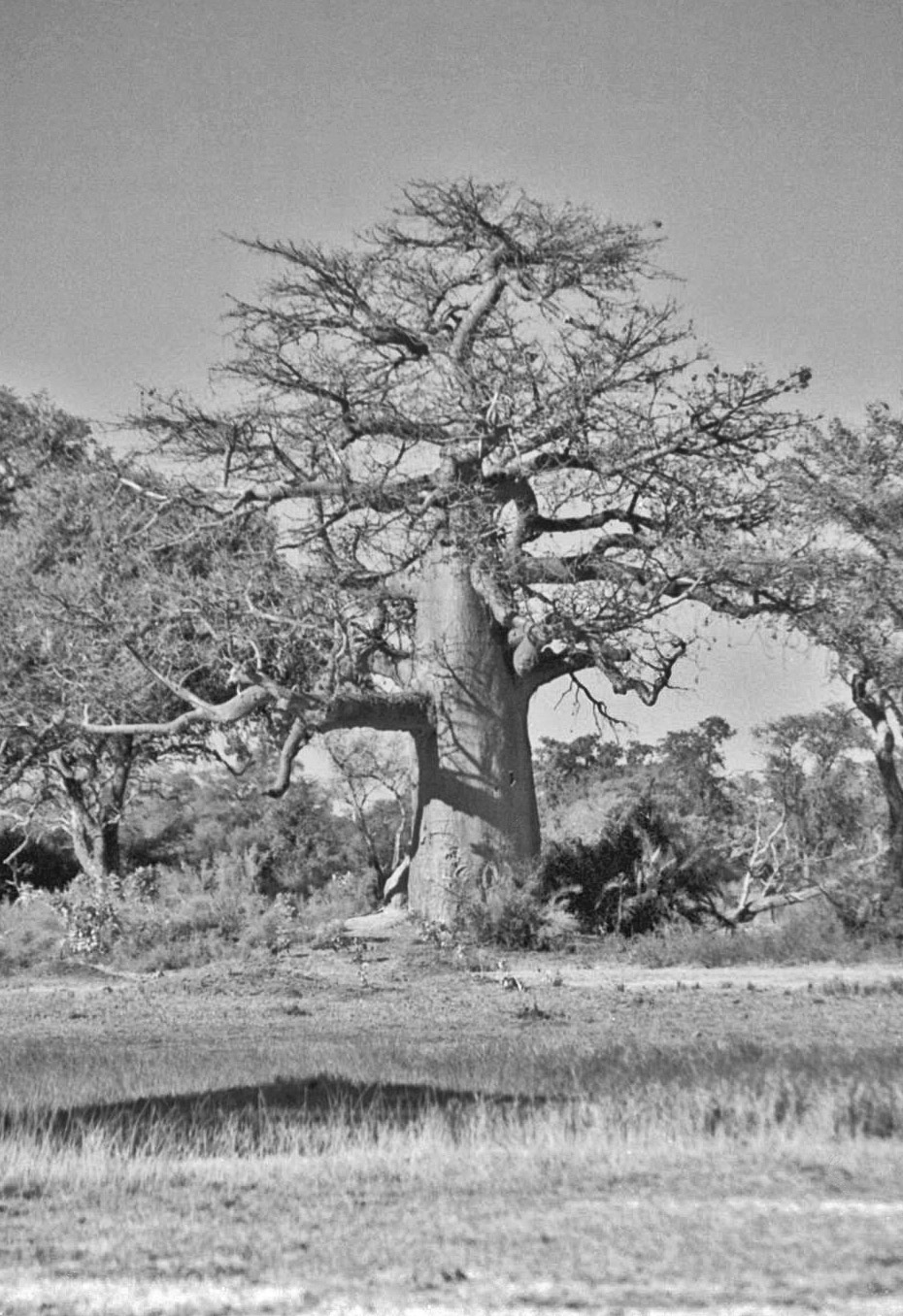
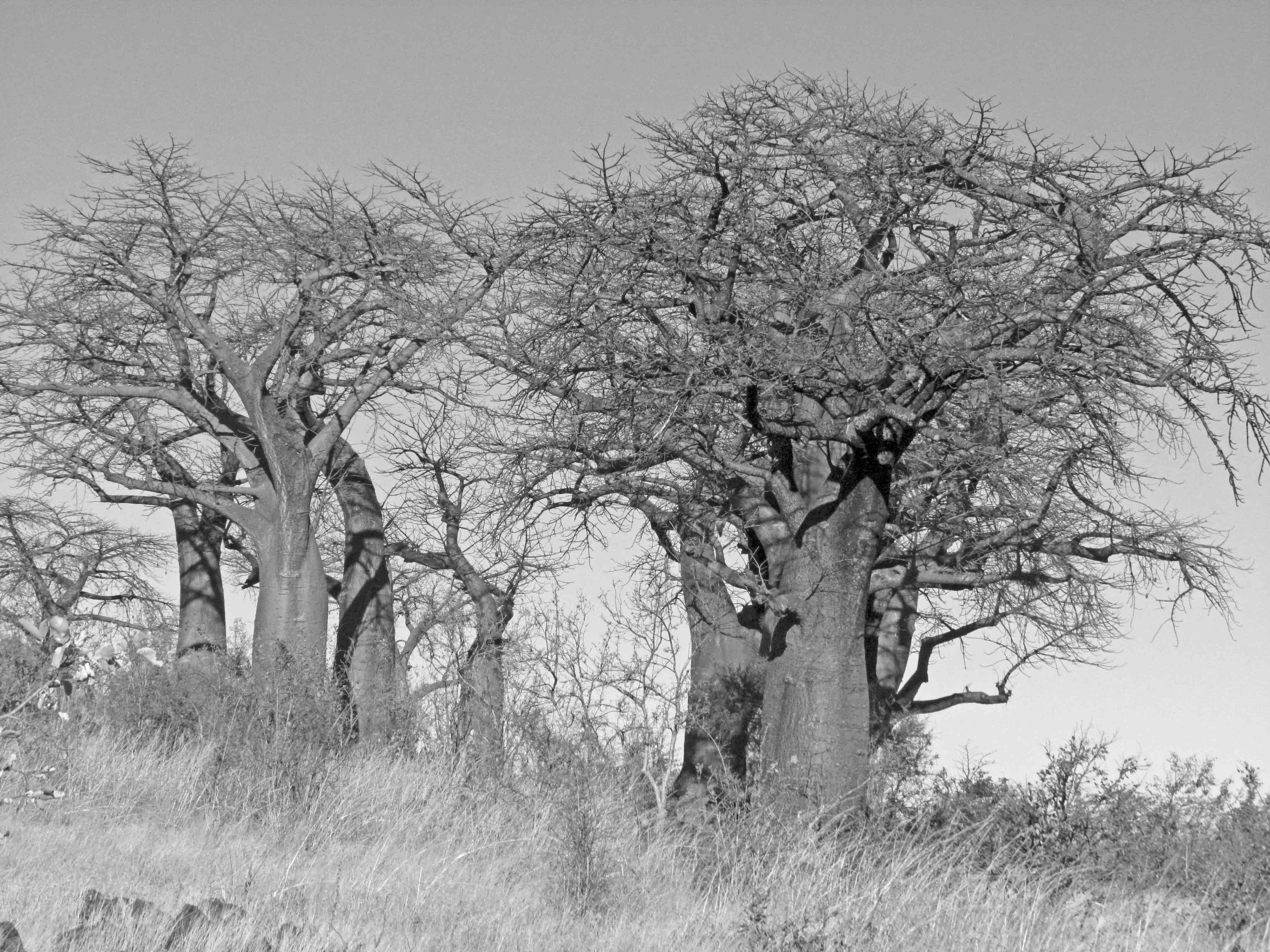
Jabu, Morula and Thembi slowly browse through the brush on one of the islands stranded after last year’s Okavango flood. Opposite of us, across a dried lagoon filled with grass, is a rare tree species for this part of the Delta: an African baobab, Adansonia digitata – digitata for the five leaves it has per stem. The baobab is deciduous, naked this time of year. Its prehistoric appearance conjures up primeval landscapes full of odd plants and crawling creatures that existed in the ages before the dinosaurs.
There are eight species of baobabs, six found in the dry deciduous forests of Madagascar, one in Australia, and digitata, which grows in West, East and Southern Africa. Baobabs are also found on the Arabian Peninsula, spread there by the movement of human settlements.
Adansonias are named after the French naturalist, Michel Adanson (1727-1806), who spent five years in Senegal, brought home a huge plant collection, and published a paper on digitata after his return. Adanson also wrote a masterwork of natural history, an encyclopedic l’Ordre Universel de la Nature, but it was based on his own system of classification, distinct from that of his contemporary, Linnaeus (1707-1788). Linnaeus’s Systema Naturae, introduced binomial nomenclature – using an organism’s Genus, Adansonia, followed by a descriptive modifier such as digitata. Systema Naturae classified 4,400 species of animals and 7,700 species of plants.
In contrast to Linnaeus’s system based on structures, Adanson proposed a “natural” system that took many features of the plant into account, which included structure along with function, growth, evolution and distribution. His system was ignored in his time because he refused to use binomial nomenclature. However, the publication in 1789 of Genera Plantarum, by Antoine Laurent de Jussieu, combined Adanson’s use of multiple structures with Linnaeus’s binomial classifications – a methodology widely accepted and still in use.
Adanson’s masterwork was huge, just like the baobab: 27 large volumes with a 150-volume index that contained an alphabetical treatment of 40,000 species, a vocabulary listing 200,000 words, 40,000 drawings and 30,000 specimens. It was never published. It is, however, preserved in the Hunt Institute for Botanical Documentation, at Carnegie Mellon University in Pittsburgh, Pennsylvania.
Elephants love the bark of the baobab because of its moisture content. As insurance against harsh drought, the swollen trunk of a single baobab stores up to 32,000 gallons of water, making its wood soft, spongy and fibrous. A plank cut from this tree will decrease in volume by 40% and shrink in length by 15% while it dries. Sometimes, during these times of drought, elephants will completely gird a tree, leaving it standing as if standing on its own pedestal, and yet the baobab will still survive.
The bark on the baobab across the lagoon is smooth and pinkish gray – untouched by elephants, probably due to its proximity to the Okavango’s permanent water channels. I estimate this tree to be about 22 feet in diameter and 70 feet tall. Mature baobabs have trunk diameters of twenty-three to thirty-six feet and reach heights of sixteen to ninety-eight feet. The Glencoe baobab, near Hoedspruit in the Limpopo Province of South Africa, is considered the largest specimen alive. Up to recent times it had a circumference of 154 feet. In 2009 it split into two still-living parts, revealing an enormous hollow in the middle. The date 1893 is carved into its trunk.
Found mostly in seasonally arid areas, baobabs grow very slowly as they age. However, in its first years of life, a baobab grows relatively quickly. A tree planted in Kruger National Park in South Africa grew 65 feet tall with an eleven-foot diameter in just 38 years. In contrast, an older tree described by Livingstone in 1858 grew only two feet in circumference in 110 years. Despite their early exuberance, baobabs can be cultivated as bonsai trees.
Although the Glencoe baobab is thought to be two thousand years old, baobab wood does not produce annual growth rings and it actually shrinks during times of drought, so its size is not an indicator of its age. The baobab across the grass lagoon is probably – my best guess – around 600 years old, or older, taking root about the time Eric the Red colonized Greenland (985), or later – perhaps the year Gutenberg invented the printing press (1439). This tree, this timepiece, first dropped its leaves during the Middle Ages, and will continue dropping them, annually, for several thousand years more.
Just twenty days after leaving England, the Beagle anchored at the Cape Verde Islands on Jan 16th, 1832. As Charles Darwin surveyed the islands with ship’s captain Robert Fitzroy, they measured a baobab that was 45 feet tall and thirteen feet in diameter, and rumored to be a thousand years old. Darwin remarked in his diary that Adanson supposed some “celebrated baobabs” to be 6,000 years old. The enormous tree “with its great thickness” impressed Darwin, and he wrote in his diary, “This one bears on its bark the signs of its notoriety – it is as completely covered with initials & dates as any one (tree) in Kensington Gardens.”
The Glencoe baobab has never been subjected to radiocarbon dating, but another in the Limpopo area has been carbon-dated at over 6,000 years, older than the pyramids at Giza (2560 BC). Several other trees in the region have also been dated – at about two-to-three thousand years old.
As I look at the baobab across the grass lagoon, I wish I could slip sideways into the life of this nearly eternal tree, and time-lapsed, witness the swirl of life around it as it fattened and grew. And why not wish also for the future, for another one or two thousand years more?
I turn at the sound of a branch breaking behind me, squint against the sun, and cup a hand at my forehead to shade my eyes. The elephants are great gray silhouettes, haloed all around in bright, bright light. My watch ticks on my wrist, its hands pointing to meaningless numbers.
Parked at the lip of the waterhole, seven humans sit in a roof-less, side-less vehicle, eggs in a carton without a lid. Earlier, at dusk, giraffes reflected the setting sun, but now icy stars stare down at us with chilled, blue eyes. Somewhere, out there beyond this waterhole, hyenas will make short work of bones.
An elephant appears. And then another. Gray wave after gray wave surges out of the bush in small herds of twenty or less, flooding the huge hollow in front of us. Dust rises in the air, a potent blend of manure, dried grass and sand. The backwash swells in our direction. Soon a sea of elephants surrounds us.
Snorts, grumbles, trumpets, growling bellies, and gargantuan belches resound. Some of the vibrations are too low to hear, but I feel them as they pass through my body, reverberate in my chest cavity, squeeze my heart. Eye after eye inspects us as eddies of elephants swirl past.
An old world laps at the foot of our memories, extinguishes centuries of communal fires. The ropes that tether us loosen. We slip away from the familiar shore and set off. We look around with wild hearts. We have become part of the herd.
Behind us, close enough to touch with an outstretched arm, a huge female chuffs and huffs at regular intervals, locomotive-style. Hunched and folded, I turn my head slowly to look into her left eye. Her trunk periscopes into an s-shape, swivels, and tests the air in my direction. Her massive body blocks our only way out. She rocks back and forth, side to side, grows quiet. Small and cold, I drop my head, totally at her mercy, if she knows such a thing.
Suddenly, from a crush of rumbling bodies, a baby elephant squirts out and heads straight in our direction. Right behind is her mother. Even our guide quits breathing.
The baby elephant stops less than a foot from our left front wheel. Her mother looms over us, illuminated by our parking lights. With just one step she could snatch any of us right out of our seats.
A small, short elephant trunk reaches out, touches the tire and a collective inhale is heard, as if the vehicle itself is trying to shrink away. Behind us, the huge matriarch chuffs rapidly, building up steam.
Then the tiny trunk jerks back, blasts a bubbly snort of air, and the baby’s face contorts into an expression that can only be translated as Yuuuuck! The mother shifts into an I-told-you-so attitude. Her trunk relaxes, blows small puffs in the sand.
Carefully, I turn to look the matriarch in the eye. She blinks once, twice, emits a large exhalation Whooooff, and turns her back on us.
The baby charges our vehicle, flaps her ears, and trumpets like a bicycle horn, causing a gust of giggles in return. Her mother rumbles, pivots from us peons and makes a regal exit, strolling off in a stately manner no human monarch could ever attain. The baby twirls several times, then follows her mom in a quick side-to-side rocking gait reminiscent of Charlie Chaplin.
Singly, and by twos and threes and tens, massive silhouettes disappear into the darkness. A young female strolls by, scans us as if we’re department store mannequins. And then, they are all gone.
WordPress.com stats. A 2012 annual report for this blog.
Here’s an excerpt:
600 people reached the top of Mt. Everest in 2012. This blog got about 5,400 views in 2012. If every person who reached the top of Mt. Everest viewed this blog, it would have taken 9 years to get that many views.
I’m reposting this piece in honor of the new year. It occurred very early in my blog:
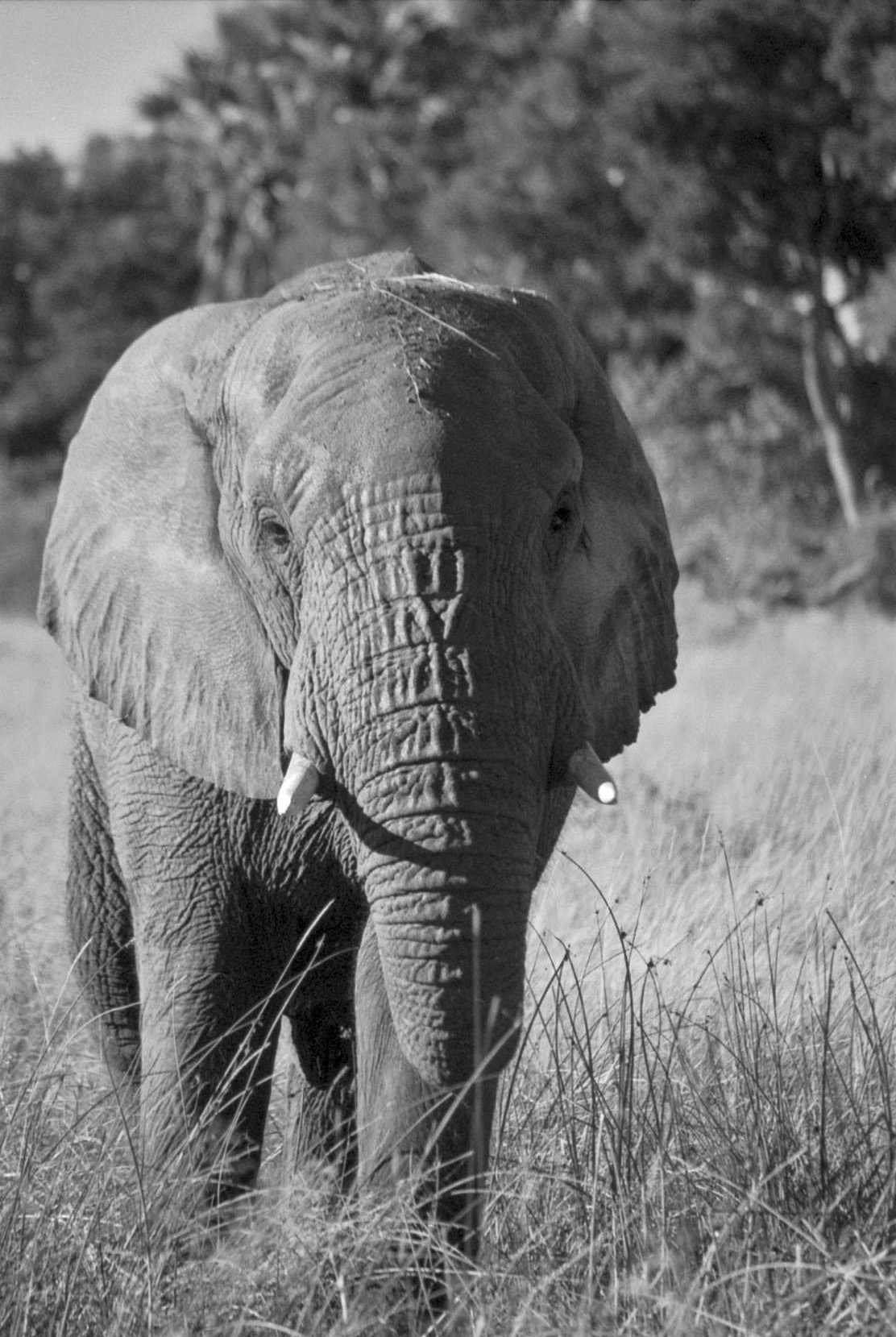
Heart shapes can be found in nature, if you’re lucky enough to spy one. There’s a heart on Jabu’s trunk, a ridge of skin that feels like fine shoe leather. One of his wrinkles pierces the lower third of this heart shape, from left to right, straight as an arrow. His real heart hangs between his breastbone and ribs, a little to the left, just like mine does. But instead of having a heart with a single point, an elephant’s heart has two points at its apex – so it’s the wrinkled outline of a human heart that Jabu carries on his trunk.
The length of Jabu’s real heart is about twenty-two inches, its width eighteen. His heart weighs around forty-four pounds, almost the same as a medium-sized dog. Still, it’s less than 1% of his body weight, a common proportion among large mammals and among humans. My heart also weighs less than 1% of my body weight: about ten ounces.
The human heart is approximately five inches long, three-and-a-half inches wide and shaped like a pulsing cone. It is the only muscle in my body that acts on its own – my heartbeat doesn’t need any messages from my brain. The cells in my heart tissue involuntarily constrict, all together, all at once, over and over, a soft perpetual-motion machine. Rip my heart from my body, chop it into pieces, immerse the pieces in a saline solution, and then give them a small jolt of electricity. The remnants of my cardiac muscle will contract . . . contract . . . contract – all on their own, sometimes for hours.
It’s designed to be strong, my heart.
In mammals, birds, and reptiles the heart has the same basic pump-like design, a design that has worked through eons – even cold-blooded dinosaurs had hearts. A day or two after fertilization, embryos develop a pinpoint that pales, then brightens, pales, then brightens, the beginnings of a tiny pump practicing emptying, filling, emptying, refilling. An old, old pattern. The master timepiece.
There are four chambers in my heart: two auricles (“little ears”) and two ventricles (“little bellies”) – named by anatomists for the external parts of the body they resemble. Spent, dark-red blood is collected in the right auricle, then dropped into the right ventricle, which constricts and pumps it out to the lungs to pick up oxygen. Bright red again, full of oxygen, blood circulates back to the left auricle and from there drops into the left ventricle. In the next twitch blood is delivered to every corner of my body.
The “little ears,” the auricles, make very little sound as they drain blood into the lower chambers of my heart, a distance of an inch or so. It’s the ventricles, the “little bellies,” that boom as each contraction forces open heart valves and blood gushes up the aorta under pressure. Lupp DUPP. Lupp DUPP. Lupp DUPP. One beat smaller, one beat larger, flush after flush.
My right ventricle has walls thin as paper – it delivers blood only as far as the lungs. If I could hold it up to the light I could see right through it. The left side of my heart is the heavyweight lifter, pumping blood all the way to my toes, moving 150,000 tons of blood in my lifetime.
Jabu’s great artery, the aorta, takes off from the left ventricle of his heart, the same as mine does. Named in the Middle Ages, aorta means, “to heave.” It’s an artery more flexible and sturdier than any manmade pipe. Jabu’s left ventricle pumps a continuous stream of blood up and out of his heart into the aorta, which then drops down into his chest and down each leg, where it branches and branches and branches all the way to his toes. Each arterial branch has less space than the artery it came from, but the sum of their volume is always greater than their mother artery. The blood moves, but more and more slowly through smaller and smaller pipes, trickling into all corners of Jabu’s body, trickling through capillaries one cell thick.
Blood’s trip back to the heart is made through veins. Millions of tiny venules drain into thousands of small veins, thousands drain to hundreds, hundreds to the one that empties back into the heart. Veins are even more elastic than arteries, can hold variable quantities of blood, and serve as a reservoir for all that moving liquid. At any one moment, 65% of my blood is contained in my veins. It’s an ancient blueprint, this branching, this heartbeat, this coming and going, a blueprint brought to life in even the tiniest of creatures.
Blood has to be literally hoisted from Jabu’s toes. Squeezed along by muscles wrapped around veins, pushed by valves in the veins, and sucked upward by the huge action of breathing, blood finally arrives in the vena cava, where it drops into the heart. Jabu has two vena cavae, possibly because of the large amounts of blood that need to be moved.The blood vessels of an African elephant reach lengths of twelve feet, a huge network of life.
Jabu’s body contains 120 gallons of blood, enough to fill an aquarium six feet long, two feet wide and two feet deep. At one-and-a-half gallons, my puny amount of blood would barely fill a birdbath.
Blood is the body’s only liquid organ, five times denser than water. It takes food and water in, removes waste and byproducts to the disposal areas of the body, the kidneys, lungs, and skin. Blood irrigates all tissue, both feeds and cleanses. It leaves the heart at one mile per hour and returns, laden with waste, at about half that speed. Construction materials move along highways of blood, demolished materials return. Blood is 20% solids and 80% water, carrying products of digestion, products made by the body, foreign intruders, the dust of stars, even cobalt from the original ocean of the earth where both of us, human and elephant, began our journeys.
We each have roughly one billion heartbeats for our lives. Mouse, hummingbird, elephant, human, all the same. Like us, elephants suffer cardiovascular disease, die of heart attacks and strokes.
Cardiac arrest: when the heart shudders and stops, when the light in the eyes flickers, fades and snuffs.
And when the heart quits beating, its resonance
Lupp DUPP Lupp DUPP Lupp DUPP
is gone. The gurgle of digestion, all the silky, sturdy, slapping noises, the blood rush, gone. The symphony of the body is finished.
For those of us left, that silence is almost too much to bear.
Only a few yards from our Land Rover, a single-cylinder water pump alternately chugs and sputters, drawing from the water table beneath the sand, and sending spurts through a pipe to a square trough. This supply of water keeps the bachelor elephants in Savuti area, as they wait for spring rains and the return of female breeding herds.
The steady sound of the pump, chug-sputter, chug-sputter, chug-sputter lulls my eyes closed. They open, close, open half-lidded, close again.
“Here he comes,” someone whispers and my eyes flick open as a huge bull strolls past. I pick up my camera.
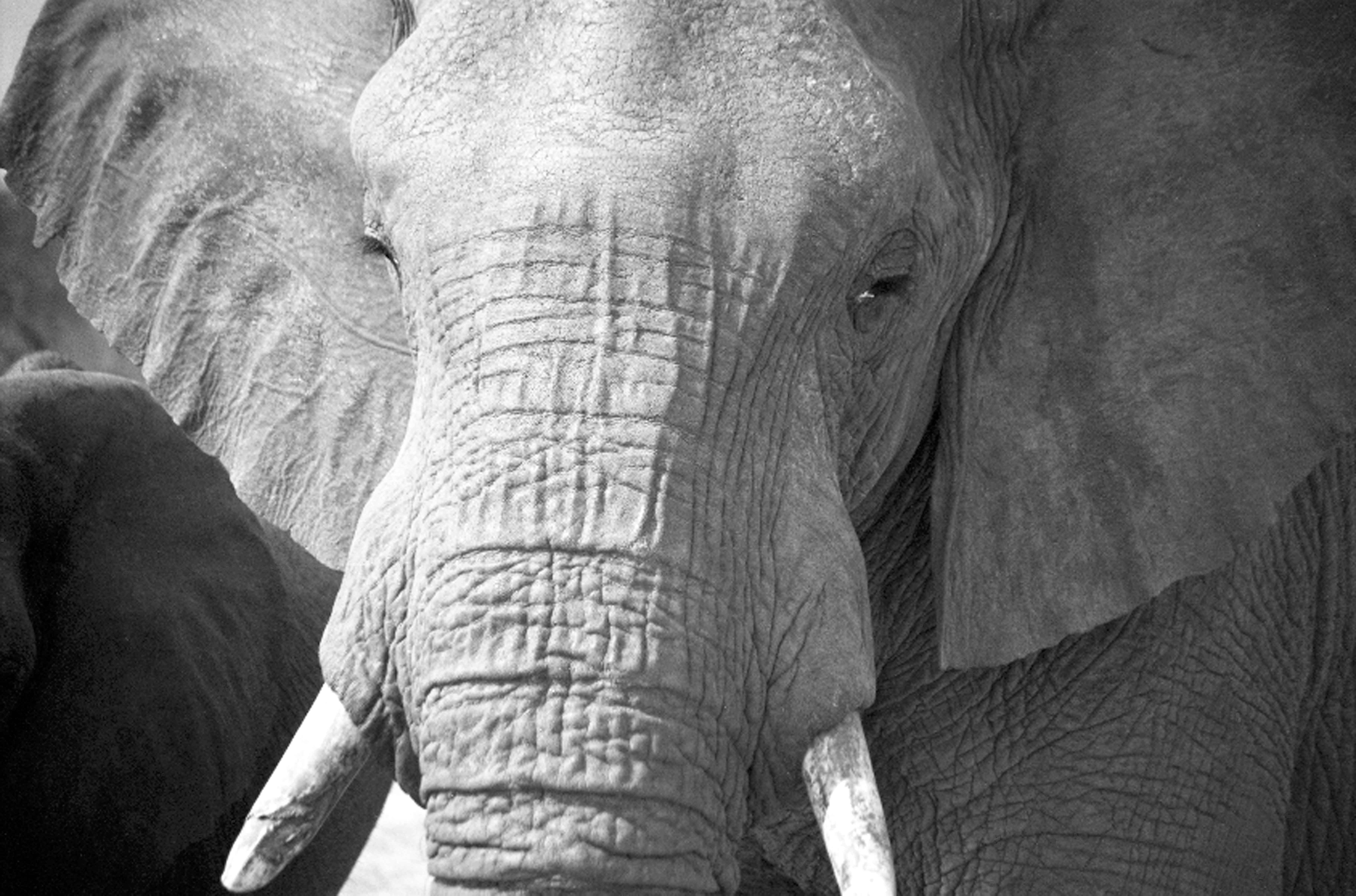
His enormous tusk splay out almost sideways. I focus on his great head, nodding downward with each step, as he trudges past. A thirsty pilgrim in a parched land, his trek to water is nearly finished. He heads straight to the square trough. The clicking and whirring of our cameras doesn’t alter his gait.
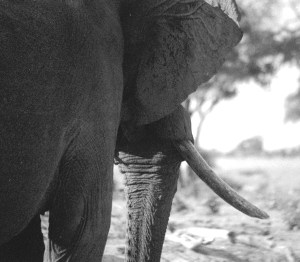
Through the viewfinder I marvel at his tusk. It is easily four feet long, stained and chipped on its end. Because of its growth pattern – out, rather than down and up – his tusks make him a much wider elephant than he really is.
Mid-drink, he curls his trunk into his mouth; his head tilts back; his eyes close. He makes gargling sounds as he drank. Extending his trunk into the waterhole, he blows bubbles before curling his trunk again and again to hose several gallons down his throat. With each swallow goes the taste of dung, samplings from all the animals that used this waterhole – zebra, wildebeest, warthog, ostrich, hyena and the occasional furtive flavor of lion.
I try to imagine the bouquet garni of this waterhole and how its myriad fragrances might seep into the crevices of an elephant’s mind, form pools of scent elephants recognize, year after year, the liquid memory of Africa. Perhaps the old bull is memorizing the stories in this trough, paragraphs of taste and smell, twists of plot and character and fate.
He returns to where we are parked, and stops close by. His skin is the color of seasoned cast iron. The waterline on his body rises just past his belly. Spatters of mud stain his ears and back. His forehead bulges and flutters audible sounds, if I had the ears for infrasound.
After several long minutes, his eyelids droop and his mouth slackens. Under the hot sun he falls asleep, lulled perhaps by the narcotic of a long, slow drink. The tip of his trunk coils like a magic rope on the ground. He sleeps with his weight on three legs, resting a hind leg, occasionally rocking back on it as if he dreams of his trek. Drool from his trunk slowly seeps into the sand.
I match my breathing with his, and drowse, sedated by the sun.
The giant beside us rumbles soft snores in his sleep, yet he is probably aware of the humans next to him, nodding their heads, also falling asleep. Other bachelors scuff past him, on their way to and from the waterhole.
Tiny paws of wind skitter across my arms and keep me half-awake. But for a moment, I almost enter his dreams.
Several months ago, Sheila Bender, friend and fellow writer, interviewed me for her radio show, “In Conversation: Discussions on Writing and the Writing Life.” The show will air Tuesday, Nov. 27th at noon PST and Thursday, Nov. 29th at 6 p.m, PST. It can be heard streaming from our local radio station at http://www.kptz.org. I talk about elephants and why I decided to write about them. I hope you get a chance to hear it.
In writing Larger than Life: Living in the Shadows of Elephants, I tried to answer two questions – what is it like to live with elephants, and, what is it like to live? For me, writing is living. I write everywhere, all the time, tucking pieces of paper into pockets, jotting down notes under the covers, with a flashlight on. I write on the backs of envelopes, I write in the margins of manuscripts, I write in notebooks, notepads and ipads. I write because reading is just one of the pleasures caused by words, even though words by themselves are drops of human magic, sprinkled against death and darkness. I write to grave rob my own language, excavating tombs of words and phrases, looking for riches, for golden ideas buried in underworlds of common dust.
Every writer tells old stories in order to see anew. All humans take the same journey from life to death, though our paths are never the same. We begin as an explosion of infinite possibilities and then, for the rest of our lives, fall back upon ourselves, grabbing at some of those possibilities during our fall. Our trajectory, which touched the very rim of life, descends toward the center, ending at zero, at what some see as a portal and others see as finality. Falling, always falling towards the center of ourselves, the huge unknown universe within, our journeys are all the same.
I write to tell about my journey, my story, and it all comes together in just one place, my writing room.
As you listen to this interview, you can also see where I write.







 ABOUT ELEPHANTS
