Posted in Nature, Writing, Zoos

Solitary Confinement

Jabu eye 2 b&w

Alone,

alone,

two steps forward, two steps back,

the elephant sways to a rhythm no one, not even she, can hear.  Two steps forward, two steps back.  Swaying, her head dips to one side, then the other.  Her motions are born from a numb brain, from uncut boredom, from the measurement of a life by that which does not happen.

Beyond the barriers that surround her, a jerky stream of humans flows past, day after day.  Their powerful odors overwhelm her, and she touches her temporal gland, samples her urine, the only familiar smells left to her.  At the end of each day, after the humans are gone, she hears a multitude of rumbles, but none have resonances she can recognize.

Sometimes she will lie down on the huge square stone into which she is entombed and sleep.  There are no stars over her head.

She ceased calling out to her kin a long time ago.

As near as she knows, she is the only elephant left on earth.


Note:  There are 284 elephants in 79 accredited zoos in the United States.  Most zoos have more than one elephant, because elephants are social creatures who need companions from their own species.  I originally wrote this piece when I learned of Maggie, who lived at the Alaska Zoo in Anchorage for 24 years, the last eleven of those years alone.  In 2008 she was transported to the PAWS sanctuary in California, where she now lives with other African elephants.  Here are the remaining zoos that keep just one elephant:

  1. San Antonio Zoo – “Lucky”
  2. Double M. Ranch, New York – “Reba”
  3. T.I.G.E.R.S., South Carolina – “Bubbles”
  4. Natural Bridge Zoo, Virgina – “Asha”
  5. Wild Adventures, Georgia – “Shirley”  – Shirley is age 69 and has been in captivity since 1946.

Sources:  verified independently, using the database from http://www.elephant.se

Posted in Africa, Nature, Nonfiction, Photography, Writing

Our Journeys are All the Same

Sunset

We tell old stories in order to see anew.  Each and every one of us takes the same journey from life to death, though our paths are never the same.

We begin as an explosion of infinite possibilities and then fall back upon ourselves, grabbing at some of those possibilities during our fall.

Our trajectory, which touched the very rim of life, descends toward the center, ending at zero, at what some see as a portal and others see as finality.

Falling, always falling towards the center of ourselves, the huge unknown universe within, our journeys are all the same.

Sunset at Doug & Sandi’s camp, Okavango Delta, Botswana
Posted in Africa, Elephants, Nature, Travel

The Most Useful Appendage That Ever Evolved

An excerpt from my book-in-progress:

Trunk in face


The tip of Jabu’s trunk hovers in front of my eyes, wet with mucous, dotted with sand, nostril hairs visible.

He blows into my face, gently.  I blow back, gently.  We exchange breath, distillations of our own personal atmospheres, particle-swarms of changed, exchanged air, brewed though all the cells of our bodies.

My lungs fill with the fragrance of crushed leaves, with saproots and spearmint-scented bark, all lightly fermented.  I think of the stagnant air that surrounds my daily life, air that is conditioned, filtered, deodorized, air that is bland.  Elephant’s breath is said to cure headaches.  And it just might, if I had one.

Jabu’s trunk tip investigates my right boot tip.  The scents I’ve picked up while walking tumble up two seven-foot-long nostrils – nostrils surrounded by nerves, arteries, veins and a staggering array of longitudinal and transverse muscles, the world’s biggest, longest and certainly most flexible schnozz.

A trunk is the most useful appendage that ever evolved.  Imagine having an arm in place of your nose, an arm long enough to reach to the top of a tree, and pluck a single leaf from its crown.  Imagine having a nose with which you could rip, tear, excavate, whack, and blow bubbles.  You could steal with your nose, suck on it, squeal, swat, poke and siphon with it.  You could take a shower, or reach over your shoulder and scratch your back with it.  You could even arm wrestle with your nose.

He chuffs, a hot gust of air directed at my feet.  Wet mist covers one boot top momentarily, then evaporates.


Posted in Africa, Elephants, Nature, Travel

Trunk Show

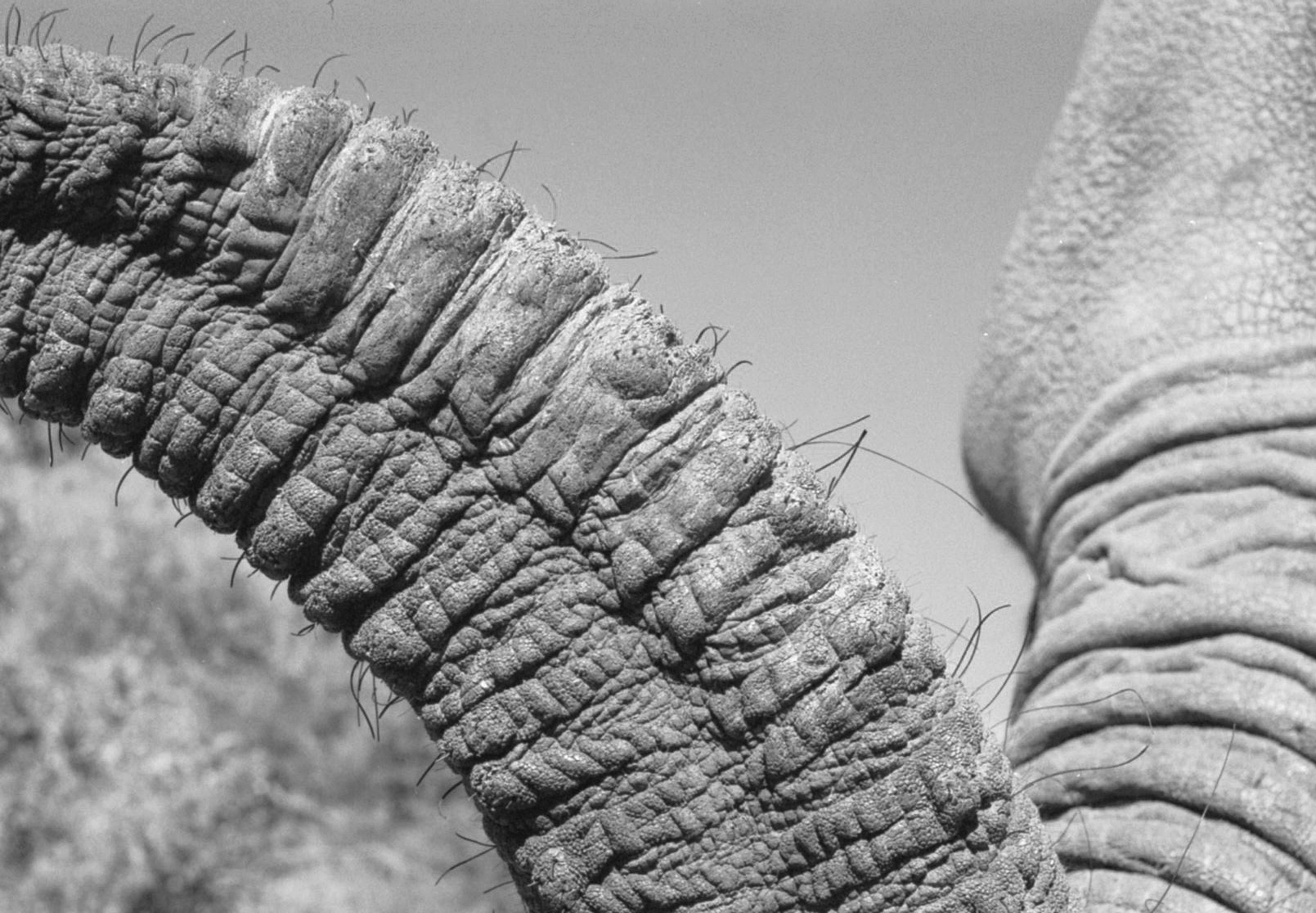
Morula trunk underside b&w


Funky jazzy trombone trunk.  Snaking snorkeling vacuuming trunk.  Showerhead.  Backhoe.  Slinky.  Shimmying sucking swigging trunk.  Empty pipe.  Water gun.  Periscope.  Plucking siphoning tenacious trunk.  Kazoo.  Tweezers.  Tentacle.  Affectionate handshaking pickpocket trunk.  Python.  Air hose.  Question mark.  Whistling snorting sneezing trunk.


Breathtaking

trunk.


Posted in Extinction, Nature

That’s Life

An excerpt from my book, Larger than Life: Living in the Shadows of Elephants:

As Doug and Sandi prepare for our morning walk, a nearby Cape mourning dove begins its chanting call:  hoo-HOO-hoo, hoo-HOO-hoo.  The dove is the same shape and color of the pigeons strutting the streets of my hometown, and belongs to the same family as pigeons, Columbidae.  Doves are generally smaller birds and pigeons are larger.

One member of Columbidae, the American Passenger Pigeon, was once the most abundant land bird in the world.  It’s been estimated that nine billion passenger pigeons were in the United States before colonization – more than twice the number of all birds alive in the U.S. today.  Up to a foot-and-a-half in length, the passenger pigeon had distinctive, even iridescent, coloration.

In the early 1800s a flock of passenger pigeons that numbered 2.2 billion birds flew between Kentucky and Indiana – a flock one mile wide extending 240 miles.  So many Passenger Pigeons were in that flock that if they were placed beak-to-tail they would have wound around the circumference of the earth nearly 23 times.  Audubon recorded an over-flight of Passenger Pigeons that took three days to pass, even though the birds averaged sixty miles an hour.  He likened their passage to an eclipse of the sun.

            One nesting colony in Wisconsin measured 850 square miles.  The rumble of wings erupting from that roost made the ground tremble.  Tune your stereo receiver to a place between stations, then turn up the volume until your walls shake.  That was the sound of huge flocks of passenger pigeons, a Niagara of birds.

Audubon's Passenger Pigeons
Audubon’s Passenger Pigeons

Audubon painted the passenger pigeon in 1824.  Printed plates of his painting show a female on the frosted upper branch of a tree feeding a male perched on a lower branch of the same tree – which is a bit of artistic license, since the pairs always stood next to each other on a branch.

The sexes of the passenger pigeon differed in coloration.  The female, with her drab, brownish-orange back and gray plumage on her belly, contrasted with the male’s brilliant blue back and deep pink breast.  In Audubon’s painting the male has a duller neck than was often reported  – a neck that glittered purple, gold, yellow and green iridescence.  Both sexes are depicted with their trademark pink feet and red eyes.

            Now the passenger pigeon is gone.  Snuffed out.  Not a single bird left.  Flocks in the millions whose wing beats sounded like thunder, whose descent to the ground in funnels looked like tornados, whose excrement rained to the ground like sleet, gone.  Flocks that blocked sunlight from the sky and moved in squalls, in weather fronts, gone.  Flocks that would have turned entire radar screens green, gone.

            Their extinction was not a natural one, caused by a meteor or ice age or disease.  No, we did it.  We destroyed their habitat, hunted them, killed them, ate them, fed them to livestock, stuck their feathers in our hats, and shipped them by the ton in railroad cars, five billion birds by the late 1890s.

            No one ever thought that five billion birds could disappear.  An Ohio legislator wrote in 1857 that the pigeons were “Wonderfully prolific.  No ordinary destruction can lessen them or be missed from the myriads that are yearly produced.”  But nets, guns and the railroads did their job.  Speedy travel meant that pigeon feathers and meat reached their markets in forty-eight hours.  Live pigeons were shipped for sport.  An estimated half-million pigeons were netted annually for use in shooting matches.  One trap shooter claimed he had personally shot 30,000 pigeons in his lifetime.  In 1875 three nesting areas in Michigan yielded 1,000 tons of squabs and 2.4 million live birds for consumption.

Martha, stuffed and mounted at the Smithsonian

            And yet, scarcely 25 years later, a young boy in Ohio named Press Clay Southworth shot the last wild passenger pigeon on March 12, 1900.

On Sept 1, 1914, Martha, the only passenger pigeon left in the world, died at the Cincinnati Zoo.

I wonder what our skies would look like if the passenger pigeon (instead of the turkey) had been designated our national bird.

The probability of any human being alive is one in billions of trillions.  That’s

1,000,000,000,000

multiplied several billion times.

Life.  It’s not easy to come by.  And lessened by all that has been subtracted from it.

Posted in Africa, Travel

The Three Graces

In Greek mythology, the Charites were goddesses of charm, beauty, nature and creativity. Aglaea, “Splendor” was the youngest, Euphrosyne, “Mirth,” was the middle sister and Thalia, “Good Cheer,” the eldest. To the Romans they were known as the Gratiae, the “Graces.” Homer wrote that they were in the retinue of Aphrodite, the goddess of love, pleasure and procreation. Although early depictions of the Graces occurred in marble sculptures dating from the 6th century BC and a first century fresco at Pompeii, they are more likely known by the Renaissance paintings of Botticelli, Raphael and Rubens.

The Three Graces - Rafael
The Three Graces – Rafael


In Africa, grace – the pleasure of beauty in nature – is a constant state of existence.  Splendor, the youngest of the Gratiae, can be found in moments both large and small – in the turn of a head or in a long, glorious sunset.


Three Graces photo small


These three  impala in identical coats pause before us in a moment of easy grace.  The youngest, coltish, knock-kneed, takes our breath away when she throws us a glance over her shoulder.  The charm, the Charities, of fleeting beauty.

Posted in Africa, Travel

The Deadliest Animal in Africa

The deadliest animal in Africa is not a snake, nor a leopard, nor a lion – it’s the hippo, those oddly comic, rotund herbivores that sound like submerged tubas.  Hippos kill more people in Africa than any other animal: several hundred per year.  In contrast, sharks kill only around ten people per year, worldwide.

Hippos don’t even eat the people they kill.  They’re vegetarians, emerging at night from ponds and rivers to eat grass.  Their beady, sherry-colored eyes don’t see well at all, but their sense of smell is acute.  Males defend territory, females their calves.  Both can outrun you, and you never know what might set off a 6,000 pound animal that can achieve a speed of 19 mph.

In 2002, I was traveling through the Moremi Game Reserve in Botswana on a mobile camping safari.  Six people in an open-sided Landcruiser focused their cameras on laid-back hippo blimps floating in a nearby pond.  It was that magic half-hour before sunset when the light is golden and incredible – perfect for photographs.  A short distance away a male grazed on flowers.  I raised my camera.

Without warning, the hippo opened his mouth in a threat gesture, displaying his long, razor-sharp canines.  A second later, he charged, head swinging side to side like a giant sledgehammer, running directly for us at a surprisingly clip, intent on slamming into our vehicle.

He was closing fast.  All I could see through my camera lens were those massive incisors, as the camer’s autofocus kept singing out zzzzt zzzt, zzzzzt zzzt.

Luckily, the engine of our vehicle started without a cough and the hippo just missed our back bumper.  He continued on into the bush for thirty yards before stopping to wonder where we had gone.  This is the only picture I have of him, right before he charged.

Posted in Africa, Travel

Something in the Way She Moves

She is beautiful in the way many large women are beautiful.  There’s something about the smooth sheen on her plump skin and the defiant stare she gives you that makes you fall in love with her, even when she’s eating.

Posted in Africa, Lions, Uncategorized

Lions, Part Two

Before I fell in love with elephants, I went to Africa to see lions.  Fed by documentaries and National Geographic, I wanted the excitement of watching lions hunting.  I wanted tooth and claw and blood.  I wanted my skin to crawl.

So in 1999, near Kruger National Park, I spent a morning following the paw prints of Panthera leo krugeri, afoot in the Sabi Sabi Game Reserve – the name derived from a Tsonga word that means “Danger! Danger!”

Six would-be trackers and two rangers named Syd and Bernardo clumped together and stared at a set of padded marks in the sand.  “Which way?”  Syd asked.  We pointed variously in the same general direction.  “Okay, ready?”

We scuffed our feet.  We’re sort of ready.  Syd hefted the rifle from its rack on the dash of our Land Rover and my eyes followed this motion.  I nodded to myself; the clenched spot in my chest relaxed a little.  The lions of Kruger actively hunt humans.  So far, a bullet into the ground at their feet has proven to be an effective deterrent.

Syd told us it was three years ago that he last fired at a lion.  “You cannot believe the paperwork!  Every bullet has to be accounted for.”

We followed the tracks into the bush.  Bernardo took up the rear.

“I am here to stop you from running,” he said with a small smile.

Eight people marching in a line and stepping on each other’s heels are not easily identifiable as prey to a lion.  But if I ran away from our group, I would trigger an instant hunting response:  Look!  Breakfast!  And it’s fat and slow!

I stepped literally in the lions’ tracks.  They’re about three-fourths the length of my boots.  And so fresh I could see where the claws have sunk into the sand and made deep slash marks at the front of their pads.  I took a deep breath and tried to slow my pounding heart.

Slowly we made our way through mixed scrub and across pockets of dry, withered grass, stopping frequently to listen for the calls of francolins and baboons, early-warning radar for lions.

Syd picked up a handful of sand and let it fall through his fingers.  A fluttering wind blew from the right direction, into our faces.  If warned by our smell, the lions could decide to swing around behind and follow us.  Bernardo kept glancing backwards, as do I, the last one but for him in our column.  Even though it’s fall and many of the scrub thorns had lost their leaves, we couldn’t see very far behind or ahead.  Syd and Bernardo occasionally conferred back and forth in low voices, speaking in Shangaan.  I probably didn’t want to know what they were saying.

Just beyond several deep gullies, the lions’ footprints disappeared into a thicket.  Syd stopped and listened intently, then swept his arm to the right.  We bypassed the thicket, perfect for ambush, and checked for lion prints on the other side.

In an open, grassy area beyond, our line bumped to a halt.

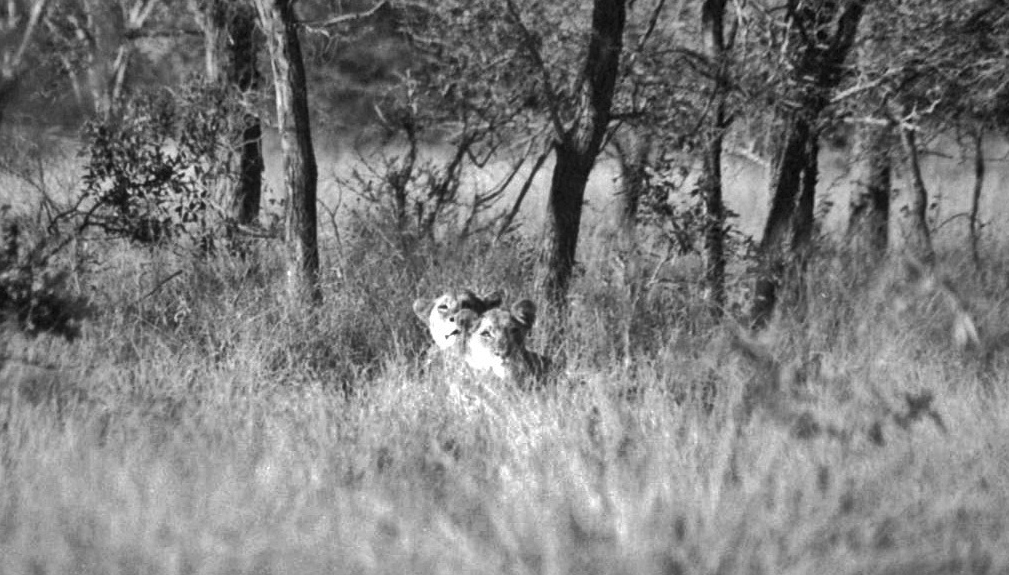
“See them?”  Syd asked.Image
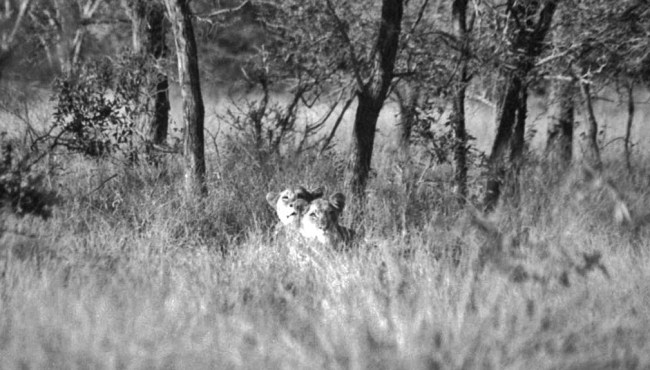
As if on cue, two heads popped up.  The back of my brain started freezing.  Apparently I had stopped breathing a long time ago.  RUUNNNN! my brain yelled to my legs, but they were so far away they couldn’t make out what all the shouting was about.

The lionesses were under trees on the far side of the field.  They were lying down, but our invasion made them curious.  They stared at us, open-mouthed.

The whir of a camera reminded me that mine was dangling around my neck.  Through its telephoto the lions looked less dangerous, more relaxed, squinting at us.

Then, off to the right, another lion roared.  Syd’s eyes widened in surprise.  A low “Tsssssss,” escaped between his teeth.  There were more lions here than we saw tracks for.  Everyone’s head, including those of the lionesses, swiveled in the direction of the roar.  Even my hair follicles were listening.

Almost simultaneously, a white bakkie, a mini-pickup, bounced into view near the lionesses and stopped.  The woman driver surveyed the two with her binoculars and wrote something in a notebook.  Bored with it all, the lions laid back down.

Momentarily distracted from the fact that there were lions to the left and lions to the right, we asked Syd, “Who’s that?”  Against all training, we’ve condensed into a tight ball around him.  Even Bernardo moved up.

Syd still stared in the direction of the roar.  “The ecologist,” he said, “she works in the reserve.”

The bakkie left the lions and rattled over the rough ground to us.

“Morning,” the ecologist nodded to each one of us in slow motion.  I wondered to myself if the lion that roared was moving in our direction.

She looked at Syd.  “There’s a male about a quarter mile up the road.  Be careful where you walk.”

“Is it?” he said, “thanks.”  Their exchange was so matter-of-fact it sounded as if they were discussing potholes.

“Right then,” she said and the bakkie joggled off.  Not even an offer of a lift.

Bernardo and Syd had a short conversation in Shangaan.  Then Syd said, “We go back the same as we came.  Bernardo goes to get the Rover.”

Bernardo led and Syd provided the rearguard.  As soon as we expanded into a column, the lionesses’ heads popped up and followed our exit.

We moved as one, marching in step, our spines expectant of fang and claw.  As soon as we are out of view behind clusters of brush, Bernardo trotted off, and I was now in the lead, careful to back-track our own footprints.

Soon we were in the Rover headed back to the clearing.  The male hadn’t roared again.  One of the lionesses opened her eye as we drove up, then shut it and flattened her ears.  We were an annoyance to her afternoon nap but nothing to get excited about; not like whatever that strange beast was that just left.

Syd told us that these sisters were the only survivors of a pride that once ruled this territory.  Another pride recently moved in and killed all their relatives.  That was the reason they didn’t answer the male lion.  We were lucky; if they had answered, he would have come running.

One of the sisters had a wound on her shoulder and hadn’t eaten while healing.  Her ribs were showing.

“They do not bring food to each other,” Syd said.  “She has to be well enough to hunt.”

We watched the sisters nap.  We’ve evolved from being possible prey to compassionate observers, all because we’re caged in a vehicle.

“Will they make it?” one of us asked.

“Do you feel sorry for them?” someone else added.

“Yes,” Syd said, “But that is just my feeling.  If they move to another territory, they will be okay.”

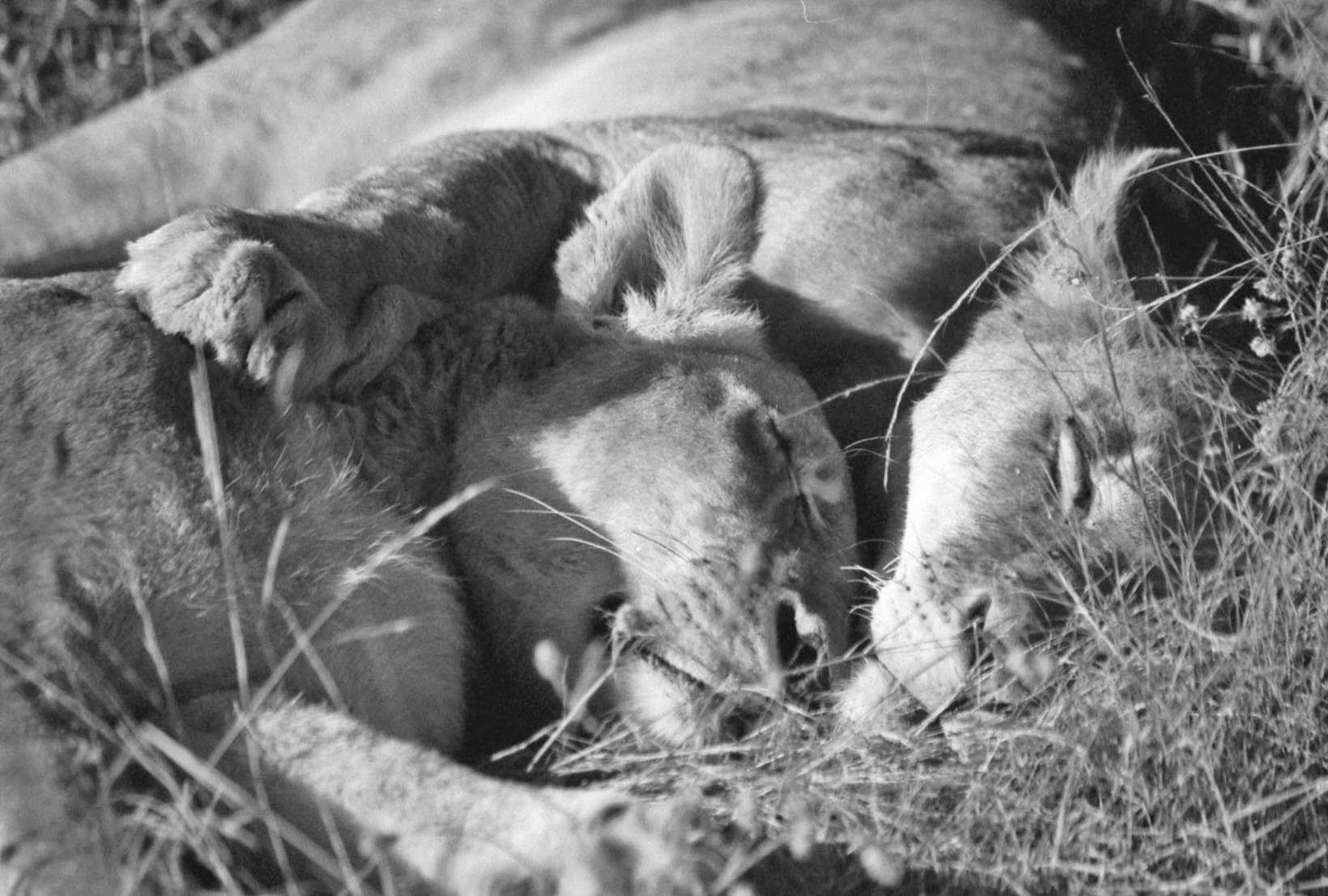
The lionesses napped side-by-side.  Without opening her eyes the healthy one raised a front paw and draped it over her sister’s neck.The Sisters b&w
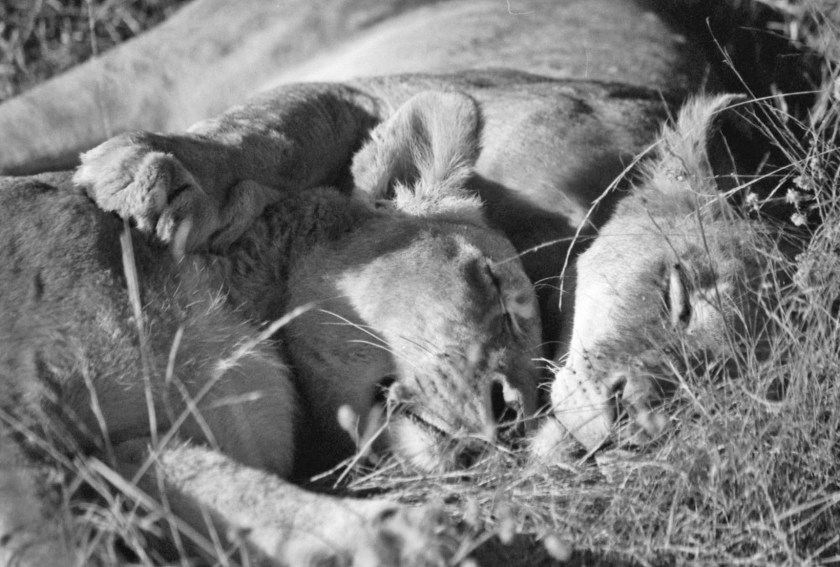
No tooth, no claw, no blood.  Funny, how, even in Africa, you always get something different than what you expect.

Posted in Africa, Doug, Elephants, Jabu, Lions, Morula, Thembi, Travel

Lions, Part One

While standing in the shade of my tent, I look out over a lagoon of bent grass to the trees at its far shoreline.  A few of the stalks shiver and crosshatch in the lagoon as a mouse or grasshopper nibble at their stems.  Otherwise, the grass is motionless.

I stick my hands in my pocket and scuff dust with the toe of my boot.

Something rustles in the underbrush.  My sleepy senses come to full alert.  It’s an ancient world out there  – full of primitive memories storied at the bottom of our brains.  i spot one of the honorary camp staff, a francolin, scratching around a clump of buffalo grass.

We are all afraid of something.  Thembi gets in a tizzy over bees.  (Imagine bees up your nose!)  Eggshells horrify Jabu.  For Morula, it’s the fear of not belonging.

Are elephants afraid of mice?  No, but quick small things moving around their feet startle them.  I consider that a prudent reaction in a world full of snakes.

My fears are primitive, hard-wired into the base of my brain from the time when humans were prey to huge fanged predators – cats as large as grizzlies, bears as large as elephants.  My primitive brain is not comfortable when there are carnivores around, especially when I can’t see them.

Just last night a lion’s roar ripped me awake from a deep sleep: WAAA-AH-UNGHHH   UNGH  UNGH  UNGH  ungh  ungh. . . .It ended with those deep grunts lions cough up from their bellies.

A lion’s roar can be heard for five miles.  This one was incredibly loud and incredibly close, right at the edge of camp.

A cold set of fingers wrapped around my heart.  In the darkness my heart threw itself repeatedly against my ribs, then slowly backed into a corner of my chest.  Wary, it waited there for another roar, which never came.  I knew I was safe – no lion has ever dragged someone out of a zippered tent in Botswana.    But tell that to my primitive brain.

Four days ago, as I waited for Doug to pick me up from Stanley’s Camp, I had enough time before his arrival to join an evening game drive.  A young couple on their first trip to Africa climbed into the tier of seats behind me in the Landcruiser and held hands.  They were on their honeymoon.  John, our driver and guide, explained that two other vehicles from camp had found a pride of lions on the other side of the reserve – but it was too far away for us to join them and be back before dinner.

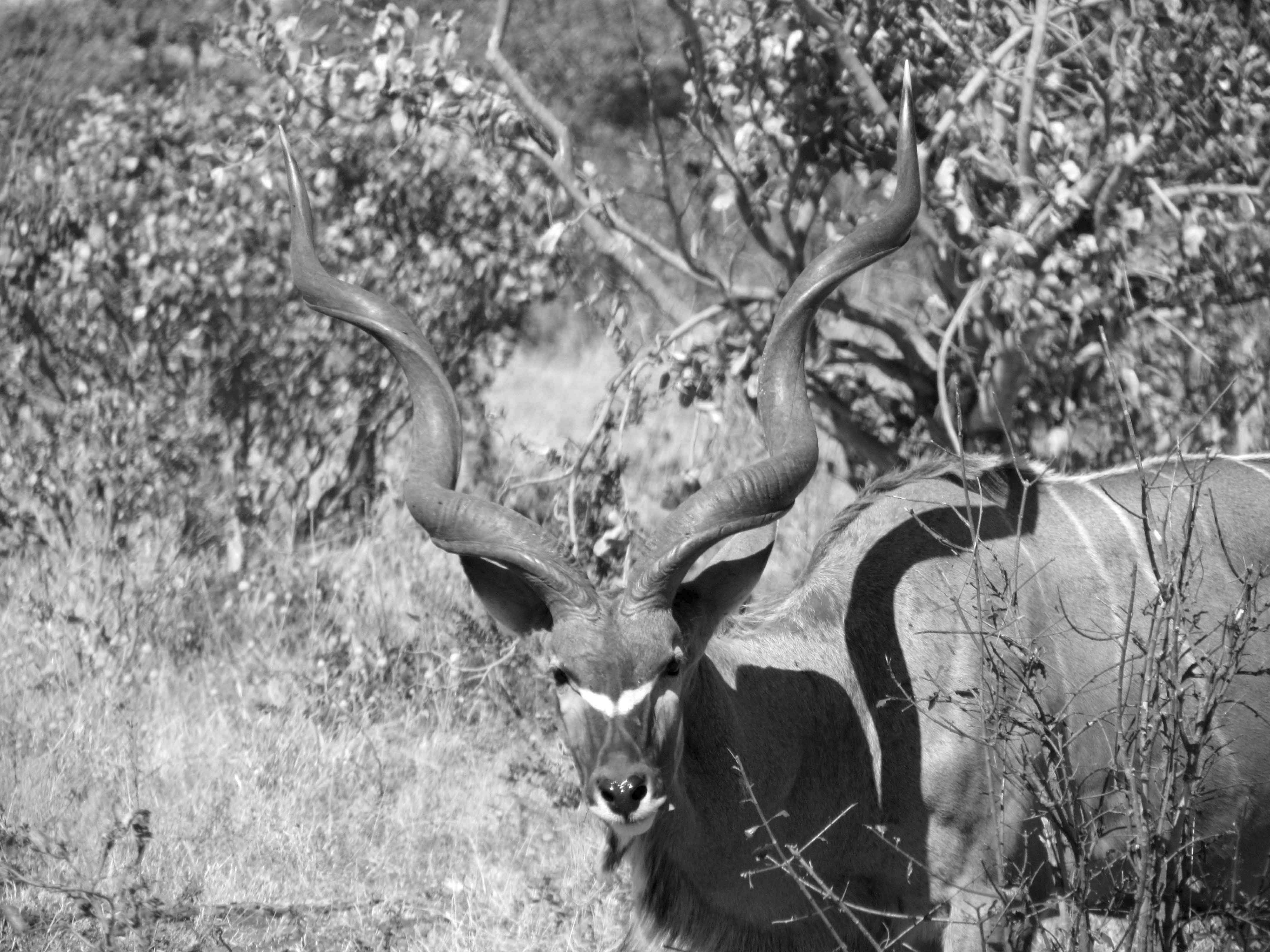
Kudu horns b&wSo we headed off in the opposite direction.  The young couple happily snapped photographs of zebras and impalas and baboons, giddy with the realization they were in the midst of their dream vacation.  A male kudu with magnificent horns kept us in one place for nearly a half hour as the couple peppered John with questions and marveled over the graceful curl of the kudu’s horns.

At dusk John parked at the top of a knoll.  With open grassland all around us it was safe to descend from the vehicle.  He prepared traditional sundowners – gin and tonics – and handed them around.

As I take my first sip a lion roared in the near distance.  “That’s not very far,” I said and looked at John.

“We could get lucky,” he looked at the couple with us.

They nodded, so we dashed our drinks on the ground, stashed our glasses back in their basket, and scrambled back into the Landcruiser.

Just down the road, where we’d been half an hour earlier, four large males lounged in the tall grass alongside our tracks.  One lifted his chin and roared, loud enough to rattle our hearts:  WAAUNNNNNNGH, UNGH, UNGH, ungh, ungh, ungh.

John sent a radio message to the other vehicles.  They will detour to join us on their way back to Stanley’s.

As we watched the four males, light faded from the sky and disappeared.  Blue became purple, then black.  Stars appeared, each one of them a cold clear diamond.

John switched on a spotlight.   A male sat in front of us, looking to our right, listening.

Spotlight off.  The couple behind me murmured to each other and tried to become small blobs, rather than humans with discernable arms and legs and heads.

Spotlight on.  Another male, on the left, folded into the grass, on his side, with a barely audible ufff.B&W male lion

Spotlight off.

A distant contact roar from one of the lions on the other side of the reserve.

Spotlight on.  The male in front of us headed to a wall of brush and trees, disappeared.

Spotlight off.  Shallow breaths through my open mouth.  A commotion to our left.

Spotlight on.  Another male, who was sitting off to our right, had moved across the road and was now rubbing the side of his face against the lion inert in the grass.  When he couldn’t get his companion to rise, he also slid into the bush.  A fourth lion, just up the road, ghostly in the spotlight’s shadow, followed the first two, disappeared.

Spotlight off.  Silence.

Then a faint roar, in the distance again.

The hair on my arm rose before I even thought about it, as I realized that next to me the grass hissed, hisss zissh, hisss zissh, as something large walked by.

“He’s right beside me,” I whisper without moving my lips.

Spotlight on.

The inert lion was gone.  John twisted his hand over his shoulder and the light caught the back of a lion just passing the front tire on my side of the vehicle.  His great head swung back and forth as he walked hisss zissh, hisss zissh through the tall grass.  The lion had walked around the back end of the vehicle without us hearing him until he was right next to me.  The skin on the back of my neck tried to crawl up to the top of my head.A Lion Walks By b&w

The lion turned his head toward the light.  The pupils in his yellow eyes shrank to pinpoints.

He was that close.  I saw his pupils shrink to pinpoints.

He huffed and swung around to follow his three brothers into the bush.  I exhaled.  Had I been holding my breath that long?

The two other vehicles appeared just in time to catch a glimpse of his back in waist-high grass.  They followed him, bouncing through the brush, their headlights tapping the tops of trees.

John turned in his seat and looked at us.  The spotlight in his lap illuminated his face and glinted from the eyes of the young couple, eyes that were now nearly the size of  their open mouths.

“I think it is enough,” he said.  “Let’s go to the hyena’s den before the others get there.”