Posted in Africa, Doug, Elephants, Jabu, Lions, Morula, Thembi, Travel

Lions, Part One

While standing in the shade of my tent, I look out over a lagoon of bent grass to the trees at its far shoreline.  A few of the stalks shiver and crosshatch in the lagoon as a mouse or grasshopper nibble at their stems.  Otherwise, the grass is motionless.

I stick my hands in my pocket and scuff dust with the toe of my boot.

Something rustles in the underbrush.  My sleepy senses come to full alert.  It’s an ancient world out there  – full of primitive memories storied at the bottom of our brains.  i spot one of the honorary camp staff, a francolin, scratching around a clump of buffalo grass.

We are all afraid of something.  Thembi gets in a tizzy over bees.  (Imagine bees up your nose!)  Eggshells horrify Jabu.  For Morula, it’s the fear of not belonging.

Are elephants afraid of mice?  No, but quick small things moving around their feet startle them.  I consider that a prudent reaction in a world full of snakes.

My fears are primitive, hard-wired into the base of my brain from the time when humans were prey to huge fanged predators – cats as large as grizzlies, bears as large as elephants.  My primitive brain is not comfortable when there are carnivores around, especially when I can’t see them.

Just last night a lion’s roar ripped me awake from a deep sleep: WAAA-AH-UNGHHH   UNGH  UNGH  UNGH  ungh  ungh. . . .It ended with those deep grunts lions cough up from their bellies.

A lion’s roar can be heard for five miles.  This one was incredibly loud and incredibly close, right at the edge of camp.

A cold set of fingers wrapped around my heart.  In the darkness my heart threw itself repeatedly against my ribs, then slowly backed into a corner of my chest.  Wary, it waited there for another roar, which never came.  I knew I was safe – no lion has ever dragged someone out of a zippered tent in Botswana.    But tell that to my primitive brain.

Four days ago, as I waited for Doug to pick me up from Stanley’s Camp, I had enough time before his arrival to join an evening game drive.  A young couple on their first trip to Africa climbed into the tier of seats behind me in the Landcruiser and held hands.  They were on their honeymoon.  John, our driver and guide, explained that two other vehicles from camp had found a pride of lions on the other side of the reserve – but it was too far away for us to join them and be back before dinner.
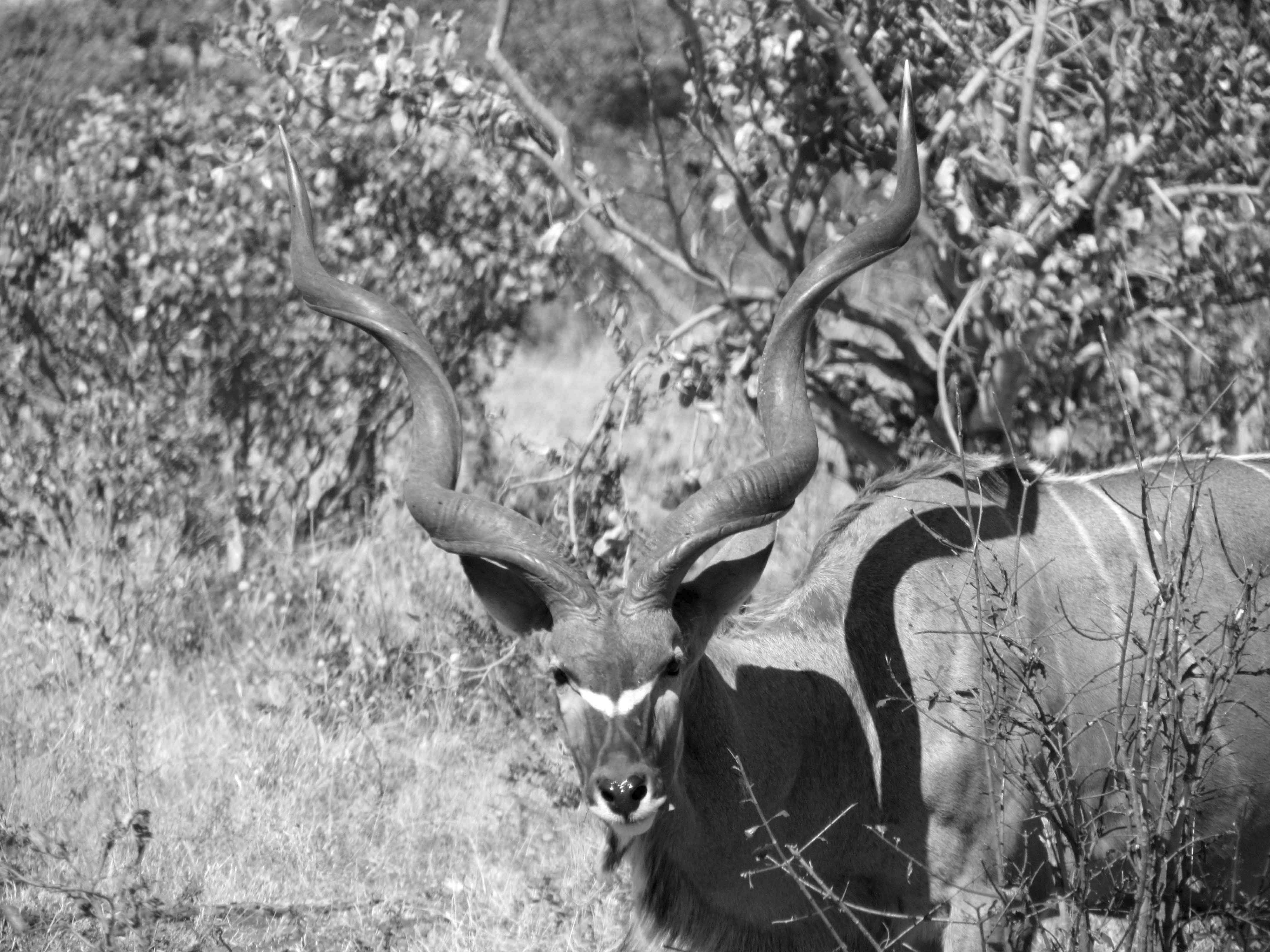
Kudu horns b&wSo we headed off in the opposite direction.  The young couple happily snapped photographs of zebras and impalas and baboons, giddy with the realization they were in the midst of their dream vacation.  A male kudu with magnificent horns kept us in one place for nearly a half hour as the couple peppered John with questions and marveled over the graceful curl of the kudu’s horns.

At dusk John parked at the top of a knoll.  With open grassland all around us it was safe to descend from the vehicle.  He prepared traditional sundowners – gin and tonics – and handed them around.

As I take my first sip a lion roared in the near distance.  “That’s not very far,” I said and looked at John.

“We could get lucky,” he looked at the couple with us.

They nodded, so we dashed our drinks on the ground, stashed our glasses back in their basket, and scrambled back into the Landcruiser.

Just down the road, where we’d been half an hour earlier, four large males lounged in the tall grass alongside our tracks.  One lifted his chin and roared, loud enough to rattle our hearts:  WAAUNNNNNNGH, UNGH, UNGH, ungh, ungh, ungh.

John sent a radio message to the other vehicles.  They will detour to join us on their way back to Stanley’s.

As we watched the four males, light faded from the sky and disappeared.  Blue became purple, then black.  Stars appeared, each one of them a cold clear diamond.

John switched on a spotlight.   A male sat in front of us, looking to our right, listening.

Spotlight off.  The couple behind me murmured to each other and tried to become small blobs, rather than humans with discernable arms and legs and heads.

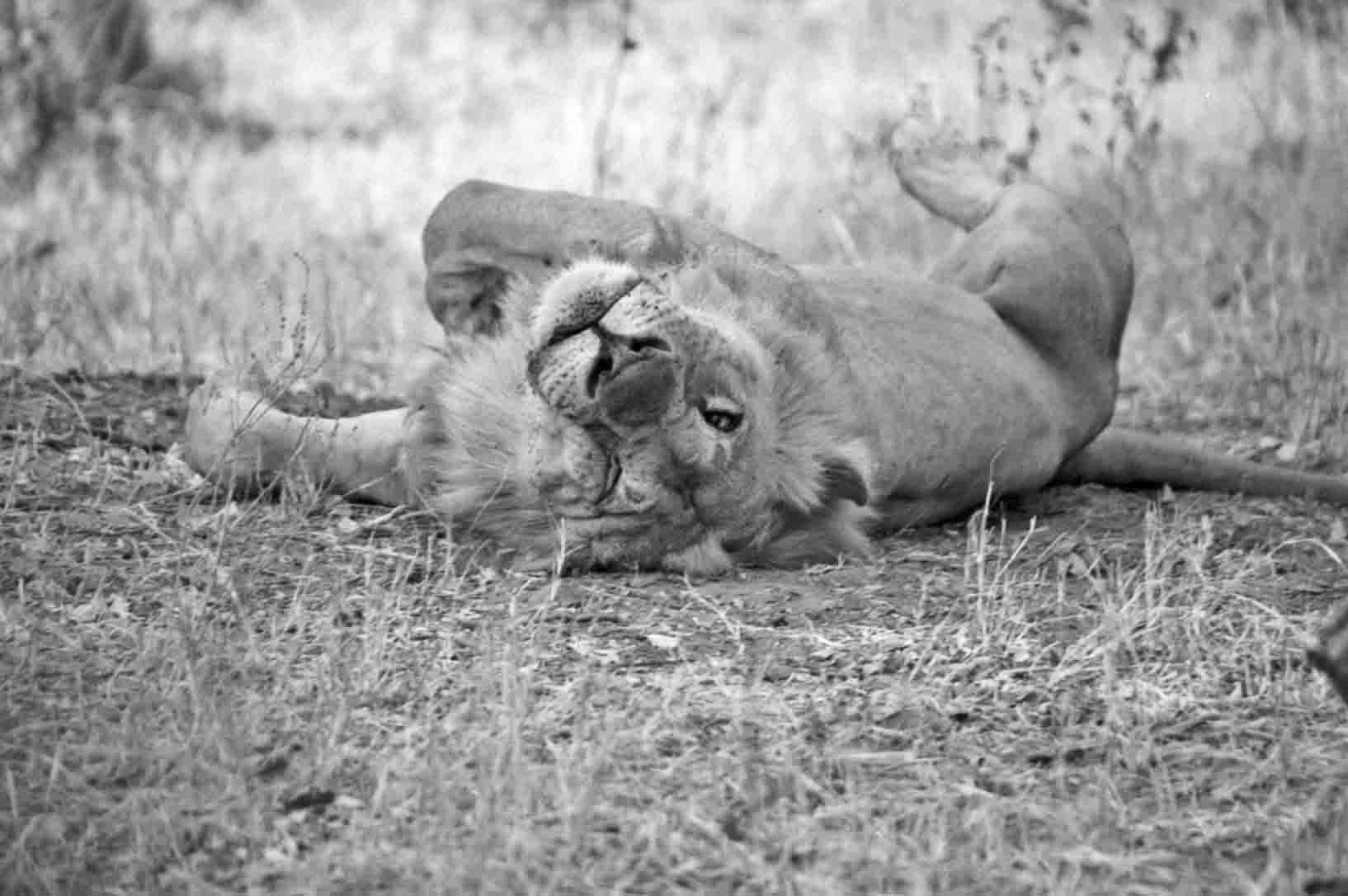
Spotlight on.  Another male, on the left, folded into the grass, on his side, with a barely audible ufff.B&W male lion
Spotlight off.

A distant contact roar from one of the lions on the other side of the reserve.

Spotlight on.  The male in front of us headed to a wall of brush and trees, disappeared.

Spotlight off.  Shallow breaths through my open mouth.  A commotion to our left.

Spotlight on.  Another male, who was sitting off to our right, had moved across the road and was now rubbing the side of his face against the lion inert in the grass.  When he couldn’t get his companion to rise, he also slid into the bush.  A fourth lion, just up the road, ghostly in the spotlight’s shadow, followed the first two, disappeared.

Spotlight off.  Silence.

Then a faint roar, in the distance again.

The hair on my arm rose before I even thought about it, as I realized that next to me the grass hissed, hisss zissh, hisss zissh, as something large walked by.

“He’s right beside me,” I whisper without moving my lips.

Spotlight on.

The inert lion was gone.  John twisted his hand over his shoulder and the light caught the back of a lion just passing the front tire on my side of the vehicle.  His great head swung back and forth as he walked hisss zissh, hisss zissh through the tall grass.  The lion had walked around the back end of the vehicle without us hearing him until he was right next to me.  The skin on the back of my neck tried to crawl up to the top of my head.A Lion Walks By b&w
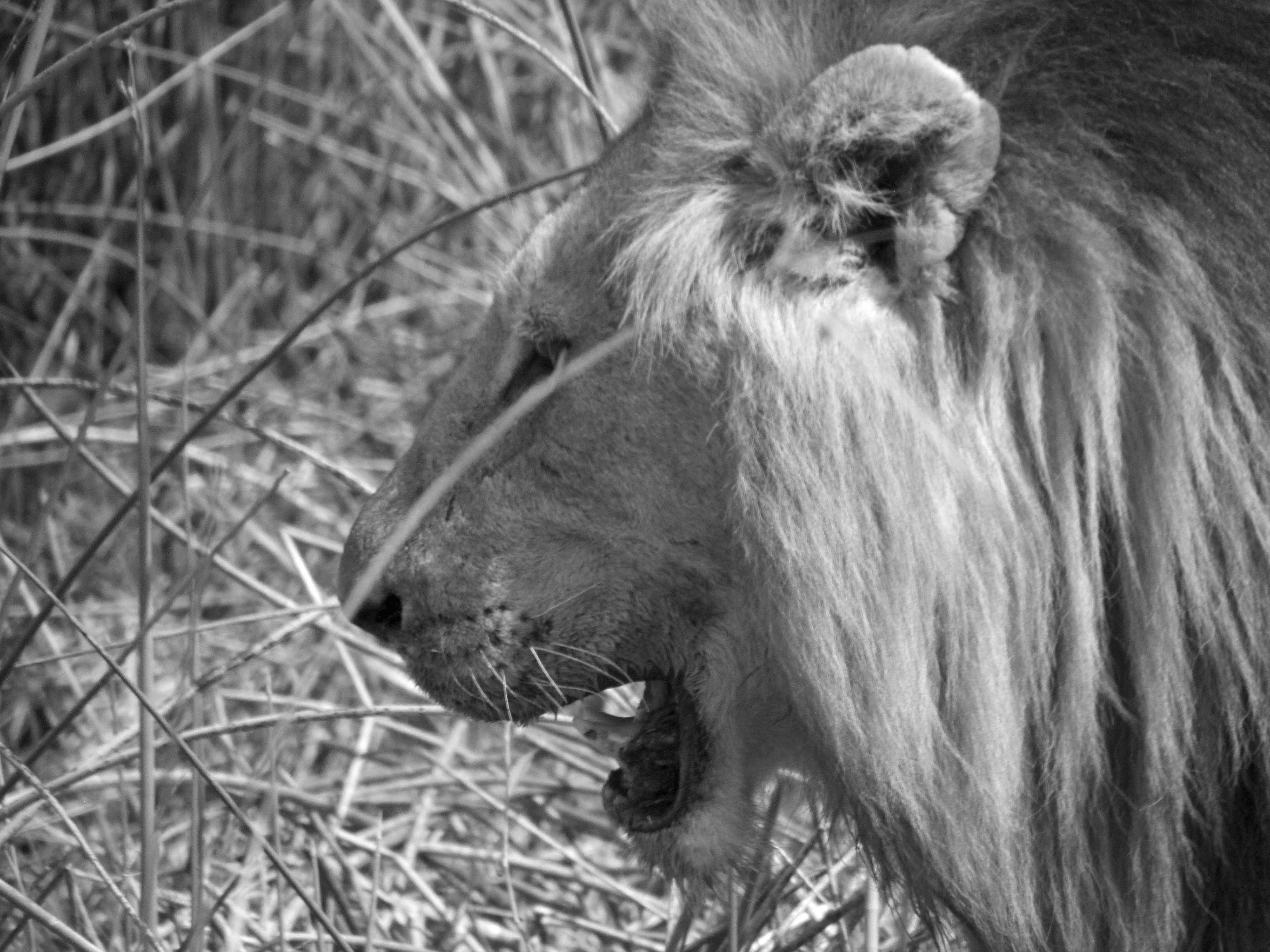
The lion turned his head toward the light.  The pupils in his yellow eyes shrank to pinpoints.

He was that close.  I saw his pupils shrink to pinpoints.

He huffed and swung around to follow his three brothers into the bush.  I exhaled.  Had I been holding my breath that long?

The two other vehicles appeared just in time to catch a glimpse of his back in waist-high grass.  They followed him, bouncing through the brush, their headlights tapping the tops of trees.

John turned in his seat and looked at us.  The spotlight in his lap illuminated his face and glinted from the eyes of the young couple, eyes that were now nearly the size of  their open mouths.

“I think it is enough,” he said.  “Let’s go to the hyena’s den before the others get there.”
Posted in Africa, Jabu, Morula, Thembi, Travel

The Tree of Life, Part Two

An excerpt from my book, Larger than Life, Living in the Shadows of Elephants:

In 1998, the Disney Corporation opened the Animal Kingdom Park in Florida. It is, in essence, a 500-acre zoo, containing 1,700 animals representing 250 species, from Abdim’s storks to African zebras.  In the center of the park is a 145-foot-tall, 50-foot-wide sculpture of a baobab, representing the Tree of Life from the Disney film, The Lion King.  Much larger than any known baobab, the sculpture is molded around a refitted oil platform.  Its trunk is carved with 325 animals and contains a theater with 430 seats.  Upon its branches are 103,000 leaves dyed five shades of green, made of kynar, a flexible fluoropolymer resin.

Since opening, the park has averaged 9 million visitors annually, ranking seventh in the world in theme park attractions.  Disney’s resident herd of African elephants has produced six calves, three females and three males, all still living – the most successful breeding program in the United States.  The herd now consists of twelve elephants: four males and 8 females.

Here, in the Okavango Delta, our small herd of three elephants, one male and two females, browse through thick brush on one of the islands left stranded after last year’s flood.  As I might linger over a sunset, Jabu, the male, lingers over a small mopane tree, whose leaves have high protein content, an important year-round food source.  Thembi pulls out a single leaf from a young palm and chews on the sweet cane-like stalk.  Morula has entirely disappeared into a thicket, but I can hear an occasional crack from a breaking branch as she tugs it from a tree.

The white eye of the sun glares down upon us, blinding, melting the wax that held together a small, feathered breeze.  My bones soften, melting.  I lose my ability to soar.  Baobob in winter

The sun reflects from my camera’s metal buckle and penetrates my brain like a dull pickax.  It’s a burst bomb, pure and searing, a light behind my eyelids, a glimpse of the beginning of our solar system.  Halfway through its own lifespan, the sun is fueled by enough hydrogen to last five billion years more.

I move into the shadow of a nearby mopane.  Thick, dappled shade makes diamond patterns at my feet.  Slowly we begin to leave the island, the elephants more reluctantly than the humans.

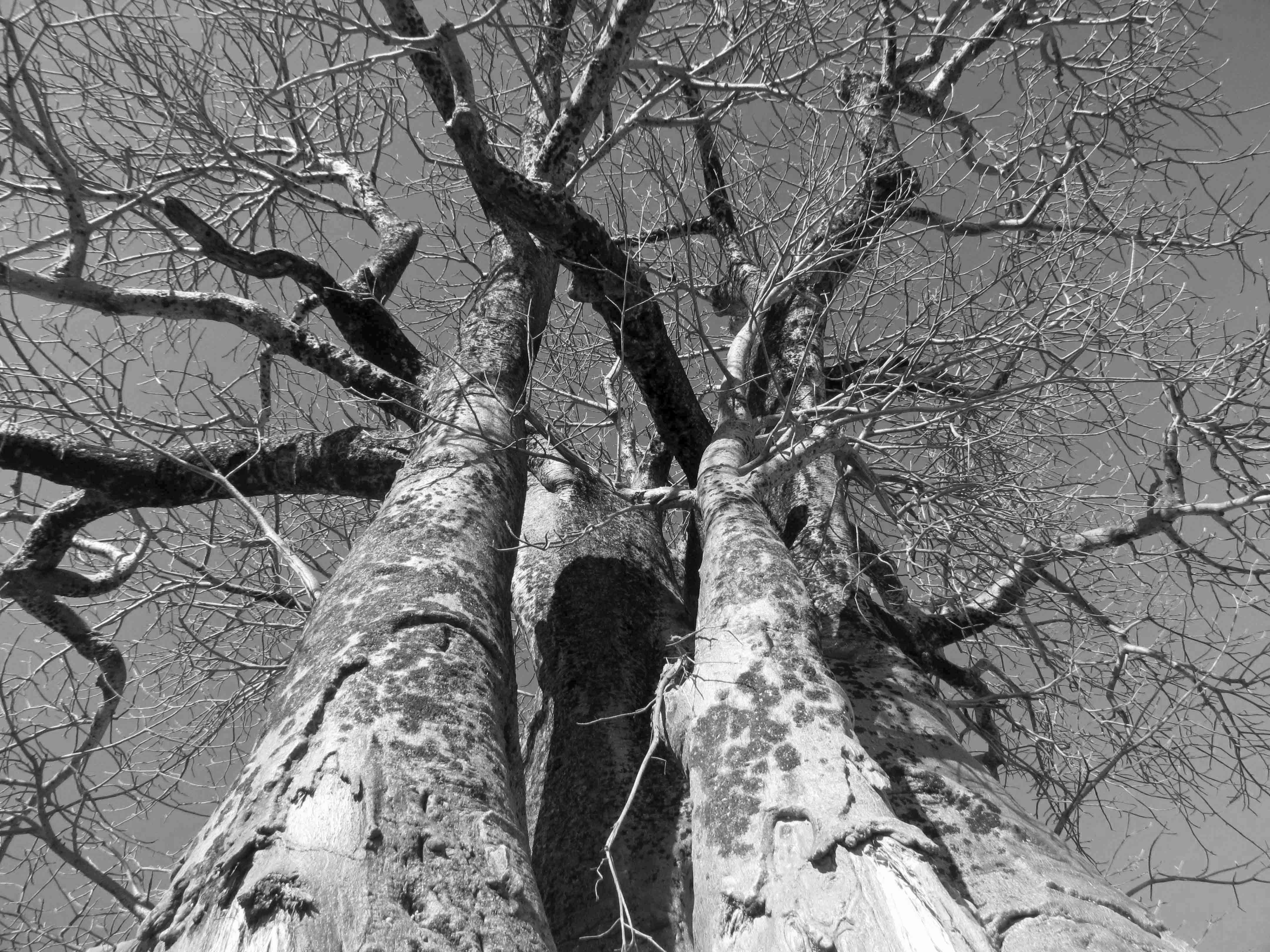
Across a dried up lagoon full of grass, is a baobab, a rare species for this part of the Delta.  Its nude limbs, entangled as a root system, seem to search for moisture from the sky.  Kalahari Bushmen believe the trees appear fully-grown, planted upside down by the gods, with the tree’s roots in the air.  They also believe spirits inhabit the baobab’s large, waxy-white flowers, and if anyone has the audacity to pick one, they will be eaten by a lion.

This baobab is deciduous and luckily naked this time of year.  It’s around twenty-two feet in diameter and about seventy feet tall; a young tree that I would guess is 600 years old.  Its trunk is smooth and relatively unblemished.

Older baobabs have a tendency to rot out their heartwood, but completely heal around the hollowed trunk.  Rats and reptiles frequently invade them.  The African honeybee often establishes hives in crevices of a hollowed trunk.  Native to central and southern Africa the bees are actually a subspecies of the Western honeybee.

A single sting from an African bee is no more venomous than a single European or American bee sting, though African honeybees respond more quickly when disturbed and send out three to four times as many workers in response to a threat.  They also pursue an intruder for a greater distance from the hive – thus their reputation as “killer” bees.”

So the Honeyguide bird is more than willing to let another species take that risk.  Physically unable to break open a bee’s nest, it has developed a symbiotic relationship with humans, indicating the presence of a hive by continuously dive-bombing nearby, all the while uttering monotonous, squirrel-like chirps.  Alerted by the Honeyguide, intrepid Kalahari Bushmen pound pegs into the soft bark of baobabs to climb the tree, lull the bees with smoke and obtain a sweet reward for taking that risk.  Bushmen always leave honey for the birds, for if they should fail to do so, the Honeyguide will one day lead them to a lion, instead of a hive.

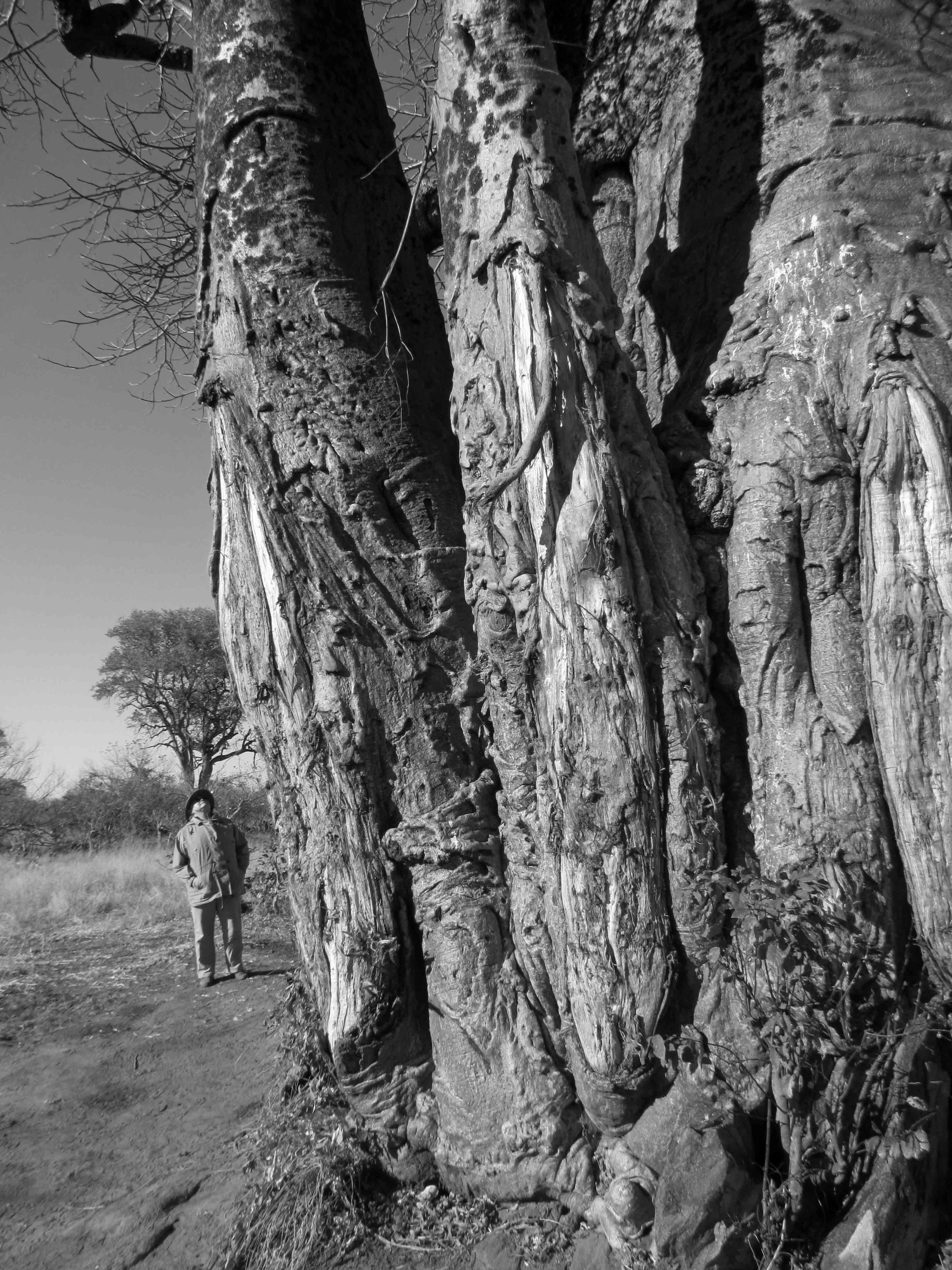
Smooth and pinkish-gray, the baobab across the grass lagoon has only a few hollows in its trunk excavated for bird nests, and a single scrape from an elephant’s tusk.   Older trees are often deeply scarred as high as an elephant can reach.

Baobab barkHollow baobabs have a long history of creative uses by humans.  During World War II, a baobab in Namibia was fitted with a toilet.  The toilet is still there, but the tree has grown around the door, which no longer opens.  On the lower Zambezi River, the Kayila Lodge has an operational toilet tree, used more for photo opportunities than necessity.  And on a private farm in Sunland, South Africa, an enormous baobab contains a wine cellar and bar, complete with draft beer, a dartboard, stools, and a wooden bench along the wall.  The tree is possibly the oldest baobab in existence – it has been radiocarbon-dated to the end of the Stone Age, around six thousand years ago.

In Kasane, Botswana, a baobab was used as women’s prison in the early twentieth century.  I imagine it also served as a deterrent – incarceration with potential rat and reptile cellmates would make any criminal think twice.  Although that baobab died in 1967, an offshoot now grows next to the remains of the jail.  Throughout Africa, hollow baobabs have served various purposes – as hiding places during tribal warfare, as shops, storage shelters, barns, chapels, burial sites, post offices, even a bus stop.

Almost every part of the baobab is edible.  Fresh leaves are eaten as spinach and condiments.  The shoots from germinating seeds taste like asparagus.  Bulbs from its roots make porridge.  Fluid extracted from the bark of the baobab is used to dilute milk. The ash from a burnt tree is a good substitute for salt.  Pulp and seeds of its fruit contain potassium acid tartrate as well as citric acid, an effective substitute for cream of tartar, and resulting in the Afrikaans name “Kremetartboom.”  Early settlers also used fruit pulp in place of yeast and added baobab leaves to speed up the fermentation process in winemaking.  The fruit pulp has the highest known concentration of Vitamin C.  It makes a slightly acidic, but refreshing drink when mixed with water.  Baobab seeds have the same protein value as domestic nuts and can also be roasted and ground into a substitute for coffee.

The baobab is often called “the Monkey-bread tree,” because baboons and monkeys eagerly consume its fruits.  Nearly all four-legged browsers eat the baobab’s fallen leaves and flowers.  The flowers open just before dark, produce copious amounts of nectar and last for only 24 hours.  Their heavy, carrion-like scent attracts nocturnal insects and bats, such as Peter’s Epaulleted Fruit Bat.

In times of drought, elephants strip the bark of the baobab and eat the spongy wood underneath, estimated to contain 40-70% water – classifying the baobab as the world’s largest succulent.  An individual baobab can store up to 32,000 gallons of water and weigh 266,880 pounds – or one hundred and twenty-one tons.   A big bull like Jabu can weigh up to 16,000 pounds or seven tons.  If you stacked elephants one upon the other, it would take seventeen or eighteen elephants to equal the weight (if not the mass) of the water stored in a large baobab.

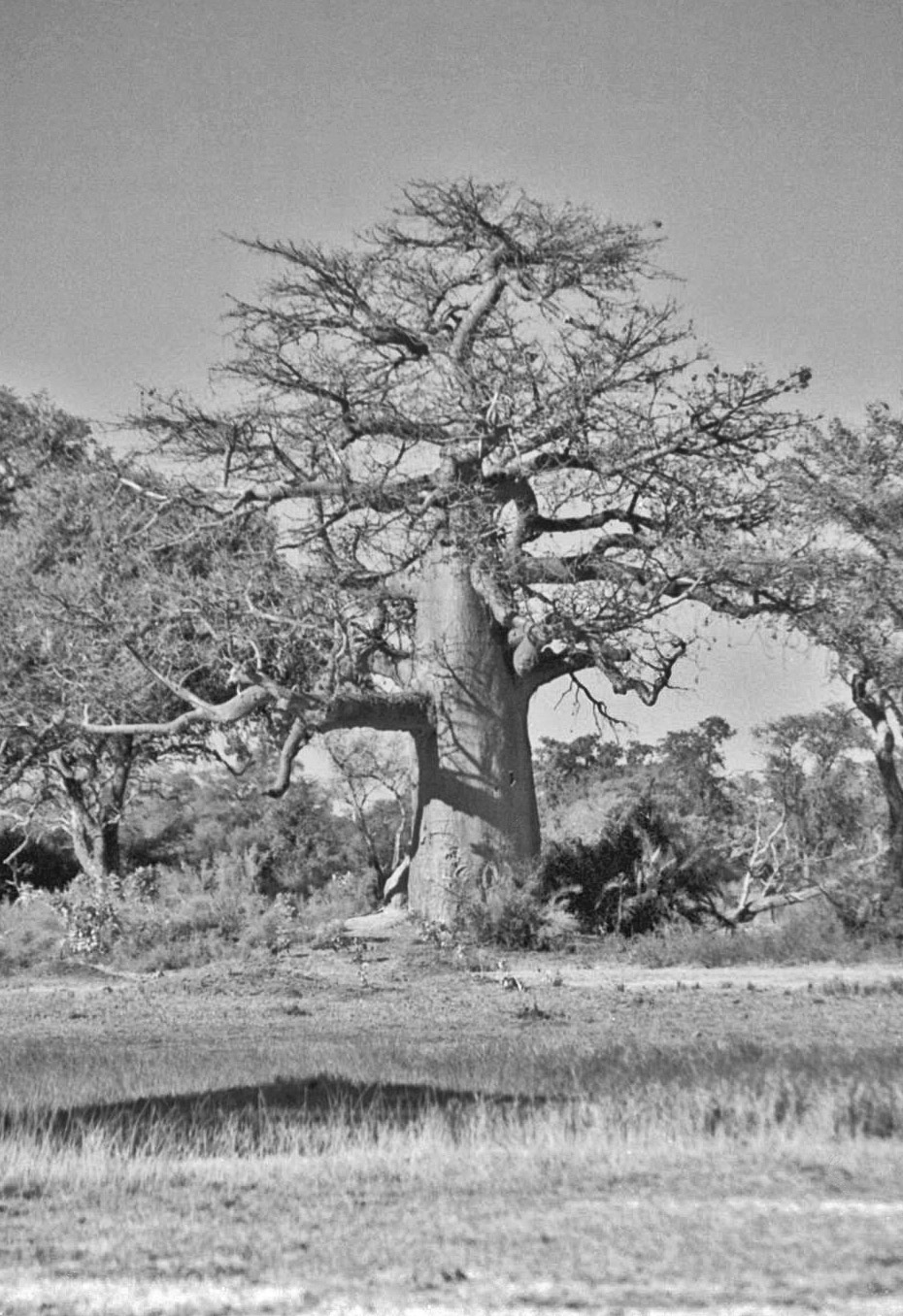
The name baobab derives from North African Arabic, bu-hibab, “fruit of many seeds.”  Within life spans that reach six thousand years, the baobab nourishes countless species, takes in tons of carbon dioxide and releases equal amounts of oxygen.  It cycles and recycles, measures seasons by dropping its leaves, measures centuries by the blur of life beneath its limbs.  A baobab’s death is the death of an eternity, as measured by one of those species for which it provides.Savuti baobab 2 b&w

Posted in Africa, Elephants, Jabu, Morula, Thembi, Travel

The Tree of Life, Part One

An excerpt from the book I’m writing about elephants:

Baobob in winterJabu, Morula and Thembi slowly browse through the brush on one of the islands stranded after last year’s Okavango flood.  Opposite of us, across a dried lagoon filled with grass, is a rare tree species for this part of the Delta: an African baobab, Adansonia digitata – digitata for the five leaves it has per stem.  The baobab is deciduous, naked this time of year.  Its prehistoric appearance conjures up primeval landscapes full of odd plants and crawling creatures that existed in the ages before the dinosaurs.

There are eight species of baobabs, six found in the dry deciduous forests of Madagascar, one in Australia, and digitata, which grows in West, East and Southern Africa.  Baobabs are also found on the Arabian Peninsula, spread there by the movement of human settlements.

Adansonias are named after the French naturalist, Michel Adanson (1727-1806), who spent five years in Senegal, brought home a huge plant collection, and published a paper on digitata after his return.  Adanson also wrote a masterwork of natural history, an encyclopedic l’Ordre Universel de la Nature, but it was based on his own system of classification, distinct from that of his contemporary, Linnaeus (1707-1788).  Linnaeus’s Systema Naturae, introduced binomial nomenclature – using an organism’s Genus, Adansonia, followed by a descriptive modifier such as digitataSystema Naturae classified 4,400 species of animals and 7,700 species of plants.

In contrast to Linnaeus’s system based on structures, Adanson proposed a “natural” system that took many features of the plant into account, which included structure along with function, growth, evolution and distribution.  His system was ignored in his time because he refused to use binomial nomenclature.  However, the publication in 1789 of Genera Plantarum, by Antoine Laurent de Jussieu, combined Adanson’s use of multiple structures with Linnaeus’s binomial classifications – a methodology widely accepted and still in use.

Adanson’s masterwork was huge, just like the baobab: 27 large volumes with a 150-volume index that contained an alphabetical treatment of 40,000 species, a vocabulary listing 200,000 words, 40,000 drawings and 30,000 specimens.  It was never published.  It is, however, preserved in the Hunt Institute for Botanical Documentation, at Carnegie Mellon University in Pittsburgh, Pennsylvania.

Elephants love the bark of the baobab because of its moisture content.  As insurance against harsh drought, the swollen trunk of a single baobab stores up to 32,000 gallons of water, making its wood soft, spongy and fibrous.  A plank cut from this tree will decrease in volume by 40% and shrink in length by 15% while it dries.  Sometimes, during these times of drought, elephants will completely gird a tree, leaving it standing as if standing on its own pedestal, and yet the baobab will still survive.

The bark on the baobab across the lagoon is smooth and pinkish gray – untouched by elephants, probably due to its proximity to the Okavango’s permanent water channels.  I estimate this tree to be about 22 feet in diameter and 70 feet tall.  Mature baobabs have trunk diameters of twenty-three to thirty-six feet and reach heights of sixteen to ninety-eight feet.  The Glencoe baobab, near Hoedspruit in the Limpopo Province of South Africa, is considered the largest specimen alive.  Up to recent times it had a circumference of 154 feet.  In 2009 it split into two still-living parts, revealing an enormous hollow in the middle.  The date 1893 is carved into its trunk.

Found mostly in seasonally arid areas, baobabs grow very slowly as they age.  However, in its first years of life, a baobab grows relatively quickly.  A tree planted in Kruger National Park in South Africa grew 65 feet tall with an eleven-foot diameter in just 38 years.  In contrast, an older tree described by Livingstone in 1858 grew only two feet in circumference in 110 years.  Despite their early exuberance, baobabs can be cultivated as bonsai trees.

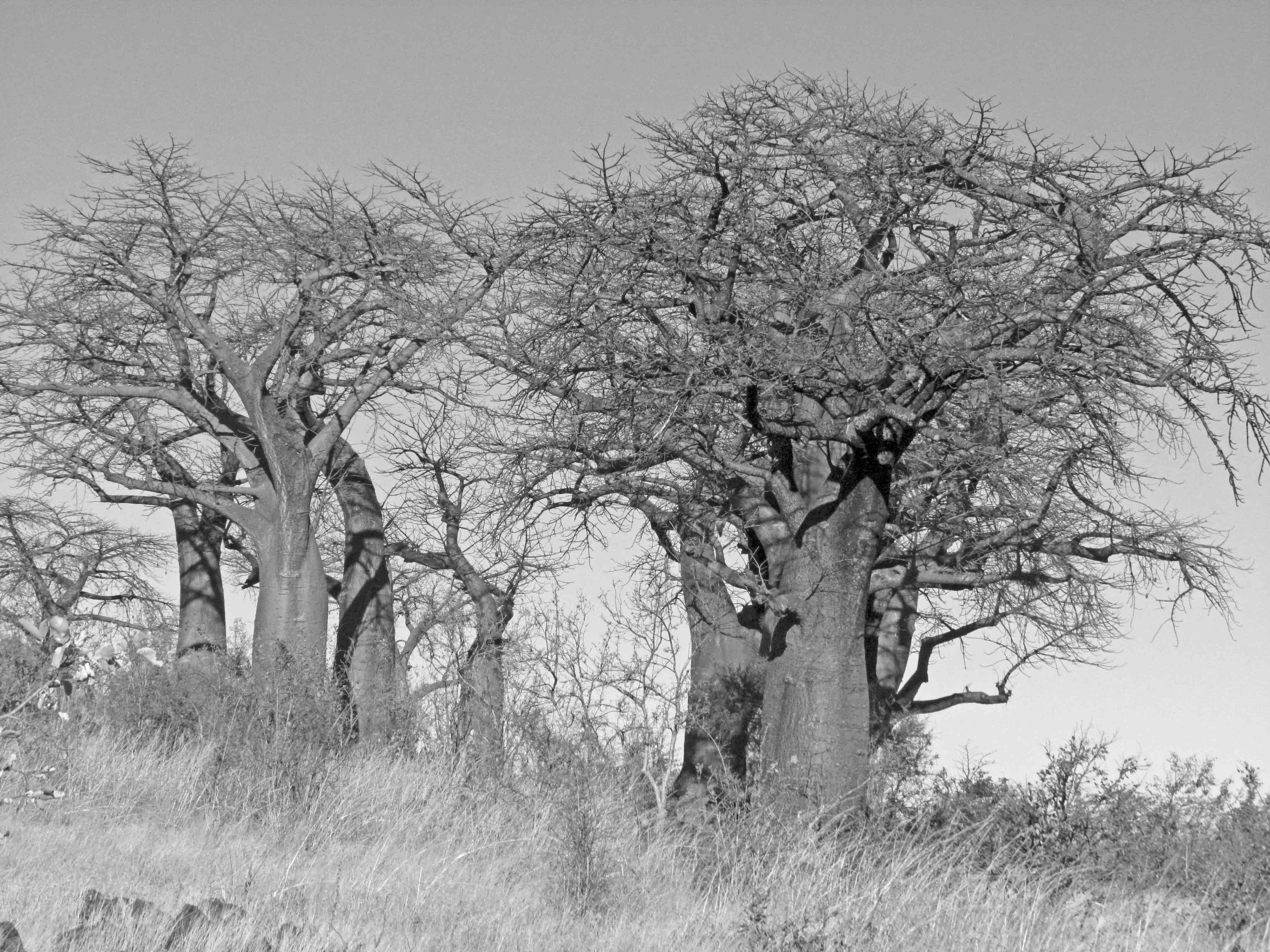
Baobab forest b&wAlthough the Glencoe baobab is thought to be two thousand years old, baobab wood does not produce annual growth rings and it actually shrinks during times of drought, so its size is not an indicator of its age.  The baobab across the grass lagoon is probably – my best guess – around 600 years old, or older, taking root about the time Eric the Red colonized Greenland (985), or later – perhaps the year Gutenberg invented the printing press (1439).  This tree, this timepiece, first dropped its leaves during the Middle Ages, and will continue dropping them, annually, for several thousand years more.

Just twenty days after leaving England, the Beagle anchored at the Cape Verde Islands on Jan 16th, 1832.  As Charles Darwin surveyed the islands with ship’s captain Robert Fitzroy, they measured a baobab that was 45 feet tall and thirteen feet in diameter, and rumored to be a thousand years old.  Darwin remarked in his diary that Adanson supposed some “celebrated baobabs” to be 6,000 years old.  The enormous tree “with its great thickness” impressed Darwin, and he wrote in his diary, “This one bears on its bark the signs of its notoriety – it is as completely covered with initials & dates as any one (tree) in Kensington Gardens.”

The Glencoe baobab has never been subjected to radiocarbon dating, but another in the Limpopo area has been carbon-dated at over 6,000 years, older than the pyramids at Giza (2560 BC).  Several other trees in the region have also been dated  – at about two-to-three thousand years old.

As I look at the baobab across the grass lagoon, I wish I could slip sideways into the life of this nearly eternal tree, and time-lapsed, witness the swirl of life around it as it fattened and grew.  And why not wish also for the future, for another one or two thousand years more?

I turn at the sound of a branch breaking behind me, squint against the sun, and cup a hand at my forehead to shade my eyes. The elephants are great gray silhouettes, haloed all around in bright, bright light.  My watch ticks on my wrist, its hands pointing to meaningless numbers.

Posted in Africa, Elephants, Morula, Travel

Dung Beetles

An excerpt from my book:

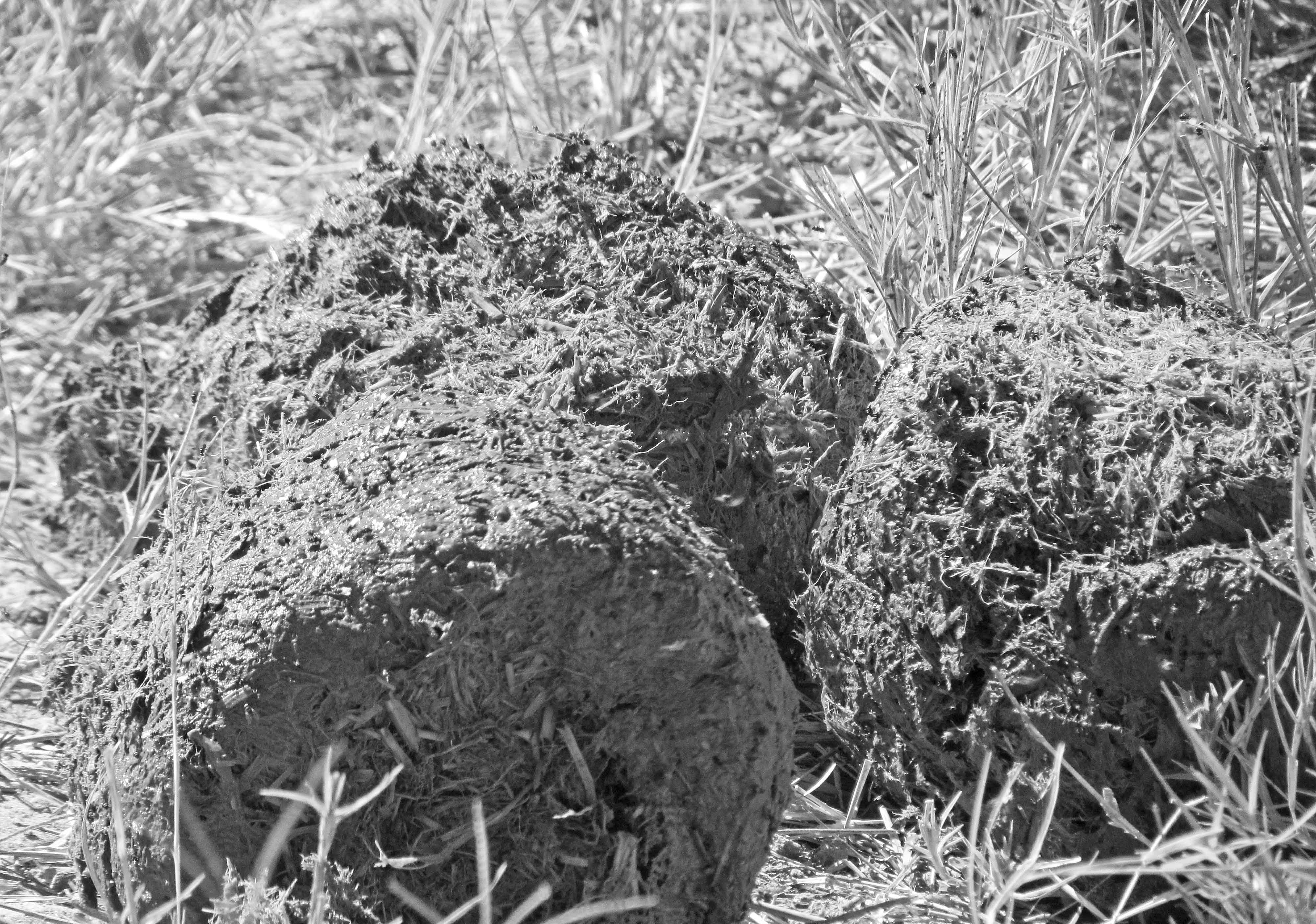
One fine Delta morning, walking along behind Morula, I stumble over a pile of dried dung.  An elephant defecates fifteen to seventeen times per day, up to 250 pounds of droppings.  If Morula used the same spot each time, as pigs do for their privies, the resultant tally of her daily dump would be taller and heavier than I am.  Luckily, elephants leave their leavings wherever they happen to be.  Luckily, this pile of dung wasn’t a fresh one.  But the one next to it is.

Fresh!

I kneel down and take a closer look at Morula’s fragrant pile of feces.  Since she’s a vegetarian, it smells more of compost than rot.  Crosshatched with undigested twigs, this wet pile contains quite a few seeds.  Thirty species of African trees rely on an elephant’s intestine.  Passing untouched through the gut, their seeds emerge in the feces, instantly fertilized.

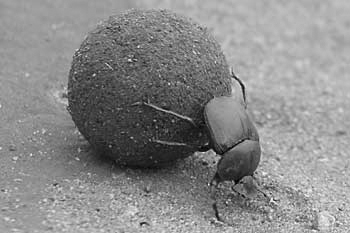
I bend closer.  Tiny grooves in the sand mark where dung beetles have already rolled off balls of dung.  Even tinier footprints dot each groove.  With its hind legs, a dung beetle can propel a ball of dung 1,041 times its own body weight – equivalent to me, lying on my back, trying to push around Morula with my feet.

One study found 22,000 dung beetles on a single elephant plop.  Dung beetles enrich the soil, prevent the spread of parasites and disease, and provide food for their young, night and day, day and night – finding their way around at night by polarized moonlight.

A dung beetle barrel rolls past my ear and lands on top of Morula’s output.  Tightly rolled bits of it are already making off into the grass, propelled by industrious hind legs.  As the male rolls his ball of dung, a female rides on top.  She will lay her egg on it once the ball is buried.  In less than an hour, most of this pile will be gone, entombed in tiny birthing chambers, each ball of dung containing a few seeds and a single egg.  When the beetle larva hatches from the egg, it has all of the food and water it will need until it is able to function on its own.

There are 1800 species of dung beetles in southern Africa  – 1800 tribes of sanitary engineers cleaning things up.  Worldwide, the dung beetle family includes 5,000 species.  In the United States there are 90 species.  Ranchers love them – an established population of dung beetles can clear out a cow pasture in thirty-six hours.  Australians import African dung beetles to augment their native population and are experimenting with them in big cities to rid sidewalks and streets of dog droppings.  In East Africa, dung beetles work their way through eighty percent of the leavings left behind by the mass migrations on the Serengeti.  Without dung beetles all of Africa would be covered with, well, you know.

A Sanitation Engineer on the job
Posted in Africa, Doug, Elephants, Jabu, Morula, Thembi

Squh-week

Doug calls out, “Jabu here.”

Then he turns to Stacey.  “Time for a photo-op?”  I leave off drawing diagrams in the dust, stand up, dust off my pant cuffs, and join them.

Stacey fishes a disposable camera from the pocket of her shorts, “Do you mind?” and hands it to me.  I smile; she had a camera after all.

“Ears,” Doug says to Jabu in a conversational tone, in the same tone a mother might remind a teenager, “Dishes.”

But Jabu’s way ahead of him.  As soon as the camera came out he spread his ears and posed.

Stacey cuddles his trunk; I turn the camera horizontally in order to squeeze them into the frame.

“How many?’ I ask.  Practically the entire roll, it turns out.  Jabu with Stacey.  Jabu with Stacey & Doug.  Jabu and Doug.  Just Jabu.  Then Jabu with Stacey again.  It’s hard to fit all of Jabu into the frame of a point-and-shoot without Stacey appearing to be a mere speck.  I do a couple of close-ups.

Behind me seedpods rattle their tiny gourds as Thembi swishes through the grass.  Her ears ripple as she walks, a wave going through them, top to bottom.  She’s giving up eating to find out what’s going on.

Stacey joins me.  I hand over her camera.

“Squhweeek, Jabu.”

Doug’s voice rises an octave between “Squh”  and “weeek.”

Trunk tip squeezed together, Jabu obliges, emitting a series of squeaks similar in sound to rubber tires leaving skid-marks on pavement.

“It’s an inhalation,” Doug comments.

Standing shoulder to shoulder with Jabu, Thembi joins in.  And over in the brush, with her back to us, Morula squeaks too.  Like a kid in a corner, she keeps on practicing.  Her squeaks sound more like a finger rubbed across a balloon.

“Talk.” Doug says to Jabu and Thembi.

First one “talks” and then the other.  They rumble, leaning back and forth, abdomens filling and emptying like bellows, sounds made by exhalations.

It’s a rhythmic conversation.  Jabu and Thembi’s low bass tones carry layer upon layer of vibrations.  I close my eyes and imagine giant, reverberating oboes.

Is there an under-current of conversation going on between them?  Silly humans.  They get so pleased over the littlest things.

Morula saunters over.  The tip of her trunk curls against her forehead, waves Hello.

“Morula has something to show you, too” Doug says.  “Morula, open,”

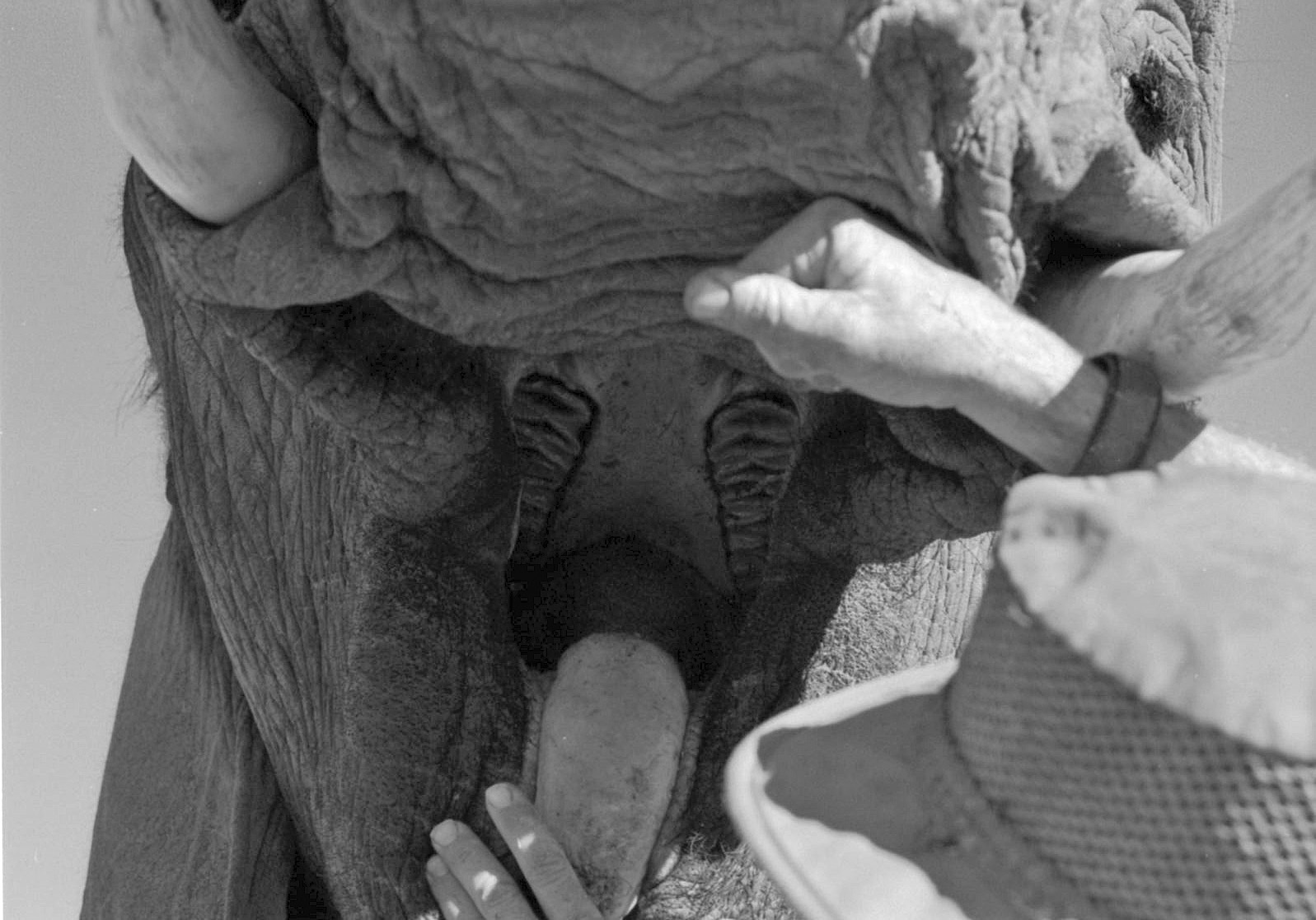
First Stacey, standing on tiptoe, reaches in, and then I reach in to rub Morula’s tongue.  It’s much bigger than mine is, but feels pretty much the same – wet, soft, fleshy.  It’s flecked with bits of leaves.

There’s a common but erroneous belief throughout Asia that all elephants are tongue-tied.  It’s also believed that if the tip of their tongue were not tied down at the front of their mouths, each and every one of them could speak.

Morula pushes against Doug’s fingers with her strong tongue.

What if Morula could speak?  There’s not a single one of us who do not wish that the great beasts of this world could whisper into our ears the secret of life, could answer our questions in a language we might understand.

But would we want to hear what they have to say about us?

Something tickles the underbrush, a small rustle from a smaller body.  Insects buzz in the background, a white noise that echoes the beginnings of the universe, a biological chorus constantly singing.

 I listen as if I am a young species, as if my life depended on

Posted in Africa, Doug, Elephants, Jabu, Morula, Sandi, Thembi, Travel

Mammals Are Called Mammals Becuz. . .

An excerpt from my book, Larger than Life:

Doug gets my full attention when he proclaims to his guests, “Thembi has a great set of knockers.”

“Thembi, leg.”

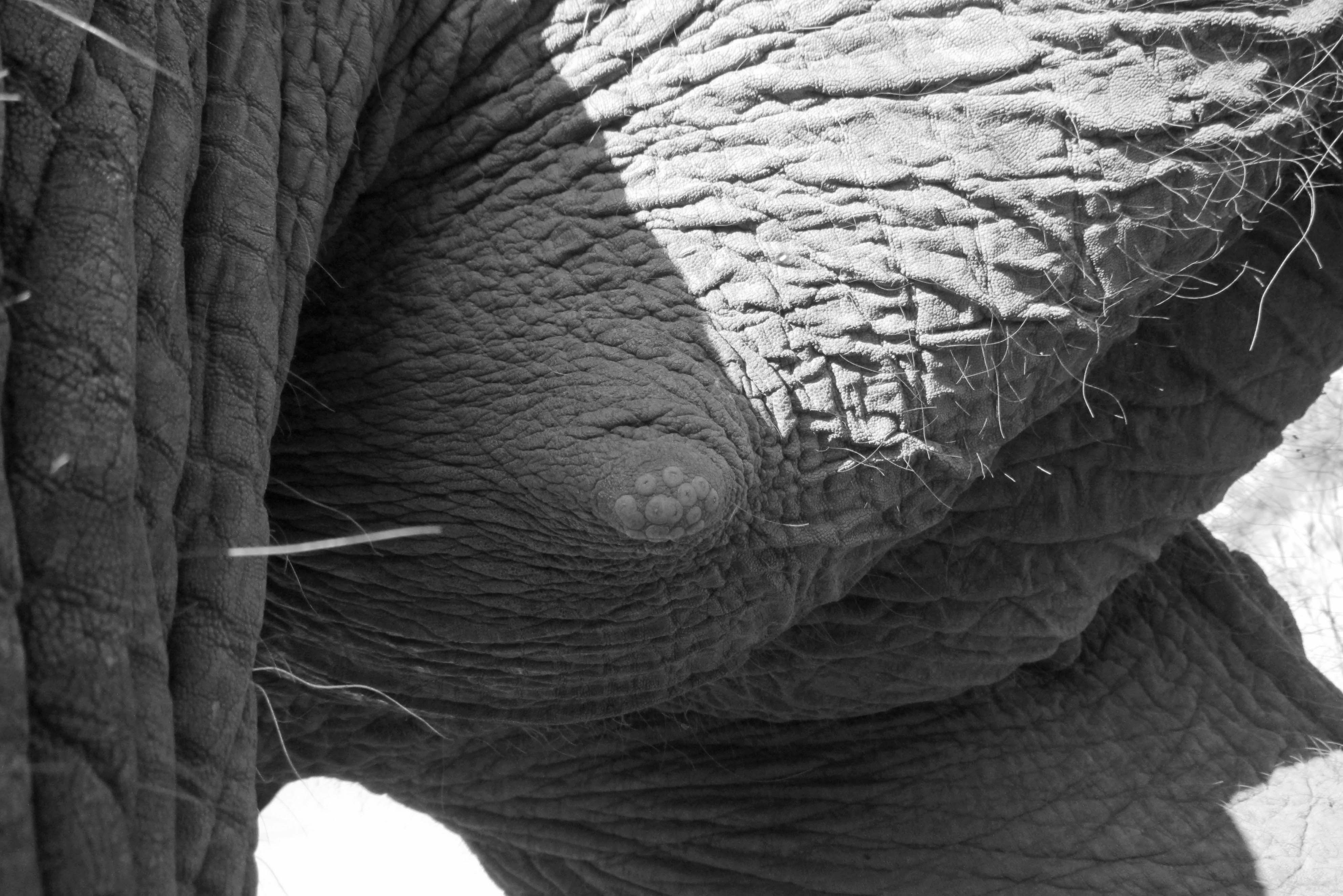
She obliges by bending her left front leg at the knee and raising it, exposing a clear view of her breast.  “See?  Elephant mammary glands are located on the chest, like humans.”

A Great Set of Knockers

I lean over Doug’s shoulder and look at two gray breasts with permanently erect nipples.  They’re about the size of a medium cantaloupe and, like human breasts, slightly globular, due to the pull of gravity.

“Alllllll-right, Thembi.”  As her foot touches the ground, she flaps her ears and her trunk snorfles around his feet.

“If you reach in like this,” Doug demonstrates, “you can feel them.”

Steadying myself with one hand on Thembi’s leg, I reach in and cup her breast with the other hand.  The skin of her breast is as soft as an old, creased leather bag.  Her nipple, as one might expect, is harder than the flesh around it.

Thembi emits a low, murmuring rumble.

“Oh you like that, do you, Thembi girl?”  Doug chuckles.

I quickly withdraw my hand and step away from her side.

“Anyone else want to try?” asks Doug.

Out of the seven of us, several people look away, several look down.  No one ventures forward.  I can’t tell if everyone is embarrassed or just reticent.  Feeling up an elephant may not be quite what they had in mind.  It certainly wasn’t what I had in mind.

“Well, OK.  Mammals are called mammals because . . . . ?”

One of the guests ventures, “Mammary glands?”

“Right.”  Doug continues his lecture: “Like all mammals, Thembi’s lactiferous ducts terminate in her nipples.  They point out a bit, while Morula’s nipples point down.  Thembi gets a bit of stimulation while she walks, don’t you, Thembi girl?”

Some of the guests look mildly scandalized, while others giggle and whisper to each other.

Doug rubs Thembi’s leg, which generates another snorfle.

Female elephants don’t have a row of teats, like cats or dogs.  They don’t lie on their sides, suckling a litter.  Elephant calves nurse standing up, with their small trunks flipped over an eye like a wayward curl.

All mammal breasts are modified sweat glands.  Some mammal breasts are located in the groin and some on the chest.  The breasts between Thembi’s front legs are in the same location mine would be if I walked around on all fours.  Her breasts weigh about four pounds each, .1% of her body weight.  Human breasts weigh .08% of total body weight, dogs 2%, rats 9%.

Do all mammals have larger breast size to body weight than humans?  I pull out my notebook to write down that question, but then decided I really don’t care, and put the notebook away.

“Is she pregnant?” asks the woman behind me.

Although Thembi possesses relatively trim tonnage in comparison to the other two elephants, she is significantly rounder – huge thighs, huge belly, a Rubenesque sort of girl with a really long nose – and very full breasts, unusually large for a non-pregnant elephant.

“We don’t think so,” Doug replies.  “We had her hormone levels tested about six months ago, and they were normal.  She’s an enthusiastic eater, so she might be a tad rotund because of that.  She might be incubating a surprise, but we doubt it.”

Sandi laughs. “That’s because she’s a bit of a flirt with the wild boys around here, but when things get serious she becomes quite horrified and scoots on home.”

Another one of the guests pipes up: “Has Jabu ever tried mating with her?”

“Yes, he’s tried,” Sandi replies, “But we’ve never yet seen him achieve intromission.”

Heads nod thoughtfully.  I can see intromission has thrown them a bit.  It’s not a word commonly used to describe sexual penetration, but I think most of the guests have a general idea of what it might mean.  Several of their heads swivel to gaze at Jabu, ripping apart a nearby bush.  Since he’s such a big boy, why couldn’t he just have his own way?

“Thembi doesn’t really favor him,” says Sandi, as if she’s reading minds.

“What if she had a calf?”

There’s not one second of hesitancy to Sandi’s reply: “Oh, we’d keep it.  It wouldn’t be easy, though.  Thembi’s never been in a breeding herd and has no clue about birth.  And she’s rather stuck on herself, you know.  We don’t think she’d be a good mother.  But if it happened, we’d make it work.”

Even though it’s not likely that Jabu and Thembi will become pachyderm parents, I can easily imagine Thembi as a pregnant princess, mood swings, food cravings and all.  As if to prove my point, she regally sweeps through a stand of grass, a princess on a mission.  She breaks off a few branches from a small thornbush, stuffs them against her back molars and chews with her mouth open.

Thembi has never been with an extended herd of mothers and sisters and aunts and hasn’t had the opportunity to learn the complex behaviors required to be a mother.  She’s never learned that newborn calves stay in physical contact ninety-nine percent of the time, either below or beside their mothers.  Although calves will begin to forage by nine months, they continue to suckle for about four years.  Elephants in zoos will quite frequently shun newborn calves.  So I can just about predict Thembi’s reaction to a calf:  What IS this thing following me around?

I glance over at Jabu.  He has nipples, too.  Guy nipples, nozzle-like nipples, surrounded with sparse hair.

A Guy Nipple

All mammals have three distinct features: hair, three middle ear bones, and mammary glands.  Even whales, dolphins, porpoises and manatees have hair, usually on their snouts or next to blowholes.  Elephants and manatees shared a common ancestor fifty-six million years ago, but the nipples of female manatees are now under their flippers, in their armpits.

A question comes from the back of the tourist group.  “What about Morula?”

Dear, Old Maid Morula.  The wallflower with big ears, large liquid eyes and a knobby forehead.

“If an elephant doesn’t breed by the age of twenty-five, they are unlikely to,” Sandi replies.  “Morula is already the ripe old age of thirty.”

Female elephants typically become active at a quite young age, around thirteen.  They can conceive as early as ten years old and possibly have 12-15 offspring by the time they are fifty.  Female calves will stay with the herd the rest of their lives.

Male elephants take a bit longer to mature and become sexually active around the age of twenty-nine.

Morula has missed the boat.  But I’ll bet she’d make a great aunty.  She stands close by, slowly opening and closing her great ears, patiently watching.

One of the Lactating Class

When he first developed his classification system, Swedish botanist and zoologist Carl Linnaeus originally called mammals Quadrupedia, after the name Aristotle gave them.  Later he became actively opposed to wet-nursing practices in the 1750s and wrote a book on the benefits of breast-feeding your own child.  As a political act, he reclassified Quadrupedia to Mammalia in later editions of his most famous work, Systema Naturae, defining mammals as a lactating class within the Animalia kingdom, a classification that has lasted to this day – all because women of nobility in Linnaeus’s time thought breastfeeding would ruin their figures.

Certainly that’s one thing Thembi doesn’t have to worry about.

Posted in Africa, Doug, Elephants, Jabu, Morula, Sandi, Thembi, Travel

Transported into the Okavango Delta

As the Air Botswana flight descended into Maun, I looked out the window and gasped.  The Okavango floods had already reached the Thamalakane River on the outskirts of town!  Ponds, lagoons, lakes and meandering channels filled the landscape to the horizon.  The last time I visited, in 2007, Maun sat in the middle of a dusty desert.  Now blue waters surrounded it, sparkling in the sunlight.

In the terminal stood a small woman with a permanent smile, bright brown eyes and a “Mack Air” sign.  As Grace sorted scrums of passengers onto various flights out into the Delta she said, “Wait for me over there.”  Throughout a confusion of bags and jetlagged tourists, she never lost her smile.

I followed her to the Mack Air offices across the street from the terminal.  “Tea?” she queried.  Over the next several hours the office staff must have offered tea at least a dozen times – unfailingly polite through an amazing amount of chaos.  One of their charter aircraft had lost radio contact and they were sending messages every plane in the air over the Delta, hoping for a visual sighting.  Finally everyone heaved a huge sigh of relief when one of the ground crew reported that the airplane just landed in Maun.  But the relief was only temporary – the aircraft’s radio couldn’t be fixed.

Now the remaining available aircraft had to be scrambled into new flights.  “Tea?”  “No, thank you.”  One of Mack Air’s pilots wandered in.  “I can take the 206.”  And off he went to pick up tourists at one of the camps.  “Two airstrips flooded overnight,” one of the office staff informed me.  “Tea?”  “No, thank you.”  Grace smiled.

Another pilot wandered in, conferred with the office manager in a low voice, and wandered out.  “Tea?”  “No, thank you.”  Computer screens flooded with revised schedules.  The radio carried constant conversations between the office and pilots scattered over the Delta.  The office staff leaned into their screens, several chewing gum in that constant motion that concentration brings to jaw movement.  “Cheryl Merrill?” asked the receptionist, “Where is she?”

All eyes, except hers swiveled toward me.  “Oh,” she said, following their looks, her face flushing into a luminous red-brown.  She giggled into her hands as I waved to her.  “Don’t worry, we’ll find you a flight,” Grace said.  “It will take a while.  Tea?”

I wandered over to the wall with pilot pictures.  Mack Air is an independent charter company based in Maun, ferrying passengers and freight all over the Delta. The profiles of their eighteen pilots pretty much covered one wall.  Seven are originally from South Africa, three from Botswana, and the rest from countries as diverse as New Zealand and Mauritius.  One photograph stood out:  Hazel Esitile, who began flying for Mack Air in February of 2011.  She’s quoted as saying, “What a man can do, a woman can do too!”  I secretly began to hope Hazel will be my pilot.

But it was Paul, choosing bush flying “as my mid-life crisis,” who escorted me out to a Cessna 210 Centurion.  Trying for some chatty small talk, I remarked, “My husband used to own a 172.”  Paul squinted at me.  “Hate those.  Had to train in them.  No power.”  He opened the cabin door. “Want to sit up front?”

“Of course!”

I crawled over the pilot’s seat and buckled into the “copilot’s” seat, which is simply another passenger spot in small aircraft.

“It’s a little bumpy out there today,” Paul said.  “Did they tell you we’re flying to Gunn’s Camp?”

“No,” I said.

“They’re working on Stanley’s airstrip.  Somebody will pick you up.”

“Okay,” I said.

Small charter aircraft fly low and slow over the Delta – a perfect vantage point to inspect the current Okavango Flood.  In 2011, the Okavango reached record levels, pushed by increased rain in both the Delta and Angola (headwaters of the Okavango system) and large amounts of residual ground water from the 2009 and 2010 floods.  The “dry” cycle of the Delta lasted between 1985 and 2005; now it is assumed that the “wet” cycle will last another ten to twelve years.  Where extensive game drives were once possible, now boats take their place.  I marveled at how much land was underwater.

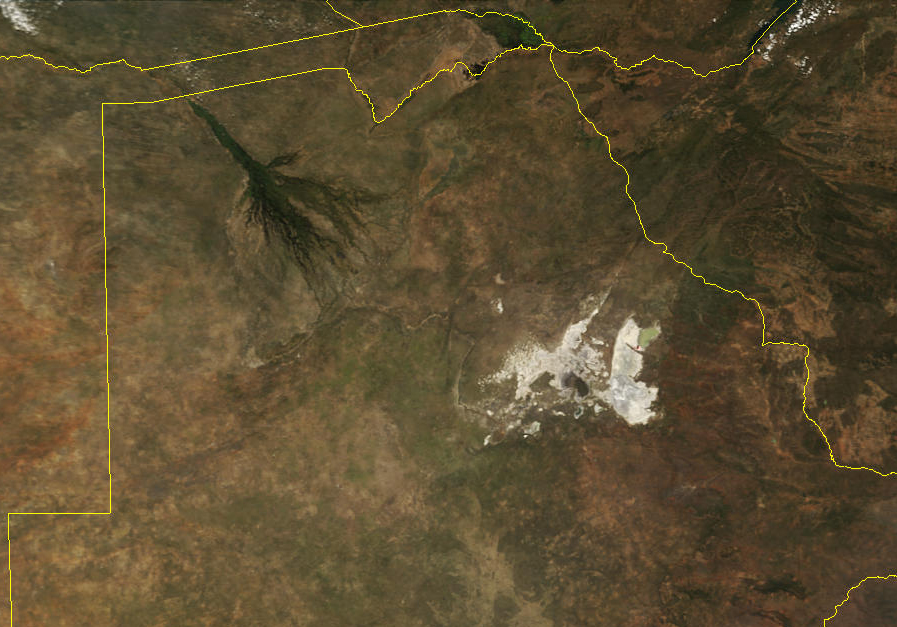
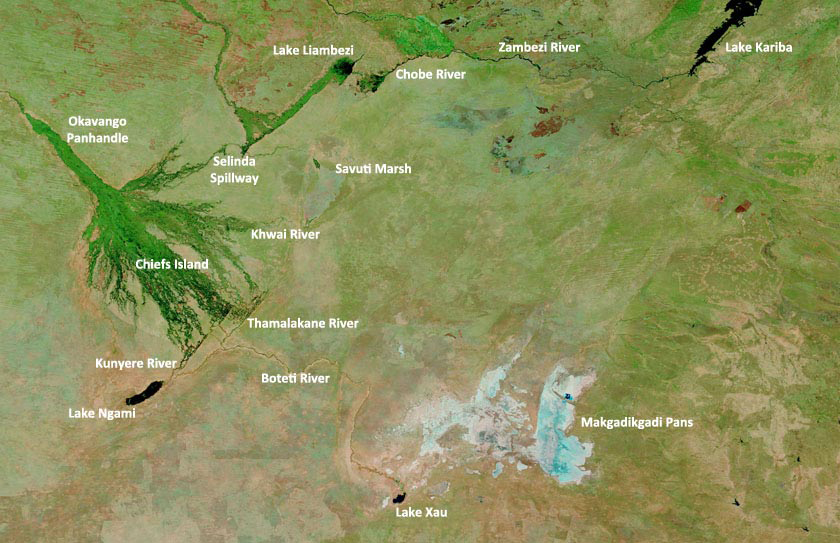
The difference from space:

A dry year in the Delta

A wet year.

For the first time in 29 years, the Savuti Channel was flooded, the Savuti Marsh swelled with birds and water seeped south into the desert pans.

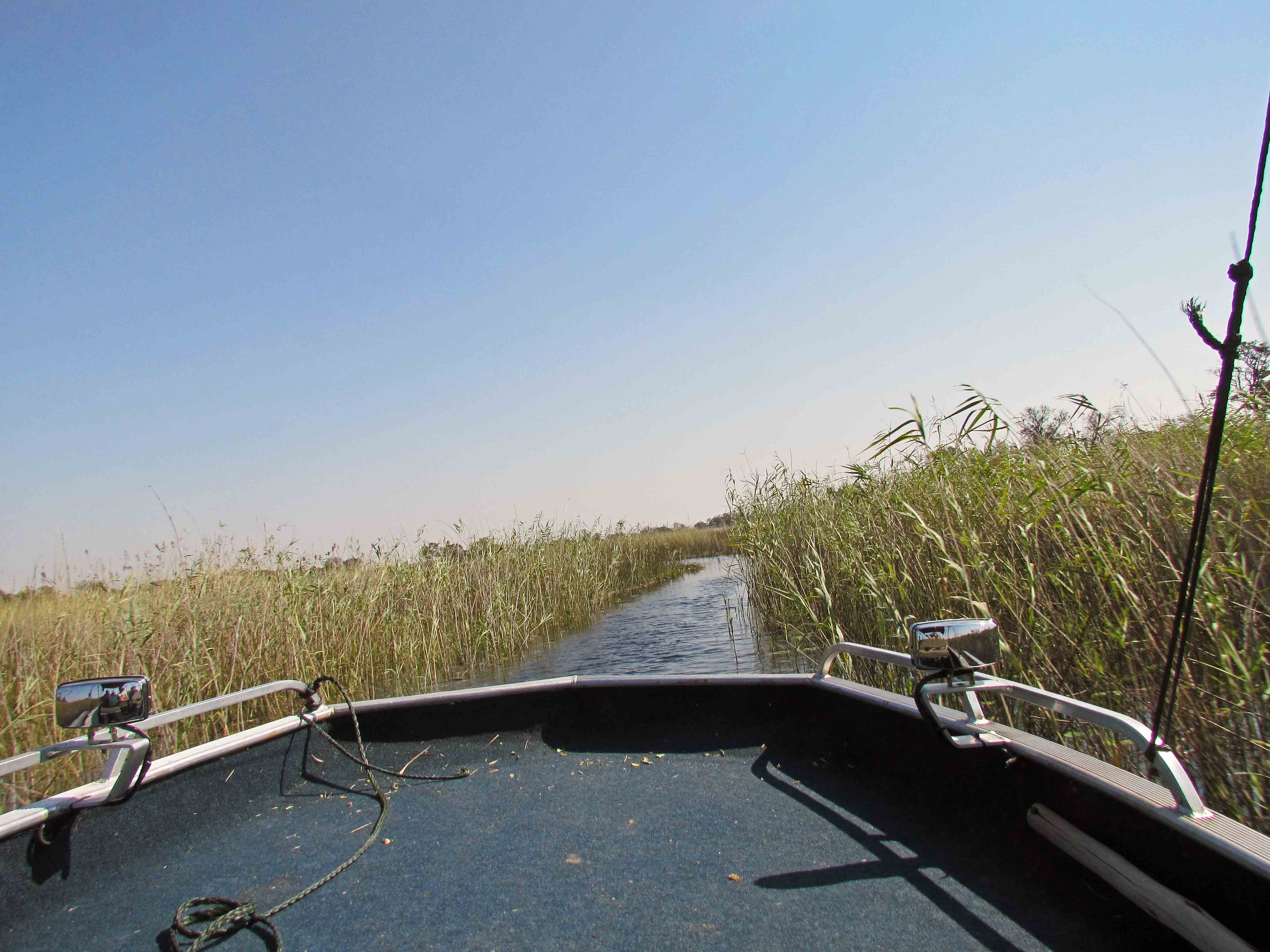
And so, rather than a 15-minute drive to Stanley’s from their airport, I took an hour-long trip down the Boro River and into meandering side channels that would have me instantly lost.

Reflected in two mirrors as we pushed through a side channel.

And, because all of Stanley’s vehicles were out on afternoon game drives, one vehicle at Baine’s (Stanley’s sister camp) was commandeered to transport me at Doug and Sandi’s place.  The flood had marooned the Groves’s vehicle in Maun.

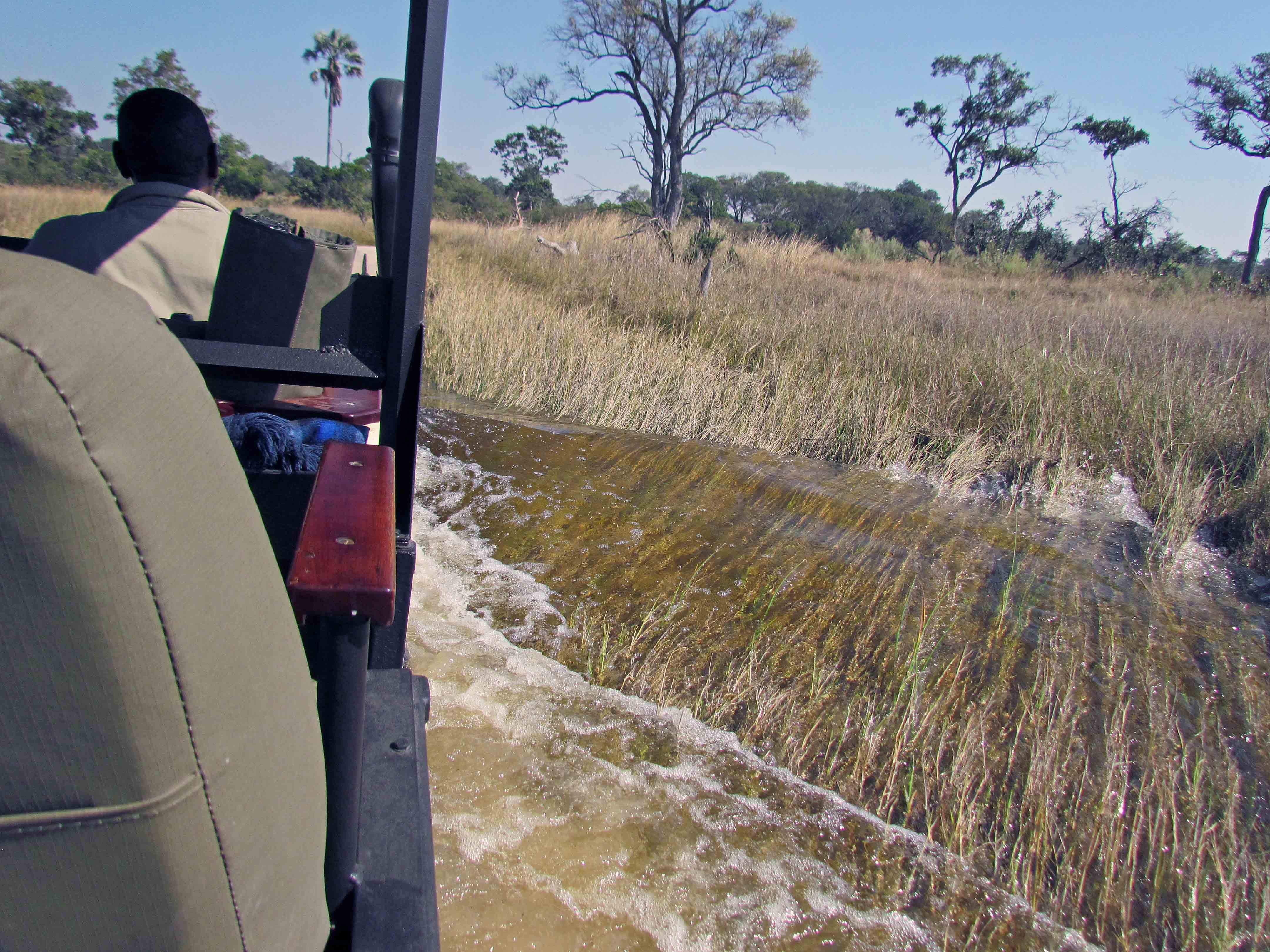
We forded rivers that were once roads.

Making waves

Sandi met me at their kitchen shelter.  “Doug and the Trio are headed out to forage.  Want to join us or settle in?”

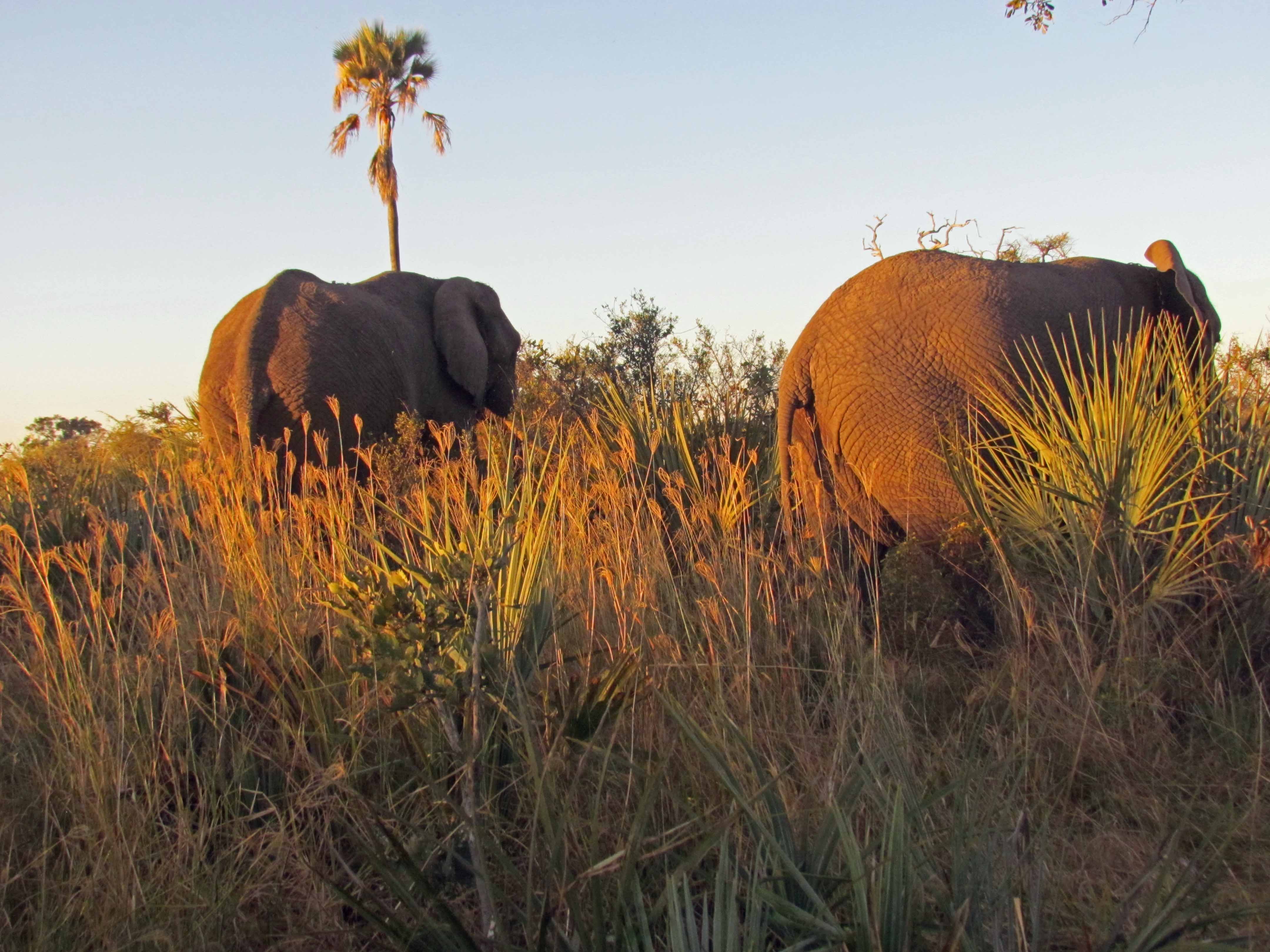
Are you kidding?  Eight hours after boarding an aircraft in Johannesburg, I was transported to this:

Sundown with Jabu and Thembi
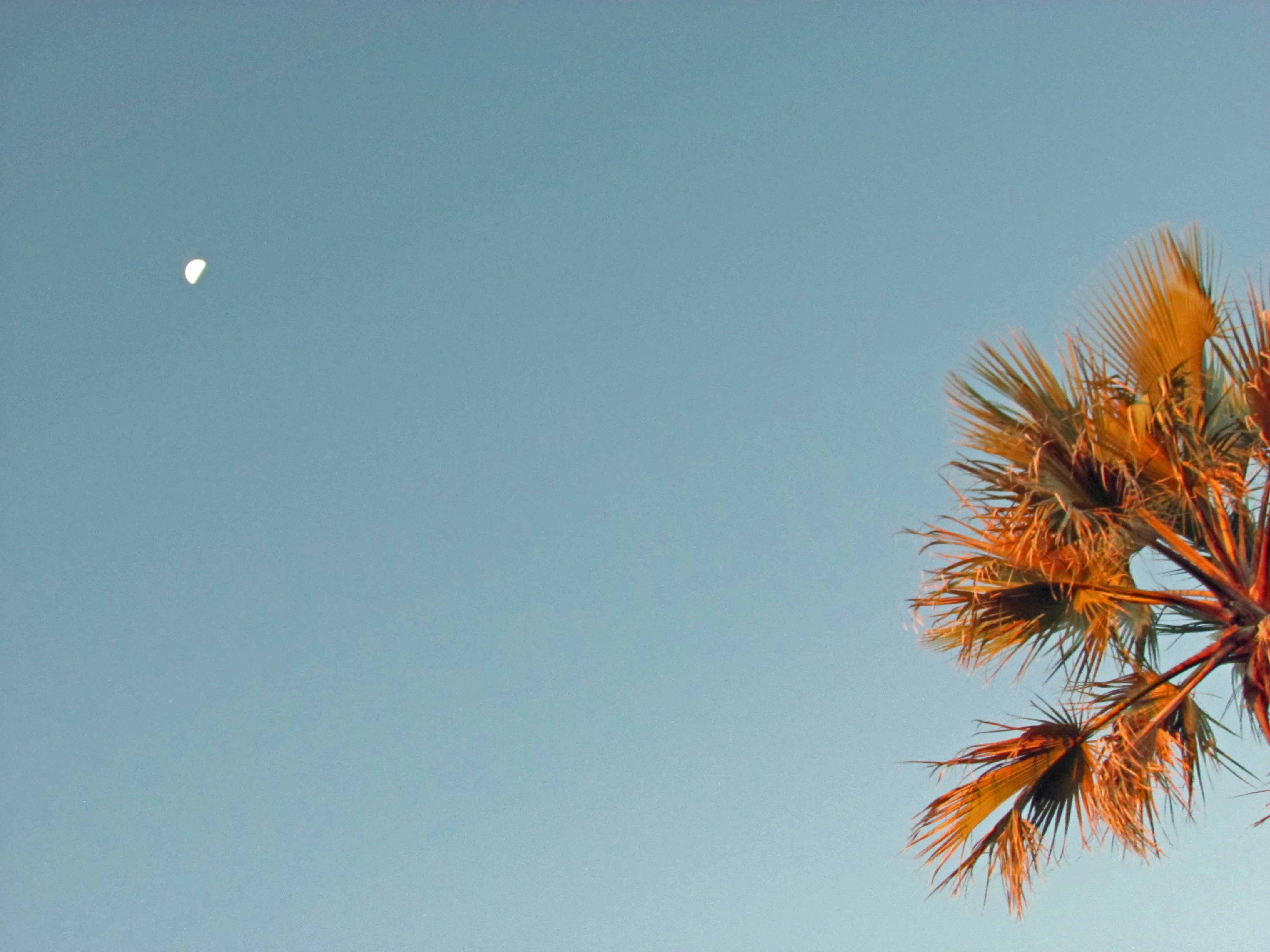
Half moon at sundown

And several hours later, after dark, we walked back under a half moon.  I had forgotten my flashlight, but I could still follow three huge silhouettes against the stars.  I was back in Africa!

PS:  The NASA images above were taken by MODIS (or Moderate Resolution Imaging Spectroradiometer) – a key instrument aboard the Terra and Aqua satellites. According to NASA, “Terra’s orbit around the Earth passes from north to south across the equator in the morning, while Aqua passes south to north over the equator in the afternoon. Their orbits view the entire Earth’s surface every 1 to 2 days.  The data they gather will hopefully improve the understanding of global dynamics and processes occurring on the land, in the oceans, and in the lower atmosphere. MODIS plays a vital role in the development of global Earth models able to predict global change accurately enough to assist policy makers to make sound decisions concerning the protection of our environment.”  (Fingers crossed that they do.)

Posted in Africa, Doug, Elephants, Hyenas, Jabu, Morula, Sandi, Thembi, Travel

Out of Africa!

Peek-a-boo with Jabu

So many tales to tell:  (1) the flooded Okavango Delta, water where there was sand last time I visited; (2) walking with elephants under starlight and a half moon (without a flashlight); (3) hyenas in the kitchen; (4) the closest I’ve ever gotten to a snake (!); (5) a leopard for my friend’s birthday present; (5) lions kill a baby hippo; (6) basic tents and luxurious chalets; (7) what not to do if you’re self-driving through the Moremi Game Reserve (hint: DO NOT rely on your GPS); (8) wild dogs, wild dogs and more wild dogs; (9) the rarest giraffes in the world; (10) hippos, hippos and more hippos; (11) a leopard hunts a male impala; (12) an absolutely wonderful stay with Sandi, Doug, Jabu, Morula and Thembi – and many, many more.  Stay tuned!

Posted in Africa, Doug, Elephants, Jabu, Morula, Sandi, Thembi, Travel

Goodbye, Hello

Jabu, Thembi, Doug, Sandi, Morula

In 2007, this was my last glimpse of Doug and Sandi, and their three incredible elephants.  Tomorrow I get on an airplane and begin a long two-day journey to return to the Okavango Delta in Botswana, to turn from “Goodbye,” to “Hello.”

Posted in Africa, Elephants, Extinction, Mammoths, Mastodons, Morula

Mastodons, Mammoths & Morula

Against a chalk-blue sky, the smooth bare branches of a Motsheketsane tree interweave like a dancer’s arms caught in a multiple exposure.  The shade it provides is full of holes, lacy as a cobweb.  Embedded in the sand at its base are the hoof prints of zebras, from hooves exactly like those of unshod horses.

Morula and I seek what little shade there is underneath the tree.  I take a swig from my water bottle while she searches for leftover Motsheketsane seeds.  Using her trunk as a leaf blower, she corrals the ones she finds into a neat little pile whuff, whuff, whuff and transfers it into her mouth.

I pick one up.  The seed is oval and has ruffled wings that divide it into 5 horizontal planes.  It looks like a small paper lantern of a vaguely Oriental design.  I try to pocket one, but its wings crumble as my hand close around it.

My everywhere-mind wanders off by itself, meanderings of no practical use except, of course, to me.  Speculatively, I eye Morula, cloak her in long, ginger-colored, shaggy fur, shrink her ears, implant upturned, pitchfork tusks, and imagine her, well, tubbier, in a mastodon suit of hair.

She waves her trunk tip at me, neighborly, as if across a backyard fence: Hello.

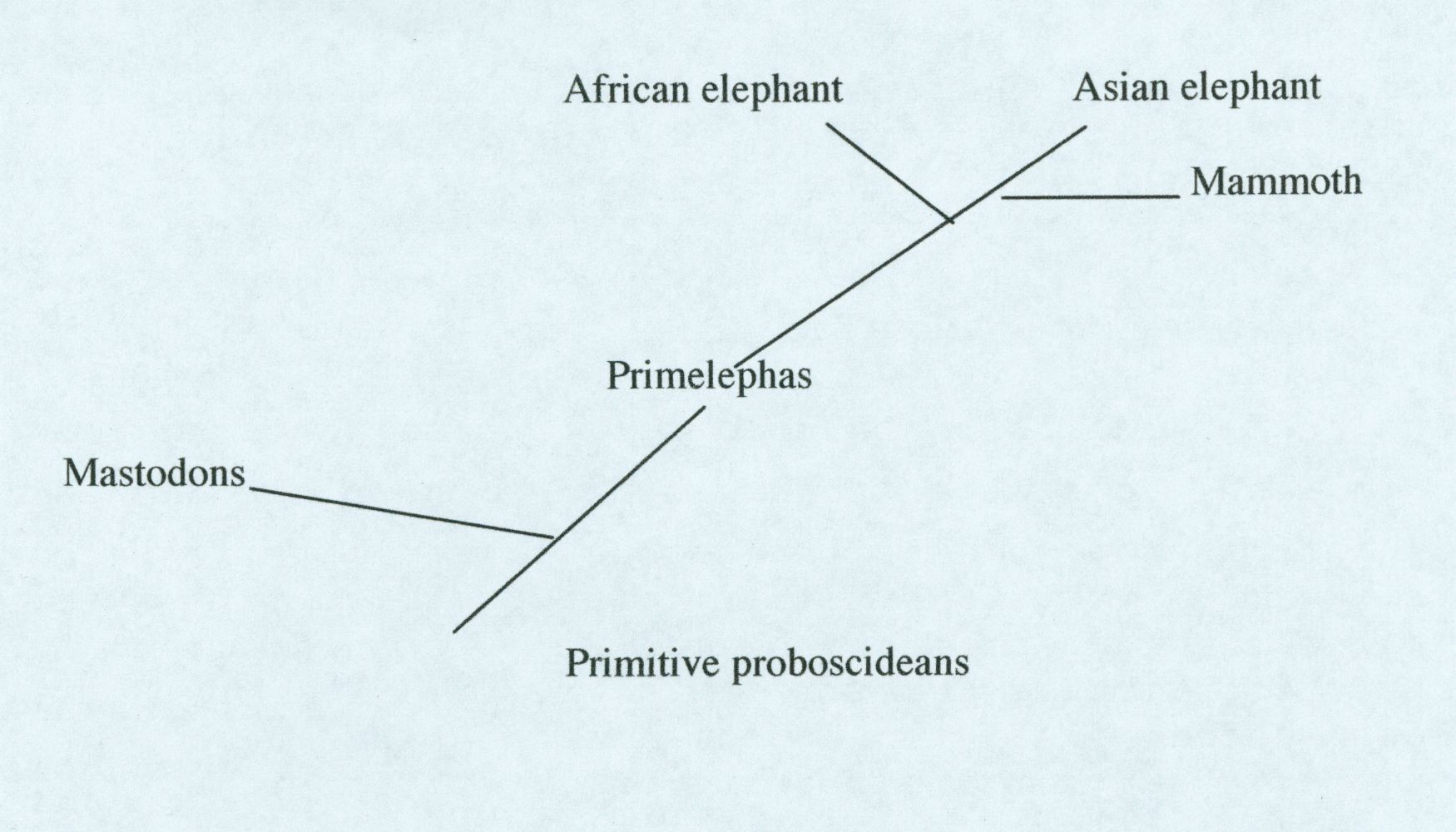
With its two fingers, the tip of her trunk could argue for a close relationship with mammoths.  But recent DNA research found direct genetic links only between Asian elephants and mammoths.  Morula’s family tree looks like this:

Mastodons branched from the proboscidean family tree 26 million years ago.  They became the first elephant cousins to leave Africa, the first to migrate through Asia and the first to arrive in North America, around 3.7 million years ago.  Mammoths followed, around 2.2 million years later.  Once in North America, the elephant cousins spread from Alaska to Central Mexico, from the Pacific to the Atlantic.  As you might expect of distant kin, mastodons and mammoths share many characteristics with surviving elephants.  They have the same basic body shape, a trunk and tusks.  But they also differ in many ways.

The most striking, of course, is that suit of hair.

Morula rubs her left haunch against the gnarly trunk of the Motsheketsane.  She has a relatively naked body – obviously a fur coat is useless under the brassy African sun.  Her body size, thick skin and subcutaneous fat all help to keep her warm when temperatures occasionally, very occasionally, dip below freezing.

If you shaved a mammoth, or a mastodon, parked it in a zoo, and sold tickets, most people would believe they’re seeing an elephant.  But if I put the three cousins on display side-by-side, almost anyone could tell the difference between them.

Of course, bringing to life two extinct species is an impossibility, unless, well . . .  .  I make things up.  Which is an acceptable thing to do as long as I confess that I’m doing it.

So I import to Africa two distinct species that never walked the continent: Mammut americanum (the American mastodon) and Mammuthus columbi (the Columbian mammoth).  Both lived exclusively in North America, where fourteen thousand years ago, they could be found, almost literally, in my backyard.

I position Morula between two cousins she will never meet – a mastodon to her right and a mammoth on her left.  Oddly enough, because everyone’s related, they don’t really look that much out of place.  Of course, this is all in my imagination, so anything is possible.

Columbia, the mammoth, is gigantic – at least four feet taller than Morula – with absolutely spectacular tusks.  Curving out, then inward, they nearly cross each other.  Even though I’m speculating about them, I don’t overdo their length.  At eight feet long, they’re only half the size of the longest mammoth tusks ever recorded.

As soon as she solidifies in my fantasy, Columbia lifts the tip of her trunk and takes a discreet sniff at Morula: Who’s this?

The top “finger” of her trunk is four inches long and the bottom “thumb” two inches – a bit longer than the fingers of Morula’s trunk tip.  Columbia’s could pluck out single petals from spring flowers or extract the newest, sweetest stems from the short grasses of the Pleistocene parklands.

She is completely cloaked in rich, russet fur, trunk and all, right down to her toes.  Her ears are oval-shaped and small, dainty really, about fifteen inches from top to bottom.  Since she lives near Pleistocene ice sheets, she has no need to dissipate heat through her ears.

She quickly loses interest in the smell of an unfamiliar elephant and strolls over to pick out dry blades from a field of African grass, leaving cratered footprints in the dust.  Except for their size, I can’t tell them apart from Morula’s.

Columbia wraps her trunk around a wad of grass, from right to left, and rips out a clump.  She stuffs the grass between elephant-like molars.  As she eats, I hear a phantom fart.  She lifts the small, triangular anal flap at the base of her short, stubby tail and drops a pile of dung, which looks exactly like Morula’s latest offerings.

I’m having way too much fun with my mammoth.

Conjuring Mammut americanum, the American mastodon, proves trickier.  I can’t quite bring him into focus.  Although entire frozen, mummified mammoth carcasses have been unearthed in Siberia – complete with tongues hanging out of their jaws – we know mastodons only by their bones.  So when I give Americanum a chestnut-colored shag – short and tangled hair on the top of his low-crowned head, thick and matted fur along his flank – I’m just agreeing with what’s been written elsewhere.  A shaggy fur coat is probably a safe bet, since Americanum ranged just south of the Pleistocene ice sheets, mingling with mammoths in the cold wet climate of North America.

Americanum is about the same height as the average African elephant.  His back, instead of sloping, like Columbia’s, or saddle-shaped, like Morula’s, is straight – he has no neck.  His skull is flatter and longer, without Columbia’s high-domed head or Morula’s rounded crest, and his jaws are elongated.  He actually has a chin.

I give my made-up mastodon huge tusks the same length as Columbia’s.  While her tusks curve out and then in, like an extravagant Bavarian moustache, his are a classic pitchfork shape.  One is a full six inches shorter than the other – Americanum is a lefty.  Laterality – right or left-handedness – is present in all proboscidean species.

Both mammoth and mastodon tusks grew to great lengths – a 16-foot mastodon tusk was found in Greece in 2007.  The record for African elephants is 11 feet.

Americanum’s tusks, like those of all his cousins, grew as tree rings grow, with varying rates for bad years, good years, summer, spring, winter, fall.  Just as African elephants do, he experienced musth after his late teens and began aggressively fighting with other males over receptive females.  Fighting caused battle scars to his tooth sockets, tusks and skull.  So, although Americanum is stocky, bulky and seemingly without much personality, he‘s not just some docile herbivore.  He’s a bull in the prime of his life.  Lucky for me, I didn’t conjure him up when his testosterone levels were elevated.

Americanum joins Columbia at a rainbush, but of course he takes no notice of her, nor she of him.  How can they?  They’re both just figments of my imagination.

He reaches into the bush, plucks a branch of dull green leaves, shoves it into his mouth and chews up and down, like I do, instead of forward and back, like Morula and Columbia.  Each ridge on Americanum’s small molars is shaped like a woman’s torso: two breasts with pointed nipple-like chewing surfaces and a valley between them.  He has only three to four ridges (sets of breasts) per molar. His common name, mastodon, is a combination of the Greek words for breast (mastos) and tooth (odõn.)

In contrast, the molars of Columbia and Morula are ridged plates: teeth that look like elongated dishes set to dry edgewise in a rack, each plate bonded to the next by enamel.  Their molars work like huge horizontal vegetable graters, grinding food back and forth across sharp, upright edges.  Morula’s teeth have ten ridges, while Columbia has twenty-seven, due to her exclusive diet of trees.

Doug shows me Morula’s molars.  “Open up,” he tells her.  She curls her trunk back over her head and he stretches to his tiptoes, pulls her lower gums wide with his hands.

Morula’s molars

“Very good, my girl.”

If there were dentists for elephants, Morula would be a patient patient.

Doug lets go of Morula’s lower jaw and she swings her trunk down but keeps her mouth     open.  He grabs a fistful of “elephant candy” and slides his arm into her mouth, all the way to his elbow.  As he lets go of the treat he rubs her tongue.  She rapidly flaps her ears.  “Elephants use their trunks to rub each other’s tongues.” Doug says.  “It’s kind of like a handshake.”

I re-conjure Morula’s elephant cousins and find them still eating – Columbia at the   rainbush, Americanum pulling up grass.  I watch them fondly; they are like old friends in new clothes.  But they are rapidly becoming distressed in the African heat.  They sway from side to side and flap their small ears like tiny surrender flags.   So even though I’ve fallen in love with these ghosts, with elephants who no longer exist, I come to my senses and banish them back to the past, where they are extinct once again.