Posted in Africa, Elephants, Nature, Nonfiction, Photography, Travel, Writing

Mud Wrestling

Image

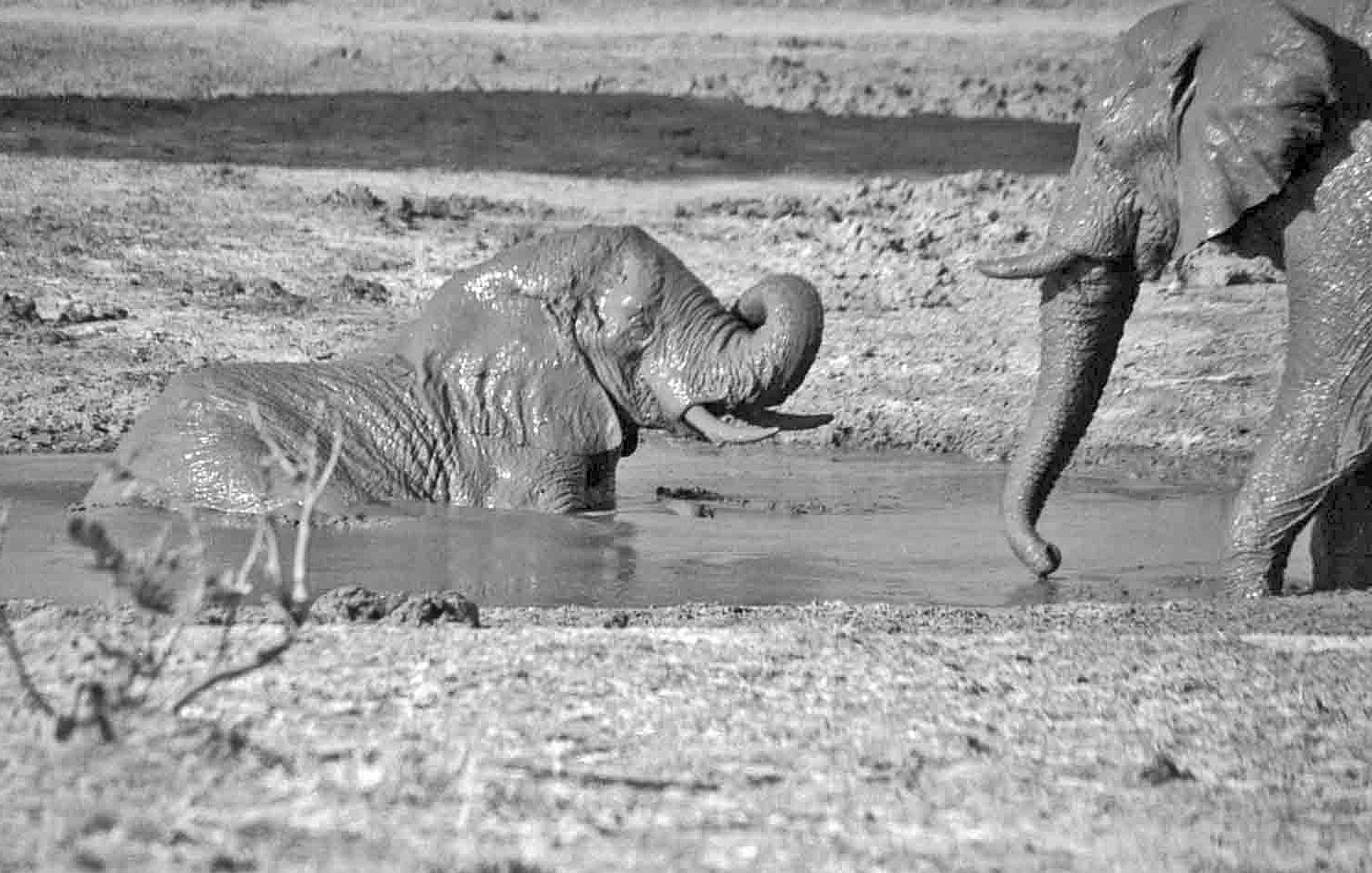
It’s a mucky, slimy, gloppy mud.  A young elephant snorkels on his side, the tip of his trunk swiveling above the surface, as he slides towards the other elephant, a brother or cousin.  His days are filled with heat and dust.  It’s winter in Botswana, the sun is relentless, and mud will soothe his scorched skin.  He lifts his head from the muck, curls his trunk and closes his eyes.  This feels good, his body language says, this feels really good.    

If we could imagine ourselves weighing four tons and think of gravity’s effect on those four tons, then maybe we could imagine wallowing in such mud, pushing and shoving like giant sumo wrestlers, reveling and rolling in the sheer pleasure of warm gunk.  We would inhale a slimy trunk-full of ooze, squirt it like a water gun in any direction, even at each other.  We would rub our eyes clear with a curled fist at the end of our trunks.  We would arise glistening and bright as a metallic statue.  We would be cooled, refreshed, gigantic, gentle beings. . . . if we could imagine such a thing.

Posted in Africa, Elephants, Nature, Nonfiction, Photography, Travel, Writing

How Much of the World Are We Missing?

Listening, really listening.


Just at the edge of darkness, where the light of our fire does not penetrate, an elephant thunders by, trumpeting the whole way, like a locomotive off track in a dry forest, a classic illustration of the Doppler Effect, sound that condenses, rises in pitch, crescendos, blows by, drops pitch, recedes. 

We lift our heads in surprise.  Waves of sound undulate away from us, kin to ripples on a pond.  We use pulsed sound waves, Doppler Radar, to see rain, to know when we should run for cover.  There is no such radar for an incoming elephant.

Eventually his outrage is extinguished in our ears, but elephants a mile away are just beginning to hear it.  Resonance fills the night air around us, yet we are deaf to it, to the sounds just below our range of hearing.

How much of the world are we missing, circle upon circle?  Perhaps instead of placing ourselves at the center we should move to the edges where our skills are low and our learning curve high.  We should extinguish our fire and sit in the darkness listening, really listening.

Posted in Nature, Photography

Let There be Light


Sunset, Moremi Game Reserve, Botswana

From 93 million miles away, pitched straight at me, vibrating, ululating like an African cry of greeting, light from the sun hurtles towards the earth at 186,282 miles per second and eight minutes later slams into me like a jabbering, long-lost relative trying to make up for lost time.  It babbles everything, all at once, into my eyes.

Our eyesight is an electro-chemical reaction to a vibrating particle-wave gushing optical information splash into my brain.  I could shut my eyes to the wonder around me and be diminished.  I could shut my eyes to the atrocities around me and become hardened.

By opening my eyes, I give shape to my perceptions.  By opening my eyes I take responsibility for my vision, for what my eyes teach me.  By opening my eyes I learn that I belong to the world, not that the world belongs to me.

Our eyes are openings into and out of our bodies.  Are my eyes, as some would say, a window to my soul?

There is a cold way of seeing that clips wings and stifles our words into faint echoes.  But there is also a way of seeing where the eye can be like a mouth, swallowing color, taking in the entire world with just one gulp.  Just the sheer fact alone that we see color should provide enough wonder to fill our lives, should stop us in our tracks, should keep our eyes wide open, devouring everything as fast as we can choke it down, leave us slack-jawed, gasping for air.


Somewhere behind my eyes, a world exists that I yearn to inhabit, dreams that might become real if only I could imagine them with my eyes wide open.


Posted in Nature, Writing, Zoos

Solitary Confinement

Jabu eye 2 b&w

Alone,

alone,

two steps forward, two steps back,

the elephant sways to a rhythm no one, not even she, can hear.  Two steps forward, two steps back.  Swaying, her head dips to one side, then the other.  Her motions are born from a numb brain, from uncut boredom, from the measurement of a life by that which does not happen.

Beyond the barriers that surround her, a jerky stream of humans flows past, day after day.  Their powerful odors overwhelm her, and she touches her temporal gland, samples her urine, the only familiar smells left to her.  At the end of each day, after the humans are gone, she hears a multitude of rumbles, but none have resonances she can recognize.

Sometimes she will lie down on the huge square stone into which she is entombed and sleep.  There are no stars over her head.

She ceased calling out to her kin a long time ago.

As near as she knows, she is the only elephant left on earth.


Note:  There are 284 elephants in 79 accredited zoos in the United States.  Most zoos have more than one elephant, because elephants are social creatures who need companions from their own species.  I originally wrote this piece when I learned of Maggie, who lived at the Alaska Zoo in Anchorage for 24 years, the last eleven of those years alone.  In 2008 she was transported to the PAWS sanctuary in California, where she now lives with other African elephants.  Here are the remaining zoos that keep just one elephant:

  1. San Antonio Zoo – “Lucky”
  2. Double M. Ranch, New York – “Reba”
  3. T.I.G.E.R.S., South Carolina – “Bubbles”
  4. Natural Bridge Zoo, Virgina – “Asha”
  5. Wild Adventures, Georgia – “Shirley”  – Shirley is age 69 and has been in captivity since 1946.

Sources:  verified independently, using the database from http://www.elephant.se

Posted in Africa, Nature, Nonfiction, Photography, Writing

Our Journeys are All the Same

Sunset

We tell old stories in order to see anew.  Each and every one of us takes the same journey from life to death, though our paths are never the same.

We begin as an explosion of infinite possibilities and then fall back upon ourselves, grabbing at some of those possibilities during our fall.

Our trajectory, which touched the very rim of life, descends toward the center, ending at zero, at what some see as a portal and others see as finality.

Falling, always falling towards the center of ourselves, the huge unknown universe within, our journeys are all the same.

Sunset at Doug & Sandi’s camp, Okavango Delta, Botswana
Posted in Extinction, Nature

That’s Life

An excerpt from my book, Larger than Life: Living in the Shadows of Elephants:

As Doug and Sandi prepare for our morning walk, a nearby Cape mourning dove begins its chanting call:  hoo-HOO-hoo, hoo-HOO-hoo.  The dove is the same shape and color of the pigeons strutting the streets of my hometown, and belongs to the same family as pigeons, Columbidae.  Doves are generally smaller birds and pigeons are larger.

One member of Columbidae, the American Passenger Pigeon, was once the most abundant land bird in the world.  It’s been estimated that nine billion passenger pigeons were in the United States before colonization – more than twice the number of all birds alive in the U.S. today.  Up to a foot-and-a-half in length, the passenger pigeon had distinctive, even iridescent, coloration.

In the early 1800s a flock of passenger pigeons that numbered 2.2 billion birds flew between Kentucky and Indiana – a flock one mile wide extending 240 miles.  So many Passenger Pigeons were in that flock that if they were placed beak-to-tail they would have wound around the circumference of the earth nearly 23 times.  Audubon recorded an over-flight of Passenger Pigeons that took three days to pass, even though the birds averaged sixty miles an hour.  He likened their passage to an eclipse of the sun.

            One nesting colony in Wisconsin measured 850 square miles.  The rumble of wings erupting from that roost made the ground tremble.  Tune your stereo receiver to a place between stations, then turn up the volume until your walls shake.  That was the sound of huge flocks of passenger pigeons, a Niagara of birds.

Audubon's Passenger Pigeons
Audubon’s Passenger Pigeons

Audubon painted the passenger pigeon in 1824.  Printed plates of his painting show a female on the frosted upper branch of a tree feeding a male perched on a lower branch of the same tree – which is a bit of artistic license, since the pairs always stood next to each other on a branch.

The sexes of the passenger pigeon differed in coloration.  The female, with her drab, brownish-orange back and gray plumage on her belly, contrasted with the male’s brilliant blue back and deep pink breast.  In Audubon’s painting the male has a duller neck than was often reported  – a neck that glittered purple, gold, yellow and green iridescence.  Both sexes are depicted with their trademark pink feet and red eyes.

            Now the passenger pigeon is gone.  Snuffed out.  Not a single bird left.  Flocks in the millions whose wing beats sounded like thunder, whose descent to the ground in funnels looked like tornados, whose excrement rained to the ground like sleet, gone.  Flocks that blocked sunlight from the sky and moved in squalls, in weather fronts, gone.  Flocks that would have turned entire radar screens green, gone.

            Their extinction was not a natural one, caused by a meteor or ice age or disease.  No, we did it.  We destroyed their habitat, hunted them, killed them, ate them, fed them to livestock, stuck their feathers in our hats, and shipped them by the ton in railroad cars, five billion birds by the late 1890s.

            No one ever thought that five billion birds could disappear.  An Ohio legislator wrote in 1857 that the pigeons were “Wonderfully prolific.  No ordinary destruction can lessen them or be missed from the myriads that are yearly produced.”  But nets, guns and the railroads did their job.  Speedy travel meant that pigeon feathers and meat reached their markets in forty-eight hours.  Live pigeons were shipped for sport.  An estimated half-million pigeons were netted annually for use in shooting matches.  One trap shooter claimed he had personally shot 30,000 pigeons in his lifetime.  In 1875 three nesting areas in Michigan yielded 1,000 tons of squabs and 2.4 million live birds for consumption.

Martha, stuffed and mounted at the Smithsonian

            And yet, scarcely 25 years later, a young boy in Ohio named Press Clay Southworth shot the last wild passenger pigeon on March 12, 1900.

On Sept 1, 1914, Martha, the only passenger pigeon left in the world, died at the Cincinnati Zoo.

I wonder what our skies would look like if the passenger pigeon (instead of the turkey) had been designated our national bird.

The probability of any human being alive is one in billions of trillions.  That’s

1,000,000,000,000

multiplied several billion times.

Life.  It’s not easy to come by.  And lessened by all that has been subtracted from it.

Posted in Africa, Travel

Something in the Way She Moves

She is beautiful in the way many large women are beautiful.  There’s something about the smooth sheen on her plump skin and the defiant stare she gives you that makes you fall in love with her, even when she’s eating.

Posted in Africa, Jabu, Morula, Thembi, Travel

The Tree of Life, Part Two

An excerpt from my book, Larger than Life, Living in the Shadows of Elephants:

In 1998, the Disney Corporation opened the Animal Kingdom Park in Florida. It is, in essence, a 500-acre zoo, containing 1,700 animals representing 250 species, from Abdim’s storks to African zebras.  In the center of the park is a 145-foot-tall, 50-foot-wide sculpture of a baobab, representing the Tree of Life from the Disney film, The Lion King.  Much larger than any known baobab, the sculpture is molded around a refitted oil platform.  Its trunk is carved with 325 animals and contains a theater with 430 seats.  Upon its branches are 103,000 leaves dyed five shades of green, made of kynar, a flexible fluoropolymer resin.

Since opening, the park has averaged 9 million visitors annually, ranking seventh in the world in theme park attractions.  Disney’s resident herd of African elephants has produced six calves, three females and three males, all still living – the most successful breeding program in the United States.  The herd now consists of twelve elephants: four males and 8 females.

Here, in the Okavango Delta, our small herd of three elephants, one male and two females, browse through thick brush on one of the islands left stranded after last year’s flood.  As I might linger over a sunset, Jabu, the male, lingers over a small mopane tree, whose leaves have high protein content, an important year-round food source.  Thembi pulls out a single leaf from a young palm and chews on the sweet cane-like stalk.  Morula has entirely disappeared into a thicket, but I can hear an occasional crack from a breaking branch as she tugs it from a tree.

The white eye of the sun glares down upon us, blinding, melting the wax that held together a small, feathered breeze.  My bones soften, melting.  I lose my ability to soar.  Baobob in winter
The sun reflects from my camera’s metal buckle and penetrates my brain like a dull pickax.  It’s a burst bomb, pure and searing, a light behind my eyelids, a glimpse of the beginning of our solar system.  Halfway through its own lifespan, the sun is fueled by enough hydrogen to last five billion years more.

I move into the shadow of a nearby mopane.  Thick, dappled shade makes diamond patterns at my feet.  Slowly we begin to leave the island, the elephants more reluctantly than the humans.

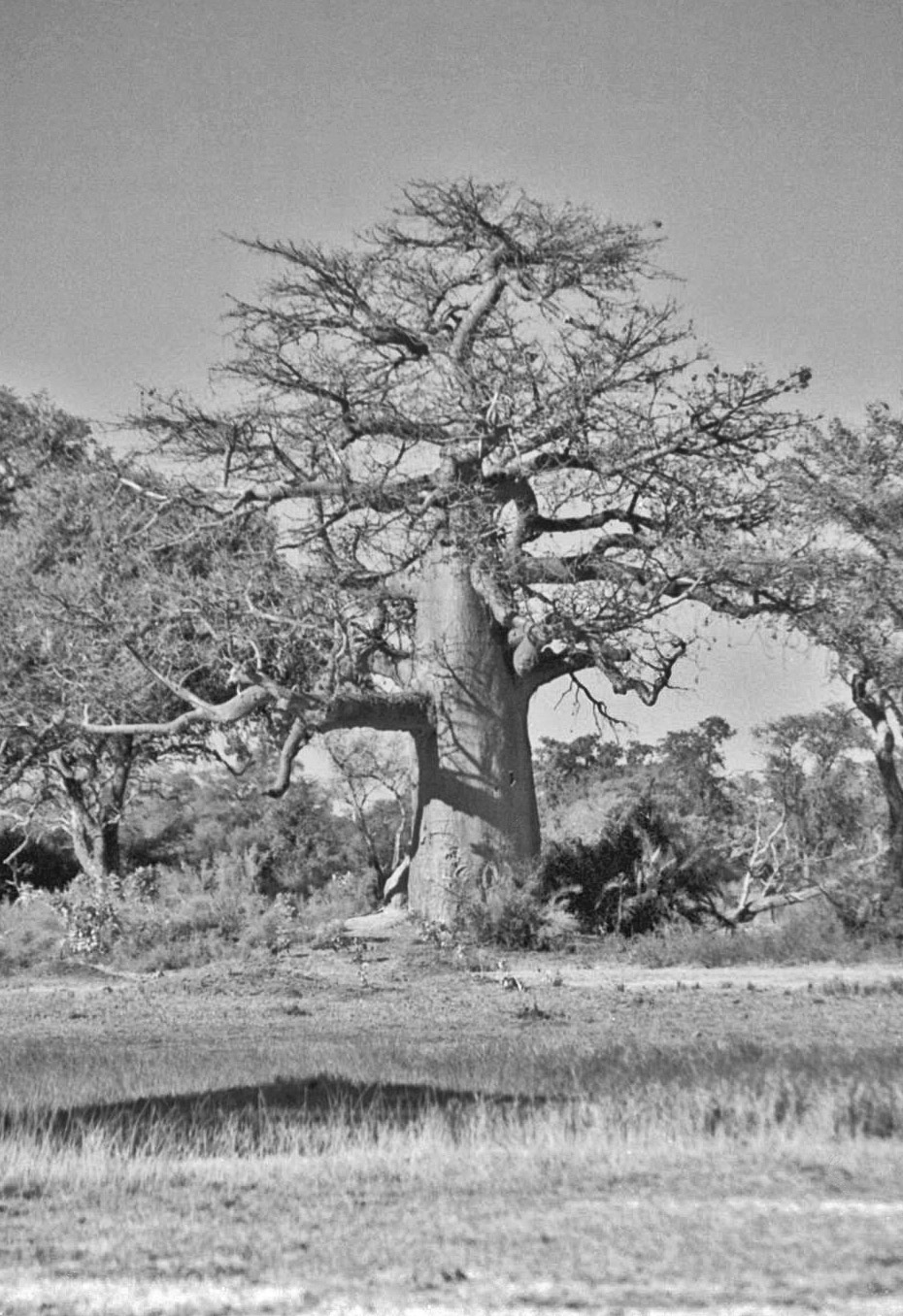
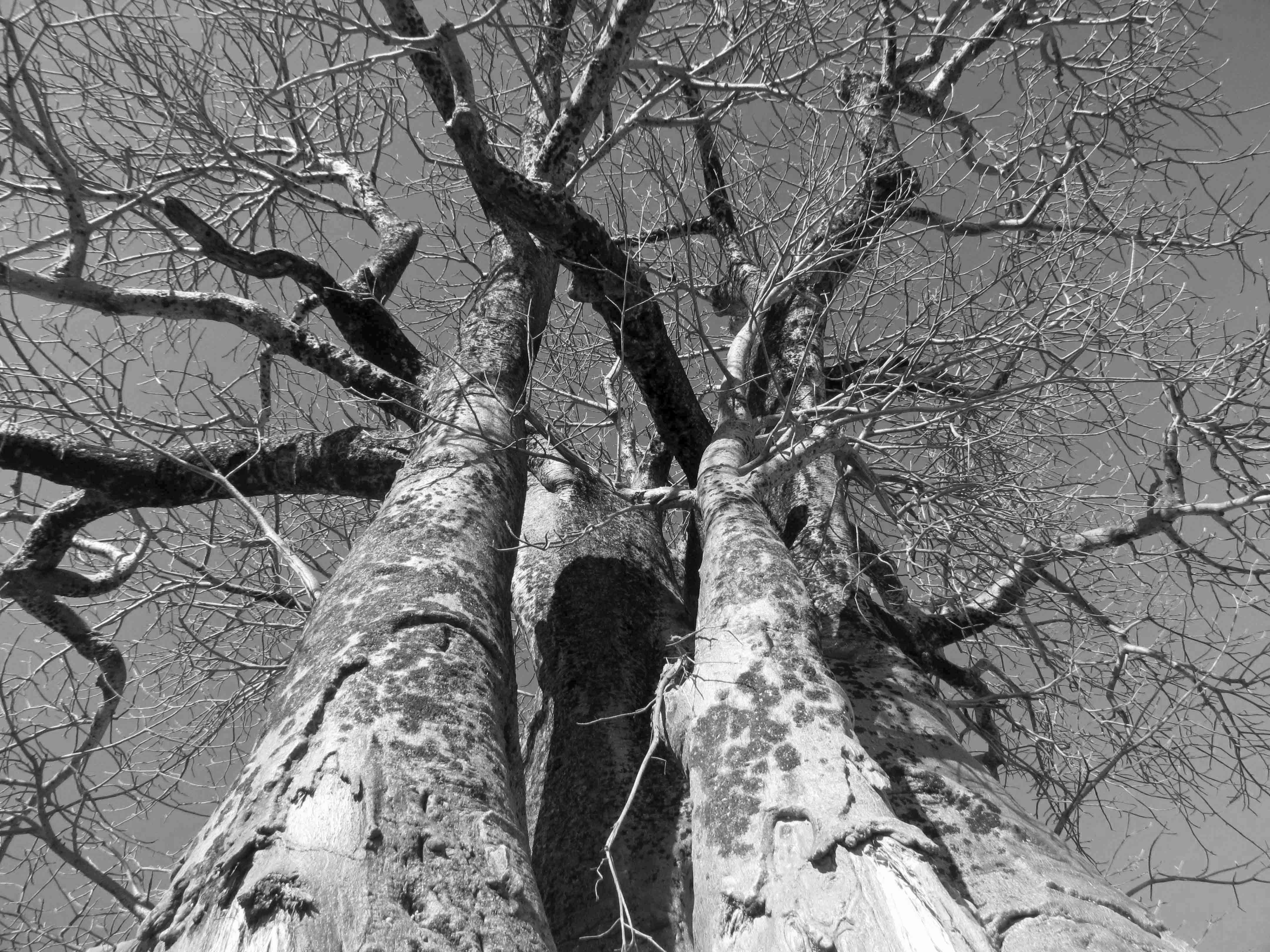
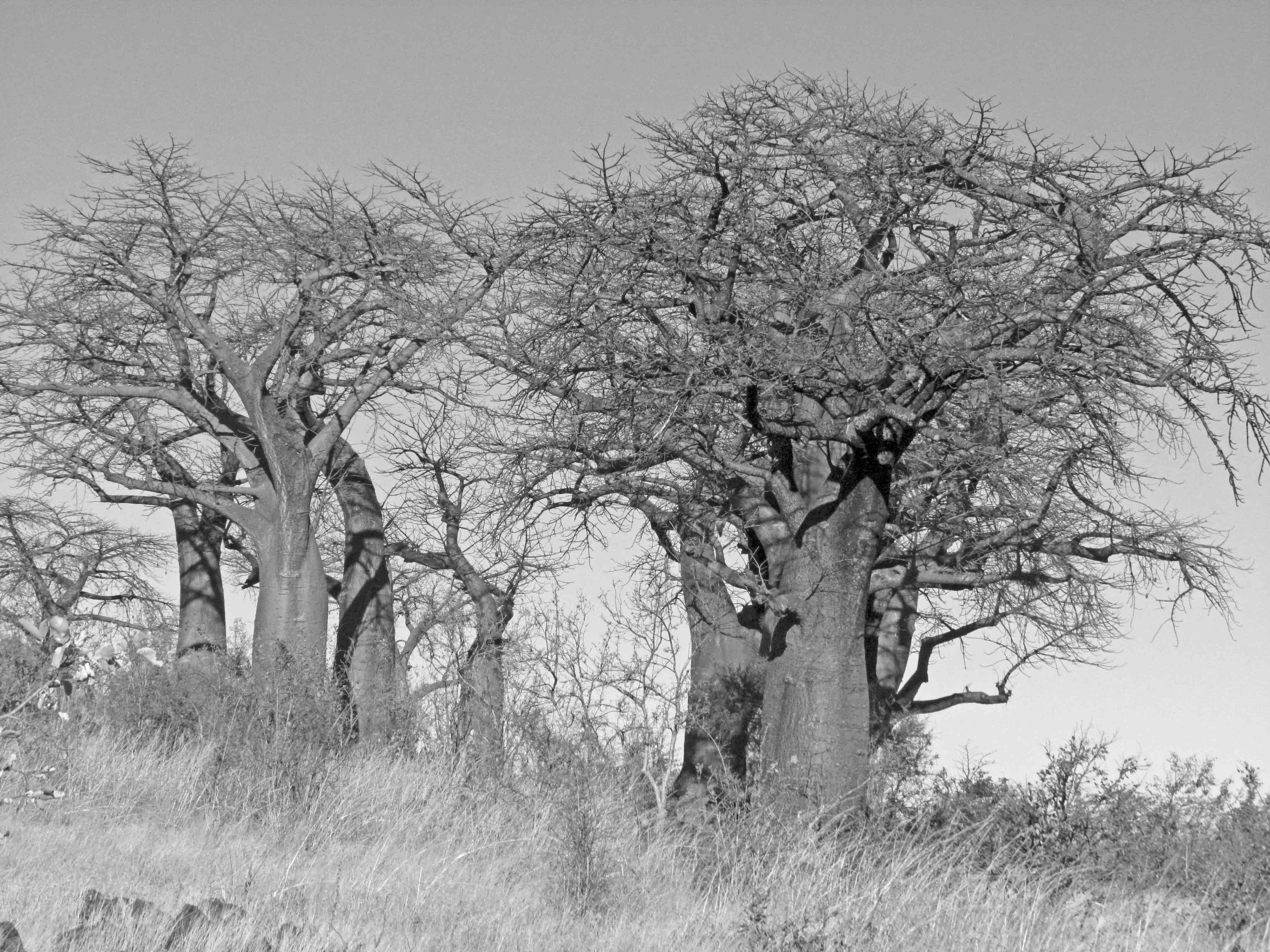
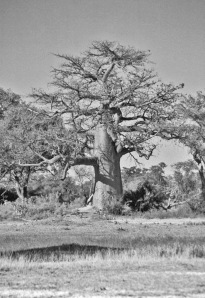
Across a dried up lagoon full of grass, is a baobab, a rare species for this part of the Delta.  Its nude limbs, entangled as a root system, seem to search for moisture from the sky.  Kalahari Bushmen believe the trees appear fully-grown, planted upside down by the gods, with the tree’s roots in the air.  They also believe spirits inhabit the baobab’s large, waxy-white flowers, and if anyone has the audacity to pick one, they will be eaten by a lion.

This baobab is deciduous and luckily naked this time of year.  It’s around twenty-two feet in diameter and about seventy feet tall; a young tree that I would guess is 600 years old.  Its trunk is smooth and relatively unblemished.

Older baobabs have a tendency to rot out their heartwood, but completely heal around the hollowed trunk.  Rats and reptiles frequently invade them.  The African honeybee often establishes hives in crevices of a hollowed trunk.  Native to central and southern Africa the bees are actually a subspecies of the Western honeybee.

A single sting from an African bee is no more venomous than a single European or American bee sting, though African honeybees respond more quickly when disturbed and send out three to four times as many workers in response to a threat.  They also pursue an intruder for a greater distance from the hive – thus their reputation as “killer” bees.”

So the Honeyguide bird is more than willing to let another species take that risk.  Physically unable to break open a bee’s nest, it has developed a symbiotic relationship with humans, indicating the presence of a hive by continuously dive-bombing nearby, all the while uttering monotonous, squirrel-like chirps.  Alerted by the Honeyguide, intrepid Kalahari Bushmen pound pegs into the soft bark of baobabs to climb the tree, lull the bees with smoke and obtain a sweet reward for taking that risk.  Bushmen always leave honey for the birds, for if they should fail to do so, the Honeyguide will one day lead them to a lion, instead of a hive.

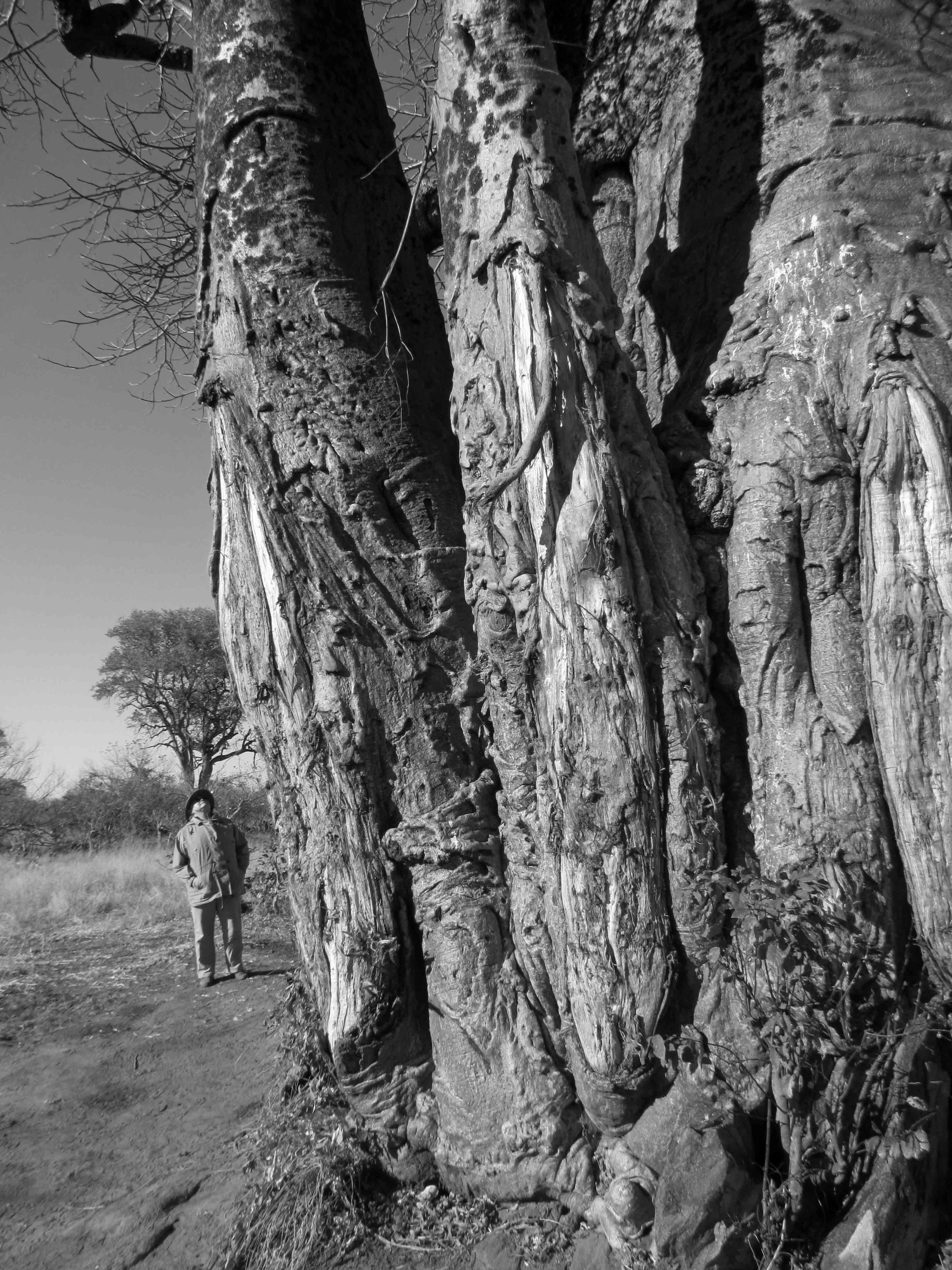
Smooth and pinkish-gray, the baobab across the grass lagoon has only a few hollows in its trunk excavated for bird nests, and a single scrape from an elephant’s tusk.   Older trees are often deeply scarred as high as an elephant can reach.
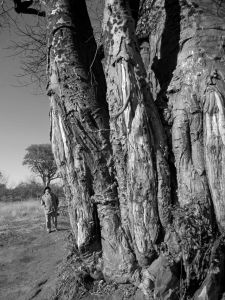
Baobab barkHollow baobabs have a long history of creative uses by humans.  During World War II, a baobab in Namibia was fitted with a toilet.  The toilet is still there, but the tree has grown around the door, which no longer opens.  On the lower Zambezi River, the Kayila Lodge has an operational toilet tree, used more for photo opportunities than necessity.  And on a private farm in Sunland, South Africa, an enormous baobab contains a wine cellar and bar, complete with draft beer, a dartboard, stools, and a wooden bench along the wall.  The tree is possibly the oldest baobab in existence – it has been radiocarbon-dated to the end of the Stone Age, around six thousand years ago.

In Kasane, Botswana, a baobab was used as women’s prison in the early twentieth century.  I imagine it also served as a deterrent – incarceration with potential rat and reptile cellmates would make any criminal think twice.  Although that baobab died in 1967, an offshoot now grows next to the remains of the jail.  Throughout Africa, hollow baobabs have served various purposes – as hiding places during tribal warfare, as shops, storage shelters, barns, chapels, burial sites, post offices, even a bus stop.

Almost every part of the baobab is edible.  Fresh leaves are eaten as spinach and condiments.  The shoots from germinating seeds taste like asparagus.  Bulbs from its roots make porridge.  Fluid extracted from the bark of the baobab is used to dilute milk. The ash from a burnt tree is a good substitute for salt.  Pulp and seeds of its fruit contain potassium acid tartrate as well as citric acid, an effective substitute for cream of tartar, and resulting in the Afrikaans name “Kremetartboom.”  Early settlers also used fruit pulp in place of yeast and added baobab leaves to speed up the fermentation process in winemaking.  The fruit pulp has the highest known concentration of Vitamin C.  It makes a slightly acidic, but refreshing drink when mixed with water.  Baobab seeds have the same protein value as domestic nuts and can also be roasted and ground into a substitute for coffee.

The baobab is often called “the Monkey-bread tree,” because baboons and monkeys eagerly consume its fruits.  Nearly all four-legged browsers eat the baobab’s fallen leaves and flowers.  The flowers open just before dark, produce copious amounts of nectar and last for only 24 hours.  Their heavy, carrion-like scent attracts nocturnal insects and bats, such as Peter’s Epaulleted Fruit Bat.

In times of drought, elephants strip the bark of the baobab and eat the spongy wood underneath, estimated to contain 40-70% water – classifying the baobab as the world’s largest succulent.  An individual baobab can store up to 32,000 gallons of water and weigh 266,880 pounds – or one hundred and twenty-one tons.   A big bull like Jabu can weigh up to 16,000 pounds or seven tons.  If you stacked elephants one upon the other, it would take seventeen or eighteen elephants to equal the weight (if not the mass) of the water stored in a large baobab.

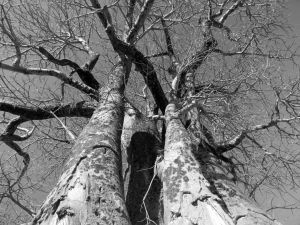
The name baobab derives from North African Arabic, bu-hibab, “fruit of many seeds.”  Within life spans that reach six thousand years, the baobab nourishes countless species, takes in tons of carbon dioxide and releases equal amounts of oxygen.  It cycles and recycles, measures seasons by dropping its leaves, measures centuries by the blur of life beneath its limbs.  A baobab’s death is the death of an eternity, as measured by one of those species for which it provides.Savuti baobab 2 b&w
Posted in Africa, Elephants, Jabu, Morula, Thembi, Travel

The Tree of Life, Part One

An excerpt from the book I’m writing about elephants:

Baobob in winterJabu, Morula and Thembi slowly browse through the brush on one of the islands stranded after last year’s Okavango flood.  Opposite of us, across a dried lagoon filled with grass, is a rare tree species for this part of the Delta: an African baobab, Adansonia digitata – digitata for the five leaves it has per stem.  The baobab is deciduous, naked this time of year.  Its prehistoric appearance conjures up primeval landscapes full of odd plants and crawling creatures that existed in the ages before the dinosaurs.

There are eight species of baobabs, six found in the dry deciduous forests of Madagascar, one in Australia, and digitata, which grows in West, East and Southern Africa.  Baobabs are also found on the Arabian Peninsula, spread there by the movement of human settlements.

Adansonias are named after the French naturalist, Michel Adanson (1727-1806), who spent five years in Senegal, brought home a huge plant collection, and published a paper on digitata after his return.  Adanson also wrote a masterwork of natural history, an encyclopedic l’Ordre Universel de la Nature, but it was based on his own system of classification, distinct from that of his contemporary, Linnaeus (1707-1788).  Linnaeus’s Systema Naturae, introduced binomial nomenclature – using an organism’s Genus, Adansonia, followed by a descriptive modifier such as digitataSystema Naturae classified 4,400 species of animals and 7,700 species of plants.

In contrast to Linnaeus’s system based on structures, Adanson proposed a “natural” system that took many features of the plant into account, which included structure along with function, growth, evolution and distribution.  His system was ignored in his time because he refused to use binomial nomenclature.  However, the publication in 1789 of Genera Plantarum, by Antoine Laurent de Jussieu, combined Adanson’s use of multiple structures with Linnaeus’s binomial classifications – a methodology widely accepted and still in use.

Adanson’s masterwork was huge, just like the baobab: 27 large volumes with a 150-volume index that contained an alphabetical treatment of 40,000 species, a vocabulary listing 200,000 words, 40,000 drawings and 30,000 specimens.  It was never published.  It is, however, preserved in the Hunt Institute for Botanical Documentation, at Carnegie Mellon University in Pittsburgh, Pennsylvania.

Elephants love the bark of the baobab because of its moisture content.  As insurance against harsh drought, the swollen trunk of a single baobab stores up to 32,000 gallons of water, making its wood soft, spongy and fibrous.  A plank cut from this tree will decrease in volume by 40% and shrink in length by 15% while it dries.  Sometimes, during these times of drought, elephants will completely gird a tree, leaving it standing as if standing on its own pedestal, and yet the baobab will still survive.

The bark on the baobab across the lagoon is smooth and pinkish gray – untouched by elephants, probably due to its proximity to the Okavango’s permanent water channels.  I estimate this tree to be about 22 feet in diameter and 70 feet tall.  Mature baobabs have trunk diameters of twenty-three to thirty-six feet and reach heights of sixteen to ninety-eight feet.  The Glencoe baobab, near Hoedspruit in the Limpopo Province of South Africa, is considered the largest specimen alive.  Up to recent times it had a circumference of 154 feet.  In 2009 it split into two still-living parts, revealing an enormous hollow in the middle.  The date 1893 is carved into its trunk.

Found mostly in seasonally arid areas, baobabs grow very slowly as they age.  However, in its first years of life, a baobab grows relatively quickly.  A tree planted in Kruger National Park in South Africa grew 65 feet tall with an eleven-foot diameter in just 38 years.  In contrast, an older tree described by Livingstone in 1858 grew only two feet in circumference in 110 years.  Despite their early exuberance, baobabs can be cultivated as bonsai trees.

Baobab forest b&wAlthough the Glencoe baobab is thought to be two thousand years old, baobab wood does not produce annual growth rings and it actually shrinks during times of drought, so its size is not an indicator of its age.  The baobab across the grass lagoon is probably – my best guess – around 600 years old, or older, taking root about the time Eric the Red colonized Greenland (985), or later – perhaps the year Gutenberg invented the printing press (1439).  This tree, this timepiece, first dropped its leaves during the Middle Ages, and will continue dropping them, annually, for several thousand years more.

Just twenty days after leaving England, the Beagle anchored at the Cape Verde Islands on Jan 16th, 1832.  As Charles Darwin surveyed the islands with ship’s captain Robert Fitzroy, they measured a baobab that was 45 feet tall and thirteen feet in diameter, and rumored to be a thousand years old.  Darwin remarked in his diary that Adanson supposed some “celebrated baobabs” to be 6,000 years old.  The enormous tree “with its great thickness” impressed Darwin, and he wrote in his diary, “This one bears on its bark the signs of its notoriety – it is as completely covered with initials & dates as any one (tree) in Kensington Gardens.”

The Glencoe baobab has never been subjected to radiocarbon dating, but another in the Limpopo area has been carbon-dated at over 6,000 years, older than the pyramids at Giza (2560 BC).  Several other trees in the region have also been dated  – at about two-to-three thousand years old.

As I look at the baobab across the grass lagoon, I wish I could slip sideways into the life of this nearly eternal tree, and time-lapsed, witness the swirl of life around it as it fattened and grew.  And why not wish also for the future, for another one or two thousand years more?

I turn at the sound of a branch breaking behind me, squint against the sun, and cup a hand at my forehead to shade my eyes. The elephants are great gray silhouettes, haloed all around in bright, bright light.  My watch ticks on my wrist, its hands pointing to meaningless numbers.

Posted in Elephants, Writing

On the Air! Radio Interview About Writing and the Writing Life

Several months ago, Sheila Bender, friend and fellow writer, interviewed me for her radio show, “In Conversation: Discussions on Writing and the Writing Life.”  The show will air Tuesday, Nov. 27th at noon PST and Thursday, Nov. 29th at 6 p.m, PST.  It can be heard streaming from our local radio station at http://www.kptz.org.  I talk about elephants and why I decided to write about them.  I hope you get a chance to hear it.

In writing Larger than Life: Living in the Shadows of Elephants, I tried to answer two questions – what is it like to live with elephants, and, what is it like to live?  For me, writing is living.  I write everywhere, all the time, tucking pieces of paper into pockets, jotting down notes under the covers, with a flashlight on.  I write on the backs of envelopes, I write in the margins of manuscripts, I write in notebooks, notepads and ipads.  I write because reading is just one of the pleasures caused by words, even though words by themselves are drops of human magic, sprinkled against death and darkness.  I write to grave rob my own language, excavating tombs of words and phrases, looking for riches, for golden ideas buried in underworlds of common dust.

Every writer tells old stories in order to see anew.  All humans take the same journey from life to death, though our paths are never the same.  We begin as an explosion of infinite possibilities and then, for the rest of our lives, fall back upon ourselves, grabbing at some of those possibilities during our fall.  Our trajectory, which touched the very rim of life, descends toward the center, ending at zero, at what some see as a portal and others see as finality.  Falling, always falling towards the center of ourselves, the huge unknown universe within, our journeys are all the same.

I write to tell about my journey, my story, and it all comes together in just one place, my writing room.

As you listen to this interview, you can also see where I write.

One side of the room I write in.
And the other