Both male and female African elephants grow tusks – the largest upper incisors on this planet. Their tusks grow every which way: up and curved, or down and straight, up and straight, or down and curved – the variations are endless. Some tusks are thin; others fat. Some are short and puny; others long and magnificent.
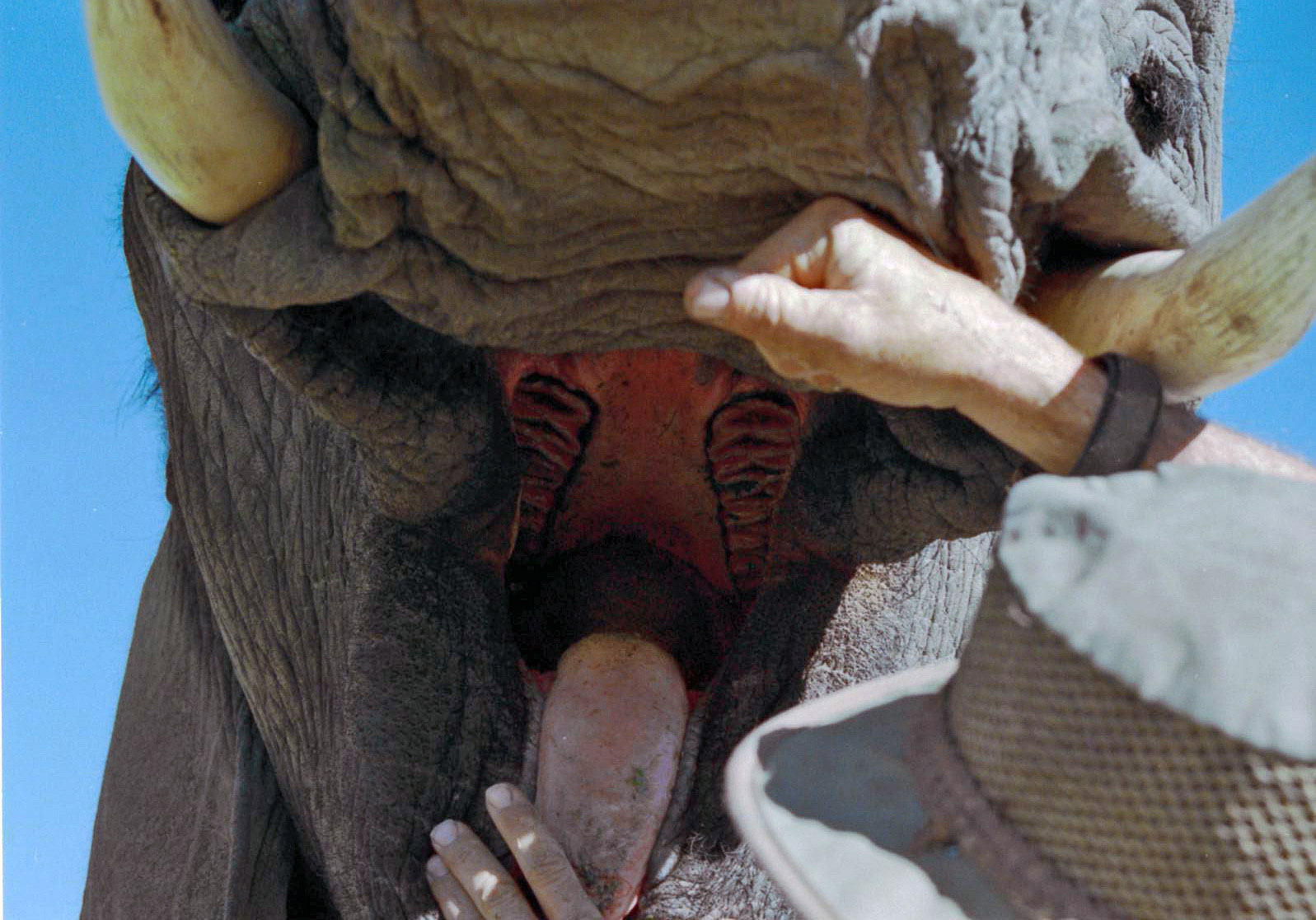
All elephants have only two types of teeth – tusks and molars. Four molars, two above and two below, are present throughout an elephant’s life.
photograph by Cheryl Merrill
An elephant’s molars look like dishes set to dry edgewise on a rack, bonded together by enamel. Vertical ridges in each molar function like giant vegetable graters as the elephants move their jaws forward and back, rather than side-to-side like a cow. Molars grow up to a foot long, with a maximum of ten ridges, and weight eleven pounds apiece – perfect for grinding up trees.
They push forward throughout an elephant’s life, becoming part of a conveyer belt of teeth. Fragments of molars crumble off in pieces as they wear down near the front of the mouth and either fall out or are swallowed. Throughout an elephant’s lifetime, twenty-four molars in six sets will grow in their mouths, but just two tusks. Only ten percent of aging elephants grow a seventh set of molars.
It’s a catchy tune, one that loops round and round inside our heads. The announcer takes center ring, resplendent under a spotlight in top hat and tails. “LADIEZZZ AND GENTLEMEN! BOYS AND GIRLS OF ALL AGES! WELCOME TO THE GREATEST SHOW ON EARTH!
And indeed it is. Here comes the parade of animals, prancing horses, muzzled bears, tigers roaring in their cages on wheels. Here come the elephants in pink tutus, performing night after night to that same inescapable rhythm which now marches into our ears.
There’s exhilaration tumbling inside us as the great beasts circle center ring. We have tamed them; they obey our commands and kneel before us. We oooo and aahh and clap at these exotic creatures from far-off places. We laugh at the clowns and at ourselves. Each and every one of us wants to run away and join the circus, relief from our humdrum lives.
When we exit the canvas tent our imaginations deflate a little, but our wish to master the world does not. We go home and try to teach new tricks to cats curled in our armchairs.
Buddhists believe a person would do well to model themselves after the elephant. Not the ones in pink tutus circling and circling to the same song, for they are most like us, made over in our own image. We should instead metamorphose into great gray patient beings standing naked in our own skins under the stars and the sun. Perhaps then we could rejoin the world of fellow beings, relearn ancient rhythms. Perhaps then we would know what they know.
There is a cold way of seeing that clips wings and stifles our words into faint echoes. But there is also a way of seeing where the eye can be like a mouth, swallowing color, taking in the entire world with one choking gulp.
A rabbit has a 360º field of vision, so that it might gauge the distance between itself and its attacker. Humans have front-facing, binocular vision. It’s hard for us to look at where we have been and where we are going, impossible to see both the stars and the ground at once.
An elephant’s vision is front facing, binocular, but an elephant also has a large blind spot caused by its nose. Place both hands between your eyes in the manner of prayer and you will see what I mean.
It is said that elephants will stare at a full moon; do they also see the stars?
What would it be like to think without words and recognize shapes without names?
There is a cave of light from our eye to our brain. But it is the corners of our eyes that perceive the most light; the corners of our minds where we begin to understand.
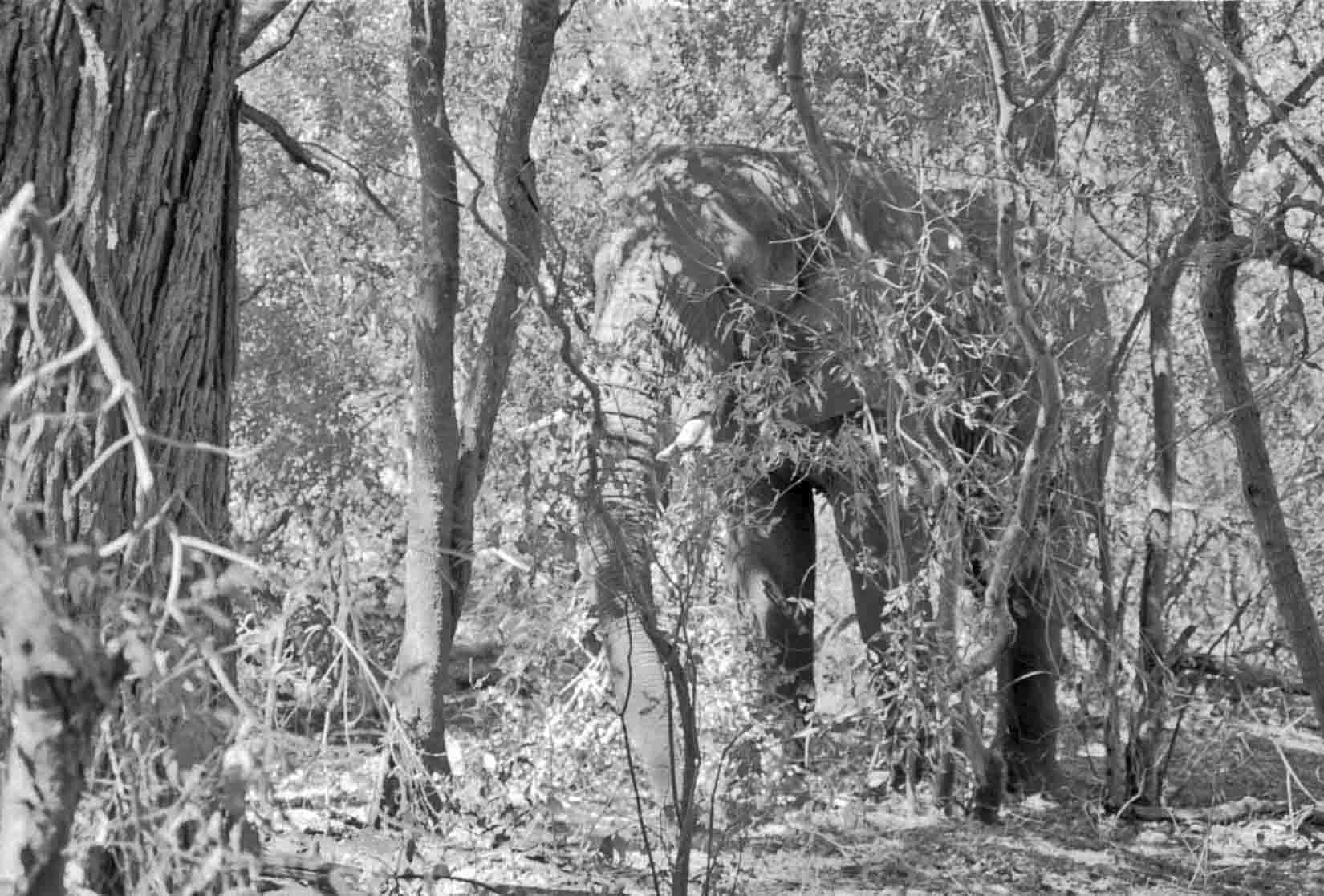
Camouflage is the art of hiding in plain sight. Of standing perfectly still, keeping silent, blending in, getting lost in the background, resembling something else. It’s an art practiced to conceal feelings, disguise intent, blind danger. Sometimes it’s a necessary skill for survival. Even elephants know how to disappear.
A door closes behind me. Another one opens before me. My life: doors and side-doors, opening, closing, rooms I do not recognize, rooms that are familiar. Outdoors, indoors. Locked doors. Doors ajar. Double doors. Doors that squeak. Doors unhinged. Silent doors.
Latch, unlatch. Doors easy to open, doors impossible to shut. Solid doors, hollow doors. Doors that blow open, doors that slam shut.
Big doors. Small doors. Ornate doors, plain ones. Doors that open in. Doors that open out.
Yours is the door upon which I now knock. This day east of you, I would carry west, and lay upon your doorstep: a world without windows, without doors.
Since this was the second-most popular post of 2014, I’m re-posting it for those who may not have read it yet.
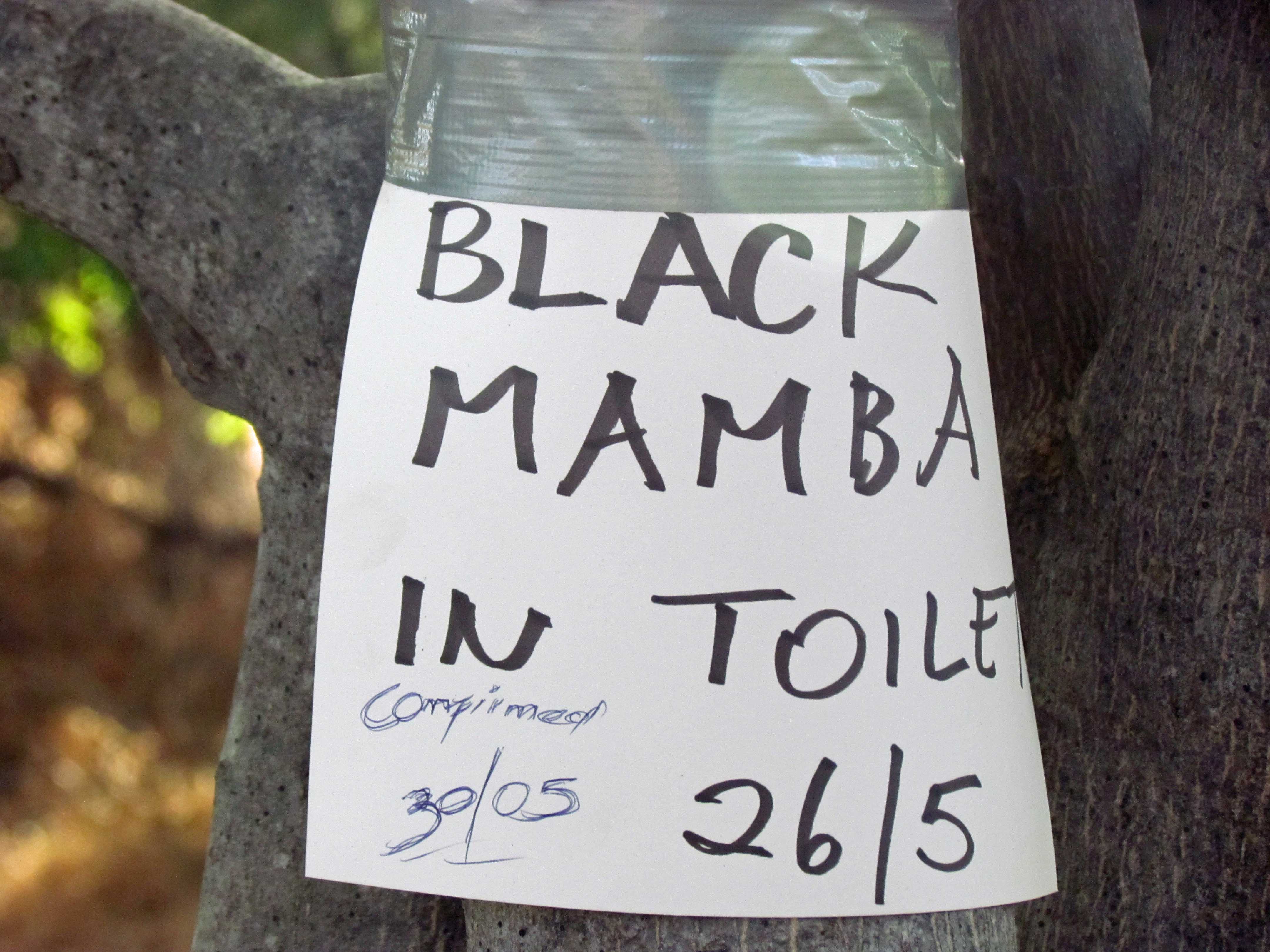
Dated 5/26/12, Reconfirmed 5/30/12!
But first, for those who are unfamiliar with black mambas, here’s a little background information:
Black mambas (Dendroaspis polytepsis) are the longest venomous snakes in Africa, measuring up to 14 ½ feet. Mambas are not black – they’re more olive or greenish gray, with a narrow, elongated head the shape of a coffin. It’s the inside of their mouths that are black – hence the name. Mambas are also extremely aggressive and may actively attack without provocation. I use the adverb “actively” with reason – a mamba can strike in all directions, even though a third of its body is raised above the ground, and it can chase you in that upright position at speeds up to 20 mph. If you are bitten, your death will occur within 20-60 minutes. An anti-venom for mamba bites exists, but it must be administered immediately, requiring 10-20 vials of solution. But if you are struck in the face or neck (quite likely, since the head of the mamba chasing you is 4 feet off the ground), you will die in ten minutes. That black mouth will be the last thing you see.
On that cheery note, on with the story:
In the Moremi Game Reserve, east of the Okavango Delta, is an elevated platform overlooking a large hippo pool in a bend of the Khwai River. Six of us, our guide OT (“just like Overtime!”) arrive in our Land Rover.
“What’s that?” I point.
It’s a large piece of stiff white paper taped with duct tape to a tree. We climb out, read it, and immediately start swiveling our heads, trying to look in all directions at once.
“Anyone want to go look?” OT laughs.
The toilet, roughly the size of those cartoon outhouses with the crescent moons carved in their doors, is a cinder block building with a tin roof. It’s about fifty feet from our Land Rover. The painted green door on the toilet is ajar.
Certainly I’m not tempted to look inside. After all, the second message was written just three days before our arrival by someone a lot more curious than I am about deadly snakes. The mamba is most likely still in there. Who wants to reconfirm a reconfirmation? Mambas are territorial; they will always return to their lairs, although that’s usually in an abandoned termite mounds or a hollow tree, rarely, I’d bet extremely rarely, in a toilet. A mamba is diurnal, active both night and day. It could be sleeping in there. Or not.
In my opinion, I’m already standing way too close to that toilet. Trying to look both at the toilet and at everything else, I walk slowly backwards. Mambas don’t like sudden movements.
Besides, I firmly believe, even though I haven’t seen it, that this toilet is not a Western ceramic throne, but a mere hole in the cement. I’ve had enough experience with toilets-in-the-middle-of-nowhere to also believe that the area around the hole is likely none-too-clean. That bush over there looks a better. A few minutes later, after careful reconnoitering and quickly taking care of business, I can confirm that no mambas are lurking around it.
As I climb the steps to the viewing platform I look for mambas wrapped around posts. On the creaky platform I look for mamba’s hidden in corners, or nestled into the thatch of the roof. I look for mambas slithering across the branches of the trees that lean dangerously close to the rails. A rustling noise among the branches spikes my heart rate to a gazillion, but it calms when I see it’s only a Burchell’s glossy starling, squawking for handouts.
Burchell’s starling
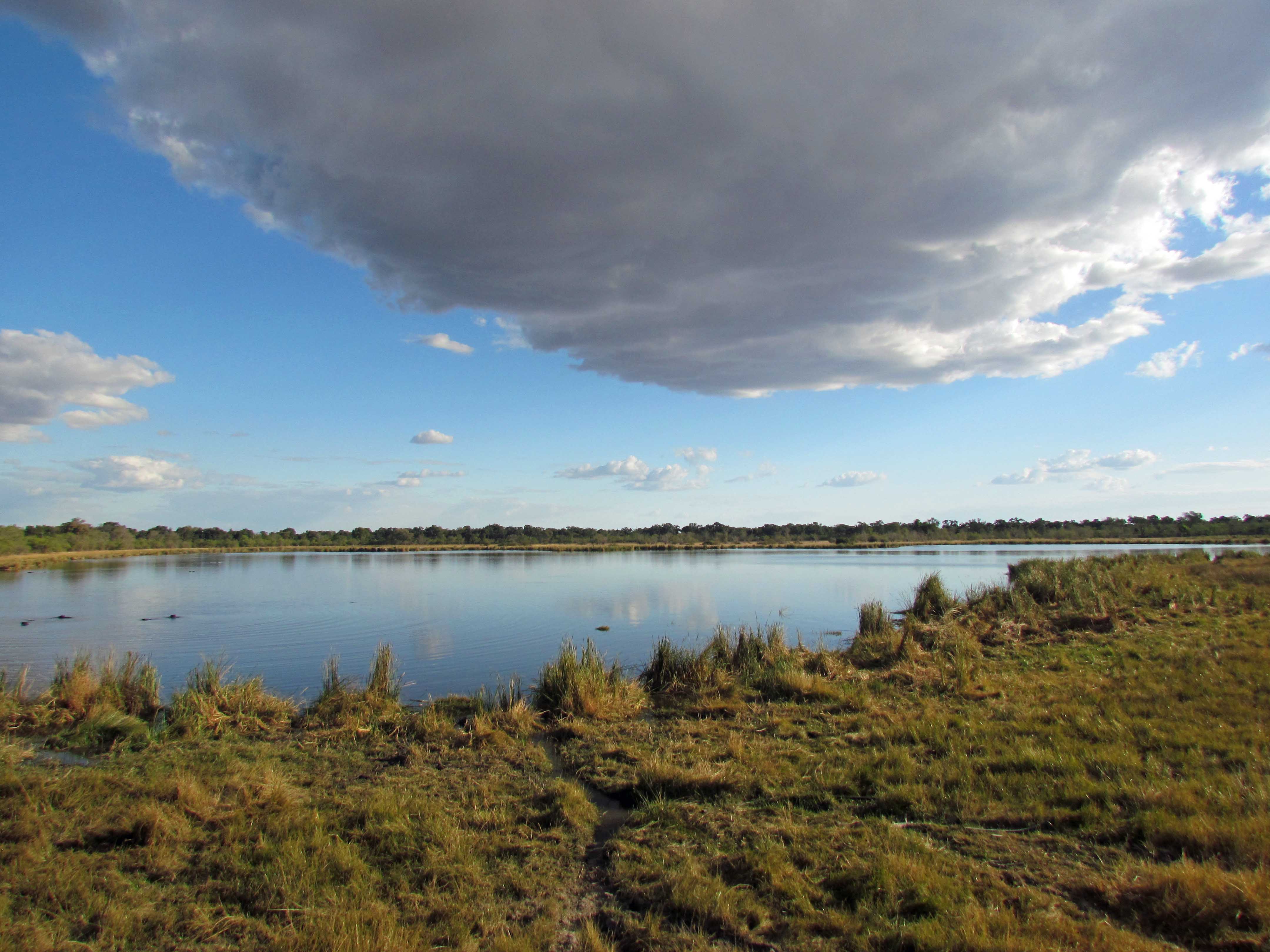
The view from the platform is marvelous. A massive cloud hangs over the hippo pool and puffs of other clouds reflect in the tranquil water. A dozen hippos rise and sink, burbling like submerged tubas. Tracks in the grass are hippo paths, where the hippos come out of the pool at night to feed, foraging as far as three miles for sweet young shoots.
At the bottom of the platform a dozen water monitors, some six-feet long, slither into positions that defend his or her portion of the bank, using the hippo paths as small highways. The smaller monitors end up with the worst spots, constantly harassed in slow-motion chases by the larger lizards. As I watch their typical reptile behavior, I think it’s lucky for us that the age of dinosaurs ended a long time ago.
Khwai River
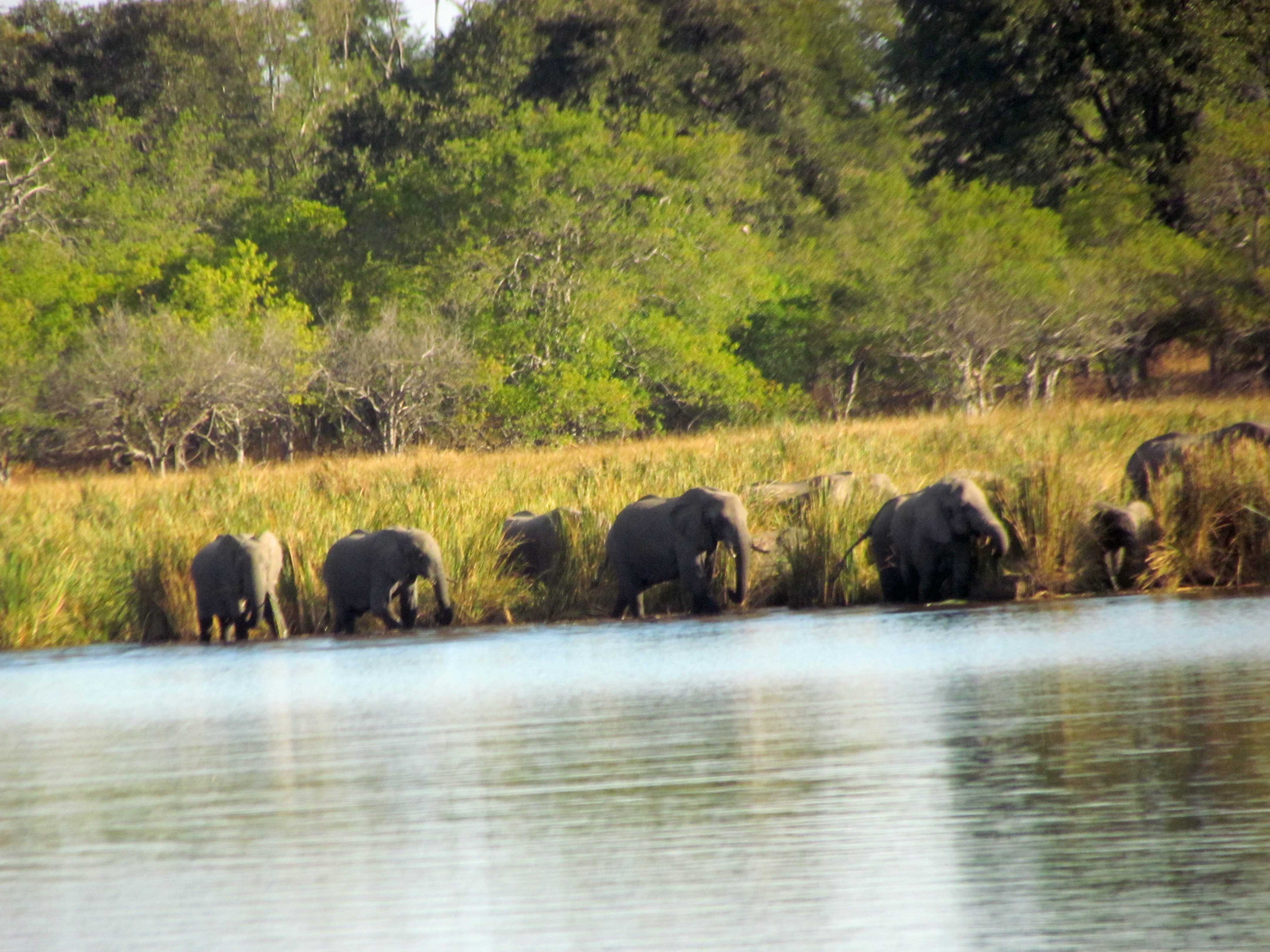
On the far side of the river, specks in the distance, a huge herd of elephants splashes along the edge of a reed bed. After I check for mambas, I lean on the rail of the platform to steady my camera. I use the digital zoom to take a picture, but it’s an extremely low-pixelated shot. The elephants are in constant motion, appearing and disappearing in the reeds, so the photo turns out fairly blurry, but at least I have proof that those specks were really elephants.
Elephants on the far bank
On the way down from the platform I look for mambas wrapped around support posts, coiled under steps, and hidden in the framework of the flooring. I scan for slithery movements in the brush and wait for someone else to climb in the Land Rover before I do. I doubt the mamba has exchanged one lair for another, but still, you never know . . .
So, Louis, the viewing platform has its own GPS coordinates. If YOU want to look at that mamba and reconfirm one more time that it’s really there, I can tell you exactly where to go!
As promised, I’m re-visiting the third most popular blog post of my blog in 2014: an excerpt from my book, Larger than Life: Living in the Shadows of Elephants.
Doug gets my full attention when he proclaims to his guests, “Thembi has a great set of knockers.”
“Thembi, leg.”
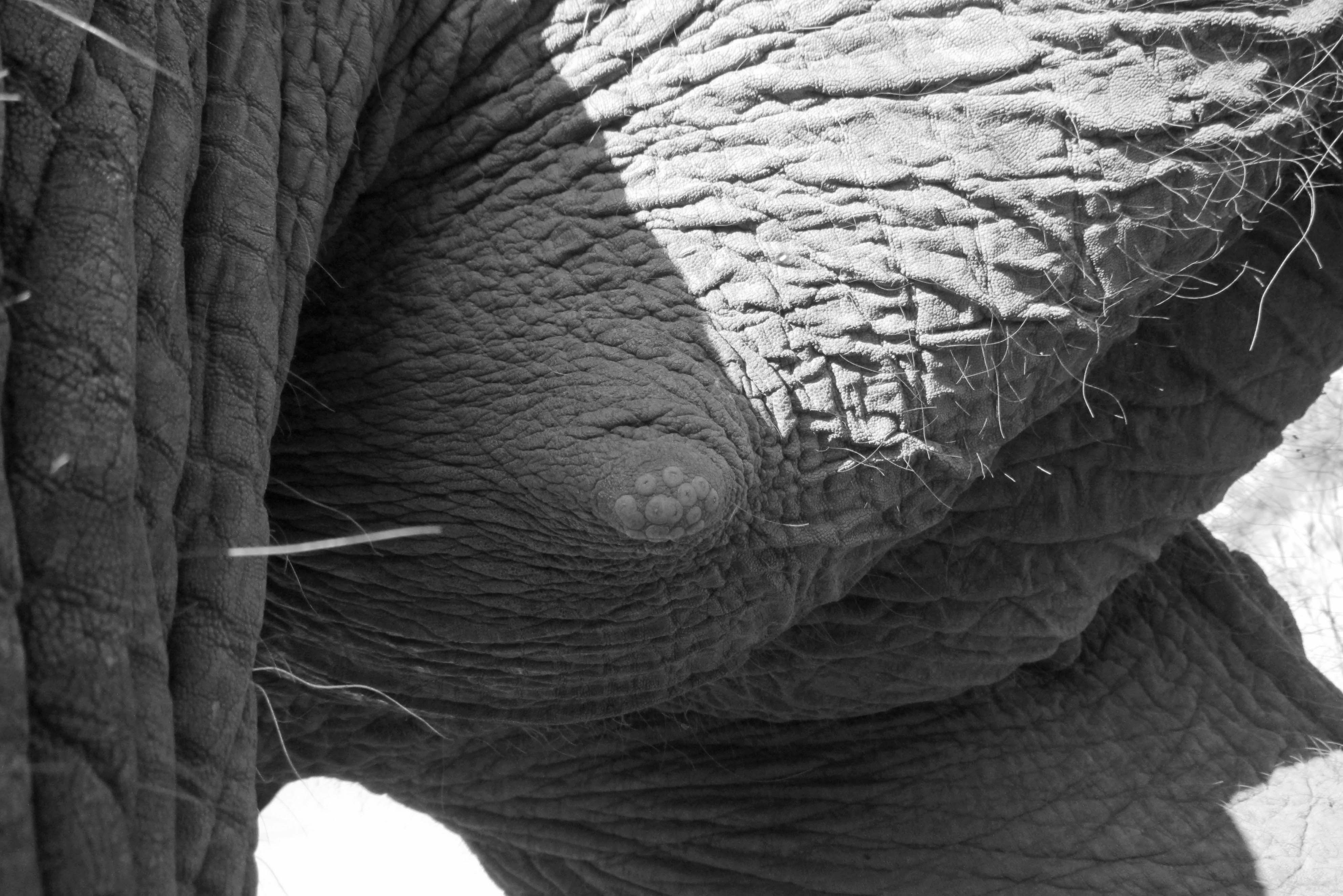
She obliges by bending her left front leg at the knee and raising it, exposing a clear view of her breast. “See? Elephant mammary glands are located on the chest, like humans.”
A Great Set of Knockers
I lean over Doug’s shoulder and look at two gray breasts with permanently erect nipples. They’re about the size of a medium cantaloupe and, like human breasts, slightly globular, due to the pull of gravity.
“Alllllll-right, Thembi.” As her foot touches the ground, she flaps her ears and her trunk snorfles around his feet.
“If you reach in like this,” Doug demonstrates, “you can feel them.”
Steadying myself with one hand on Thembi’s leg, I reach in and cup her breast with the other hand. The skin of her breast is as soft as an old, creased leather bag. Her nipple, as one might expect, is harder than the flesh around it.
Thembi emits a low, murmuring rumble.
“Oh you like that, do you, Thembi girl?” Doug chuckles.
I quickly withdraw my hand and step away from her side.
“Anyone else want to try?” asks Doug.
Out of the seven of us, several people look away, several look down. No one ventures forward. I can’t tell if everyone is embarrassed or just reticent. Feeling up an elephant may not be quite what they had in mind. It certainly wasn’t what I had in mind.
“Well, OK. Mammals are called mammals because . . . . ?”
One of the guests ventures, “Mammary glands?”
“Right.” Doug continues his lecture: “Like all mammals, Thembi’s lactiferous ducts terminate in her nipples. They point out a bit, while Morula’s nipples point down. Thembi gets a bit of stimulation while she walks, don’t you, Thembi girl?”
Some of the guests look mildly scandalized, while others giggle and whisper to each other.
Doug rubs Thembi’s leg, which generates another snorfle.
Female elephants don’t have a row of teats, like cats or dogs. They don’t lie on their sides, suckling a litter. Elephant calves nurse standing up, with their small trunks flipped over an eye like a wayward curl.
All mammal breasts are modified sweat glands. Some mammal breasts are located in the groin and some on the chest. The breasts between Thembi’s front legs are in the same location mine would be if I walked around on all fours. Her breasts weigh about four pounds each, .1% of her body weight. Human breasts weigh .08% of total body weight, dogs 2%, rats 9%.
Do all mammals have larger breast size to body weight than humans? I pull out my notebook to write down that question, but then decided I really don’t care, and put the notebook away.
“Is she pregnant?” asks the woman behind me.
Although Thembi possesses relatively trim tonnage in comparison to the other two elephants, she is significantly rounder – huge thighs, huge belly, a Rubenesque sort of girl with a really long nose – and very full breasts, unusually large for a non-pregnant elephant.
“We don’t think so,” Doug replies. “We had her hormone levels tested about six months ago, and they were normal. She’s an enthusiastic eater, so she might be a tad rotund because of that. She might be incubating a surprise, but we doubt it.”
Sandi laughs. “That’s because she’s a bit of a flirt with the wild boys around here, but when things get serious she becomes quite horrified and scoots on home.”
Another one of the guests pipes up: “Has Jabu ever tried mating with her?”
“Yes, he’s tried,” Sandi replies, “But we’ve never yet seen him achieve intromission.”
Heads nod thoughtfully. I can see intromission has thrown them a bit. It’s not a word commonly used to describe sexual penetration, but I think most of the guests have a general idea of what it might mean. Several of their heads swivel to gaze at Jabu, ripping apart a nearby bush. Since he’s such a big boy, why couldn’t he just have his own way?
“Thembi doesn’t really favor him,” says Sandi, as if she’s reading minds.
“What if she had a calf?”
There’s not one second of hesitancy to Sandi’s reply: “Oh, we’d keep it. It wouldn’t be easy, though. Thembi’s never been in a breeding herd and has no clue about birth. And she’s rather stuck on herself, you know. We don’t think she’d be a good mother. But if it happened, we’d make it work.”
Even though it’s not likely that Jabu and Thembi will become pachyderm parents, I can easily imagine Thembi as a pregnant princess, mood swings, food cravings and all. As if to prove my point, she regally sweeps through a stand of grass, a princess on a mission. She breaks off a few branches from a small thornbush, stuffs them against her back molars and chews with her mouth open.
Thembi has never been with an extended herd of mothers and sisters and aunts and hasn’t had the opportunity to learn the complex behaviors required to be a mother. She’s never learned that newborn calves stay in physical contact ninety-nine percent of the time, either below or beside their mothers. Although calves will begin to forage by nine months, they continue to suckle for about four years. Elephants in zoos will quite frequently shun newborn calves. So I can just about predict Thembi’s reaction to a calf: What IS this thing following me around?
I glance over at Jabu. He has nipples, too. Guy nipples, nozzle-like nipples, surrounded with sparse hair.
A Guy Nipple
All mammals have three distinct features: hair, three middle ear bones, and mammary glands. Even whales, dolphins, porpoises and manatees have hair, usually on their snouts or next to blowholes. Elephants and manatees shared a common ancestor fifty-six million years ago, but the nipples of female manatees are now under their flippers, in their armpits.
A question comes from the back of the tourist group. “What about Morula?”
Dear, Old Maid Morula. The wallflower with big ears, large liquid eyes and a knobby forehead.
“If an elephant doesn’t breed by the age of twenty-five, they are unlikely to,” Sandi replies. “Morula is already the ripe old age of thirty.”
Female elephants typically become active at a quite young age, around thirteen. They can conceive as early as ten years old and possibly have 12-15 offspring by the time they are fifty. Female calves will stay with the herd the rest of their lives.
Male elephants take a bit longer to mature and become sexually active around the age of twenty-nine.
Morula has missed the boat. But I’ll bet she’d make a great aunty. She stands close by, slowly opening and closing her great ears, patiently watching.
One of the Lactating Class
When he first developed his classification system, Swedish botanist and zoologist Carl Linnaeus originally called mammals Quadrupedia, after the name Aristotle gave them. Later he became actively opposed to wet-nursing practices in the 1750s and wrote a book on the benefits of breast-feeding your own child. As a political act, he reclassified Quadrupedia to Mammalia in later editions of his most famous work, Systema Naturae, defining mammals as a lactating class within the Animalia kingdom, a classification that has lasted to this day – all because women of nobility in Linnaeus’s time thought breastfeeding would ruin their figures.
Certainly that’s one thing Thembi doesn’t have to worry about.







 ABOUT ELEPHANTS