Posted in Elephants, Extinction, Nature

Mammoth Tree

“Look,” my friend says, “it’s an elephant.” I turn around.  We’re walking along a path above the tide pools at Salt Creek, on the Straits of Juan de Fuca.  It’s a cold, foggy morning, summer slipping into fall. She points to a western red cedar on a curve of the path.  “I see an elephant,” she says.

She’s right.  But where she sees a generic elephant I see a mammoth, a young Columbian mammoth, with a shaggy curl of moss on its domed forehead and layered fur all the way down its trunk.  Its small ear flaps forward and a rounded burl eye stares sightlessly out over the straits.  His trunk (by now I’ve already decided his gender) reaches down into salal and young firs, as if he is browsing while standing on the edge of a cliff where land meets sea.

Mammoth in Cedar

I reach out and touch this frozen young giant – about seven feet tall to the top of his dome.  He’ll be ten feet tall when fully grown.  Of course he’s impassive, wooden to my touch, but the swirl of his bark/fur makes him seem as if he just stopped as we rounded his corner, hoping to blend in before deciding on our intent.

I retrace my steps to the other side of the tree and discover that my gender assignment is completely wrong.  On the exact opposite side of the mammoth’s head is its unmistakably female rear end, two legs solidly planted on the ground, a hanging vulva in between them.  Even though shaggy fur covers her rump, anus and legs, her triangular shaped vulva can clearly be seen.  Male elephants have internal scrotum and their small hanging folds are tucked up and under.  This mammoth is definitely female.
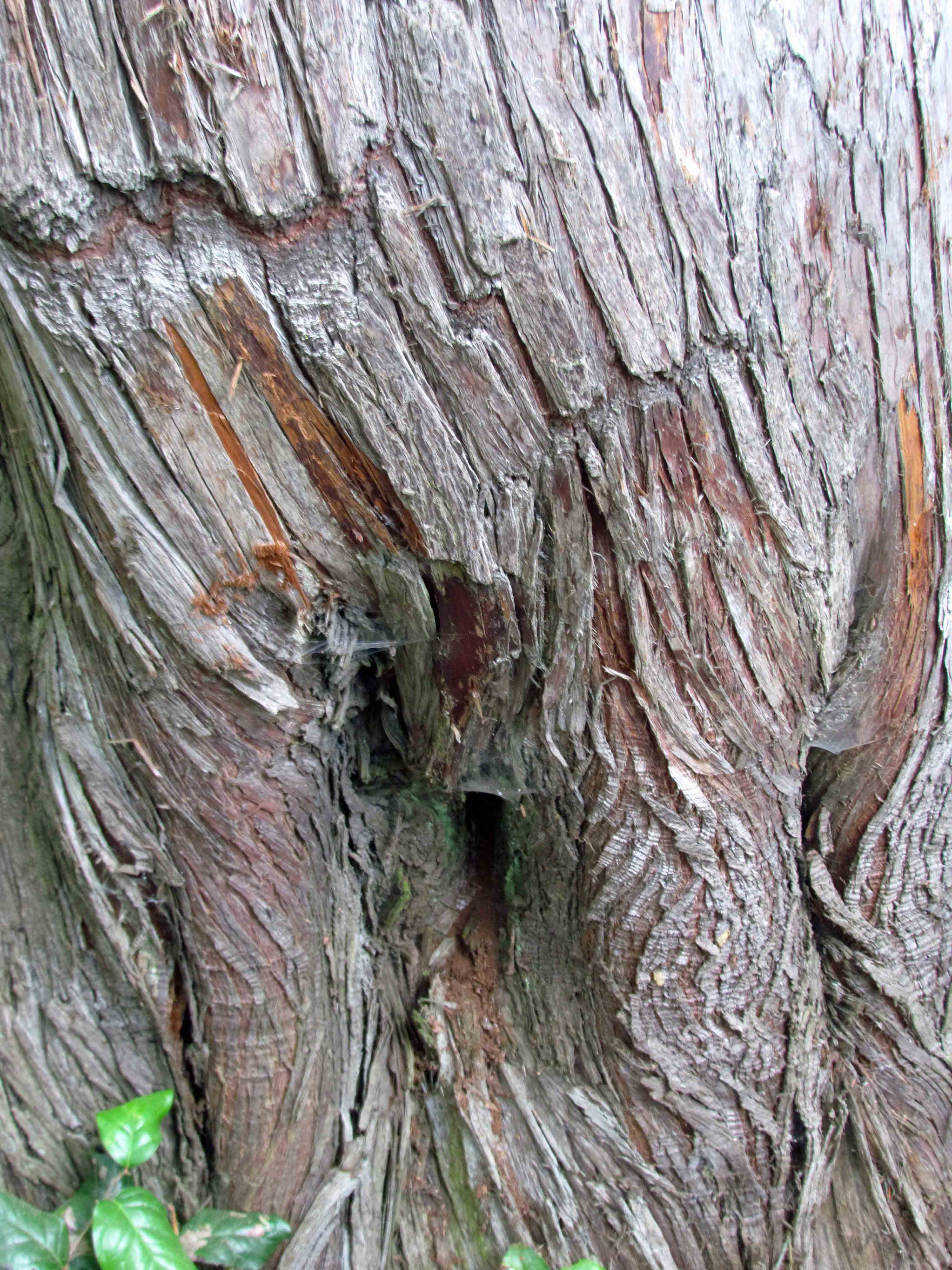
Mammoth Cedar female

The western red cedar grows straight and tall from the middle of her back.  I assume she grew around a nurse log, forming her shape during a hundred years or more.  Cedars like this one will grow to 180 feet and live for a thousand years.  Mammoths disappeared ten thousand years ago.  But I wonder if giants remember giants and try to resurrect them however they can.
Posted in Africa, Elephants, Nature, Nonfiction, Photography, Travel

Pilgrimage

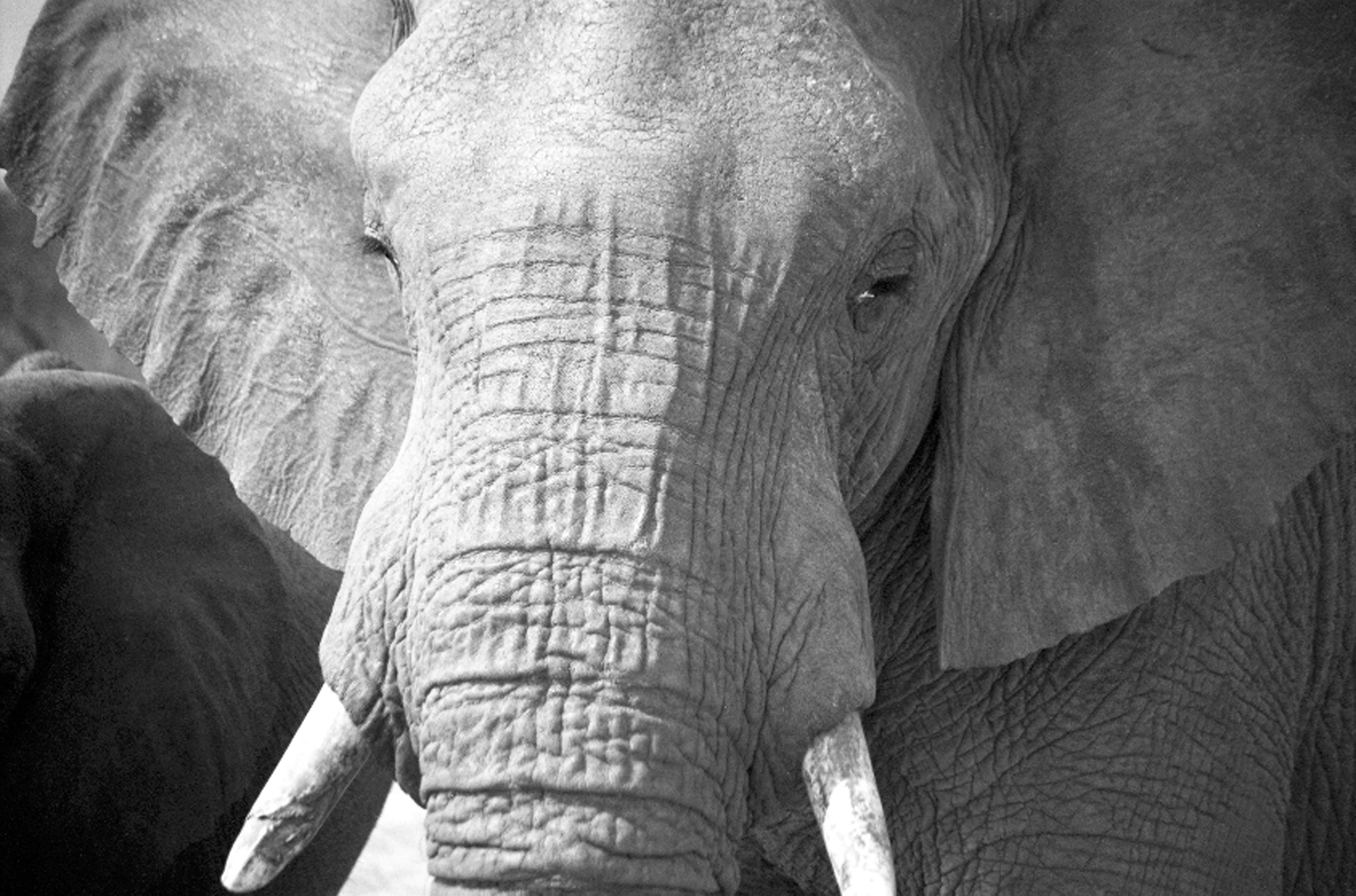
The Face

(After a trip to Africa in 1999):

I’m nearly asleep, lying across several seats at Heathrow, dreaming of elephants, my body suspended at its origin eight time zones away.  It’s neither night nor day in my dreams.  I see fluorescent lights through the lids of my eyes, hear polite announcements for flights, smell the faint barnyard dust of Africa, sense a great presence looming towards me.

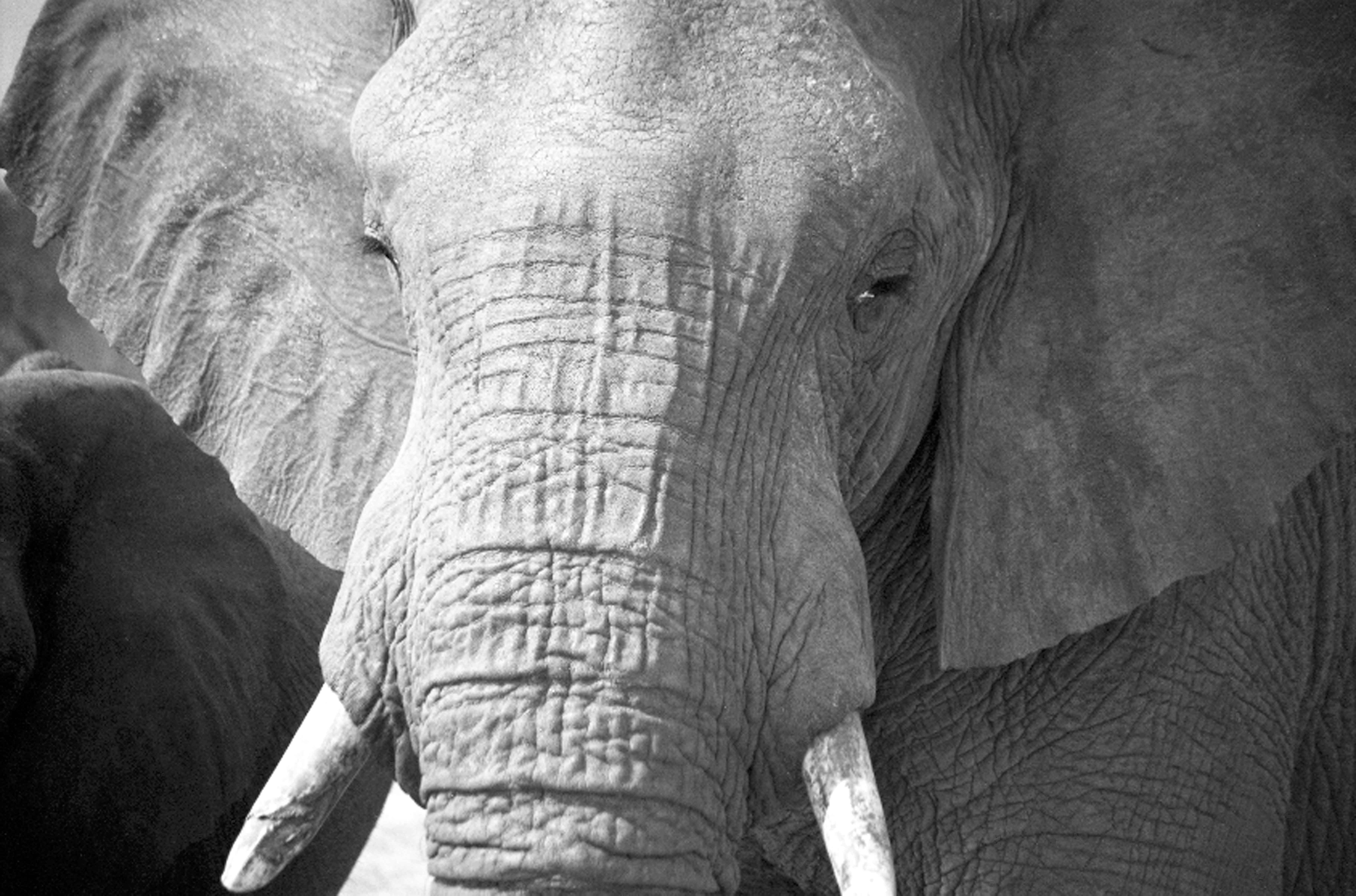
Step by step she comes closer.  She is confident, unafraid.  She looks me directly in the eye.  Her eyelashes are long and straight, her deep brown eyes are dark, dark pools.

She stops less than five feet away, just beyond the reach of an outstretched arm, should I be foolish enough to do so.  She is wild, in charge.  I am on her terms and she knows it.  She knows that people sit motionless on smelly, noisy, moveable rocks.  She knows the small sneezing sounds of the devices they carry in their hands and point at her.

She stares into my eyes, then shakes her head sideways in a movement that would say “no” in my language.  Her ears flap once, twice, and great clouds of dust rise from them.  She raises her head, looks down the top of her long trunk.  It’s an imperious, don’t-mess-with-me look, but that again is my language, not hers.  A rumble like a promise for distant rain fills my ears.  Then she sidesteps, turns and vanishes without another sound into a thicket of brush, her great presence subtracted, a void of air where she stood.

I am on a pilgrimage to that place.  I am waiting for my flight, asleep at Heathrow.  I am nearly, virtually there, in my dreams.  

Posted in Africa, Elephants, Nature, Nonfiction, Photography, Travel, Writing

Mud Wrestling

Image

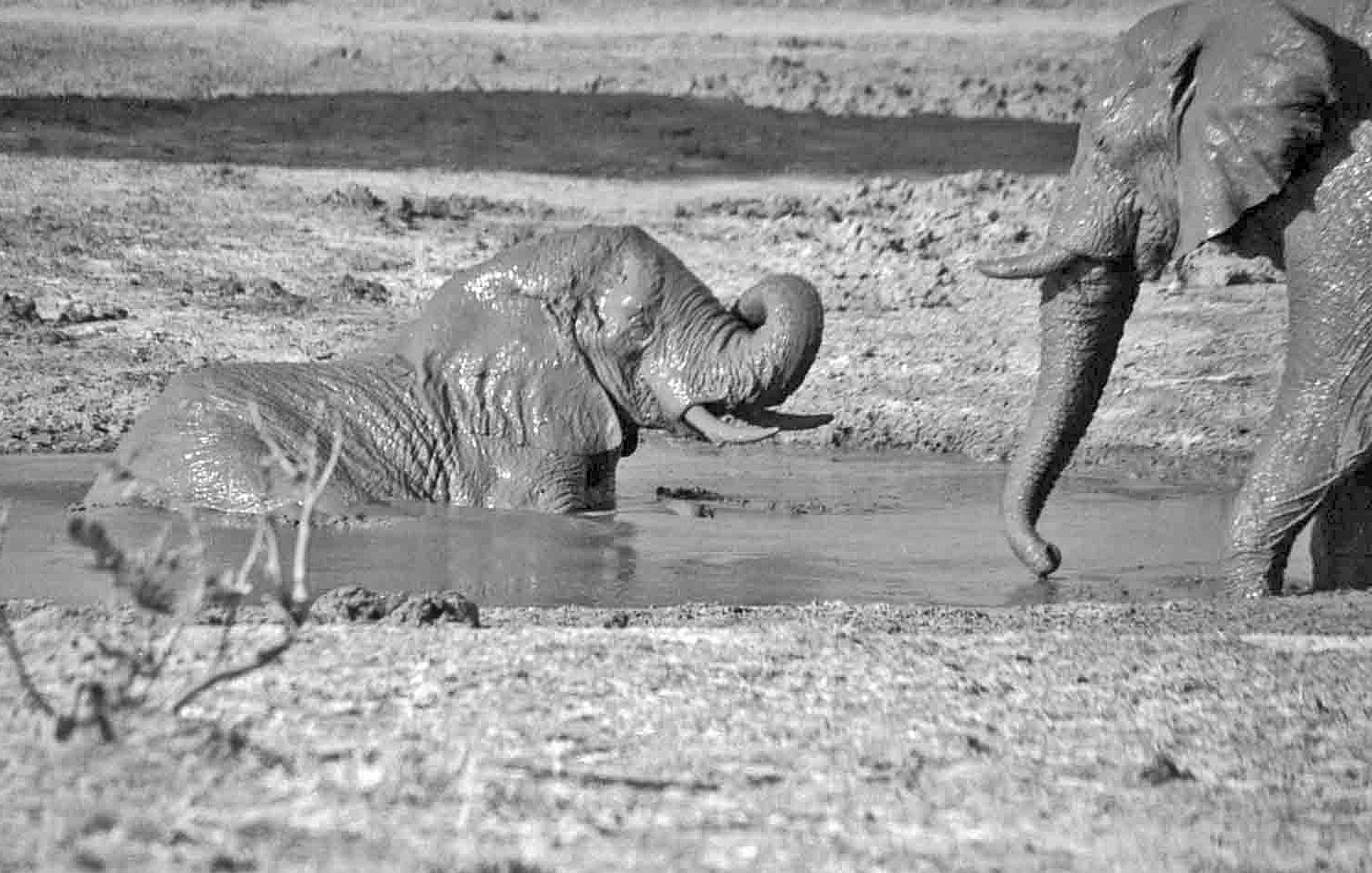
It’s a mucky, slimy, gloppy mud.  A young elephant snorkels on his side, the tip of his trunk swiveling above the surface, as he slides towards the other elephant, a brother or cousin.  His days are filled with heat and dust.  It’s winter in Botswana, the sun is relentless, and mud will soothe his scorched skin.  He lifts his head from the muck, curls his trunk and closes his eyes.  This feels good, his body language says, this feels really good.    

If we could imagine ourselves weighing four tons and think of gravity’s effect on those four tons, then maybe we could imagine wallowing in such mud, pushing and shoving like giant sumo wrestlers, reveling and rolling in the sheer pleasure of warm gunk.  We would inhale a slimy trunk-full of ooze, squirt it like a water gun in any direction, even at each other.  We would rub our eyes clear with a curled fist at the end of our trunks.  We would arise glistening and bright as a metallic statue.  We would be cooled, refreshed, gigantic, gentle beings. . . . if we could imagine such a thing.

Posted in Africa, Elephants, Nature, Nonfiction, Photography, Travel, Writing

How Much of the World Are We Missing?

Listening, really listening.


Just at the edge of darkness, where the light of our fire does not penetrate, an elephant thunders by, trumpeting the whole way, like a locomotive off track in a dry forest, a classic illustration of the Doppler Effect, sound that condenses, rises in pitch, crescendos, blows by, drops pitch, recedes. 

We lift our heads in surprise.  Waves of sound undulate away from us, kin to ripples on a pond.  We use pulsed sound waves, Doppler Radar, to see rain, to know when we should run for cover.  There is no such radar for an incoming elephant.

Eventually his outrage is extinguished in our ears, but elephants a mile away are just beginning to hear it.  Resonance fills the night air around us, yet we are deaf to it, to the sounds just below our range of hearing.

How much of the world are we missing, circle upon circle?  Perhaps instead of placing ourselves at the center we should move to the edges where our skills are low and our learning curve high.  We should extinguish our fire and sit in the darkness listening, really listening.

Posted in Africa, Elephants, Morula, Nonfiction, Photography, Pleistocene

Footprints

Footprints

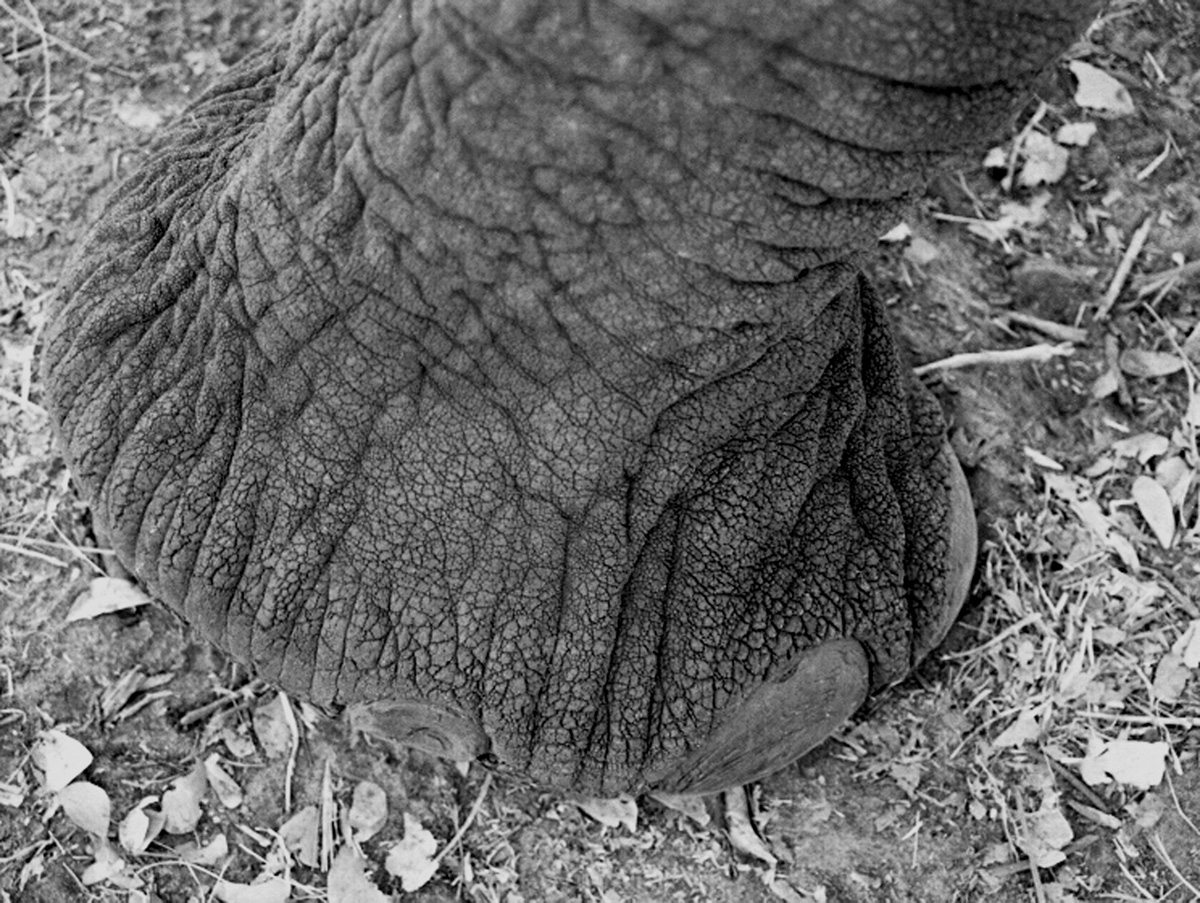
Our feet anchor us to the ground.  Just as my Pleistocene ancestors could read the tracks of mastodons, so I now gaze down at an elephant’s prints in the dust.  Her back feet are oval and her front feet round.  City slicker that I am, even I can tell the direction she is going.

 The sand beneath our feet  is the color of a lion’s coat, studded with brittle leaf litter.  Morula walks through it without making a sound.  Shock-absorbing pads on the soles of her feet cushion each footstep, smother crushed leaves.

I step on a dry leaf and it crackles into powder.

The brand name of my boots imprints within the outline of my soles; a clever advertisement made with each step.  All of my weight concentrates in two small points of contact with the earth, so I make deeper impressions than Morula’s footprints.  Each one of my steps applies more pressure per square inch; Morula’s weight spreads over four large footpads the size of a medium pizza pan.

She can step on a snake and not kill it.

Morula lifts her foot and grains of sand roll down slope into the crater of her footprint.

Following two paths, the one beneath her feet and the one in her mind, Morula strolls on.  Dust rises, a half shadow that marks her passage, before it collapses again to the ground.

There is a before and an after to each moment of our lives, paths we follow and paths we do not.

Posted in Nature, Photography

Let There be Light


Sunset, Moremi Game Reserve, Botswana

From 93 million miles away, pitched straight at me, vibrating, ululating like an African cry of greeting, light from the sun hurtles towards the earth at 186,282 miles per second and eight minutes later slams into me like a jabbering, long-lost relative trying to make up for lost time.  It babbles everything, all at once, into my eyes.

Our eyesight is an electro-chemical reaction to a vibrating particle-wave gushing optical information splash into my brain.  I could shut my eyes to the wonder around me and be diminished.  I could shut my eyes to the atrocities around me and become hardened.

By opening my eyes, I give shape to my perceptions.  By opening my eyes I take responsibility for my vision, for what my eyes teach me.  By opening my eyes I learn that I belong to the world, not that the world belongs to me.

Our eyes are openings into and out of our bodies.  Are my eyes, as some would say, a window to my soul?

There is a cold way of seeing that clips wings and stifles our words into faint echoes.  But there is also a way of seeing where the eye can be like a mouth, swallowing color, taking in the entire world with just one gulp.  Just the sheer fact alone that we see color should provide enough wonder to fill our lives, should stop us in our tracks, should keep our eyes wide open, devouring everything as fast as we can choke it down, leave us slack-jawed, gasping for air.


Somewhere behind my eyes, a world exists that I yearn to inhabit, dreams that might become real if only I could imagine them with my eyes wide open.


Posted in Nature, Writing, Zoos

Solitary Confinement

Jabu eye 2 b&w

Alone,

alone,

two steps forward, two steps back,

the elephant sways to a rhythm no one, not even she, can hear.  Two steps forward, two steps back.  Swaying, her head dips to one side, then the other.  Her motions are born from a numb brain, from uncut boredom, from the measurement of a life by that which does not happen.

Beyond the barriers that surround her, a jerky stream of humans flows past, day after day.  Their powerful odors overwhelm her, and she touches her temporal gland, samples her urine, the only familiar smells left to her.  At the end of each day, after the humans are gone, she hears a multitude of rumbles, but none have resonances she can recognize.

Sometimes she will lie down on the huge square stone into which she is entombed and sleep.  There are no stars over her head.

She ceased calling out to her kin a long time ago.

As near as she knows, she is the only elephant left on earth.


Note:  There are 284 elephants in 79 accredited zoos in the United States.  Most zoos have more than one elephant, because elephants are social creatures who need companions from their own species.  I originally wrote this piece when I learned of Maggie, who lived at the Alaska Zoo in Anchorage for 24 years, the last eleven of those years alone.  In 2008 she was transported to the PAWS sanctuary in California, where she now lives with other African elephants.  Here are the remaining zoos that keep just one elephant:

  1. San Antonio Zoo – “Lucky”
  2. Double M. Ranch, New York – “Reba”
  3. T.I.G.E.R.S., South Carolina – “Bubbles”
  4. Natural Bridge Zoo, Virgina – “Asha”
  5. Wild Adventures, Georgia – “Shirley”  – Shirley is age 69 and has been in captivity since 1946.

Sources:  verified independently, using the database from http://www.elephant.se

Posted in Africa, Elephants, Nature, Travel

The Most Useful Appendage That Ever Evolved

An excerpt from my book-in-progress:

Trunk in face


The tip of Jabu’s trunk hovers in front of my eyes, wet with mucous, dotted with sand, nostril hairs visible.

He blows into my face, gently.  I blow back, gently.  We exchange breath, distillations of our own personal atmospheres, particle-swarms of changed, exchanged air, brewed though all the cells of our bodies.

My lungs fill with the fragrance of crushed leaves, with saproots and spearmint-scented bark, all lightly fermented.  I think of the stagnant air that surrounds my daily life, air that is conditioned, filtered, deodorized, air that is bland.  Elephant’s breath is said to cure headaches.  And it just might, if I had one.

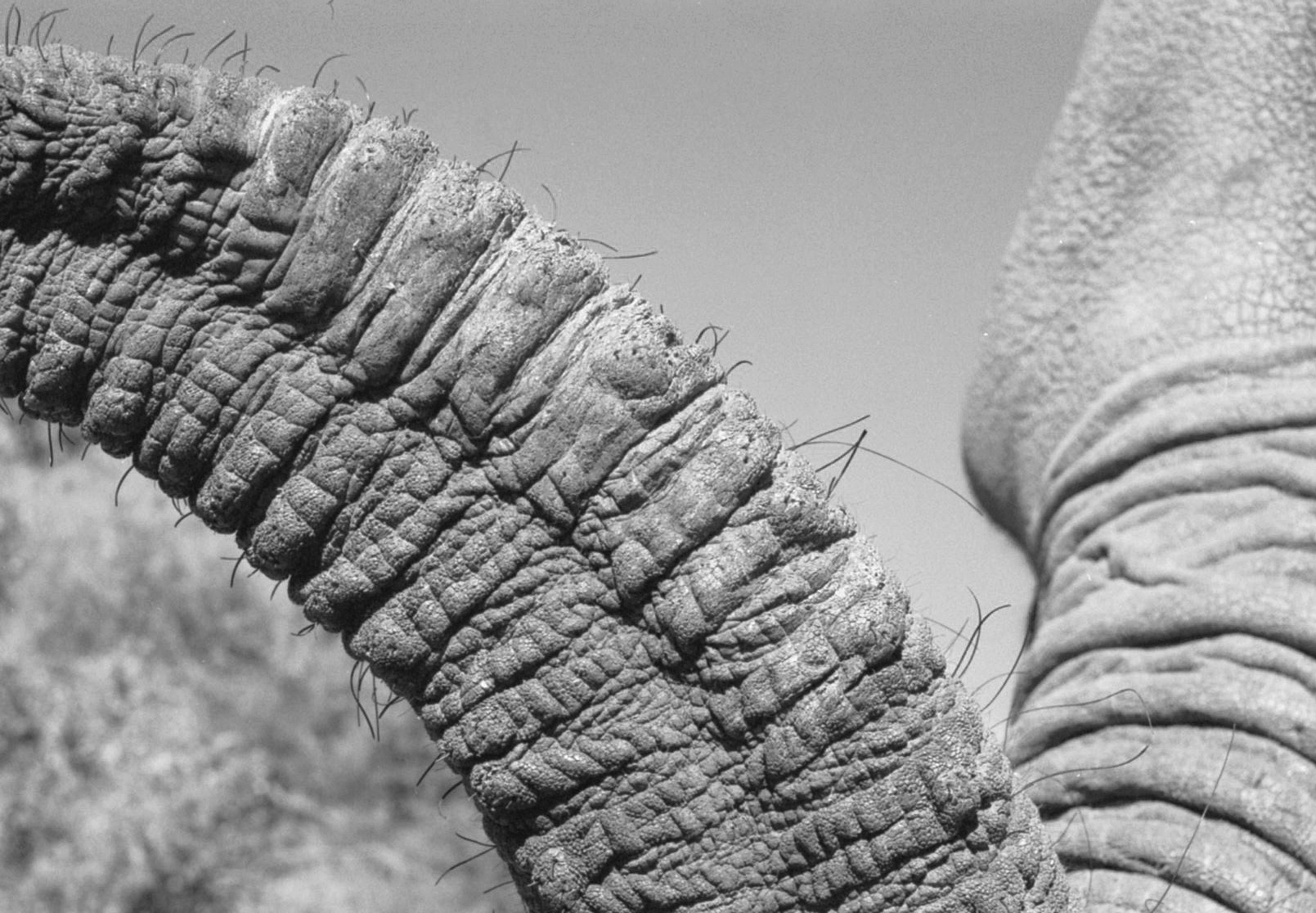
Jabu’s trunk tip investigates my right boot tip.  The scents I’ve picked up while walking tumble up two seven-foot-long nostrils – nostrils surrounded by nerves, arteries, veins and a staggering array of longitudinal and transverse muscles, the world’s biggest, longest and certainly most flexible schnozz.

A trunk is the most useful appendage that ever evolved.  Imagine having an arm in place of your nose, an arm long enough to reach to the top of a tree, and pluck a single leaf from its crown.  Imagine having a nose with which you could rip, tear, excavate, whack, and blow bubbles.  You could steal with your nose, suck on it, squeal, swat, poke and siphon with it.  You could take a shower, or reach over your shoulder and scratch your back with it.  You could even arm wrestle with your nose.

He chuffs, a hot gust of air directed at my feet.  Wet mist covers one boot top momentarily, then evaporates.


Posted in Africa, Elephants, Nature, Travel

Trunk Show

Morula trunk underside b&w


Funky jazzy trombone trunk.  Snaking snorkeling vacuuming trunk.  Showerhead.  Backhoe.  Slinky.  Shimmying sucking swigging trunk.  Empty pipe.  Water gun.  Periscope.  Plucking siphoning tenacious trunk.  Kazoo.  Tweezers.  Tentacle.  Affectionate handshaking pickpocket trunk.  Python.  Air hose.  Question mark.  Whistling snorting sneezing trunk.


Breathtaking

trunk.


Posted in Africa, Elephants

A Sea of Elephants

Hwange National Park, Zimbabwe, 1996

Parked at the lip of the waterhole, seven humans sit in a roof-less, side-less vehicle, eggs in a carton without a lid.  Earlier, at dusk, giraffes reflected the setting sun, but now icy stars stare down at us with chilled, blue eyes.  Somewhere, out there beyond this waterhole, hyenas will make short work of bones.

An elephant appears.  And then another.  Gray wave after gray wave surges out of the bush in small herds of twenty or less, flooding the huge hollow in front of us.  Dust rises in the air, a potent blend of manure, dried grass and sand.  The backwash swells in our direction.  Soon a sea of elephants surrounds us.

sea of elephants

Snorts, grumbles, trumpets, growling bellies, and gargantuan belches resound.  Some of the vibrations are too low to hear, but I feel them as they pass through my body, reverberate in my chest cavity, squeeze my heart.  Eye after eye inspects us as eddies of elephants swirl past.

An old world laps at the foot of our memories, extinguishes centuries of communal fires.  The ropes that tether us loosen.  We slip away from the familiar shore and set off.  We look around with wild hearts.  We have become part of the herd.

Behind us, close enough to touch with an outstretched arm, a huge female chuffs and huffs at regular intervals, locomotive-style.  Hunched and folded, I turn my head slowly to look into her left eye.  Her trunk periscopes into an s-shape, swivels, and tests the air in my direction.  Her massive body blocks our only way out.  She rocks back and forth, side to side, grows quiet.  Small and cold, I drop my head, totally at her mercy, if she knows such a thing.

Suddenly, from a crush of rumbling bodies, a baby elephant squirts out and heads straight in our direction.  Right behind is her mother.  Even our guide quits breathing.

The baby elephant stops less than a foot from our left front wheel.  Her mother looms over us, illuminated by our parking lights.  With just one step she could snatch any of us right out of our seats.

A small, short elephant trunk reaches out, touches the tire and a collective inhale is heard, as if the vehicle itself is trying to shrink away.  Behind us, the huge matriarch chuffs rapidly, building up steam.

Then the tiny trunk jerks back, blasts a bubbly snort of air, and the baby’s face contorts into an expression that can only be translated as Yuuuuck!  The mother shifts into an I-told-you-so attitude.  Her trunk relaxes, blows small puffs in the sand.

Carefully, I turn to look the matriarch in the eye.  She blinks once, twice, emits a large exhalation Whooooff, and turns her back on us.

The baby charges our vehicle, flaps her ears, and trumpets like a bicycle horn, causing a gust of giggles in return.  Her mother rumbles, pivots from us peons and makes a regal exit, strolling off in a stately manner no human monarch could ever attain.  The baby twirls several times, then follows her mom in a quick side-to-side rocking gait reminiscent of Charlie Chaplin.

Singly, and by twos and threes and tens, massive silhouettes disappear into the darkness.  A young female strolls by, scans us as if we’re department store mannequins.   And then, they are all gone.


The Face