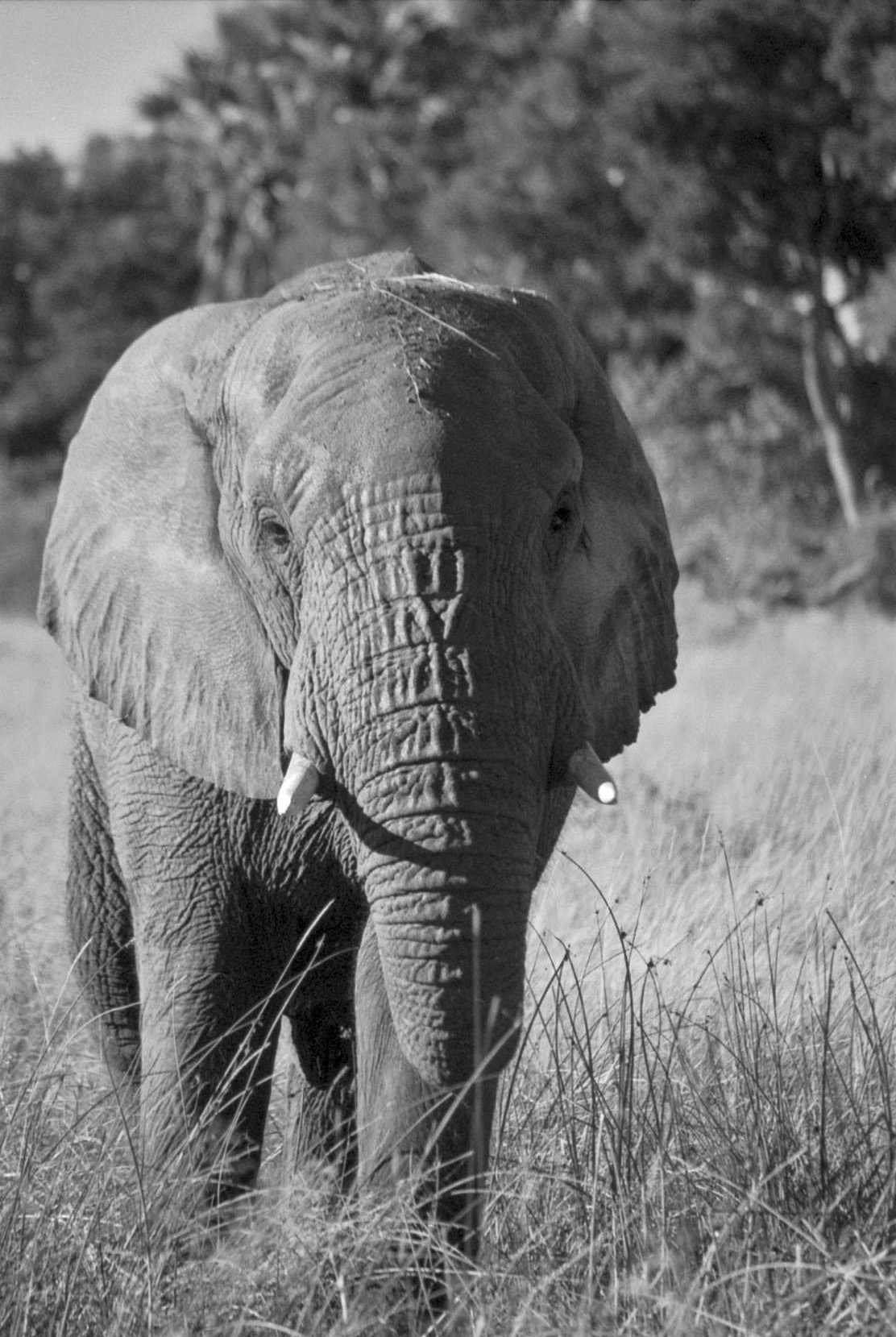
Morula stands square on, keeping her eyes upon me. Her cobbled forehead broadens from her nose upward in a triangular shape. The top of a tree is visible over her right shoulder, as if she has a giant nosegay tucked behind her ear. Short bristles like an old man’s buzz cut outline the top of her head.
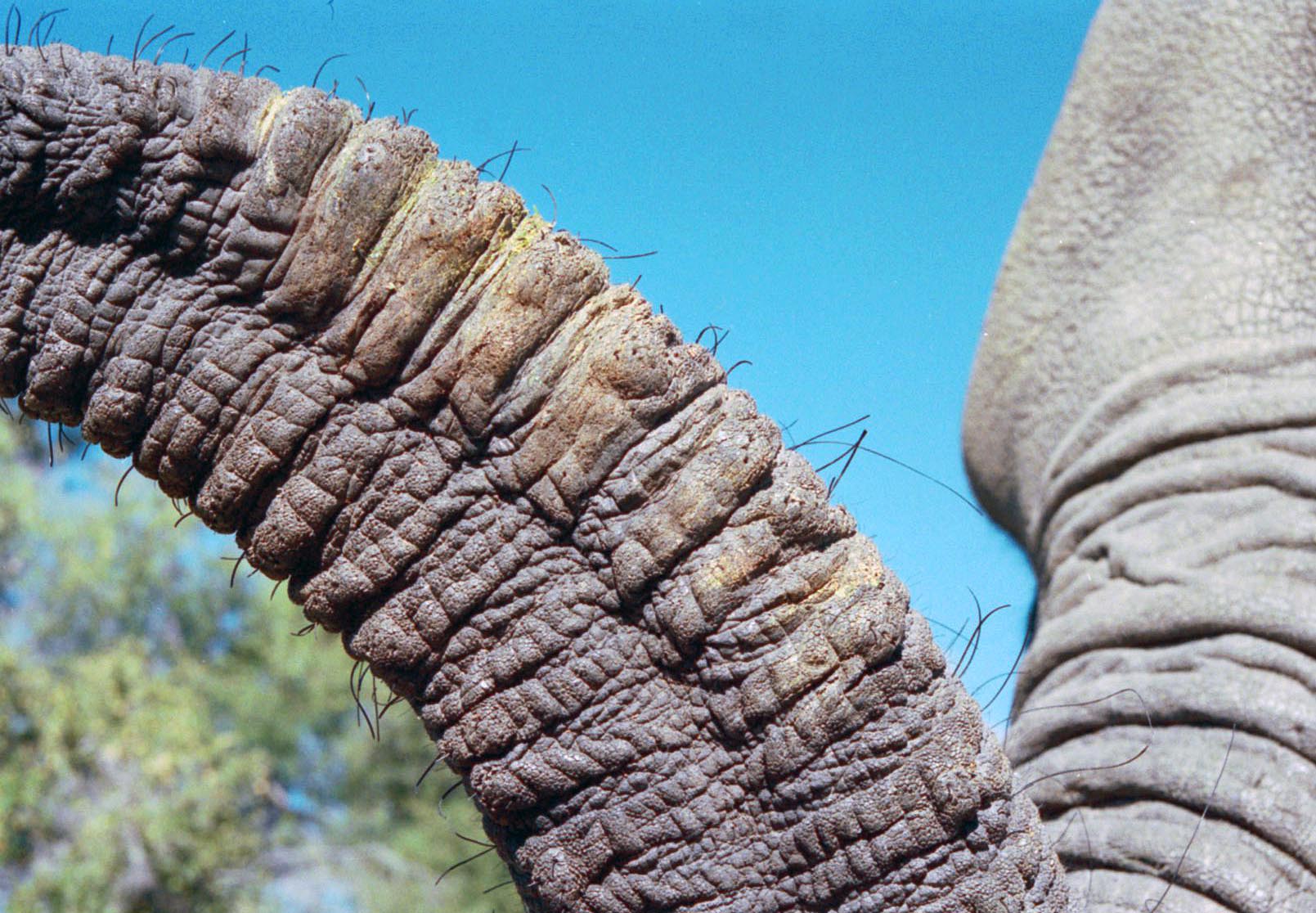
Because of the way she’s standing, ears flattened against her shoulders, Morula seems slim, her skull almost hollow. The tip of her trunk flops over itself in a loose coil and points down like a curved arrow. It begins to twitch in an irregular rhythm. I take the lens cap from my camera and glimpse a tiny reflection of myself in its mirror. Is this what she sees – another one of those small humans, with its odd upright stature? Does she see details: my hat, my camera, my idiotic grin?
I take a goofy photograph of Morula – it will look like she’s bored and playing with the only thing at hand – her trunk.
It’s a catchy tune, one that loops round and round inside our heads. The announcer takes center ring, resplendent under a spotlight in top hat and tails. “LADIEZZZ AND GENTLEMEN! BOYS AND GIRLS OF ALL AGES! WELCOME TO THE GREATEST SHOW ON EARTH!
And indeed it is. Here comes the parade of animals, prancing horses, muzzled bears, tigers roaring in their cages on wheels. Here come the elephants in pink tutus, performing night after night to that same inescapable rhythm which now marches into our ears.
There’s exhilaration tumbling inside us as the great beasts circle center ring. We have tamed them; they obey our commands and kneel before us. We oooo and aahh and clap at these exotic creatures from far-off places. We laugh at the clowns and at ourselves. Each and every one of us wants to run away and join the circus, relief from our humdrum lives.
When we exit the canvas tent our imaginations deflate a little, but our wish to master the world does not. We go home and try to teach new tricks to cats curled in our armchairs.
Buddhists believe a person would do well to model themselves after the elephant. Not the ones in pink tutus circling and circling to the same song, for they are most like us, made over in our own image. We should instead metamorphose into great gray patient beings standing naked in our own skins under the stars and the sun. Perhaps then we could rejoin the world of fellow beings, relearn ancient rhythms. Perhaps then we would know what they know.
There is a cold way of seeing that clips wings and stifles our words into faint echoes. But there is also a way of seeing where the eye can be like a mouth, swallowing color, taking in the entire world with one choking gulp.
A rabbit has a 360º field of vision, so that it might gauge the distance between itself and its attacker. Humans have front-facing, binocular vision. It’s hard for us to look at where we have been and where we are going, impossible to see both the stars and the ground at once.
An elephant’s vision is front facing, binocular, but an elephant also has a large blind spot caused by its nose. Place both hands between your eyes in the manner of prayer and you will see what I mean.
It is said that elephants will stare at a full moon; do they also see the stars?
What would it be like to think without words and recognize shapes without names?
There is a cave of light from our eye to our brain. But it is the corners of our eyes that perceive the most light; the corners of our minds where we begin to understand.
Heart shapes can be found in nature, if you’re lucky enough to spy one. There’s a heart on this elephant’s trunk, a ridge of skin that feels like fine shoe leather. One of his wrinkles pierces the lower third of this heart shape, from left to right, straight as an arrow. His real heart hangs between his breastbone and ribs, a little to the left, just like mine does. But instead of having a heart with a single point, an elephant’s heart has two points at its apex – so it’s the wrinkled outline of a human heart that he carries on his trunk.
The human heart is approximately five inches long, three-and-a-half inches wide and shaped like a pulsing cone. It is the only muscle in my body that acts on its own – my heartbeat doesn’t need any messages from my brain. The cells in my heart tissue involuntarily constrict, all together, all at once, over and over, a soft perpetual-motion machine. Rip my heart from my body, chop it into pieces, immerse the pieces in a saline solution, and then give them a small jolt of electricity. The remnants of my cardiac muscle will contract . . . contract . . . contract – all on their own, sometimes for hours.
It’s designed to be strong, my heart.
In mammals, birds, and reptiles the heart has the same basic pump-like design, a design that has worked through eons – even cold-blooded dinosaurs had hearts. A day or two after fertilization, embryos develop a pinpoint that pales, then brightens, pales, then brightens, the beginnings of a tiny pump practicing emptying, filling, emptying, refilling. An old, old pattern. The master timepiece.
There are four chambers in my heart: two auricles (“little ears”) and two ventricles (“little bellies”) – named by anatomists for the external parts of the body they resemble. Spent, dark-red blood is collected in the right auricle, then dropped into the right ventricle, which constricts and pumps it out to the lungs to pick up oxygen. Bright red again, full of oxygen, blood circulates back to the left auricle and from there drops into the left ventricle. In the next twitch blood is delivered to every corner of my body.
The “little ears,” the auricles, make very little sound as they drain blood into the lower chambers of my heart, a distance of an inch or so. It’s the ventricles, the “little bellies,” that boom as each contraction forces open heart valves and blood gushes up the aorta under pressure. Lupp DUPP. Lupp DUPP. Lupp DUPP. One beat smaller, one beat larger, flush after flush.
My right ventricle has walls thin as paper – it delivers blood only as far as the lungs. If I could hold it up to the light I could see right through it. The left side of my heart is the heavyweight lifter, pumping blood all the way to my toes, moving 150,000 tons of blood in my lifetime.
We each have roughly one billion heartbeats for our lives. Mouse, hummingbird, elephant, human, all the same. Like us, elephants suffer cardiovascular disease, die of heart attacks and strokes.
Cardiac arrest: when the heart shudders and stops, when the light in the eyes flickers, fades and snuffs.
And when the heart quits beating, its resonance
Lupp DUPP Lupp DUPP Lupp DUPP
is gone. The gurgle of digestion, all the silky, sturdy, slapping noises, the blood rush, gone. The symphony of the body is finished.
For those of us left, that silence is almost too much to bear.
Around 40,000 years ago, someone took a fragment of a mammoth’s tusk and carved a small mammoth from it – one of the earliest known pieces of art made from ivory. Roughly an inch high and one-and-a-half inches in length, it’s unmistakably a mammoth, complete with trunk, tail and a high domed head. Twelve thousand years after the carving was discarded in a cave in Germany, a band of Paleolithic people dug three shallow graves into permafrost near present-day Moscow. Thousands of tiny ivory beads adorned each skeleton, each bead laboriously made with stone tools.
The earliest carved portrait of a human face dates from around 23,000 years ago. Discovered in a cave in France, it too was crafted from mammoth ivory. Named the Venus of Brassempouy for the village near where it was found, the small ivory figurine has a forehead, eyes, brows, nose, but no mouth. The top and sides of her head depict braided hair. It was unearthed in 1894 with numerous other figurines made of stone. Other late Stone Age “Venus” figures, with their bulging torsos and small heads devoid of detail were found in sites that range from the Pyrenees to Siberia. Ongoing excavations and reconstructions of ivory carvings from the “Stone Age” include ivory birds, lions, horses, and several lion-headed humans, all made by stone tools.
Mammoth Skull in situ, Mammoth Museum, Hot Springs, South Dakota
At first, there was quite enough ivory simply lying around on the ground to satisfy the needs of man. Ice Age huts discovered in the Ukraine used mammoth skulls as foundations and shoulder blades as walls. Tusks held down hides draped over the rooflines. One hut had 35 such weights. The age of individual bones used in the construction of these huts spanned more than 10,000 years, an indication of the amount of ivory to be found at hand. When new sites are found, they are collapsed inward upon themselves; shelters reduced to reliquaries of bone.
Reconstruction of a mammoth bone hut at the Mammoth Museum, Hots Springs, South Dakota
Early Egyptian pyramids had already been built before the last of the mammoths died. As pharaohs consolidated their kingdoms, elephant ivory (the material closest to hand) was one of the valued items of tribute sent down the Nile by conquered states. Not only did Tutankhamen have an ivory headrest in his tomb, he also had ivory statuettes of concubines to accompany him in his afterlife. Game boards were entombed in his royal suite, to also allay boredom in eternity. Made of solid ivory, the boards were fitted with carved-out drawers to hold gaming pieces.
Egyptians carved ivory into veneers, reliefs, statuary, jewelry, arrow points, small furniture, combs, spoons, the handles of weapons, scarabs, amulets, coffin lids, and used as inlays on toilet caskets (cosmetic boxes) containing such items as eye shadow pots, mirrors and perfume jars, some also made of ivory. Cleopatra, who presided over the last of the Pharaonic dynasties, quite possibly participated in banquets while lying on a bronze couch inlaid with glass and ivory described as being in her palace in Alexandria. The palace was also described as having ivory-paneled entrance halls. Re-discovered in 2012 beneath the Mediterranean Sea, the royal quarters are relatively intact, having slid under water during cataclysmic earthquakes and tsunamis in the fourth and eighth centuries. Excavations have just begun of its treasures.
To Egypt’s north, no one society dominated the eastern Mediterranean trade. However, around 1,000 BC, the Phoenicians, in what is now modern-day Lebanon and Syria, had an efficient maritime network that supplied King Solomon with the ivory he needed to build his ivory throne in his temple at Jerusalem. Described in 1 Kings 10 of the Bible, it was “a great throne of ivory,” covered with the finest gold. The throne also included rubies, sapphires, emeralds and other precious stones.
In the fifth century BC, the Greek historian Herodotus traveled to the Egyptian city of Elephantine, located at the first cataract of the Nile, and reported that elephants could still be hunted to the west, in Libya. Also in the fifth century BC, Greeks saw the construction of two immense ivory-covered statues, one of Athena at the Parthenon and the other of Zeus, at Olympia. Erected around 432 BC, both were made of “chryselephantine:” clothes and scepters of gold, faces, bare arms, shoulders, and torsos covered in ivory. Zeus, sitting on his throne, was thirty-nine feet tall, the height of a four-story building. Because ivory dries out once it is separated from the creature who bore it, Zeus and Athena were constantly anointed with olive oil, which collected into a gleaming surrounding pool.
The statue of Zeus was considered one of the seven wonders of the ancient world. Carried off to Constantinople in 394 AD, it was destroyed by fire in 462 AD. By the Middle Ages all chryselephantine statues had been stripped of their valuable materials and demolished. Only the hole remains at the Parthenon that held Athena’s central wooden support.
By the third century BC, Rome replaced Greece as the center of the ancient world. Romans used more ivory than any other civilization until the 1880s. For their marble statues they inserted ivory into chiseled, empty eyes. Birdcages, scroll holders, currency, cameos, candleholders, dolls, boxes, and statuettes of gladiators were all made of ivory. Caligula built an ivory manger for his horse. Immense consular diptychs (two ivory panels joined by a hinge) carved with the image of the governing consul served as the sign of his office.
Roman doll, Louvre, copyright Genevra Kornbluth
The Roman demand for ivory caused North Africa’s last wild elephants to vanish around the 2nd century AD, about the time that the last Mediterranean cedars and oaks were felled.
Land that once supported elephants now barely supports goats.
Carved ivory thrones are mentioned in the Bible. King Solomon had one, covered with gold. Tutankhamen’s casket had a carved ivory headrest for his pillow. Cicero wrote of Roman houses where ivory doors opened onto entire rooms covered with ivory tiles. Gladiators had chariots made of ivory.
In the 1800s, in Africa, ton after ton of tusks were transported thousands of miles to Zanzibar and Khartoum, carried on the backs of slaves. By the 1980s, more than 300 elephants a day were slaughtered for their ivory, nearly 100,000 per year.
In Amboseli National Park, in Tanzania, a recessive gene is becoming dominant, occurring in 50 years instead of thousands, selected by poachers.
Year after year tuskless elephants are born.
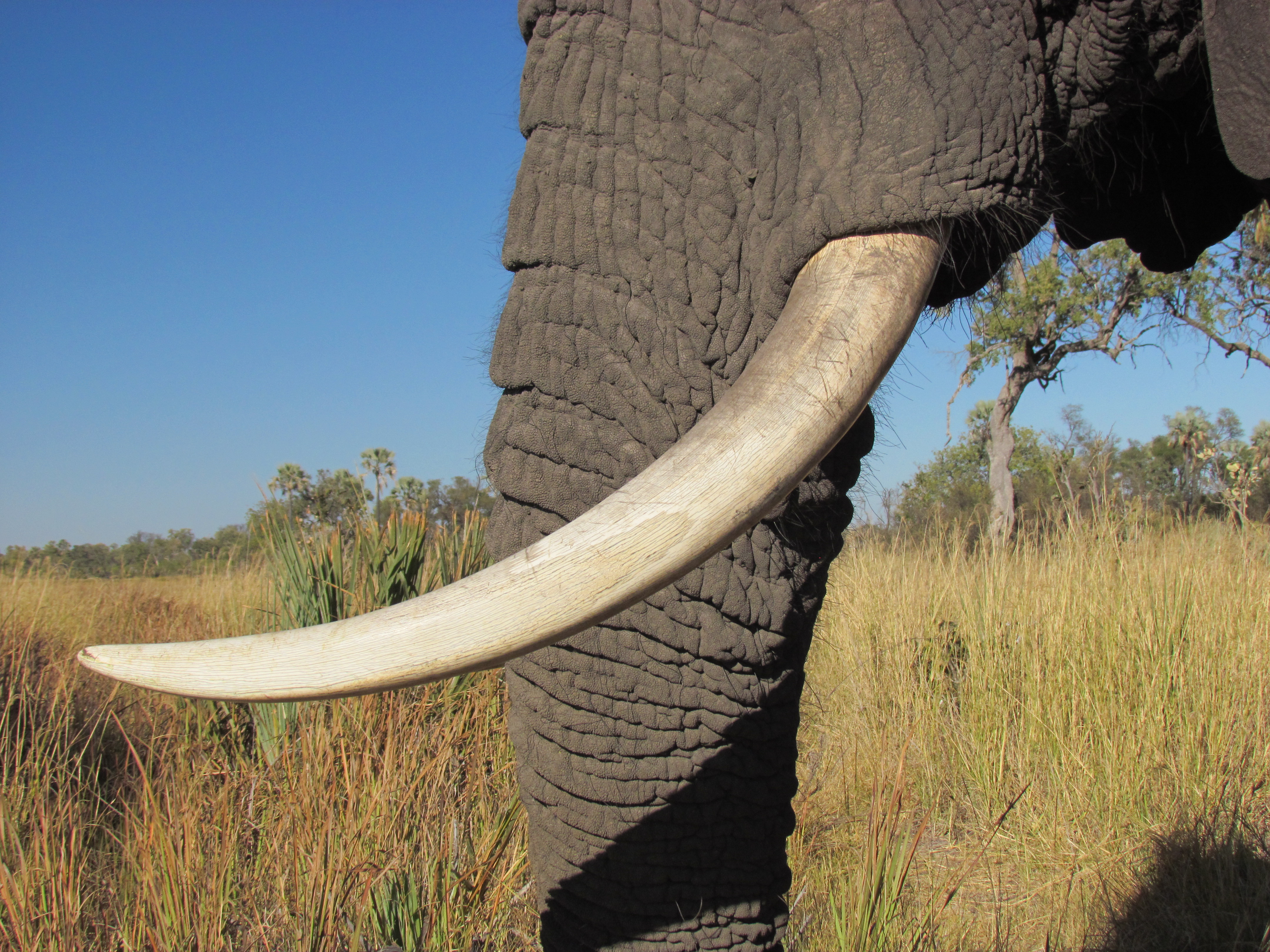
Both male and female African elephants grow tusks – the largest upper incisors on this planet. Tusks are defined as long teeth protruding beyond the mouth growing usually, but not always, in pairs. Most tusks are enlarged canines, such as those of warthogs, wild boars, hippopotamus and walruses. Enlarged canines in the myriad species of cats and dogs are called fangs.
Elephants and narwhal whales have incisor tusks. The narwhal’s single tusk is a left front incisor that grows in a straight spiral. Found mostly in males, narwhal tusks are believed to be the origin of unicorn legends. Oddly enough, narwhals with two tusks are usually female.
By the time Jabu is sixty, his tusks could theoretically reach a length of 18 to 20 feet. But in reality – if he does reach sixty – they will be much shorter, due to the wear and tear of everyday use.
Tusks on bull elephants can weigh seven times that of those on cows. The biggest pair of tusks on record weighed 460 pounds, taken from an old bull killed in 1897 near Mount Kilimanjaro in Kenya.
The longest tusks ever found came from an elephant shot in the Congo in 1907. Its right tusk was 11.4 feet long; it’s left tusk 11 feet.
Such extraordinarily enormous tusks are a genetic trait, much the same as red hair is a genetic trait. Over the centuries poachers and hunters have always targeted male elephants with the largest tusks. As a result, the trait has disappeared from most elephant populations.
The same outcome would occur if redheads were systematically eliminated within family groups. As their genes died out, the redheads among us would become extinct.
Gray wave after gray wave surges out of the bush in small herds of twenty or less, first one group, now another, flooding the huge hollow that contains a waterhole. Dust rises in the air, a potent blend of manure, dried grass and sand. The backwash swells in our direction. Soon a sea of elephants surrounds us. We’re submerged in a roiling world of noise. Snorts, grumbles, trumpets, growling bellies and gargantuan belches resound. Some of the vibrations are too low to hear, but I feel them as they pass through my body, reverberate in my chest cavity, squeeze my heart. Eye after eye inspects us as eddies of elephants swirl past. An old world laps at the foot of our memories, extinguishes centuries of communal fires. The ropes that tether us loosen. We slip away from the familiar shore and set off towards unimaginable ways of being. We look around with wild hearts. We have become part of the herd.
After a long morning walking with tourists we stumble into a shady grove near a lagoon and into the illusion of an al fresco dining room in an elegant restaurant. Fresh branches of mopane decorate the surface of a table covered with a white linen cloth. The leaves on each mopane branch fold modestly like small olive origami decorations. Knives rest across white linen napkins on white china bread plates. The staff from Stanley’s have set up a buffet complete with chafing dishes. White lace doilies edged with heavy colored beads protect the salads from flies. Pepper grinders, oil & vinegar decanters water glasses and wineglasses complete the setting. Nodding at murmured compliments, the bartender hands out cold beer, which has been uppermost on many minds.
It’s odd how fast we re-civilize. All morning long the tourists had been mostly silent, filled with awe at walking next to elephants. Now they sprawl in camp chairs and compare camera lenses.
A cake of soap sits in the fork of a bush next to a white basin on a folding wooden stand. I use the murky water in the basin to lather my hands. One of the camp staff holds a pitcher of clean water for rinsing. The water in the basin turns even grayer with dirt. I empty the basin and small puffs of dust rise from the force of the water hitting floury sand.
Then I too re-civilize, join the human conversation.
While Sandi minds the elephants, Doug mounds his plate with food. He has that unique gift of talking and eating at the same time, consuming enormous amounts of food and speaking in short bursts. Each time he answers a question he sets his fork down and regretfully watches where he places it.
“Look!”
Our heads swivel and our eyes follow a finger pointing skyward.
Locked together, talon-to-talon, fish eagles plummet toward earth in their mating dance, twirling in passionate grip with each other, taut bodies wheeling faster and faster towards earth, picking up suicidal speed.
The eagles break off a second before hitting the ground and swoop up to roost in trees opposite each other. They scream back and forth, flinging their heads over their shoulders. The female’s voice is lower, counter-point to the male’s shriek.
One of the camp staff shakes his head. “I have never seen that before.”
Like the bald eagles of North America, fish eagles have chestnut bodies, long yellow beaks, yellow feet, pure-white heads, white tails and chests, although their bibs are larger.
They have the same habits: they mate for life and build huge stick nests in trees, nests twelve feet wide and ten feet deep. They dwell in the same habitats: rivers, lakes, creeks, lagoons, estuaries, and man-made reservoirs. Both carry fresh fish caught near the surface in their grasping talons, carry the fish headfirst for lesser wind resistance, one claw behind the other, surfing, riding a fish through the air.
The eagles are a reminder that in only five more days I will be going home. Home, where I once witnessed bald eagles teaching their young how to snatch crows out of the air. Where bald eagles row fish ashore, using their wings as oars when the fish are too large to hoist aloft.
Home. Here. Home. Here. Home. Here.
Where I live and where I am. That dual place inside me, moment and memory, locked together, spiraling, spiraling, just like these fish eagles, feather tip to feather tip, talon to talon. Mind spinning, I want to hold onto a tree with fierce feet, cry out, return to the ground, stay here. Learn from birds, from clouds, from rain.







 ABOUT ELEPHANTS
