Posted in Family, Nature, Writing

Fighting for Freedom: an Immigrant’s Story

In 1775, my great-great-great-great-great-great-great-great grandfather came to America from France to help the colonists fight for independence from the British. He was 24 years old. Born in Marseilles to Lady Anne de la Lascour and Admiral Antoine Garoutte, Michel Antoine Garoutte was also born into the nobility of Provence in France, ruled at that time by Louis IV. He was educated to be a Catholic priest until the age of 15 when his older brother died in battle. Michel left the seminary and went to Military School and Officers School, the same schools as his friend, Lafayette.

Both Michel and Lafayette became convinced that the American settlers’ fight for liberty was a just cause. That it was better to have rules of law fashioned for the majority of citizens rather than laws made by edict, made by just one man. Michel was not looking for a new start on life; he was not looking to farm his own land; he was not fleeing persecution – he was fighting for a new concept of governance: democracy over monarchy.

Michel outfitted two ships at his own expense and sailed to the New York Colony. Even though he was from wealth and nobility, he became a pirate and a privateer, overtaking British vessels, seizing ammunition, artillery, and other goods to supply General George Washington’s army at Valley Forge through Little Egg Harbor, which privateers used as a home base.

At the Battle of Chestnut Neck near Little Egg Harbor in 1778, the British burned Michel’s boats and destroyed other supplies before they withdrew under threat of superior patriot forces arriving.

His named now Anglicized to Michael Garoutte, he served on the brig-of-war Enterprise and sloop-of-war Racehorse.

Shortly after the Battle of Chestnut Neck, he went ashore to help a friend hiding in an Inn that aided revolutionaries. Ambushed and bayoneted, he was left for dead. The innkeeper John Smith, a Quaker, found him and brought Michael to his inn, where he was tended to by the innkeeper’s daughter, Sophia. They married in 1778. He was 28. She was 19. They had 14 children together.

After the Revolutionary War Michael and Sophia started a tavern: the La Fayette Tavern in Pleasant Mills, New Jersey. La Fayette visited the tavern and stayed at its inn on his various trips to the newly-formed United States. Michael died at the age of 79 and is buried in the Pleasant Mills Cemetery in New Jersey. The tavern no longer stands. The gravestones at the cemetery are so eroded that his name can no longer be found.

An immigrant who owned castles and could have lived a life of extreme luxury became a commoner in the country whose founding laws he believed in. He fought for the rights of citizens in his adopted country. He didn’t go from rags to riches; he went from riches to just getting by because he did not believe that one man should rule all others; that citizens had the right to govern themselves. His life was like that of many immigrants — fighting for the country they believe in. And still believe it’s worth fighting for.
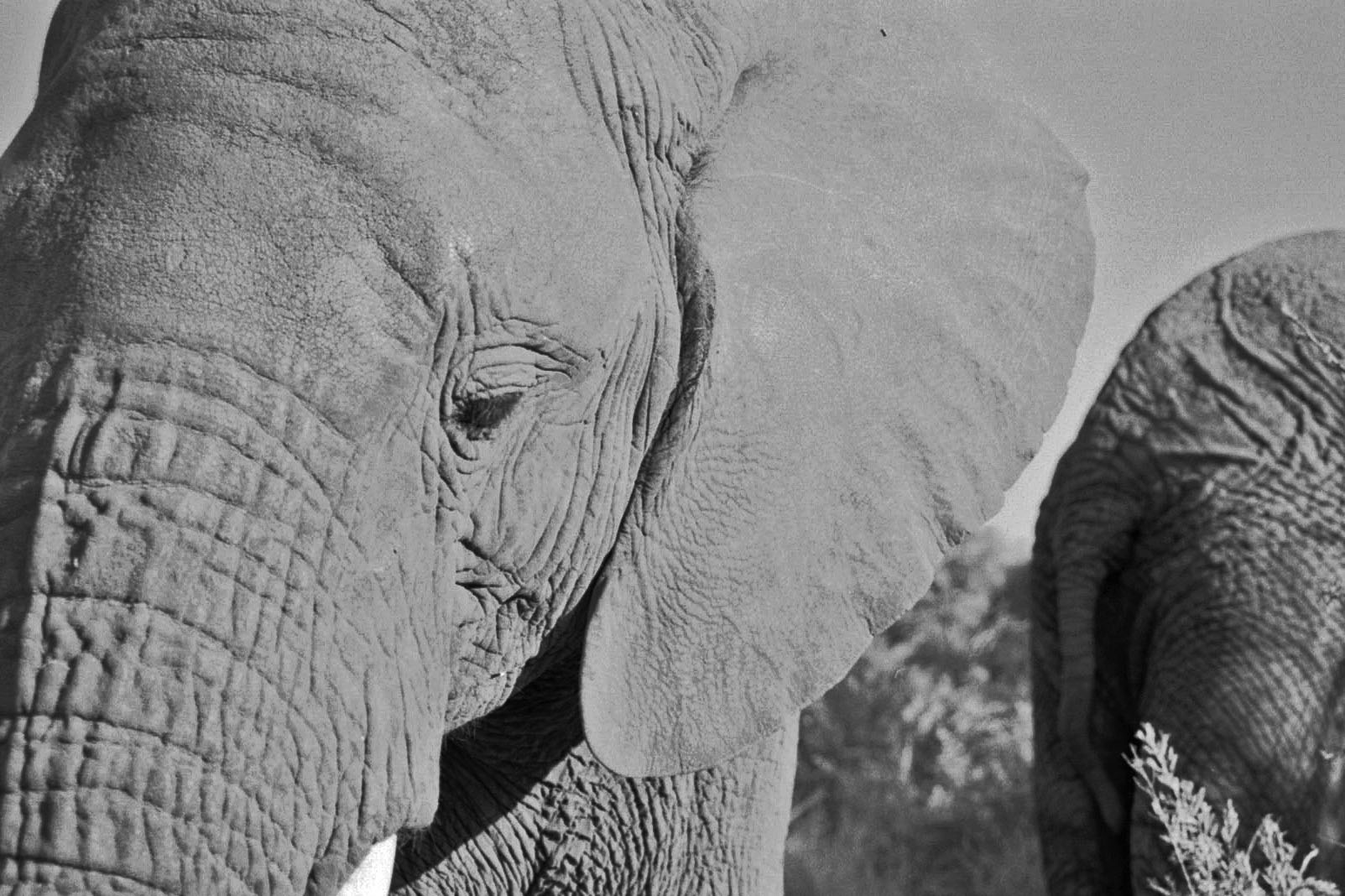

Posted in Africa, Elephants, Family, Nature, Nonfiction, Photography, Thembi, Writing

A Tribute to Thembi: Miles per Pound of Trees

On March 13, one of the elephants I who allowed me into her life died unexpectedly of colic and a heart attack.  I’ve written extensively about Thembi and her herd mates.  This is one of the pieces.


Diamond on forehead 2

Thembi, she of the evenly matched ears, long-lashed eyes, and diamond-shaped scar on the bridge of her nose, farts as she walks.  Big, burbling farts.

All the trees, grasses and leaves Thembi eats gather in her 10-gallon stomach, which is pretty much just a holding area.  From her stomach, roughage travels into her small intestine and then on into her large intestine.  Joining the two intestines is a junction called a cecum, where digestion actually takes place.  Her cecum is filled with billions of microbes, just like most mammals, including us.  The microbes break down the cellulose of leaves and trees into soluble carbohydrates Thembi can digest, but the process also gives her enough methane gas to power a car 20 miles each day.

I wonder, as I walk behind her, just how one could harness this gassy natural resource.  I live at the edge of a small town.  Twenty miles would more than cover my daily errands.  I imagine exhaust fumes smelling like fermenting grass.  I imagine driving down highways inhaling the scent of mulched trees.

I wonder, as I walk behind her, why I think of such things.

Percolating along, Thembi lifts her tail and farts again.  It’s a stupendous displacement of air.  In this just-right light, I can actually see this fart.  It looks like heat waves blasting from the back of a jet engine.

One advantage of Thembi’s size is food efficiency, miles per pound of trees.  An elephant eats four to seven percent of its body weight each day – four hundred to six hundred pounds of vegetation.  Mice eat a twenty-five percent of their weight daily and hummingbirds two times their own weight, or two hundred percent.  If hummingbirds ate trees, the forests of the world would already be gone.  Pound for pound, Thembi needs far less food than rodents or birds.  And with her size comes another advantage over smaller creatures – a longer life span.

We humans, with our penchant for measurements, have conjured up a precise formula for figuring out things like longer life spans.  The formula is called quarter-power-scaling.  A cat is about 100 times more massive than a mouse.  To calculate the cat’s age, take the square root of 100, which is ten, and then the square root of 10, which is 3.2.  The lifespan of a mouse is around 800 days, or just over two years.  Multiply 800 by 3.2.  The result is 2,560 days, or seven years, the average lifespan of a cat.

However, if a cat’s metabolic rate was 100 times faster than that of the mouse, all cats everywhere would spontaneously combust into feline fireballs.  Oddly enough, heart rate, the engine that drives the cat to chase the mouse, scales to the same formula, but in the opposite direction, to the minus quarter-power.  The resting heart rate for a mouse is 500 beats per minute.  Divide that by 3.2 and you have the average heart rate for a cat, around 156 beats per minute.

An elephant’s resting heart rate is a placid thirty-five beats per minute and a bit higher, around forty, when excited.  While the jittery mouse lives just over two years,  an elephant lives around sixty-five years, certainly long enough to power my car for the rest of my life.


Posted in Beauty, Family, Thanksgiving

Family

a-young-hand-holding-an-elderly-hand-665-x-400


A family is a place made of people who either own you or let you go. A place made of blood and breath, of fierce neglect or smothering love. A place of dreamers, borrowers, failures, legends. Of those who are hungry and those who are content. A place of the barefoot or the impeccable, the lost or the homebound, the wise or the ignorant, the selfish or the altruistic. Of those who would sacrifice for you and those who would not, of those who drop off casseroles and those who hold you in their arms.

A family is a place of infinite stories, once you start listening.