Posted in Africa, Elephants, Nature, Nonfiction, Photography, Travel, Writing

Mud Wrestling

Image

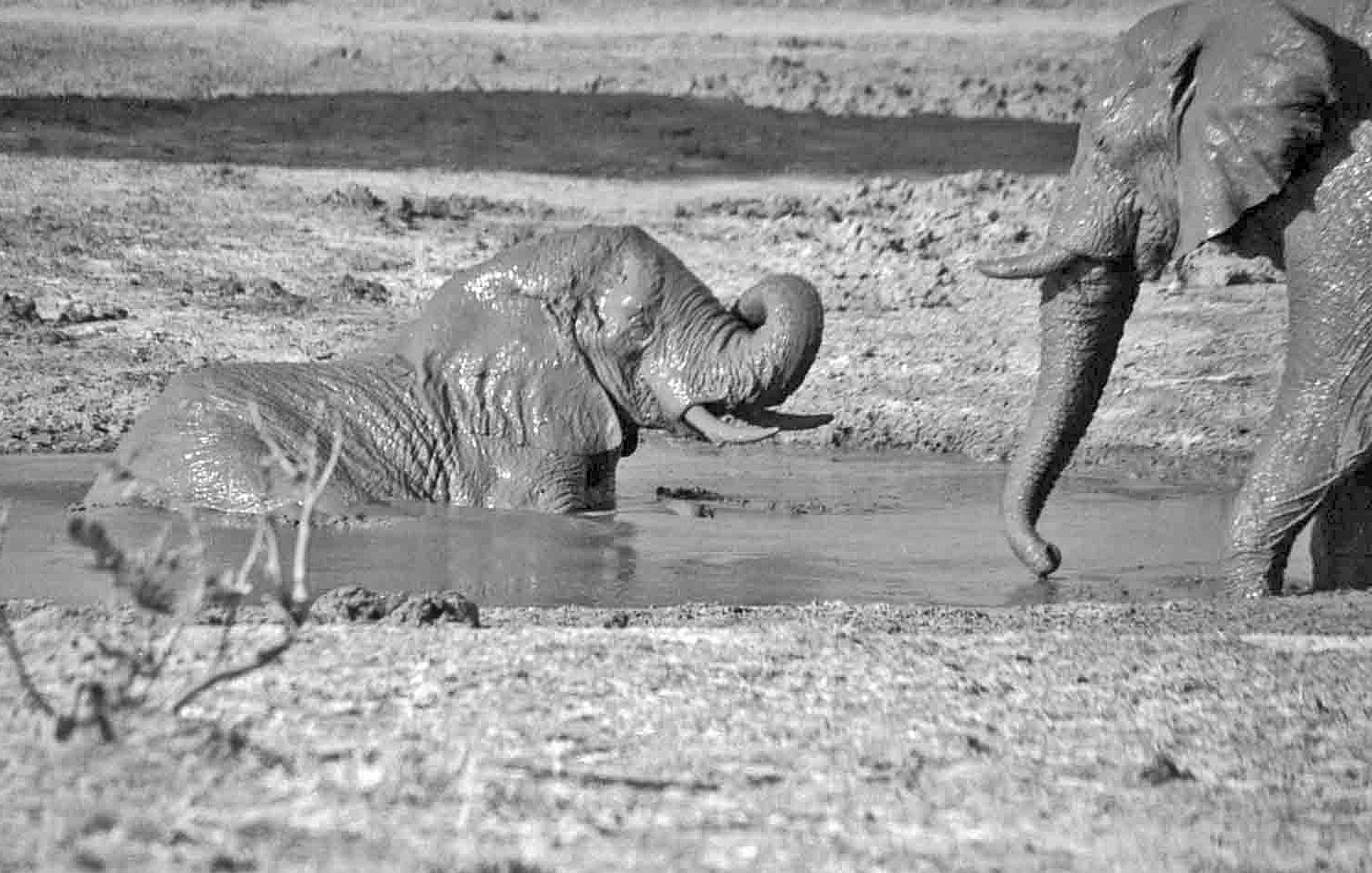
It’s a mucky, slimy, gloppy mud.  A young elephant snorkels on his side, the tip of his trunk swiveling above the surface, as he slides towards the other elephant, a brother or cousin.  His days are filled with heat and dust.  It’s winter in Botswana, the sun is relentless, and mud will soothe his scorched skin.  He lifts his head from the muck, curls his trunk and closes his eyes.  This feels good, his body language says, this feels really good.    

If we could imagine ourselves weighing four tons and think of gravity’s effect on those four tons, then maybe we could imagine wallowing in such mud, pushing and shoving like giant sumo wrestlers, reveling and rolling in the sheer pleasure of warm gunk.  We would inhale a slimy trunk-full of ooze, squirt it like a water gun in any direction, even at each other.  We would rub our eyes clear with a curled fist at the end of our trunks.  We would arise glistening and bright as a metallic statue.  We would be cooled, refreshed, gigantic, gentle beings. . . . if we could imagine such a thing.

Posted in Africa, Elephants, Nature, Nonfiction, Photography, Travel, Writing

How Much of the World Are We Missing?

Listening, really listening.


Just at the edge of darkness, where the light of our fire does not penetrate, an elephant thunders by, trumpeting the whole way, like a locomotive off track in a dry forest, a classic illustration of the Doppler Effect, sound that condenses, rises in pitch, crescendos, blows by, drops pitch, recedes. 

We lift our heads in surprise.  Waves of sound undulate away from us, kin to ripples on a pond.  We use pulsed sound waves, Doppler Radar, to see rain, to know when we should run for cover.  There is no such radar for an incoming elephant.

Eventually his outrage is extinguished in our ears, but elephants a mile away are just beginning to hear it.  Resonance fills the night air around us, yet we are deaf to it, to the sounds just below our range of hearing.

How much of the world are we missing, circle upon circle?  Perhaps instead of placing ourselves at the center we should move to the edges where our skills are low and our learning curve high.  We should extinguish our fire and sit in the darkness listening, really listening.

Posted in Africa, Lions, Nature, Nonfiction, Photography, Writing

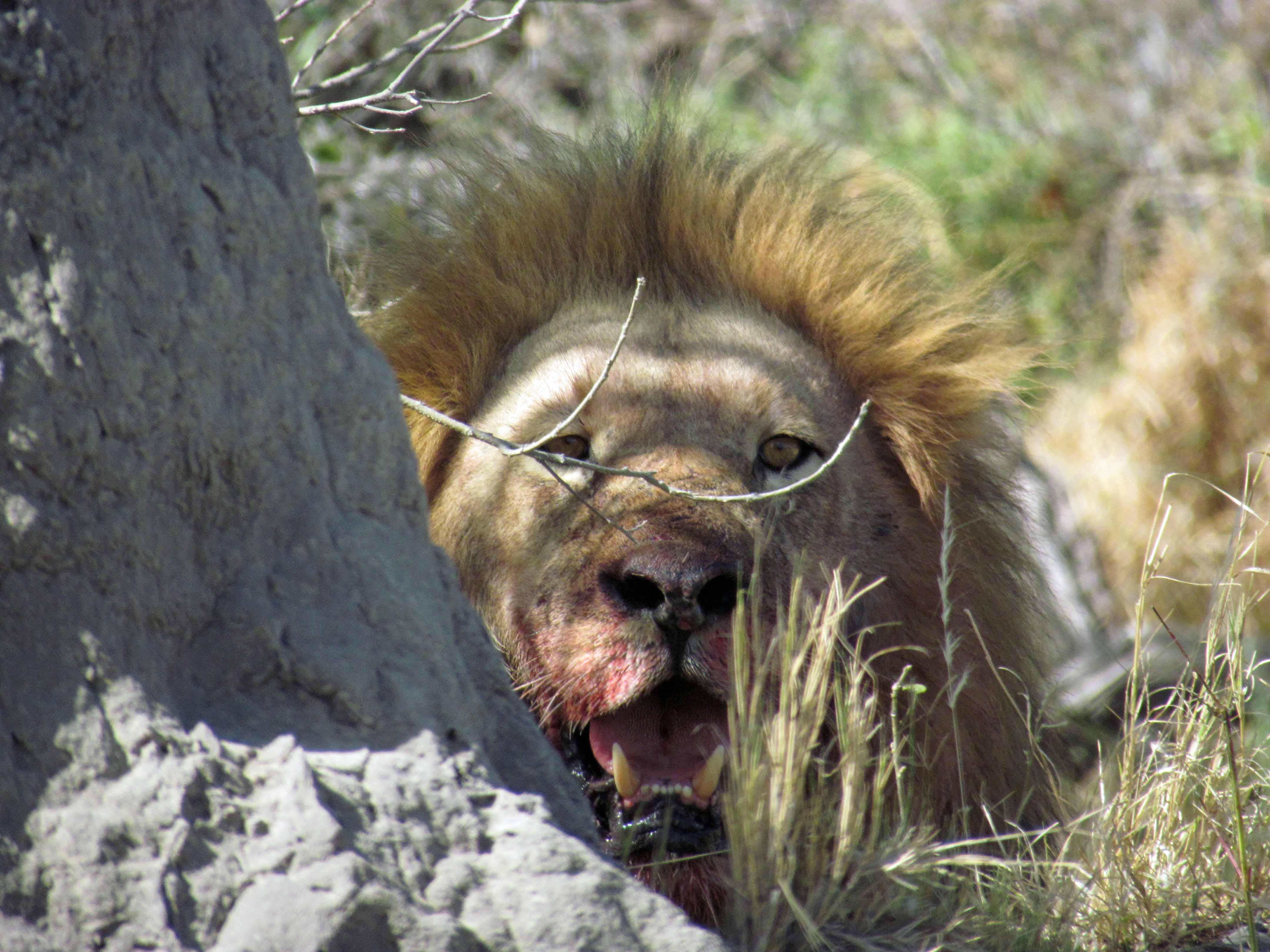
Bring on the Lions

Moremi Game Reserve, Botswana

Most impalas die of old age.  And most people die of old age, too.

But that’s not a very exciting story, is it?

What makes us want to bring on the lions?

Posted in Africa, Elephants, Morula, Nonfiction, Photography, Pleistocene

Footprints

Footprints

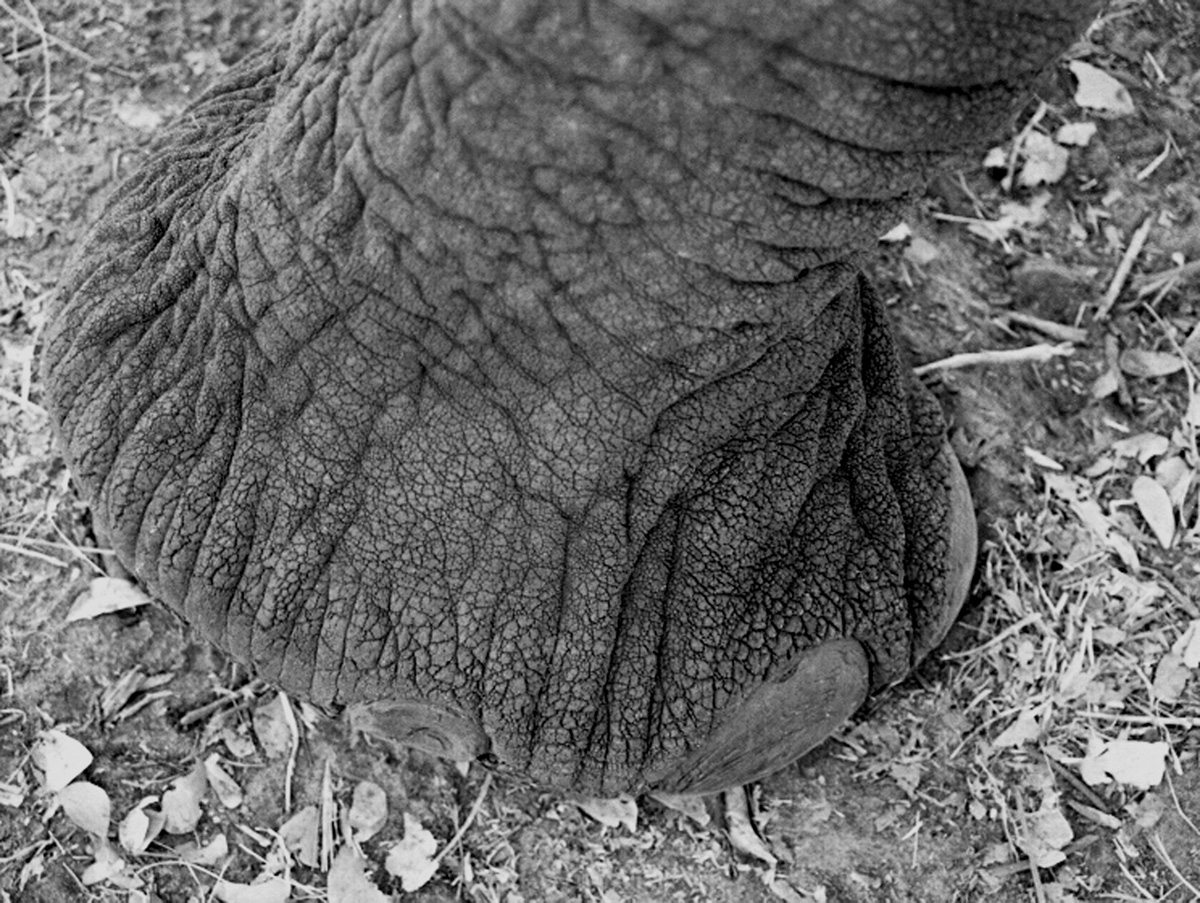
Our feet anchor us to the ground.  Just as my Pleistocene ancestors could read the tracks of mastodons, so I now gaze down at an elephant’s prints in the dust.  Her back feet are oval and her front feet round.  City slicker that I am, even I can tell the direction she is going.

 The sand beneath our feet  is the color of a lion’s coat, studded with brittle leaf litter.  Morula walks through it without making a sound.  Shock-absorbing pads on the soles of her feet cushion each footstep, smother crushed leaves.

I step on a dry leaf and it crackles into powder.

The brand name of my boots imprints within the outline of my soles; a clever advertisement made with each step.  All of my weight concentrates in two small points of contact with the earth, so I make deeper impressions than Morula’s footprints.  Each one of my steps applies more pressure per square inch; Morula’s weight spreads over four large footpads the size of a medium pizza pan.

She can step on a snake and not kill it.

Morula lifts her foot and grains of sand roll down slope into the crater of her footprint.

Following two paths, the one beneath her feet and the one in her mind, Morula strolls on.  Dust rises, a half shadow that marks her passage, before it collapses again to the ground.

There is a before and an after to each moment of our lives, paths we follow and paths we do not.

Posted in Africa, Nature, Nonfiction, Photography, Writing

Our Journeys are All the Same

Sunset

We tell old stories in order to see anew.  Each and every one of us takes the same journey from life to death, though our paths are never the same.

We begin as an explosion of infinite possibilities and then fall back upon ourselves, grabbing at some of those possibilities during our fall.

Our trajectory, which touched the very rim of life, descends toward the center, ending at zero, at what some see as a portal and others see as finality.

Falling, always falling towards the center of ourselves, the huge unknown universe within, our journeys are all the same.

Sunset at Doug & Sandi’s camp, Okavango Delta, Botswana
Posted in Africa, Elephants, Nature, Travel

The Most Useful Appendage That Ever Evolved

An excerpt from my book-in-progress:

Trunk in face


The tip of Jabu’s trunk hovers in front of my eyes, wet with mucous, dotted with sand, nostril hairs visible.

He blows into my face, gently.  I blow back, gently.  We exchange breath, distillations of our own personal atmospheres, particle-swarms of changed, exchanged air, brewed though all the cells of our bodies.

My lungs fill with the fragrance of crushed leaves, with saproots and spearmint-scented bark, all lightly fermented.  I think of the stagnant air that surrounds my daily life, air that is conditioned, filtered, deodorized, air that is bland.  Elephant’s breath is said to cure headaches.  And it just might, if I had one.

Jabu’s trunk tip investigates my right boot tip.  The scents I’ve picked up while walking tumble up two seven-foot-long nostrils – nostrils surrounded by nerves, arteries, veins and a staggering array of longitudinal and transverse muscles, the world’s biggest, longest and certainly most flexible schnozz.

A trunk is the most useful appendage that ever evolved.  Imagine having an arm in place of your nose, an arm long enough to reach to the top of a tree, and pluck a single leaf from its crown.  Imagine having a nose with which you could rip, tear, excavate, whack, and blow bubbles.  You could steal with your nose, suck on it, squeal, swat, poke and siphon with it.  You could take a shower, or reach over your shoulder and scratch your back with it.  You could even arm wrestle with your nose.

He chuffs, a hot gust of air directed at my feet.  Wet mist covers one boot top momentarily, then evaporates.


Posted in Africa, Elephants, Nature, Travel

Trunk Show

Morula trunk underside b&w


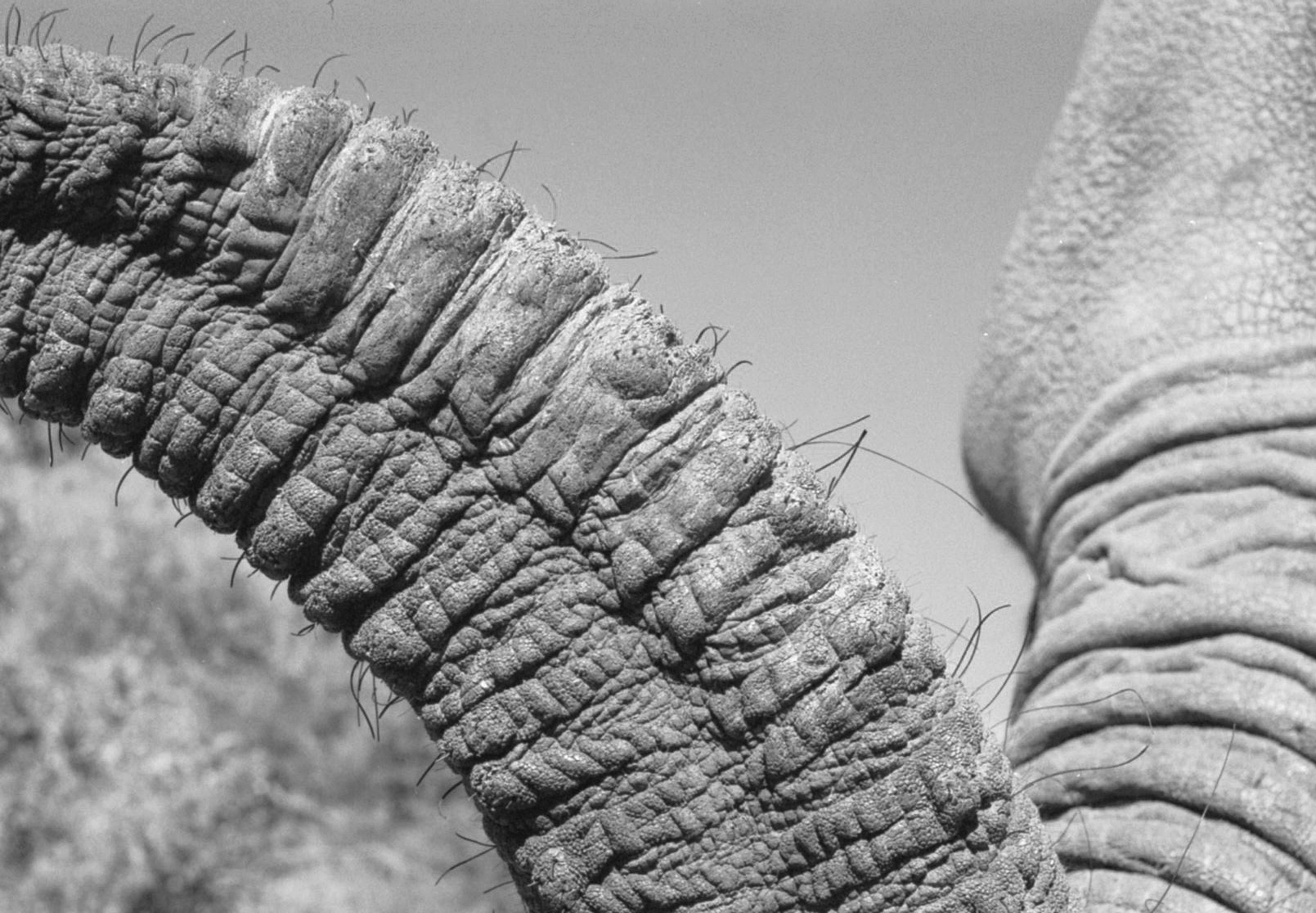
Funky jazzy trombone trunk.  Snaking snorkeling vacuuming trunk.  Showerhead.  Backhoe.  Slinky.  Shimmying sucking swigging trunk.  Empty pipe.  Water gun.  Periscope.  Plucking siphoning tenacious trunk.  Kazoo.  Tweezers.  Tentacle.  Affectionate handshaking pickpocket trunk.  Python.  Air hose.  Question mark.  Whistling snorting sneezing trunk.


Breathtaking

trunk.


Posted in Africa, Travel

The Three Graces

In Greek mythology, the Charites were goddesses of charm, beauty, nature and creativity. Aglaea, “Splendor” was the youngest, Euphrosyne, “Mirth,” was the middle sister and Thalia, “Good Cheer,” the eldest. To the Romans they were known as the Gratiae, the “Graces.” Homer wrote that they were in the retinue of Aphrodite, the goddess of love, pleasure and procreation. Although early depictions of the Graces occurred in marble sculptures dating from the 6th century BC and a first century fresco at Pompeii, they are more likely known by the Renaissance paintings of Botticelli, Raphael and Rubens.

The Three Graces - Rafael
The Three Graces – Rafael


In Africa, grace – the pleasure of beauty in nature – is a constant state of existence.  Splendor, the youngest of the Gratiae, can be found in moments both large and small – in the turn of a head or in a long, glorious sunset.


Three Graces photo small


These three  impala in identical coats pause before us in a moment of easy grace.  The youngest, coltish, knock-kneed, takes our breath away when she throws us a glance over her shoulder.  The charm, the Charities, of fleeting beauty.

Posted in Africa, Travel

The Deadliest Animal in Africa

The deadliest animal in Africa is not a snake, nor a leopard, nor a lion – it’s the hippo, those oddly comic, rotund herbivores that sound like submerged tubas.  Hippos kill more people in Africa than any other animal: several hundred per year.  In contrast, sharks kill only around ten people per year, worldwide.

Hippos don’t even eat the people they kill.  They’re vegetarians, emerging at night from ponds and rivers to eat grass.  Their beady, sherry-colored eyes don’t see well at all, but their sense of smell is acute.  Males defend territory, females their calves.  Both can outrun you, and you never know what might set off a 6,000 pound animal that can achieve a speed of 19 mph.

In 2002, I was traveling through the Moremi Game Reserve in Botswana on a mobile camping safari.  Six people in an open-sided Landcruiser focused their cameras on laid-back hippo blimps floating in a nearby pond.  It was that magic half-hour before sunset when the light is golden and incredible – perfect for photographs.  A short distance away a male grazed on flowers.  I raised my camera.

Without warning, the hippo opened his mouth in a threat gesture, displaying his long, razor-sharp canines.  A second later, he charged, head swinging side to side like a giant sledgehammer, running directly for us at a surprisingly clip, intent on slamming into our vehicle.

He was closing fast.  All I could see through my camera lens were those massive incisors, as the camer’s autofocus kept singing out zzzzt zzzt, zzzzzt zzzt.

Luckily, the engine of our vehicle started without a cough and the hippo just missed our back bumper.  He continued on into the bush for thirty yards before stopping to wonder where we had gone.  This is the only picture I have of him, right before he charged.

Posted in Africa, Travel

Something in the Way She Moves

She is beautiful in the way many large women are beautiful.  There’s something about the smooth sheen on her plump skin and the defiant stare she gives you that makes you fall in love with her, even when she’s eating.