I write about elephants. I write about other things, too.
Author: Cheryl Merrill
Cheryl Merrill’s essays have been published in Fourth Genre, Pilgrimage, Brevity, Seems, South Loop Review, Ghoti, Alaska Quarterly Review, Adventum and Isotope. “Singing Like Yma Sumac” was selected for the Best of Brevity 2005 and Creative Nonfiction #27. It was also included in the anthology Short Takes: Model Essays for Composition, 10th Edition. Another essay, “Trunk,” was chosen for Special Mention in Pushcart 2008.
She is currently working on a book about elephants: Larger than Life: Living in the Shadows of Elephants.
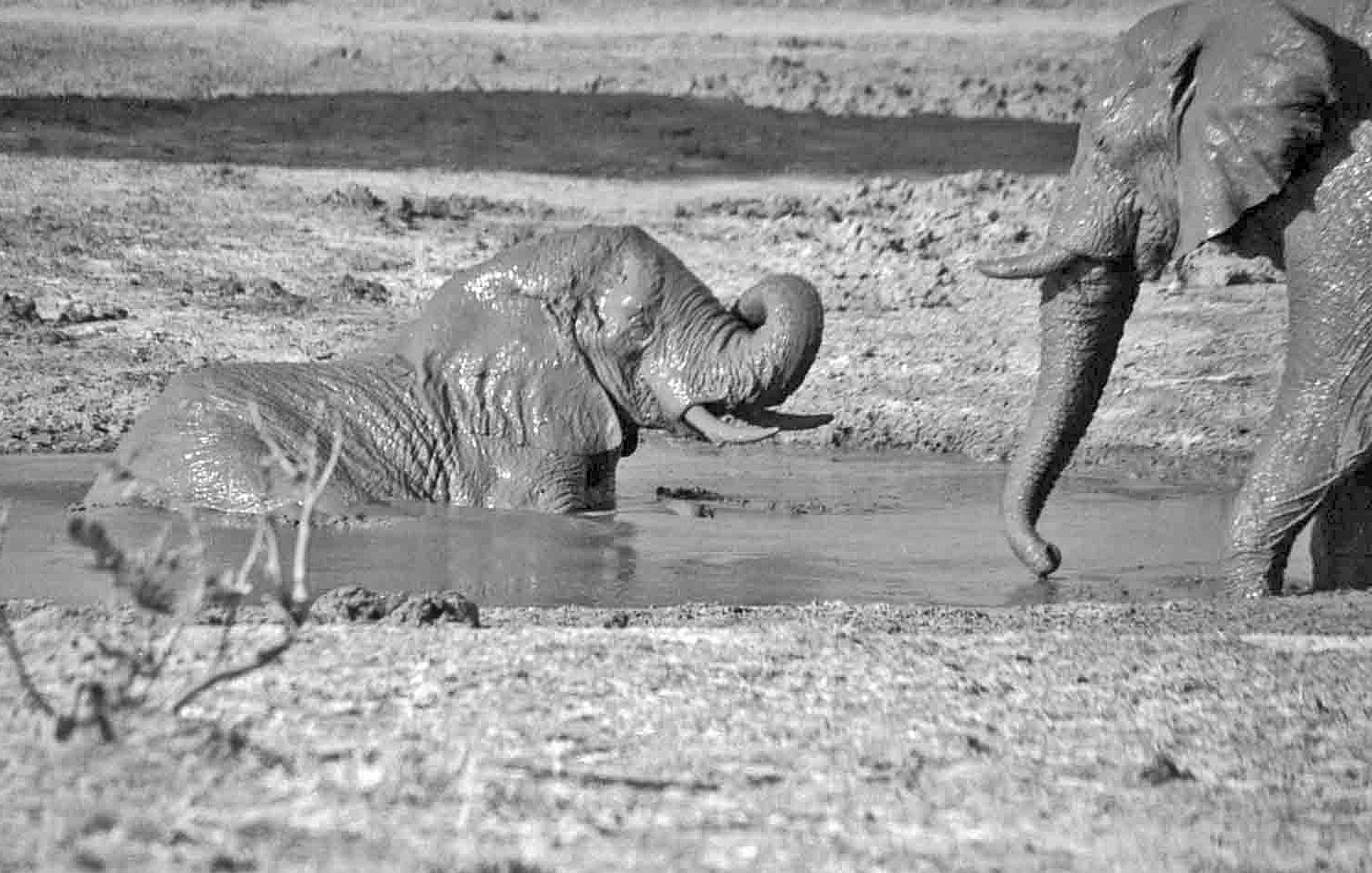
It’s a mucky, slimy, gloppy mud. A young elephant snorkels on his side, the tip of his trunk swiveling above the surface, as he slides towards the other elephant, a brother or cousin. His days are filled with heat and dust. It’s winter in Botswana, the sun is relentless, and mud will soothe his scorched skin. He lifts his head from the muck, curls his trunk and closes his eyes. This feels good, his body language says, this feels really good.
If we could imagine ourselves weighing four tons and think of gravity’s effect on those four tons, then maybe we could imagine wallowing in such mud, pushing and shoving like giant sumo wrestlers, reveling and rolling in the sheer pleasure of warm gunk. We would inhale a slimy trunk-full of ooze, squirt it like a water gun in any direction, even at each other. We would rub our eyes clear with a curled fist at the end of our trunks. We would arise glistening and bright as a metallic statue. We would be cooled, refreshed, gigantic, gentle beings. . . . if we could imagine such a thing.
Just at the edge of darkness, where the light of our fire does not penetrate, an elephant thunders by, trumpeting the whole way, like a locomotive off track in a dry forest, a classic illustration of the Doppler Effect, sound that condenses, rises in pitch, crescendos, blows by, drops pitch, recedes.
We lift our heads in surprise. Waves of sound undulate away from us, kin to ripples on a pond. We use pulsed sound waves, Doppler Radar, to see rain, to know when we should run for cover. There is no such radar for an incoming elephant.
Eventually his outrage is extinguished in our ears, but elephants a mile away are just beginning to hear it. Resonance fills the night airaround us, yet we are deaf to it, to the sounds just below our range of hearing.
How much of the world are we missing, circle upon circle? Perhaps instead of placing ourselves at the center we should move to the edges where our skills are low and our learning curve high. We should extinguish our fire and sit in the darkness listening, really listening.
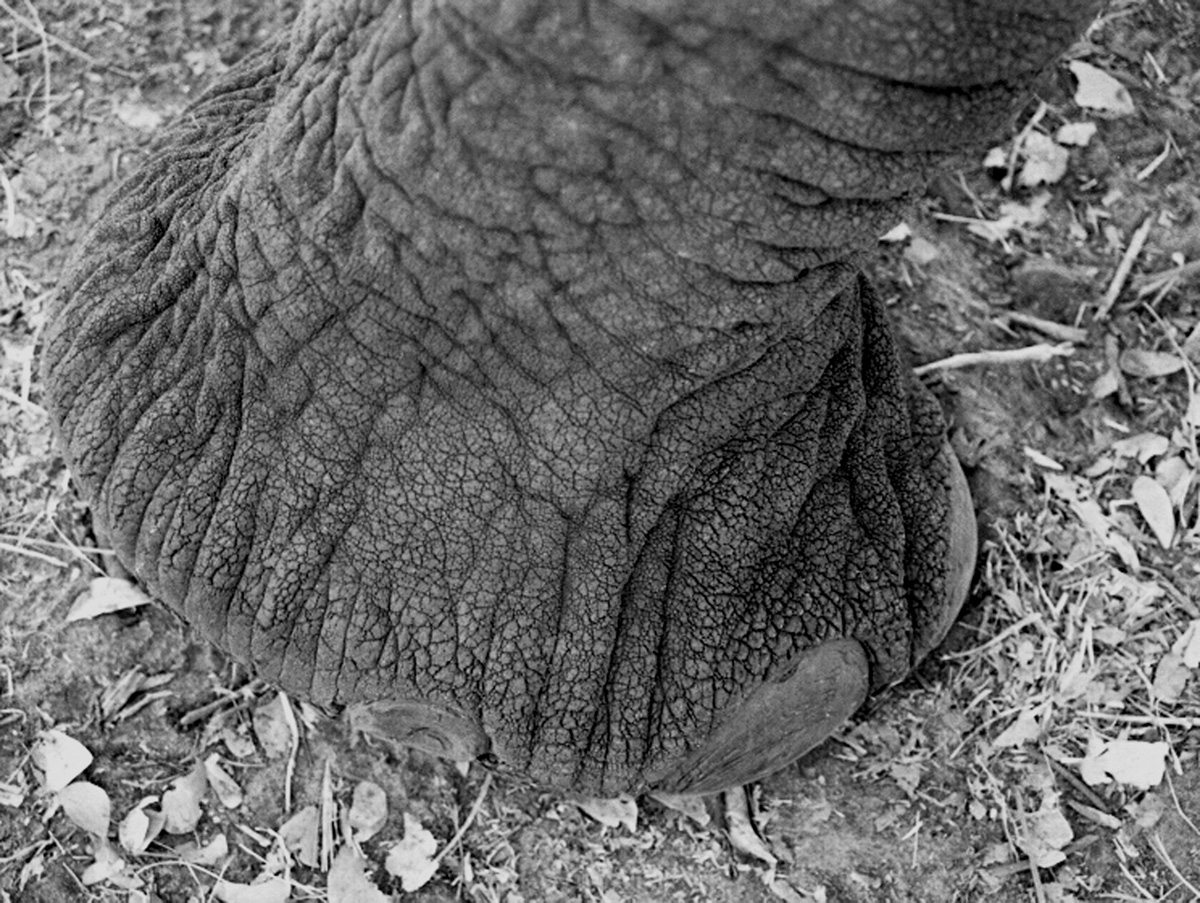
Our feet anchor us to the ground. Just as my Pleistocene ancestors could read the tracks of mastodons, so I now gaze down at an elephant’s prints in the dust. Her back feet are oval and her front feet round. City slicker that I am, even I can tell the direction she is going.
The sand beneath our feet is the color of a lion’s coat, studded with brittle leaf litter. Morula walks through it without making a sound. Shock-absorbing pads on the soles of her feet cushion each footstep, smother crushed leaves.
I step on a dry leaf and it crackles into powder.
The brand name of my boots imprints within the outline of my soles; a clever advertisement made with each step. All of my weight concentrates in two small points of contact with the earth, so I make deeper impressions than Morula’s footprints. Each one of my steps applies more pressure per square inch; Morula’s weight spreads over four large footpads the size of a medium pizza pan.
She can step on a snake and not kill it.
Morula lifts her foot and grains of sand roll down slope into the crater of her footprint.
Following two paths, the one beneath her feet and the one in her mind, Morula strolls on. Dust rises, a half shadow that marks her passage, before it collapses again to the ground.
There is a before and an after to each moment of our lives, paths we follow and paths we do not.
From 93 million miles away, pitched straight at me, vibrating, ululating like an African cry of greeting, light from the sun hurtles towards the earth at 186,282 miles per second and eight minutes later slams into me like a jabbering, long-lost relative trying to make up for lost time. It babbles everything, all at once, into my eyes.
Our eyesight is an electro-chemical reaction to a vibrating particle-wave gushing optical information splash into my brain. I could shut my eyes to the wonder around me and be diminished. I could shut my eyes to the atrocities around me and become hardened.
By opening my eyes, I give shape to my perceptions. By opening my eyes I take responsibility for my vision, for what my eyes teach me. By opening my eyes I learn that I belong to the world, not that the world belongs to me.
Our eyes are openings into and out of our bodies. Are my eyes, as some would say, a window to my soul?
There is a cold way of seeing that clips wings and stifles our words into faint echoes. But there is also a way of seeing where the eye can be like a mouth, swallowing color, taking in the entire world with just one gulp. Just the sheer fact alone that we see color should provide enough wonder to fill our lives, should stop us in our tracks, should keep our eyes wide open, devouring everything as fast as we can choke it down, leave us slack-jawed, gasping for air.
Somewhere behind my eyes, a world exists that I yearn to inhabit, dreams that might become real if only I could imagine them with my eyes wide open.
the elephant sways to a rhythm no one, not even she, can hear. Two steps forward, two steps back. Swaying, her head dips to one side, then the other. Her motions are born from a numb brain, from uncut boredom, from the measurement of a life by that which does not happen.
Beyond the barriers that surround her, a jerky stream of humans flows past, day after day. Their powerful odors overwhelm her, and she touches her temporal gland, samples her urine, the only familiar smells left to her. At the end of each day, after the humans are gone, she hears a multitude of rumbles, but none have resonances she can recognize.
Sometimes she will lie down on the huge square stone into which she is entombed and sleep. There are no stars over her head.
She ceased calling out to her kin a long time ago.
As near as she knows, she is the only elephant left on earth.
Note: There are 284 elephants in 79 accredited zoos in the United States. Most zoos have more than one elephant, because elephants are social creatures who need companions from their own species. I originally wrote this piece when I learned of Maggie, who lived at the Alaska Zoo in Anchorage for 24 years, the last eleven of those years alone. In 2008 she was transported to the PAWS sanctuary in California, where she now lives with other African elephants. Here are the remaining zoos that keep just one elephant:
San Antonio Zoo – “Lucky”
Double M. Ranch, New York – “Reba”
T.I.G.E.R.S., South Carolina – “Bubbles”
Natural Bridge Zoo, Virgina – “Asha”
Wild Adventures, Georgia – “Shirley” – Shirley is age 69 and has been in captivity since 1946.
We tell old stories in order to see anew. Each and every one of us takes the same journey from life to death, though our paths are never the same.
We begin as an explosion of infinite possibilities and then fall back upon ourselves, grabbing at some of those possibilities during our fall.
Our trajectory, which touched the very rim of life, descends toward the center, ending at zero, at what some see as a portal and others see as finality.
Falling, always falling towards the center of ourselves, the huge unknown universe within, our journeys are all the same.
Sunset at Doug & Sandi’s camp, Okavango Delta, Botswana
The tip of Jabu’s trunk hovers in front of my eyes, wet with mucous, dotted with sand, nostril hairs visible.
He blows into my face, gently. I blow back, gently. We exchange breath, distillations of our own personal atmospheres, particle-swarms of changed, exchanged air, brewed though all the cells of our bodies.
My lungs fill with the fragrance of crushed leaves, with saproots and spearmint-scented bark, all lightly fermented. I think of the stagnant air that surrounds my daily life, air that is conditioned, filtered, deodorized, air that is bland. Elephant’s breath is said to cure headaches. And it just might, if I had one.
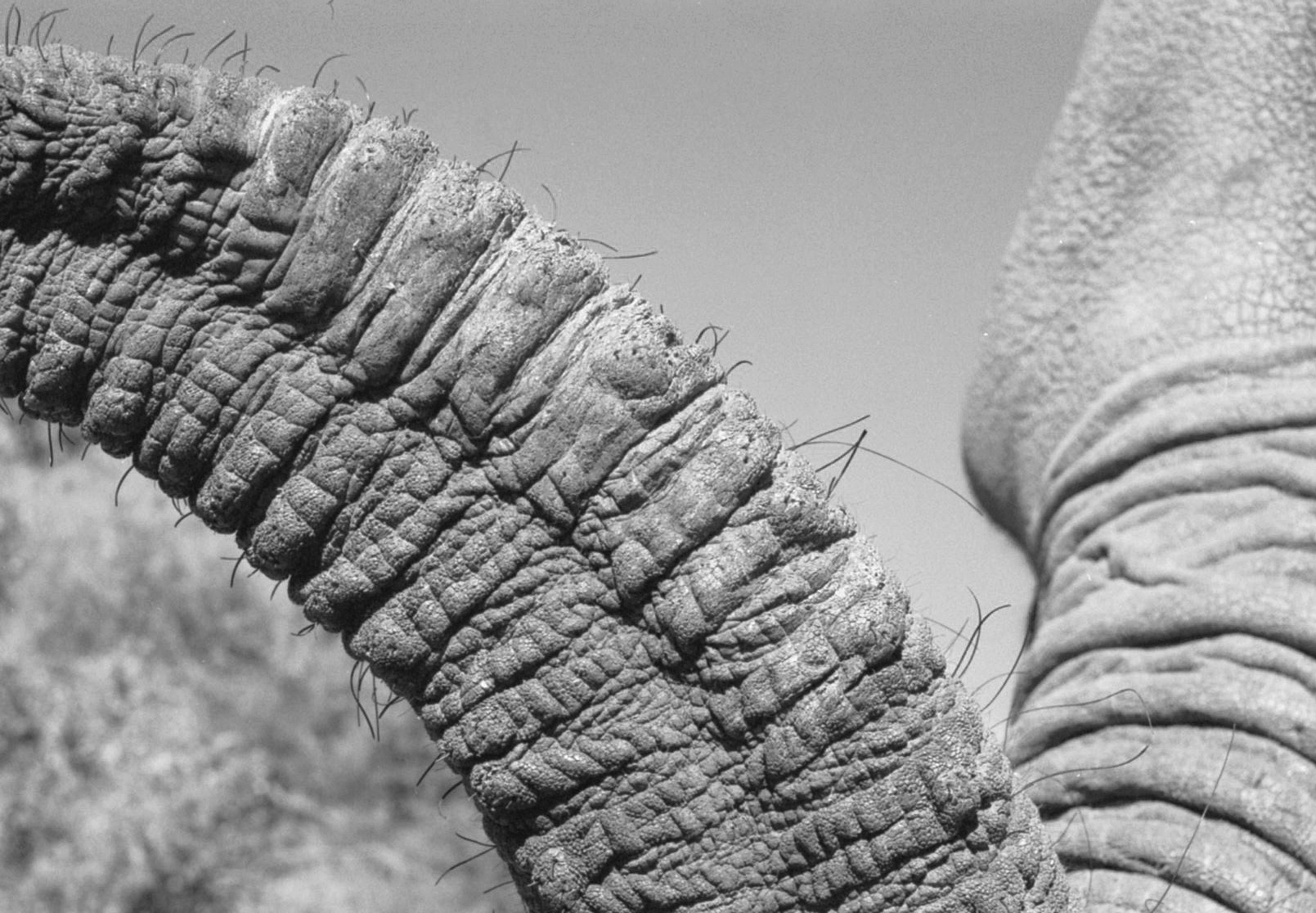
Jabu’s trunk tip investigates my right boot tip. The scents I’ve picked up while walking tumble up two seven-foot-long nostrils – nostrils surrounded by nerves, arteries, veins and a staggering array of longitudinal and transverse muscles, the world’s biggest, longest and certainly most flexible schnozz.
A trunk is the most useful appendage that ever evolved. Imagine having an arm in place of your nose, an arm long enough to reach to the top of a tree, and pluck a single leaf from its crown. Imagine having a nose with which you could rip, tear, excavate, whack, and blow bubbles. You could steal with your nose, suck on it, squeal, swat, poke and siphon with it. You could take a shower, or reach over your shoulder and scratch your back with it. You could even arm wrestle with your nose.
He chuffs, a hot gust of air directed at my feet. Wet mist covers one boot top momentarily, then evaporates.
An excerpt from my book, Larger than Life: Living in the Shadows of Elephants:
As Doug and Sandi prepare for our morning walk, a nearby Cape mourning dove begins its chanting call: hoo-HOO-hoo, hoo-HOO-hoo. The dove is the same shape and color of the pigeons strutting the streets of my hometown, and belongs to the same family as pigeons, Columbidae. Doves are generally smaller birds and pigeons are larger.
One member of Columbidae, the American Passenger Pigeon, was once the most abundant land bird in the world. It’s been estimated that nine billion passenger pigeons were in the United States before colonization – more than twice the number of all birds alive in the U.S. today. Up to a foot-and-a-half in length, the passenger pigeon had distinctive, even iridescent, coloration.
In the early 1800s a flock of passenger pigeons that numbered 2.2 billion birds flew between Kentucky and Indiana – a flock one mile wide extending 240 miles. So many Passenger Pigeons were in that flock that if they were placed beak-to-tail they would have wound around the circumference of the earth nearly 23 times. Audubon recorded an over-flight of Passenger Pigeons that took three days to pass, even though the birds averaged sixty miles an hour. He likened their passage to an eclipse of the sun.
One nesting colony in Wisconsin measured 850 square miles. The rumble of wings erupting from that roost made the ground tremble. Tune your stereo receiver to a place between stations, then turn up the volume until your walls shake. That was the sound of huge flocks of passenger pigeons, a Niagara of birds.
Audubon’s Passenger Pigeons
Audubon painted the passenger pigeon in 1824. Printed plates of his painting show a female on the frosted upper branch of a tree feeding a male perched on a lower branch of the same tree – which is a bit of artistic license, since the pairs always stood next to each other on a branch.
The sexes of the passenger pigeon differed in coloration. The female, with her drab, brownish-orange back and gray plumage on her belly, contrasted with the male’s brilliant blue back and deep pink breast. In Audubon’s painting the male has a duller neck than was often reported – a neck that glittered purple, gold, yellow and green iridescence. Both sexes are depicted with their trademark pink feet and red eyes.
Now the passenger pigeon is gone. Snuffed out. Not a single bird left. Flocks in the millions whose wing beats sounded like thunder, whose descent to the ground in funnels looked like tornados, whose excrement rained to the ground like sleet, gone. Flocks that blocked sunlight from the sky and moved in squalls, in weather fronts, gone. Flocks that would have turned entire radar screens green, gone.
Their extinction was not a natural one, caused by a meteor or ice age or disease. No, we did it. We destroyed their habitat, hunted them, killed them, ate them, fed them to livestock, stuck their feathers in our hats, and shipped them by the ton in railroad cars, five billion birds by the late 1890s.
No one ever thought that five billion birds could disappear. An Ohio legislator wrote in 1857 that the pigeons were “Wonderfully prolific. No ordinary destruction can lessen them or be missed from the myriads that are yearly produced.” But nets, guns and the railroads did their job. Speedy travel meant that pigeon feathers and meat reached their markets in forty-eight hours. Live pigeons were shipped for sport. An estimated half-million pigeons were netted annuallyfor use in shooting matches. One trap shooter claimed he had personally shot 30,000 pigeons in his lifetime. In 1875 three nesting areas in Michigan yielded 1,000 tons of squabs and 2.4 million live birds for consumption.
Martha, stuffed and mounted at the Smithsonian
And yet, scarcely 25 years later, a young boy in Ohio named Press Clay Southworth shot the last wild passenger pigeon on March 12, 1900.
On Sept 1, 1914, Martha, the only passenger pigeon left in the world, died at the Cincinnati Zoo.
I wonder what our skies would look like if the passenger pigeon (instead of the turkey) had been designated our national bird.
The probability of any human being alive is one in billions of trillions. That’s
1,000,000,000,000
multiplied several billion times.
Life. It’s not easy to come by. And lessened by all that has been subtracted from it.






 ABOUT ELEPHANTS