Heads swivel and eyes follow a finger pointing skyward.
Locked together, talons to talons, African fish eagles plummet toward earth in their mating dance, twirling in passionate grip with each other, taut bodies wheeling faster and faster towards earth, picking up suicidal speed. Spiraling, spiraling, feather tip to feather tip, wind streaming through their feathers.
The eagles break off a second before hitting the ground and swoop up to roost in trees opposite each other. They scream back and forth, flinging their heads over their shoulders. The female’s voice is lower, counter-point to the male’s shriek.
One of the guides shakes his head. “I have never seen that before.”
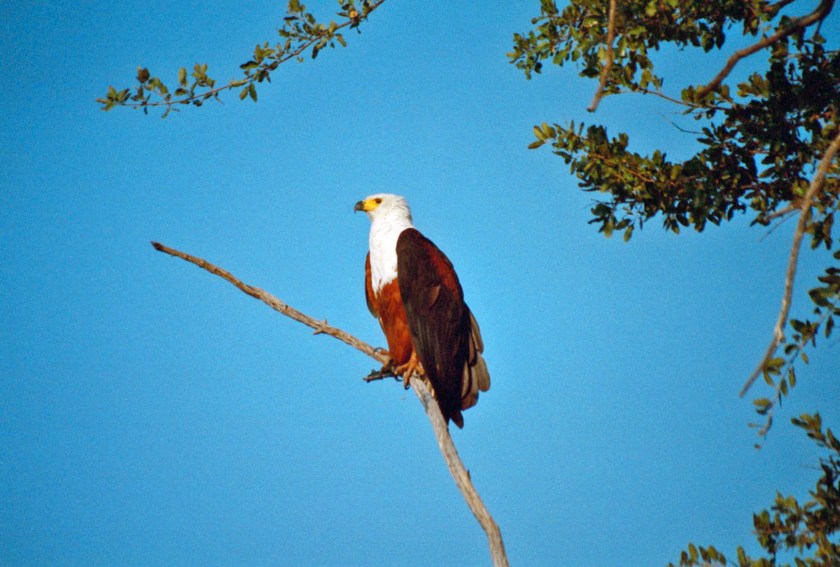
Like the bald eagles in North America, African fish eagles have chestnut bodies, long yellow beaks, yellow feet, pure white heads, white tails and white chests, although their bibs are larger.
They have the same habits – they mate for life and build huge stick nests in trees, nests twelve feet wide and ten feet deep. They dwell in the same habitats – rivers, lakes, creeks, lagoons, estuaries, sea coasts and man-made reservoirs. Both carry fish caught near the water’s surface in their grasping talons, carry the fish headfirst for lesser wind resistance, one claw behind the other, surfing, riding a fish through waves of air.
Holding to their tree with fierce feet, the eagles continue to scream at each other, perhaps in excitement from their mating twirl, or perhaps because they are dizzy. Eagles have somewhat the same structure in their inner ears as humans, including the looping canals for balance. Ah, that instinct, the one that will sweep you off your feet, twirl you around, make you dizzy, breathless, and, for the moment, drop you down totally in love.
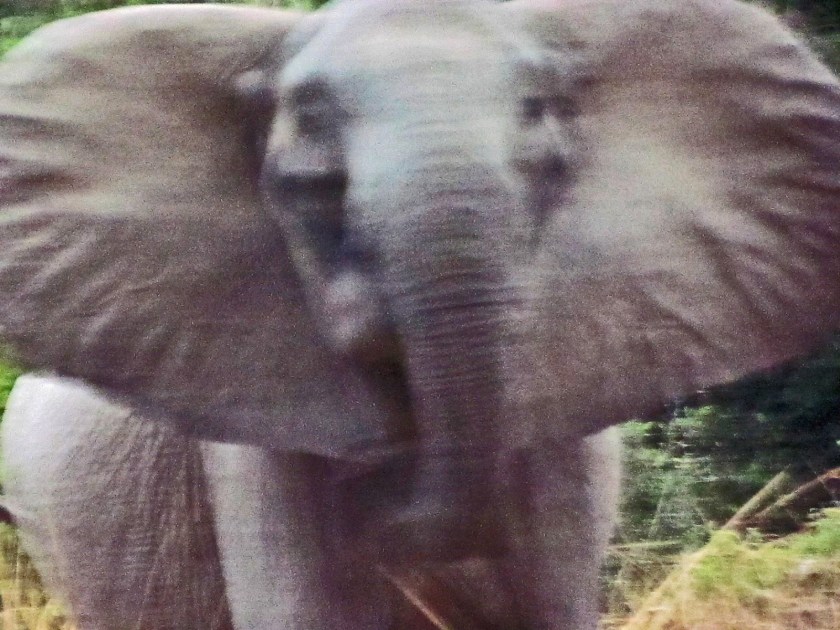
There is a hole in the space between us, filled with thrown dust. You stare down your nose with a don’t-mess-with-me look, but I am describing things in my language, not yours. Yours is a language of thunder, trombones, and a low, rumbling growl. Your breasts are full; your child hides behind you. We have come knockata-knockata noisy around the corner in a vehicle now halted before you. How quickly we became silent and supplicant, waiting with immobile slightly bowed heads, as you sample the scent of our intentions. We are watchers watching each other. Your eyes are deep brown pools. Your benevolence is the most important thing to us. We hope you will bestow it upon us. Dear Madame Elephant, what would you tell us in our language, if you could. Or did you already tell us: your forbearance louder than our beating hearts, louder than words.
As the Earth turns on its axis, everything attached to it turns with it, a lovely effect of the force we call gravity. Without gravity, we’d fly off into space in less than a heartbeat.
The earth’s rotation has another beneficial effect: instead of the atmosphere circulating only between the poles (high pressure areas) and the equator (a low pressure area), circulating air is deflected toward the right in the Northern Hemisphere and toward the left in the Southern Hemisphere, resulting in curled paths. This deflection is called the Coriolis effect, named after the French mathematician Gaspard Gustave de Coriolis (1792-1843) who studied the transfer of energy in rotating systems like waterwheels.
Because of this atmospheric circulation, it’s also believed that water goes down a sink in one direction in the Northern Hemisphere and in the opposite direction in the Southern Hemisphere. Coriolis’s deflection causes weather systems to rotate counterclockwise in the Northern Hemisphere and clockwise in the Southern Hemisphere, so it seems somewhat obvious that a sink should drain in a similar manner.
However, cyclonic systems are often more than 600 miles in diameter and may exist for several days. By contrast, a typical sink is less than four feet in diameter and drains in a matter of seconds. On this scale, the Coriolis force is miniscule – and not really observable.
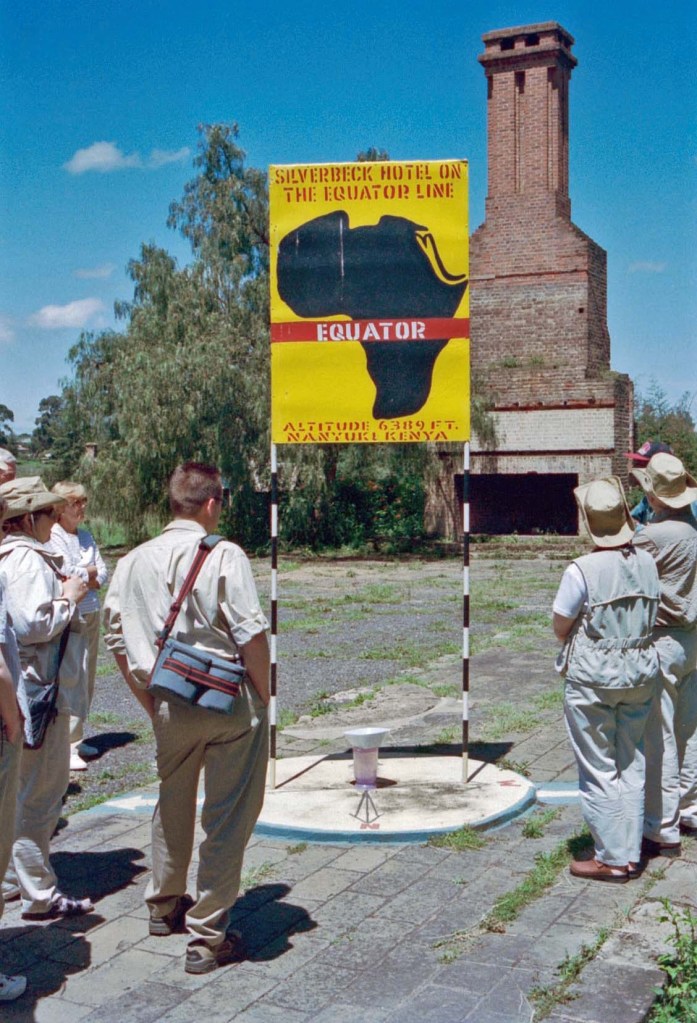
But enterprising hucksters never let the impossible get in the way of yet another tourist trap. In Nanyuki, Kenya, a little town located right on the equator, proof of the Coriolis effect exists. In the burnt shell of the Silverbeck Hotel, at the exact altitude of 6389 feet, (the sign says so), a small squarish plastic sink with a very small hole in the bottom of it rests on a pinkish bucket. The gullible group I’m with stands in the southern hemisphere. The demonstration goes like this: one of the demonstrators holds the empty sink and puts his finger in the hole to plug it. Water is slowly poured into the sink, the finger removed, and the sink is carefully set over the bucket. Matchsticks are added. The water, very slowly drains and the matchsticks barely move. Then the whole enterprise is moved about twenty feet away into the Northern Hemisphere. The sink is plugged, filled from the bucket and water in the sink is allowed to settle down. Then the sink is set down and once again, matchsticks are added to the water. The matchsticks rotate counterclockwise. Moved twenty feet into the Southern Hemisphere, the matchsticks rotate clockwise. After the demonstration we’re given the golden opportunity to purchase a certificate commemorating our witnessing of the Coriolis effect, so we can prove to our friends, who may never have a chance to visit the equator, that we saw one of the wonders of the world.
Alas, the truth always gets in the way of good stories. The secret for this deception is in the shape of the sink and a little choreography. For the first demonstration right at the equator, the water in the sink behaves as it should, with no discernible matchstick rotation in either direction. For the northern part of the demonstration, the pan was filled as the demonstrator faced the equator. He then turned to his left, walked around the bucket, turned to his left again, before he pulled the plug of his finger and added matchsticks. He’s just induced counter-clockwise rotation in a non-circular pan – because of drag, water will turn as the pan does. For the Southern hemisphere he repeated his actions, but turned to the right instead of left.
Clever, eh? But, no worries. Half the world believes that sinks drain differently in different hemispheres. It fooled Michael Palin, too, on a PBS show, no less. And it’s actually true that you can demonstrate the effect with draining water, but you need a kid’s pool, 41 degrees of separation and synced cameras, like these dudes did:

 ABOUT ELEPHANTS