Morula stands square on, keeping her eyes upon me. Her cobbled forehead broadens from her nose upward in a triangular shape. The top of a tree is visible over her right shoulder, as if she has a giant nosegay tucked behind her ear. Short bristles like an old man’s buzz cut outline the top of her head.
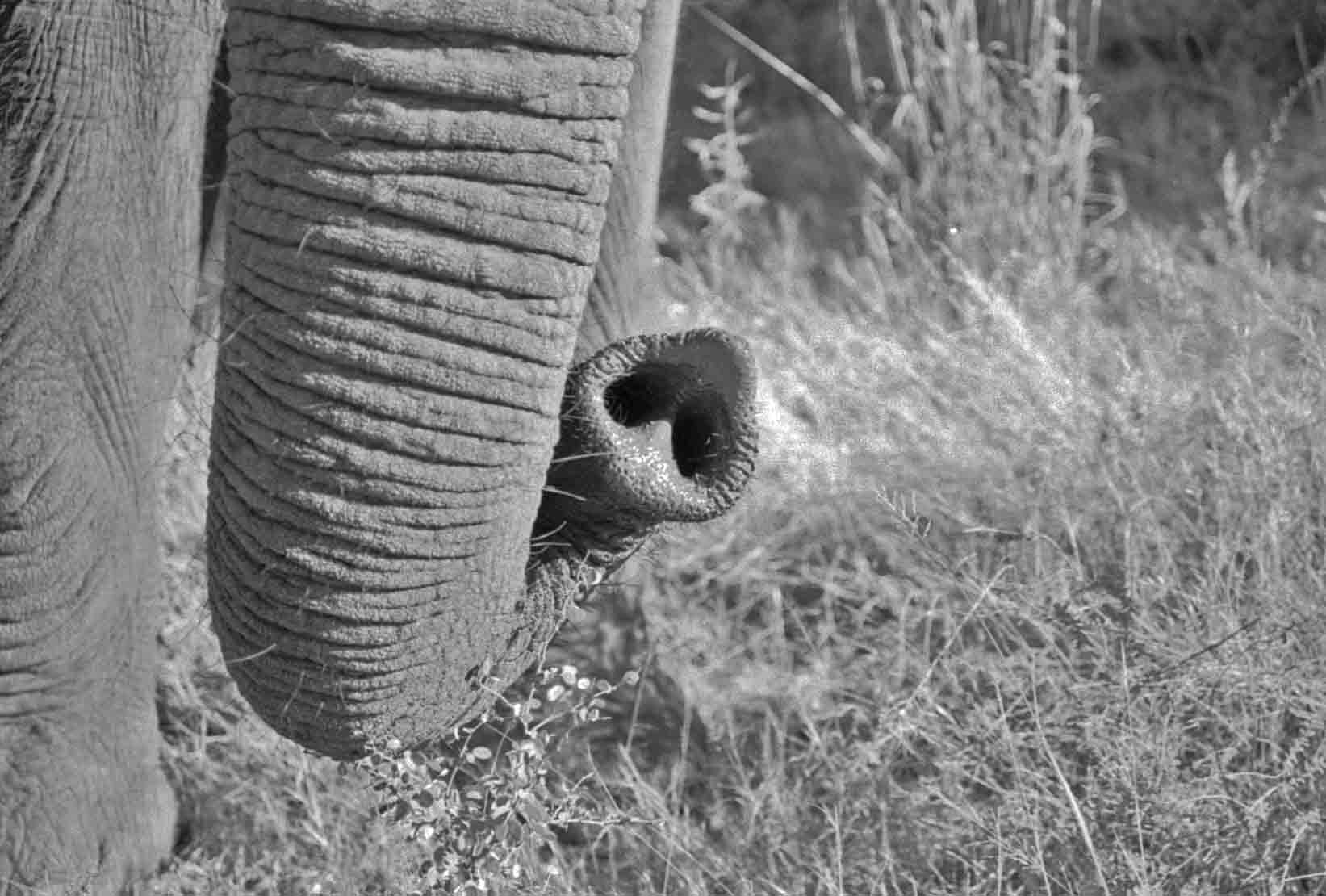
Because of the way she’s standing, ears flattened against her shoulders, Morula seems slim, her skull almost hollow. The tip of her trunk flops over itself in a loose coil and points down like a curved arrow. It begins to twitch in an irregular rhythm. I take the lens cap from my camera and glimpse a tiny reflection of myself in its mirror. Is this what she sees – another one of those small humans, with its odd upright stature? Does she see details: my hat, my camera, my idiotic grin?
I take a goofy photograph of Morula – it will look like she’s bored and playing with the only thing at hand – her trunk.
It’s a catchy tune, one that loops round and round inside our heads. The announcer takes center ring, resplendent under a spotlight in top hat and tails. “LADIEZZZ AND GENTLEMEN! BOYS AND GIRLS OF ALL AGES! WELCOME TO THE GREATEST SHOW ON EARTH!
And indeed it is. Here comes the parade of animals, prancing horses, muzzled bears, tigers roaring in their cages on wheels. Here come the elephants in pink tutus, performing night after night to that same inescapable rhythm which now marches into our ears.
There’s exhilaration tumbling inside us as the great beasts circle center ring. We have tamed them; they obey our commands and kneel before us. We oooo and aahh and clap at these exotic creatures from far-off places. We laugh at the clowns and at ourselves. Each and every one of us wants to run away and join the circus, relief from our humdrum lives.
When we exit the canvas tent our imaginations deflate a little, but our wish to master the world does not. We go home and try to teach new tricks to cats curled in our armchairs.
Buddhists believe a person would do well to model themselves after the elephant. Not the ones in pink tutus circling and circling to the same song, for they are most like us, made over in our own image. We should instead metamorphose into great gray patient beings standing naked in our own skins under the stars and the sun. Perhaps then we could rejoin the world of fellow beings, relearn ancient rhythms. Perhaps then we would know what they know.
It’s always interesting to look at statistics and try to tease out what’s behind them. My most popular blog posts were (1) Miles per Pound of Trees (elephant farts), (2) Black Mamba in the Toilet (self-explanatory) and (3) Mammals are Called Mammals Because . . . (elephant nipples). You can see where this is going. All I can hope is that those folks using their search engines for snakes in the toilet, elephant farts and elephant nipples are surprised and educated along the way. For those of you with piqued prurient interest, I’ll repost them this month while I’m working on tightening up my elephant manuscript. Thanks to the many followers – you know who you are.
Here’s an excerpt:
The concert hall at the Sydney Opera House holds 2,700 people. This blog was viewed about 15,000 times in 2014. If it were a concert at Sydney Opera House, it would take about 6 sold-out performances for that many people to see it.
Popularized in the 17th century and still available today, netsuke (pronounced nets-keh) are small carved toggles used to attach pouches or boxes to the sashes of traditional Japanese robes worn by men, robes which had no pockets. Instead, “sagemono” (suspended objects) hung by cords from the belts of men’s kimono robes – the two holes in the netsuke at the end of the cords prevented them from slipping through the sash. Sagemono included cloth pouches, small woven baskets, or the most popular (and beautifully made) wooden boxes. In this manner, Japanese men carried pipes, tobacco, writing implements, personal seals, medicine, or money. The combination of sagemona and netsuke were carefully considered before any well-dressed gentleman appeared in public.
Most popular during the Endo period (1615-1868), netsuke evolved from being strictly utilitarian objects made of shell and wood into intricately carved miniature sculptures with motifs inspired by animals, vegetables, fairy tales, daily life and mythological or religious figures. Most common are sculptural netsuke: compact three-dimensional figures carved into round shapes and one to three inches long. Other types include elongated carvings, hollow netsuke, masks, or trick netsuke with hidden or moving parts.
Materials used for carving netsuke include elephant and mammoth ivory, hardwoods, hippopotamus tusks, boar tusks, rhinoceros horn, antlers, and clay. Woven netsuke are made from cane. Other materials used are the casques (upper mandible) of the Helmeted hornbill; black coral; partially fossilized pine and cedar wood found under sections of Sendai, Japan; walrus tusks; sperm whale teeth; whale bone; bear’s teeth; tiger’s teeth; ivory palm nuts, walnuts; agate; the underground stems of bamboo; and ivorine – made from the dust created when carving ivory, which is mixed with clear resin and compressed.
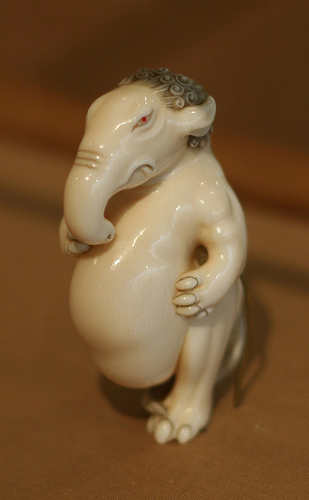
Subjects portrayed by netsuke include nearly every aspect of Japanese culture, including people famous, anonymous, historical, fantastical, or real. Some netsuke depict entire scenes from mythology, literature, or history. Trades people were often carved in action – woodcutters cutting wood, fishermen catching fish. Other subjects included plants, especially beans and chestnuts, often carved in actual size; inanimate objects such as roof tiles, coins and tools; and abstract patterns. Shunga, or erotic netsuke, include humans or animals in acts of conjugation or contain subtle or symbolic sexual references. Animal subjects varied from zodiac signs to rats, from octopi to rabbits. One of my favorites is by Masatoshi: “Baku Monster Who Eats Nightmares.” It resembles a standing pregnant elephant with red eyes, dark curly hair, and biceps. A contemporary piece, it is made of ivory.
Nearly 50% of netsuke is ivory.
Netsuke: an art that requires death.
Between 1977 and 1987 Japan imported 2,832 tons of elephant ivory. Two-thirds of that amount was carved into Hankos, writing seals still required on official documents. One hundred and seventy tons of ivory went into the production of netsuke. In 1989, a ban was enacted on all ivory trade. Still, countries could apply for, and receive, ivory under special sales. In 2006, 2.8 tons of illegal ivory was seized in Osaka. Japan last received a legal import of ivory in 2009.In 2011, Japan’s biggest ivory dealer, Takaichi Co., was found to be trading in “unregistered” ivory. An estimated 572-1622 illegal tusks had been converted into hankos between 2005 and 2010 by the firm – 87% of their production.And nearly all Japanese people have figurines, anime or cartoon characters, many made from ivory, hanging from their mobile phones — a mass-produced, contemporary way keeping alive the nation’s netsuke tradition.
Netsuke. Small, beautiful sculptures made of calcium, made from the incisors of dead elephants.
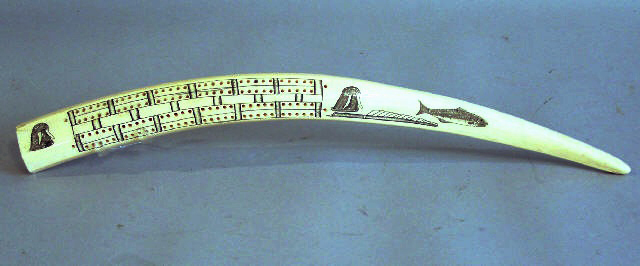
From the 1860s to the 1880s, an estimated 100,000 elephants per year were slaughtered for their ivory, a total of two million elephants in twenty years. Their tusks were made into:
Victorian gentry wore perforated ivory cylinders around their necks, each cylinder baited with blood – flea traps. Women with high Marie Antoinette wigs had long ivory sticks for scratching their scalps. Renoir’s favorite formulation for black paint included burnt ivory, which was also used to tint gray hair. Peter the Great spent long hours turning out ivory candlesticks and goblets on his lathe. It was fashionable for gentry to have such hobbies. Newton had his portrait painted in watercolor on an ivory medallion, another fashionable thing to do.
Ivory was used in making billiard balls and piano keys – fixtures of Victorian gentility. Industrialized plants in Ivoryton, Connecticut produced 350,000 pianos; each and every key made of ivory. Ivory shavings were boiled with water into jelly and hawked for medicinal purposes. Ivory dust was sold as fertilizer.
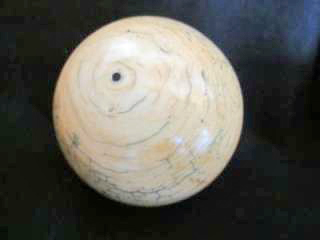
Billiard balls required the use of small, straight female tusks, which could yield five or less rough-cut balls, with the central nerve channel in the precise middle of each ball. They were highly valued because such balls rolled in true lines. The density of each ball was matched with similar balls to produce a complete set. A complete set of fifteen billiard balls required the tusks from three elephants.
Most billiard players were unaware that the click of one ball hitting another was the same sound elephants produce in the wild as they greet each other by gently tapping their tusks together.
Ivory billiard balls changed according to weather and the temperature of the room. Queen Victoria kept her billiard table heated. Shipping labels on sets of balls warned that they would split if used when cold. Eventually, over time, ivory billiard balls developed an egg shape and needed to be replaced. As a hedge against fluctuating supply (tusks) and demand (replacement sets) manufacturers stocked as many as twenty thousand balls in vaults with stable temperatures.
When cheaper resin replaced ivory for billiard balls and plastic replaced ivory piano keys, elephants were given a reprieve.
Around 40,000 years ago, someone took a fragment of a mammoth’s tusk and carved a small mammoth from it – one of the earliest known pieces of art made from ivory. Roughly an inch high and one-and-a-half inches in length, it’s unmistakably a mammoth, complete with trunk, tail and a high domed head. Twelve thousand years after the carving was discarded in a cave in Germany, a band of Paleolithic people dug three shallow graves into permafrost near present-day Moscow. Thousands of tiny ivory beads adorned each skeleton, each bead laboriously made with stone tools.
The earliest carved portrait of a human face dates from around 23,000 years ago. Discovered in a cave in France, it too was crafted from mammoth ivory. Named the Venus of Brassempouy for the village near where it was found, the small ivory figurine has a forehead, eyes, brows, nose, but no mouth. The top and sides of her head depict braided hair. It was unearthed in 1894 with numerous other figurines made of stone. Other late Stone Age “Venus” figures, with their bulging torsos and small heads devoid of detail were found in sites that range from the Pyrenees to Siberia. Ongoing excavations and reconstructions of ivory carvings from the “Stone Age” include ivory birds, lions, horses, and several lion-headed humans, all made by stone tools.
Mammoth Skull in situ, Mammoth Museum, Hot Springs, South Dakota
At first, there was quite enough ivory simply lying around on the ground to satisfy the needs of man. Ice Age huts discovered in the Ukraine used mammoth skulls as foundations and shoulder blades as walls. Tusks held down hides draped over the rooflines. One hut had 35 such weights. The age of individual bones used in the construction of these huts spanned more than 10,000 years, an indication of the amount of ivory to be found at hand. When new sites are found, they are collapsed inward upon themselves; shelters reduced to reliquaries of bone.
Reconstruction of a mammoth bone hut at the Mammoth Museum, Hots Springs, South Dakota
Early Egyptian pyramids had already been built before the last of the mammoths died. As pharaohs consolidated their kingdoms, elephant ivory (the material closest to hand) was one of the valued items of tribute sent down the Nile by conquered states. Not only did Tutankhamen have an ivory headrest in his tomb, he also had ivory statuettes of concubines to accompany him in his afterlife. Game boards were entombed in his royal suite, to also allay boredom in eternity. Made of solid ivory, the boards were fitted with carved-out drawers to hold gaming pieces.
Egyptians carved ivory into veneers, reliefs, statuary, jewelry, arrow points, small furniture, combs, spoons, the handles of weapons, scarabs, amulets, coffin lids, and used as inlays on toilet caskets (cosmetic boxes) containing such items as eye shadow pots, mirrors and perfume jars, some also made of ivory. Cleopatra, who presided over the last of the Pharaonic dynasties, quite possibly participated in banquets while lying on a bronze couch inlaid with glass and ivory described as being in her palace in Alexandria. The palace was also described as having ivory-paneled entrance halls. Re-discovered in 2012 beneath the Mediterranean Sea, the royal quarters are relatively intact, having slid under water during cataclysmic earthquakes and tsunamis in the fourth and eighth centuries. Excavations have just begun of its treasures.
To Egypt’s north, no one society dominated the eastern Mediterranean trade. However, around 1,000 BC, the Phoenicians, in what is now modern-day Lebanon and Syria, had an efficient maritime network that supplied King Solomon with the ivory he needed to build his ivory throne in his temple at Jerusalem. Described in 1 Kings 10 of the Bible, it was “a great throne of ivory,” covered with the finest gold. The throne also included rubies, sapphires, emeralds and other precious stones.
In the fifth century BC, the Greek historian Herodotus traveled to the Egyptian city of Elephantine, located at the first cataract of the Nile, and reported that elephants could still be hunted to the west, in Libya. Also in the fifth century BC, Greeks saw the construction of two immense ivory-covered statues, one of Athena at the Parthenon and the other of Zeus, at Olympia. Erected around 432 BC, both were made of “chryselephantine:” clothes and scepters of gold, faces, bare arms, shoulders, and torsos covered in ivory. Zeus, sitting on his throne, was thirty-nine feet tall, the height of a four-story building. Because ivory dries out once it is separated from the creature who bore it, Zeus and Athena were constantly anointed with olive oil, which collected into a gleaming surrounding pool.
The statue of Zeus was considered one of the seven wonders of the ancient world. Carried off to Constantinople in 394 AD, it was destroyed by fire in 462 AD. By the Middle Ages all chryselephantine statues had been stripped of their valuable materials and demolished. Only the hole remains at the Parthenon that held Athena’s central wooden support.
By the third century BC, Rome replaced Greece as the center of the ancient world. Romans used more ivory than any other civilization until the 1880s. For their marble statues they inserted ivory into chiseled, empty eyes. Birdcages, scroll holders, currency, cameos, candleholders, dolls, boxes, and statuettes of gladiators were all made of ivory. Caligula built an ivory manger for his horse. Immense consular diptychs (two ivory panels joined by a hinge) carved with the image of the governing consul served as the sign of his office.
Roman doll, Louvre, copyright Genevra Kornbluth
The Roman demand for ivory caused North Africa’s last wild elephants to vanish around the 2nd century AD, about the time that the last Mediterranean cedars and oaks were felled.
Land that once supported elephants now barely supports goats.
Carved ivory thrones are mentioned in the Bible. King Solomon had one, covered with gold. Tutankhamen’s casket had a carved ivory headrest for his pillow. Cicero wrote of Roman houses where ivory doors opened onto entire rooms covered with ivory tiles. Gladiators had chariots made of ivory.
In the 1800s, in Africa, ton after ton of tusks were transported thousands of miles to Zanzibar and Khartoum, carried on the backs of slaves. By the 1980s, more than 300 elephants a day were slaughtered for their ivory, nearly 100,000 per year.
In Amboseli National Park, in Tanzania, a recessive gene is becoming dominant, occurring in 50 years instead of thousands, selected by poachers.
Year after year tuskless elephants are born.
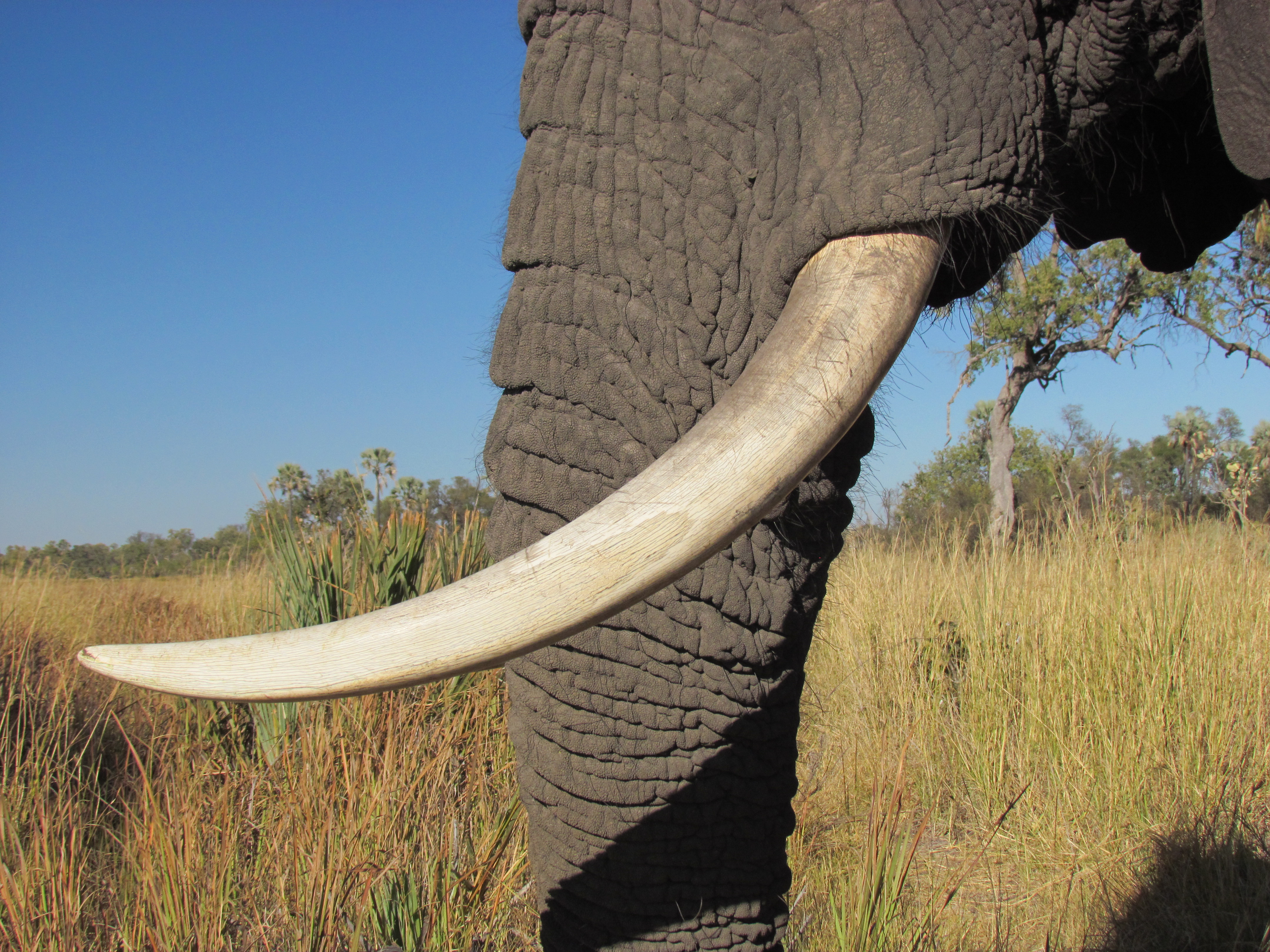
Both male and female African elephants grow tusks – the largest upper incisors on this planet. Tusks are defined as long teeth protruding beyond the mouth growing usually, but not always, in pairs. Most tusks are enlarged canines, such as those of warthogs, wild boars, hippopotamus and walruses. Enlarged canines in the myriad species of cats and dogs are called fangs.
Elephants and narwhal whales have incisor tusks. The narwhal’s single tusk is a left front incisor that grows in a straight spiral. Found mostly in males, narwhal tusks are believed to be the origin of unicorn legends. Oddly enough, narwhals with two tusks are usually female.
By the time Jabu is sixty, his tusks could theoretically reach a length of 18 to 20 feet. But in reality – if he does reach sixty – they will be much shorter, due to the wear and tear of everyday use.
Tusks on bull elephants can weigh seven times that of those on cows. The biggest pair of tusks on record weighed 460 pounds, taken from an old bull killed in 1897 near Mount Kilimanjaro in Kenya.
The longest tusks ever found came from an elephant shot in the Congo in 1907. Its right tusk was 11.4 feet long; it’s left tusk 11 feet.
Such extraordinarily enormous tusks are a genetic trait, much the same as red hair is a genetic trait. Over the centuries poachers and hunters have always targeted male elephants with the largest tusks. As a result, the trait has disappeared from most elephant populations.
The same outcome would occur if redheads were systematically eliminated within family groups. As their genes died out, the redheads among us would become extinct.
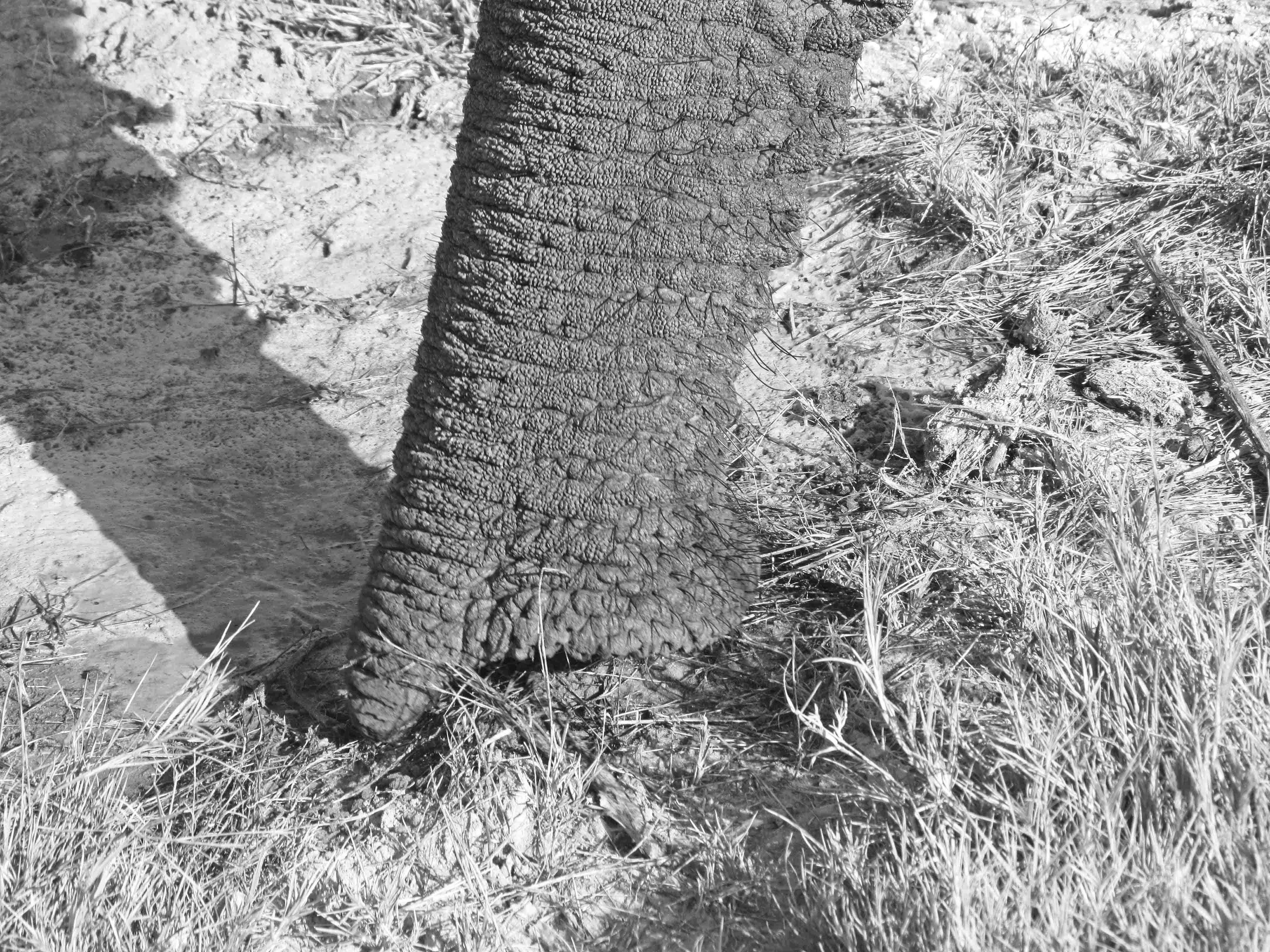
Awash in a sea of scent, Jabu curls his trunk and samples wave after wave of odors breaking at his feet. Redolent tides wash in, wash out, a floating realm populated with aromatic citizens. Schools of scents cluster at his feet, swimming through the grass at the bottom of an ocean of air.
Sixty percent of his brain is dedicated to smell. Jabu can distinguish between a million or more separate odors in the daily news that floats by on warm currents. Just a few molecules bring him history and current events: stories of who was here, who is there, how long they stayed and in which direction they went. Jabu can detect fellow elephants ten miles away.
He reaches out and flattens the tip of his trunk over a wet spot in the sand. Eyes half closed, he stands completely still, as if lost in memory, his brain sorting through the various scents tumbling up his trunk. He samples the air thoughtfully, as if listening to a quiet conversation, as if storing it, word by word, in those huge frontal lobes of his.
I remember that elephants see the world in yellows and blues, like color-blind humans. I fasten a yellow filter over my camera lens, then a blue one. Jabu turns aquamarine. From far, far away, he snaps a branch from a shrub the color of kelp, chomps, munches, drifts closer. His slow motions make perfect sense underwater.
I wade into a lagoon of grass. Ankles, knees, waist, chest, neck. Some of the grass stalks bob over my head. My hands, my body, my thoughts, move slowly.
Immersed, my ears fill with a pure hum. The sound of my passage whispers in seashell voices.
As Jabu drifts by, undertones of blue and gray shimmer against his flanks, reflections of seaweed and kelp. I follow, sub-aquatic, at the bottom of air. Carried by the current of my imagination, I am about to tumble downstream.
Then the breeze kicks up, feels as if it comes all the way from the bottom of the Kalahari, feels red, feels gritty, feels dry as a hundred-year-old skeleton left in the desert. It sucks every bit of moisture from under me and lands me beached and gasping.
I lower my camera. Red invades yellow and the world greens.
Gray wave after gray wave surges out of the bush in small herds of twenty or less, first one group, now another, flooding the huge hollow that contains a waterhole. Dust rises in the air, a potent blend of manure, dried grass and sand. The backwash swells in our direction. Soon a sea of elephants surrounds us. We’re submerged in a roiling world of noise. Snorts, grumbles, trumpets, growling bellies and gargantuan belches resound. Some of the vibrations are too low to hear, but I feel them as they pass through my body, reverberate in my chest cavity, squeeze my heart. Eye after eye inspects us as eddies of elephants swirl past. An old world laps at the foot of our memories, extinguishes centuries of communal fires. The ropes that tether us loosen. We slip away from the familiar shore and set off towards unimaginable ways of being. We look around with wild hearts. We have become part of the herd.











 ABOUT ELEPHANTS