As a writer, the unarticulated language of each day is what I try to comprehend. Gray grammar, revealing run-on sentences, naughty nouns, veritable verbs, placid paragraphs, excited exclamations, or periods big as moons – I try to comprehend the meld of minutes and hours, but all of it without words, until I begin to think about meaning. But it’s never close enough, this thinking in images, to relive the day. It’s not the whole, not for a person who spends her life following a trail of breadcrumb words constantly picked apart by the birds in my mind, birds of short attention spans who flutter in and flutter off.
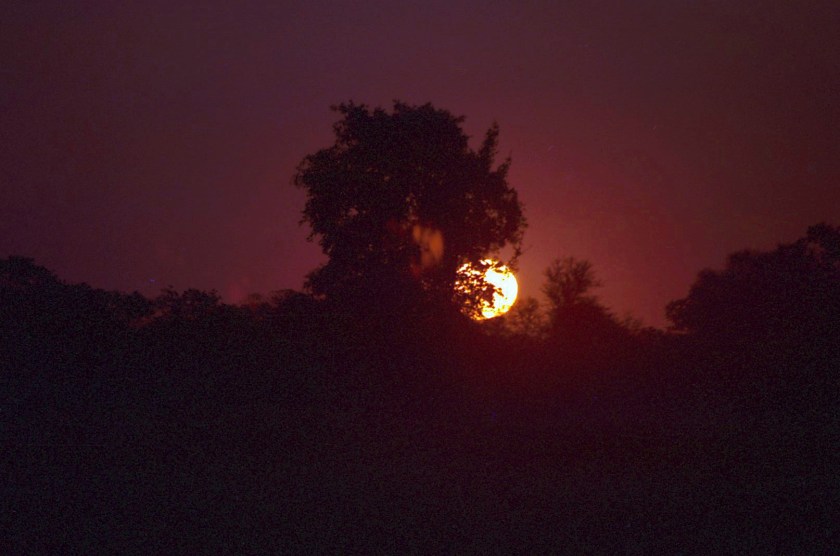
I try to pin each day to the page. I run after the squiggly pen marks that scamper off and disappear, my thought unfinished. I try to make every thought come together in the center; I try to herd them, one slow word at a time. I try to leave a tangible record of where I have been and where I might likely be found in the terrain of my mind. I watch the hourglass drip grain after grain of sand. I bend my head closer to the page; push my pen faster as a dusky rose light fades in the west and the moon sets into a blanket of black trees standing in a pool of fog.
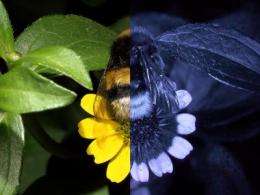
photo by Klaus Schmitt, for the Floral Reflectance Database, Univ. of London
Every color I see is really a color rejected. Elephants are gray because gray is the color of the wavelengths of light reflected from the surface of their skins. Blue jays are blue and daffodils are yellow for the same reason. It’s possible for our eyes to gorge on a thousand or more different color combinations – tints of turquoise, hues of hyacinth, shades of sapphire. For proof, simply go to the nearest paint store.
But the colors I see are not the colors seen by elephants or by snakes or by insects or by cats and dogs. Many scientists after many experiments believe that cats and dogs do not see colors well, but that birds do, and that the colors of their feathers have a lot to do with either camouflage or sexy come-ons. I believe the scientists are right. Otherwise we would endure male dogs with tails like peacocks and female cats with hind ends as red and swollen as baboons.
The colors I see, and the subtle natural variations of them, were of considerable advantage to my ancestors, foraging primates swinging down from the trees into the lion-colored grass. Colors indicated ripe fruit; motion and patterns the difference between zebras and leopards.
To honeybees, the world as I see it moves like molasses. Each eye of the honeybee contains nearly 7000 lenses, 7000 pinpoint openings for light, giving it composite images shaped somewhat like snow globes. Homing in on flowers at 300 images per second, (vs. 60 for humans) bees zoom about in fast-forward, so they can make all those in-flight adjustments to the slightest change of wind, grasp all those swollen bodies of pollen.
Like us, honeybees have three photoreceptors in their eyes. Where we see blue, green, and red, bees perceive blue, green and ultraviolet, combined into colors entirely different from those we see. Ultraviolet patterns on flowers are invisible to us, but to bees those patterns announce seductive landing zones.
It’s been long speculated that creatures with compound eyes see far less efficiently than we do. But seeing is in the eye of the beholder, in the language of colors available to read. Where I might not even notice a certain flower a besotted bee ogles an orgy of ultraviolet ravishment, an irresistible, come-hither promise of pollen and nectar.
I want the language of bees in my head, to see the world differently when I write. I want my words to unfold like time-lapsed flowers, petal pushing against petal, blooming in foreign color combinations, perennial, glorious, sexy, irresistible. I want you to stick your nose inside my flowers, waggling and buzzing. I want you to come away pollinated.
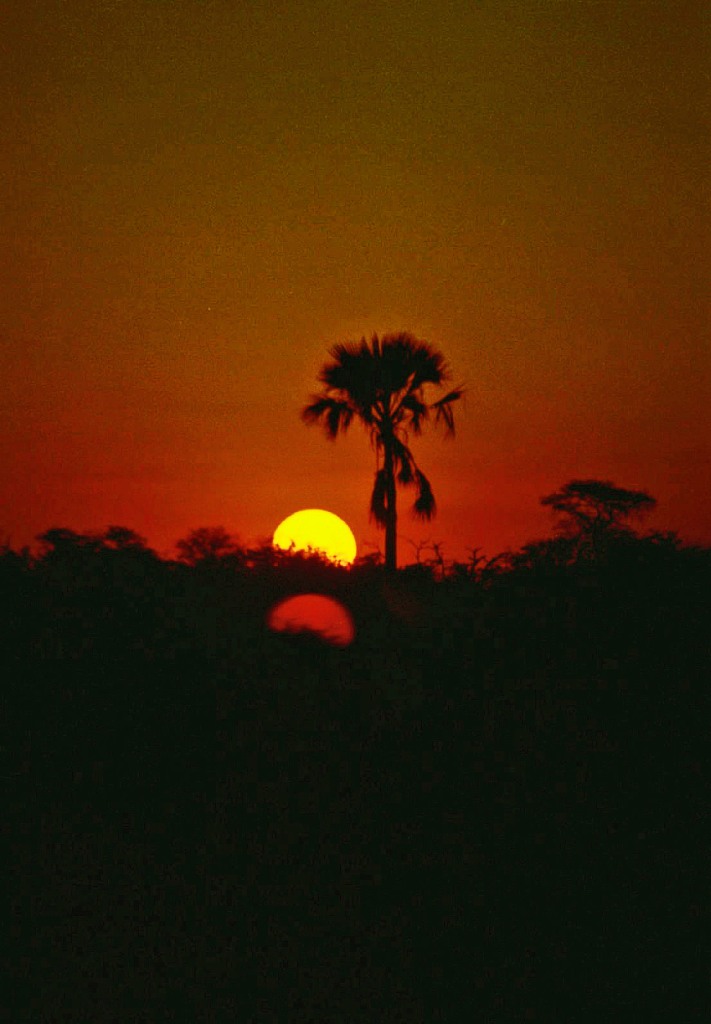
Melting from yellow to orange the swirled, stained-glass sun hangs round and unfastened, rolling down a line of bush. The last hot breath of the day exhales and in a single moment the sun drops and is gone.
A lemon sky turns violet. Moisture thickens as plants exhale and shadows deepen. As light fades, smells condense – the cold iron of stars, the ancient, clean smell of cold sand under my feet, sage on my fingertips, smoke in my hair.
Palm trees fan black silhouettes against the stars.
I look up at a sky filled with diamonds where the giant, gem-studded belt of the Milky Way girdles the full belly of the night. By its light alone I pick my way to my tent.
The moon sails west, round and immense, shining a clean, pure light that has a whiff of blue about it. The brush is full of crickets, each one singing in a different rhythm. I hear a few individuals among the many – soloists. I hear collective phrasing – the choir. And right before I sleep I hear them singing even more loudly to the sizzling stars.
We tell old stories in order to see anew. All of us take the same journey from life to death, though our paths are never the same. We begin as an explosion of infinite possibilities and then, for the rest of our lives, fall back upon ourselves, grabbing at some of those possibilities during our fall. Our trajectory, which touched the very rim of life, descends toward the center, ending at zero, at what some see as a portal and others see as finality. Falling, always falling towards the center of ourselves, the huge unknown universe within, our journeys are all the same.
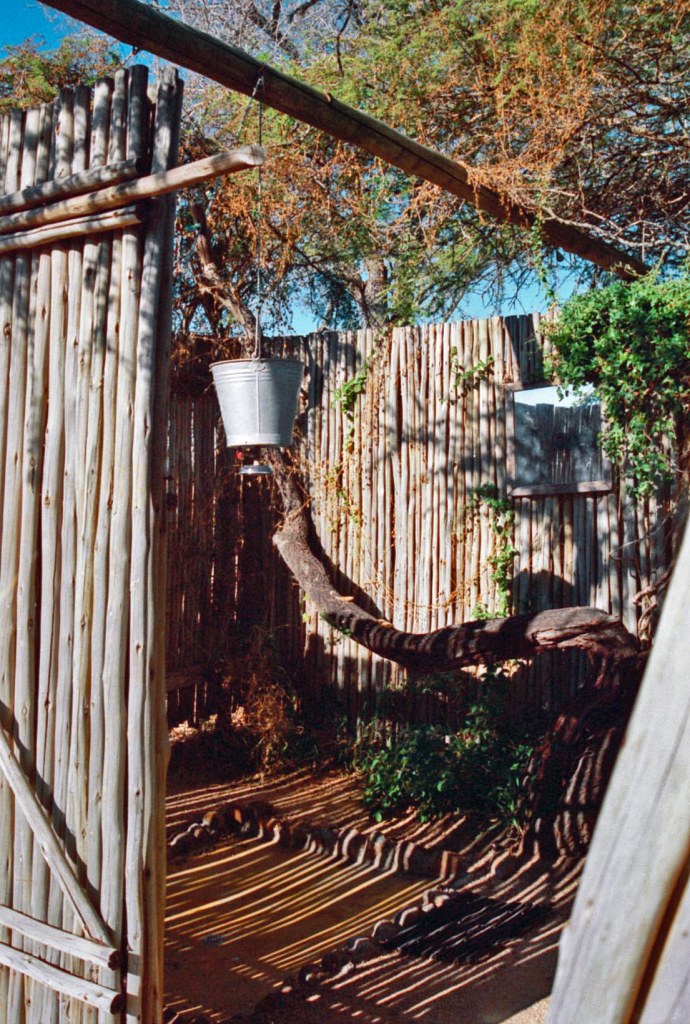
A metal pail hangs over my head, fixed by a rope and pulley to the limb of a tree. The bottom of the pail has a showerhead with a spigot to control water flow. I stand on sand within a rectangle of stones while a loose, slat-sided fence protects my modesty. Vines climb up and around and through the slats. Sunlight filters through the overhanging tree while the sky above it snaps blue, blue, blue with the upbeat tempo of a jazzy song.
Naked, my skin softens as buttery light melts into my pores. Naked, I create my own breezes as I wash. Naked, I smell saltish, metallic, as if newly risen from the sea. Naked, I am clothed in myself.
Cool water the color of weak tea trickles down my neck and across the landscape of my body. Each sluice takes a different path: one rivulet down an arm, another makes it all the way to my ankle. The water becomes darker and turns into rivers full of dust as it washes away islands of soap. A small puddle gathers around my feet and sinks immediately into the sand.
As I dry off insect noise boils shrill as a teapot. I dress and step around the edge of the fence.
The afternoon hunkers down and sits on its heels – occasionally fanning itself with a short breeze,perfumed with the faint scent of hot, dry wood. Faint whisperings rustle through the grass, prayers for rain. If there were clouds I would lie on my back and watch them.
I sip hot oxygen in tiny gulps, panting.
Life, perishable life, rests in the shade, its thin legs tucked under, safe for the moment, waiting, even-eyed, for the predators of the dark to awaken.
Gray wave after gray wave surges out of the bush in small herds of twenty or less, first one group, now another, flooding the huge hollow that contains a waterhole. Dust rises in the air, a potent blend of manure, dried grass and sand. The backwash swells in our direction. Soon a sea of elephants surrounds us. We’re submerged in a roiling world of noise. Snorts, grumbles, trumpets, growling bellies and gargantuan belches resound. Some of the vibrations are too low to hear, but I feel them as they pass through my body, reverberate in my chest cavity, squeeze my heart. Eye after eye inspects us as eddies of elephants swirl past. An old world laps at the foot of our memories, extinguishes centuries of communal fires. The ropes that tether us loosen. We slip away from the familiar shore and set off towards unimaginable ways of being. We look around with wild hearts. We have become part of the herd.
Outside my window shaggy shadows move among the firs. An immense shape assembles and disassembles in the wind.
Fourteen thousand years ago, mastodons and mammoths roamed North America, grazed alongside the buffalo. Paleolithic peoples followed the woolly giants across the Bering Bridge to lands as game-rich as the Serengeti. Projectile points can be found embedded in the bones of their prey.
But now the great ones are nearly everywhere gone.
Time twists as I stare out the window at the huge ghost facing me. A giant form conjured from a smear of rhododendrons and shadows lifts his trunk into the wind, changes back into a bush beast with flowers in his stomach, and is extinct once again.
Near a small, bog-rich pond, a pussy willow rattles pearl-gray catkins in the driving sleet. Ice coats the bare branches of a soopolallie growing at the water’s edge, frozen red berries clinging to their stems. Upslope from the pond, in a brushy part of the tundra, a herd of elk seeks shelter from the spring squall. Higher still, the mountains are sheathed in glacial ice.
The temperature drops and the sky clears. When night falls curtains of light shimmer in the north, an aurora rippling in solar winds. Oxygen atoms bombarded by geomagnetic storms turn the whole hemisphere red. Glazed with the colors of fire, the pond flickers and burns throughout the night.
A muskrat surfaces and swims towards her burrow. The legs of a frog dangle and twitch from her mouth. The wake behind her broad tail sends ripples through the aurora’s reflection shimmering on the pond’s surface. The ripples pass through a black, four-legged silhouette in the middle of the pond. Looming over his own night shadow, an old mastodon bull curls his trunk into his mouth and releases cold clear water down his throat.
All day, during the icy storm, the mastodon browsed on sage, spirea, rosehips, frosted buttercups, wormwood and sedge as the wind left ice crystals in his eyelashes. He trudged across a marshland through sticky, hydrated clay, each footstep making a loud, sucking sound. Sunshine and snow, both opalescent, washed over him in waves.
All day long on the tall-grass prairie, through blowing clouds of sunshine and snow, he saw herds of equus and pricus, horses and bison, standing with heads lowered, their backs to the stinging wind. He saw a shaggy outline sweeping the tall grass clear with her curled tusks. Barely visible, a small calf nuzzled the fur between her front legs and suckled from a hidden breast.
Recognizing her high domed cranium and sloping profile, the mastodon did not cross the prairie to meet her, though he has seen her foraging at this place before. She is a mammoth and not of his low-browed kind.
At a gravel bar he crossed a crystalline river formed from glacial outmelt. A goose feather spiraled down from a migrating flock. His pace was slow and he often stopped, his trunk resting on the ground. An Arctic fox circled in behind him, veered away when he wheeled and held his huge tusks high.
Finally, in the middle of the night, he reached the pond and waded in.
Now he drinks and eats listlessly, pulls out hippuris, water plants with long tails and sweet green stems. The sky is clear, cold, and the blood-red aurora flames and dances over his head, wildfire in the sky. Cattails chatter in the wind.
He staggers toward the bank of the pond and into boggy mud – rich, black, and carnivorous. He touches his side, where the hole-that-hurts still bleeds. Mired, he closes his eyes, sways, falls.
Near dawn the two-legged hunters find him on his side, half in water, half out. They build a fire and settle to their work.
Fourteen thousand years later, in the summer of 1977, near the town of Sequim in Washington State, Emanuel Manis decided he wanted a duck pond in his front yard. His backhoe brought up a couple of blackish curved logs. His wife Clare thought they might be tusks and started making phone calls, eventually contacting Washington State University. The resulting excavation lasted eight years and attracted 50,000 visitors to the Manis farm.
In the loam of an ancient pond the archaeological dig found a mastodon. The left side of the skeleton was intact, all the bones in their correct anatomical position. The bones of the uppermost side, the right side, were scattered upslope from the pond and the mastodon’s shattered skull faced backwards, as if staring at its own remains. Many bones had scratches, indentations, rectangular gouges and sharp-edged cut marks – the type of fracturing done in large-scale butchering, butchery less like gutting a fish and more like chopping up a tree.
But the star of the excavation, the reason so many people journeyed to the Manis Mastodon site, was a fragment of rib that had a bone spear point embedded in it.
The first direct evidence that humans hunted mastodons.
Originally researchers thought the spear point was made of elk bone, but later analysis confirmed it was fashioned from another mastodon. It was sturdy enough to penetrate thick hide, ten inches of muscle, and three-fourths of an inch into the rib. The rib was healing, so the mastodon may have died of infection, old age, or many more wounds that did not show on his bones.
Three charcoal beds, one on top of the other, were unearthed near the pond, evidence of the oldest human occupation yet found in the Americas. During a later phase of the excavation, twelve separate layers of human habitation were discovered, ranging from 7,000 to 14,000 years ago.
The site was occupied again and again by people hunting and butchering other large mammals, such as bison, that gathered at the ancient pond. The partial remains of two more mastodons were excavated. Radiocarbon dating determined that their bones – which also had the square-cut marks of butchering – were even older than those of the mastodon originally discovered. In 1996, the remains of a mammoth were found near the site. The two elephant species lived there together, 14,000 years ago.
Emanuel and Clare Manis were more than generous. They built a fence, arranged parking, allowed researchers to construct a laboratory and storage sheds, gave tours and turned their barn into a theater for audio slide shows. And to the skeptics at the time who questioned whether or not humans hunted mastodons, Clare Manis had a short, curt reply. “What, did an elk explode?”
After the excavations were finished in 1985, the ancient pond was reburied to protect the bones that remained. The site officially became part of the National Registry of Historic Places in 1978. “Manny” Manis died in 2000; Clare Manis Hatler eventually remarried. In 2002, the land was donated to an archaeological conservancy.
Not long ago I visited the museum in Sequim, near the site of the Manis farm. Some of the mastodon’s bones remain there, caged behind glass, chop marks clearly visible from the butchering. A huge tank holds the tusks underwater so they won’t dry out and become brittle. On a shelf nearby is a rib bone labeled “Please touch me.” It’s highly polished by the thousands of hands that have done so. And just as thousands of hands obeyed the impulse to caress its delicate, yellowed length, so did mine.
I missed him by only 14,000 years, an eyelash of time.
No other creatures of the savannah sleep as deeply or as soundly as lions, but after all, lions are the main reason for not sleeping soundly, so this is not surprising. – Elizabeth Marshall Thomas, The Old Way
We’re in a diesel Land Rover, a lovely old relic of earlier safari days thirty, maybe even forty, years ago. It shudders loudly when we stop. Yet they don’t wake up.
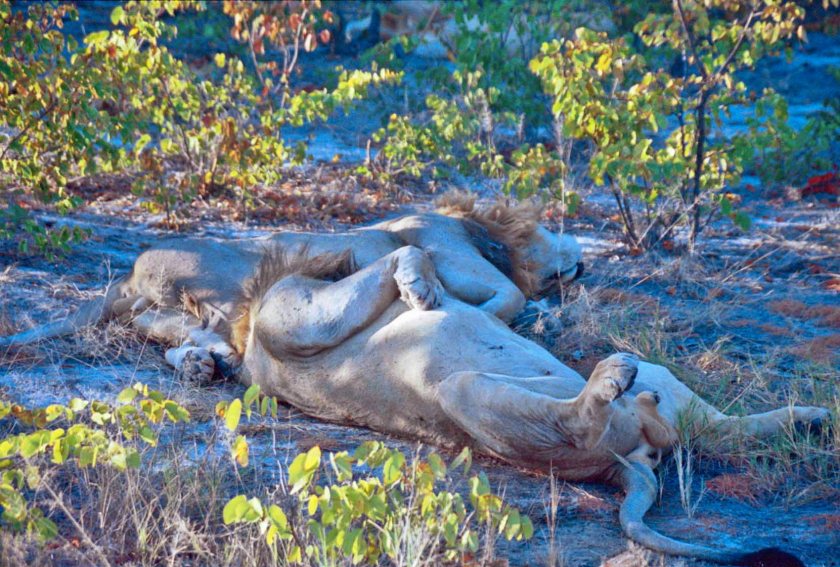
Two male lions sprawl in a cool swath of sand shaded by a thick clump of mopane. Blotches of pale blue rest upon tawny bodies like cloud shadows. It’s late afternoon and the sun is softening into that round light that blurs the edges of things.
After our ears clear of the clatter from the Land Rover, the wary silence whispers in a leaf twitch, in the movement of the sun across the sky. It’s the kind of silence that follows a lion’s roar. Even the birds are hiding.
The lions sleep on their sides. They haven’t eaten lately; their loose hides wrinkle against the ground. Without opening his eyes, the closest rolls onto his back. A small spot of sunlight outlines his high ribcage, deepens his navel.
Odd to think of him as a placental mammal, like humans. Odd to think of our inheritance from the Old Days, when we were afoot with cats. We were armed then with spears and rocks and our ability to make ourselves seem larger than we were, brandishing blazing torches, standing upright together, throwing and screaming.
Lions rarely sleep at night. It is the time of greatest vulnerability for most, and it would be so for us, too, if we were alone, without fire or companionship. But now we are encaged in the old Land Rover, gazing down without fear at two lions asleep on the blue-dappled sand.
There is something else watching. Lying deep in the mopane, camouflaged by leaves, a lioness stares at us. Her eyes are unwavering, ringed in black, with a white patch under each one. Long minutes later she loses interest in us and yawns, revealing the black edges of her gums, a baby-pink tongue, sharp white fangs, and one tooth broken. She looks over at the males.
photograph by Cheryl Merrill
They sleep on. The closest male has the abandoned flung body of a napping child. No, not a child. Not with hard-muscled shoulders and those ripping claws.
Between splayed legs his balls droop in their bags. We notice a tick crawling across one of them, wild creature upon wild creature. Small attacking large. As the tick tickles his scrotum, the tip of the lion’s penis emerges from its furred sheath, begins to drip. His right hind paw lifts and twitches.
Rouffignal – The Cave of a Hundred Mammoths, France
There is comfort in keeping what is sacred inside us not as a secret, but as a prayer.
Terry Tempest Williams, When Women Were Birds
There are certain things that can only be learned from a different perspective.
Pushing aside the darkness, a tiny, flickering lamp in hand, our ancestors crawled into the caves of Europe to paint the animals important to them. Still alive on those walls, mammoths with high, domed foreheads and a hump over their shoulders face two-legged stick hunters. Their humps held fat reserves, making them coveted prey, and dangerous prey make great stories.
Caves are potent, resonant underworlds. Tallow lamps held in a hand cast a low-level light, shadow each curve of the rock wall, suggesting a hump over there, the curve of an antler here. With red, brown and yellow soils dampened by egg white, blood, animal fat or plant juices, our ancestors recorded the vocabulary of the hunt on wall after wall. They made their brushes of hair and their sponges of moss or leaves. They inhaled the dampness of the earth that receives all, both those who eat and those who are eaten.
Escape, exhaustion, success, death, galloping bison and herds of antelope, squared jaws of lions, the arched necks of horses, and outlines of cave bears – painted by generation after generation of artists, who left their signatures in an outline of a hand or a couple of dots, who left only stick representations of themselves.
After etching the outline of a mammoth on rock and storing its spirit forever in darkness, the crawl back to light perhaps gave the world a new appearance – as if it could be conquered, controlled, illuminated, literally brought alive by an artist. Life stories painted under the ribs of the earth. Hidden knowledge. The past the present the future recorded on rocks deep in caves.
Was the crawling to light a prayer?
We are the progeny of ancestors who lived with, hunted and ate the great ones. We are the result of their lives intertwined with those they knew in the belly of the earth.
I carry in my veins a longing for turquoise-blue glaciers, a blood-red night sky and breath I can see as I breathe. Ancient memories flicker across my mind, casting shadows against cave walls. I press my hand against rock, blow pigment between my fingers. This is my signature. Look, I was once here. See how your hand fits into the outline of mine? See these hairy elephants? They were here then, too.
Imagine the smell of air freshly born from retreating glaciers, a sky cleared by melting snow. Imagine the scent of an earth newly thawed. Out there, just like you painted, a mammoth driven by a hunt has fallen over a cliff and bellows arrive in waves.
Our palm prints on cave walls, carvings on bone, the exposure of light on glass plates full of chemicals, digital cameras, electrons arranged in display across computer screens, voices tumbling through the air – is it the destiny of the human race to remember and record? Is that our place on earth?
There is a cave of light from our eye to our brain; but it is the corners of our eyes that perceive the most light; the corners of our minds where we begin to understand.
Here are the first few pages of my manuscript, Larger than Life: Eye to Eye with Elephants. Having read this much, would you go on reading the rest of the book? I’d love to have feedback. Thanks!
photograph by Cheryl Merrill
There is nothing like him on earth. His head alone is more immense than an entire gorilla.
Jabu is one hundred times larger than I am. His trunk is larger than I am. A single leg is larger than I am.
He rests his trunk on the ground and the tip of it lifts, opens, inhales my scent. I reach out and run my fingers along his warm tusk.
Do you recognize me, Jabu, do you?
* * * * *
The pilot lets me sit up front. As his clattering Cessna lifts straight into the sun, we pass a line of small aircraft and a block-and-brick terminal only slightly larger than the Air Botswana 727 parked next to it. We leave behind a flattened land where the tallest structure is a water tower, where the olive-green scrub spreads as far as can be seen, and where footsteps have no echoes in a country mantled by sand.
We gain altitude and Maun slides under us. The last town before venturing into Botswana’s Okavango Delta, Maun is an odd frontier mix of trading companies, outfitters, curio shops, supermarkets, cattle in the streets, and an airstrip long enough for daily international flights.
We fly higher. Haphazard, barely paved roads meander to round stockades – bomas, fenced by thornbush. Each boma contains a hut plastered with mud and roofed with straw, or a small square cinderblock covered by rusty corrugated metal. Only a few corral a cow or a goat. Behind us the last buildings disappear into a curtain of shimmering haze. Maun melts into the desert.
The shadow of our Cessna passes over thin dirt tracks, which lose their way and vanish. A waterhole appears, an orphan left behind by last year’s flood. Another comes into sight, and then another. Etched into the sand by countless hooves, game trails wander through the dry landscape, headed to those life-giving pockets of water. Few animals follow the trails in the heat of the glaring sun. A small herd of zebra. A single giraffe.
Suspended above what could be considered a great emptiness, I remember the map I studied a week ago. Printed alongside the log of GPS coordinates for airstrips – some of them makeshift, many little used – I read another list of handy notations. “Tourist road, 4×4 required . . .Top road extremely sandy, takes very long.” Eighty percent of Botswana is covered by sand, some of it a thousand feet deep, but the airstrip where we’ll land is barely above water.
Swollen by November rains, the Okavango River floods south from Angola, arrives in Botswana in May or June, fans out, and then stops when it bumps into a barrier of fault lines near Maun. Landlocked, the river penetrates deeply into the Delta before it dies in the Kalahari sands. Not a single drop reaches the sea.
As the river pushes south, it creates, in the midst of a vast desert, an oasis – a floodplain the size of Massachusetts containing an ark-full of animals. Dependent upon the rainfall in Angola, the river swells or shrinks. In the dry season, it leaves behind ponds no bigger than puddles, abandoned lagoons that shrink into brackish swamps, and waterholes reflecting a cornflower blue sky.
Last week I reviewed the latest satellite photograph of the Delta – four skinny channels with several webs of water between them. The river is beginning to flood. The photograph reminded me of a duck’s giant footprint pressed into the sands of southern Africa. I located my destination, a dry spot between two of the bird’s toes.
Twenty minutes after leaving Maun, the pilot pushes in the throttle and the Cessna’s clatter mutes. We drop lower. A thousand waterholes are a thousand mirrors signaling the sun. Lower still, the mirrors turn back into waterholes, some of them connected in long braids of water.
Right before we land on a strip of dirt, we glimpse a cheetah sprinting for cover. With that single spotted blur, my life divides once again between home and Africa.






 ABOUT ELEPHANTS