Posted in Africa, Elephants, Nature, Nonfiction, Photography, Travel, Writing

Mud Wrestling

Image

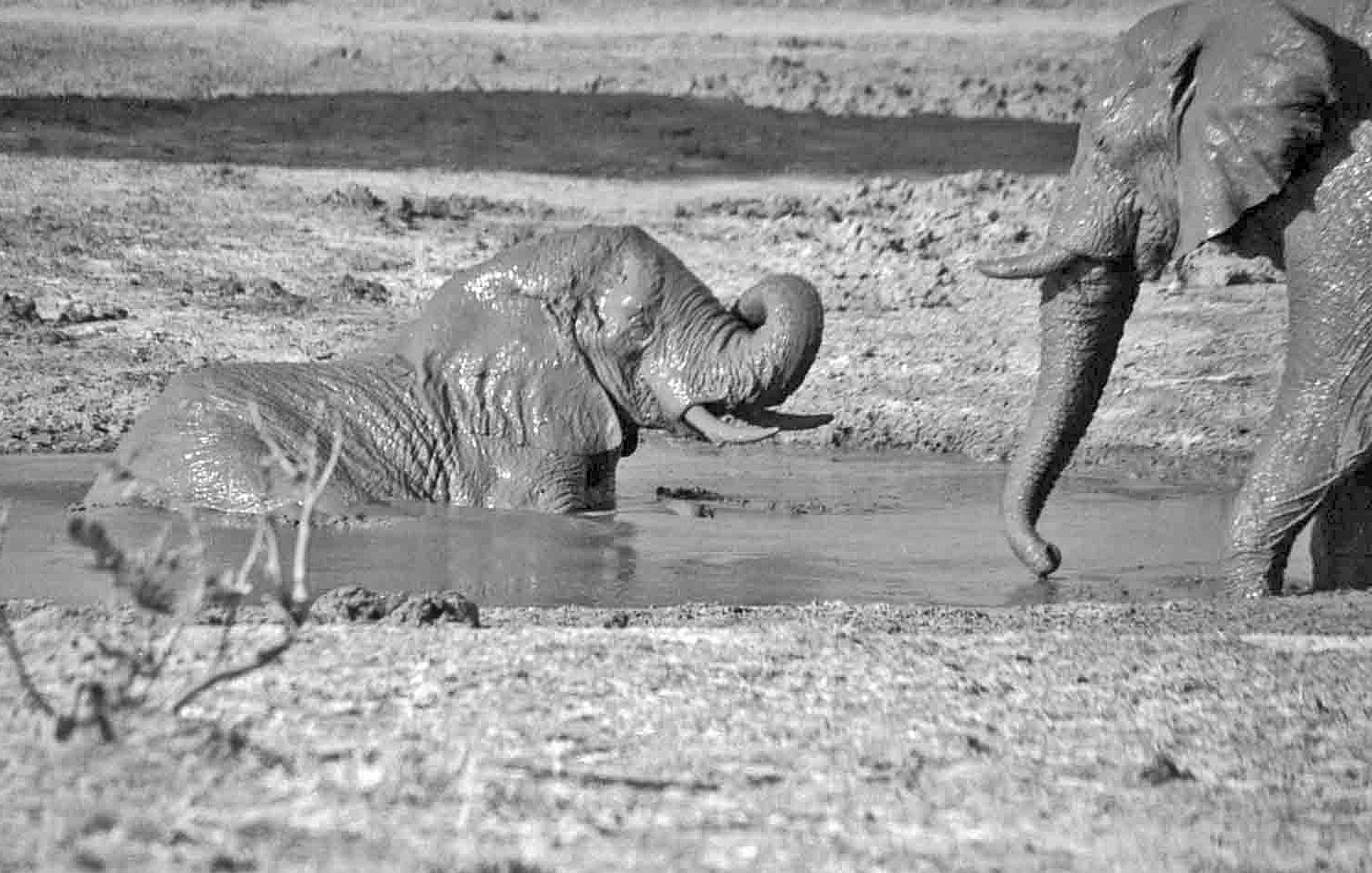
It’s a mucky, slimy, gloppy mud.  A young elephant snorkels on his side, the tip of his trunk swiveling above the surface, as he slides towards the other elephant, a brother or cousin.  His days are filled with heat and dust.  It’s winter in Botswana, the sun is relentless, and mud will soothe his scorched skin.  He lifts his head from the muck, curls his trunk and closes his eyes.  This feels good, his body language says, this feels really good.    

If we could imagine ourselves weighing four tons and think of gravity’s effect on those four tons, then maybe we could imagine wallowing in such mud, pushing and shoving like giant sumo wrestlers, reveling and rolling in the sheer pleasure of warm gunk.  We would inhale a slimy trunk-full of ooze, squirt it like a water gun in any direction, even at each other.  We would rub our eyes clear with a curled fist at the end of our trunks.  We would arise glistening and bright as a metallic statue.  We would be cooled, refreshed, gigantic, gentle beings. . . . if we could imagine such a thing.

Posted in Africa, Elephants, Nature, Nonfiction, Photography, Travel, Writing

How Much of the World Are We Missing?

Listening, really listening.


Just at the edge of darkness, where the light of our fire does not penetrate, an elephant thunders by, trumpeting the whole way, like a locomotive off track in a dry forest, a classic illustration of the Doppler Effect, sound that condenses, rises in pitch, crescendos, blows by, drops pitch, recedes. 

We lift our heads in surprise.  Waves of sound undulate away from us, kin to ripples on a pond.  We use pulsed sound waves, Doppler Radar, to see rain, to know when we should run for cover.  There is no such radar for an incoming elephant.

Eventually his outrage is extinguished in our ears, but elephants a mile away are just beginning to hear it.  Resonance fills the night air around us, yet we are deaf to it, to the sounds just below our range of hearing.

How much of the world are we missing, circle upon circle?  Perhaps instead of placing ourselves at the center we should move to the edges where our skills are low and our learning curve high.  We should extinguish our fire and sit in the darkness listening, really listening.

Posted in Africa, Lions, Nature, Nonfiction, Photography, Writing

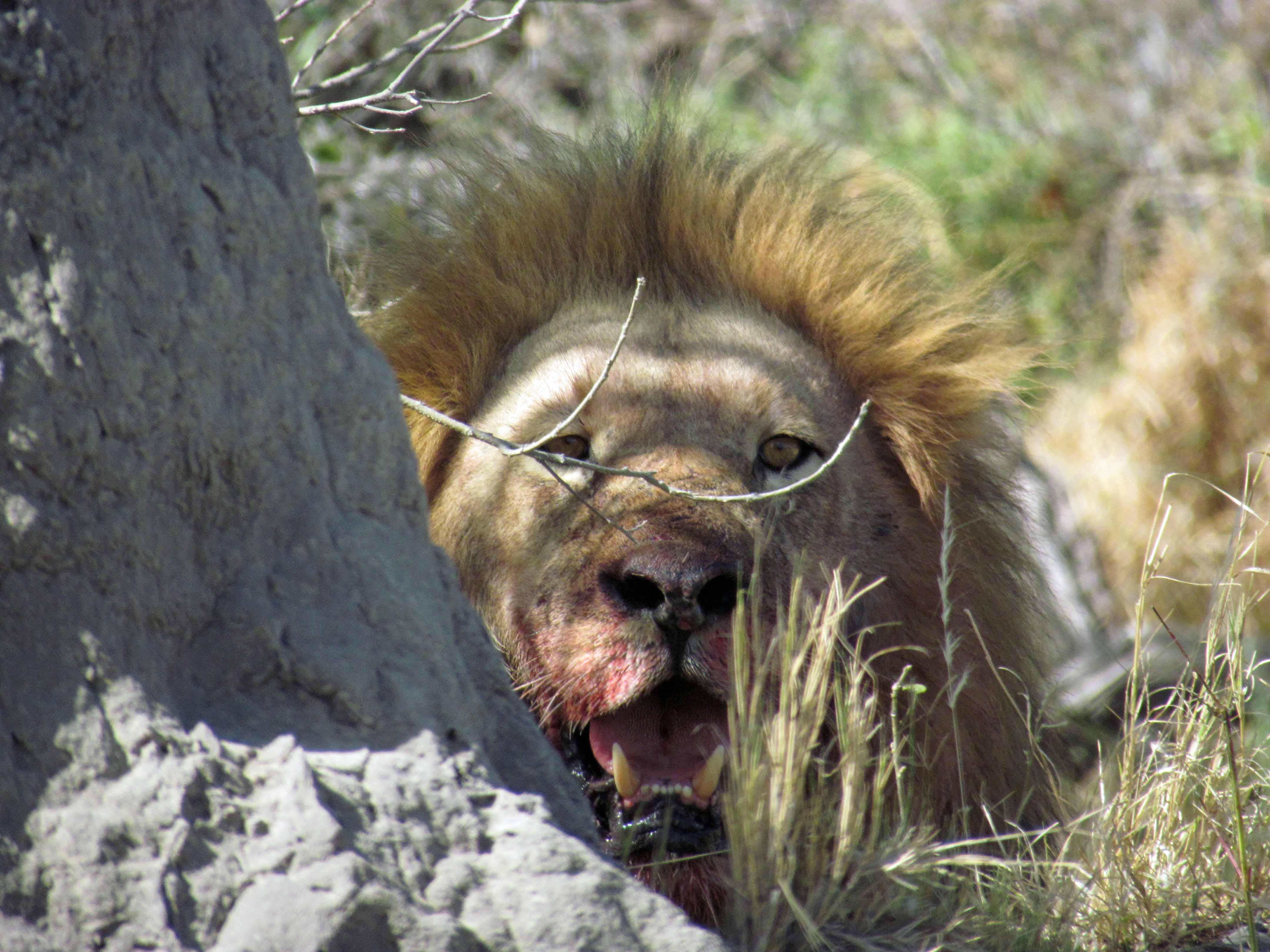
Bring on the Lions

Moremi Game Reserve, Botswana

Most impalas die of old age.  And most people die of old age, too.

But that’s not a very exciting story, is it?

What makes us want to bring on the lions?

Posted in Africa, Elephants, Morula, Nonfiction, Photography, Pleistocene

Footprints

Footprints

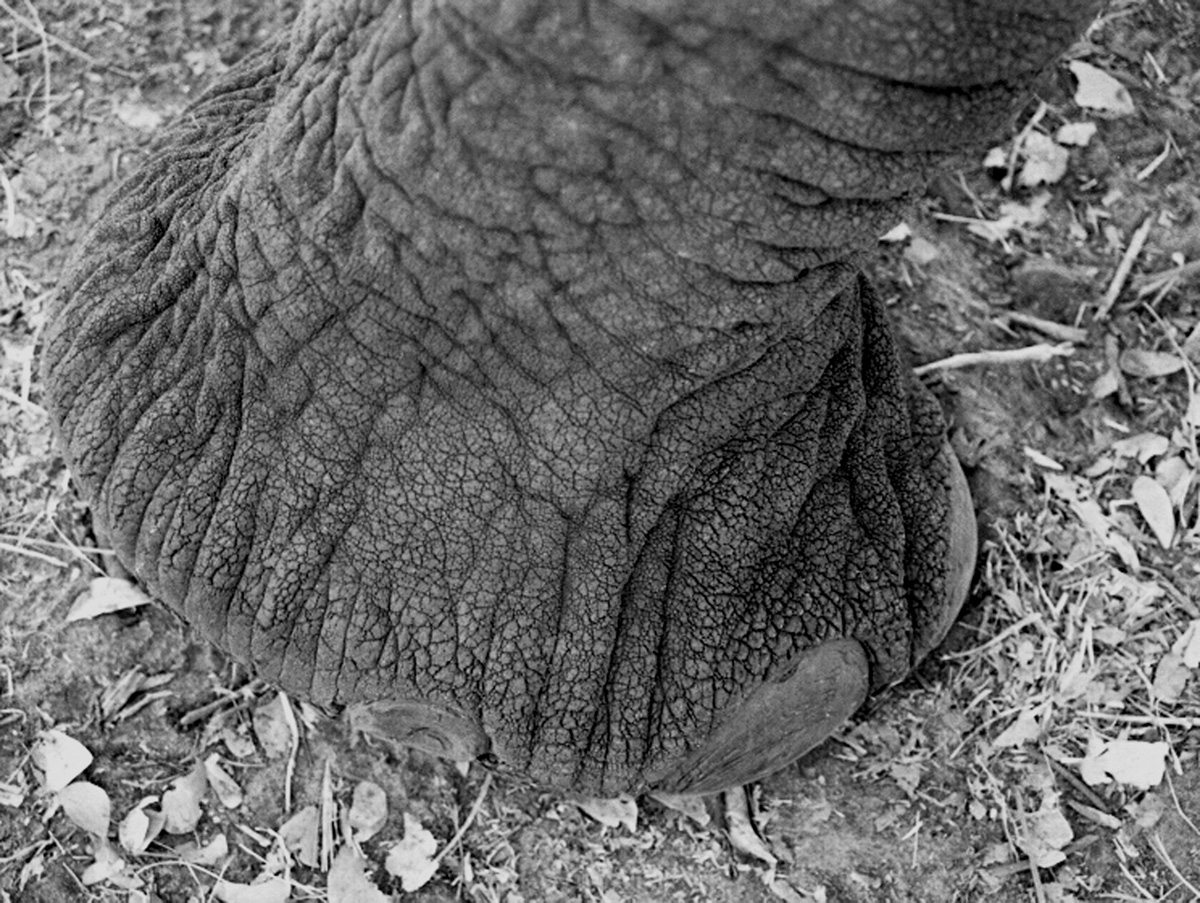
Our feet anchor us to the ground.  Just as my Pleistocene ancestors could read the tracks of mastodons, so I now gaze down at an elephant’s prints in the dust.  Her back feet are oval and her front feet round.  City slicker that I am, even I can tell the direction she is going.

 The sand beneath our feet  is the color of a lion’s coat, studded with brittle leaf litter.  Morula walks through it without making a sound.  Shock-absorbing pads on the soles of her feet cushion each footstep, smother crushed leaves.

I step on a dry leaf and it crackles into powder.

The brand name of my boots imprints within the outline of my soles; a clever advertisement made with each step.  All of my weight concentrates in two small points of contact with the earth, so I make deeper impressions than Morula’s footprints.  Each one of my steps applies more pressure per square inch; Morula’s weight spreads over four large footpads the size of a medium pizza pan.

She can step on a snake and not kill it.

Morula lifts her foot and grains of sand roll down slope into the crater of her footprint.

Following two paths, the one beneath her feet and the one in her mind, Morula strolls on.  Dust rises, a half shadow that marks her passage, before it collapses again to the ground.

There is a before and an after to each moment of our lives, paths we follow and paths we do not.

Posted in Nature, Photography

Let There be Light


Sunset, Moremi Game Reserve, Botswana

From 93 million miles away, pitched straight at me, vibrating, ululating like an African cry of greeting, light from the sun hurtles towards the earth at 186,282 miles per second and eight minutes later slams into me like a jabbering, long-lost relative trying to make up for lost time.  It babbles everything, all at once, into my eyes.

Our eyesight is an electro-chemical reaction to a vibrating particle-wave gushing optical information splash into my brain.  I could shut my eyes to the wonder around me and be diminished.  I could shut my eyes to the atrocities around me and become hardened.

By opening my eyes, I give shape to my perceptions.  By opening my eyes I take responsibility for my vision, for what my eyes teach me.  By opening my eyes I learn that I belong to the world, not that the world belongs to me.

Our eyes are openings into and out of our bodies.  Are my eyes, as some would say, a window to my soul?

There is a cold way of seeing that clips wings and stifles our words into faint echoes.  But there is also a way of seeing where the eye can be like a mouth, swallowing color, taking in the entire world with just one gulp.  Just the sheer fact alone that we see color should provide enough wonder to fill our lives, should stop us in our tracks, should keep our eyes wide open, devouring everything as fast as we can choke it down, leave us slack-jawed, gasping for air.


Somewhere behind my eyes, a world exists that I yearn to inhabit, dreams that might become real if only I could imagine them with my eyes wide open.


Posted in Africa, Nature, Nonfiction, Photography, Writing

Our Journeys are All the Same

Sunset

We tell old stories in order to see anew.  Each and every one of us takes the same journey from life to death, though our paths are never the same.

We begin as an explosion of infinite possibilities and then fall back upon ourselves, grabbing at some of those possibilities during our fall.

Our trajectory, which touched the very rim of life, descends toward the center, ending at zero, at what some see as a portal and others see as finality.

Falling, always falling towards the center of ourselves, the huge unknown universe within, our journeys are all the same.

Sunset at Doug & Sandi’s camp, Okavango Delta, Botswana
Posted in Africa, Elephants, Nature, Travel

The Most Useful Appendage That Ever Evolved

An excerpt from my book-in-progress:

Trunk in face


The tip of Jabu’s trunk hovers in front of my eyes, wet with mucous, dotted with sand, nostril hairs visible.

He blows into my face, gently.  I blow back, gently.  We exchange breath, distillations of our own personal atmospheres, particle-swarms of changed, exchanged air, brewed though all the cells of our bodies.

My lungs fill with the fragrance of crushed leaves, with saproots and spearmint-scented bark, all lightly fermented.  I think of the stagnant air that surrounds my daily life, air that is conditioned, filtered, deodorized, air that is bland.  Elephant’s breath is said to cure headaches.  And it just might, if I had one.

Jabu’s trunk tip investigates my right boot tip.  The scents I’ve picked up while walking tumble up two seven-foot-long nostrils – nostrils surrounded by nerves, arteries, veins and a staggering array of longitudinal and transverse muscles, the world’s biggest, longest and certainly most flexible schnozz.

A trunk is the most useful appendage that ever evolved.  Imagine having an arm in place of your nose, an arm long enough to reach to the top of a tree, and pluck a single leaf from its crown.  Imagine having a nose with which you could rip, tear, excavate, whack, and blow bubbles.  You could steal with your nose, suck on it, squeal, swat, poke and siphon with it.  You could take a shower, or reach over your shoulder and scratch your back with it.  You could even arm wrestle with your nose.

He chuffs, a hot gust of air directed at my feet.  Wet mist covers one boot top momentarily, then evaporates.


Posted in Africa, Travel

The Deadliest Animal in Africa

The deadliest animal in Africa is not a snake, nor a leopard, nor a lion – it’s the hippo, those oddly comic, rotund herbivores that sound like submerged tubas.  Hippos kill more people in Africa than any other animal: several hundred per year.  In contrast, sharks kill only around ten people per year, worldwide.

Hippos don’t even eat the people they kill.  They’re vegetarians, emerging at night from ponds and rivers to eat grass.  Their beady, sherry-colored eyes don’t see well at all, but their sense of smell is acute.  Males defend territory, females their calves.  Both can outrun you, and you never know what might set off a 6,000 pound animal that can achieve a speed of 19 mph.

In 2002, I was traveling through the Moremi Game Reserve in Botswana on a mobile camping safari.  Six people in an open-sided Landcruiser focused their cameras on laid-back hippo blimps floating in a nearby pond.  It was that magic half-hour before sunset when the light is golden and incredible – perfect for photographs.  A short distance away a male grazed on flowers.  I raised my camera.

Without warning, the hippo opened his mouth in a threat gesture, displaying his long, razor-sharp canines.  A second later, he charged, head swinging side to side like a giant sledgehammer, running directly for us at a surprisingly clip, intent on slamming into our vehicle.

He was closing fast.  All I could see through my camera lens were those massive incisors, as the camer’s autofocus kept singing out zzzzt zzzt, zzzzzt zzzt.

Luckily, the engine of our vehicle started without a cough and the hippo just missed our back bumper.  He continued on into the bush for thirty yards before stopping to wonder where we had gone.  This is the only picture I have of him, right before he charged.

Posted in Africa, Travel

Something in the Way She Moves

She is beautiful in the way many large women are beautiful.  There’s something about the smooth sheen on her plump skin and the defiant stare she gives you that makes you fall in love with her, even when she’s eating.

Posted in Africa, Lions, Uncategorized

Lions, Part Two

Before I fell in love with elephants, I went to Africa to see lions.  Fed by documentaries and National Geographic, I wanted the excitement of watching lions hunting.  I wanted tooth and claw and blood.  I wanted my skin to crawl.

So in 1999, near Kruger National Park, I spent a morning following the paw prints of Panthera leo krugeri, afoot in the Sabi Sabi Game Reserve – the name derived from a Tsonga word that means “Danger! Danger!”

Six would-be trackers and two rangers named Syd and Bernardo clumped together and stared at a set of padded marks in the sand.  “Which way?”  Syd asked.  We pointed variously in the same general direction.  “Okay, ready?”

We scuffed our feet.  We’re sort of ready.  Syd hefted the rifle from its rack on the dash of our Land Rover and my eyes followed this motion.  I nodded to myself; the clenched spot in my chest relaxed a little.  The lions of Kruger actively hunt humans.  So far, a bullet into the ground at their feet has proven to be an effective deterrent.

Syd told us it was three years ago that he last fired at a lion.  “You cannot believe the paperwork!  Every bullet has to be accounted for.”

We followed the tracks into the bush.  Bernardo took up the rear.

“I am here to stop you from running,” he said with a small smile.

Eight people marching in a line and stepping on each other’s heels are not easily identifiable as prey to a lion.  But if I ran away from our group, I would trigger an instant hunting response:  Look!  Breakfast!  And it’s fat and slow!

I stepped literally in the lions’ tracks.  They’re about three-fourths the length of my boots.  And so fresh I could see where the claws have sunk into the sand and made deep slash marks at the front of their pads.  I took a deep breath and tried to slow my pounding heart.

Slowly we made our way through mixed scrub and across pockets of dry, withered grass, stopping frequently to listen for the calls of francolins and baboons, early-warning radar for lions.

Syd picked up a handful of sand and let it fall through his fingers.  A fluttering wind blew from the right direction, into our faces.  If warned by our smell, the lions could decide to swing around behind and follow us.  Bernardo kept glancing backwards, as do I, the last one but for him in our column.  Even though it’s fall and many of the scrub thorns had lost their leaves, we couldn’t see very far behind or ahead.  Syd and Bernardo occasionally conferred back and forth in low voices, speaking in Shangaan.  I probably didn’t want to know what they were saying.

Just beyond several deep gullies, the lions’ footprints disappeared into a thicket.  Syd stopped and listened intently, then swept his arm to the right.  We bypassed the thicket, perfect for ambush, and checked for lion prints on the other side.

In an open, grassy area beyond, our line bumped to a halt.

“See them?”  Syd asked.Image
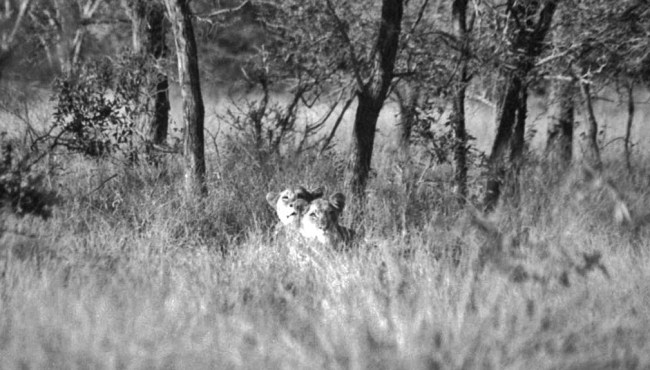
As if on cue, two heads popped up.  The back of my brain started freezing.  Apparently I had stopped breathing a long time ago.  RUUNNNN! my brain yelled to my legs, but they were so far away they couldn’t make out what all the shouting was about.

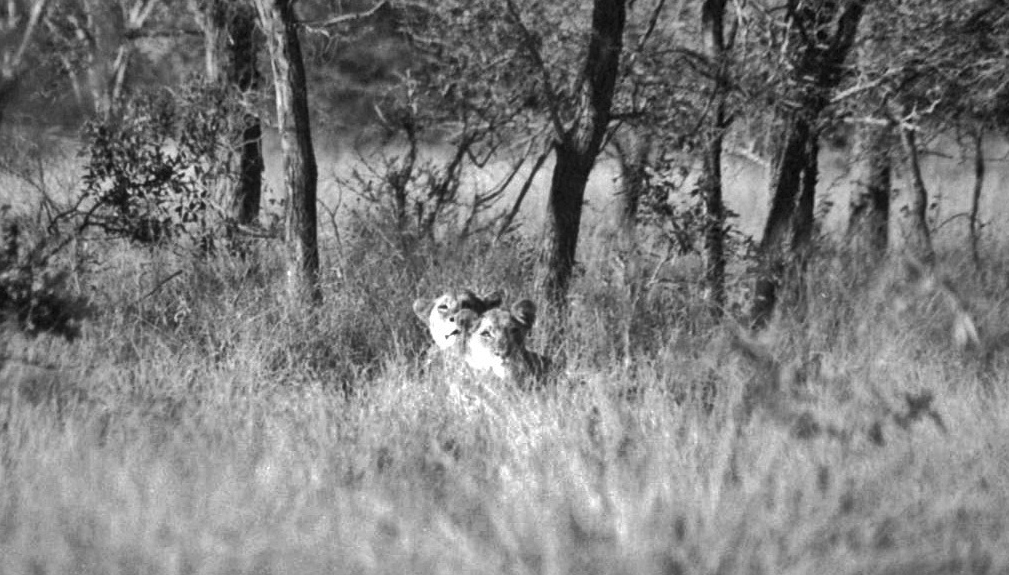
The lionesses were under trees on the far side of the field.  They were lying down, but our invasion made them curious.  They stared at us, open-mouthed.

The whir of a camera reminded me that mine was dangling around my neck.  Through its telephoto the lions looked less dangerous, more relaxed, squinting at us.

Then, off to the right, another lion roared.  Syd’s eyes widened in surprise.  A low “Tsssssss,” escaped between his teeth.  There were more lions here than we saw tracks for.  Everyone’s head, including those of the lionesses, swiveled in the direction of the roar.  Even my hair follicles were listening.

Almost simultaneously, a white bakkie, a mini-pickup, bounced into view near the lionesses and stopped.  The woman driver surveyed the two with her binoculars and wrote something in a notebook.  Bored with it all, the lions laid back down.

Momentarily distracted from the fact that there were lions to the left and lions to the right, we asked Syd, “Who’s that?”  Against all training, we’ve condensed into a tight ball around him.  Even Bernardo moved up.

Syd still stared in the direction of the roar.  “The ecologist,” he said, “she works in the reserve.”

The bakkie left the lions and rattled over the rough ground to us.

“Morning,” the ecologist nodded to each one of us in slow motion.  I wondered to myself if the lion that roared was moving in our direction.

She looked at Syd.  “There’s a male about a quarter mile up the road.  Be careful where you walk.”

“Is it?” he said, “thanks.”  Their exchange was so matter-of-fact it sounded as if they were discussing potholes.

“Right then,” she said and the bakkie joggled off.  Not even an offer of a lift.

Bernardo and Syd had a short conversation in Shangaan.  Then Syd said, “We go back the same as we came.  Bernardo goes to get the Rover.”

Bernardo led and Syd provided the rearguard.  As soon as we expanded into a column, the lionesses’ heads popped up and followed our exit.

We moved as one, marching in step, our spines expectant of fang and claw.  As soon as we are out of view behind clusters of brush, Bernardo trotted off, and I was now in the lead, careful to back-track our own footprints.

Soon we were in the Rover headed back to the clearing.  The male hadn’t roared again.  One of the lionesses opened her eye as we drove up, then shut it and flattened her ears.  We were an annoyance to her afternoon nap but nothing to get excited about; not like whatever that strange beast was that just left.

Syd told us that these sisters were the only survivors of a pride that once ruled this territory.  Another pride recently moved in and killed all their relatives.  That was the reason they didn’t answer the male lion.  We were lucky; if they had answered, he would have come running.

One of the sisters had a wound on her shoulder and hadn’t eaten while healing.  Her ribs were showing.

“They do not bring food to each other,” Syd said.  “She has to be well enough to hunt.”

We watched the sisters nap.  We’ve evolved from being possible prey to compassionate observers, all because we’re caged in a vehicle.

“Will they make it?” one of us asked.

“Do you feel sorry for them?” someone else added.

“Yes,” Syd said, “But that is just my feeling.  If they move to another territory, they will be okay.”

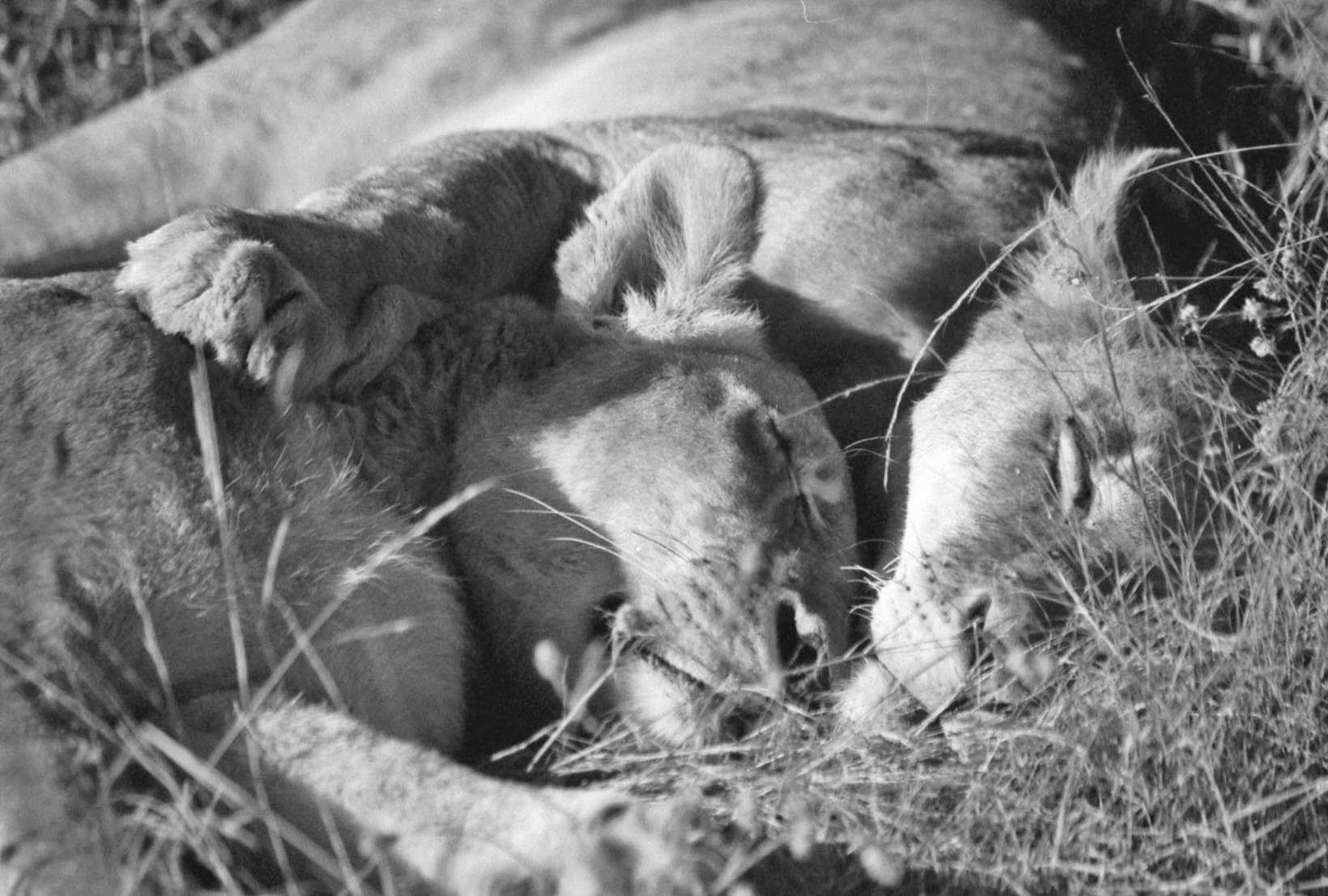
The lionesses napped side-by-side.  Without opening her eyes the healthy one raised a front paw and draped it over her sister’s neck.The Sisters b&w
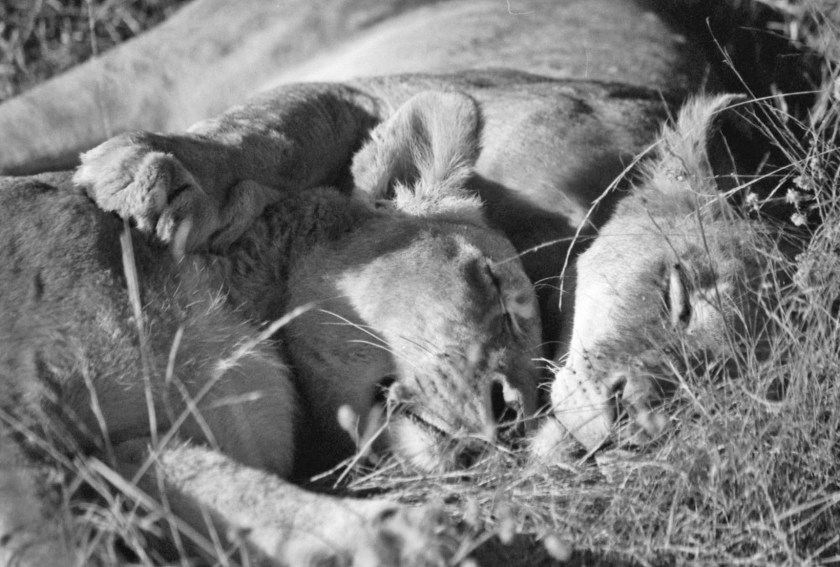
No tooth, no claw, no blood.  Funny, how, even in Africa, you always get something different than what you expect.