So many tales to tell: (1) the flooded Okavango Delta, water where there was sand last time I visited; (2) walking with elephants under starlight and a half moon (without a flashlight); (3) hyenas in the kitchen; (4) the closest I’ve ever gotten to a snake (!); (5) a leopard for my friend’s birthday present; (5) lions kill a baby hippo; (6) basic tents and luxurious chalets; (7) what not to do if you’re self-driving through the Moremi Game Reserve (hint: DO NOT rely on your GPS); (8) wild dogs, wild dogs and more wild dogs; (9) the rarest giraffes in the world; (10) hippos, hippos and more hippos; (11) a leopard hunts a male impala; (12) an absolutely wonderful stay with Sandi, Doug, Jabu, Morula and Thembi – and many, many more. Stay tuned!
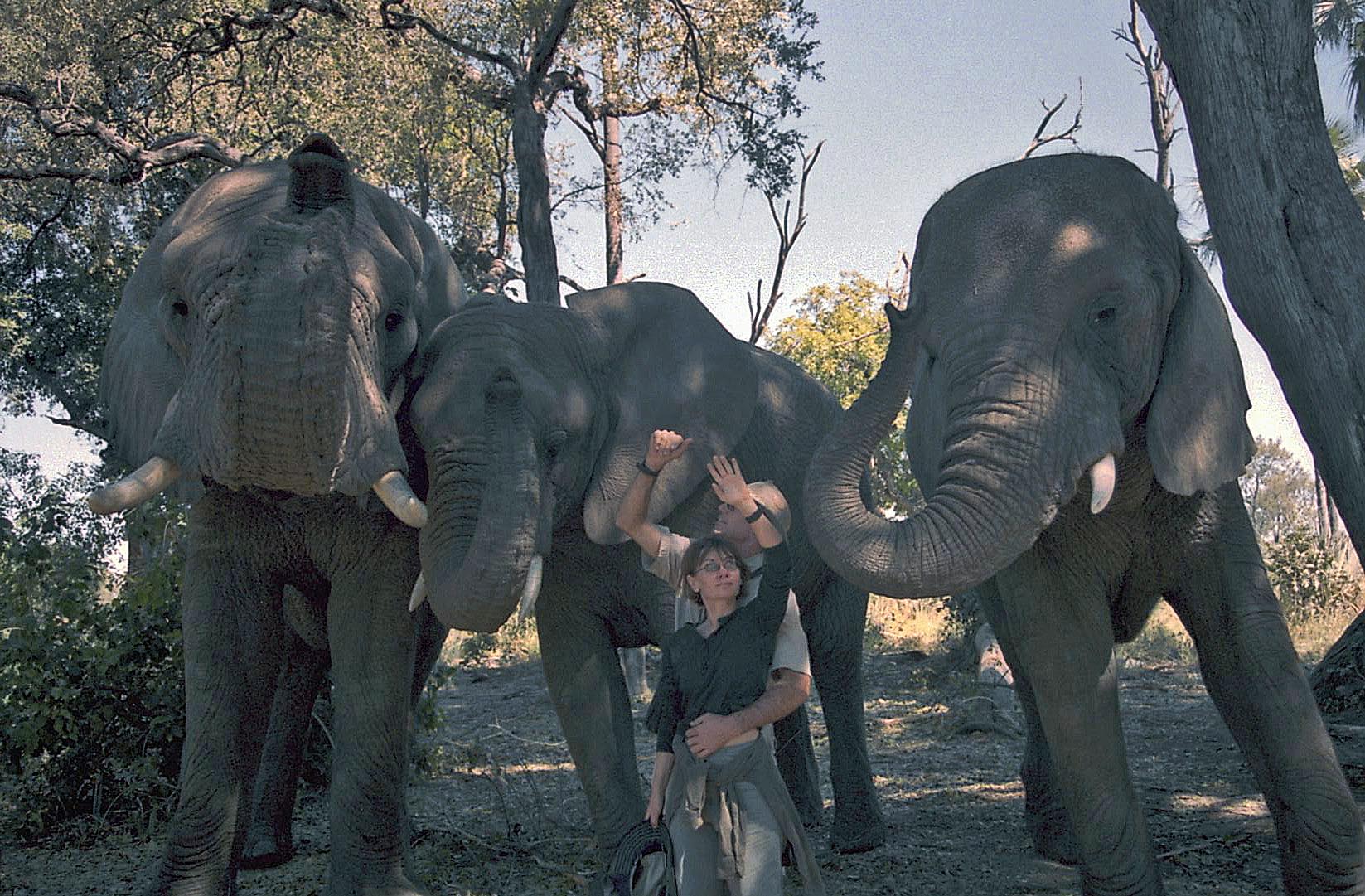
In 2007, this was my last glimpse of Doug and Sandi, and their three incredible elephants. Tomorrow I get on an airplane and begin a long two-day journey to return to the Okavango Delta in Botswana, to turn from “Goodbye,” to “Hello.”
Morula plucks a branch from one of her favorite snacks, a bush-willow. She holds the stem in her teeth, wraps her trunk from right to left around the branch, and sheers off leaves, top-to-bottom with a single swipe. She drops the branch and transfers the leaves from the curl of her trunk into her mouth.
Morula is right-trunked, as I am right-handed, preferring to grab and wrap from the right. Thembi is also right-trunked, but Jabu’s a lefty.
One of the ways to determine an elephant’s dominant tendencies is to inspect the underside of its trunk for green stains on either the right side or the left. But before you do this, make sure you know the elephant and, more importantly, the elephant knows you.
Morula peels and discards branch after branch. Shredded bushes mark her path. She pauses next to a candle-pod acacia, easily recognizable by its upright seedpods. It reminds me of a giant leafy candelabrum, holding a hundred or more candles in ruffled tiers. Sharp curved thorns protect each pod. Morula strips the acacia of a branch, then puts it in her mouth and eats it, thorns, pods and all.
She sidles close to Doug and curls her trunk against her forehead.
“Those round bumps on her forehead might be an old skin infection,” Doug tells me, “but we really don’t know.”
Morula waves hello
A light breeze feathers the hair in her ears as she stands slightly sideways and nods the tipof her trunk in a tiny Hello. . . Ribbed muscles cross the underside of her trunk. Bristles stick out like the legs of a giant centipede.
There is no other living creature on this planet that has a trunk. If elephants were already extinct, which brave paleontologist would go out on a limb and reconstruct the trunk just from evidence of bony nostrils high on the skull? Who could imagine a nose dangling close to the ground where scents abound? A nose with the ability to pick up a single straw, rip a tree out by its roots, bench-press 600 pounds and untie your shoelaces without you ever noticing?
“Stand here,” Doug commands me.
I obey, my back to an elephant lineup.
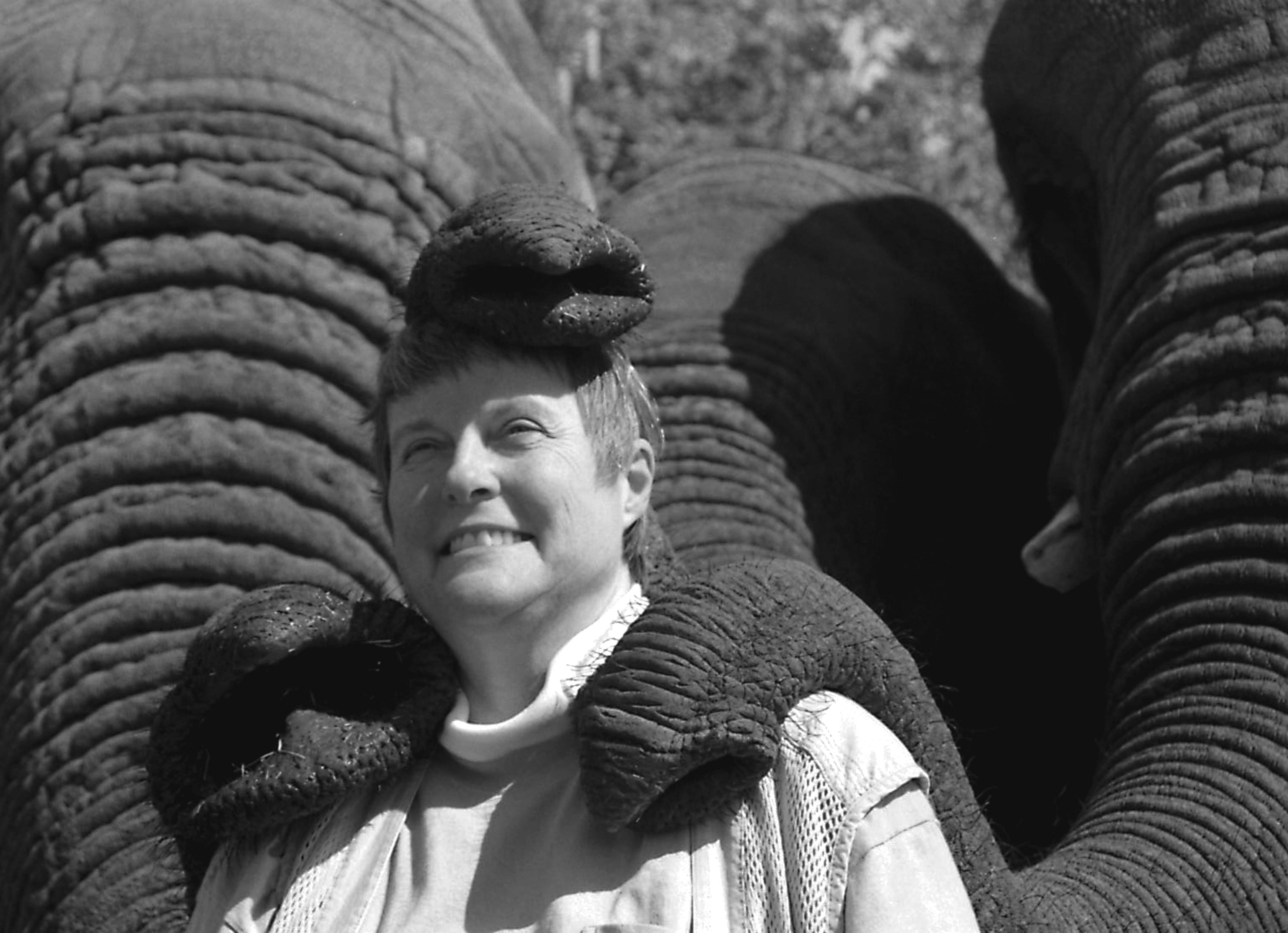
With a little guidance from Doug, Thembi gently places the tip of her trunk on top of my head. It feels like a big beanbag up there, but one that’s warm, wiggly, drooling and breathing.
As Thembi rubs nose slime into my hair, Doug places Jabu’s trunk tip on my right shoulder and then Morula’s on my left.
Jabu has trouble keeping his trunk balanced on such a narrow ledge. He constantly fidgets and pokes my cheek with his bristles. Morula’s trunk drapes over my shoulder like a slack hose with a dripping nozzle. Her runny nose continuously drains to clear out inhaled dust – the common condition of all elephant trunks.
When I look down and to the left, I have a close-up view of the two “fingers” on her trunk. Her top finger is more pointed than the one on the bottom. The shape of it reminds me of a hooded cobra. But perhaps that’s because I think of Morula’s trunk as thinner and “snakier” than Jabu’s spectacular snout.
Which is getting heavier by the moment. With the peripheral vision in my right eye, I see two nostrils dotted with grains of moist sand, nostrils more flesh-colored than gray. Each opening is nearly as wide as the “O” of my mouth.
All three trunk tips, I can attest, are not just sheer weights. They sniff, snorf, squirm, wiggle, inhale and exhale. They create an atmosphere of elephant breath around my head.
Doug lowers my camera and pronounces, “Allll-right.”
The weights disappear. For a few steps I am oddly light, as if walking on the surface of the moon.
There is an elsewhere, somewhere, but it’s not a place I want to be right now.
The sun rises with spokes on her head like the Statue of Liberty. She rises into an immense lemon sky that almost turns green before it turns blue. She ignites the tops of trees with her torch. Bare, wood-muscular branches of a jackal-berry tree stretch above my head, tips ablaze with light. Crisp and clear, the air tastes of damp sage mixed with cold sand.
Doug sets down his coffee cup and leaves to fetch the elephants. Skirting a tree-line filled with purple shadows, he crosses an open field of grass.
Sandi and I wait, our hands wrapped around steaming cups.
Half an hour later Doug returns. Jabu, Thembi and Morula are right behind him.
Sandi whispers, “Let’s go, Jabu,” and he turns away to follows her down the dusty road in front of camp.
Plain-Jane Morula is next to saunter past, her broad, honest face etched with a network of creases and wrinkles, the tip of her trunk canted in my direction. Thembi lags behind, with Doug at her side, but soon catches up to Jabu, picking up a stick like he does, stashing it between her trunk and tusk like he does, dropping it just as soon as he does.
The order in which they assemble never varies. First Jabu, then Morula, and finally Thembi. Yet, when we set off on our morning walks, it is always Morula, the oldest, who brings up the rear.
We mosey away from camp at a slow ramble, all in a line – Doug and Sandi, three elephants, and me.
Yesterday I traveled by jet. Today I fall into place behind an elephant. My mind is having a hard time keeping up with a change greater than eight time zones and two hemispheres.
I’m clumsy in this new world. The old discarded one of concrete and cell phones trails me like a lost dog. I kick at it, but it circles back to nip at my heels. It just won’t leave me alone.
Tufts of grass nods gently in the wind of our passing. Isolated clumps of finger grass wave six-digit tassels at us. The fingers of a slight breeze hold my hair up to the sun.
Morula stops, turns, and takes a single step toward me. Somehow she doubles in size.
Morula
My heart leaps, captive within its ribs, desperate to flee. I know Morula is not wild, not truly. I know she has spent half her life with Doug and Sandi. Nevertheless, I’m paralyzed. I forget how to breathe. Everyone else is up near the front of the herd, as far away as another continent.
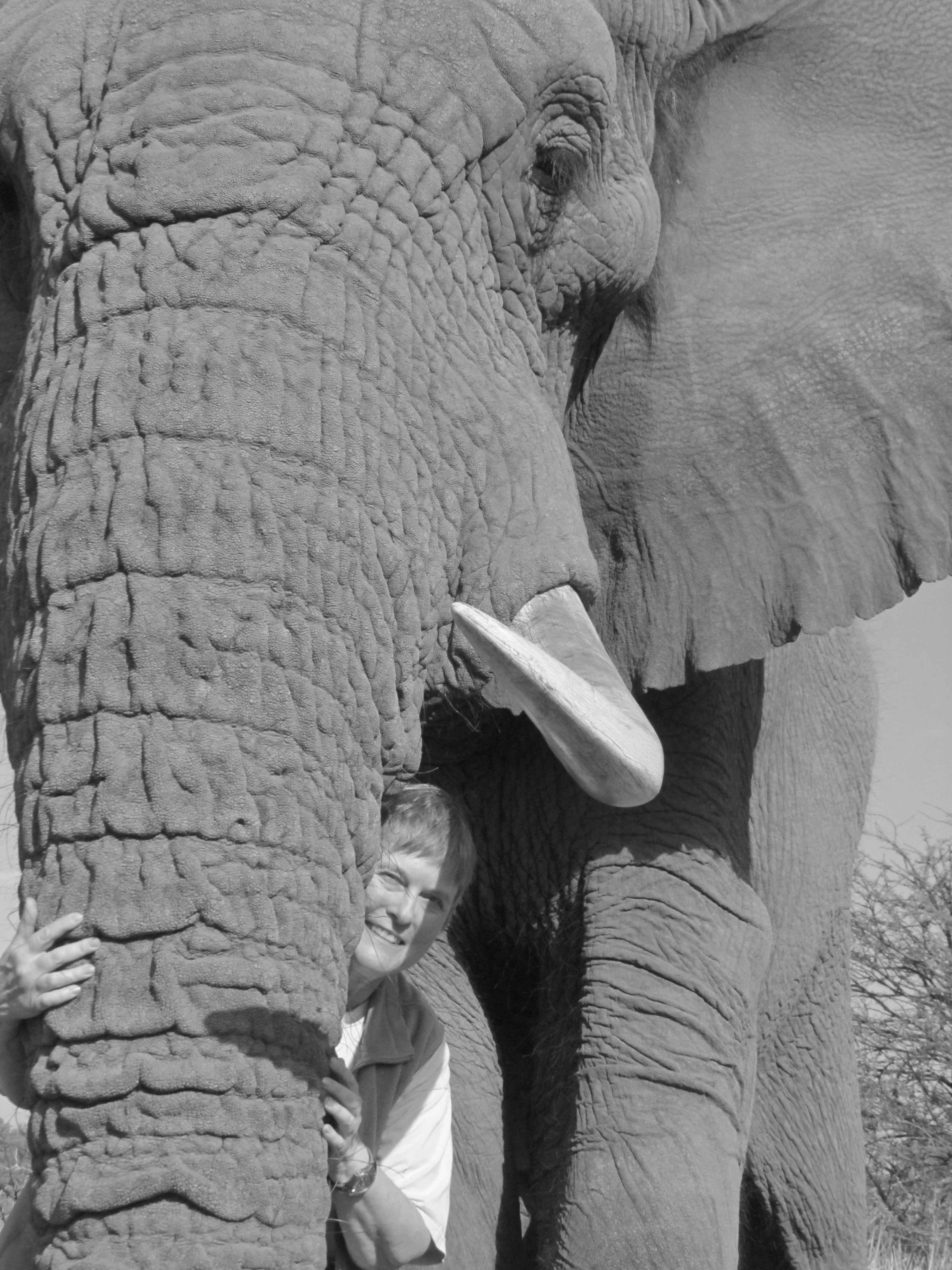
Morula stands in half-profile, stares at me with one nut-brown eye. A feathery tuft of hair sticks out from her ear canal. Her mottled forehead glistens like cracked mud.
Slowly she blinks her eyes, flaps her ears, and a lifetime later swings around to overtake Thembi. I exhale as they entwine trunks.
Cicadas chirr, stirring up the morning. I stare down at huge round footprints in the dust. I look up; the elephants are receding. Last in line, I’ve been left behind.
Wait for me! shouts every cell in my brain, as I scramble to catch up with the herd, take my allotted slot in the order of march.
We walk out to the elephant’s enclosure under the lidless eye of a full moon. Puffs of dust stir around my feet, pale little clouds that settle to the ground. The scent of sand and dung layers a gritty, farmyard taste at the back of my throat.Soft rustles in the waist-high grass are unseen snakes or mice or birds.
Moist as a swamp cooler, musty and bacterial, the night air condenses into cold pools and sends my fingers into my pockets. Warm air under the trees brings them out again.
My vision is elemental, full of shapes without fine details. As I walk, shifting slabs of moonglow keep rearranging trees as if they are pieces on a giant pearled chessboard, their trunks whitewashed the color of ash.
The elephant’s enclosure is hidden in the bush, around a few bends in the road and down a dusty path, out of view for the guests at Stanley’s Camp. The enclosure consists of two heavy cables strung high and low through seven-foot wooden posts set in concrete. A second, lighter wire is suspended outside the periphery. Cowbells dangle from it, an early-warning system for invaders or escapees. Granted, an elephant could bust out of (or into) this enclosure in less than a minute. It’s more of a security blanket for the Trio, a protected space for eating and sleeping.
Just ahead a huge smudge of charcoal broadens.
Elephant.
Hushed and gaping, tugged like a blank comet into an immense gravitational presence, I orbit a little to the left in a cautious arc.
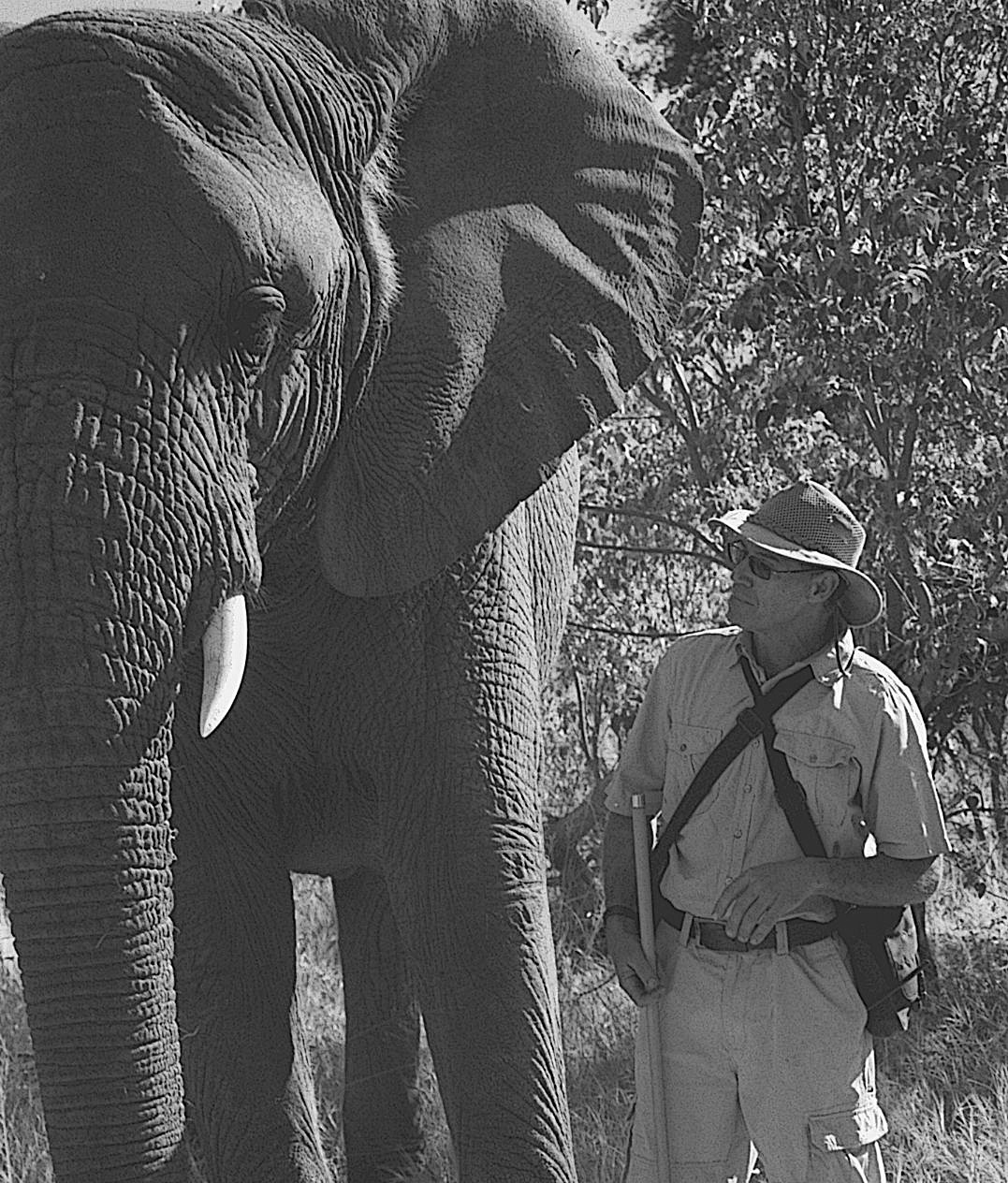
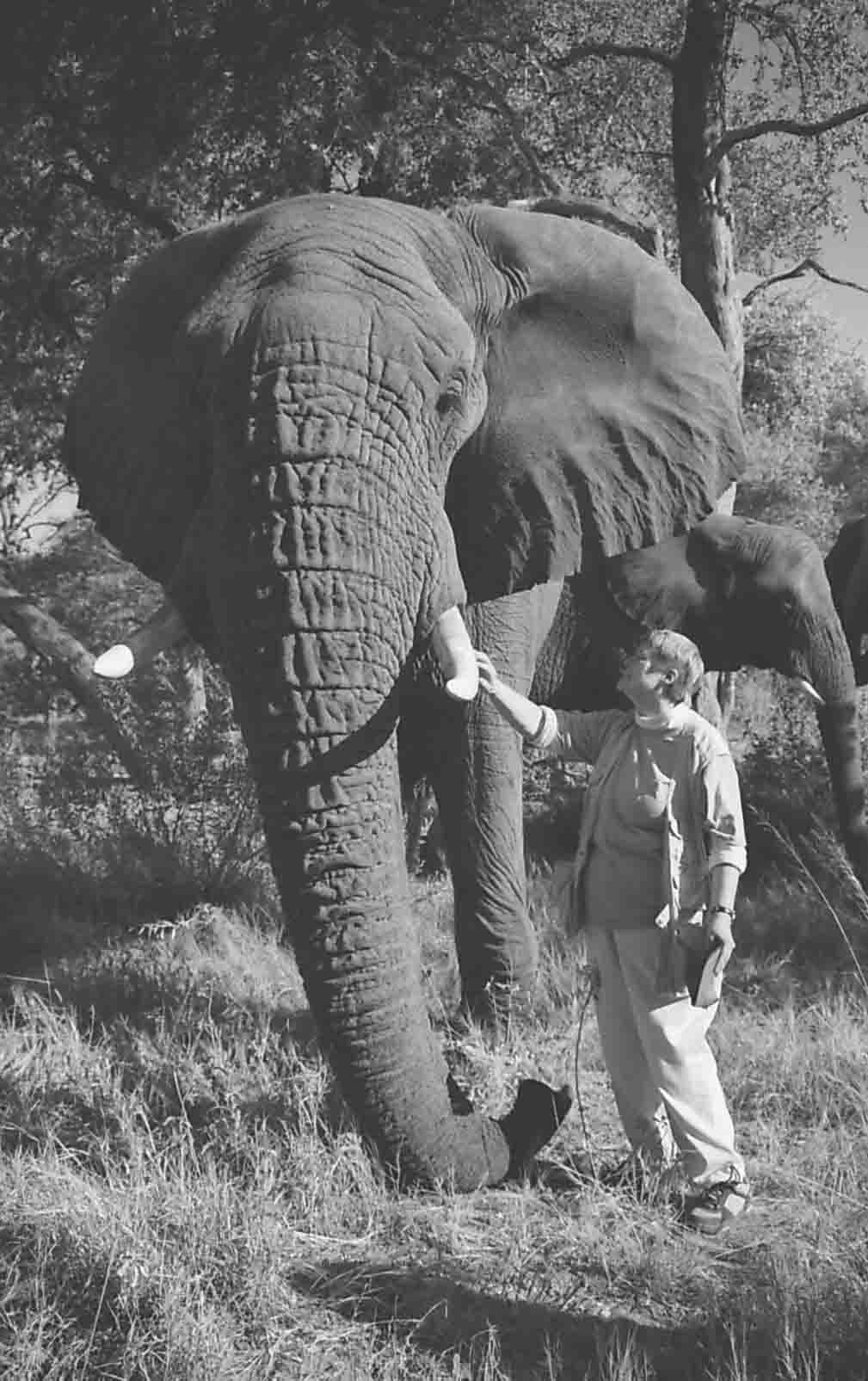
With a low throaty rumble MmmmRRRRRrrrrrr, his own elephant greeting, Doug slips under her jaw and stands by her side. Glasses on his face are two mirrored moons. He reaches up and strokes the skin just in front of her ear.
“Steady, Thembi,” he says, “you’re a pretty girl, aren’t you Thembi?” He pronounces her name “Tem-bee.”
She nods Yes. Later I will learn Thembi always nods Yes at the word “pretty.” But she is a beautiful elephant, all her proportions flawless. And Thembi knows she is pretty. She holds herself perfectly still in half-profile, the way beautiful women do all over the world when under regard by an admiring eye.
With a low throaty rumble MmmmRRRRRrrrrrr, his own elephant greeting, Doug slips under Thembi’s jaw and stands by her side. He reaches up and strokes the skin just in front of her ear.
“Steady, Thembi,” he says, “you’re a pretty girl, aren’t you Thembi?” He pronounces her
Doug & Thembi
name “Tem-bee.”
She nods Yes. Later I will learn Thembi always nods Yes at the word “pretty.” But she is a beautiful elephant, all her proportions flawless. And Thembi knows she is pretty. She holds herself perfectly still in half-profile, the way beautiful women do all over the world when under regard by an admiring eye.
But her pose does not last long. She turns her attention to a pile of mopane branches. She picks up a single branch, strips its bark and stuffs the curled peelings into her mouth. Thembi is after the sweet, green inner bark of the smaller branches. Dessert first, the main course later.
Jabu, Morula and Thembi live in Botswana’s Okavango Delta. I don’t need radio collars or binoculars or even 4-wheel drive vehicles to study them. They are companions, who allow me to walk alongside them, close as an eyelash. Adopted as orphans from culling operations by Doug and Sandi Groves, they spend their days as most wild elephants do: strolling and eating. But they are also willing ambassadors between the elephant world and the human world.
Walk with me. Stroll with three unfettered and unfenced elephants in a world where the thin-skinned sky is a bare reminder that the earth is covered with air, where clouds stampede as if chased by lions – a world without asphalt, without cell phones, without that strange human notion of time.



 ABOUT ELEPHANTS