Not far from here jungles of papyrus lean their feathery seed heads over the clear blue channels of the Okavango River, tall stands of reeds that line the permanent footprint of the Delta. The river is inching southward, breaking the boundary between water and desert. Soon it will flush this lagoon, scouring out the sweet muck at its bottom to spread among grassy floodplains.
With the river will come crocodiles and hippos and other denizens of its deep, running water. When the river reaches this part of the Delta, a new population of birds will arrive with it: Wattled cranes, Egyptian geese, Reed cormorants, Darters, Avocets, Black crakes, Red-knobbed coots, Sacred ibis, Hamerkops, Fish eagles, and Saddle-bill storks.
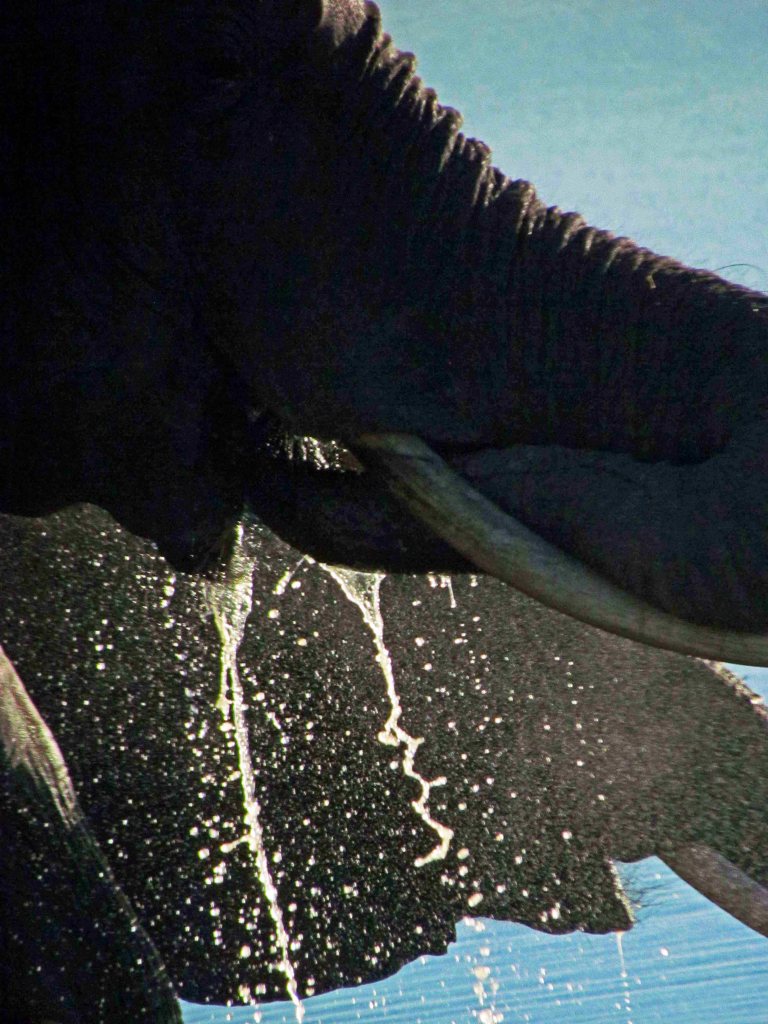
Standing shoulder to shoulder on a mat of trampled reeds, two elephants blow a concert of bubbles, bassoons under water. They shower their spines, poke their trunks into the back of their throats and release gallons of water at a time. Corkscrew spirals spill from their mouths, patter like rain on the surface of the lagoon. Sky-blue ripples spread from one edge to another, bounce back images of a thousand suns.
Believe me: you could spend the rest of your life watching this.
The sound of water splashing draws us away from camp. We leave behind dinner preparations and walk out into the sunset, our feet soft in the sand. My boots kick up dust the color and texture of crumbled parchment.
Musty, bacterial, moist as a swamp cooler, the evening air condenses into cold pools. Shreds of scent blossom. I inhale freshened earth, the damp beginnings of night.
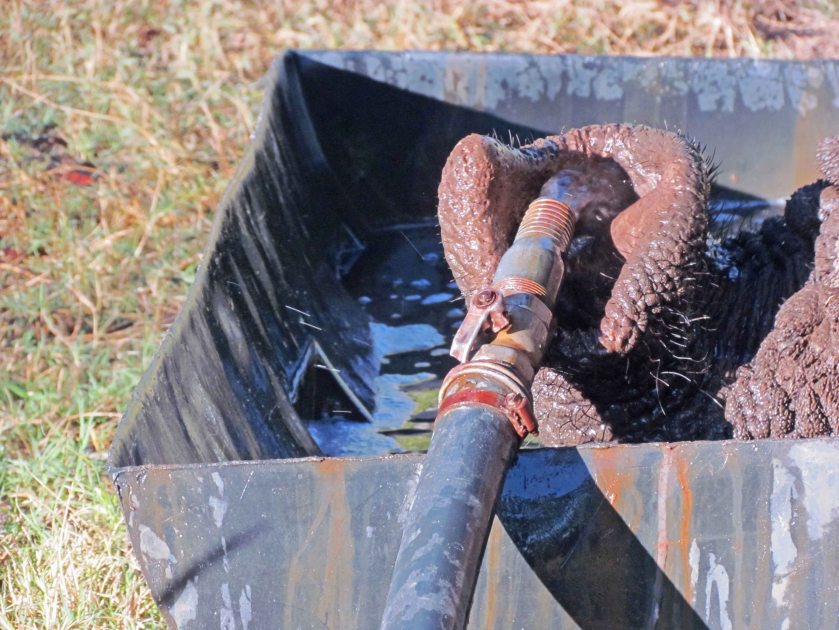
We find the elephants in a lengthening night shadow, drinking from a metal trough. Trunks curled, heads tipped back, eyes closed – they siphon water from the trough into their mouths. The sound they make as they siphon mimics the sound of rain in gutters, only the water is going up, not down.
Three elephant trunks reach toward us, sniffing the shadowed, violet air. Jabu thonks the end of his trunk against the ground, as if testing a cantaloupe for ripeness. Then he places the tip of his trunk directly under the hose gushing into the trough. Thembi curls her trunk tight enough to be nearly round, like a tire. Morula waves a medium-sized Hello.
The honey-colored evening deepens to gold, then orange, shot through with veins of red, a saffron sunset. The elephants become a shade of rusty rose.
On our walk back to camp the last of the sun catches the top of a fan palm as the purple shadow of the earth spreads across the sky. The rim of the earth becomes the rim of the moon as it rises.
I dream of elephants. They stand around me in my sleep. Surrounded by legs, by their great gray columns, I feel them sway, hear their deep long breaths. A light tap from a trunk reassures me, reminds me of who is here and where we are, all of us dreaming together.
Night’s curtain pulls back as earth rolls out of darkness and into dawn. Black becomes purple becomes blue. The person I was in my dreams vanishes. Reluctantly, reluctantly, I step out into a new day, but my watch is unreliable now. It’s my heartbeat that I listen to, an echo from that soft machine that pumps on.
The elephants cross a dry lagoon abandoned by the Okavango River after last year’s flood. Enticed by a nearby tidbit, Thembi stops, sniffs at a bush willow, and daintily picks a single leaf to taste-test it. Morula and Jabu join in, not so daintily, ripping entire branches from the bush. Deft as magicians, they use the tips of their trunks to strip the soft leaves, as if conjuring playing cards from a stacked deck.
Jabu crams a wad of leaves into his mouth. He drags one foot and stirs up a gauzy curtain of powdered insects, ash, crumbled grass and dust. From his belly up, Jabu is all the colors of mud; from his belly down, seen through the dust, he’s a bit hazier, like an old, old photograph.
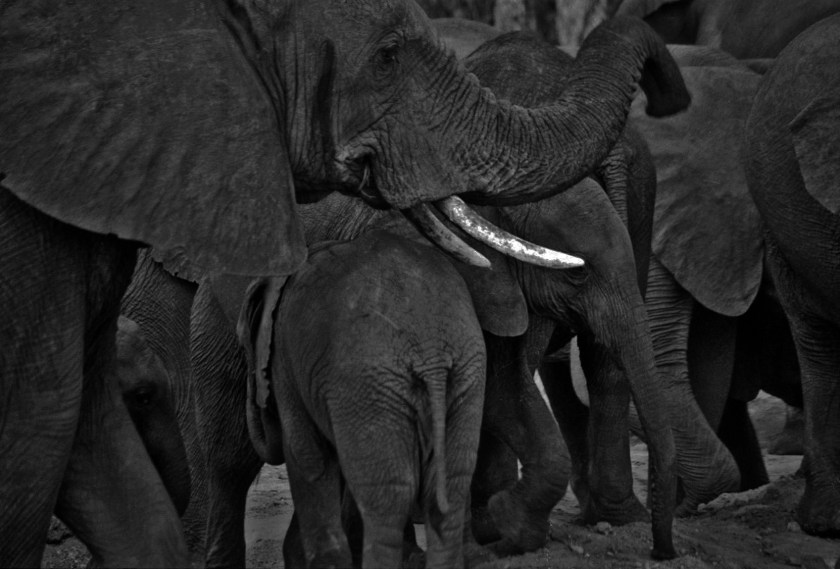
Gray wave after gray wave surges out of the bush in small herds of twenty or less, first one group, now another, flooding the huge hollow that contains a waterhole. Dust rises in the air, a potent blend of manure, dried grass and sand. The backwash swells in our direction. Soon a sea of elephants surrounds us. We’re submerged in a roiling world of noise. Snorts, grumbles, trumpets, growling bellies and gargantuan belches resound. Some of the vibrations are too low to hear, but I feel them as they pass through my body, reverberate in my chest cavity, squeeze my heart. Eye after eye inspects us as eddies of elephants swirl past. An old world laps at the foot of our memories, extinguishes centuries of communal fires. The ropes that tether us loosen. We slip away from the familiar shore and set off towards unimaginable ways of being. We look around with wild hearts. We have become part of the herd.
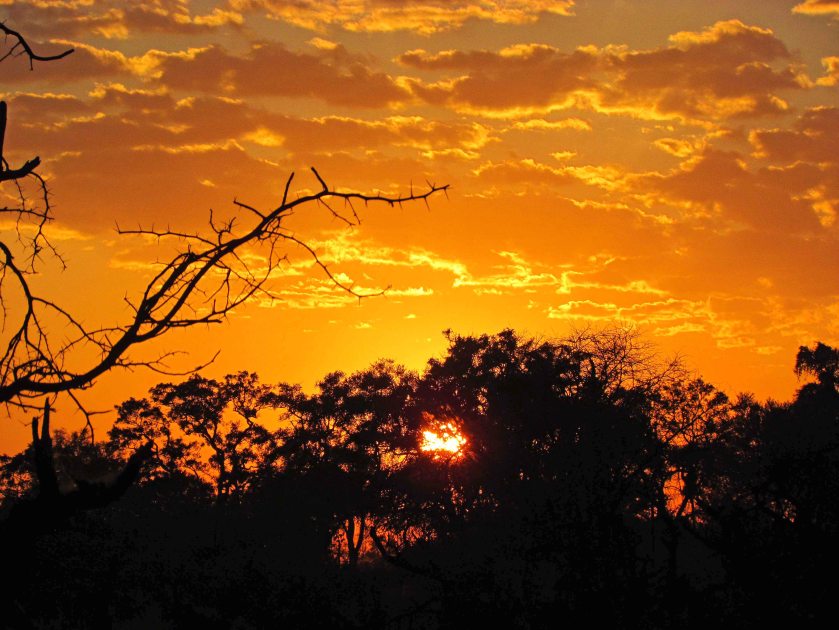
The sky turns orange and the clouds turn yellow. Sunsets like this one have hung in galleries for centuries. A slight breeze rises – the lungs of the earth inhaling warmth, exhaling coolness. The breeze brings a faintly watery smell, even though the sun still warms the tops of trees. Beneath the trees, in cool green-black shadows, night begins, spreading a transitory stillness that will soon fill with the Invisibles – hyenas, leopards, lions – beginning their nightly rounds.
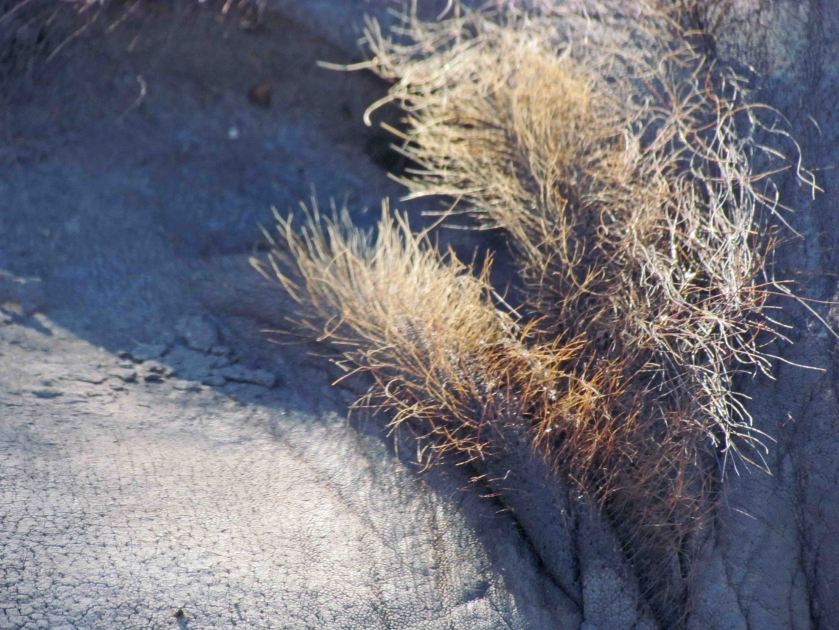
Morula’s luxuriant ear hair catches the sunlight. Flakes of mud cake the opening of her ear.
Just as in humans, an elephant’s ear hair grows longer and longer throughout its life. Hers is cinnamon-colored, has black roots, and is six inches long. It reminds me of the color of a lion’s mane.
When I reach up, the patch of hair feels like the underbelly of a longhaired cat.
No other creatures of the savannah sleep as deeply or as soundly as lions, but after all, lions are the main reason for not sleeping soundly, so this is not surprising. – Elizabeth Marshall Thomas, The Old Way
We’re in a diesel Land Rover, a lovely old relic of earlier safari days thirty, maybe even forty, years ago. It shudders loudly when we stop. Yet they don’t wake up.
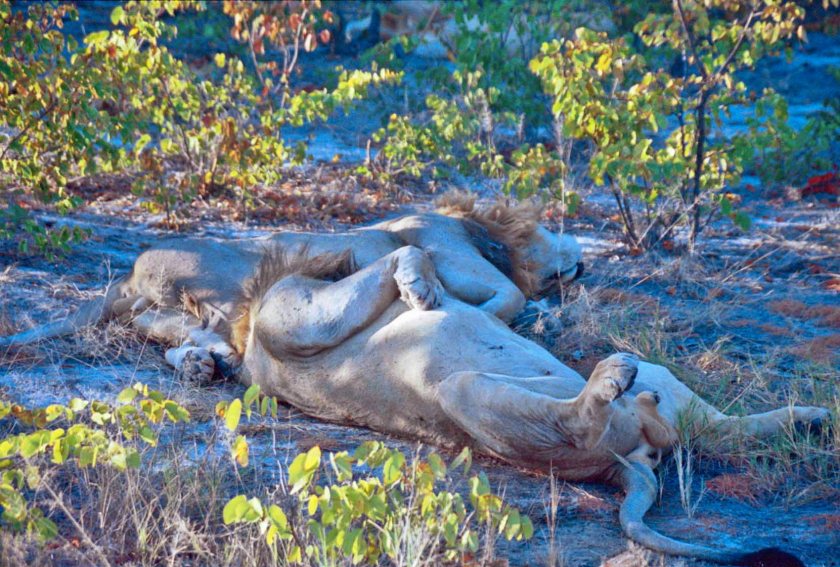
Two male lions sprawl in a cool swath of sand shaded by a thick clump of mopane. Blotches of pale blue rest upon tawny bodies like cloud shadows. It’s late afternoon and the sun is softening into that round light that blurs the edges of things.
After our ears clear of the clatter from the Land Rover, the wary silence whispers in a leaf twitch, in the movement of the sun across the sky. It’s the kind of silence that follows a lion’s roar. Even the birds are hiding.
The lions sleep on their sides. They haven’t eaten lately; their loose hides wrinkle against the ground. Without opening his eyes, the closest rolls onto his back. A small spot of sunlight outlines his high ribcage, deepens his navel.
Odd to think of him as a placental mammal, like humans. Odd to think of our inheritance from the Old Days, when we were afoot with cats. We were armed then with spears and rocks and our ability to make ourselves seem larger than we were, brandishing blazing torches, standing upright together, throwing and screaming.
Lions rarely sleep at night. It is the time of greatest vulnerability for most, and it would be so for us, too, if we were alone, without fire or companionship. But now we are encaged in the old Land Rover, gazing down without fear at two lions asleep on the blue-dappled sand.
There is something else watching. Lying deep in the mopane, camouflaged by leaves, a lioness stares at us. Her eyes are unwavering, ringed in black, with a white patch under each one. Long minutes later she loses interest in us and yawns, revealing the black edges of her gums, a baby-pink tongue, sharp white fangs, and one tooth broken. She looks over at the males.
photograph by Cheryl Merrill
They sleep on. The closest male has the abandoned flung body of a napping child. No, not a child. Not with hard-muscled shoulders and those ripping claws.
Between splayed legs his balls droop in their bags. We notice a tick crawling across one of them, wild creature upon wild creature. Small attacking large. As the tick tickles his scrotum, the tip of the lion’s penis emerges from its furred sheath, begins to drip. His right hind paw lifts and twitches.
On the far side of a large swath of golden grass the air shimmers, full of birds. As if by some sort of avian telepathy, Red-billed queleas rise and fall in curling waves, with wing-beats that sound like distant surf. Wave after wave washes across the clearing in front of us. It’s impossible to distinguish individual birds among the swell and tumble. Dust rises, perfumed by millions of feathers, hundreds of birds, each bird no bigger than my thumb. The flock settles into a tree. The branches of the tree droop as if suddenly laden with snow, then spring back up as the birds roll on.
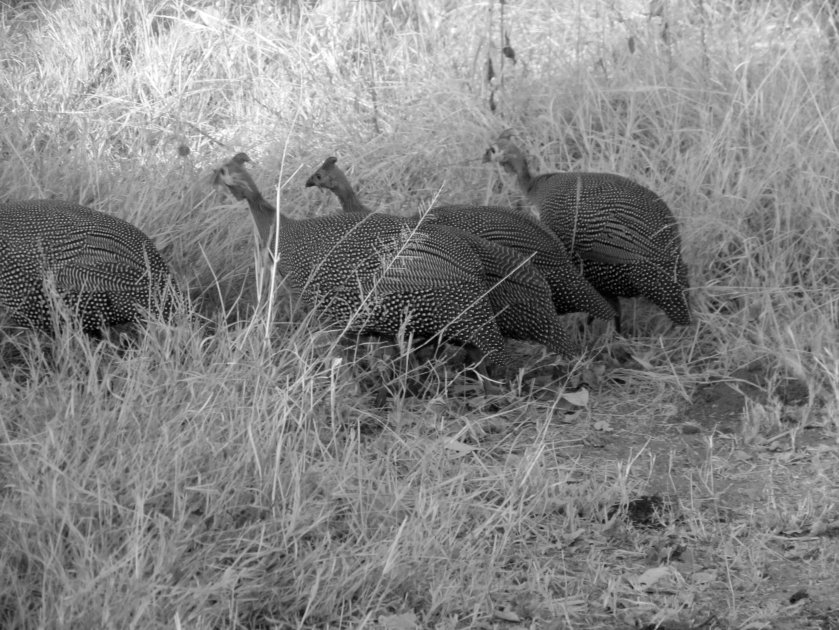
As we make our way down the two-rut road, a mob of Helmeted guineafowl runs ahead of us. They dart from one side of the road to the other, a bunch of silly old biddies, with shrunken featherless heads, thick bodies covered in spotted dark gray plumage and large rumps that bounce when they run. Blue jowls on their necks flap back and forth under their beaks. They never once consider flying to get out of our path.
The guineafowl call excitedly to each other as we flush them: Keck, keck, keck, keck, keck, keck, KECK!!!!!!! Eventually they dash to the side of the road and disappear into the bush.
Ignoring them, the elephant in front of us steadily treads down the right rut of the road. His pace is unhurried, measured, constant. A shoulder lifts, a leg straightens, accepts weight, and the foot splays out. A back leg moves forward, toenails scraping sand, straightens, accepts weight, and the foot splays out. A creature bigger than most monuments is on the move.






 ABOUT ELEPHANTS