Posted in Africa, Elephants, Nature, Nonfiction, Photography, Travel, Zoos

A Pedestrian Afternoon

Plump, babbling, feather-brained guinea fowl run ahead of us in silly mobs.  Perched atop impossibly skinny blue necks, their noggins look professionally shrunk by headhunters.  The morning air is hot, dusty, and soft as windblown sheets.

A faint sizzle above my head makes me look up.  A pointed dart in the shape of a cross moves steadily across the pale blue sky, spawns a cloud of ice behind itself for a hundred miles or more.   Its contrail broadens from a sharp point into a wide cottony smudge.  One of the astronauts reported from space that contrails could be seen over all parts of the world, often radiating from major airports like the spokes on a wheel.

Morula and I mosey along at the rear of the herd, one foot in front of the other, each footstep connected to the next one.

I place my boot inside Morula’s huge footprint.  The brand name of my boots is imprinted within the outline of my soles; a clever advertisement made with each step.  My boots make deeper impressions than Morula’s feet because each one of my steps applies more pressure per square inch.  All my weight transfers to my feet, my two small points of contact with the earth.  Morula’s weight spreads over four large footpads the size of a medium pizza pan.

One week ago, looking down from a jet that took me across Tanzania, I was surprised to see crater after crater, giant ancient footprints, leading to Kilma-ngaro, the Maasai words for “hill of water.”  At 19,340 feet, Kilimanjaro is the highest peak in Africa and one of its oldest volcanic cones, providing water to the rivers of the Masa Mara.

Some of the cratered footprints leading to Kilimanjaro were shaped like the sharp tracks of zebras.  Others were so worn down they were completely covered with vegetation, visible only from the air.  The sequence of volcanic craters looked as if Kilimanjaro itself had marched up the eastern fault line of the Great Rift Valley, which is sort of what volcanoes do, given millions of years to do it.

From the air, I could see webs of roads and trails near the ancient craters – some leading up to their rims, some circling around them.  Many of these paths are generations old, harmonious with the landscape, paths that flow around obstacles and toward places of safety and browse.  Compacted by many feet, they are safe passages across treacherous quagmires that could swallow you and me.  Some of them make so much sense to the feet that they can be followed in the dark.  In Kenya, the old highway from Nairobi to Nakuru was once an ancient elephant route, zigzagging down to the Rift Valley floor.

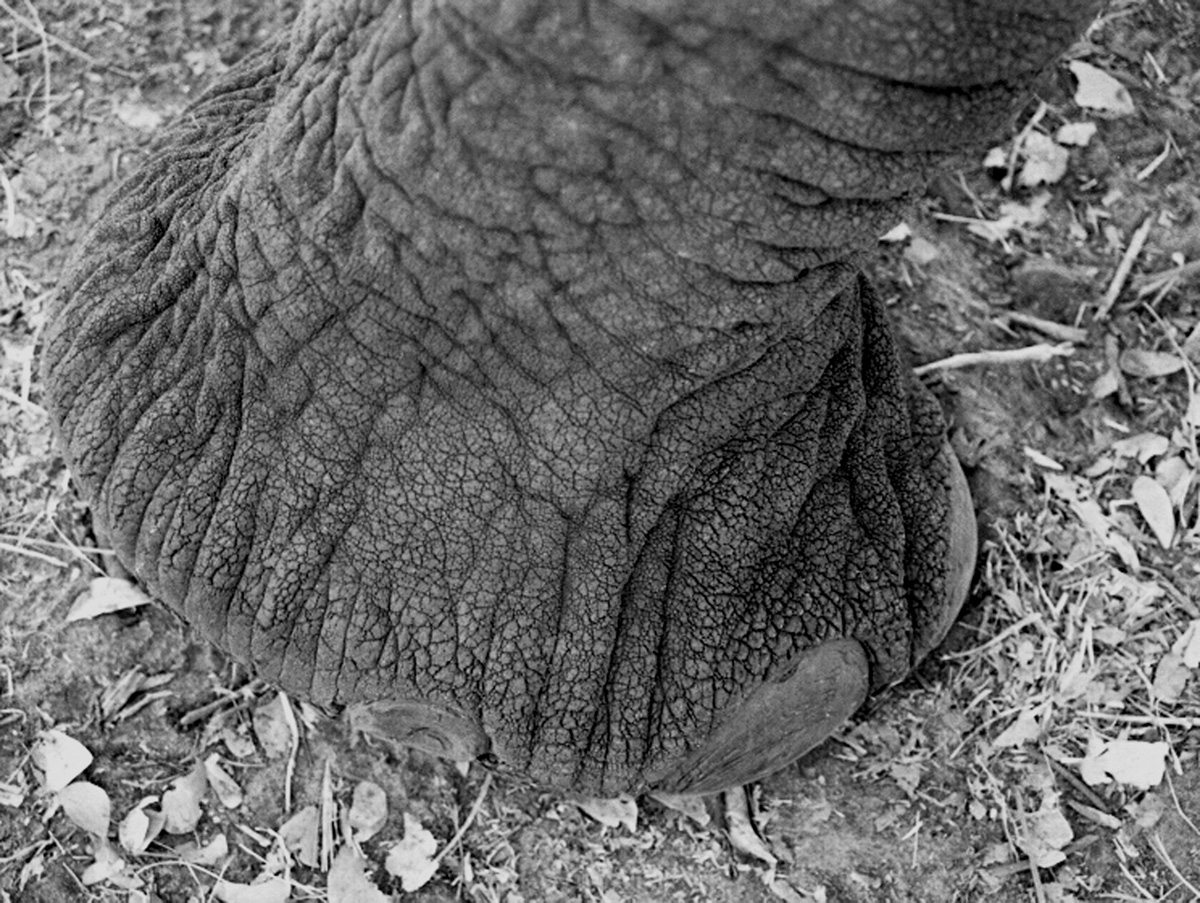
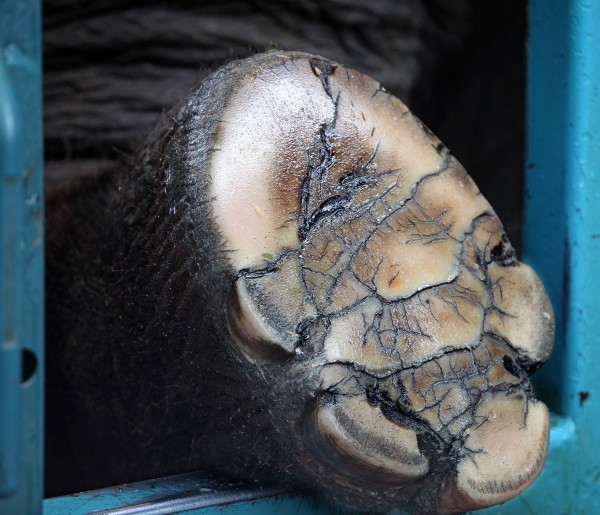
Earlier in the afternoon, the elephants stopped to browse.  I took a photograph of Morula resting against an eroded termite mound and noticed the bottoms of her feet were as cracked as dried mud puddles.  They mirrored the ground upon which she walks.Morula's cracked footpads

Morula has four toes on her front feet and three on her hind feet.  They grow at a rate that might be expected from an animal that walks twenty to thirty miles a day.  In captivity, an elephant’s nails must be constantly trimmed, often on a daily basis; otherwise they become infected and ingrown.

Incarcerated elephants also have problems with the pads on their feet.  Without wide-ranging activity the pads thicken and grow hard and must frequently be pared down.  Otherwise their feet begin to resemble shoes with worn heels.  The displacement of their gait will cause joint problems later on.
Steve Ringman, The Seattle Times

Tramping along in Morula’s wake, I’m beginning to get the hang of all this walking and browsing – less sweating, less reliance on my water bottle.   I’m beginning to wish I could do this every day of my life.

There’s a lot of languid movement packed into the word: “browse.”  Days and weeks and years of walking.  Walking and stopping.  Walking and stopping.  Walking in one elephant’s lifetime the equivalent of 5 times around the circumference of the earth.

Morula’s round print, side-by-side with my boot print, tell a story of companionship, of human and elephant as equals.   Our direction is not purposeful or hurried or even random.  We take this path day after day, a normal occurrence.  It’s a way of life.

Imagine that.  A way of life.

Posted in Nature, Photography

If It Were Possible

Through the Grass

If it were possible

To sleep standing up

To taste the many flavors of water

To tell each part of the day by its scent

To wear nothing but our own skins

To walk always barefoot in the grass

To watch the nightly migration of stars

To smell the stories brought by the wind

To be surrounded by family

To hear the symphony of their heartbeats

To trumpet to the skies and rumble to the ground

Could you then live the life you were given?

Posted in Africa, Elephants, Nature, Nonfiction, Photography, Travel

Toenail Sun

Morula Sucking Trunk

An Excerpt from my Book:

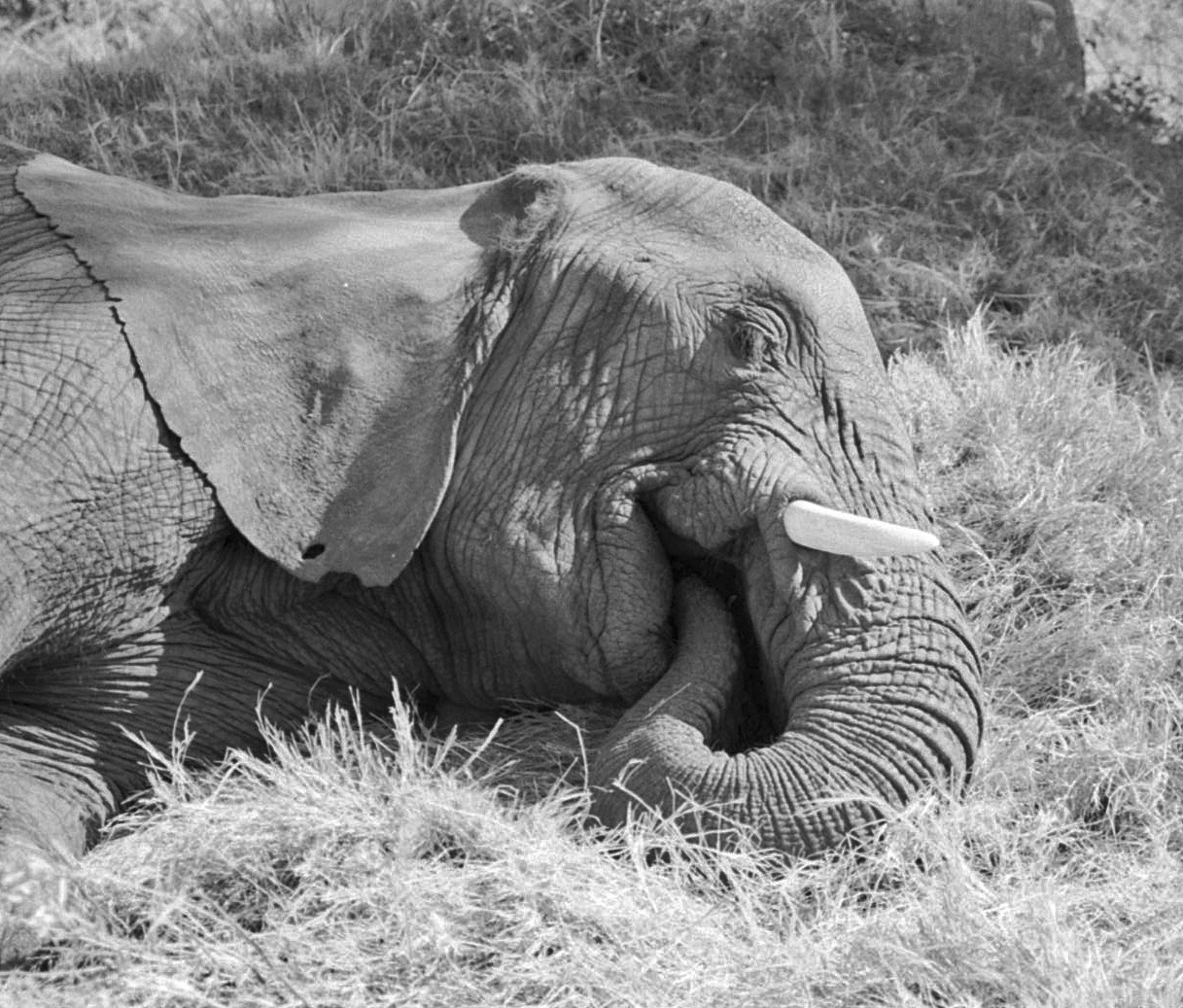
Morula drowses, lying on her side, falling asleep in the sun.  She catches the tip of her trunk in her mouth, as Doug rubs the bottom of her front foot.  Her eyes droop and her mouth slackens with pleasure.

As Doug continues to rub, the tip of her trunk slips from her mouth.  Her eyes nearly close.  She drools a bit.

I kneel down next to her.

Morula’s legs are folded together, bent at the ankle and knee, the same way I fold my wrists and elbows together in sleep.  She’s strangely voluptuous, even Rubenesque, with her rounded belly and nipple peaking out from underneath her right leg.  Her ear drapes like a leather cloak over her shoulder.  From this angle it’s easy to see how her right tusk pierces her upper lip.

People often mistake an elephant’s ankle joint for a knee, since it seems far away from the foot, but the locations of her ankle, knee and shoulder are clear from the way her legs are bent.

Except for their gray color, Morula’s toenails look pretty much the same as mine do, only bigger and thicker.  Human and elephant nails are made of tough, insoluble keratin, a semi-transparent protein that is the major component of hair, hooves, horns and quills.

Morula’s toenails grow at a rate that might be expected from an animal that walks twenty or thirty miles a day.  They are also highly polished from walking through sand.  In captivity, an elephant’s nails must be constantly trimmed, often on a daily basis; otherwise they become infected and ingrown.  And without the opportunity to walk long distances, the pads on the feet of incarcerated elephants thicken and grow hard, and must be frequently pared down.  If they’re not, the displacement of their gait will cause joint problems later on.

I take a photograph of the sun mirrored on Morula’s highly polished nail.


Morula's toenail b&w

Posted in Africa, Elephants, Nature, Photography, Travel, Writing

Windows of the Soul

Jabu's eyeLike us, like all mammals, an elephant’s eye has one large lens, its aperture always open, except for a blink, or in sleep.  Like us, like all mammals, Jabu’s round iris controls the amount of light that enters his pupil.  Like us, the lens of his eye focuses light images on his retinas, where they are converted into chemical and electrical impulses, and conveyed along the optic nerve directly into his brain.

The iris is the only muscle of our bodies not colored a shade of red.  It contains pigment instead.  The density of that pigment colors our eyes from brown to blue, mostly shades of brown for elephants, although a blue-eyed calf was photographed this year in South Africa.

Iris is the Greek word for rainbow.  When light refracts through countless prisms of rain, it produces that arched scatter of reds, greens, blues and violets that we call rainbows.  But what we see is only half the story.  Rainbows are perfect circles cut in two by the horizon.  It’s only possible to see a complete circular rainbow if you are in an aircraft and the sun is high enough behind you.  A round rainbow is named a “glory.”  A halo for the earth.

How did the Greeks know rainbows are round?

Hurtling towards earth at 186,282 miles per second, light from the sun is carried by subatomic particles called photons, which vibrate up and down in perpendicular motion to the direction of the advancing light waves, passing along their energy to the retinas of our eyes.  Photons are both the medium and the message, carrying waves like water carries waves, invisible surf lapping against the islands of my eyes.  The cells in my eyes, in Jabu’s eyes, are precisely one photon wide.

I blink, he blinks, photon by photon we gaze into each other’s souls.

Posted in Nature, Nonfiction, Photography

The Light from Saxophones

Tsessebes afternoon sunThree tsessebees saunter up to their bellies in strong vertical spikes of custard-colored grass.  Their shoulder humps, sea-horse faces and gleaming russet coats rise and fall, rise and fall, from left to right, like a musical score on parchment.

The light in this photograph belongs to lingering saxophones.  Long, rich, golden notes catch and roll on the backs of impalas, snag in the teeth of lions and smolder in the burnt umber eyes of eagles.  The grasses, the trees, the tsessebees, all are coated in honey as the sun bends at the waist and pours out the last light of day in a long slow moan, a sweet trickle down the throat of night.

Posted in Elephants, Extinction, Nature

Mammoth Tree

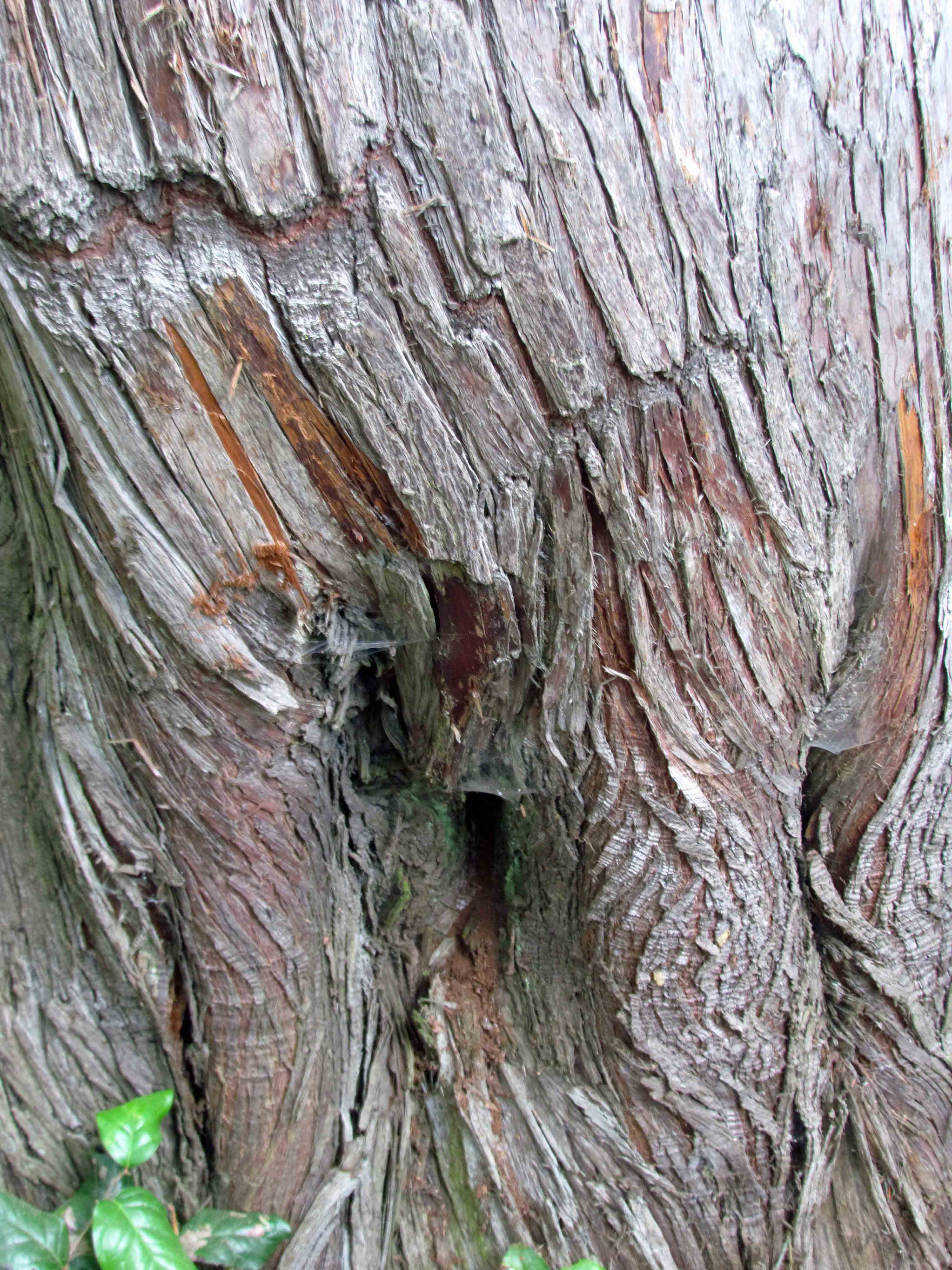
“Look,” my friend says, “it’s an elephant.” I turn around.  We’re walking along a path above the tide pools at Salt Creek, on the Straits of Juan de Fuca.  It’s a cold, foggy morning, summer slipping into fall. She points to a western red cedar on a curve of the path.  “I see an elephant,” she says.

She’s right.  But where she sees a generic elephant I see a mammoth, a young Columbian mammoth, with a shaggy curl of moss on its domed forehead and layered fur all the way down its trunk.  Its small ear flaps forward and a rounded burl eye stares sightlessly out over the straits.  His trunk (by now I’ve already decided his gender) reaches down into salal and young firs, as if he is browsing while standing on the edge of a cliff where land meets sea.

Mammoth in Cedar

I reach out and touch this frozen young giant – about seven feet tall to the top of his dome.  He’ll be ten feet tall when fully grown.  Of course he’s impassive, wooden to my touch, but the swirl of his bark/fur makes him seem as if he just stopped as we rounded his corner, hoping to blend in before deciding on our intent.

I retrace my steps to the other side of the tree and discover that my gender assignment is completely wrong.  On the exact opposite side of the mammoth’s head is its unmistakably female rear end, two legs solidly planted on the ground, a hanging vulva in between them.  Even though shaggy fur covers her rump, anus and legs, her triangular shaped vulva can clearly be seen.  Male elephants have internal scrotum and their small hanging folds are tucked up and under.  This mammoth is definitely female.

Mammoth Cedar female

The western red cedar grows straight and tall from the middle of her back.  I assume she grew around a nurse log, forming her shape during a hundred years or more.  Cedars like this one will grow to 180 feet and live for a thousand years.  Mammoths disappeared ten thousand years ago.  But I wonder if giants remember giants and try to resurrect them however they can.

Posted in Africa, Elephants, Morula, Nonfiction, Photography, Pleistocene

Footprints

Footprints

Our feet anchor us to the ground.  Just as my Pleistocene ancestors could read the tracks of mastodons, so I now gaze down at an elephant’s prints in the dust.  Her back feet are oval and her front feet round.  City slicker that I am, even I can tell the direction she is going.

 The sand beneath our feet  is the color of a lion’s coat, studded with brittle leaf litter.  Morula walks through it without making a sound.  Shock-absorbing pads on the soles of her feet cushion each footstep, smother crushed leaves.

I step on a dry leaf and it crackles into powder.

The brand name of my boots imprints within the outline of my soles; a clever advertisement made with each step.  All of my weight concentrates in two small points of contact with the earth, so I make deeper impressions than Morula’s footprints.  Each one of my steps applies more pressure per square inch; Morula’s weight spreads over four large footpads the size of a medium pizza pan.

She can step on a snake and not kill it.

Morula lifts her foot and grains of sand roll down slope into the crater of her footprint.

Following two paths, the one beneath her feet and the one in her mind, Morula strolls on.  Dust rises, a half shadow that marks her passage, before it collapses again to the ground.

There is a before and an after to each moment of our lives, paths we follow and paths we do not.

Posted in Nature, Photography

Let There be Light


Sunset, Moremi Game Reserve, Botswana

From 93 million miles away, pitched straight at me, vibrating, ululating like an African cry of greeting, light from the sun hurtles towards the earth at 186,282 miles per second and eight minutes later slams into me like a jabbering, long-lost relative trying to make up for lost time.  It babbles everything, all at once, into my eyes.

Our eyesight is an electro-chemical reaction to a vibrating particle-wave gushing optical information splash into my brain.  I could shut my eyes to the wonder around me and be diminished.  I could shut my eyes to the atrocities around me and become hardened.

By opening my eyes, I give shape to my perceptions.  By opening my eyes I take responsibility for my vision, for what my eyes teach me.  By opening my eyes I learn that I belong to the world, not that the world belongs to me.

Our eyes are openings into and out of our bodies.  Are my eyes, as some would say, a window to my soul?

There is a cold way of seeing that clips wings and stifles our words into faint echoes.  But there is also a way of seeing where the eye can be like a mouth, swallowing color, taking in the entire world with just one gulp.  Just the sheer fact alone that we see color should provide enough wonder to fill our lives, should stop us in our tracks, should keep our eyes wide open, devouring everything as fast as we can choke it down, leave us slack-jawed, gasping for air.


Somewhere behind my eyes, a world exists that I yearn to inhabit, dreams that might become real if only I could imagine them with my eyes wide open.


Posted in Africa, Travel

Nature’s Bar Codes

An Excerpt from my book:

Our honey-colored morning is airbrushed with dust as we scuff our way toward a mid-day meal.  The road we’re following, just two ruts in the sand, has a center grown up in grass.  It’s as tall as the undercarriage of a passing vehicle, but a lot shorter than the undercarriage of passing elephants.  Paved roads don’t exist in this part of the Okavango Delta; spring floods would only wash them away.

Off in the distance zebras nod as they plod past a line of trees.  Yes, this is the right way; Yes, this is the right way.

They are nature’s bar codes, no two alike.

In his book, Origin of Species, Darwin speculated on whether a zebra was a white horse with black stripes or a black horse with white stripes.  He compiled examples of the occasional striping on all horses, arguing that a trait from a distant common ancestor, white on black, is brought to full fruition in the zebra.  His examples revealed that some zebras are born with white dots and blotches, incomplete stripes on a black background, Morse code instead of bar code, natural proof that a zebra is a black horse with white stripes.  The white is lack of pigmentation.

So  – here’s the question that pops into my mind as I watch the zebras: do zebra foals imprint on the black stripes of their mothers or on the white stripes?  The accepted belief puts money on the black pattern.  But isn’t that the human response, the bar code response?

Not one of us knows what a zebra knows.

Posted in Africa, Elephants, Jabu, Uncategorized

Heart

I’m reposting this piece in honor of the new year.  It occurred very early in my blog:

Heart shapes can be found in nature, if you’re lucky enough to spy one.  There’s a heart on Jabu’s trunk, a ridge of skin that feels like fine shoe leather.  One of his wrinkles pierces the lower third of this heart shape, from left to right, straight as an arrow.  His real heart hangs between his breastbone and ribs, a little to the left, just like mine does.  But instead of having a heart with a single point, an elephant’s heart has two points at its apex – so it’s the wrinkled outline of a human heart that Jabu carries on his trunk.


The length of Jabu’s real heart is about twenty-two inches, its width eighteen.  His heart weighs around forty-four pounds, almost the same as a medium-sized dog.  Still, it’s less than 1% of his body weight, a common proportion among large mammals and among humans.  My heart also weighs less than 1% of my body weight: about ten ounces.

The human heart is approximately five inches long, three-and-a-half inches wide and shaped like a pulsing cone.  It is the only muscle in my body that acts on its own – my heartbeat doesn’t need any messages from my brain.  The cells in my heart tissue involuntarily constrict, all together, all at once, over and over, a soft perpetual-motion machine.  Rip my heart from my body, chop it into pieces, immerse the pieces in a saline solution, and then give them a small jolt of electricity.  The remnants of my cardiac muscle will contract . . . contract . . .  contract – all on their own, sometimes for hours.

It’s designed to be strong, my heart.

In mammals, birds, and reptiles the heart has the same basic pump-like design, a design that has worked through eons – even cold-blooded dinosaurs had hearts.  A day or two after fertilization, embryos develop a pinpoint that pales, then brightens, pales, then brightens, the beginnings of a tiny pump practicing emptying, filling, emptying, refilling.  An old, old pattern.  The master timepiece.

There are four chambers in my heart: two auricles (“little ears”) and two ventricles (“little bellies”) – named by anatomists for the external parts of the body they resemble.  Spent, dark-red blood is collected in the right auricle, then dropped into the right ventricle, which constricts and pumps it out to the lungs to pick up oxygen.  Bright red again, full of oxygen, blood circulates back to the left auricle and from there drops into the left ventricle.  In the next twitch blood is delivered to every corner of my body.

The “little ears,” the auricles, make very little sound as they drain blood into the lower chambers of my heart, a distance of an inch or so.  It’s the ventricles, the “little bellies,” that boom as each contraction forces open heart valves and blood gushes up the aorta under pressure.  Lupp DUPP.  Lupp DUPP.  Lupp DUPP.  One beat smaller, one beat larger, flush after flush.

My right ventricle has walls thin as paper – it delivers blood only as far as the lungs.  If I could hold it up to the light I could see right through it.  The left side of my heart is the heavyweight lifter, pumping blood all the way to my toes, moving 150,000 tons of blood in my lifetime.

Jabu’s great artery, the aorta, takes off from the left ventricle of his heart, the same as mine does.  Named in the Middle Ages, aorta means, “to heave.”   It’s an artery more flexible and sturdier than any manmade pipe.  Jabu’s left ventricle pumps a continuous stream of blood up and out of his heart into the aorta, which then drops down into his chest and down each leg, where it branches and branches and branches all the way to his toes.  Each arterial branch has less space than the artery it came from, but the sum of  their volume is always greater than their mother artery.  The blood moves, but more and more slowly through smaller and smaller pipes, trickling into all corners of Jabu’s body, trickling through capillaries one cell thick.

Blood’s trip back to the heart is made through veins.  Millions of tiny venules drain into thousands of small veins, thousands drain to hundreds, hundreds to the one that empties back into the heart.  Veins are even more elastic than arteries, can hold variable quantities of blood, and serve as a reservoir for all that moving liquid.  At any one moment, 65% of my blood is contained in my veins.  It’s an ancient blueprint, this branching, this heartbeat, this coming and going, a blueprint brought to life in even the tiniest of creatures.

Blood has to be literally hoisted from Jabu’s toes.  Squeezed along by muscles wrapped around veins, pushed by valves in the veins, and sucked upward by the huge action of breathing, blood finally arrives in the vena cava, where it drops into the heart.  Jabu has two vena cavae, possibly because of the large amounts of blood that need to be moved.  The blood vessels of an African elephant reach lengths of twelve feet, a huge network of life.

Jabu’s body contains 120 gallons of blood, enough to fill an aquarium six feet long, two feet wide and two feet deep.  At one-and-a-half gallons, my puny amount of blood would barely fill a birdbath.

Blood is the body’s only liquid organ, five times denser than water.  It takes food and water in, removes waste and byproducts to the disposal areas of the body, the kidneys, lungs, and skin.  Blood irrigates all tissue, both feeds and cleanses.  It leaves the heart at one mile per hour and returns, laden with waste, at about half that speed.  Construction materials move along highways of blood, demolished materials return.  Blood is 20% solids and 80% water, carrying products of digestion, products made by the body, foreign intruders, the dust of stars, even cobalt from the original ocean of the earth where both of us, human and elephant, began our journeys.

We each have roughly one billion heartbeats for our lives.  Mouse, hummingbird, elephant, human, all the same.  Like us, elephants suffer cardiovascular disease, die of heart attacks and strokes.

Cardiac arrest: when the heart shudders and stops, when the light in the eyes flickers, fades and snuffs.

And when the heart quits beating, its resonance

Lupp DUPP     Lupp DUPP     Lupp DUPP

is gone.  The gurgle of digestion, all the silky, sturdy, slapping noises, the blood rush, gone.  The symphony of the body is finished.

For those of us left, that silence is almost too much to bear.

The heart on Jabu’s trunk