
A continuing series of elephant photographs. Ear hair. Yep, just like all men (and some women). Grows longer with age, too. Okavango Delta, Botswana.

A continuing series of elephant photographs. Ear hair. Yep, just like all men (and some women). Grows longer with age, too. Okavango Delta, Botswana.
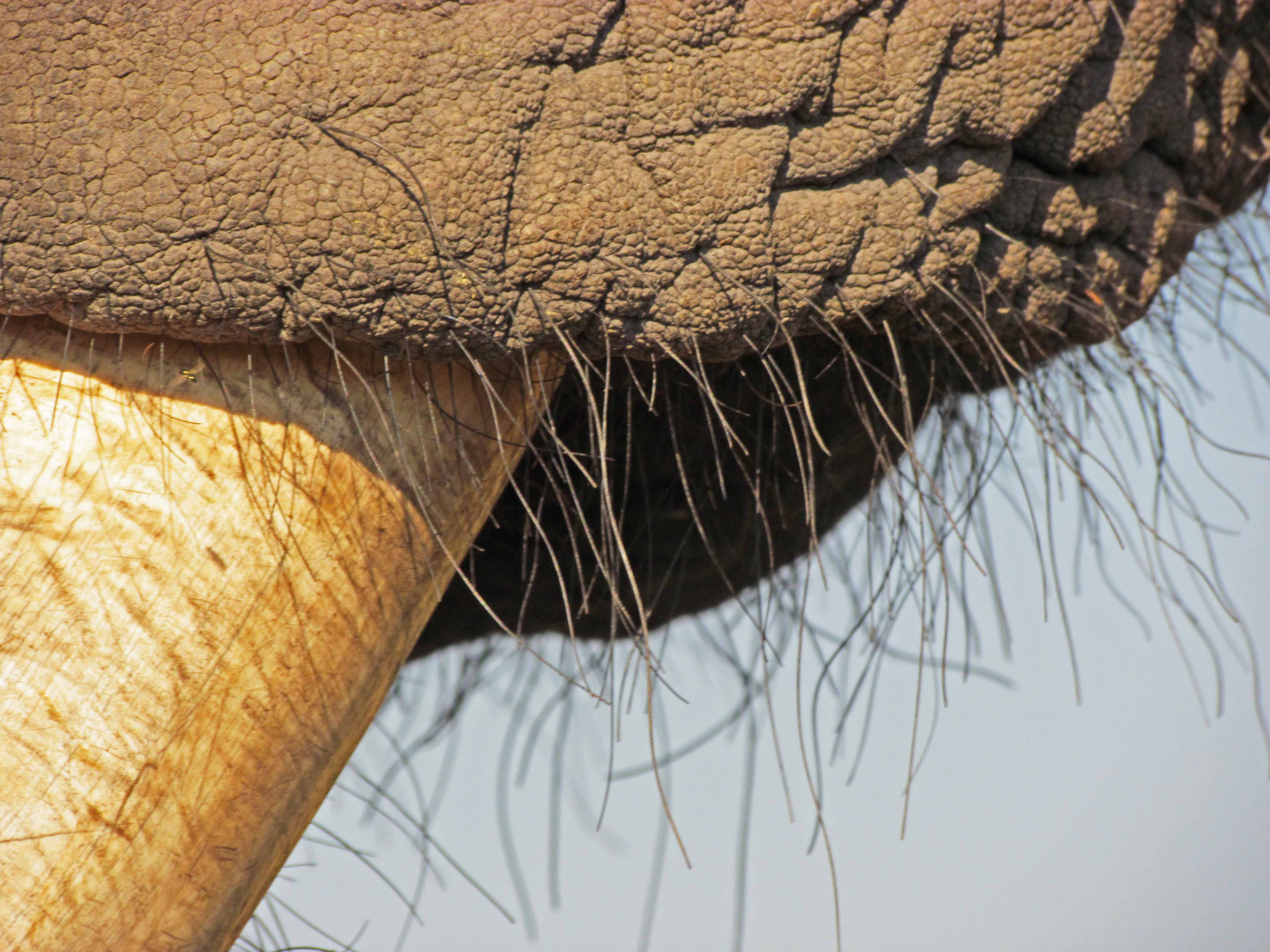
A continuing photographic series. Did you know elephants have beards? Okavango Delta, Botswana.
Since this was the second-most popular post of 2014, I’m re-posting it for those who may not have read it yet.
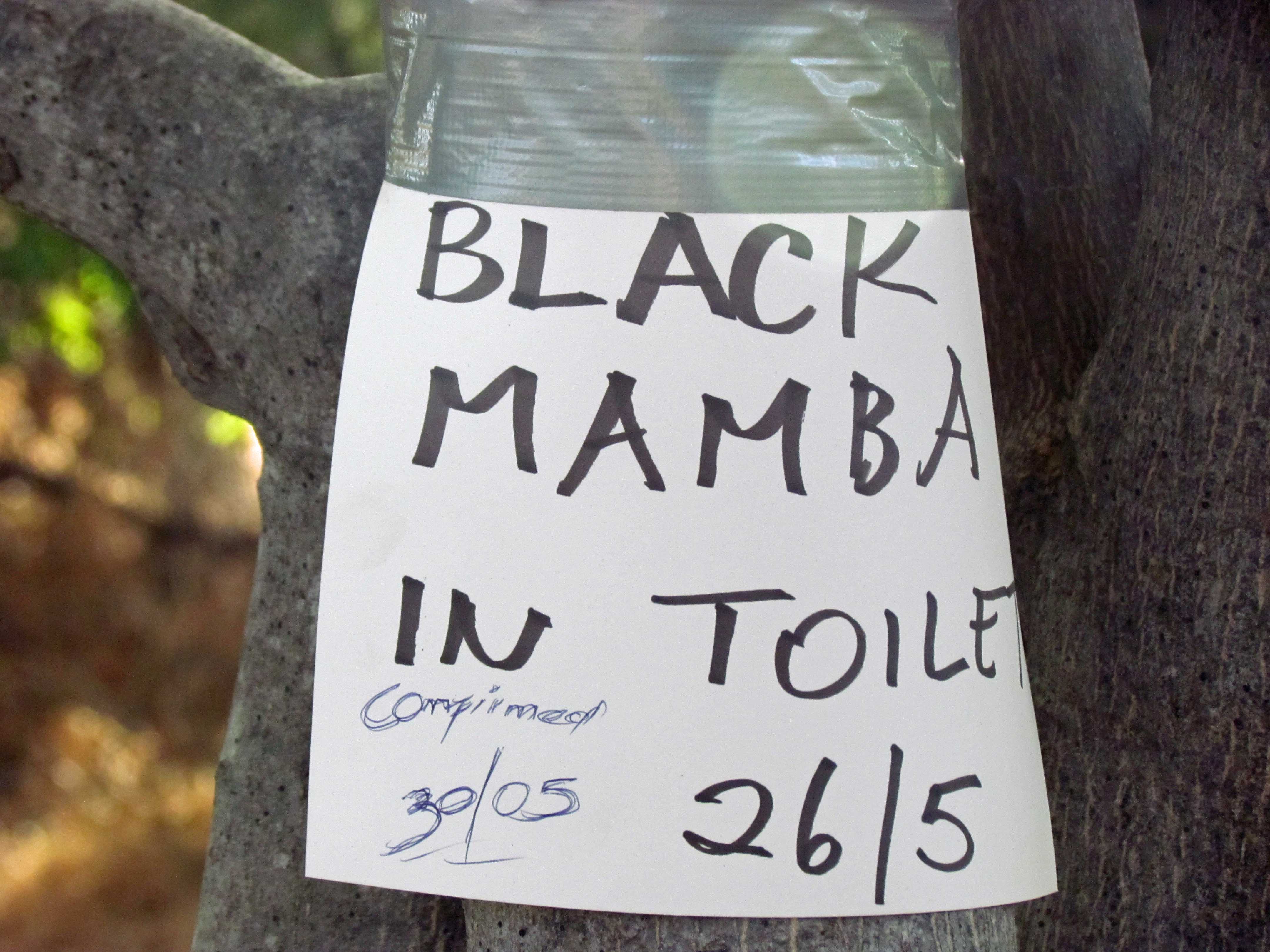
But first, for those who are unfamiliar with black mambas, here’s a little background information:
Black mambas (Dendroaspis polytepsis) are the longest venomous snakes in Africa, measuring up to 14 ½ feet. Mambas are not black – they’re more olive or greenish gray, with a narrow, elongated head the shape of a coffin. It’s the inside of their mouths that are black – hence the name. Mambas are also extremely aggressive and may actively attack without provocation. I use the adverb “actively” with reason – a mamba can strike in all directions, even though a third of its body is raised above the ground, and it can chase you in that upright position at speeds up to 20 mph. If you are bitten, your death will occur within 20-60 minutes. An anti-venom for mamba bites exists, but it must be administered immediately, requiring 10-20 vials of solution. But if you are struck in the face or neck (quite likely, since the head of the mamba chasing you is 4 feet off the ground), you will die in ten minutes. That black mouth will be the last thing you see.
On that cheery note, on with the story:
In the Moremi Game Reserve, east of the Okavango Delta, is an elevated platform overlooking a large hippo pool in a bend of the Khwai River. Six of us, our guide OT (“just like Overtime!”) arrive in our Land Rover.
“What’s that?” I point.
It’s a large piece of stiff white paper taped with duct tape to a tree. We climb out, read it, and immediately start swiveling our heads, trying to look in all directions at once.
“Anyone want to go look?” OT laughs.
The toilet, roughly the size of those cartoon outhouses with the crescent moons carved in their doors, is a cinder block building with a tin roof. It’s about fifty feet from our Land Rover. The painted green door on the toilet is ajar.
Certainly I’m not tempted to look inside. After all, the second message was written just three days before our arrival by someone a lot more curious than I am about deadly snakes. The mamba is most likely still in there. Who wants to reconfirm a reconfirmation? Mambas are territorial; they will always return to their lairs, although that’s usually in an abandoned termite mounds or a hollow tree, rarely, I’d bet extremely rarely, in a toilet. A mamba is diurnal, active both night and day. It could be sleeping in there. Or not.
In my opinion, I’m already standing way too close to that toilet. Trying to look both at the toilet and at everything else, I walk slowly backwards. Mambas don’t like sudden movements.
Besides, I firmly believe, even though I haven’t seen it, that this toilet is not a Western ceramic throne, but a mere hole in the cement. I’ve had enough experience with toilets-in-the-middle-of-nowhere to also believe that the area around the hole is likely none-too-clean. That bush over there looks a better. A few minutes later, after careful reconnoitering and quickly taking care of business, I can confirm that no mambas are lurking around it.
As I climb the steps to the viewing platform I look for mambas wrapped around posts. On the creaky platform I look for mamba’s hidden in corners, or nestled into the thatch of the roof. I look for mambas slithering across the branches of the trees that lean dangerously close to the rails. A rustling noise among the branches spikes my heart rate to a gazillion, but it calms when I see it’s only a Burchell’s glossy starling, squawking for handouts.

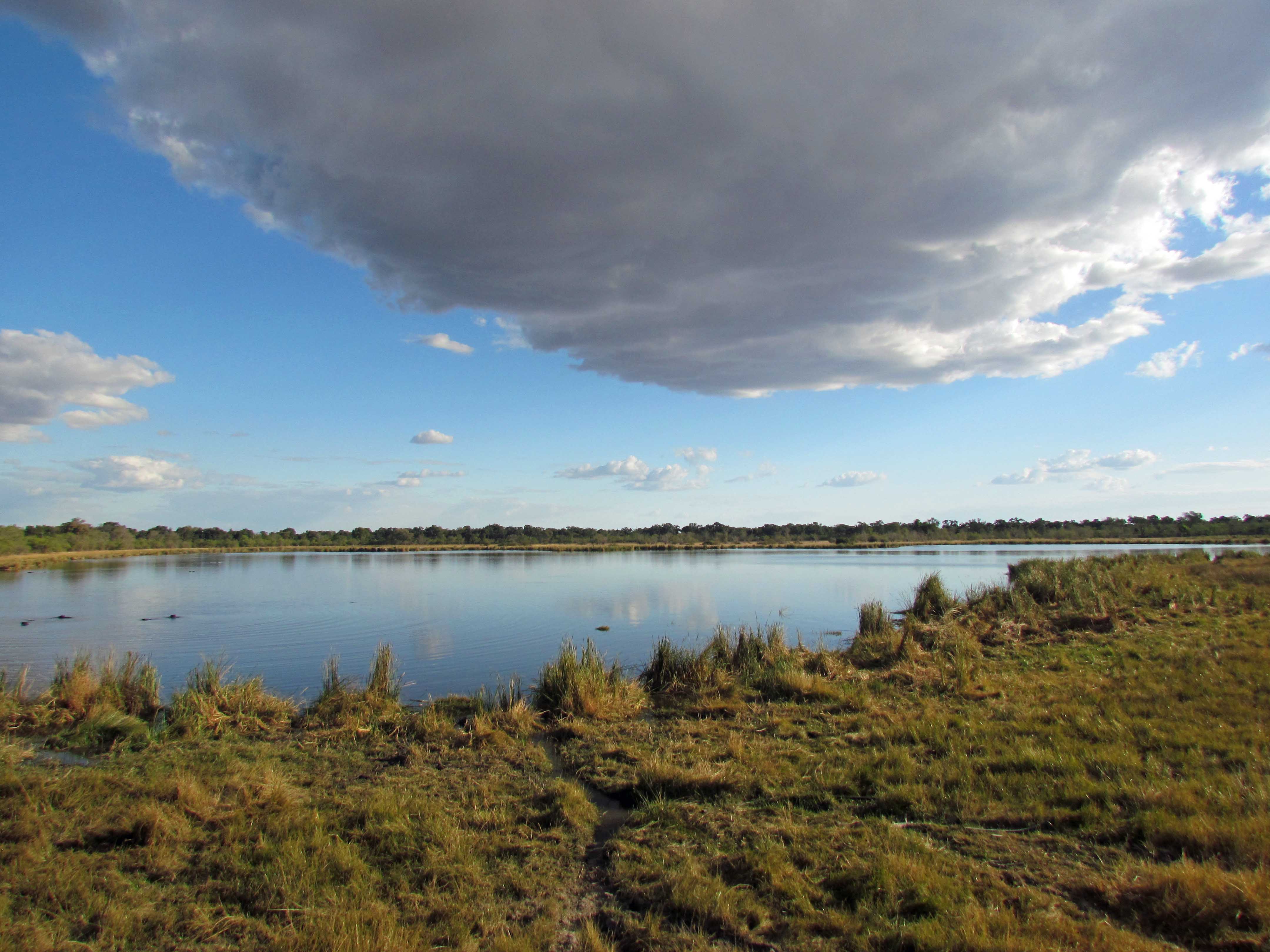
The view from the platform is marvelous. A massive cloud hangs over the hippo pool and puffs of other clouds reflect in the tranquil water. A dozen hippos rise and sink, burbling like submerged tubas. Tracks in the grass are hippo paths, where the hippos come out of the pool at night to feed, foraging as far as three miles for sweet young shoots.
At the bottom of the platform a dozen water monitors, some six-feet long, slither into positions that defend his or her portion of the bank, using the hippo paths as small highways. The smaller monitors end up with the worst spots, constantly harassed in slow-motion chases by the larger lizards. As I watch their typical reptile behavior, I think it’s lucky for us that the age of dinosaurs ended a long time ago.
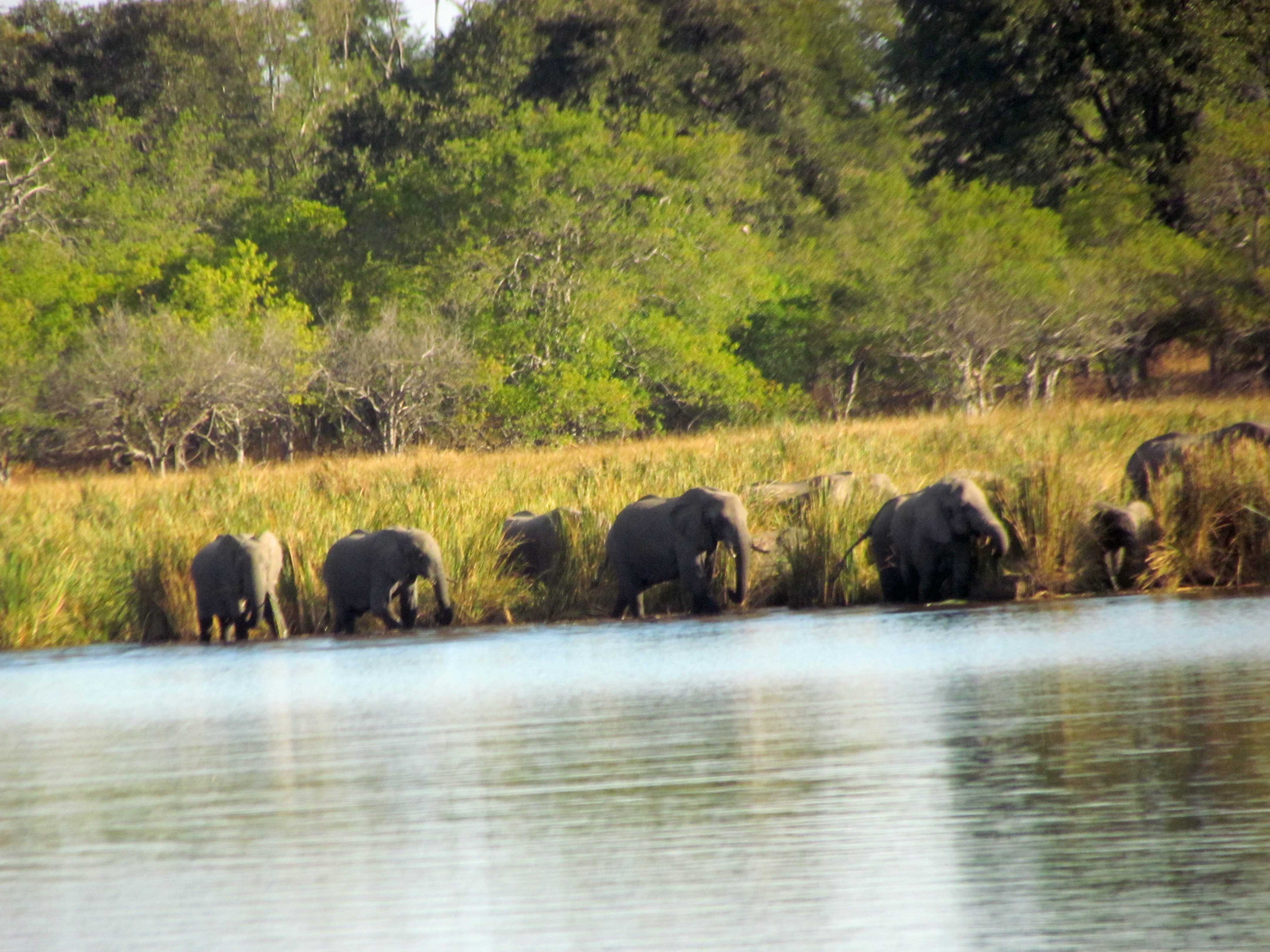
On the far side of the river, specks in the distance, a huge herd of elephants splashes along the edge of a reed bed. After I check for mambas, I lean on the rail of the platform to steady my camera. I use the digital zoom to take a picture, but it’s an extremely low-pixelated shot. The elephants are in constant motion, appearing and disappearing in the reeds, so the photo turns out fairly blurry, but at least I have proof that those specks were really elephants.
On the way down from the platform I look for mambas wrapped around support posts, coiled under steps, and hidden in the framework of the flooring. I scan for slithery movements in the brush and wait for someone else to climb in the Land Rover before I do. I doubt the mamba has exchanged one lair for another, but still, you never know . . .
So, Louis, the viewing platform has its own GPS coordinates. If YOU want to look at that mamba and reconfirm one more time that it’s really there, I can tell you exactly where to go!
As promised, I’m re-visiting the third most popular blog post of my blog in 2014: an excerpt from my book, Larger than Life: Living in the Shadows of Elephants.
Doug gets my full attention when he proclaims to his guests, “Thembi has a great set of knockers.”
“Thembi, leg.”
She obliges by bending her left front leg at the knee and raising it, exposing a clear view of her breast. “See? Elephant mammary glands are located on the chest, like humans.”
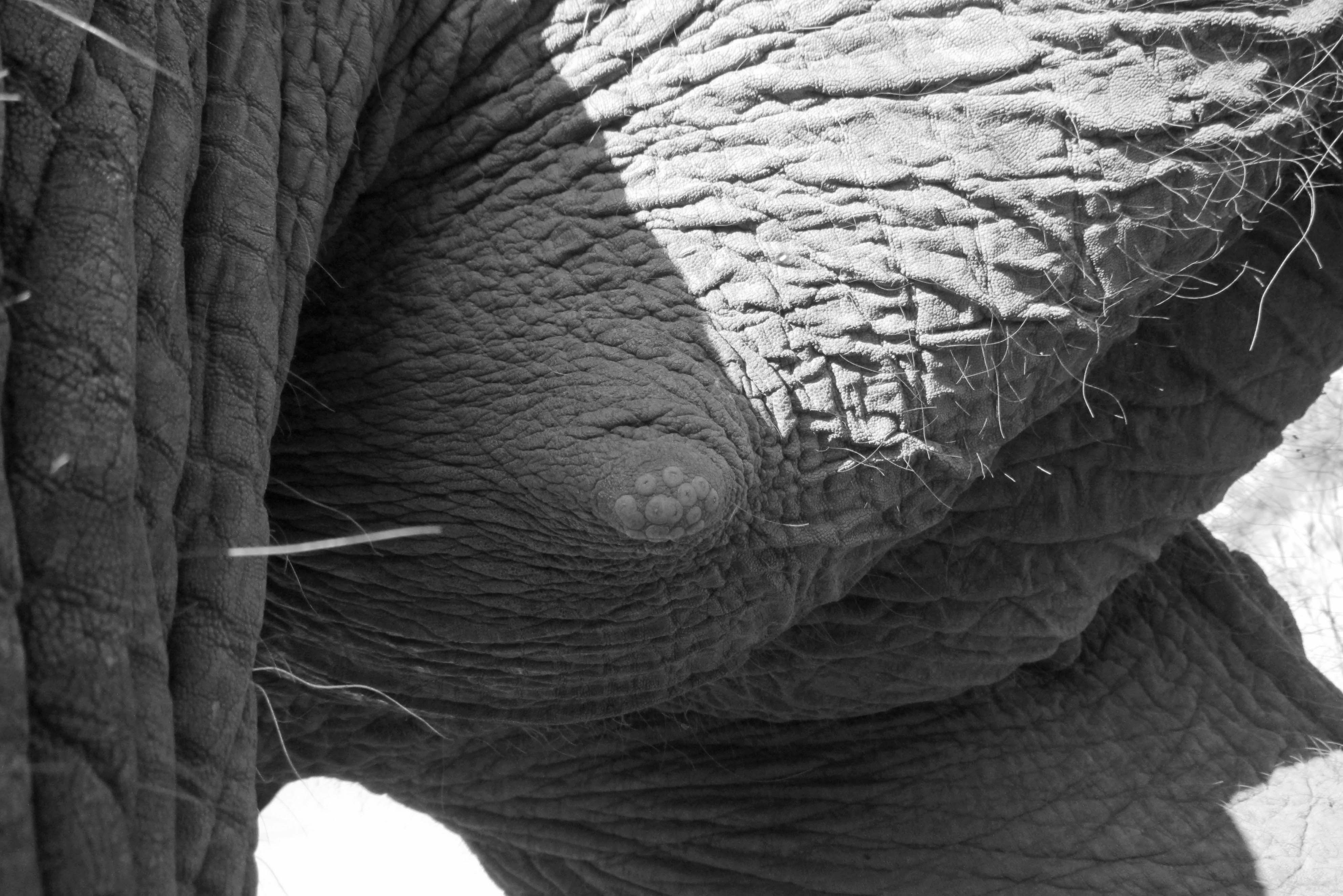
I lean over Doug’s shoulder and look at two gray breasts with permanently erect nipples. They’re about the size of a medium cantaloupe and, like human breasts, slightly globular, due to the pull of gravity.
“Alllllll-right, Thembi.” As her foot touches the ground, she flaps her ears and her trunk snorfles around his feet.
“If you reach in like this,” Doug demonstrates, “you can feel them.”
Steadying myself with one hand on Thembi’s leg, I reach in and cup her breast with the other hand. The skin of her breast is as soft as an old, creased leather bag. Her nipple, as one might expect, is harder than the flesh around it.
Thembi emits a low, murmuring rumble.
“Oh you like that, do you, Thembi girl?” Doug chuckles.
I quickly withdraw my hand and step away from her side.
“Anyone else want to try?” asks Doug.
Out of the seven of us, several people look away, several look down. No one ventures forward. I can’t tell if everyone is embarrassed or just reticent. Feeling up an elephant may not be quite what they had in mind. It certainly wasn’t what I had in mind.
“Well, OK. Mammals are called mammals because . . . . ?”
One of the guests ventures, “Mammary glands?”
“Right.” Doug continues his lecture: “Like all mammals, Thembi’s lactiferous ducts terminate in her nipples. They point out a bit, while Morula’s nipples point down. Thembi gets a bit of stimulation while she walks, don’t you, Thembi girl?”
Some of the guests look mildly scandalized, while others giggle and whisper to each other.
Doug rubs Thembi’s leg, which generates another snorfle.
Female elephants don’t have a row of teats, like cats or dogs. They don’t lie on their sides, suckling a litter. Elephant calves nurse standing up, with their small trunks flipped over an eye like a wayward curl.
All mammal breasts are modified sweat glands. Some mammal breasts are located in the groin and some on the chest. The breasts between Thembi’s front legs are in the same location mine would be if I walked around on all fours. Her breasts weigh about four pounds each, .1% of her body weight. Human breasts weigh .08% of total body weight, dogs 2%, rats 9%.
Do all mammals have larger breast size to body weight than humans? I pull out my notebook to write down that question, but then decided I really don’t care, and put the notebook away.
“Is she pregnant?” asks the woman behind me.
Although Thembi possesses relatively trim tonnage in comparison to the other two elephants, she is significantly rounder – huge thighs, huge belly, a Rubenesque sort of girl with a really long nose – and very full breasts, unusually large for a non-pregnant elephant.
“We don’t think so,” Doug replies. “We had her hormone levels tested about six months ago, and they were normal. She’s an enthusiastic eater, so she might be a tad rotund because of that. She might be incubating a surprise, but we doubt it.”
Sandi laughs. “That’s because she’s a bit of a flirt with the wild boys around here, but when things get serious she becomes quite horrified and scoots on home.”
Another one of the guests pipes up: “Has Jabu ever tried mating with her?”
“Yes, he’s tried,” Sandi replies, “But we’ve never yet seen him achieve intromission.”
Heads nod thoughtfully. I can see intromission has thrown them a bit. It’s not a word commonly used to describe sexual penetration, but I think most of the guests have a general idea of what it might mean. Several of their heads swivel to gaze at Jabu, ripping apart a nearby bush. Since he’s such a big boy, why couldn’t he just have his own way?
“Thembi doesn’t really favor him,” says Sandi, as if she’s reading minds.
“What if she had a calf?”
There’s not one second of hesitancy to Sandi’s reply: “Oh, we’d keep it. It wouldn’t be easy, though. Thembi’s never been in a breeding herd and has no clue about birth. And she’s rather stuck on herself, you know. We don’t think she’d be a good mother. But if it happened, we’d make it work.”
Even though it’s not likely that Jabu and Thembi will become pachyderm parents, I can easily imagine Thembi as a pregnant princess, mood swings, food cravings and all. As if to prove my point, she regally sweeps through a stand of grass, a princess on a mission. She breaks off a few branches from a small thornbush, stuffs them against her back molars and chews with her mouth open.
Thembi has never been with an extended herd of mothers and sisters and aunts and hasn’t had the opportunity to learn the complex behaviors required to be a mother. She’s never learned that newborn calves stay in physical contact ninety-nine percent of the time, either below or beside their mothers. Although calves will begin to forage by nine months, they continue to suckle for about four years. Elephants in zoos will quite frequently shun newborn calves. So I can just about predict Thembi’s reaction to a calf: What IS this thing following me around?
I glance over at Jabu. He has nipples, too. Guy nipples, nozzle-like nipples, surrounded with sparse hair.
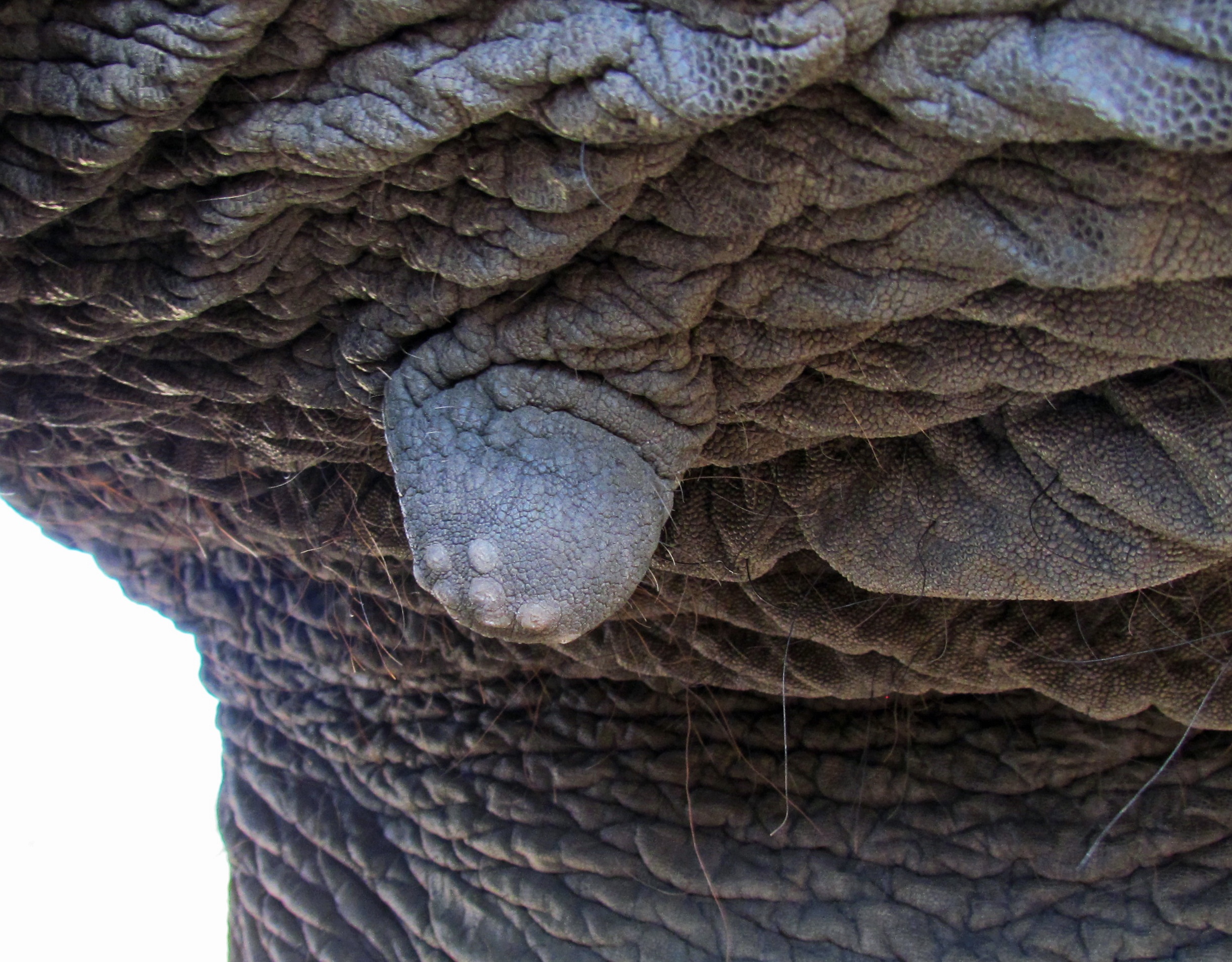
All mammals have three distinct features: hair, three middle ear bones, and mammary glands. Even whales, dolphins, porpoises and manatees have hair, usually on their snouts or next to blowholes. Elephants and manatees shared a common ancestor fifty-six million years ago, but the nipples of female manatees are now under their flippers, in their armpits.
A question comes from the back of the tourist group. “What about Morula?”
Dear, Old Maid Morula. The wallflower with big ears, large liquid eyes and a knobby forehead.
“If an elephant doesn’t breed by the age of twenty-five, they are unlikely to,” Sandi replies. “Morula is already the ripe old age of thirty.”
Female elephants typically become active at a quite young age, around thirteen. They can conceive as early as ten years old and possibly have 12-15 offspring by the time they are fifty. Female calves will stay with the herd the rest of their lives.
Male elephants take a bit longer to mature and become sexually active around the age of twenty-nine.
Morula has missed the boat. But I’ll bet she’d make a great aunty. She stands close by, slowly opening and closing her great ears, patiently watching.
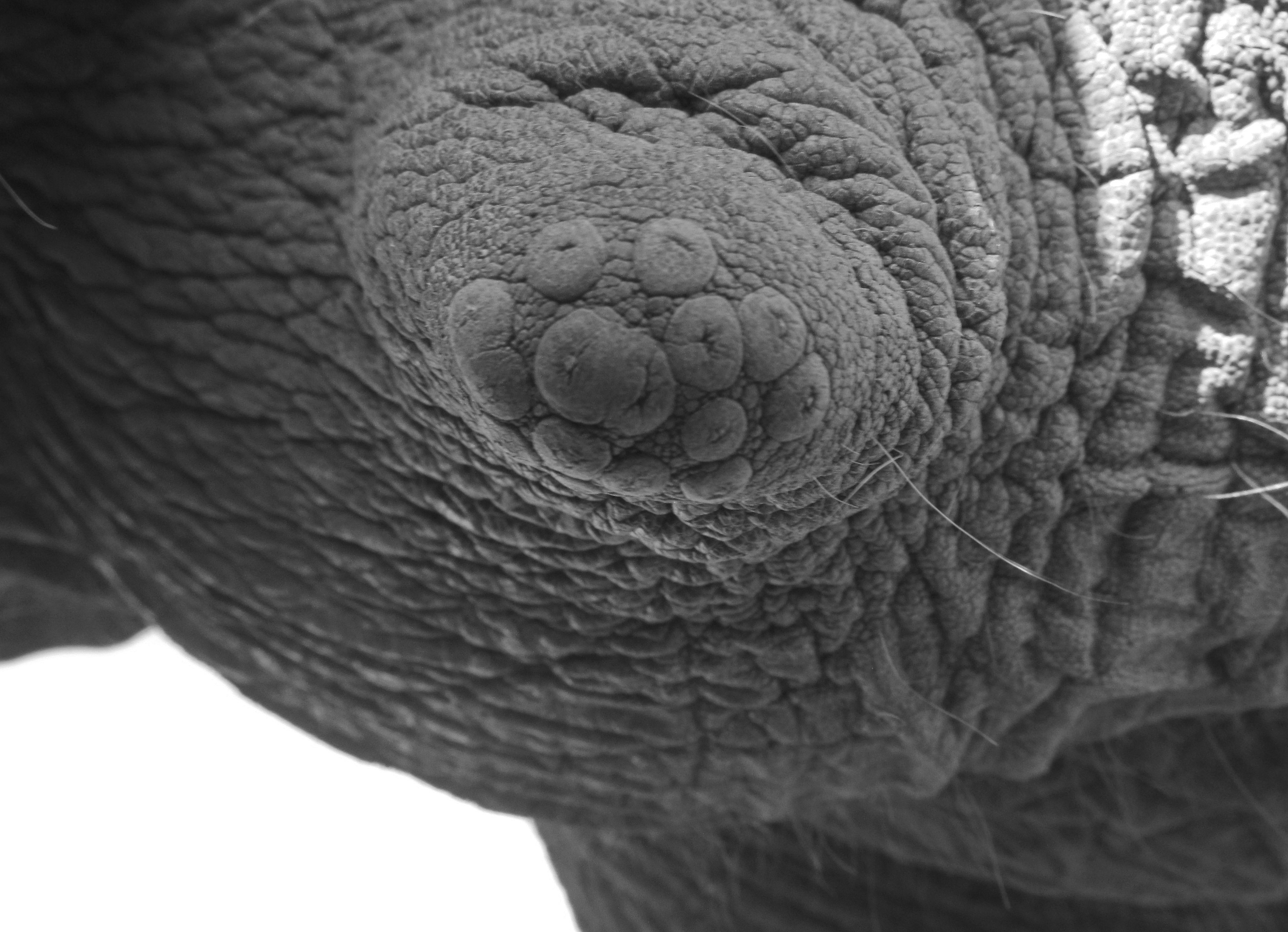
When he first developed his classification system, Swedish botanist and zoologist Carl Linnaeus originally called mammals Quadrupedia, after the name Aristotle gave them. Later he became actively opposed to wet-nursing practices in the 1750s and wrote a book on the benefits of breast-feeding your own child. As a political act, he reclassified Quadrupedia to Mammalia in later editions of his most famous work, Systema Naturae, defining mammals as a lactating class within the Animalia kingdom, a classification that has lasted to this day – all because women of nobility in Linnaeus’s time thought breastfeeding would ruin their figures.
Certainly that’s one thing Thembi doesn’t have to worry about.

I sit on my heels next to a high-burning fire and rock back and forth, toe to heel, toward the fire and away from it. Leaning in, I cup the palms of my hands to its heat. Tongues of flame lick blackened lips of wood as if they want to tell my fortune with hot, strange words.
In Botswana, this close to the equator, there are twelve hours of daylight and twelve hours of darkness. The earth rolls into night at 1,000 miles a minute – thirty minutes from sundown to dark. No long sunsets technicolored by particles of pollution, no lingering light due to the earth’s tilt, no instant barrage of street lamps.
My night is lit only by flame and stars.
The fire spits an ember into the sand near the toes of my boots where it flares and dies.
Above my head a brilliant swath of the Milky Way spanned a vault of sky already crowded with stars. Stars wheel toward dawn, the second hand on a clock face, the only clock that measures eons of time.
The beginning and the end are up there, somewhere.
The people of the Kalahari call the Milky Way “The Backbone of the Night.” They believe it keeps the sky from crashing down on their heads. If I squint hard enough, long enough, the Milky Way knits itself into what might look like pieces of solid bone.
Each time I look up it births even more new stars.
Most of our Old Stories must have originated like this, at night, around a hand-warming fire.
The fire burns down to single chips of orange. My hands make a small lid over the last of its heat.
I walk down the path to my tent. Soft night shadows loom around the circle of my flashlight. At the tent’s threshold, I switch it off. I trace the outlines of gods in the constellations overhead. I see Orion doing a slow cartwheel, his left hand already touching the horizon. Leo naps on his back, the way most lions sleep. Scorpio thrusts one claw into the leaves of a fan palm. Buried deep in the Milky Way, a jewel box of stars contains the tiny, tilted Southern Cross.
Moonlight rains through mesh openings of the tent’s windows, spatters my blanket with shifting, delicate squares. Sleep comes quickly, like an African nightfall. My dreams fill with elephants as the backbone of the night arches over me and holds up the entire sky.
(an excerpt from my book-in-progress, Larger than Life: Living in the Shadows of Elephants)
Subsistence farmers depend on hard work and luck. About 70% of rural households in Botswana derive their livelihoods from subsistence farming crops dependent upon seasonal rains. As a consequence of low and erratic rainfall and relatively poor soils, such farms have low productivity.
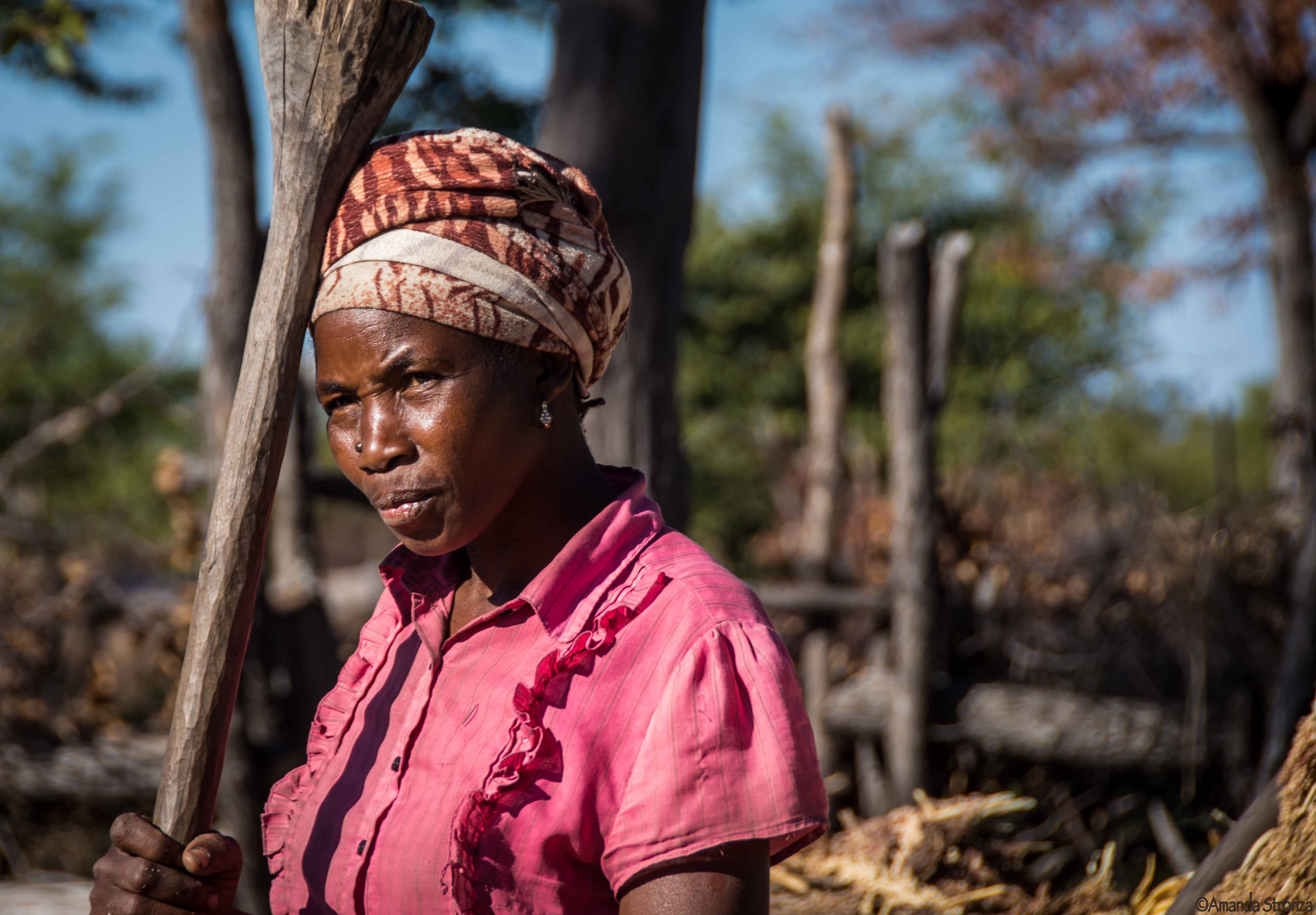
Keikagile (Kee-ka-HEE-lay) owns such a farm, in the panhandle of the Okavango Delta. But she has one large problem most subsistence farmers do not have: elephants. Her field is close to one of the most frequently used pathways used by generations of elephants as they move south in April and June from the drying pans near Namibia to the waters of the Okavango River. A night’s raid by a single herd of elephants could destroy her entire crop.
In her book Coming of Age with Elephants: A Memoir, elephant researcher Joyce Poole writes: “Imagine having your entire livelihood destroyed by a beast that comes in the dead of the night. Imagine defending your homestead from a monster weighing close to a hundred times your weight, one that knows exactly where you are through its extraordinary sense of hearing and smell, while your only useful sense is reduced to what you can see in a dim circle of light from a flashlight with failing batteries. Imagine being too poor to buy new batteries.”
And once each year, coming and going on ancient pathways, elephants pass close to Keikagile’s farm. However, starting in 2014, she’s had help from Ecoexist, one of the programs featured in Howard G. Buffet’s book, 40 Chances: Finding Hope in a Hungry World. A five-year effort aimed at fostering coexistence between the 15,000 elephants and the 15,000 people of the Okavango panhandle, Ecoexist http://www.ecoexistproject.org/ seeks to apply multiple strategies to alleviate human/elephant conflicts and improve human/elephant coexistence.
In partnership with Texas A&M University, and with support from the Amarula Trust, and USAID”S Southern Africa Regional Environment Program, The Ecoexist Project has five main goals, designed to work in tandem with each other:
Using techniques such as radio collars and GPS tracking, the Ecoexist researchers are learning more about the movements and habits of the elephants in the Panhandle, in order to help predict possible points of land use conflict. The government of Botswana pays farmers to expand their fields in order to increase productions, yet the land boards responsible for allocating the land lack information about where and when elephants move through villages and fields. Ecoexist is mapping elephant movements in order to help local land boards allocate fields away from the elephants’ pathways. By amplifying the voices, experiences and ideas of farmers such as Keikagile, policy makers learn from those most affected by crop-raiding, while the farmers are able to share responsibility with policy makers to manage the knowledge, tools and resources for field protection. Improving yields with short-cycle crops, early harvests and planting techniques ensure that farmers are less vulnerable to elephants raiding their fields. Since tourists rarely visit their part of the Okavango watershed, efforts to collaborate with private companies to market the Panhandle as an elephant-based destination with community-based tourism experiences are being developed.

Ecoexist has a large team of advisors and participants. Its directors include a conservation biologist, an ecologist and an anthropologist, as well as post-graduate students and interns from Botswana’s department of Wildlife and National Parks and other relevant government departments. With input and guidance from Botswana’s Department of Agricultural Research, the College of Agriculture, the Department of Wildlife, land boards, international trusts, private corporations, Oxford University, Texas A&M University, the University of Botswana, and most importantly local farmers and residents, the goal of Ecoexist is to make the Panhandle “a place where elephants benefit people more than imperil them…a place where people benefit elephants more than imperil them.” It’s also an endeavor to create solutions that can be used throughout Botswana and beyond.
Keikagile has already used new planting techniques and a solar-powered electric fence to protect her field. Her millet yield this year is 10 times the national average! And next April, when the elephants begin their seasonal migration, she’ll be able to sleep better at night.
To see more of Dr. Stronza’s incredible photographs, click Here.
To follow Ecoexist’s Facebook page: http://www.facebook.com/ecoexistproject
For several months of each year Keikagile (Kee-ka-HEE-lay) has elephants in her backyard. Entire herds of elephants. Lions, zebras, crocodiles, hippos, hyenas, and other wild denizens of Africa surround her home. But it’s the elephants she most fears, for they can destroy her entire farm in just one night.
Keikagile lives in the Okavango Delta of northern Botswana, in an area of roughly 3,500 square miles (9,000 km2) where 15,000 elephants roam freely and 15,000 people plant fields, herd livestock, and walk to and from school. Between April and June, elephants move southward from drying pans near Namibia to the permanent waters found in the Delta. And as they follow their ancient migration routes, the herds often stop to forage in the fields planted closest to those paths. When seasonal rains return in November, the elephants return north along the same routes.

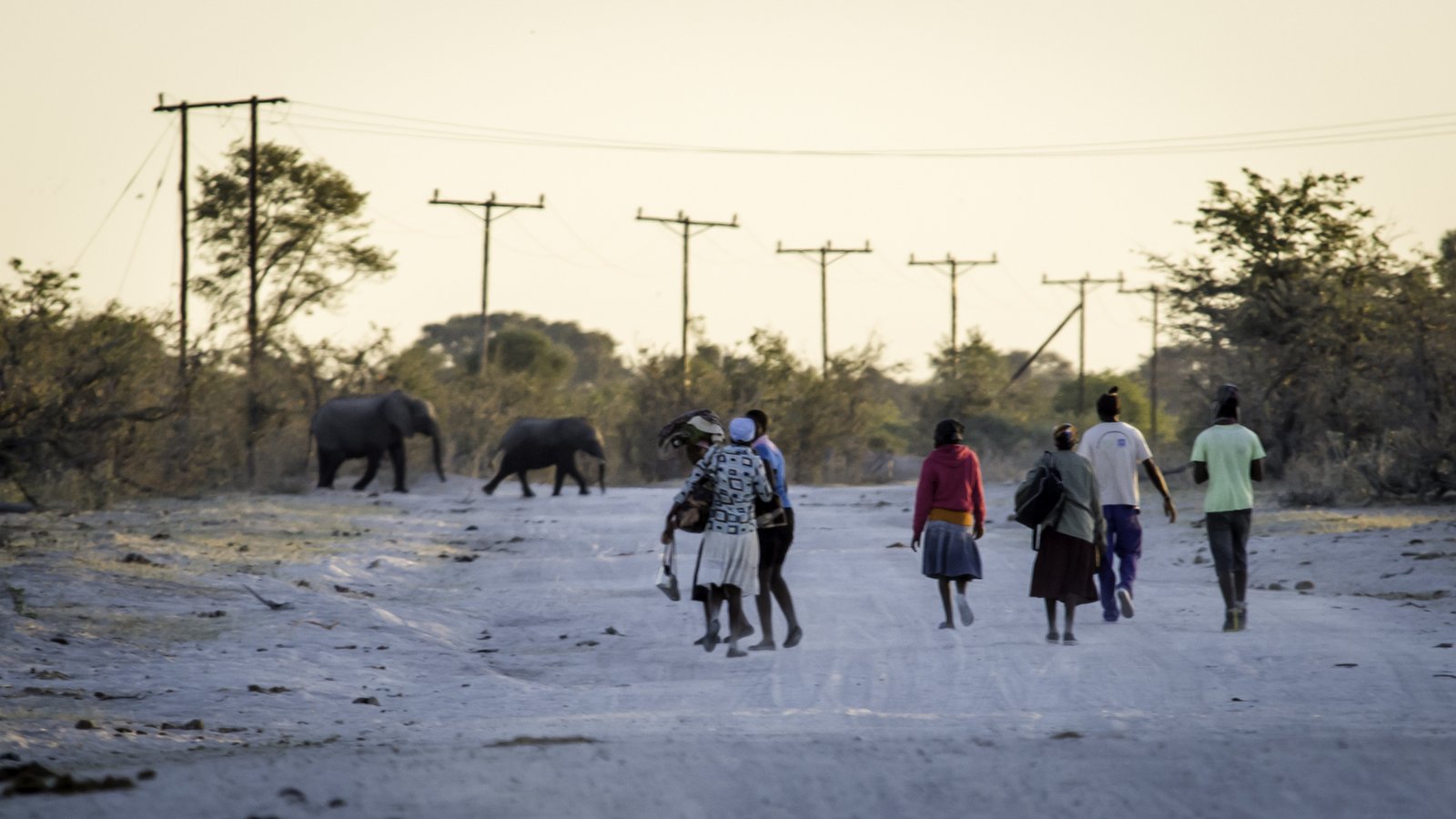
Keikagile’s fields are less than a mile (1.2 km) from one of the largest and most frequently used elephant pathways. Her farm is twice as likely to be raided as those further away, a risk that could happen twice a year, as the elephants migrate to and from the waters of the Delta. (Note the man in the background of this photograph and the power lines.)
Keikagile’s crops are mostly pearl millet, maize (corn) and Bambara ground nuts. Pearl millet has been grown in Africa since prehistoric times. It has a slightly nutty taste, can be cooked like brown rice and ground into flour for flatbreads. It’s high in antioxidants and magnesium. Dried ground maize can be cooked into porridge or a dish called bogobe, made by putting sorghum, maize or millet flour into boiling water, stirring the mixture into a soft paste, and then cooking it slowly. Sometimes the sorghum or maize is fermented, and milk and sugar added. Bambara ground nuts ripen, like peanuts, below ground. They are high in protein (an important food source for people who cannot afford animal protein) and can be eaten roasted, salted or boiled, similar to beans. Most importantly, the plant improves the soil with nitrogen fixation.
Pearl millet grows well in soils with high salinity and is a highly drought-tolerant crop. The Bambara ground nut grows best in sandy soils and is resistant to high temperatures. Maize, the most difficult to grow in a semi-arid climate, is preferred by farmers. The three plants can be grown together, mixed into the same space, in a practice called intercropping, which maximizes space and creates biodiversity.

As a subsistence farmer and a single mother, Keikagile feeds and provides for her three children. In the past, the yields from her fields were barely enough to support her family. And the threat of catastrophic damage to her livelihood by elephants is an annual worry for her.
EcoExist (Ecoexist) hopes to change that. Partnering with local farmers, EcoExist (EcoExist Facebook)is a five-year program aimed at reducing human/elephant conflicts in the Okavango Delta. Read about the dual efforts of Keikagile and EcoExist in Part Two, The Elephant in Her Backyard.
An excerpt from my book-in-progress:
Whenever I leave for Africa I’m always, invariably asked, “Aren’t you afraid?”
“Of what?”
“Snakes. Alligators. Lions.”
“Well,” I usually reply, “there are no alligators in Africa. Only crocodiles.”
“So crocodiles, whatever.”
Once, in Tanzania, I saw a submerged crocodile lunge up amid four wildebeest faster than they, or I, could blink. I don’t know how, but he missed all of them as they leapt in four different directions. I’ve never taken a bathing suit to Africa. Didn’t seem like a great idea on my first trip and less so on subsequent ones.
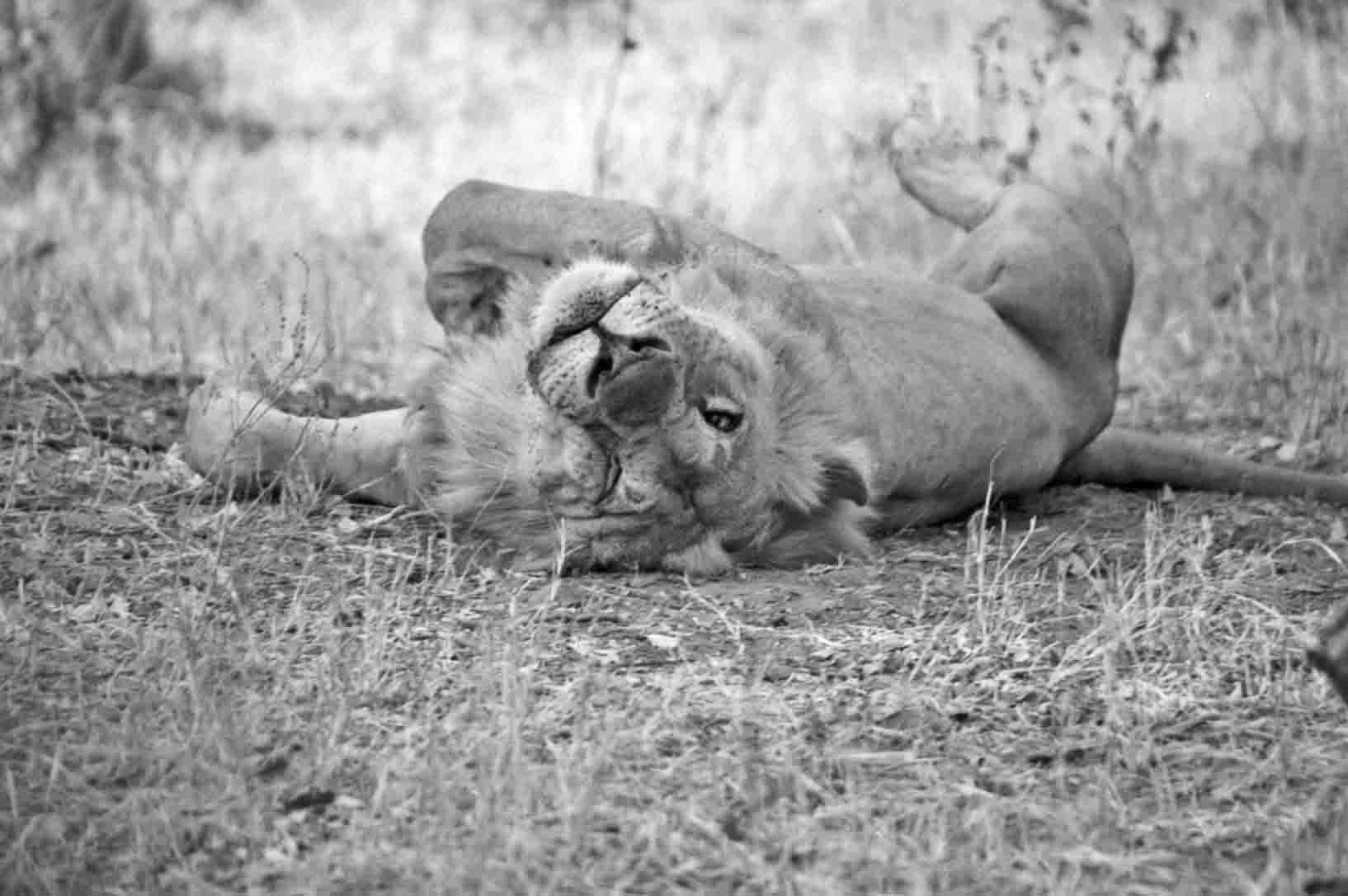
Lions? Well, lions will consider me prey if I act like prey. Look! Breakfast! And it’s fat and slow!
The possibility of actually encountering a lion is pretty rare. There are only about 20,000 lions left in Africa, down from 200,000 in 1975. Until 2007 Botswana allowed 50 lions to be hunted per year. By the time a hunting ban was enacted many of the male trophies were just two or three years old – requiring hair extensions woven into their manes before they were mounted on a hunter’s wall.
Snakes? There are a lot of snakes in Africa. Black mambas. Vipers. Cobras. Pythons. Boomslangs. Puff adders. In the Okavango Delta I could encounter Egyptian cobras or a puff adder or an African rock python or a black mamba or perhaps even a shy boomslang. I could, but I haven’t. In all the times I’ve been to Africa, I’ve never seen a snake. Bad luck, I guess, because each of these snakes, in their own way, is fascinating, and I really wouldn’t mind seeing one of them.
The deadliest animal in Africa is not a snake nor a crocodile nor a lion – it’s the hippo, those oddly comic, rotund herbivores that Walt Disney put in tutus. Hippos kill more people in Africa than any other animal: several hundred per year. In contrast, sharks kill only around ten people per year, worldwide.
Hippos don’t even eat the people they kill. They emerge at night from ponds and rivers to spend all night eating grass. Their beady, sherry-colored eyes don’t see well, but their sense of smell is acute. Males defend territory, females their calves. They can outrun you, and you never know what might set them off.
In 2002, I was on a game drive with six people in an open-sided Landcruiser. Laid-back hippo blimps floated in a nearby pond. One of the hippos grunted, burbling like a submerged tuba.
A herd of hippos is known as a “thunder” – possibly a reference to their size, but more likely because of the noises they make. When a group of hippos get going, their combined grunts sound like rolling thunder. But these hippos were relatively quiet. They rose and sank, twirled their ears, exhaled wetly through their nostrils.
It was that magic half-hour before sunset when the light is golden and incredible – perfect for photographs. A short distance away a male grazed on flowers. I raised my camera.
Without warning, the hippo opened his mouth in a threat gesture, displaying his long, razor-sharp canines. A second later, he charged, head swinging side to side like a giant sledgehammer, running directly for us at a surprisingly clip, intent on slamming into our vehicle. Since a hippo’s top speed is around twenty miles per hour, he was closing fast. All I could see through my camera lens were those massive incisors, as the autofocus kept singing out zzzzt zzzt, zzzzzt zzzt.

Luckily, the engine of our vehicle started without a cough and the hippo just missed the back bumper. He continued on into the bush for thirty yards before stopping to wonder where we had gone.
An excerpt from my book in progress:
After Morula finishes browsing, I follow her down one of the unmapped, two-track, lightly traveled, nameless roads of the Okavango Delta.
Zik! Zik! Zik-zik! A masked weaver hops through the brush beside us. White clouds above our heads twirl like cotton candy across the sky. The track we’re following parts a shallow lake of grass and climbs out on an island of trees. A game trail crosses the road. Morula swivels her trunk to one side, then the other, at the intersection where the grass is beaten down.
In dun-colored sand as finely ground as cake flour, Morula’s prints barely register. I can’t see a single puff from the impact of her feet. With each step, she leaves behind outlines of small moons. We cross the recent, delicate hoof prints of impala and the moons obliterate them.

My boot prints, inside the crater of her footprints, look like exclamation points, the heel separate from the rest of my sole.
The oldest human footprints in the world are 1500 miles north of here, at Laetoli, in Tanzania. Found in 1976, the 3.5 million-year-old footprints are not far from the Olduvai Gorge, where the Leakey family discovered the first hominids. Although the Laetoli hominids are Australopithecines and not Homo sapiens, they are part of our family tree, a relationship comparable to that of mammoths and elephants.
Fossil footprints are not uncommon, especially near ancient riverbeds. But the Laetoli footprints were created when a nearby volcano erupted, covering the ground with a slurry of volcanic ash somewhat the consistency of concrete. Once excavated, the site was found to have over 9,500 impressions, mostly made by rabbits. In order of decreasing abundance, tracks were also found of guinea fowl, hyena, antelope, rhinoceros, giraffe, buffalo, elephant, horse, small carnivores, monkeys, pigs and ostriches. Just one short, 80-foot section was made by hominids.
Their footprints – that of a man, a woman and a small child – tell us much about our ancestry. For in that trackway is a hesitation, as if one of the hominids thought about turning left. Perhaps it was the moment before an earthquake, when the ground was no longer solid beneath their feet. Or perhaps one of them considered turning around, going back.
I stop and look over my shoulder, in the same way my human ancestor did. All of Africa stretches out behind me – overlapped boot prints and footprints leading backward into her hot, crowded maze of life. It was Africa who designed us to walk upright across her landscapes. Because of Africa, I know the ground better than I know trees.
In the distance, across a golden backwater of high grass, stand a family of giraffes. They are motionless, watching us cross between islands of bush. The spotted derricks of their necks swivel in all directions to get a better look at us. At the end of each neck a head is cocked sideways: the universal body language that says, “Huh?” But once we stop to look, they turn away and head for cover, except for one curious female who continues to watch us.

Tramping along in Morula’s wake, I’m beginning to get the hang of all this walking and browsing – less sweating, less reliance on my water bottle. I’m beginning to wish I could do this every day of my life.
Could not resist re-blogging this for the WordPress Weekly Photo Challenge:
From 93 million miles away, pitched straight at me, vibrating, ululating like an African cry of greeting, light from the sun hurtles towards the earth at 186,282 miles per second and eight minutes later slams into me like a jabbering, long-lost relative trying to make up for lost time. It babbles everything, all at once, into my eyes.
 Our eyesight is an electro-chemical reaction to a vibrating particle-wave that gushes optical information splash into my brain. I could shut my eyes to the wonder around me and be diminished. I could shut my eyes to the atrocities around me and become hardened.
By opening my eyes, I give shape to my perceptions. By opening my eyes I take responsibility for my vision, for what my eyes teach me. By opening my eyes I learn that I belong to the world, not that the world belongs to me.
Our eyes are openings into and out of our bodies. Are my eyes, as some would say, a window to my soul?
There is a cold way of seeing that clips wings and stifles our words into faint echoes. But there is also a way of seeing where the eye can be like a mouth, swallowing color, taking in the entire world with just one gulp. Just the sheer fact alone that we see color should provide enough wonder to fill our lives, should stop us in our tracks, should keep our eyes wide open, devouring everything as fast as we can choke it down, leave us slack-jawed, gasping for air.
Somewhere behind my eyes, a world exists that I yearn to inhabit, dreams that might become real if only I could imagine them with my eyes wide open.
 ABOUT ELEPHANTS