(From an older post, revised for the Winter Solstice.)
I sit on my heels, rock back and forth, toward the fire and away from it. Behind my back giant looming shadows shift and dance in firelight. Palm trees fan dark silhouettes against the stars.
The fire spits a small ember beyond the stone ring; it lands near the toes of my boots and dies. My eyes follow as another ember is tossed into the shadows where it also flares and dies.
Leaning in, I show the palms of my hands to the eyes of the fire. Tongues of flame lick blackened lips of wood as if the fire wants to open its mouth and tell my fortune with hot, strange words. Above my head the stars wheel toward dawn, the second hand on a clock face, the only clock that measures eons of time.
Most of our Old Stories must have begun like this, at night, around a hand-warming fire.
Arching from one edge of the horizon to the other, a brilliant swath of the Milky Way spans a vault of sky already thick with white-hot stars. The people of the Kalahari call the Milky Way “The Backbone of the Night.” They believe it keeps the sky from crashing down on their heads.
The fire burns down to single chips of orange. My hands make a small lid over the last of its heat.
I walk out to my tent and then switch off the bubble of light from my flashlight. Next to my tent a single leaf dangles from the bare branches of a thornbush. Held by an spider’s thread, basted silver by starlight, it spins a slow half-circle, then spins back. The panicked hawing of a lone zebra cuts through the silence. The Invisibles –hyenas, leopards, lions – are beginning their nightly rounds.
I trace the outlines of old gods in the night sky, see Orion doing a slow cartwheel, his left hand already touching the horizon. Leo naps on his back, the way most lions bitsleep. Buried deep in the Milky Way, a jewel box of stars contains the tiny, tilted Southern Cross. Scorpio is just rising, thrusting one claw into the leaves of a fan palm.
If I squint hard enough, long enough, the Milky Way knits itself into what might look like pieces of solid bone. Along its spine and under its ribs stars coalesce into galaxies whirling towards dawn. They rain light into my uplifted arms.
The beginning and the end are up there, somewhere.
No more than a mile from my home huge freighters push through the deep, cold waters of Puget Sound. On flat black nights the thump-thump of their propellers travels through water, through air, churns into my bed, my bones, and the lowest threshold of my hearing. Born in the bellies and boilers of machines, the mechanical throb carries along rotating shafts that turn the metal blades of propellers, which slice through water like a dull knife hacking flesh: whummmp. ..whummmp…..whummmp.
Everything makes a sound when vibrations travel through a conducting medium, although we may not be able to hear it.
As Morula scuffs dirt, waves of air particles wash out in all directions. They reach my ear and vibrate my eardrum, which excites the three small bones of my middle ear: the hammer, anvil and stirrup. When the last little bone, the stirrup, takes up the vibration, it presses against fluid in my inner ear and creates a tiny sea of waves that tickle the hairs inside the spiral of my cochlea. The tickled hairs trigger auditory nerve cells that shoot electric signals to my brain.
Air, water and electricity in such a small space.
Large without, Morula’s ears are also large within. The bones of her inner ear are massive compared to mine. The combined weight of her hammer, anvil and stirrup totals just over a pound, compared to mine at two ounces. Her ear canal is eight inches long and her eardrum is about one and a half square inches. Maybe this doesn’t seem very big, but my eardrum is thinner than this paper and only one third of an inch square. You would need two hundred and fifty of my eardrums to create a stack an inch high.
Hum with your mouth closed. Now place your hands over your ears and hum again. The vibrations bypass your eardrums and are transmitted through your skull. Wavelengths tingle along your jaw line. Your bones are rattling.
Sounds are louder with a bigger collecting surface. Cup your hands behind your ears and listen as if you were an elephant.
In 1984 whale researcher Katy Payne spent a week with eleven elephants at the Washington Park Zoo in Portland, Oregon, 170 miles south from my Pacific Northwest home. An acoustic biologist with fifteen years of experience studying the long and complex calls of whales, she was curious as to the kinds of sounds elephants make. Every waking hour of that week she listened and watched the elephants’ behavior at the zoo. She noticed that certain keepers elicited a positive response from the elephants, an intangible “thrill” in the air, like the rolling vibrations of thunder right before you hear them.
On her way back to Cornell University, while she thought about her observations, the throbbing of the airplane reminded her of a pipe organ she once heard. During a performance of Bach’s Passion According to St. Matthew, a shuddering filled the air as bass notes from the great pipes descended in a deep scale until sound disappeared – but the air still throbbed. Those same, strong, vibrations-without-sound had filled the air around the elephants in Oregon. Could they be communicating with infrasound, like whales?
Four months later, back at the zoo, Payne and fellow researcher Bill Langbauer set their recording equipment to its slowest speed. They mapped the elephants’ movements and timed changes in their behavior with the recordings. Working around the clock for an entire month, they recorded what sounded like snores, chirps, barks, rumbles and even moments of absolute silence.
Back at Cornell, the first tape Payne selected to review was during a time of silence, when there was a “thrill” in the air as a female elephant faced a concrete wall and a male elephant faced the same wall in an adjoining enclosure. The elephants were just three feet apart, but completely separated. Running the tape at ten times its normal speed, the researchers heard sounds emerge from silence – elephants carrying on an extensive conversation in infrasound, even when they couldn’t see each other.
To test this new theory of elephant communication, The Cornell research team rigged a double-blind experiment in Africa. An observation tower near a waterhole at Etosha National Park in Namibia was outfitted with video cameras and microphones. Miles from the waterhole, a mobile van roamed through the bush outfitted with broadcast speakers and tape recordings. The timing, location and content of the broadcasts were unknown to the observers at the tower.
One hot, dry afternoon, two male elephants, Mohammed and Hannibal, picked their way through the white calcareous rocks around the waterhole and paused for a drink. As soon as the two bulls arrived, the tower radioed the van. Selected at random, infrasonic estrous calls of a female elephant from Kenya were broadcast to the two bachelors in Namibia.
A female elephant needs to advertise as far and as wide as she can, since she is receptive to males for just a few days every estrus cycle. She repeats her calls over and over for up to forty-five minutes at a time. The calls can be heard for nineteen square miles – but only by other elephants.
Just seconds after the sound was sent, Mohammed and Hannibal froze, spread their ears and lifted their heads – twisting them side-to-side like scanning radar. Within two minutes the bulls set off. Half an hour later the pair strode past the van, looking for love in all the wrong places.
As she walks, Morula’s ears slap flatly against her shoulders, Whoooosh, thwack . . . Whoooosh, thwack . . . Whooosh, thwack . . . Elephant air-conditioning.
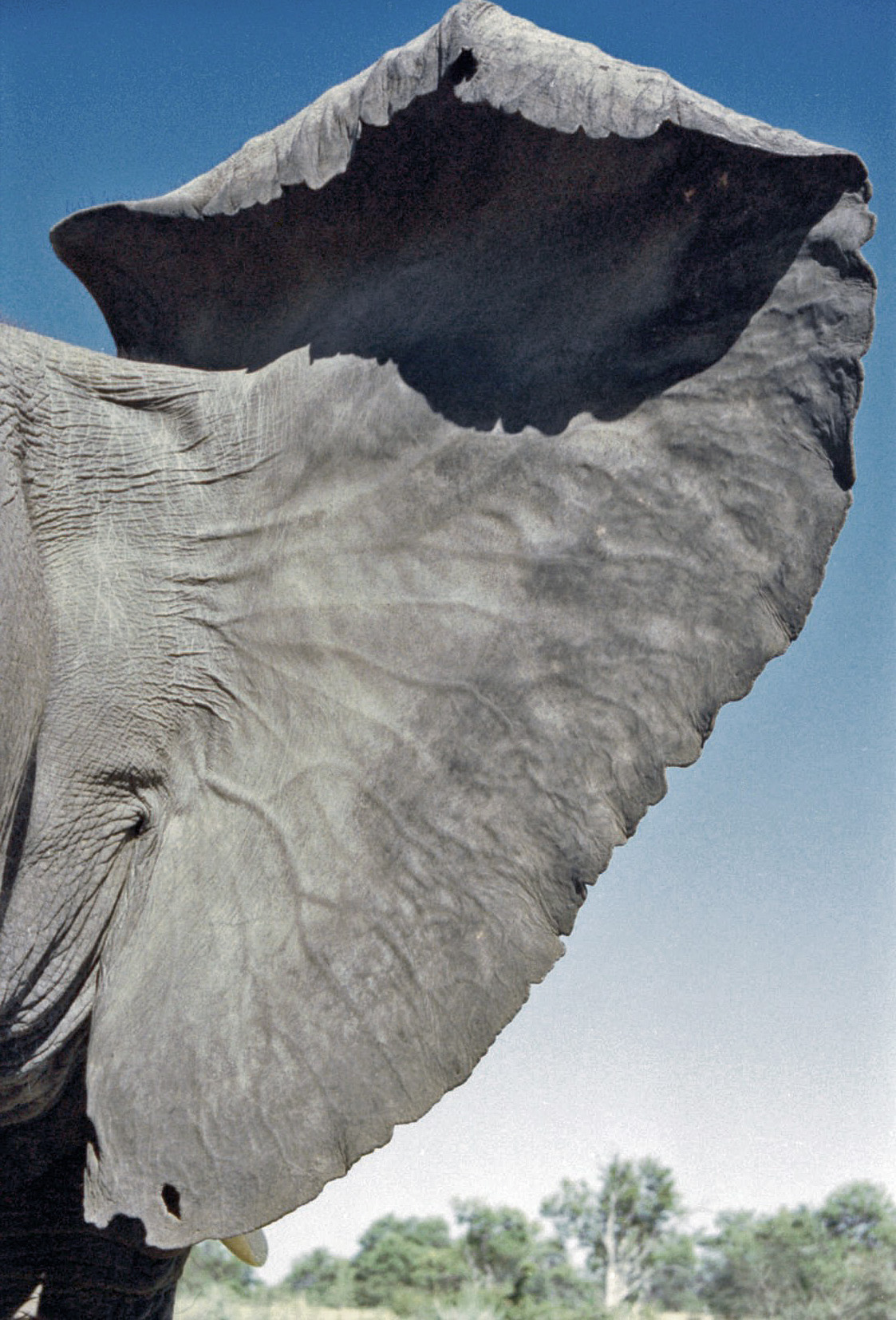
Morula produces enough heat to warm a small house. She is also pachy-dermed, thick-skinned. Some of her blood vessels are as deep as one-and-a-half inches under her skin’s surface. Since she doesn’t have sweat glands, her ears act like giant heat exchangers, regulating her body temperature. As air moves over the huge network of swollen arteries covering each ear, Morula’s blood cools as much as nine degrees before it returns to her body. When spread open, her ears increase her body size by roughly twenty square feet, a huge area for the process of thermoregulation.
I take a photograph of her ear in mid-flap. Where Morula’s ear attaches to her shoulder, wrinkles give way to swollen arteries pumping five gallons of blood per minute across the surface of her ears. The pattern of those arteries is as unique as a fingerprint and often used to identify individual elephants.
The breeze she creates dies before it reaches me. I take off my cap and fan my own neck.
My teeny, itsy ears are built somewhat the same as hers are, with an upper rim of cartilage and a fleshy, lower lobe. But I don’t have an auriculo-occipitalis, an ear muscle the size of a weightlifter’s bicep. I can’t flap my ears. I can’t even wiggle them.
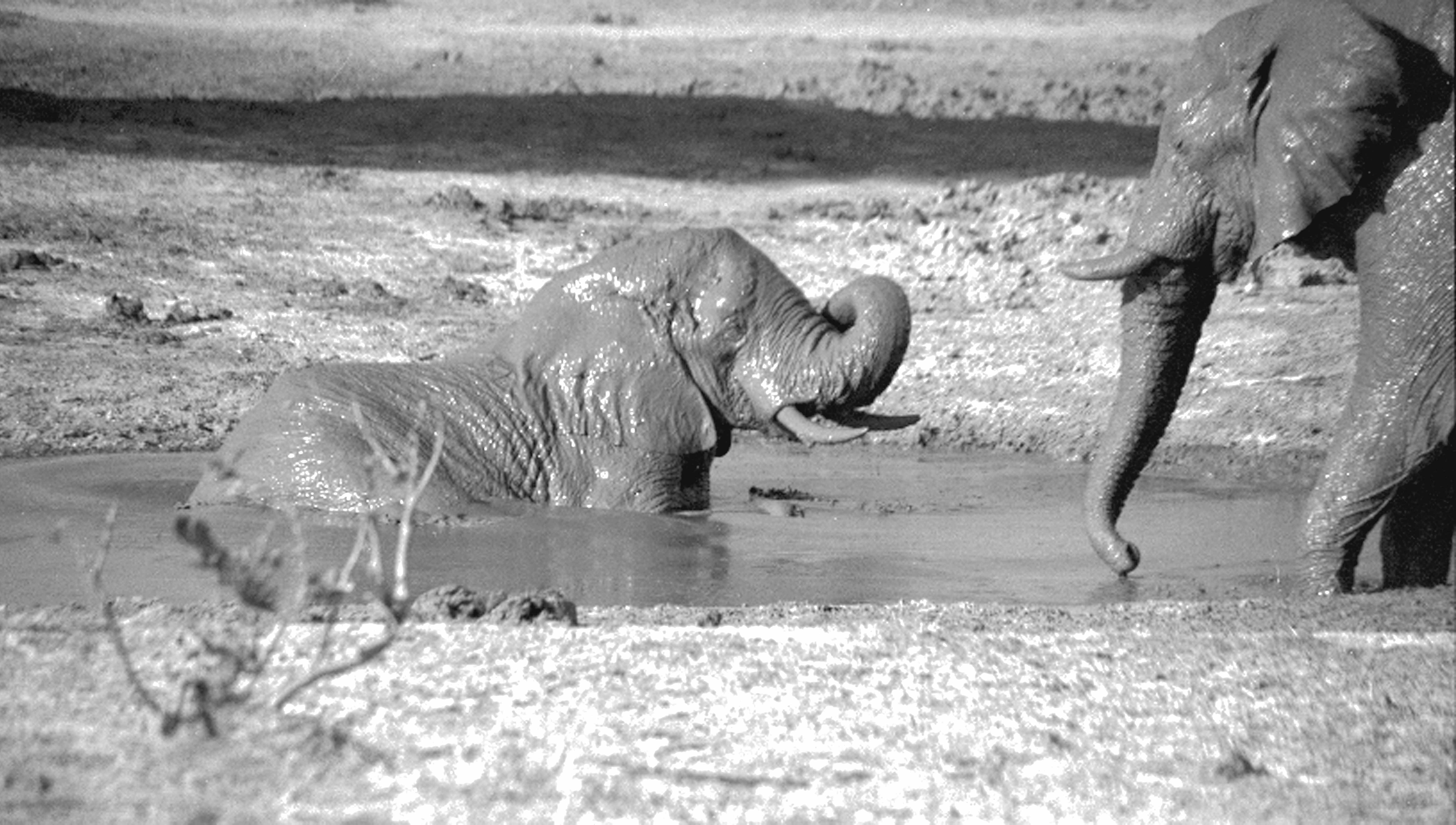
It’s a mucky, slimy, gloppy mud. The young elephant snorkels on his side, the tip of his trunk swiveling above the surface, as he slides towards another bull. His days are filled with heat and dust.
This feels good, his body language says, this feels really good.
If we could imagine ourselves weighing four tons, and think of gravity’s effect on those four tons, then maybe we could imagine wallowing in such mud, pushing and shoving like giant sumo wrestlers, reveling and rolling in the sheer pleasure of this warm gunk. We would inhale a slimy trunkful of ooze, squirt it like a watergun in any direction, even at each other. We would rub our eyes clear with a curled fist at the end of our trunks. We would arise glistening and bright as a metallic statue; we would be cooled, refreshed. . . .
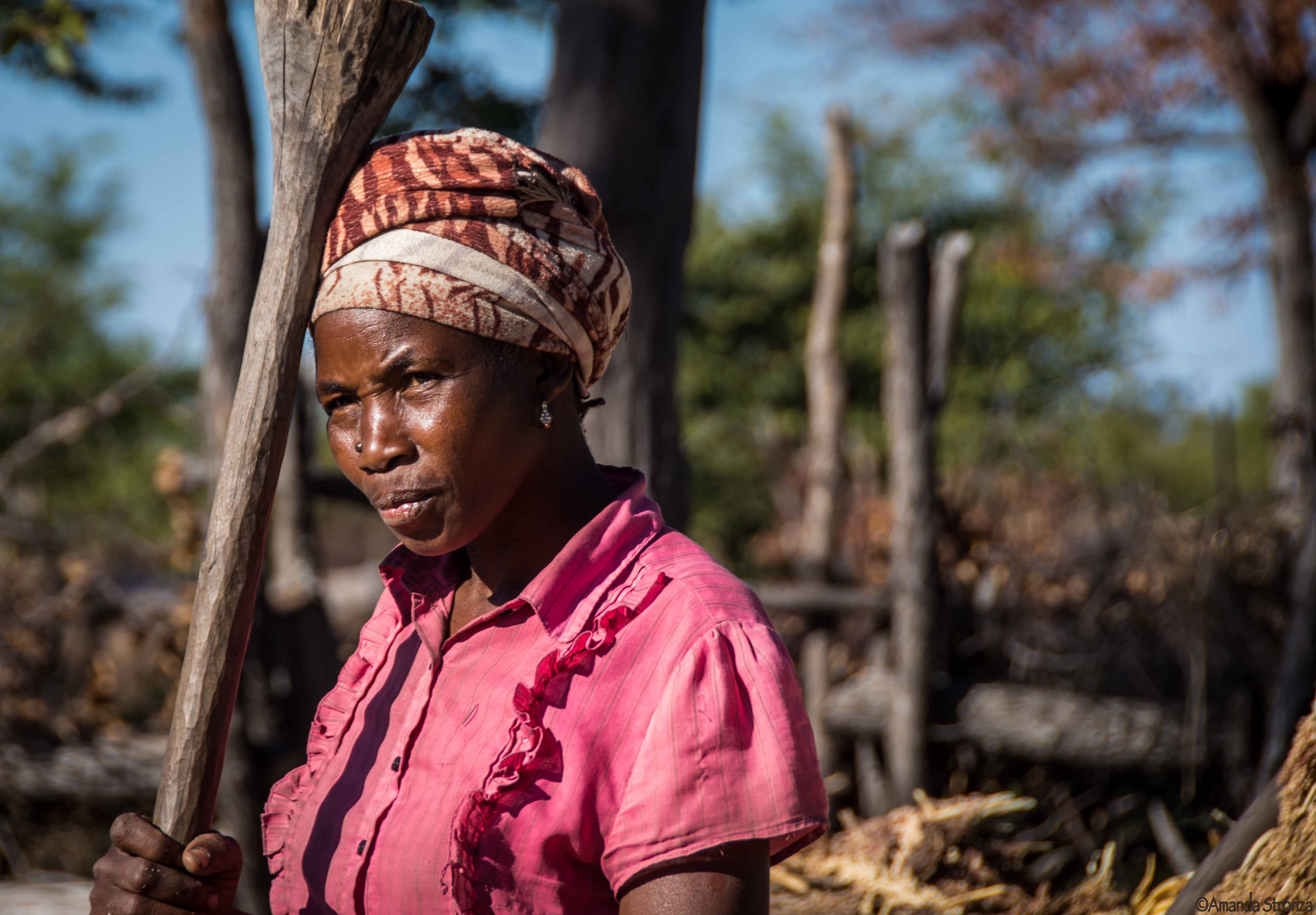
For several months of each year Keikagile (Kee-ka-HEE-lay) has elephants in her backyard. Entire herds of elephants. Lions, zebras, crocodiles, hippos, hyenas, and other wild denizens of Africa surround her home. But it’s the elephants she most fears, for they can destroy her entire farm in just one night.
Photograph by Dr. Amanda Stronza
Keikagile lives in the Okavango Delta of northern Botswana, in an area of roughly 3,500 square miles (9,000 km2) where 15,000 elephants roam freely and 15,000 people plant fields, herd livestock, and walk to and from school. Between April and June, elephants move southward from drying pans near Namibia to the permanent waters found in the Delta. And as they follow their ancient migration routes, the herds often stop to forage in the fields planted closest to those paths. When seasonal rains return in November, the elephants return north along the same routes.
Photograph by Dr. Amanda Stronza
Keikagile’s fields are less than a mile (1.2 km) from one of the largest and most frequently used elephant pathways. Her farm is twice as likely to be raided as those further away, a risk that could happen twice a year, as the elephants migrate to and from the waters of the Delta. (Note the man in the background of this photograph and the power lines.)
Keikagile’s crops are mostly pearl millet, maize (corn) and Bambara ground nuts. Pearl millet has been grown in Africa since prehistoric times. It has a slightly nutty taste, can be cooked like brown rice and ground into flour for flatbreads. It’s high in antioxidants and magnesium. Dried ground maize can be cooked into porridge or a dish called bogobe, made by putting sorghum, maize or millet flour into boiling water, stirring the mixture into a soft paste, and then cooking it slowly. Sometimes the sorghum or maize is fermented, and milk and sugar added. Bambara ground nuts ripen, like peanuts, below ground. They are high in protein (an important food source for people who cannot afford animal protein) and can be eaten roasted, salted or boiled, similar to beans. Most importantly, the plant improves the soil with nitrogen fixation.
Pearl millet grows well in soils with high salinity and is a highly drought-tolerant crop. The Bambara ground nut grows best in sandy soils and is resistant to high temperatures. Maize, the most difficult to grow in a semi-arid climate, is preferred by farmers. The three plants can be grown together, mixed into the same space, in a practice called intercropping, which maximizes space and creates biodiversity.
Pearl Millet
As a subsistence farmer and a single mother, Keikagile feeds and provides for her three children. In the past, the yields from her fields were barely enough to support her family. And the threat of catastrophic damage to her livelihood by elephants is an annual worry for her.
EcoExist (Ecoexist) hopes to change that. Partnering with local farmers, EcoExist (EcoExist Facebook)is a five-year program aimed at reducing human/elephant conflicts in the Okavango Delta. Read about the dual efforts of Keikagile and EcoExist in Part Two, The Elephant in Her Backyard.
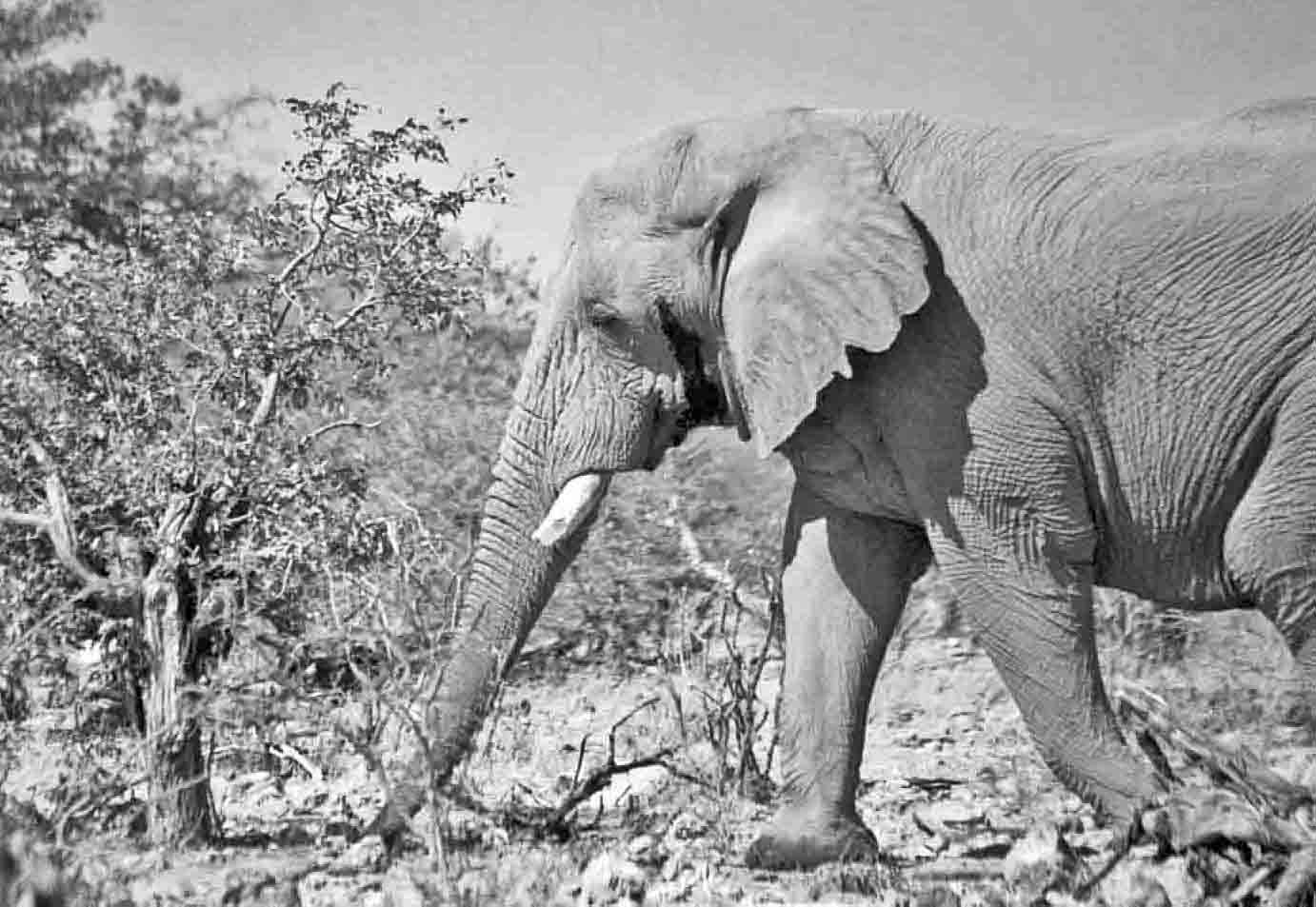
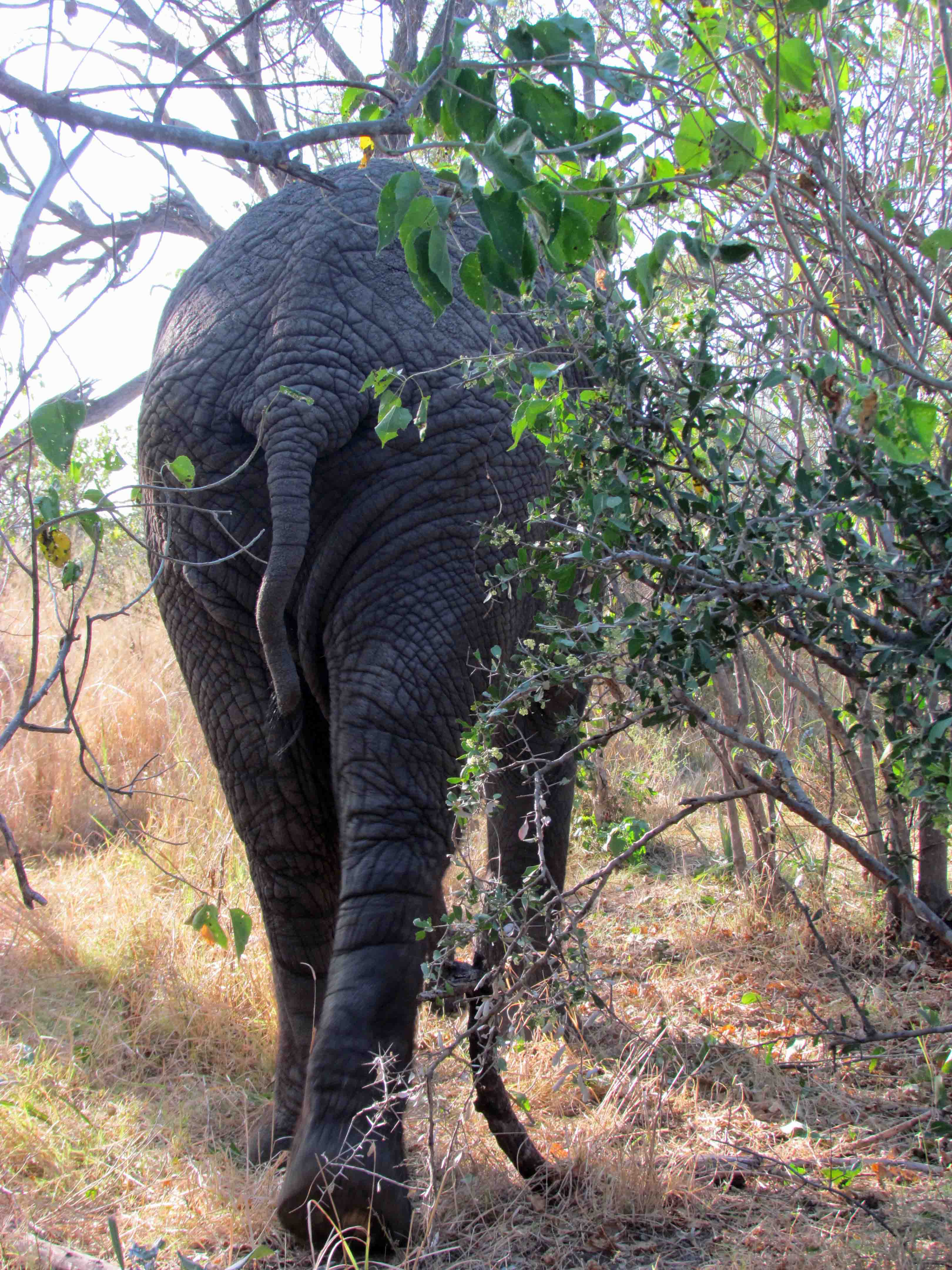
After Morula finishes browsing, I follow her down one of the unmapped, two-track, lightly traveled, nameless roads of the Okavango Delta.
Zik! Zik! Zik-zik! A masked weaver hops through the brush beside us. White clouds above our heads twirl like cotton candy across the sky. The track we’re following parts a shallow lake of grass and climbs out on an island of trees. A game trail crosses the road. Morula swivels her trunk to one side, then the other, at the intersection where the grass is beaten down.
In dun-colored sand as finely ground as cake flour, Morula’s prints barely register. I can’t see a single puff from the impact of her feet. With each step, she leaves behind outlines of small moons. We cross the recent, delicate hoof prints of impala and the moons obliterate them.
photo by Cheryl Merrill
My boot prints, inside the crater of her footprints, look like exclamation points, the heel separate from the rest of my sole.
The oldest human footprints in the world are 1500 miles north of here, at Laetoli, in Tanzania. Found in 1976, the 3.5 million-year-old footprints are not far from the Olduvai Gorge, where the Leakey family discovered the first hominids. Although the Laetoli hominids are Australopithecines and not Homo sapiens, they are part of our family tree, a relationship comparable to that of mammoths and elephants.
Fossil footprints are not uncommon, especially near ancient riverbeds. But the Laetoli footprints were created when a nearby volcano erupted, covering the ground with a slurry of volcanic ash somewhat the consistency of concrete. Once excavated, the site was found to have over 9,500 impressions, mostly made by rabbits. In order of decreasing abundance, tracks were also found of guinea fowl, hyena, antelope, rhinoceros, giraffe, buffalo, elephant, horse, small carnivores, monkeys, pigs and ostriches. Just one short, 80-foot section was made by hominids.
Their footprints – that of a man, a woman and a small child – tell us much about our ancestry. For in that trackway is a hesitation, as if one of the hominids thought about turning left. Perhaps it was the moment before an earthquake, when the ground was no longer solid beneath their feet. Or perhaps one of them considered turning around, going back.
I stop and look over my shoulder, in the same way my human ancestor did. All of Africa stretches out behind me – overlapped boot prints and footprints leading backward into her hot, crowded maze of life. It was Africa who designed us to walk upright across her landscapes. Because of Africa, I know the ground better than I know trees.
In the distance, across a golden backwater of high grass, stand a family of giraffes. They are motionless, watching us cross between islands of bush. The spotted derricks of their necks swivel in all directions to get a better look at us. At the end of each neck a head is cocked sideways: the universal body language that says, “Huh?” But once we stop to look, they turn away and head for cover, except for one curious female who continues to watch us.
photo by Cheryl Merrill
Tramping along in Morula’s wake, I’m beginning to get the hang of all this walking and browsing – less sweating, less reliance on my water bottle. I’m beginning to wish I could do this every day of my life.
Around 40,000 years ago, someone took a fragment of a mammoth’s tusk and carved a small mammoth from it – one of the earliest known pieces of art made from ivory. Roughly an inch high and one-and-a-half inches in length, it’s unmistakably a mammoth, complete with trunk, tail and a high domed head. Twelve thousand years after the carving was discarded in a cave in Germany, a band of Paleolithic people dug three shallow graves into permafrost near present-day Moscow. Thousands of tiny ivory beads adorned each skeleton, each bead laboriously made with stone tools.
The earliest carved portrait of a human face dates from around 23,000 years ago. Discovered in a cave in France, it too was crafted from mammoth ivory. Named the Venus of Brassempouy for the village near where it was found, the small ivory figurine has a forehead, eyes, brows, nose, but no mouth. The top and sides of her head depict braided hair. It was unearthed in 1894 with numerous other figurines made of stone. Other late Stone Age “Venus” figures, with their bulging torsos and small heads devoid of detail were found in sites that range from the Pyrenees to Siberia. Ongoing excavations and reconstructions of ivory carvings from the “Stone Age” include ivory birds, lions, horses, and several lion-headed humans, all made by stone tools.
Mammoth Skull in situ, Mammoth Museum, Hot Springs, South Dakota
At first, there was quite enough ivory simply lying around on the ground to satisfy the needs of man. Ice Age huts discovered in the Ukraine used mammoth skulls as foundations and shoulder blades as walls. Tusks held down hides draped over the rooflines. One hut had 35 such weights. The age of individual bones used in the construction of these huts spanned more than 10,000 years, an indication of the amount of ivory to be found at hand. When new sites are found, they are collapsed inward upon themselves; shelters reduced to reliquaries of bone.
Reconstruction of a mammoth bone hut at the Mammoth Museum, Hots Springs, South Dakota
Early Egyptian pyramids had already been built before the last of the mammoths died. As pharaohs consolidated their kingdoms, elephant ivory (the material closest to hand) was one of the valued items of tribute sent down the Nile by conquered states. Not only did Tutankhamen have an ivory headrest in his tomb, he also had ivory statuettes of concubines to accompany him in his afterlife. Game boards were entombed in his royal suite, to also allay boredom in eternity. Made of solid ivory, the boards were fitted with carved-out drawers to hold gaming pieces.
Egyptians carved ivory into veneers, reliefs, statuary, jewelry, arrow points, small furniture, combs, spoons, the handles of weapons, scarabs, amulets, coffin lids, and used as inlays on toilet caskets (cosmetic boxes) containing such items as eye shadow pots, mirrors and perfume jars, some also made of ivory. Cleopatra, who presided over the last of the Pharaonic dynasties, quite possibly participated in banquets while lying on a bronze couch inlaid with glass and ivory described as being in her palace in Alexandria. The palace was also described as having ivory-paneled entrance halls. Re-discovered in 2012 beneath the Mediterranean Sea, the royal quarters are relatively intact, having slid under water during cataclysmic earthquakes and tsunamis in the fourth and eighth centuries. Excavations have just begun of its treasures.
To Egypt’s north, no one society dominated the eastern Mediterranean trade. However, around 1,000 BC, the Phoenicians, in what is now modern-day Lebanon and Syria, had an efficient maritime network that supplied King Solomon with the ivory he needed to build his ivory throne in his temple at Jerusalem. Described in 1 Kings 10 of the Bible, it was “a great throne of ivory,” covered with the finest gold. The throne also included rubies, sapphires, emeralds and other precious stones.
In the fifth century BC, the Greek historian Herodotus traveled to the Egyptian city of Elephantine, located at the first cataract of the Nile, and reported that elephants could still be hunted to the west, in Libya. Also in the fifth century BC, Greeks saw the construction of two immense ivory-covered statues, one of Athena at the Parthenon and the other of Zeus, at Olympia. Erected around 432 BC, both were made of “chryselephantine:” clothes and scepters of gold, faces, bare arms, shoulders, and torsos covered in ivory. Zeus, sitting on his throne, was thirty-nine feet tall, the height of a four-story building. Because ivory dries out once it is separated from the creature who bore it, Zeus and Athena were constantly anointed with olive oil, which collected into a gleaming surrounding pool.
The statue of Zeus was considered one of the seven wonders of the ancient world. Carried off to Constantinople in 394 AD, it was destroyed by fire in 462 AD. By the Middle Ages all chryselephantine statues had been stripped of their valuable materials and demolished. Only the hole remains at the Parthenon that held Athena’s central wooden support.
By the third century BC, Rome replaced Greece as the center of the ancient world. Romans used more ivory than any other civilization until the 1880s. For their marble statues they inserted ivory into chiseled, empty eyes. Birdcages, scroll holders, currency, cameos, candleholders, dolls, boxes, and statuettes of gladiators were all made of ivory. Caligula built an ivory manger for his horse. Immense consular diptychs (two ivory panels joined by a hinge) carved with the image of the governing consul served as the sign of his office.
Roman doll, Louvre, copyright Genevra Kornbluth
The Roman demand for ivory caused North Africa’s last wild elephants to vanish around the 2nd century AD, about the time that the last Mediterranean cedars and oaks were felled.
Land that once supported elephants now barely supports goats.
Carved ivory thrones are mentioned in the Bible. King Solomon had one, covered with gold. Tutankhamen’s casket had a carved ivory headrest for his pillow. Cicero wrote of Roman houses where ivory doors opened onto entire rooms covered with ivory tiles. Gladiators had chariots made of ivory.
In the 1800s, in Africa, ton after ton of tusks were transported thousands of miles to Zanzibar and Khartoum, carried on the backs of slaves. By the 1980s, more than 300 elephants a day were slaughtered for their ivory, nearly 100,000 per year.
In Amboseli National Park, in Tanzania, a recessive gene is becoming dominant, occurring in 50 years instead of thousands, selected by poachers.
Year after year tuskless elephants are born.
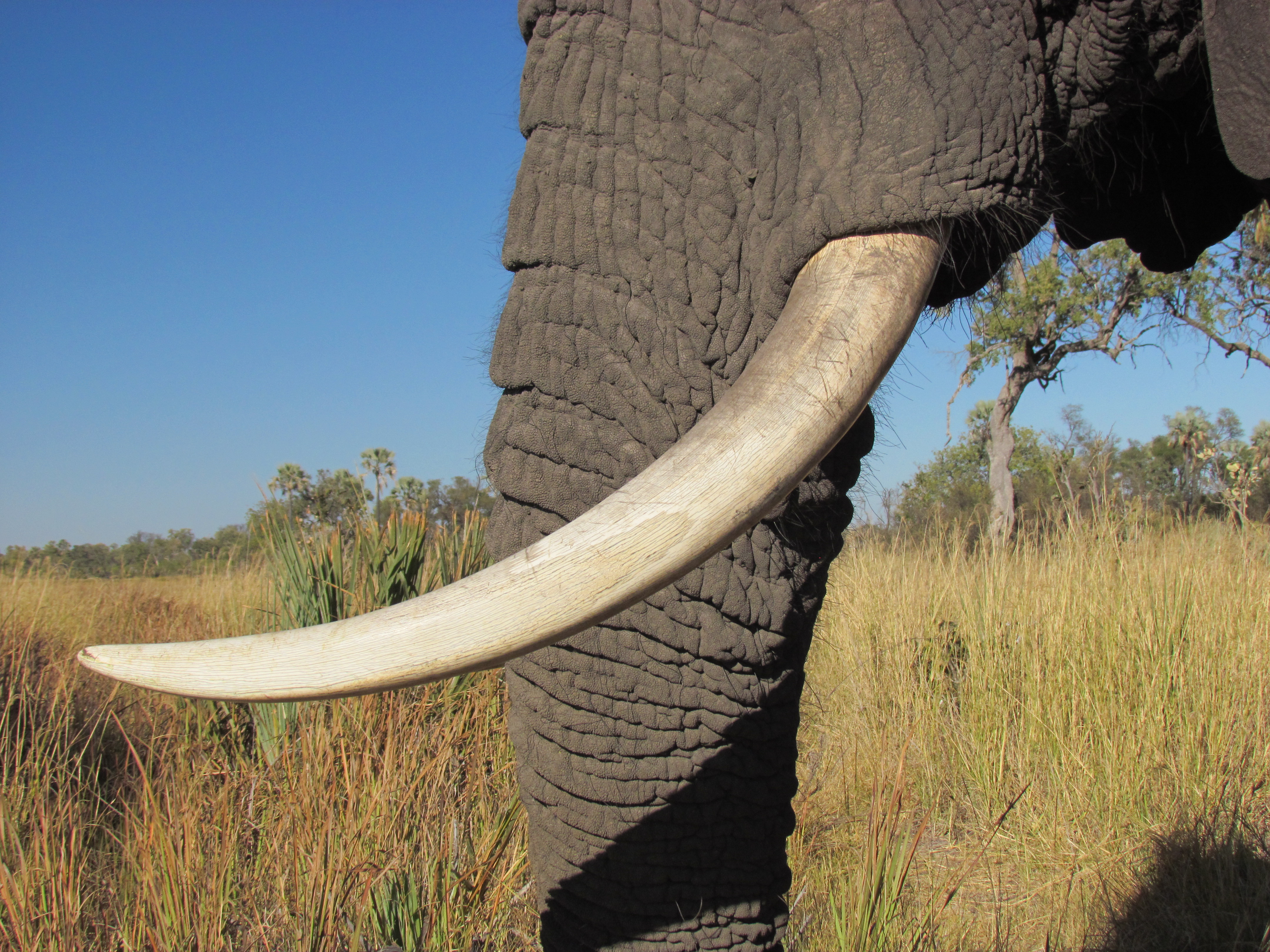
Both male and female African elephants grow tusks – the largest upper incisors on this planet. Tusks are defined as long teeth protruding beyond the mouth growing usually, but not always, in pairs. Most tusks are enlarged canines, such as those of warthogs, wild boars, hippopotamus and walruses. Enlarged canines in the myriad species of cats and dogs are called fangs.
Elephants and narwhal whales have incisor tusks. The narwhal’s single tusk is a left front incisor that grows in a straight spiral. Found mostly in males, narwhal tusks are believed to be the origin of unicorn legends. Oddly enough, narwhals with two tusks are usually female.
By the time Jabu is sixty, his tusks could theoretically reach a length of 18 to 20 feet. But in reality – if he does reach sixty – they will be much shorter, due to the wear and tear of everyday use.
Tusks on bull elephants can weigh seven times that of those on cows. The biggest pair of tusks on record weighed 460 pounds, taken from an old bull killed in 1897 near Mount Kilimanjaro in Kenya.
The longest tusks ever found came from an elephant shot in the Congo in 1907. Its right tusk was 11.4 feet long; it’s left tusk 11 feet.
Such extraordinarily enormous tusks are a genetic trait, much the same as red hair is a genetic trait. Over the centuries poachers and hunters have always targeted male elephants with the largest tusks. As a result, the trait has disappeared from most elephant populations.
The same outcome would occur if redheads were systematically eliminated within family groups. As their genes died out, the redheads among us would become extinct.
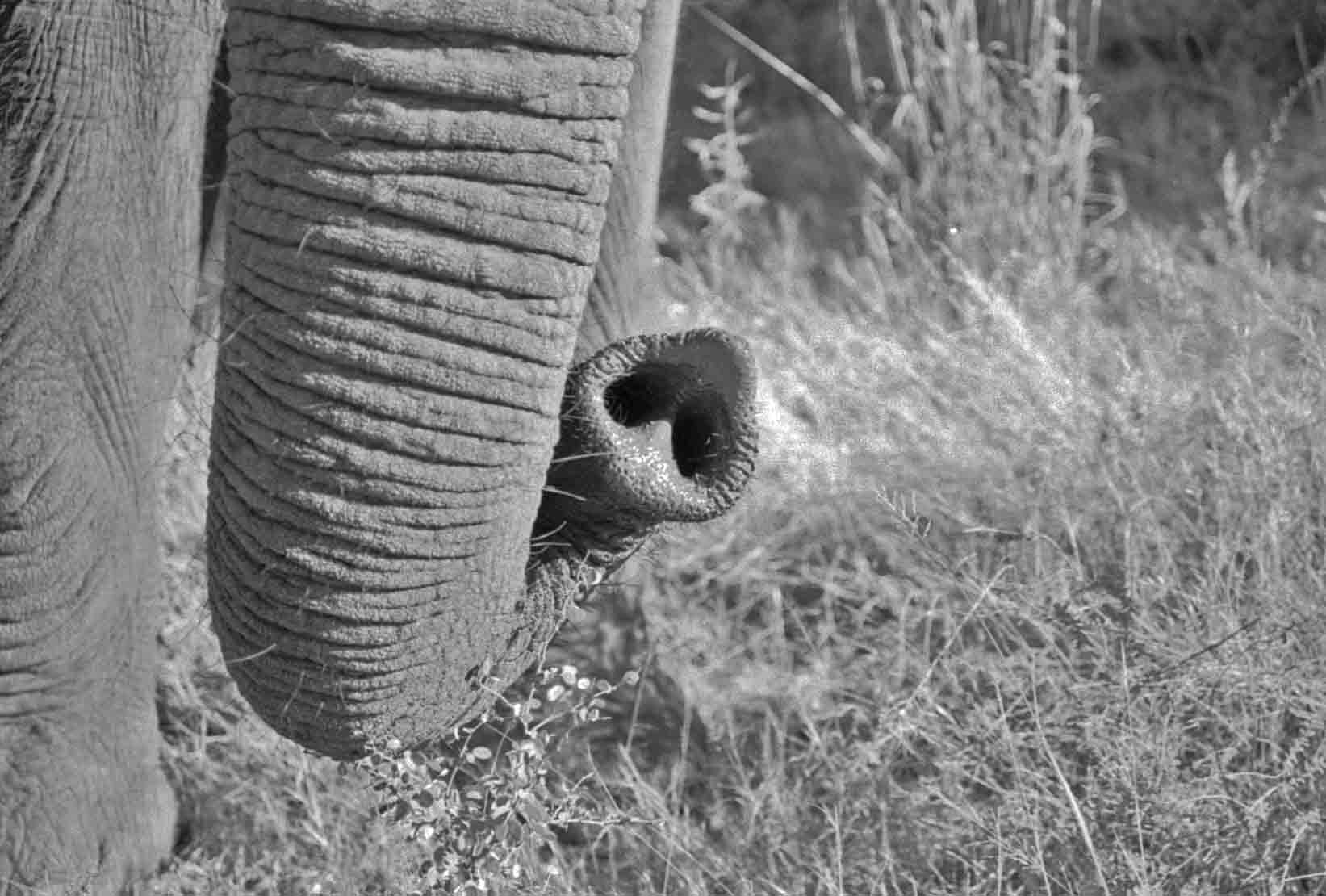
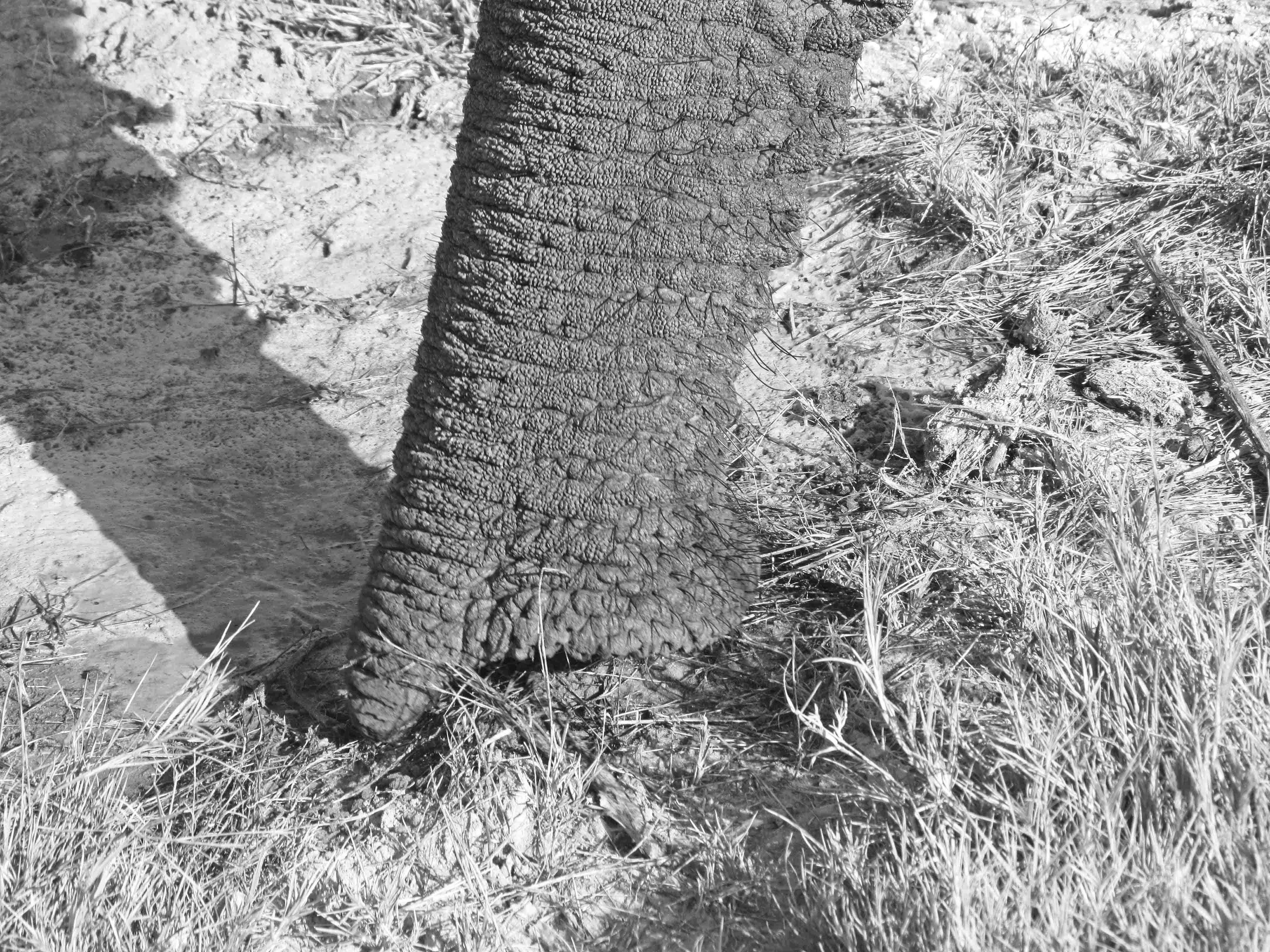
Awash in a sea of scent, Jabu curls his trunk and samples wave after wave of odors breaking at his feet. Redolent tides wash in, wash out, a floating realm populated with aromatic citizens. Schools of scents cluster at his feet, swimming through the grass at the bottom of an ocean of air.
Sixty percent of his brain is dedicated to smell. Jabu can distinguish between a million or more separate odors in the daily news that floats by on warm currents. Just a few molecules bring him history and current events: stories of who was here, who is there, how long they stayed and in which direction they went. Jabu can detect fellow elephants ten miles away.
He reaches out and flattens the tip of his trunk over a wet spot in the sand. Eyes half closed, he stands completely still, as if lost in memory, his brain sorting through the various scents tumbling up his trunk. He samples the air thoughtfully, as if listening to a quiet conversation, as if storing it, word by word, in those huge frontal lobes of his.
I remember that elephants see the world in yellows and blues, like color-blind humans. I fasten a yellow filter over my camera lens, then a blue one. Jabu turns aquamarine. From far, far away, he snaps a branch from a shrub the color of kelp, chomps, munches, drifts closer. His slow motions make perfect sense underwater.
I wade into a lagoon of grass. Ankles, knees, waist, chest, neck. Some of the grass stalks bob over my head. My hands, my body, my thoughts, move slowly.
Immersed, my ears fill with a pure hum. The sound of my passage whispers in seashell voices.
As Jabu drifts by, undertones of blue and gray shimmer against his flanks, reflections of seaweed and kelp. I follow, sub-aquatic, at the bottom of air. Carried by the current of my imagination, I am about to tumble downstream.
Then the breeze kicks up, feels as if it comes all the way from the bottom of the Kalahari, feels red, feels gritty, feels dry as a hundred-year-old skeleton left in the desert. It sucks every bit of moisture from under me and lands me beached and gasping.
I lower my camera. Red invades yellow and the world greens.









 ABOUT ELEPHANTS