So many tales to tell: (1) the flooded Okavango Delta, water where there was sand last time I visited; (2) walking with elephants under starlight and a half moon (without a flashlight); (3) hyenas in the kitchen; (4) the closest I’ve ever gotten to a snake (!); (5) a leopard for my friend’s birthday present; (5) lions kill a baby hippo; (6) basic tents and luxurious chalets; (7) what not to do if you’re self-driving through the Moremi Game Reserve (hint: DO NOT rely on your GPS); (8) wild dogs, wild dogs and more wild dogs; (9) the rarest giraffes in the world; (10) hippos, hippos and more hippos; (11) a leopard hunts a male impala; (12) an absolutely wonderful stay with Sandi, Doug, Jabu, Morula and Thembi – and many, many more. Stay tuned!
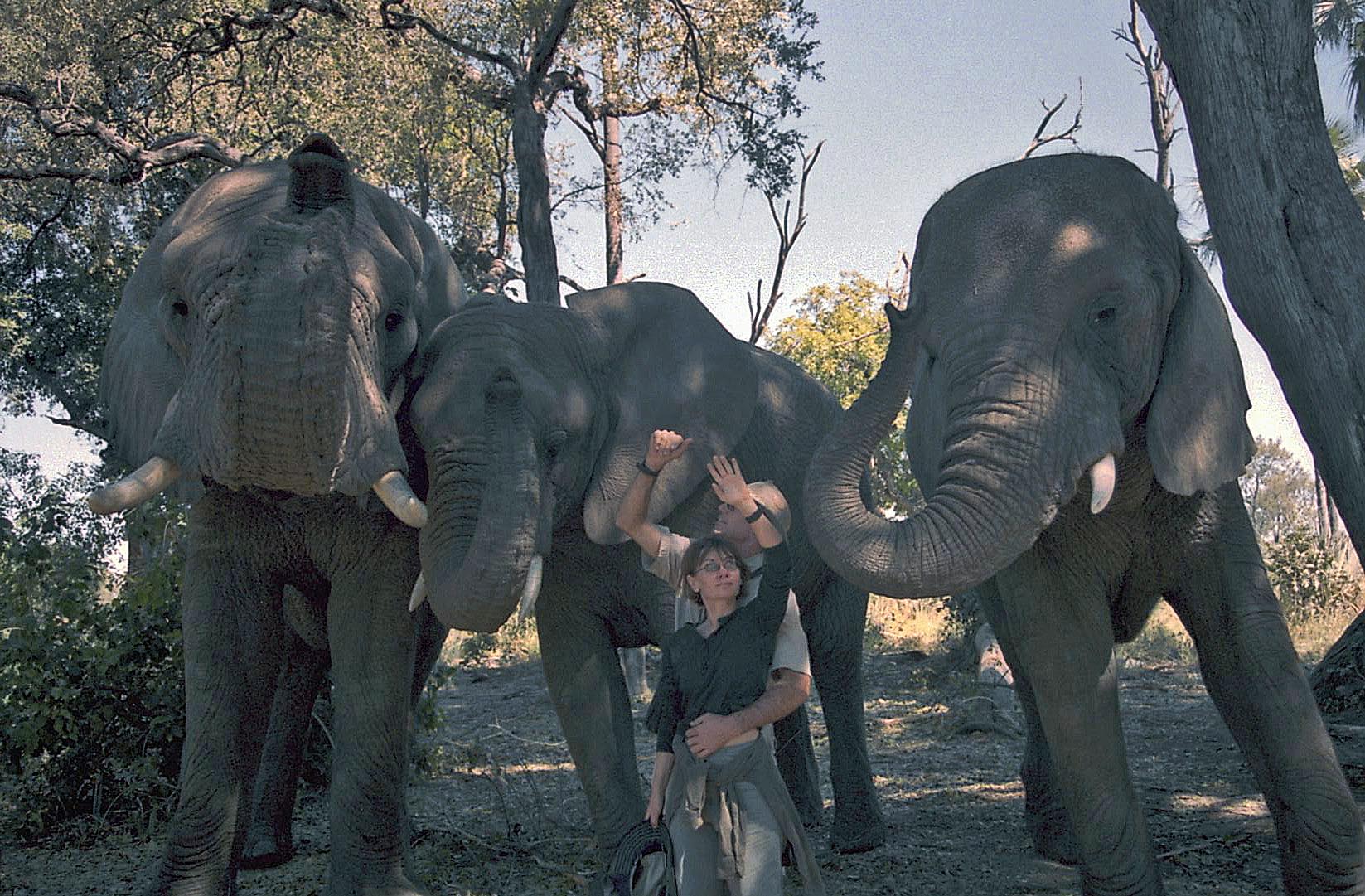
In 2007, this was my last glimpse of Doug and Sandi, and their three incredible elephants. Tomorrow I get on an airplane and begin a long two-day journey to return to the Okavango Delta in Botswana, to turn from “Goodbye,” to “Hello.”
Carved ivory thrones are mentioned in the Bible. King Solomon had one, covered with gold. Tutankhamen’s casket had a carved ivory headrest for his pillow. Cicero wrote of Roman houses where ivory doors opened onto entire rooms covered with ivory tiles. Gladiators had chariots made of ivory.
In the 1800s, in Africa, ton after ton of tusks were transported thousands of miles to Zanzibar and Khartoum, carried on the backs of slaves. An estimated two million elephants were slaughtered from 1860 to 1882, their tusks fashioned into billiard balls and piano keys.
The decade between 1979 and 1989 was the deadliest ever for African elephants. Over 691,000 died. In a line, trunk to tail, enough elephants to cover the distance between Miami, Florida and New York City: 1120 miles. Around 8800 tons of ivory was harvested in that decade. The average weight of tusks traded in 1979 was 21 pounds. Fifty-two elephants died for each ton of tusks. By the mid-1980s the average weight had shrunk to just 11 pounds – and so more elephants, 100 of them, died per ton.
In just one decade, the elephant population of Africa was halved – from 1.3 million to 650,000.
In Amboseli National Park, in Tanzania, a recessive gene is becoming dominant, occurring in 50 years instead of thousands, selected by poachers.
Theoretically, it is possible to reclaim extinct beings, to spin evolution backwards. To recreate a mammoth all you need are a few live mammoth cells, since each and every cell contains complete genetic information. Red-furred segments of mammoth flesh are not uncommon discoveries in Siberia, usually found by sled dogs that eagerly gnaw on frozen haunches. But cells die if stored above minus 94º Fahrenheit, even for short periods. Still, the possibility of finding live cells does exist. Paleontologists in Ohio have isolated 11,000-year-old bacteria from the stomach of a mastodon, the oldest living organisms ever found.
To recreate a mammoth, destroy the nucleus in the ovum of an Asian elephant. Then inject live mammoth-cell DNA into the altered ovum and implant the artificial zygote into the uterus of an Asian elephant. If the 22-month pregnancy is successful, you can expect the birth of a 100% mammoth baby.
Another method is to take mammoth sperm (selected to ensure female offspring), inject it into an elephant’s egg and wait 22 months for your mammophant, a half elephant, half mammoth calf. Then wait until the hybrid is sixteen or so, breed it with more female-selected sperm, and in 3 generations of mammophants, say sixty years, the resulting pachyderm will be 90% mammoth with 16-foot tusks. The obvious obstacle to this method is that hardly any non-degraded frozen mammoth cells exist, let along viable sperm. And even if some were found, would two species separated by millions of years of evolution even be capable of producing offspring?
So let’s go back to the method that just might be successful. Let’s find live mammoth DNA, or perhaps just replicate some of it, and join it with the ovum of an Asian elephant. The resulting offspring would be a cloned mammoth.
Then what?
To get more mammoths you have to artificially construct more zygotes, which need more live mammoth cells, which would result in clones of clones – unless you find a lot of live mammoth DNA from many different individuals. And for such a project you need elephants as surrogate moms. Endangered Asian elephants. Even with a whole herd of resurrected mammoths, inbreeding could make the population nonviable. Would a hyper-disease be resurrected too? Could it jump to elephants?
And where would we put our newly minted species? In zoos? On reservations? In those isolated pockets we call National Parks? While we’re at it, shouldn’t we resurrect some cavemen, too? In Northern Siberia scientists are already attempting to create a mammoth ecosystem called Pleistocene Park. Imagine the tickets they could sell to watch Neanderthals, our human cousins, hunting.
And where do we stop? Do we bring back Saber-toothed Cats, Dire wolves and Giant Short-faced Bears? Do we re-create their habitats? Lower the temperature of the earth four degrees in this time of global warming? Bring back the Ice Ages?
Against a chalk-blue sky, the smooth bare branches of a Motsheketsane tree interweave like a dancer’s arms caught in a multiple exposure. The shade it provides is full of holes, lacy as a cobweb. Embedded in the sand at its base are the hoof prints of zebras, from hooves exactly like those of unshod horses.
Morula and I seek what little shade there is underneath the tree. I take a swig from my water bottle while she searches for leftover Motsheketsane seeds. Using her trunk as a leaf blower, she corrals the ones she finds into a neat little pile whuff, whuff, whuff and transfers it into her mouth.
I pick one up. The seed is oval and has ruffled wings that divide it into 5 horizontal planes. It looks like a small paper lantern of a vaguely Oriental design. I try to pocket one, but its wings crumble as my hand close around it.
My everywhere-mind wanders off by itself, meanderings of no practical use except, of course, to me. Speculatively, I eye Morula, cloak her in long, ginger-colored, shaggy fur, shrink her ears, implant upturned, pitchfork tusks, and imagine her, well, tubbier, in a mastodon suit of hair.
She waves her trunk tip at me, neighborly, as if across a backyard fence: Hello.
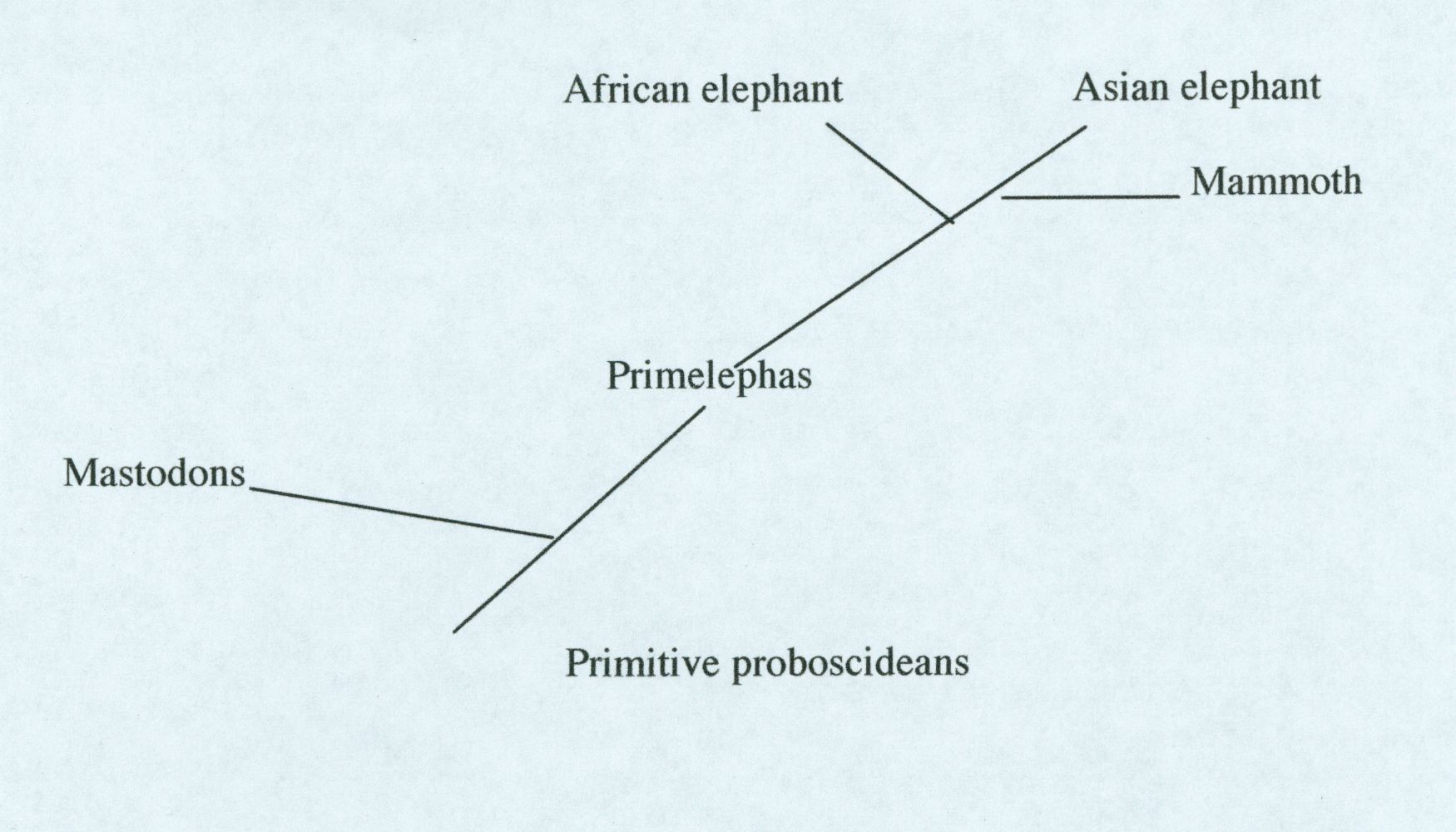
With its two fingers, the tip of her trunk could argue for a close relationship with mammoths. But recent DNA research found direct genetic links only between Asian elephants and mammoths. Morula’s family tree looks like this:
Mastodons branched from the proboscidean family tree 26 million years ago. They became the first elephant cousins to leave Africa, the first to migrate through Asia and the first to arrive in North America, around 3.7 million years ago. Mammoths followed, around 2.2 million years later. Once in North America, the elephant cousins spread from Alaska to Central Mexico, from the Pacific to the Atlantic. As you might expect of distant kin, mastodons and mammoths share many characteristics with surviving elephants. They have the same basic body shape, a trunk and tusks. But they also differ in many ways.
The most striking, of course, is that suit of hair.
Morula rubs her left haunch against the gnarly trunk of the Motsheketsane. She has a relatively naked body – obviously a fur coat is useless under the brassy African sun. Her body size, thick skin and subcutaneous fat all help to keep her warm when temperatures occasionally, very occasionally, dip below freezing.
If you shaved a mammoth, or a mastodon, parked it in a zoo, and sold tickets, most people would believe they’re seeing an elephant. But if I put the three cousins on display side-by-side, almost anyone could tell the difference between them.
Of course, bringing to life two extinct species is an impossibility, unless, well . . . . I make things up. Which is an acceptable thing to do as long as I confess that I’m doing it.
So I import to Africa two distinct species that never walked the continent: Mammut americanum (the American mastodon) and Mammuthus columbi (the Columbian mammoth). Both lived exclusively in North America, where fourteen thousand years ago, they could be found, almost literally, in my backyard.
I position Morula between two cousins she will never meet – a mastodon to her right and a mammoth on her left. Oddly enough, because everyone’s related, they don’t really look that much out of place. Of course, this is all in my imagination, so anything is possible.
Columbia, the mammoth, is gigantic – at least four feet taller than Morula – with absolutely spectacular tusks. Curving out, then inward, they nearly cross each other. Even though I’m speculating about them, I don’t overdo their length. At eight feet long, they’re only half the size of the longest mammoth tusks ever recorded.
As soon as she solidifies in my fantasy, Columbia lifts the tip of her trunk and takes a discreet sniff at Morula: Who’s this?
The top “finger” of her trunk is four inches long and the bottom “thumb” two inches – a bit longer than the fingers of Morula’s trunk tip. Columbia’s could pluck out single petals from spring flowers or extract the newest, sweetest stems from the short grasses of the Pleistocene parklands.
She is completely cloaked in rich, russet fur, trunk and all, right down to her toes. Her ears are oval-shaped and small, dainty really, about fifteen inches from top to bottom. Since she lives near Pleistocene ice sheets, she has no need to dissipate heat through her ears.
She quickly loses interest in the smell of an unfamiliar elephant and strolls over to pick out dry blades from a field of African grass, leaving cratered footprints in the dust. Except for their size, I can’t tell them apart from Morula’s.
Columbia wraps her trunk around a wad of grass, from right to left, and rips out a clump. She stuffs the grass between elephant-like molars. As she eats, I hear a phantom fart. She lifts the small, triangular anal flap at the base of her short, stubby tail and drops a pile of dung, which looks exactly like Morula’s latest offerings.
I’m having way too much fun with my mammoth.
Conjuring Mammut americanum, the American mastodon, proves trickier. I can’t quite bring him into focus. Although entire frozen, mummified mammoth carcasses have been unearthed in Siberia – complete with tongues hanging out of their jaws – we know mastodons only by their bones. So when I give Americanum a chestnut-colored shag – short and tangled hair on the top of his low-crowned head, thick and matted fur along his flank – I’m just agreeing with what’s been written elsewhere. A shaggy fur coat is probably a safe bet, since Americanum ranged just south of the Pleistocene ice sheets, mingling with mammoths in the cold wet climate of North America.
Americanum is about the same height as the average African elephant. His back, instead of sloping, like Columbia’s, or saddle-shaped, like Morula’s, is straight – he has no neck. His skull is flatter and longer, without Columbia’s high-domed head or Morula’s rounded crest, and his jaws are elongated. He actually has a chin.
I give my made-up mastodon huge tusks the same length as Columbia’s. While her tusks curve out and then in, like an extravagant Bavarian moustache, his are a classic pitchfork shape. One is a full six inches shorter than the other – Americanum is a lefty. Laterality – right or left-handedness – is present in all proboscidean species.
Both mammoth and mastodon tusks grew to great lengths – a 16-foot mastodon tusk was found in Greece in 2007. The record for African elephants is 11 feet.
Americanum’s tusks, like those of all his cousins, grew as tree rings grow, with varying rates for bad years, good years, summer, spring, winter, fall. Just as African elephants do, he experienced musth after his late teens and began aggressively fighting with other males over receptive females. Fighting caused battle scars to his tooth sockets, tusks and skull. So, although Americanum is stocky, bulky and seemingly without much personality, he‘s not just some docile herbivore. He’s a bull in the prime of his life. Lucky for me, I didn’t conjure him up when his testosterone levels were elevated.
Americanum joins Columbia at a rainbush, but of course he takes no notice of her, nor she of him. How can they? They’re both just figments of my imagination.
He reaches into the bush, plucks a branch of dull green leaves, shoves it into his mouth and chews up and down, like I do, instead of forward and back, like Morula and Columbia. Each ridge on Americanum’s small molars is shaped like a woman’s torso: two breasts with pointed nipple-like chewing surfaces and a valley between them. He has only three to four ridges (sets of breasts) per molar. His common name, mastodon, is a combination of the Greek words for breast (mastos) and tooth (odõn.)
In contrast, the molars of Columbia and Morula are ridged plates: teeth that look like elongated dishes set to dry edgewise in a rack, each plate bonded to the next by enamel. Their molars work like huge horizontal vegetable graters, grinding food back and forth across sharp, upright edges. Morula’s teeth have ten ridges, while Columbia has twenty-seven, due to her exclusive diet of trees.
Doug shows me Morula’s molars. “Open up,” he tells her. She curls her trunk back over her head and he stretches to his tiptoes, pulls her lower gums wide with his hands.
Morula’s molars
“Very good, my girl.”
If there were dentists for elephants, Morula would be a patient patient.
Doug lets go of Morula’s lower jaw and she swings her trunk down but keeps her mouth open. He grabs a fistful of “elephant candy” and slides his arm into her mouth, all the way to his elbow. As he lets go of the treat he rubs her tongue. She rapidly flaps her ears. “Elephants use their trunks to rub each other’s tongues.” Doug says. “It’s kind of like a handshake.”
I re-conjure Morula’s elephant cousins and find them still eating – Columbia at the rainbush, Americanum pulling up grass. I watch them fondly; they are like old friends in new clothes. But they are rapidly becoming distressed in the African heat. They sway from side to side and flap their small ears like tiny surrender flags. So even though I’ve fallen in love with these ghosts, with elephants who no longer exist, I come to my senses and banish them back to the past, where they are extinct once again.
Near a small, bog-rich pond, the pearl-gray catkins of a pussy willow rattle in the driving sleet. Ice coats the bare branches of a soopolallie growing at the water’s edge. Frozen red berries still cling to its stems. Upslope from the pond, in a brushy part of the tundra, a herd of elk seeks shelter from the spring squall. Higher still, the mountains are sheathed in glacial ice.
The temperature drops and the sky clears. When night falls curtains of light shimmer in the north, an aurora rippling in solar winds. Oxygen atoms bombarded by geomagnetic storms turn the whole hemisphere red. Glazed with the colors of fire, the pond flickers and burns throughout the night.
A muskrat surfaces and swims towards her burrow. The legs of a frog dangle and twitch from her mouth. The wake behind her broad tail sends ripples through the aurora’s reflection, shimmering the four-legged silhouette on the pond’s surface. Looming over his own shadow, an old mastodon bull curls his trunk into his mouth and releases cold clear water down his throat.
All day, during the icy storm, the mastodon browsed on sage, spirea, rosehips, frosted buttercups, wormwood and sedge as the wind left ice crystals in his eyelashes. He trudged across a marshland through sticky, hydrated clay, pulled out each foot with a loud, sucking sound. Sunshine and snow, both opalescent, washed over him in waves.
On the tall-grass prairie, he saw herds of equus and pricus, horses and bison, standing with heads lowered, their backs to the stinging wind. He saw a shaggy outline, obscured by blowing snow, sweeping the tall grass clear with her curled tusks. Barely visible, a small calf nuzzled the fur between her front legs and suckled from a hidden breast.
Recognizing her high domed cranium and sloping profile, the mastodon did not cross the prairie to meet her, though he has seen her foraging at this place before. She is a mammoth and not a member of his low-browed kind.
At a gravel bar he crossed a crystalline river formed from glacial outmelt. A goose feather spiraled down from a migrating flock. His pace was slow and he often stopped, his trunk resting on the ground. An Arctic fox circled in behind him, veered away when he wheeled and held his huge tusks high.
Finally, in the middle of the night, he reached the pond and waded in.
Now he drinks and eats listlessly, pulls out hippuris, water plants with long tails and sweet green stems. The sky is clear, cold, and the blood-red aurora flames and dances over his head, wildfire in the sky. Cattails chatter in the wind.
He staggers toward the bank of the pond and into boggy mud, rich, black, and carnivorous. He touches his side, where the hole-that-hurts still bleeds. Mired, he closes his eyes, sways, falls.
Near dawn the two-legged hunters find him on his side, half in water, half out. They build a fire and settle to their work.
In the summer of 1977, near the town of Sequim, Washington, which is about thirty miles from my backdoor, Emanuel Manis decided he wanted a duck pond in the low spot of his front yard. His backhoe brought up a couple of blackish curved logs. His wife Clare thought they might be tusks and started making phone calls, eventually contacting Washington State University. The resulting excavation lasted eight years and attracted 50,000 visitors to the Manis farm.
In the loam of an ancient pond the archaeological dig found a mastodon. The left side of the skeleton was intact, all its bones in a correct anatomical position. The bones of the uppermost side, the right side, were scattered upslope from the pond. The mastodon’s shattered skull faced backwards, as if staring at its own remains. Many bones had scratches, indentations, rectangular gouges and sharp-edged cut marks – the type of fracturing done in large-scale butchering, butchery less like gutting a fish and more like chopping up a tree.
But the star of the excavation, the reason so many people journeyed to the Manis Mastodon site, was a fragment of rib that had a bone spear point embedded in it.
The first direct evidence that humans hunted mastodons.
The projectile made of elk bone penetrated three-fourths of an inch into the rib. The rib was healing, so the mastodon may have died of infection, old age, or many more wounds that did not show on his bones.
Three charcoal beds, one on top of the other, were found near the pond. During a later phase of the excavation, the partial remains of two more mastodons were unearthed. Radiocarbon dating determined that their bones – which also had the square-cut marks of butchering – were even older than those of the mastodon originally discovered. In 1996, the remains of a mammoth were also found near the site. The two species lived there together, 14,000 years ago.
Emanuel and Clare Manis were more than generous. They built a fence, arranged parking, allowed researchers to construct a laboratory and storage sheds – even gave tours. And to the skeptics who questioned whether or not humans hunted mastodons, Clare Manis had a short reply. “Did an elk explode?”
After the excavations were finished in 1985, the ancient pond was reburied to protect the bones that remained. Recently, the land was donated to an archaeological conservancy.
Not long ago I visited the museum in Sequim, near the site of the Manis farm. Some of the mastodon’s bones remain caged behind glass, chop marks clearly visible from the butchering. A huge tank holds the tusks underwater so they won’t dry out and become brittle. On a shelf nearby is a rib bone labeled “Please touch me.” It’s highly polished by the thousands of hands that have done so. And just as thousands of hands obeyed the impulse to caress its delicate, yellowed length, so did mine. In nearby glass cases the mastodon’s bones tell their history, chop mark by slash, elk bone embedded in rib. I missed him by only 14,000 years, an eyelash of time.
Outside my window shaggy shadows move among the firs. An immense shape assembles and disassembles in the wind.
Fourteen thousand years ago, mastodons and mammoths roamed North America, grazed alongside the buffalo. Paleolithic peoples followed the woolly giants across the Bering Bridge to lands as game-rich as the Serengeti. Projectile points can be found embedded in the bones of their prey.
But now the great ones are nearly everywhere gone.
Time twists as I stare out the window at the huge ghost facing me. A giant form conjured from a smear of rhododendrons and shadows lifts his trunk into the wind, changes back into a bush beast with flowers in his stomach, and is extinct once again.





 ABOUT ELEPHANTS