Posted in Africa, Elephants, Morula

Singing Like Yma Sumac

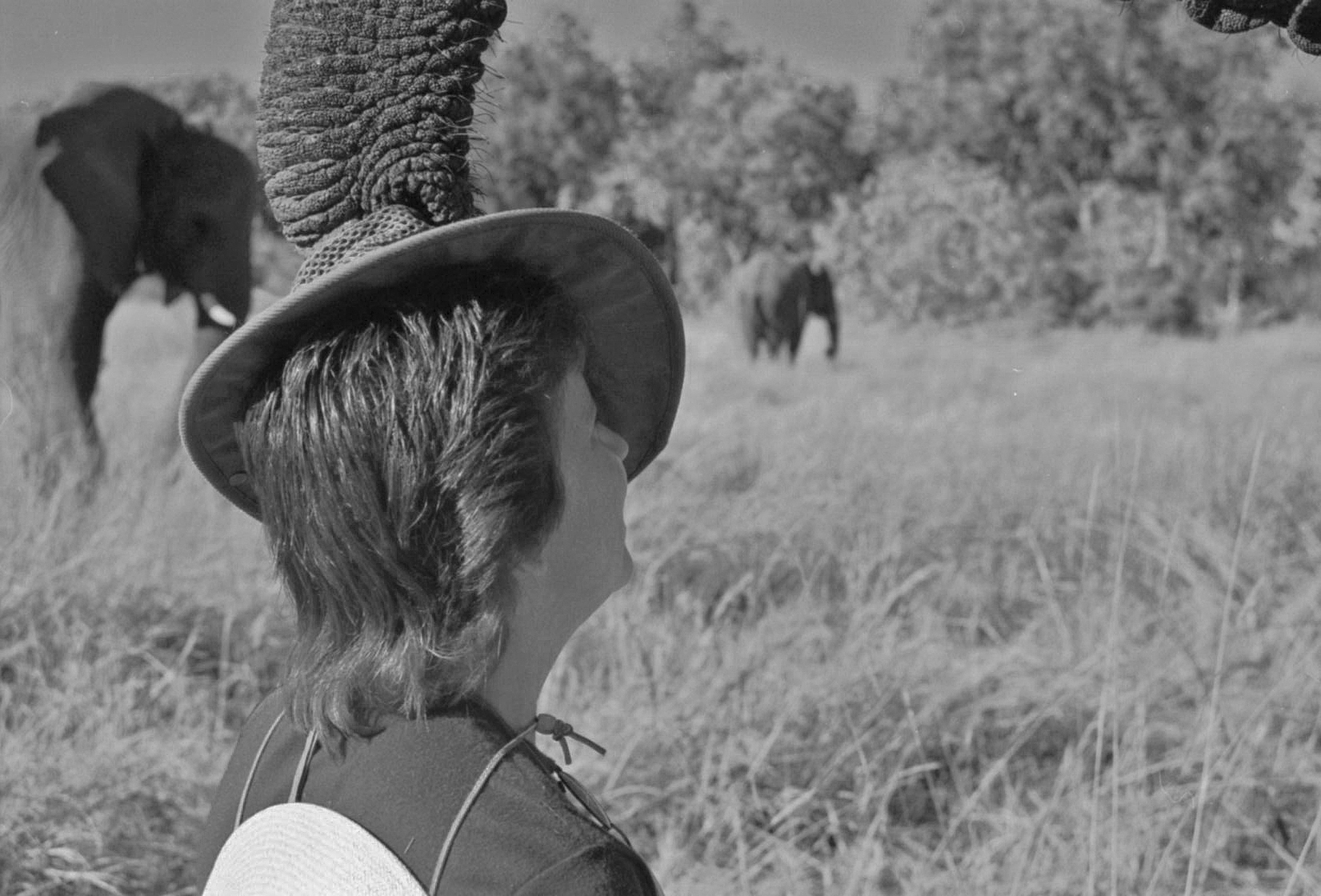
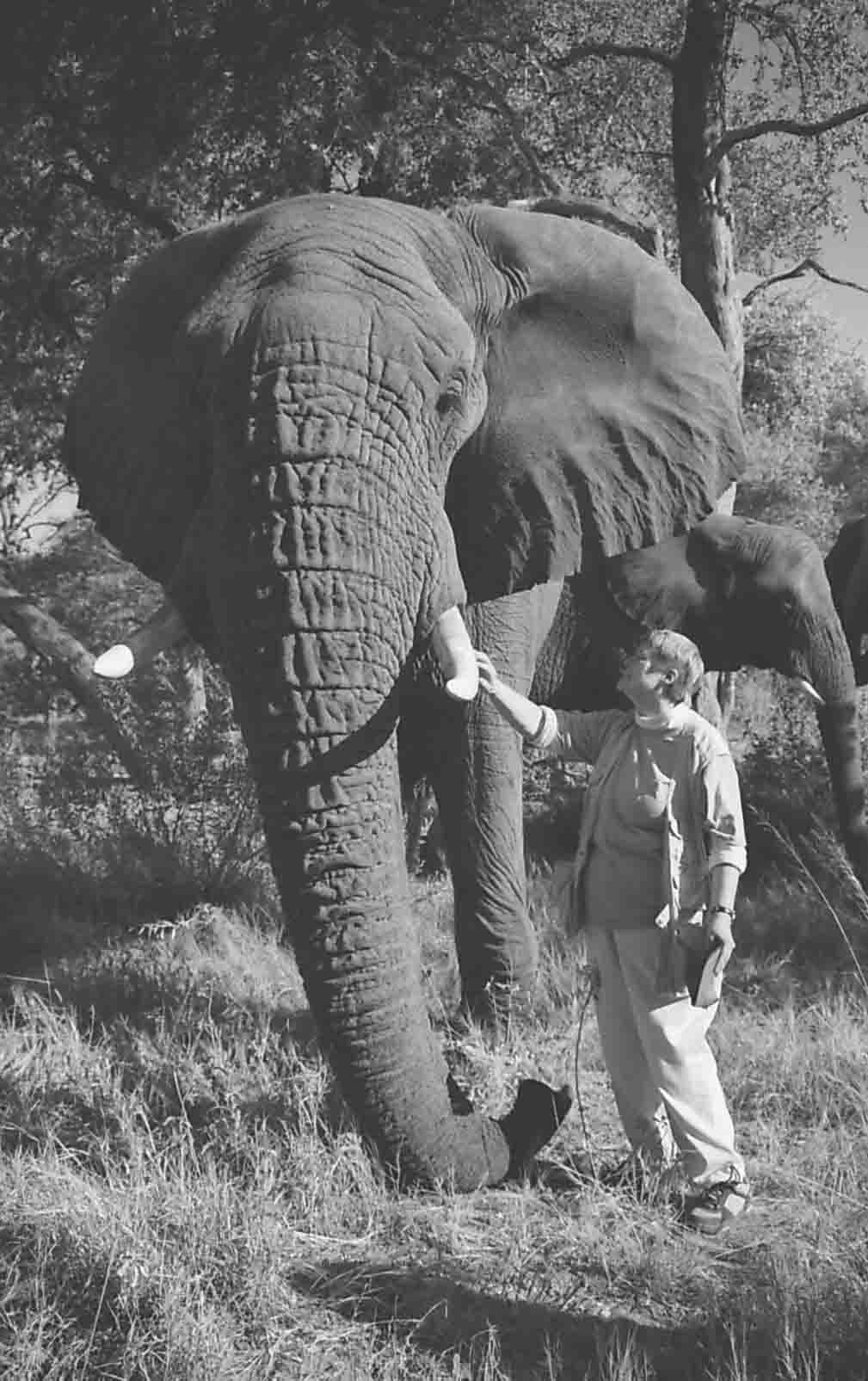
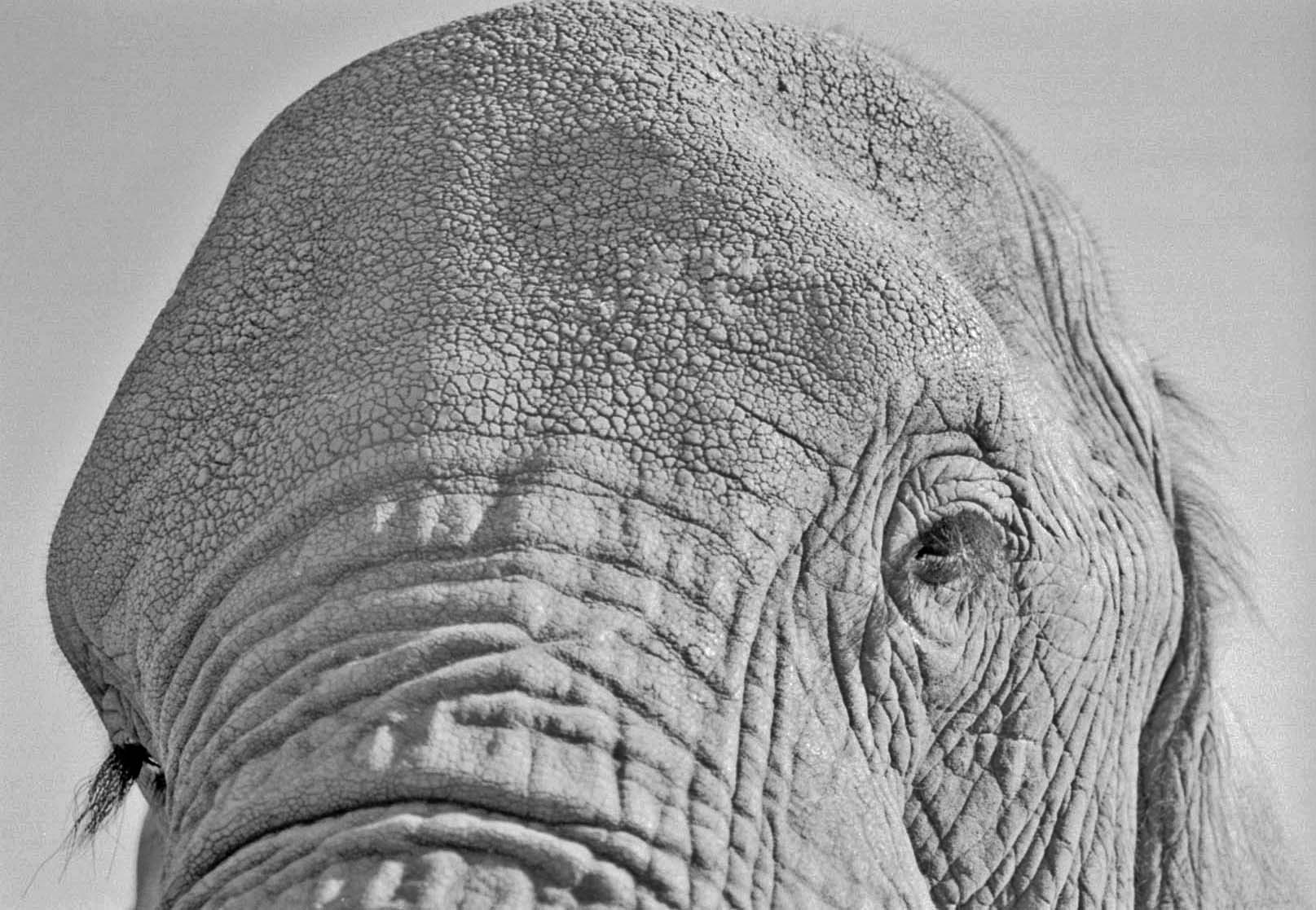
Standing on a termite mound, face-to-trunk with an elephant, I place the palm of my hand against Morula’s fluttering forehead, a forehead as cool and rough as tree bark.  She’s burbling, a rumble that resonates like water gurgling down a hollow pipe.

She’s also making sounds I can feel, but not hear.  Right at the top of her trunk, where her bulging nasal passage enters her skull, her skin pulses beneath my hand, vibrations that reverberate in my chest cavity, drum against my heart.  Muscular ground swells of sound roll full and luxuriously out in the bush, bumping into hippos, giraffes, zebras, lions, hyenas, birds, snakes and tsetse flies.

But it is only elephants who raise their heads and listen.

Most of Morula’s vocalizations are rumbles, which fall partially or entirely in the infrasonic range of 5-30 Hz., throbbing, quaking air for which we humans have no auditory perception.  Such low-frequency rumbles usually have harmonics and overtones, both of which can be selectively emphasized.  As in whale song, each individual elephant has a signature sound, one like no other elephant – their voices as different from each other as our voices are different from each other.

Are you there?

And invisibly, from beyond an island of trees: Yes, I am here.

Speech makes us human, makes these marks on this page possible.  When we speak, our vocal chords vibrate with forced, small explosions of air from our lungs.  We shape words with our mouth and tongue.  Expelled from a chest full of wind, words float around us like little clouds, each one a separate exhalation, creating an atmosphere of meaning, thickening language one word after another.  Sounds unfold in time, in agreeable waves pulsing against our ears.  When we are lost and listening to a piece of pleasurable music, time even suspends itself.  Songs hang on our bones.

Standing on a termite mound, I close my eyes.  The fluttering beneath my hand goes on and on and on.

I open my eyes.  “MO-RU-LA,” I sing.

My voice, like hers, originates in my vocal chords.  But my vocal range is barely an octave, limping through the air at 220 Hz.  Morula’s range is tremendous, more than 10 octaves, from 5 Hz. To 9,000 Hz.

The most athletic human voice in history belonged to Yma Sumac, a Peruvian, who had a self-proclaimed range of five octaves and a recorded range of four and a half.  From B below low C to A above high C, from about 123 Hz. to 1760 Hz.  Sumac’s high range was the same frequency as an elephant’s trumpet.  This is a woman who could occasionally hit a triple-trill and whose voice could sound like an upright bass.

Morula would find her vocalizations a lot more fascinating than mine are.

Like all elephants, Morula is able to produce low frequency sounds just because she is big.  The larger the resonating chamber (think cello compared to violin), the lower the frequency of its sound.  Morula also has long and loose vocal chords and a flexible arrangement of bones attached to her tongue and larynx.  In addition to her loose voicebox she also has another special structure at the back of her throat called a pharyngeal pouch, which not only affects her low-frequency tones but also holds an emergency supply of water.

Morula can produce different results from the same basic rumble by holding her mouth open or shut, by an empty or full pharyngeal pouch, by flapping her ears rapidly or slowly, by holding her head high or low, or by the position of her trunk and the speed of air moving through it.  She can combine hundreds of variables to invent thousands of sounds.

Imagine a vocal instrument equal parts cello, double bass, violin, tuba and trumpet, one whose entire body is an expanding and contracting resonating chamber, one that can sing with a throat full of water and triple-trill a rumble, a roar, and infrasound, all in one 3-second call.

Yma Sumac would be horribly jealous.

Straight-armed, I lean against Morula’s forehead.  A soothing mantle of high-pitched insect noise drapes over my shoulders.

The fluttering beneath my hand has unexpected results.  A soft dry scrape makes me look around.  It’s Thembi’s ears whisking against her shoulders.  She’s standing behind me, on the opposite side of the termite mound.

Glancing from one large forehead to another, from one set of eyes and back, I have a feeling Morula and Thembi are waiting for me to do something.

Maybe something as simple as rumbling in return.
Morula's fluttering forehead.
Posted in Africa, Elephants, Morula, Travel

Biophony

An excerpt from my book

Whoosh-thwack . . . Whoosh-thwack . . .Whoosh-thwack. . . . As Morula’s ears hit her shoulder, they sound like heavy canvas sails snapping in a high wind.

Insects sizzle in the underbrush.  A bleating warbler cries out Help-me, Help-me, Help-me, Help-me!  The trickling call of a coucal drops like large beads into an empty wooden bucket:  Doo-doo-doo-doo-doo-doo . . . doo.  . . doo . . . doo. .   Francolins scatter into the underbrush, a tiny mob of cackling maniacs.

Standing on a termite mound, face-to-trunk with an elephant, I place the palm of my hand against her fluttering forehead, a forehead as cool and rough as tree bark.  Morula is burbling, a contented rumble that resonates like water gurgling down a hollow pipe.

She is also making sounds I can feel, but not hear.  Right at the top of her trunk, where her bulging nasal passage enters her skull, her skin pulses beneath my hand, vibrations that reverberate in my chest cavity, drum against my heart.  Muscular ground swells of sounds roll full and luxuriously out in the bush, bumping into hippos, giraffes, zebras, lions, hyenas, birds, snakes and tsetse flies.

But it is only elephants who raise their heads and listen.

Every desert, river, forest or sea on earth has a mix of sounds biological in origin – birds, mammals, fish – mingled with non-biological sounds – wind, rain, waves, or the blanketing silence of snow.  The symphony of a place is dependent upon night, day, weather, time of year and the creatures within it.  John Muir always said he could tell exactly where he was in the Sierra Nevadas just by the pine needle music.  Few of us are that familiar with our home ground.

Every animal’s voice has its own aural niche within its home ground.  When an ecosystem is altered, when trees are cut, ponds drained, soils covered with concrete, and structures built, the orchestra of the land and its chorus of animal voices are silenced.

Wild sounds disappear as fast as habitats disappear.

Bernie Krause, an American bio-accoustician, notes that 25% of the North American natural soundscapes in his archives are now extinct.  Habitats that no longer exist.  Sounds we will never hear again.  Silent summers, silent autumns, silent winters, silent springs.

In this part of the Delta, in this season, the soundscape around me is filled with dry cracklings.  With crickets who rasp their legs together and listen to each other with ears on their tibias.  With rattling grass.  With the scrape of our footsteps.  With the buzz of small flies seeking moisture at the corners of my eyes.

Those sounds will soon be joined with new animal voices once the Okavango River floods into waiting channels.  For Delta inhabitants, the river also serves as a unique measurement of time.  Rumor has it, Doug tells me, the river is two weeks away.

When it arrives, the symphony of the Delta changes.  The delicate tink-tink, tink-tink of reed frogs will join the rasp of crickets.  Hippos will jostle for elbowroom, grunting and burbling like a band of drowning tubas.  Wildebeest will question their daily survival from the jaws of lions with overlapped musings: Hmmmmh?/Hmmmh.   Hmmmmh?/Hmmmh.

And as fields of grass submerge in the returning river, ground hornbills will stride to and fro in front of the water’s many tongues.  Hornbills are satiny, Satan-y black birds, bigger than fattened geese, with inflated air sacs red as bleeding throats, and beaks like a pickaxes – executioners stalking mice and snakes in advance of the tide.  Their tympanic calls sound like thumbs rubbed across a kettle drum:    Hmmmmph . . . . . . hmph-hmph.   Hmmmmph . . . . . . hmph-hmph.

And intersecting each sound, in each season, the quaking air of elephant calls.

Bernie Krause created a new word for the soundscapes of animal voices: “Biophony” –  the combination of sounds which living organisms produce in their particular biome.  And for each biome, evolutionary complexity reverberates in the music of that particular place.  Millions of years condense into the current symphony I hear as I place my hand on an elephant’s forehead.  Wind rustles leaves, birds teer, insects zzzzzz, a palm weevil drones by and the skin under my palm flutters on and on.  Without the low bass tones of elephants, without their soft rumbling regards, the animal orchestra of the Delta would not be complete.

Soft, rumbling regards - Morula


Posted in Elephants, Jabu, Morula, Sandi

Sleight of Trunk

An excerpt from my book:

The tip of Morula’s trunk, like that of all African elephants, has two opposing fleshy extensions of muscle called “fingers,” one on the top of the tip, one on the bottom.  Asian elephants have only one “finger” on the upper side of their trunk tips.  To pick up objects, Asian elephants grasp an object between their single digit and the thick, stumpy underside of their trunk tips.

With her “fingers” Morula can remove a thorn, uncork a bottle, turn on a faucet, write with a stick in the sand, pick a leaf from a branch without making the others quiver, hold a cup by its handle, and swipe loose objects with the dexterity of a pickpocket.

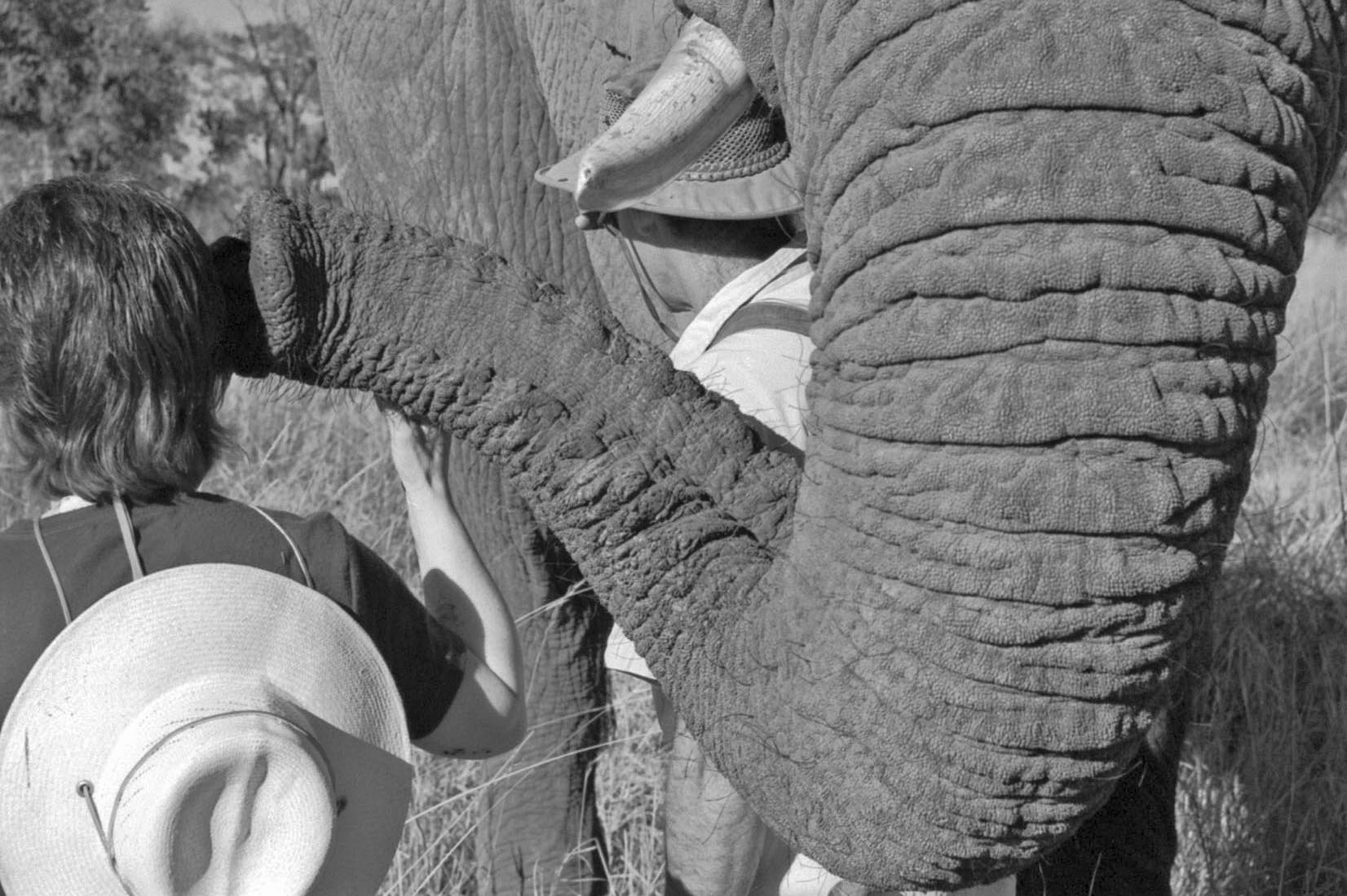
Morula pinches the cap on my head and lifts it.

“Morula, behave yourself.”  I hear Doug’s voice behind me.

My cap plunks down, askew.  I take it off and examine a two-pronged smear of mud on its crown.

Amazing.

I had no sensation of her huge trunk hovering over my head.

Morula backs away, gazing sideways and down, caught in the act.

Who me? says her body language.

An exultant thief, Morula looks in every direction but at me.  If she could giggle, she’d be doing it now.

”Morula,” Doug tone is scolding, but all of us laugh, humans and elephant together.  Morula’s mouth is open and curled at the ends and she becomes, if possible, lighter on her feet, cross-stepping away from me.

Doug once wrote in his field notes:  “To experience these creatures fully, you have to be anthropomorphic.”

I agree.  How do humans measure anything but against themselves?

Stacey can’t wait to join the sleight-of-trunk game, but her hat is brand-new.  It’s not even dusty.

“Here,” Doug says, and plunks his hat, stained multiple times by his elephants’ trunks, on Stacey’s head.

“OK,” he says, “Jabu.  Take.”

Jabu fingers the hat, swipes it, and lifts it to the crown of his head.

Jabu takes a hat

“Jabu, Allll right,” Doug says, and Doug’s hat is returned to Stacey’s head, one more smear on its discolored crown.

She turns it in her hands before handing it back to Doug.  “Wow,” she says.

But I’m more impressed with Jabu’s quick assessment of the change of rules in a game he’s played over and over again.  This hat game wasn’t a simple one.  Jabu had two side-by-side bare heads upon which to place Doug’s hat.  And Doug’s hat would smell like Doug.  Yet Jabu knew which head was which.  And he knew Doug’s hat did not belong on Doug’s head this time.

Out in the field ahead of us Morula and Thembi continuously wrap and rip grass out by its roots, zzzzzzt,  zzzzzzt.  They beat the grass on the ground to remove sand and then place the thatch sideways in their mouths.  Bits of it fall to the ground as they grind their massive molars together.

Sandi stands near the road, watching them patiently, a mother with bright, exuberant children.  Her eyes slide sideways as I walk up next to her.  “Do you ever get tired of this?”  I swing my arm, trying to encompass the entire scene.  Four inches shorter than I am, Sandi tilts her head to look into my face.

“No.  We’re family,” she says.  I don’t have a reply to that simple statement so we both watch the elephants.  Then she says, “Sometimes I miss lipstick and makeup and movies.  But not often.”

I turn around to look at Stacey and Doug behind us.  Doug stands under Jabu’s head and Stacey is next to him.  Deep in conversation, they have their backs to us, looking in general direction of the way we came.  Jabu curls his trunk down and awkwardly to the right, exploring the scent of Stacey’s hair.  Even though the tip of his trunk is out of his range of vision, it hovers an inch from Stacey’s face as she, absentmindedly, touches it with one hand the way a child might reach for the arm of a mother brushing her hair.

Posted in Africa, Elephants, Jabu, Morula, Thembi, Travel

The Most Useful Appendage Ever Evolved

Morula plucks a branch from one of her favorite snacks, a bush-willow.  She holds the stem in her teeth, wraps her trunk from right to left around the branch, and sheers off leaves, top-to-bottom with a single swipe.  She drops the branch and transfers the leaves from the curl of her trunk into her mouth.

Morula is right-trunked, as I am right-handed, preferring to grab and wrap from the right.  Thembi is also right-trunked, but Jabu’s a lefty.

One of the ways to determine an elephant’s dominant tendencies is to inspect the underside of its trunk for green stains on either the right side or the left.  But before you do this, make sure you know the elephant and, more importantly, the elephant knows you.

Morula peels and discards branch after branch.  Shredded bushes mark her path.  She pauses next to a candle-pod acacia, easily recognizable by its upright seedpods.  It reminds me of a giant leafy candelabrum, holding a hundred or more candles in ruffled tiers.  Sharp curved thorns protect each pod.  Morula strips the acacia of a branch, then puts it in her mouth and eats it, thorns, pods and all.

She sidles close to Doug and curls her trunk against her forehead.

“Those round bumps on her forehead might be an old skin infection,” Doug tells me, “but we really don’t know.”

Morula waves hello

A light breeze feathers the hair in her ears as she stands slightly sideways and nods the tipof her trunk in a tiny Hello. . .   Ribbed muscles cross the underside of her trunk.  Bristles stick out like the legs of a giant centipede.

There is no other living creature on this planet that has a trunk.  If elephants were already extinct, which brave paleontologist would go out on a limb and reconstruct the trunk just from evidence of bony nostrils high on the skull?  Who could imagine a nose dangling close to the ground where scents abound?  A nose with the ability to pick up a single straw, rip a tree out by its roots, bench-press 600 pounds and untie your shoelaces without you ever noticing?

“Stand here,” Doug commands me.

I obey, my back to an elephant lineup.

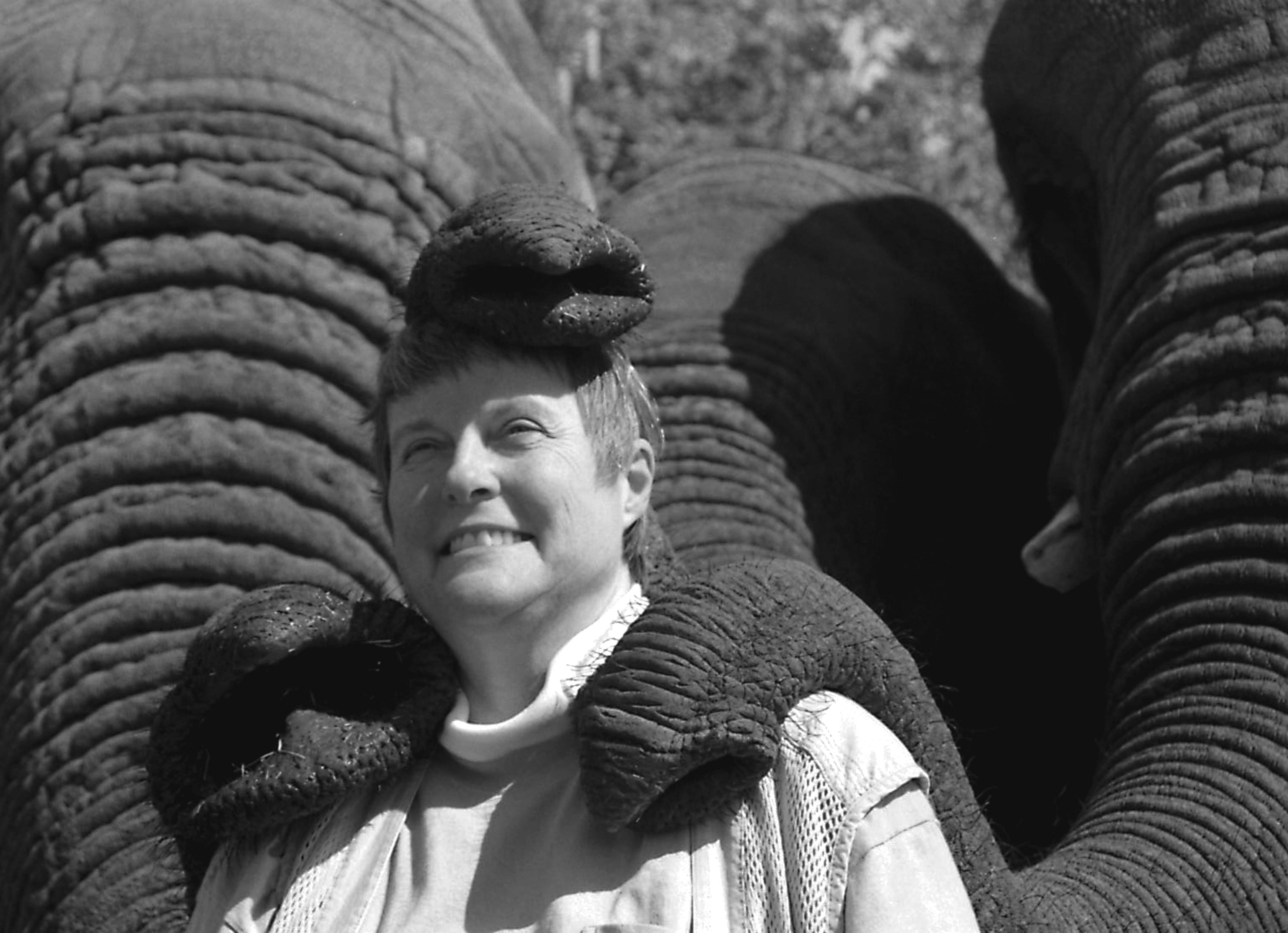
With a little guidance from Doug, Thembi gently places the tip of her trunk on top of my head.  It feels like a big beanbag up there, but one that’s warm, wiggly, drooling and breathing.

As Thembi rubs nose slime into my hair, Doug places Jabu’s trunk tip on my right shoulder and then Morula’s on my left.

Jabu has trouble keeping his trunk balanced on such a narrow ledge.  He constantly fidgets and pokes my cheek with his bristles.  Morula’s trunk drapes over my shoulder like a slack hose with a dripping nozzle.  Her runny nose continuously drains to clear out inhaled dust – the common condition of all elephant trunks.

When I look down and to the left, I have a close-up view of the two “fingers” on her trunk.  Her top finger is more pointed than the one on the bottom.  The shape of it reminds me of a hooded cobra.  But perhaps that’s because I think of Morula’s trunk as thinner and “snakier” than Jabu’s spectacular snout.

Which is getting heavier by the moment.  With the peripheral vision in my right eye, I see two nostrils dotted with grains of moist sand, nostrils more flesh-colored than gray.  Each opening is nearly as wide as the “O” of my mouth.

All three trunk tips, I can attest, are not just sheer weights.  They sniff, snorf, squirm, wiggle, inhale and exhale.  They create an atmosphere of elephant breath around my head.

Doug lowers my camera and pronounces, “Allll-right.”

The weights disappear.  For a few steps I am oddly light, as if walking on the surface of the moon.

There is an elsewhere, somewhere, but it’s not a place I want to be right now.

Posted in Africa, Elephants, Morula

Elephant Air-Conditioning

An excerpt from my book:

Under a sun-bleached sky that is no longer blue, dry coughing barks from black-backed jackals lope in from our left . . . Wraack, wraack, wraack. . .  Black-backs are scavengers, more aggressive than other types of jackals, occupying the same ecological niche in Africa as coyotes do in North America.  Unlike coyotes, black-backed jackals do not howl.  They often steal meat within the reach of a lion’s paw – although their main diet consists of insects, lizards, snakes, rodents, birds and ripe fruit.

Up ahead Morula slaps her ears flatly against her shoulders.

Whoooosh, thwack . . . Whoooosh, thwack . . . Whooosh, thwack . . .

Elephant air-conditioning for a creature that produces enough heat to warm a small house.

Elephants are pachy-dermed, “thick-skinned.”  Some of Morula’s blood vessels are buried as deep as one-and-a-half inches under the surface of her skin.  Since she doesn’t have sweat glands, her ears act like giant heat exchangers, regulating her body temperature.  As her ears open, her body size increases by roughly twenty square feet, a huge area for thermoregulation.  Air moving over the swollen arteries of each ear cools her blood as much as nine degrees before it returns to her body.

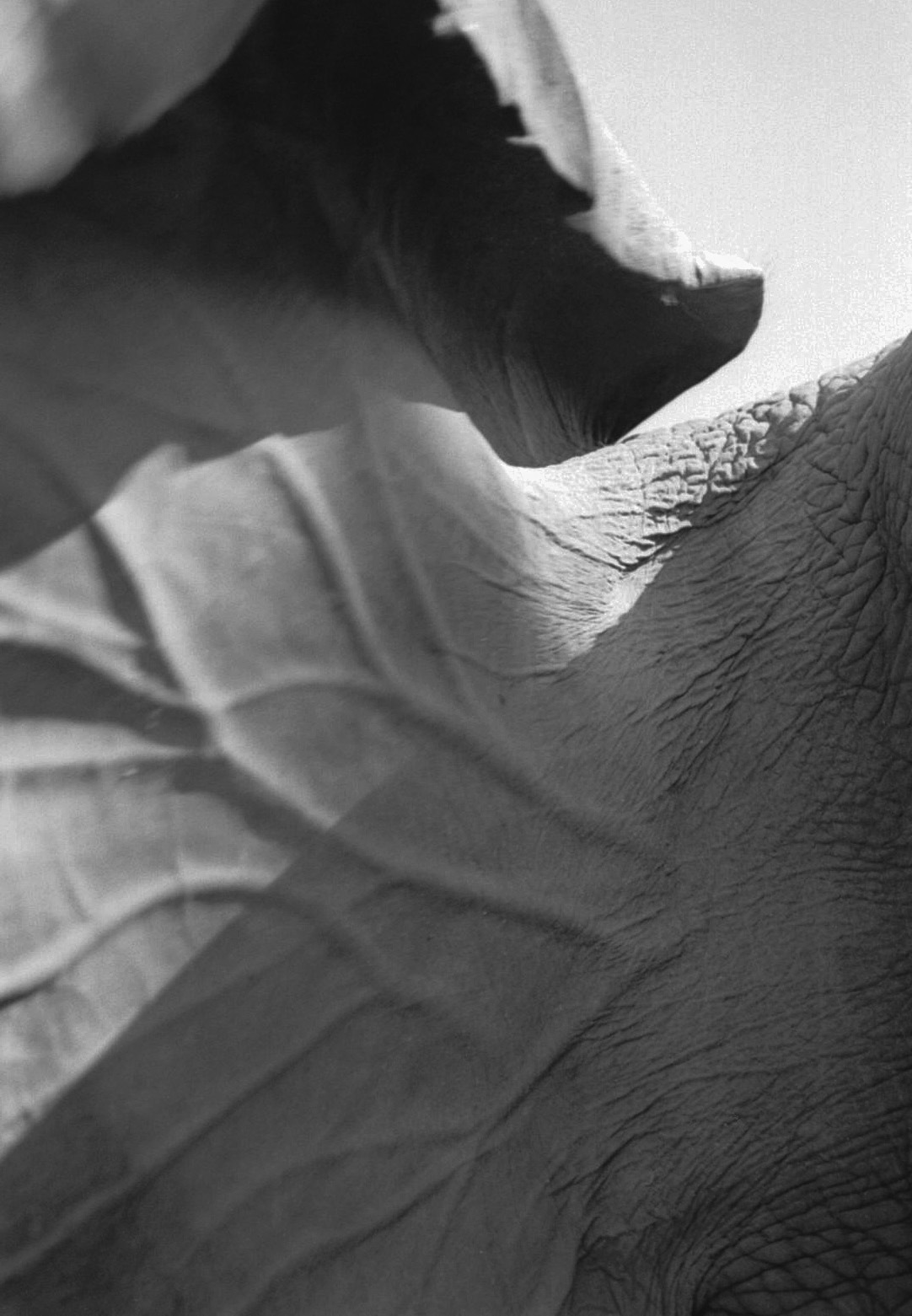
I take a photograph of her ear in mid-flap.  Where Morula’s ear attaches to her shoulder, wrinkles give way to he swollen vessels pumping five gallons of blood per minute across the surface of her ears.  The pattern of those arteries is as unique as a fingerprint, and often used for identifying individual elephants.

Morula's ear

Whooosh, thwack . . . Whooosh, thwack . . . Whooosh, thwack . . .

The breeze she creates dies before it reaches me.  I take off my cap and fan my own neck.

My teeny, itsy ears are built somewhat the same as hers are, with an upper rim of cartilage and a fleshy, lower lobe.  But I don’t have an auriculo-occipitalis, an ear muscle the size of a weightlifter’s bicep.  I can’t flap my ears.  I can’t even wiggle them.

Posted in Africa, Elephants, Jabu, Morula, Sandi

Maps of Africa

An excerpt from my book:

Under a sun-bleached sky that is no longer blue, dry coughing barks from black-backed jackals lope in from our left . . . Wraack, wraack, wraack. . .  Black-backs are scavengers, more aggressive than other types of jackals, and occupy the same ecological niche in Africa as coyotes do in North America.  They are bold enough to steal meat within the reach of a lion’s paw – although their main diet consists of insects, lizards, snakes, rodents, birds and ripe fruit.  Unlike coyotes, black-backed jackals do not howl.

Up ahead of us Morula slaps her ears flatly against her shoulders.

Whoooosh, thwack . . . Whoooosh, thwack . . . Whooosh, thwack . . .

 Elephant air-conditioning, for a creature that produces enough heat to warm a small house.  Elephants are pachy-dermed, thick-skinned.  Some of Morula’s blood vessels are buried as deep as one-and-a-half inches under her skin.  Since she doesn’t have sweat glands, her ears act like giant heat exchangers, regulating her body temperature. As her ears open, her body size increases by roughly one-fifth and her ears provide a huge area for thermoregulation.  The air moving over swollen arteries on the surface of each ear cools her blood as much as nine degrees before it returns to her body.

The veins in Morula's ear

I take a photograph of her ear in mid-flap.  Where Morula’s ear attaches to her shoulder, wrinkles give way to rising rivers of blood, pumping five gallons per minute across the surface of her ears.  The pattern of arteries on an elephant’s ear is as unique as a fingerprint, and often used for identification.

Whooosh, thwack . . . Whooosh, thwack . . . Whooosh, thwack . . .

The breeze she creates dies before it reaches me.  I take off my cap and fan my own neck.

My teeny, itsy ears are built somewhat the same as hers are, with an upper rim of cartilage and a fleshy, lower lobe.  But I don’t have an auriculo-occipitalis, an ear muscle the size of a weightlifter’s bicep.  I can’t flap my ears.  I can’t even wiggle them.

Whooosh, thwack . . . Whooosh, thwack . . . Whooosh, thwack . . .

In the late morning heat Morula’s ears are in constant motion.

Ears of African elephants resemble huge maps of Africa.  Ears of Asian elephants flop forward at the top and hang like small, wrinkled outlines of India.  Morula’s ears fold backward, giving them a smooth, tidy appearance, a map pressed flat.  Although the ears of all elephants have a similar construction – cartilage covered by a thin layer of skin – Morula’s ears are roughly three times larger than those of her Asian kin.  African elephants have the biggest external ears of all mammals, perhaps the biggest of all time.  Each one weighs approximately one hundred pounds.

And no two elephant ears are the same.  As pliable and soft as worn canvas, the leading edge of an elephant’s ear is often caught and torn on branches or by the tusks of other elephants.  In Kenya I watched an adolescent flare her ear and trace its outline with her trunk like a matador holding out her cape.  Backlit by sunlight, three perfectly round holes on its border reminded me of diamond studs.  Nearby, a huge bull posed for my gulping camera as I shot an entire roll of film in less than two minutes.  Only later, with the film developed and the prints in my hands, did I notice the edges of his ears were as scalloped as an old lace tablecloth.

Whooosh, thwack . . . Whooosh, thwack . . . Whooosh, thwack . . .

Jabu sidles up to Morula to investigate the thorn branch in her mouth.  Sandi intercepts him and reaches into her bag of treats.

“Jabu, be nice to Morula,” she says.

Jabu holds out his trunk, cups his treat and puts a handful of pellets into his mouth.  While he’s busy, Sandi reaches back into her bag and transfers treats to the inside curl of Morula’s trunk.  Morula fans her ears, her perfect maps of Africa, and continues munching on her thorn branch.  She finishes the branch before eating her treats.

Jabu, Sandi & Morula
Posted in Africa, Elephants, Morula

A Morning Walk with Elephants, Part 3

An excerpt from my book:

Last night Stanley’s Camp radioed Doug to inform him a guest had purchased the activity option of joining us on a foraging trek.  In partnership with Doug and Sandi, the hosts at Stanley’s offer their guests the experience of a lifetime – an opportunity to walk for several hours through the bush with three unfenced and unfettered elephants, culminating in a picnic lunch at the end of the trek.

As we walk along the dusty road to the rendezvous point for Stanley’s guests, Doug tells me we will meet up with Stacey from New York City.

Rather than submitting to elephant-back safari rides, Jabu, Morula and Thembi provide one-on-one interactions with guests like Stacey, a unique chance to learn how elephants behave in the wild from elephants who accept humans as part of their herd.

The posh tents at Stanley’s Camp are located in a private concession at the southern tip of Chief’s Island, four hundred square miles of dry land in the vast wetlands of the inner Delta.  Private concessions in Botswana lease exclusive tourism use of wildlife areas from community trusts, providing both jobs and taxes.  A committee elected from the six villages within the community trust area NG32 leases 406 square miles to Stanley’s parent company, Sanctuary Retreats.

Exclusive use means exclusive sightings of game – no flocks of vehicles following a single lion.  It also gives Jabu, Thembi, Morula – and their local wild cousins – a daily life without a huge human presence.  Only one sandy pass-through road connects concession to concession.  It is lightly traveled, used mainly by the occasional researcher or for overland supply trucks.  Most tourists fly in.

Our rendezvous point with Stacey is an island of bush.  In the surrounding lagoon of grass a few stalks shiver and crosshatch as a mouse or grasshopper nibbles at their stems.  Otherwise, the lagoon is perfectly still.  The island is a good hiding place for elephants.  Sandi and I will step out to the road when we hear a vehicle coming.

As we wait for Stacey, Doug asks me, “Have you ever seen an elephant’s nictitating membrane?”

No, I haven’t.  Not many chances to do that, where I live.

“Steady Morula.”  He puts both hands up by her left eye and uses them to hold it open.  An opaque membrane slides from the corner of her eye toward the front of her face, toward her trunk.

“It helps protect the eye from sand,” Doug says, “or when she sticks her face in a bush.”

Morula stands perfectly still.

Such trust, I think.  I hate it when a doctor holds my eye open, shines a bright light into it and causes tears to course down my cheek.

Morula’s tears are oilier than mine are, produced by a gland in the nictitating membrane and from a modified sebaceous gland located in her eyelids.  Human tears originate from large lachrymal glands located behind our eyebrows which discharge when irritated or when we are emotional.  When our tear ducts (actually drains) are overwhelmed, tears spill from the corners of our eyes.

Doug releases Morula’s eyelids.  She blinks several times, then knuckles her eye with the tip of her trunk curled as tight as a fist.  As she rubs a dark smudge, a triangle of tears, spreads like a delta from the corner of her eye.

Morula and I stand together, watchers watching, measuring each other.  Steadfast, she looks down her nose at me.  I gaze upward into an iris of liquid oak with sun flecks and shadows in it.

I remember the camera hanging from my neck and lift it.  I feel the earth breathing, the air turning older; each moment caught, then left behind.

“Hello,” I whisper.

Morula's eye

The light from her eye just now reaches mine.

Posted in Africa, Elephants, Morula

A Morning Walk with Elephants, Part Two

An excerpt from my book:

Morula stands around fidgeting, if an elephant can be said to fidget.  She lifts her right leg and swings her foot.  Puts it down, backs up two steps.  Lifts her leg and swings her foot again.

Sandi is quick to notice.

“Morula, here,“ Sandi commands and Morula complies, touching Sandi’s leg with her trunk.  I join them.

Sandi has the calm face of a mother with large, exuberant children.  Her eyes have white creases at their corners from squinting into the sun.  She wears a huge, floppy cloth hat with a brim longer in back than in front.  It’s black under the brim and light green on top.

“How many commands do they understand?” I ask.

“Verbal? About a hundred.  And that’s limited only by our imagination, not theirs.”

Morula leans in like an eager teenager.

She’s a little too close for Sandi’s liking.  “Morula, over and back.”  Sandi taps on Morula’s leg.  Morula backs up a step.  “Over and back.”  Morula is carefully responsive.  When you’re as big as she is, every movement has consequence.  Each step backward is slow, deliberate, and precisely placed.

Once Sandi has her positioned, she gestures to me. I step forward and place a hand on Morula’s trunk.  Studded with sparse bristles, her trunk feels like a stiff old brush.  I look up.

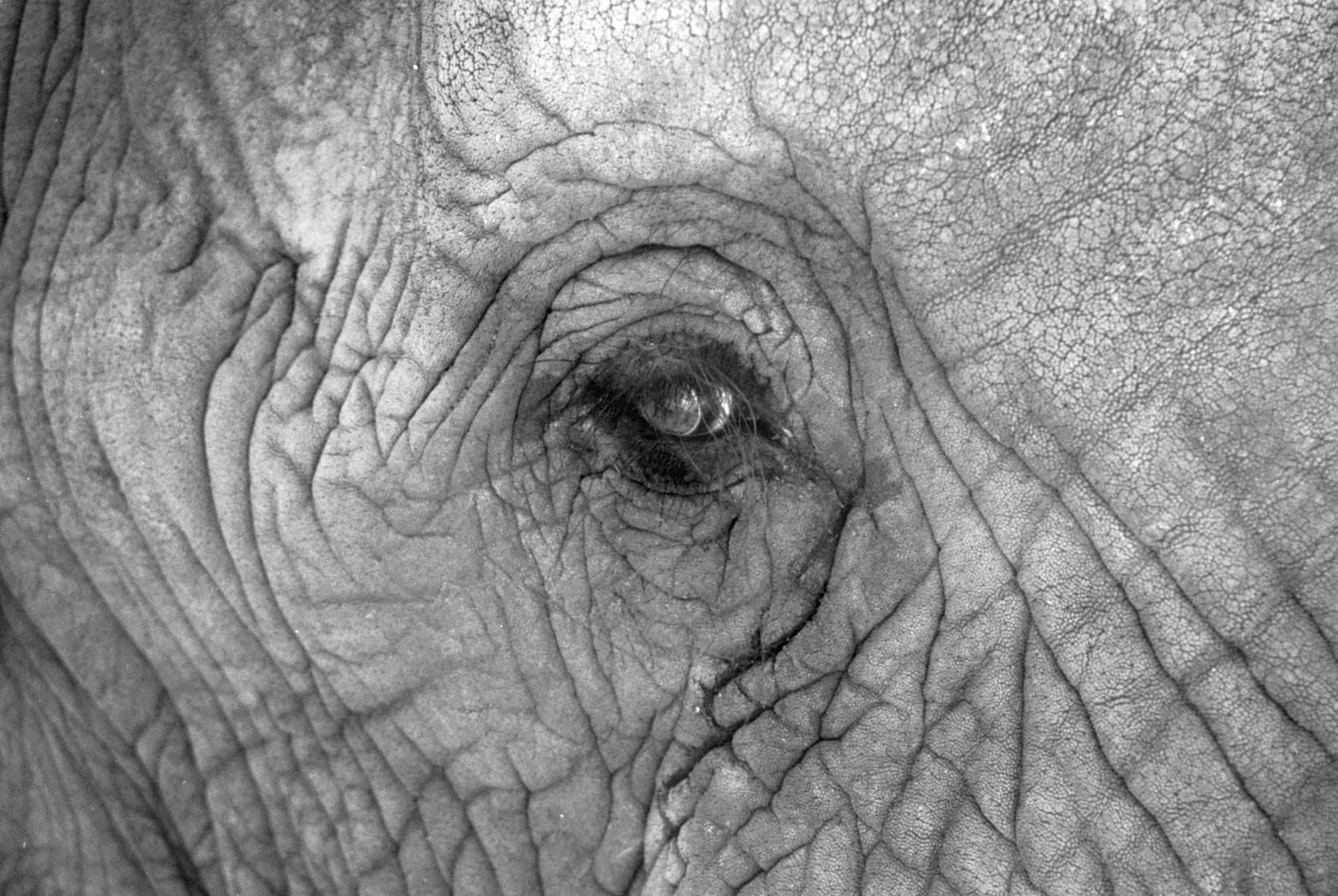
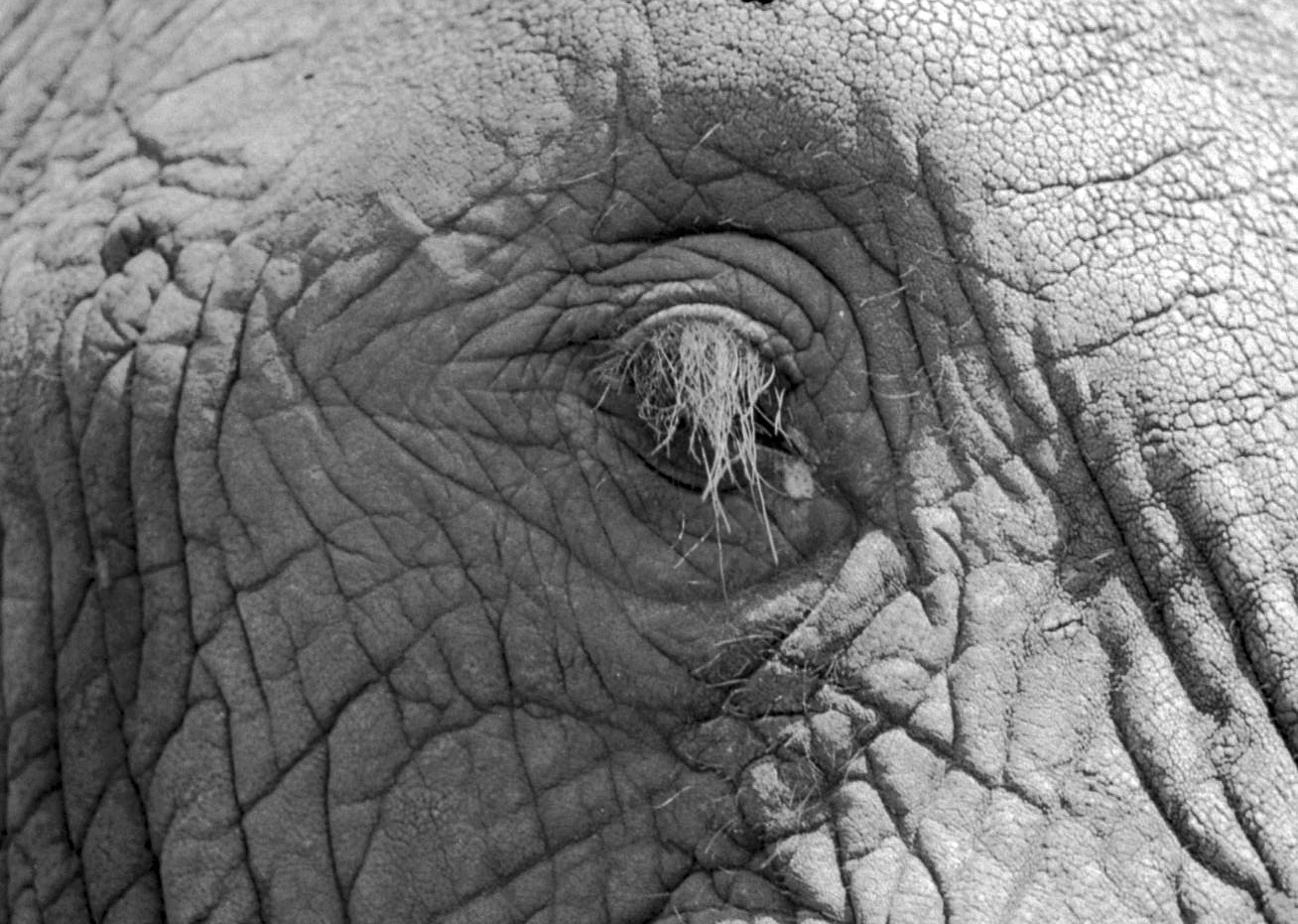
Three-inch lashes cast shadows down Morula’s cheeks.  She blinks and her lashes sweep against her skin like small brooms.  A bit of matter is clustered in the corner of her lower eyelid.

Morula's eye

Each of the more than 200 lashes around my eye is shed every 3 to 5 months.  Has anyone ever done research on the shed rate of elephant eyelashes?

I could.

I could stand here forever looking into the oak burls of her eyes.

Posted in Africa, Elephants, Morula

Morula

An excerpt from my book:

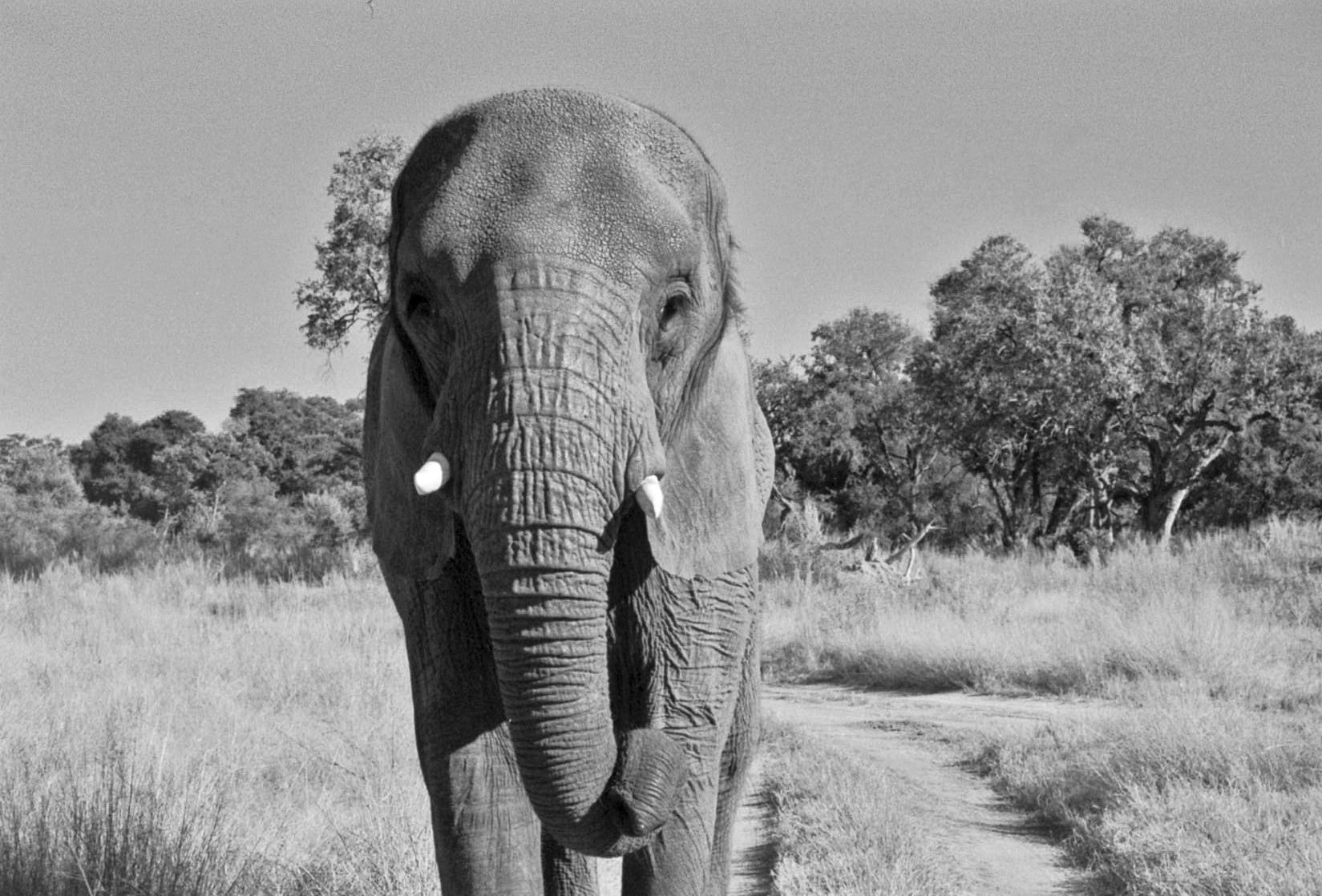
Morula stands square on. Her cobbled forehead broadens from her nose upward in a triangular shape.  Her eyes are nearly hidden, tucked behind the curve of her forehead.  She raises her head to focus on me.  She’s motionless, concentrating.  I can’t even hear her breathing.

I have this odd feeling that she wants me to like her as much as I want her to like me.

I take the lens cap from my camera and glimpse a tiny reflection of myself in its mirror.  Is this what she sees – another one of those small humans, with its odd aura of scents?   Does she see details: my hat, my camera, my idiotic grin?

Morula

The top of a tree is visible over her right shoulder, as if she has a giant corsage tucked behind her ear.  Short bristles like an old man’s buzz cut outline the top of her head.

Because of the way she’s standing, ears flattened against her shoulders, Morula seems slim, her skull almost hollowed.  The tip of her trunk flops over itself in a loose coil and points straight down like a curved arrow.  It begins to twitch in an irregular rhythm.  I take a goofy photograph of Morula – like she’s bored and playing with the only thing at hand – her trunk.

Behind us, around us, for 360 degrees, the Botswana landscape surrounds us.  And neither one of us pays it a bit of attention.

Posted in Africa, Doug, Elephants, Jabu, Sandi, Thembi, Writing

The Elephants Who Accepted Me as Part of Their Herd

An excerpt from my book:

Jabu, Morula and Thembi live in Botswana’s Okavango Delta.  I don’t need radio collars or binoculars or even 4-wheel drive vehicles to study them.  They are companions, who allow me to walk alongside them, close as an eyelash.  Adopted as orphans from culling operations by Doug and Sandi Groves, they spend their days as most wild elephants do: strolling and eating.  But they are also willing ambassadors between the elephant world and the human world.

Walk with me.  Stroll with three unfettered and unfenced elephants in a world where the thin-skinned sky is a bare reminder that the earth is covered with air, where clouds stampede as if chased by lions – a world  without asphalt, without cell phones, without that strange human notion of time.

I hope you enjoy and follow this blog.

Jabu & me