
Continuing series of elephant photographs. Broken-tusked male, Savuti, Botswana.

Continuing series of elephant photographs. Broken-tusked male, Savuti, Botswana.
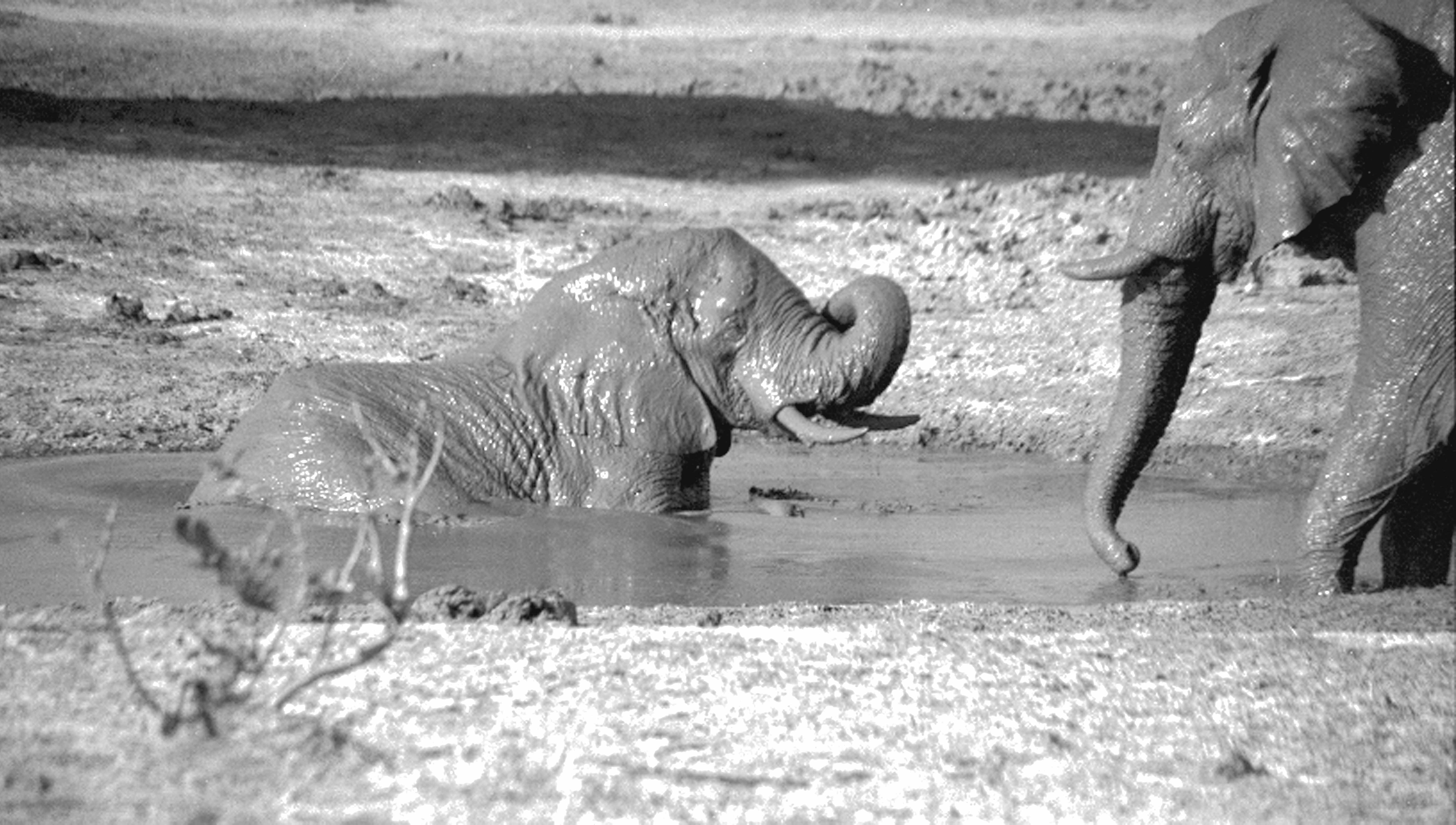
It’s a mucky, slimy, gloppy mud. The young elephant snorkels on his side, the tip of his trunk swiveling above the surface, as he slides towards another bull. His days are filled with heat and dust.
This feels good, his body language says, this feels really good.
If we could imagine ourselves weighing four tons, and think of gravity’s effect on those four tons, then maybe we could imagine wallowing in such mud, pushing and shoving like giant sumo wrestlers, reveling and rolling in the sheer pleasure of this warm gunk. We would inhale a slimy trunkful of ooze, squirt it like a watergun in any direction, even at each other. We would rub our eyes clear with a curled fist at the end of our trunks. We would arise glistening and bright as a metallic statue; we would be cooled, refreshed. . . .
if we could imagine such a thing.
An excerpt from my book in progress:
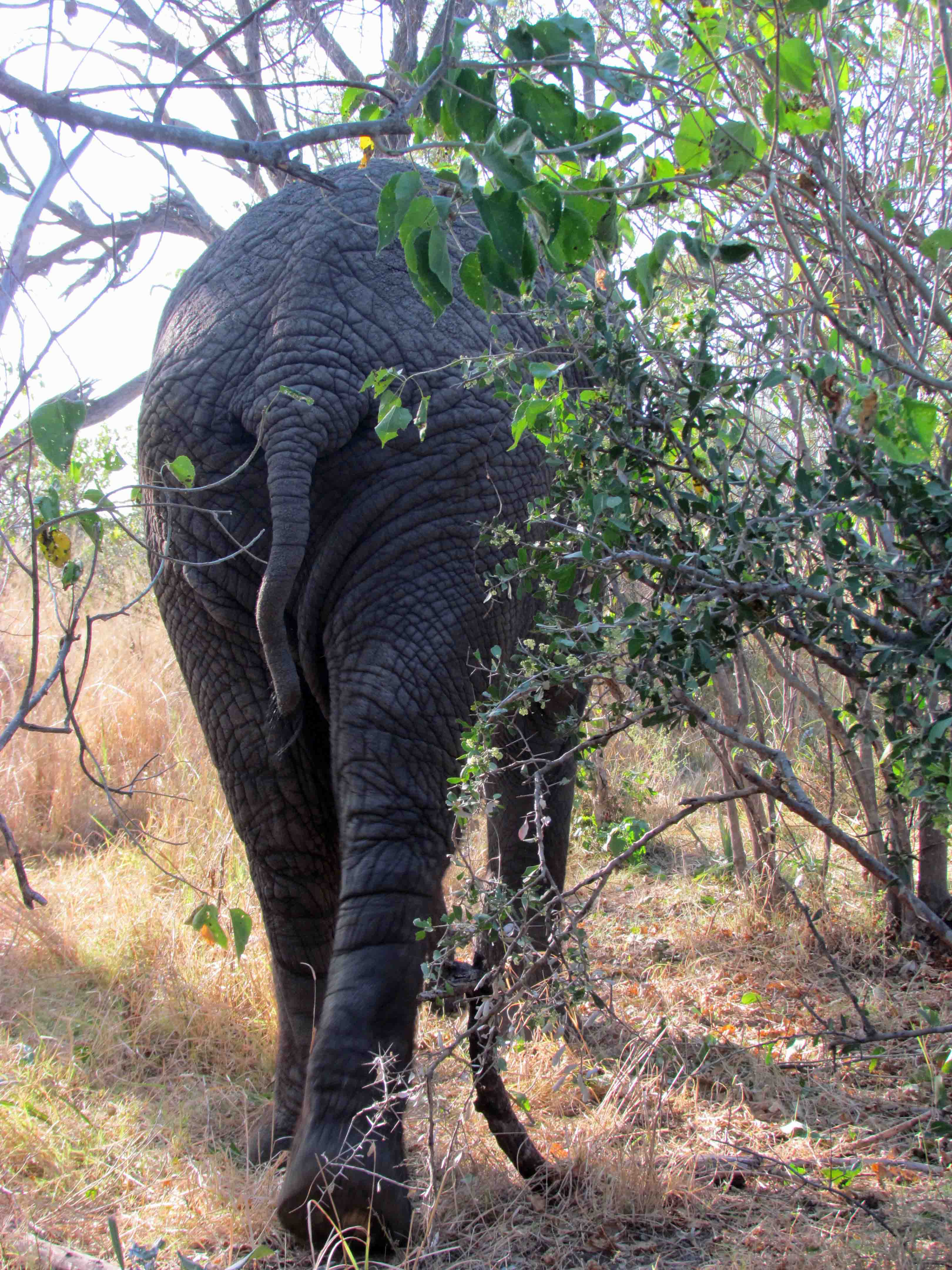
After Morula finishes browsing, I follow her down one of the unmapped, two-track, lightly traveled, nameless roads of the Okavango Delta.
Zik! Zik! Zik-zik! A masked weaver hops through the brush beside us. White clouds above our heads twirl like cotton candy across the sky. The track we’re following parts a shallow lake of grass and climbs out on an island of trees. A game trail crosses the road. Morula swivels her trunk to one side, then the other, at the intersection where the grass is beaten down.
In dun-colored sand as finely ground as cake flour, Morula’s prints barely register. I can’t see a single puff from the impact of her feet. With each step, she leaves behind outlines of small moons. We cross the recent, delicate hoof prints of impala and the moons obliterate them.

My boot prints, inside the crater of her footprints, look like exclamation points, the heel separate from the rest of my sole.
The oldest human footprints in the world are 1500 miles north of here, at Laetoli, in Tanzania. Found in 1976, the 3.5 million-year-old footprints are not far from the Olduvai Gorge, where the Leakey family discovered the first hominids. Although the Laetoli hominids are Australopithecines and not Homo sapiens, they are part of our family tree, a relationship comparable to that of mammoths and elephants.
Fossil footprints are not uncommon, especially near ancient riverbeds. But the Laetoli footprints were created when a nearby volcano erupted, covering the ground with a slurry of volcanic ash somewhat the consistency of concrete. Once excavated, the site was found to have over 9,500 impressions, mostly made by rabbits. In order of decreasing abundance, tracks were also found of guinea fowl, hyena, antelope, rhinoceros, giraffe, buffalo, elephant, horse, small carnivores, monkeys, pigs and ostriches. Just one short, 80-foot section was made by hominids.
Their footprints – that of a man, a woman and a small child – tell us much about our ancestry. For in that trackway is a hesitation, as if one of the hominids thought about turning left. Perhaps it was the moment before an earthquake, when the ground was no longer solid beneath their feet. Or perhaps one of them considered turning around, going back.
I stop and look over my shoulder, in the same way my human ancestor did. All of Africa stretches out behind me – overlapped boot prints and footprints leading backward into her hot, crowded maze of life. It was Africa who designed us to walk upright across her landscapes. Because of Africa, I know the ground better than I know trees.
In the distance, across a golden backwater of high grass, stand a family of giraffes. They are motionless, watching us cross between islands of bush. The spotted derricks of their necks swivel in all directions to get a better look at us. At the end of each neck a head is cocked sideways: the universal body language that says, “Huh?” But once we stop to look, they turn away and head for cover, except for one curious female who continues to watch us.

Tramping along in Morula’s wake, I’m beginning to get the hang of all this walking and browsing – less sweating, less reliance on my water bottle. I’m beginning to wish I could do this every day of my life.
Could not resist re-blogging this for the WordPress Weekly Photo Challenge:
From 93 million miles away, pitched straight at me, vibrating, ululating like an African cry of greeting, light from the sun hurtles towards the earth at 186,282 miles per second and eight minutes later slams into me like a jabbering, long-lost relative trying to make up for lost time. It babbles everything, all at once, into my eyes.
 Our eyesight is an electro-chemical reaction to a vibrating particle-wave that gushes optical information splash into my brain. I could shut my eyes to the wonder around me and be diminished. I could shut my eyes to the atrocities around me and become hardened.
By opening my eyes, I give shape to my perceptions. By opening my eyes I take responsibility for my vision, for what my eyes teach me. By opening my eyes I learn that I belong to the world, not that the world belongs to me.
Our eyes are openings into and out of our bodies. Are my eyes, as some would say, a window to my soul?
There is a cold way of seeing that clips wings and stifles our words into faint echoes. But there is also a way of seeing where the eye can be like a mouth, swallowing color, taking in the entire world with just one gulp. Just the sheer fact alone that we see color should provide enough wonder to fill our lives, should stop us in our tracks, should keep our eyes wide open, devouring everything as fast as we can choke it down, leave us slack-jawed, gasping for air.
Somewhere behind my eyes, a world exists that I yearn to inhabit, dreams that might become real if only I could imagine them with my eyes wide open.
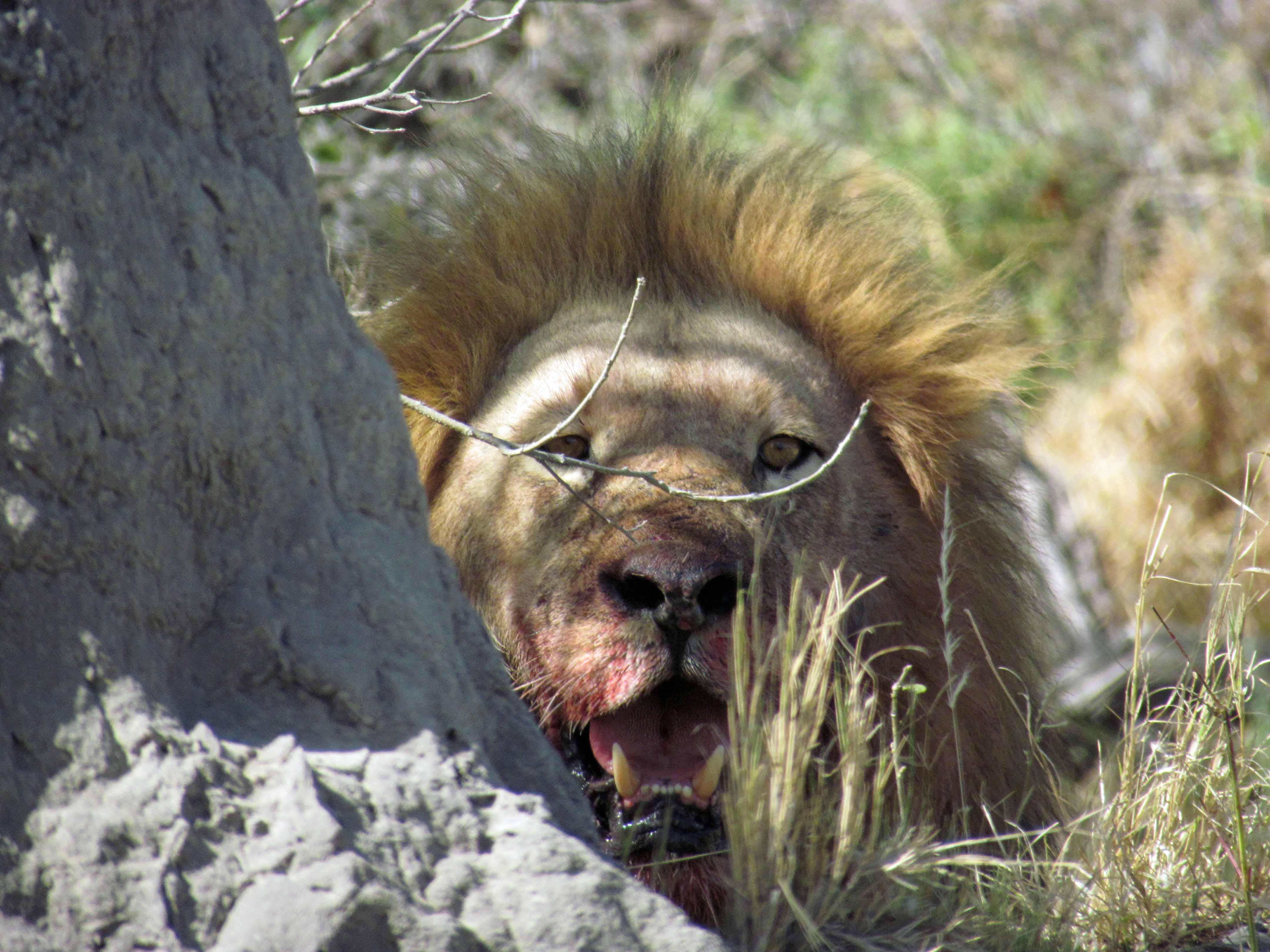
Most impalas die of old age. And most people die of old age, too.
But that’s not a very exciting story, is it?
What makes us want to bring on the lions?
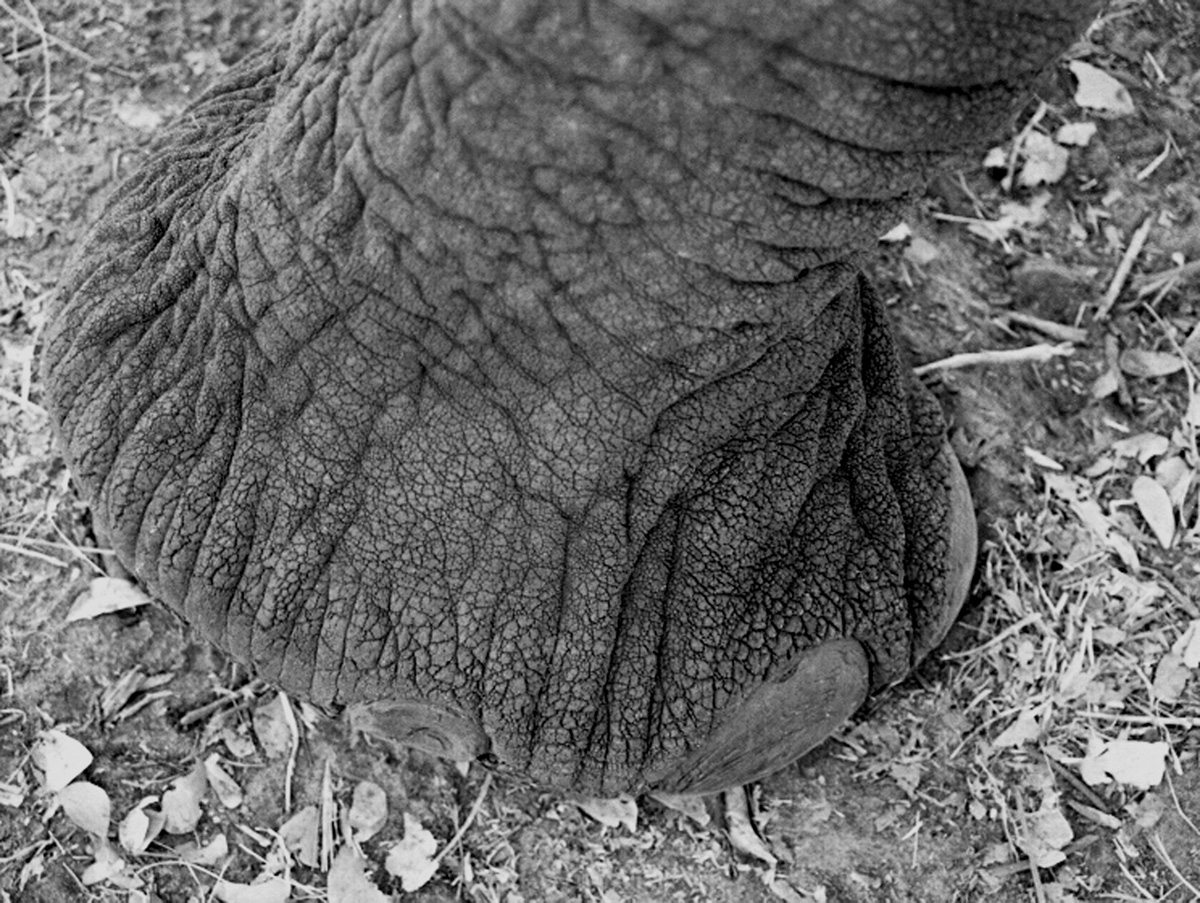
Our feet anchor us to the ground. Just as my Pleistocene ancestors could read the tracks of mastodons, so I now gaze down at an elephant’s prints in the dust. Her back feet are oval and her front feet round. City slicker that I am, even I can tell the direction she is going.
I step on a dry leaf and it crackles into powder.
The brand name of my boots imprints within the outline of my soles; a clever advertisement made with each step. All of my weight concentrates in two small points of contact with the earth, so I make deeper impressions than Morula’s footprints. Each one of my steps applies more pressure per square inch; Morula’s weight spreads over four large footpads the size of a medium pizza pan.
She can step on a snake and not kill it.
Morula lifts her foot and grains of sand roll down slope into the crater of her footprint.
Following two paths, the one beneath her feet and the one in her mind, Morula strolls on. Dust rises, a half shadow that marks her passage, before it collapses again to the ground.
There is a before and an after to each moment of our lives, paths we follow and paths we do not.

From 93 million miles away, pitched straight at me, vibrating, ululating like an African cry of greeting, light from the sun hurtles towards the earth at 186,282 miles per second and eight minutes later slams into me like a jabbering, long-lost relative trying to make up for lost time. It babbles everything, all at once, into my eyes.
Our eyesight is an electro-chemical reaction to a vibrating particle-wave gushing optical information splash into my brain. I could shut my eyes to the wonder around me and be diminished. I could shut my eyes to the atrocities around me and become hardened.
By opening my eyes, I give shape to my perceptions. By opening my eyes I take responsibility for my vision, for what my eyes teach me. By opening my eyes I learn that I belong to the world, not that the world belongs to me.
Our eyes are openings into and out of our bodies. Are my eyes, as some would say, a window to my soul?
There is a cold way of seeing that clips wings and stifles our words into faint echoes. But there is also a way of seeing where the eye can be like a mouth, swallowing color, taking in the entire world with just one gulp. Just the sheer fact alone that we see color should provide enough wonder to fill our lives, should stop us in our tracks, should keep our eyes wide open, devouring everything as fast as we can choke it down, leave us slack-jawed, gasping for air.
Somewhere behind my eyes, a world exists that I yearn to inhabit, dreams that might become real if only I could imagine them with my eyes wide open.
An excerpt from my book-in-progress:

The tip of Jabu’s trunk hovers in front of my eyes, wet with mucous, dotted with sand, nostril hairs visible.
He blows into my face, gently. I blow back, gently. We exchange breath, distillations of our own personal atmospheres, particle-swarms of changed, exchanged air, brewed though all the cells of our bodies.
My lungs fill with the fragrance of crushed leaves, with saproots and spearmint-scented bark, all lightly fermented. I think of the stagnant air that surrounds my daily life, air that is conditioned, filtered, deodorized, air that is bland. Elephant’s breath is said to cure headaches. And it just might, if I had one.
Jabu’s trunk tip investigates my right boot tip. The scents I’ve picked up while walking tumble up two seven-foot-long nostrils – nostrils surrounded by nerves, arteries, veins and a staggering array of longitudinal and transverse muscles, the world’s biggest, longest and certainly most flexible schnozz.
A trunk is the most useful appendage that ever evolved. Imagine having an arm in place of your nose, an arm long enough to reach to the top of a tree, and pluck a single leaf from its crown. Imagine having a nose with which you could rip, tear, excavate, whack, and blow bubbles. You could steal with your nose, suck on it, squeal, swat, poke and siphon with it. You could take a shower, or reach over your shoulder and scratch your back with it. You could even arm wrestle with your nose.
He chuffs, a hot gust of air directed at my feet. Wet mist covers one boot top momentarily, then evaporates.
The deadliest animal in Africa is not a snake, nor a leopard, nor a lion – it’s the hippo, those oddly comic, rotund herbivores that sound like submerged tubas. Hippos kill more people in Africa than any other animal: several hundred per year. In contrast, sharks kill only around ten people per year, worldwide.
Hippos don’t even eat the people they kill. They’re vegetarians, emerging at night from ponds and rivers to eat grass. Their beady, sherry-colored eyes don’t see well at all, but their sense of smell is acute. Males defend territory, females their calves. Both can outrun you, and you never know what might set off a 6,000 pound animal that can achieve a speed of 19 mph.
In 2002, I was traveling through the Moremi Game Reserve in Botswana on a mobile camping safari. Six people in an open-sided Landcruiser focused their cameras on laid-back hippo blimps floating in a nearby pond. It was that magic half-hour before sunset when the light is golden and incredible – perfect for photographs. A short distance away a male grazed on flowers. I raised my camera.
Without warning, the hippo opened his mouth in a threat gesture, displaying his long, razor-sharp canines. A second later, he charged, head swinging side to side like a giant sledgehammer, running directly for us at a surprisingly clip, intent on slamming into our vehicle.
He was closing fast. All I could see through my camera lens were those massive incisors, as the camer’s autofocus kept singing out zzzzt zzzt, zzzzzt zzzt.
Luckily, the engine of our vehicle started without a cough and the hippo just missed our back bumper. He continued on into the bush for thirty yards before stopping to wonder where we had gone. This is the only picture I have of him, right before he charged.

She is beautiful in the way many large women are beautiful. There’s something about the smooth sheen on her plump skin and the defiant stare she gives you that makes you fall in love with her, even when she’s eating.
 ABOUT ELEPHANTS