Posted in Extinction, Mammoths, Mastodons, Pleistocene

The Last Mammoths on Earth

Around 1650 BCE (Before the Common Era), the last mammoth on earth died on Wrangel Island, a small outpost in the Chukchi Sea off northeastern Siberia.  In the same general period of time, the Shang Dynasty ruled China, the Thirteenth Dynasty began in Egypt, (it will be 300 more years before Tutankhamen is born), the Hittites sack Babylon and the world’s first wooden bridge was constructed on Lake Zurich.

Frequently ice-bound, Wrangel was visited by hunters before its mammoth population became extinct, evidenced by the various stone and ivory tools the hunters left behind.  Possibly a part of a vast Inuit trading culture, the hunters did what hunters do – feed their families.  They might, or might not, have known mammoths were becoming very scarce.  Large mammals such as reindeer and sea lions were their prey – why not the last mammoth left on earth?  Wrangel Island is now a sanctuary, a breeding ground for polar bears, with the highest density of dens in the world.

Most mammoth and mastodon populations became extinct during the transition from the Late Pleistocene (126,000 BCE to 12,000 BCE) to the Holocene, the age of modern man beginning at 12,000 BCE.  The word Holocene derives from the Greek words holos (whole or entire) and kainos (new) and the epoch encompasses all of the period from the last glaciations throughout the worldwide population growth of the human species and up to present day.  Animals and plants have not evolved much during the Holocene, but have undergone major shifts in their distributions, due to the effects of man.  It was also the period where the megafauna – mammoths, mastodons, giant bears and an entire range of predators – disappeared.

During the transition from the Pleistocene to the Holocene, the Stone Age came to an end with the advent of flint tool manufacturing, the first usage of advanced darts and harpoons, and the development of a modern toolkit including oil lamps, fish hooks, ropes, and eyed needles – all perfect inventions that indicate successful hunting-gathering techniques.  During this transitionary period, Neanderthals became extinct, clay figures were hardened in wood-fired ovens, the bow and arrow was invented, and cave painting appeared in Europe.  By 12,000 BCE, Asiatic peoples crossed from Asia to North America, entered South America as far as the Andes, and domesticated llamas.

Although climate change and human predation are considered the main causes for the extinction of the Pleistocene-Holocene megafauna, the spread of disease is also an extinction theory.  Scientists who believe that the catastrophic drop in mammoth and mastodon populations was due to a hyper-disease are studying frozen samples from the mammoths of Wrangel, hoping to find evidence of an Ebola-like virus in their DNA.   They theorize that the virus could have jumped from fleas to mammoths, which would account for an extinction rate that increased as humans spread across the planet.  (Rats, which carry fleas, caravanned right alongside us, as we propagated our way across the continents.)  To date, the DNA recovered from Wrangel is incomplete and fragmentary.

But climate change and overhunting are the two main theories for the Holocene extinctions.  During the last glaciations of the Pleistocene (19,000 to 20,000 BCE) most of the climate of the world was colder and drier.  Deserts expanded, sea level dropped, and rain forests were splintered by savannah.  Twelve thousand years ago, the last Ice Age ended.  The vast grasslands of Siberia froze under permafrost.  Trees marched north.  Humans moved into the more temperate regions, following game.  As habitat collapsed with the climate change, as mammoths and mastodons were confined to shrinking islands of refuge, they became easier to hunt.

Females and the young, the easiest and most numerous, died first.  And with the older females went the knowledge of where and when to migrate.  With fewer and fewer females, birthrates could not keep up with death rates.  Mammoths couldn’t pop up every spring like wildflowers. 

The longer it takes to find each elusive herd makes a difference on how long you stay and how much you overhunt it.  But even as places of refuge became further and further apart, it was still possible to find them.  And hunt again and again and again.

There’s a lot of return for killing mammoths, much more so than gathering grass seeds, which were the most abundant food item of the Pleistocene.  In the last twenty years tons of evidence has been unearthed, confirming the overhunting theory.  Below Krakow’s Spadzista Street in Poland, 8,000 bones of 73 individuals were found in a 40 x 40-foot square area, a mammoth mausoleum.  At a hunting campsite in Czechoslovakia, archeologists excavated more than a thousand mammoths.  In areas where wood was scarce, such as the Ukraine, shelter frameworks were constructed of mammoth bones, with skulls for foundations and interlocking tusks as arches.   One shelter, near Kiev, contained the bones of 95 mammoths.  And in Dent, Colorado, the bones of a dozen mammoths are clustered at the bottom of a cliff.  Scattered among them are stone spear points and large rocks.

Mammoths and mastodons survived through the Pleistocene and into the age of man.  Ten thousand years ago, North America resembled Africa, with huge migrating herds of elephant, camels, horses and antelope.  Following alongside the herds were Saber-toothed cats, Dire wolves, Miracinonx (the American cheetah that looked like an elongated cougar), Giant short-faced bears and American lions.  Then, in the blink of an evolutionary eye, within just eight thousand years, three-fourths of North America’s large mammals disappeared.
Posted in Africa, Elephants, Extinction, Mammoths, Mastodons, Morula

Mastodons, Mammoths & Morula

Against a chalk-blue sky, the smooth bare branches of a Motsheketsane tree interweave like a dancer’s arms caught in a multiple exposure.  The shade it provides is full of holes, lacy as a cobweb.  Embedded in the sand at its base are the hoof prints of zebras, from hooves exactly like those of unshod horses.

Morula and I seek what little shade there is underneath the tree.  I take a swig from my water bottle while she searches for leftover Motsheketsane seeds.  Using her trunk as a leaf blower, she corrals the ones she finds into a neat little pile whuff, whuff, whuff and transfers it into her mouth.

I pick one up.  The seed is oval and has ruffled wings that divide it into 5 horizontal planes.  It looks like a small paper lantern of a vaguely Oriental design.  I try to pocket one, but its wings crumble as my hand close around it.

My everywhere-mind wanders off by itself, meanderings of no practical use except, of course, to me.  Speculatively, I eye Morula, cloak her in long, ginger-colored, shaggy fur, shrink her ears, implant upturned, pitchfork tusks, and imagine her, well, tubbier, in a mastodon suit of hair.

She waves her trunk tip at me, neighborly, as if across a backyard fence: Hello.

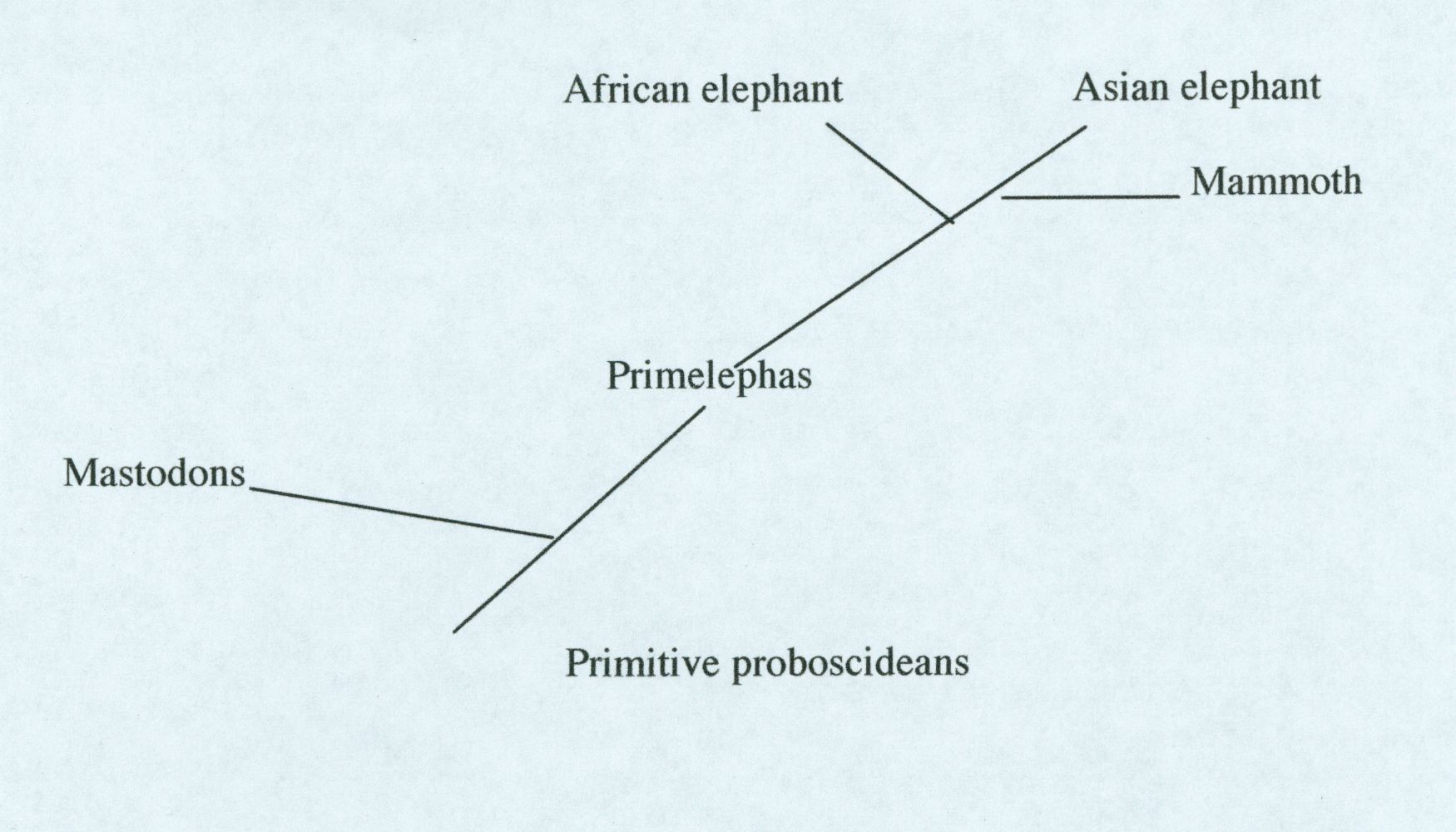
With its two fingers, the tip of her trunk could argue for a close relationship with mammoths.  But recent DNA research found direct genetic links only between Asian elephants and mammoths.  Morula’s family tree looks like this:

Mastodons branched from the proboscidean family tree 26 million years ago.  They became the first elephant cousins to leave Africa, the first to migrate through Asia and the first to arrive in North America, around 3.7 million years ago.  Mammoths followed, around 2.2 million years later.  Once in North America, the elephant cousins spread from Alaska to Central Mexico, from the Pacific to the Atlantic.  As you might expect of distant kin, mastodons and mammoths share many characteristics with surviving elephants.  They have the same basic body shape, a trunk and tusks.  But they also differ in many ways.

The most striking, of course, is that suit of hair.

Morula rubs her left haunch against the gnarly trunk of the Motsheketsane.  She has a relatively naked body – obviously a fur coat is useless under the brassy African sun.  Her body size, thick skin and subcutaneous fat all help to keep her warm when temperatures occasionally, very occasionally, dip below freezing.

If you shaved a mammoth, or a mastodon, parked it in a zoo, and sold tickets, most people would believe they’re seeing an elephant.  But if I put the three cousins on display side-by-side, almost anyone could tell the difference between them.

Of course, bringing to life two extinct species is an impossibility, unless, well . . .  .  I make things up.  Which is an acceptable thing to do as long as I confess that I’m doing it.

So I import to Africa two distinct species that never walked the continent: Mammut americanum (the American mastodon) and Mammuthus columbi (the Columbian mammoth).  Both lived exclusively in North America, where fourteen thousand years ago, they could be found, almost literally, in my backyard.

I position Morula between two cousins she will never meet – a mastodon to her right and a mammoth on her left.  Oddly enough, because everyone’s related, they don’t really look that much out of place.  Of course, this is all in my imagination, so anything is possible.

Columbia, the mammoth, is gigantic – at least four feet taller than Morula – with absolutely spectacular tusks.  Curving out, then inward, they nearly cross each other.  Even though I’m speculating about them, I don’t overdo their length.  At eight feet long, they’re only half the size of the longest mammoth tusks ever recorded.

As soon as she solidifies in my fantasy, Columbia lifts the tip of her trunk and takes a discreet sniff at Morula: Who’s this?

The top “finger” of her trunk is four inches long and the bottom “thumb” two inches – a bit longer than the fingers of Morula’s trunk tip.  Columbia’s could pluck out single petals from spring flowers or extract the newest, sweetest stems from the short grasses of the Pleistocene parklands.

She is completely cloaked in rich, russet fur, trunk and all, right down to her toes.  Her ears are oval-shaped and small, dainty really, about fifteen inches from top to bottom.  Since she lives near Pleistocene ice sheets, she has no need to dissipate heat through her ears.

She quickly loses interest in the smell of an unfamiliar elephant and strolls over to pick out dry blades from a field of African grass, leaving cratered footprints in the dust.  Except for their size, I can’t tell them apart from Morula’s.

Columbia wraps her trunk around a wad of grass, from right to left, and rips out a clump.  She stuffs the grass between elephant-like molars.  As she eats, I hear a phantom fart.  She lifts the small, triangular anal flap at the base of her short, stubby tail and drops a pile of dung, which looks exactly like Morula’s latest offerings.

I’m having way too much fun with my mammoth.

Conjuring Mammut americanum, the American mastodon, proves trickier.  I can’t quite bring him into focus.  Although entire frozen, mummified mammoth carcasses have been unearthed in Siberia – complete with tongues hanging out of their jaws – we know mastodons only by their bones.  So when I give Americanum a chestnut-colored shag – short and tangled hair on the top of his low-crowned head, thick and matted fur along his flank – I’m just agreeing with what’s been written elsewhere.  A shaggy fur coat is probably a safe bet, since Americanum ranged just south of the Pleistocene ice sheets, mingling with mammoths in the cold wet climate of North America.

Americanum is about the same height as the average African elephant.  His back, instead of sloping, like Columbia’s, or saddle-shaped, like Morula’s, is straight – he has no neck.  His skull is flatter and longer, without Columbia’s high-domed head or Morula’s rounded crest, and his jaws are elongated.  He actually has a chin.

I give my made-up mastodon huge tusks the same length as Columbia’s.  While her tusks curve out and then in, like an extravagant Bavarian moustache, his are a classic pitchfork shape.  One is a full six inches shorter than the other – Americanum is a lefty.  Laterality – right or left-handedness – is present in all proboscidean species.

Both mammoth and mastodon tusks grew to great lengths – a 16-foot mastodon tusk was found in Greece in 2007.  The record for African elephants is 11 feet.

Americanum’s tusks, like those of all his cousins, grew as tree rings grow, with varying rates for bad years, good years, summer, spring, winter, fall.  Just as African elephants do, he experienced musth after his late teens and began aggressively fighting with other males over receptive females.  Fighting caused battle scars to his tooth sockets, tusks and skull.  So, although Americanum is stocky, bulky and seemingly without much personality, he‘s not just some docile herbivore.  He’s a bull in the prime of his life.  Lucky for me, I didn’t conjure him up when his testosterone levels were elevated.

Americanum joins Columbia at a rainbush, but of course he takes no notice of her, nor she of him.  How can they?  They’re both just figments of my imagination.

He reaches into the bush, plucks a branch of dull green leaves, shoves it into his mouth and chews up and down, like I do, instead of forward and back, like Morula and Columbia.  Each ridge on Americanum’s small molars is shaped like a woman’s torso: two breasts with pointed nipple-like chewing surfaces and a valley between them.  He has only three to four ridges (sets of breasts) per molar. His common name, mastodon, is a combination of the Greek words for breast (mastos) and tooth (odõn.)

In contrast, the molars of Columbia and Morula are ridged plates: teeth that look like elongated dishes set to dry edgewise in a rack, each plate bonded to the next by enamel.  Their molars work like huge horizontal vegetable graters, grinding food back and forth across sharp, upright edges.  Morula’s teeth have ten ridges, while Columbia has twenty-seven, due to her exclusive diet of trees.

Doug shows me Morula’s molars.  “Open up,” he tells her.  She curls her trunk back over her head and he stretches to his tiptoes, pulls her lower gums wide with his hands.

Morula’s molars

“Very good, my girl.”

If there were dentists for elephants, Morula would be a patient patient.

Doug lets go of Morula’s lower jaw and she swings her trunk down but keeps her mouth     open.  He grabs a fistful of “elephant candy” and slides his arm into her mouth, all the way to his elbow.  As he lets go of the treat he rubs her tongue.  She rapidly flaps her ears.  “Elephants use their trunks to rub each other’s tongues.” Doug says.  “It’s kind of like a handshake.”

I re-conjure Morula’s elephant cousins and find them still eating – Columbia at the   rainbush, Americanum pulling up grass.  I watch them fondly; they are like old friends in new clothes.  But they are rapidly becoming distressed in the African heat.  They sway from side to side and flap their small ears like tiny surrender flags.   So even though I’ve fallen in love with these ghosts, with elephants who no longer exist, I come to my senses and banish them back to the past, where they are extinct once again.

Posted in Extinction, Mammoths, Mastodons, Pleistocene

The Death of the Manis Mastodon

I imagine how the Mastodon in My Backyard died:

Near a small, bog-rich pond, the pearl-gray catkins of a pussy willow rattle in the driving sleet.  Ice coats the bare branches of a soopolallie growing at the water’s edge.  Frozen red berries still cling to its stems.  Upslope from the pond, in a brushy part of the tundra, a herd of elk seeks shelter from the spring squall.  Higher still, the mountains are sheathed in glacial ice.

The temperature drops and the sky clears.  When night falls curtains of light shimmer in the north, an aurora rippling in solar winds.  Oxygen atoms bombarded by geomagnetic storms turn the whole hemisphere red.  Glazed with the colors of fire, the pond flickers and burns throughout the night.

A muskrat surfaces and swims towards her burrow.  The legs of a frog dangle and twitch from her mouth.  The wake behind her broad tail sends ripples through the aurora’s reflection, shimmering the four-legged silhouette on the pond’s surface.  Looming over his own shadow, an old mastodon bull curls his trunk into his mouth and releases cold clear water down his throat.

All day, during the icy storm, the mastodon browsed on sage, spirea, rosehips, frosted buttercups, wormwood and sedge as the wind left ice crystals in his eyelashes.  He trudged across a marshland through sticky, hydrated clay, pulled out each foot with a loud, sucking sound.  Sunshine and snow, both opalescent, washed over him in waves.

On the tall-grass prairie, he saw herds of equus and pricus, horses and bison, standing with heads lowered, their backs to the stinging wind.  He saw a shaggy outline, obscured by blowing snow, sweeping the tall grass clear with her curled tusks.  Barely visible, a small calf nuzzled the fur between her front legs and suckled from a hidden breast.

Recognizing her high domed cranium and sloping profile, the mastodon did not cross the prairie to meet her, though he has seen her foraging at this place before.  She is a mammoth and not a member of his low-browed kind.

At a gravel bar he crossed a crystalline river formed from glacial outmelt.  A goose feather spiraled down from a migrating flock.  His pace was slow and he often stopped, his trunk resting on the ground.  An Arctic fox circled in behind him, veered away when he wheeled and held his huge tusks high.

Finally, in the middle of the night, he reached the pond and waded in.

Now he drinks and eats listlessly, pulls out hippuris, water plants with long tails and sweet green stems.  The sky is clear, cold, and the blood-red aurora flames and dances over his head, wildfire in the sky.  Cattails chatter in the wind.

He staggers toward the bank of the pond and into boggy mud, rich, black, and carnivorous.  He touches his side, where the hole-that-hurts still bleeds.  Mired, he closes his eyes, sways, falls.

Near dawn the two-legged hunters find him on his side, half in water, half out.  They build a fire and settle to their work.

Posted in Extinction, Mammoths, Mastodons, Pleistocene

Mammoth

Outside my window shaggy shadows move among the firs. An immense shape assembles and disassembles in the wind.

Fourteen thousand years ago, mastodons and mammoths roamed North America, grazed alongside the buffalo.  Paleolithic peoples followed the woolly giants across the Bering Bridge to lands as game-rich as the Serengeti.  Projectile points can be found embedded in the bones of their prey.

But now the great ones are nearly everywhere gone.

Time twists as I stare out the window at the huge ghost facing me.  A giant form conjured from a smear of rhododendrons and shadows lifts his trunk into the wind, changes back into a bush beast with flowers in his stomach, and is extinct once again.


Posted in Africa, Elephants, Morula

Singing Like Yma Sumac

Standing on a termite mound, face-to-trunk with an elephant, I place the palm of my hand against Morula’s fluttering forehead, a forehead as cool and rough as tree bark.  She’s burbling, a rumble that resonates like water gurgling down a hollow pipe.

She’s also making sounds I can feel, but not hear.  Right at the top of her trunk, where her bulging nasal passage enters her skull, her skin pulses beneath my hand, vibrations that reverberate in my chest cavity, drum against my heart.  Muscular ground swells of sound roll full and luxuriously out in the bush, bumping into hippos, giraffes, zebras, lions, hyenas, birds, snakes and tsetse flies.

But it is only elephants who raise their heads and listen.

Most of Morula’s vocalizations are rumbles, which fall partially or entirely in the infrasonic range of 5-30 Hz., throbbing, quaking air for which we humans have no auditory perception.  Such low-frequency rumbles usually have harmonics and overtones, both of which can be selectively emphasized.  As in whale song, each individual elephant has a signature sound, one like no other elephant – their voices as different from each other as our voices are different from each other.

Are you there?

And invisibly, from beyond an island of trees: Yes, I am here.

Speech makes us human, makes these marks on this page possible.  When we speak, our vocal chords vibrate with forced, small explosions of air from our lungs.  We shape words with our mouth and tongue.  Expelled from a chest full of wind, words float around us like little clouds, each one a separate exhalation, creating an atmosphere of meaning, thickening language one word after another.  Sounds unfold in time, in agreeable waves pulsing against our ears.  When we are lost and listening to a piece of pleasurable music, time even suspends itself.  Songs hang on our bones.

Standing on a termite mound, I close my eyes.  The fluttering beneath my hand goes on and on and on.

I open my eyes.  “MO-RU-LA,” I sing.

My voice, like hers, originates in my vocal chords.  But my vocal range is barely an octave, limping through the air at 220 Hz.  Morula’s range is tremendous, more than 10 octaves, from 5 Hz. To 9,000 Hz.

The most athletic human voice in history belonged to Yma Sumac, a Peruvian, who had a self-proclaimed range of five octaves and a recorded range of four and a half.  From B below low C to A above high C, from about 123 Hz. to 1760 Hz.  Sumac’s high range was the same frequency as an elephant’s trumpet.  This is a woman who could occasionally hit a triple-trill and whose voice could sound like an upright bass.

Morula would find her vocalizations a lot more fascinating than mine are.

Like all elephants, Morula is able to produce low frequency sounds just because she is big.  The larger the resonating chamber (think cello compared to violin), the lower the frequency of its sound.  Morula also has long and loose vocal chords and a flexible arrangement of bones attached to her tongue and larynx.  In addition to her loose voicebox she also has another special structure at the back of her throat called a pharyngeal pouch, which not only affects her low-frequency tones but also holds an emergency supply of water.

Morula can produce different results from the same basic rumble by holding her mouth open or shut, by an empty or full pharyngeal pouch, by flapping her ears rapidly or slowly, by holding her head high or low, or by the position of her trunk and the speed of air moving through it.  She can combine hundreds of variables to invent thousands of sounds.

Imagine a vocal instrument equal parts cello, double bass, violin, tuba and trumpet, one whose entire body is an expanding and contracting resonating chamber, one that can sing with a throat full of water and triple-trill a rumble, a roar, and infrasound, all in one 3-second call.

Yma Sumac would be horribly jealous.

Straight-armed, I lean against Morula’s forehead.  A soothing mantle of high-pitched insect noise drapes over my shoulders.

The fluttering beneath my hand has unexpected results.  A soft dry scrape makes me look around.  It’s Thembi’s ears whisking against her shoulders.  She’s standing behind me, on the opposite side of the termite mound.

Glancing from one large forehead to another, from one set of eyes and back, I have a feeling Morula and Thembi are waiting for me to do something.

Maybe something as simple as rumbling in return.

Morula's fluttering forehead.
Posted in Africa, Elephants, Morula, Travel

Biophony

An excerpt from my book

Whoosh-thwack . . . Whoosh-thwack . . .Whoosh-thwack. . . . As Morula’s ears hit her shoulder, they sound like heavy canvas sails snapping in a high wind.

Insects sizzle in the underbrush.  A bleating warbler cries out Help-me, Help-me, Help-me, Help-me!  The trickling call of a coucal drops like large beads into an empty wooden bucket:  Doo-doo-doo-doo-doo-doo . . . doo.  . . doo . . . doo. .   Francolins scatter into the underbrush, a tiny mob of cackling maniacs.

Standing on a termite mound, face-to-trunk with an elephant, I place the palm of my hand against her fluttering forehead, a forehead as cool and rough as tree bark.  Morula is burbling, a contented rumble that resonates like water gurgling down a hollow pipe.

She is also making sounds I can feel, but not hear.  Right at the top of her trunk, where her bulging nasal passage enters her skull, her skin pulses beneath my hand, vibrations that reverberate in my chest cavity, drum against my heart.  Muscular ground swells of sounds roll full and luxuriously out in the bush, bumping into hippos, giraffes, zebras, lions, hyenas, birds, snakes and tsetse flies.

But it is only elephants who raise their heads and listen.

Every desert, river, forest or sea on earth has a mix of sounds biological in origin – birds, mammals, fish – mingled with non-biological sounds – wind, rain, waves, or the blanketing silence of snow.  The symphony of a place is dependent upon night, day, weather, time of year and the creatures within it.  John Muir always said he could tell exactly where he was in the Sierra Nevadas just by the pine needle music.  Few of us are that familiar with our home ground.

Every animal’s voice has its own aural niche within its home ground.  When an ecosystem is altered, when trees are cut, ponds drained, soils covered with concrete, and structures built, the orchestra of the land and its chorus of animal voices are silenced.

Wild sounds disappear as fast as habitats disappear.

Bernie Krause, an American bio-accoustician, notes that 25% of the North American natural soundscapes in his archives are now extinct.  Habitats that no longer exist.  Sounds we will never hear again.  Silent summers, silent autumns, silent winters, silent springs.

In this part of the Delta, in this season, the soundscape around me is filled with dry cracklings.  With crickets who rasp their legs together and listen to each other with ears on their tibias.  With rattling grass.  With the scrape of our footsteps.  With the buzz of small flies seeking moisture at the corners of my eyes.

Those sounds will soon be joined with new animal voices once the Okavango River floods into waiting channels.  For Delta inhabitants, the river also serves as a unique measurement of time.  Rumor has it, Doug tells me, the river is two weeks away.

When it arrives, the symphony of the Delta changes.  The delicate tink-tink, tink-tink of reed frogs will join the rasp of crickets.  Hippos will jostle for elbowroom, grunting and burbling like a band of drowning tubas.  Wildebeest will question their daily survival from the jaws of lions with overlapped musings: Hmmmmh?/Hmmmh.   Hmmmmh?/Hmmmh.

And as fields of grass submerge in the returning river, ground hornbills will stride to and fro in front of the water’s many tongues.  Hornbills are satiny, Satan-y black birds, bigger than fattened geese, with inflated air sacs red as bleeding throats, and beaks like a pickaxes – executioners stalking mice and snakes in advance of the tide.  Their tympanic calls sound like thumbs rubbed across a kettle drum:    Hmmmmph . . . . . . hmph-hmph.   Hmmmmph . . . . . . hmph-hmph.

And intersecting each sound, in each season, the quaking air of elephant calls.

Bernie Krause created a new word for the soundscapes of animal voices: “Biophony” –  the combination of sounds which living organisms produce in their particular biome.  And for each biome, evolutionary complexity reverberates in the music of that particular place.  Millions of years condense into the current symphony I hear as I place my hand on an elephant’s forehead.  Wind rustles leaves, birds teer, insects zzzzzz, a palm weevil drones by and the skin under my palm flutters on and on.  Without the low bass tones of elephants, without their soft rumbling regards, the animal orchestra of the Delta would not be complete.

Soft, rumbling regards - Morula


Posted in Elephants, Jabu, Morula, Sandi

Sleight of Trunk

An excerpt from my book:

The tip of Morula’s trunk, like that of all African elephants, has two opposing fleshy extensions of muscle called “fingers,” one on the top of the tip, one on the bottom.  Asian elephants have only one “finger” on the upper side of their trunk tips.  To pick up objects, Asian elephants grasp an object between their single digit and the thick, stumpy underside of their trunk tips.

With her “fingers” Morula can remove a thorn, uncork a bottle, turn on a faucet, write with a stick in the sand, pick a leaf from a branch without making the others quiver, hold a cup by its handle, and swipe loose objects with the dexterity of a pickpocket.

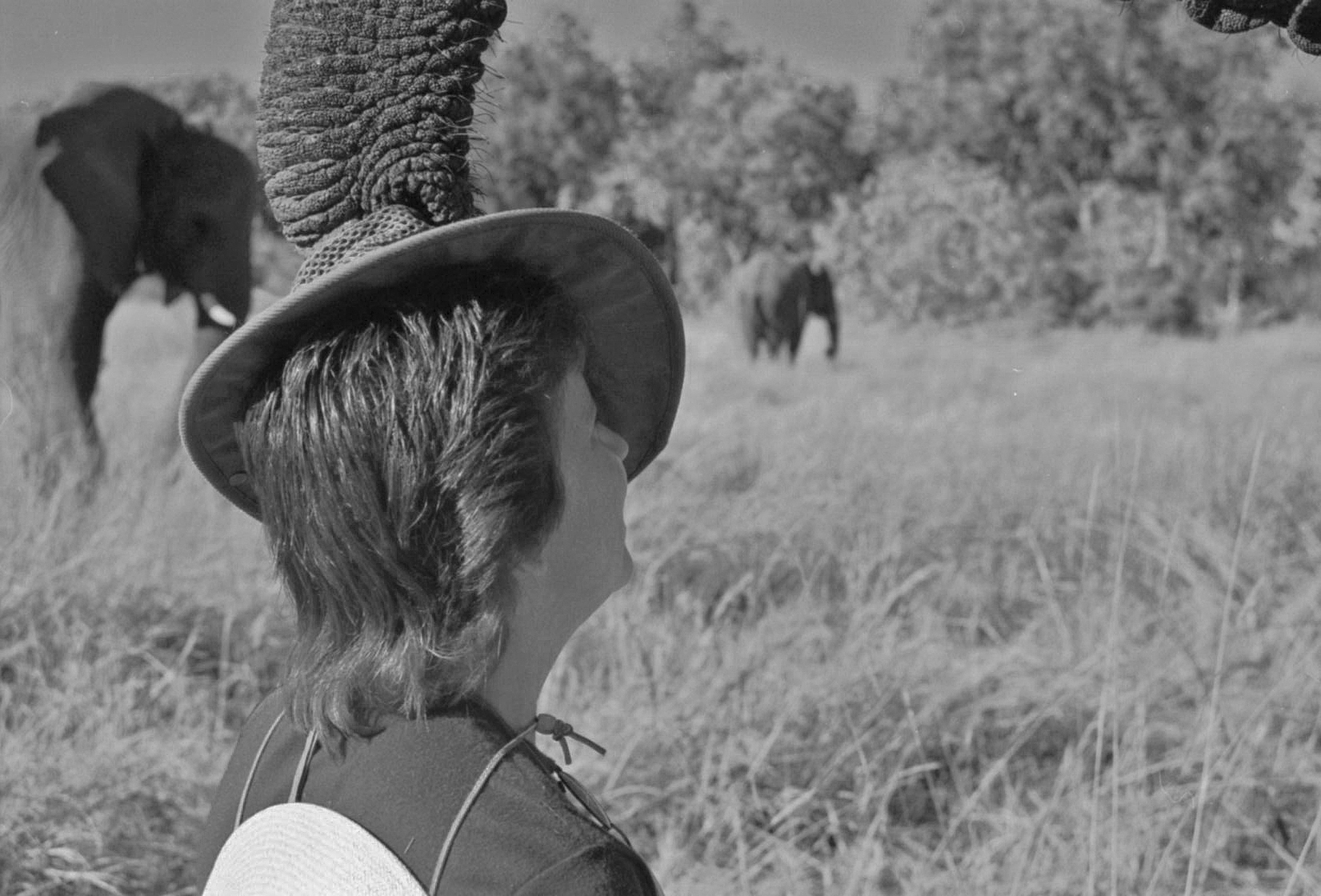
Morula pinches the cap on my head and lifts it.

“Morula, behave yourself.”  I hear Doug’s voice behind me.

My cap plunks down, askew.  I take it off and examine a two-pronged smear of mud on its crown.

Amazing.

I had no sensation of her huge trunk hovering over my head.

Morula backs away, gazing sideways and down, caught in the act.

Who me? says her body language.

An exultant thief, Morula looks in every direction but at me.  If she could giggle, she’d be doing it now.

”Morula,” Doug tone is scolding, but all of us laugh, humans and elephant together.  Morula’s mouth is open and curled at the ends and she becomes, if possible, lighter on her feet, cross-stepping away from me.

Doug once wrote in his field notes:  “To experience these creatures fully, you have to be anthropomorphic.”

I agree.  How do humans measure anything but against themselves?

Stacey can’t wait to join the sleight-of-trunk game, but her hat is brand-new.  It’s not even dusty.

“Here,” Doug says, and plunks his hat, stained multiple times by his elephants’ trunks, on Stacey’s head.

“OK,” he says, “Jabu.  Take.”

Jabu fingers the hat, swipes it, and lifts it to the crown of his head.

Jabu takes a hat

“Jabu, Allll right,” Doug says, and Doug’s hat is returned to Stacey’s head, one more smear on its discolored crown.

She turns it in her hands before handing it back to Doug.  “Wow,” she says.

But I’m more impressed with Jabu’s quick assessment of the change of rules in a game he’s played over and over again.  This hat game wasn’t a simple one.  Jabu had two side-by-side bare heads upon which to place Doug’s hat.  And Doug’s hat would smell like Doug.  Yet Jabu knew which head was which.  And he knew Doug’s hat did not belong on Doug’s head this time.

Out in the field ahead of us Morula and Thembi continuously wrap and rip grass out by its roots, zzzzzzt,  zzzzzzt.  They beat the grass on the ground to remove sand and then place the thatch sideways in their mouths.  Bits of it fall to the ground as they grind their massive molars together.

Sandi stands near the road, watching them patiently, a mother with bright, exuberant children.  Her eyes slide sideways as I walk up next to her.  “Do you ever get tired of this?”  I swing my arm, trying to encompass the entire scene.  Four inches shorter than I am, Sandi tilts her head to look into my face.

“No.  We’re family,” she says.  I don’t have a reply to that simple statement so we both watch the elephants.  Then she says, “Sometimes I miss lipstick and makeup and movies.  But not often.”

I turn around to look at Stacey and Doug behind us.  Doug stands under Jabu’s head and Stacey is next to him.  Deep in conversation, they have their backs to us, looking in general direction of the way we came.  Jabu curls his trunk down and awkwardly to the right, exploring the scent of Stacey’s hair.  Even though the tip of his trunk is out of his range of vision, it hovers an inch from Stacey’s face as she, absentmindedly, touches it with one hand the way a child might reach for the arm of a mother brushing her hair.

Posted in Africa, Elephants, Jabu, Morula, Thembi, Travel

The Most Useful Appendage Ever Evolved

Morula plucks a branch from one of her favorite snacks, a bush-willow.  She holds the stem in her teeth, wraps her trunk from right to left around the branch, and sheers off leaves, top-to-bottom with a single swipe.  She drops the branch and transfers the leaves from the curl of her trunk into her mouth.

Morula is right-trunked, as I am right-handed, preferring to grab and wrap from the right.  Thembi is also right-trunked, but Jabu’s a lefty.

One of the ways to determine an elephant’s dominant tendencies is to inspect the underside of its trunk for green stains on either the right side or the left.  But before you do this, make sure you know the elephant and, more importantly, the elephant knows you.

Morula peels and discards branch after branch.  Shredded bushes mark her path.  She pauses next to a candle-pod acacia, easily recognizable by its upright seedpods.  It reminds me of a giant leafy candelabrum, holding a hundred or more candles in ruffled tiers.  Sharp curved thorns protect each pod.  Morula strips the acacia of a branch, then puts it in her mouth and eats it, thorns, pods and all.

She sidles close to Doug and curls her trunk against her forehead.

“Those round bumps on her forehead might be an old skin infection,” Doug tells me, “but we really don’t know.”

Morula waves hello

A light breeze feathers the hair in her ears as she stands slightly sideways and nods the tipof her trunk in a tiny Hello. . .   Ribbed muscles cross the underside of her trunk.  Bristles stick out like the legs of a giant centipede.

There is no other living creature on this planet that has a trunk.  If elephants were already extinct, which brave paleontologist would go out on a limb and reconstruct the trunk just from evidence of bony nostrils high on the skull?  Who could imagine a nose dangling close to the ground where scents abound?  A nose with the ability to pick up a single straw, rip a tree out by its roots, bench-press 600 pounds and untie your shoelaces without you ever noticing?

“Stand here,” Doug commands me.

I obey, my back to an elephant lineup.

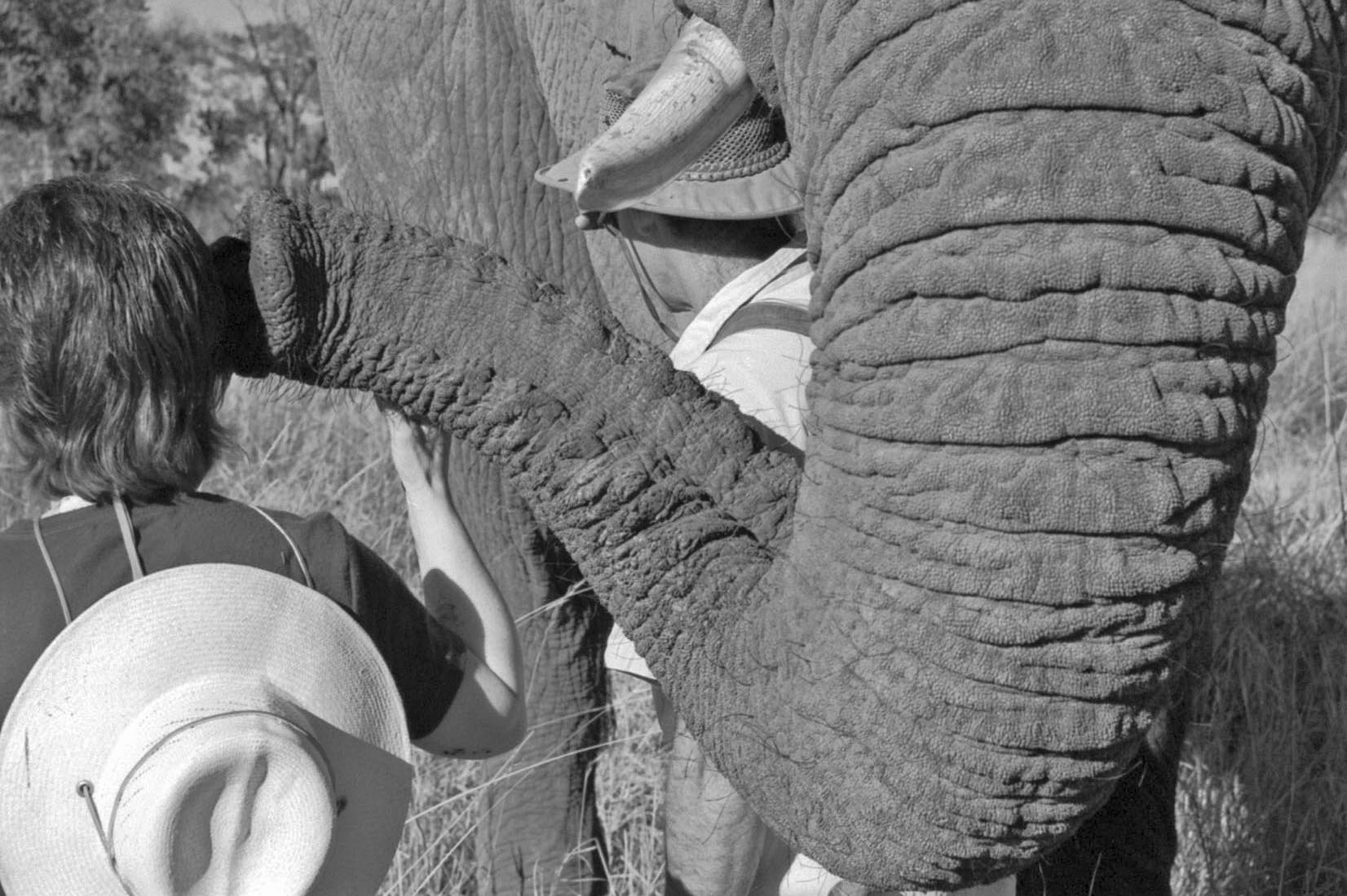
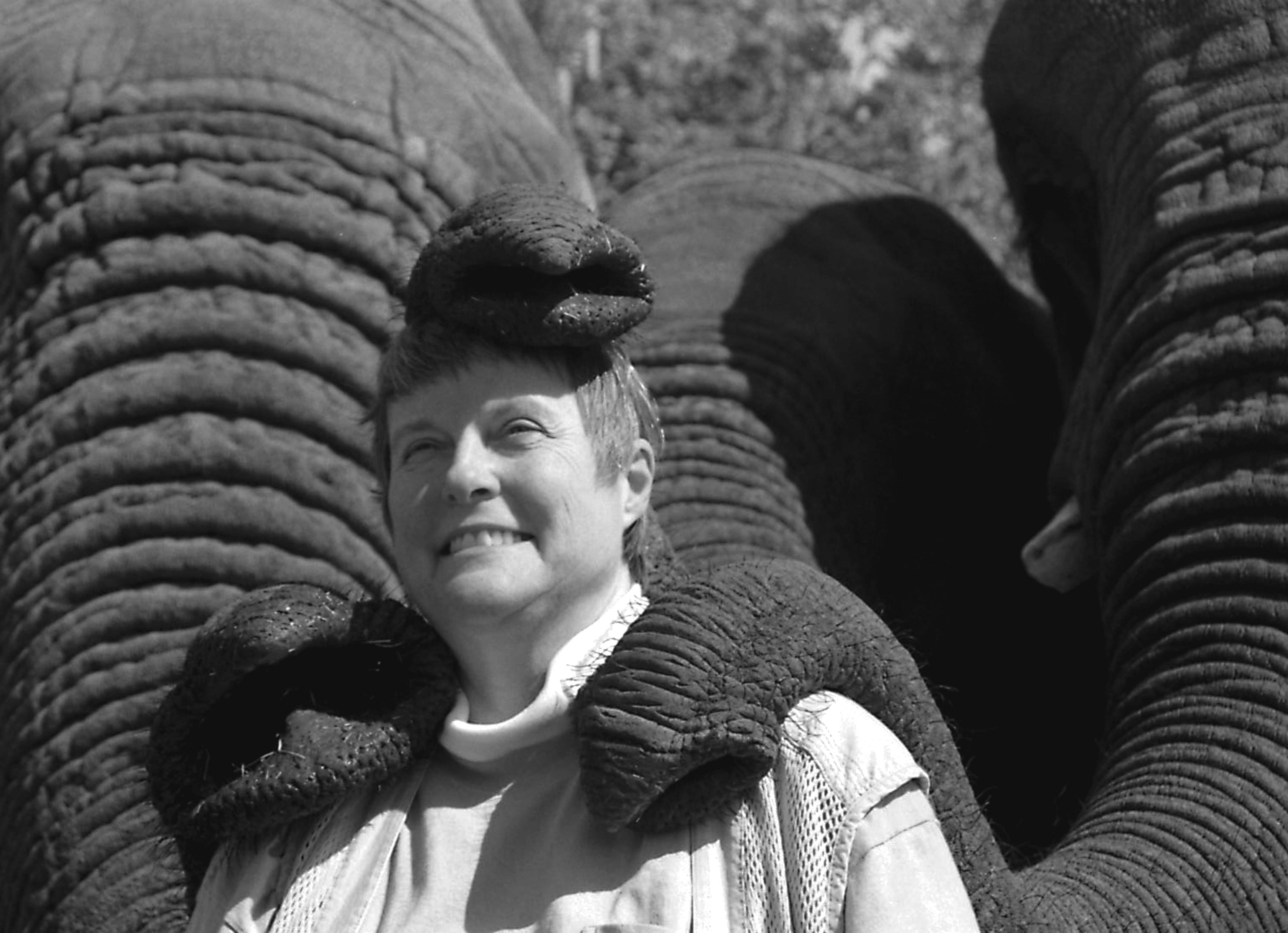
With a little guidance from Doug, Thembi gently places the tip of her trunk on top of my head.  It feels like a big beanbag up there, but one that’s warm, wiggly, drooling and breathing.

As Thembi rubs nose slime into my hair, Doug places Jabu’s trunk tip on my right shoulder and then Morula’s on my left.

Jabu has trouble keeping his trunk balanced on such a narrow ledge.  He constantly fidgets and pokes my cheek with his bristles.  Morula’s trunk drapes over my shoulder like a slack hose with a dripping nozzle.  Her runny nose continuously drains to clear out inhaled dust – the common condition of all elephant trunks.

When I look down and to the left, I have a close-up view of the two “fingers” on her trunk.  Her top finger is more pointed than the one on the bottom.  The shape of it reminds me of a hooded cobra.  But perhaps that’s because I think of Morula’s trunk as thinner and “snakier” than Jabu’s spectacular snout.

Which is getting heavier by the moment.  With the peripheral vision in my right eye, I see two nostrils dotted with grains of moist sand, nostrils more flesh-colored than gray.  Each opening is nearly as wide as the “O” of my mouth.

All three trunk tips, I can attest, are not just sheer weights.  They sniff, snorf, squirm, wiggle, inhale and exhale.  They create an atmosphere of elephant breath around my head.

Doug lowers my camera and pronounces, “Allll-right.”

The weights disappear.  For a few steps I am oddly light, as if walking on the surface of the moon.

There is an elsewhere, somewhere, but it’s not a place I want to be right now.

Posted in Africa, Elephants, Morula

Elephant Air-Conditioning

An excerpt from my book:

Under a sun-bleached sky that is no longer blue, dry coughing barks from black-backed jackals lope in from our left . . . Wraack, wraack, wraack. . .  Black-backs are scavengers, more aggressive than other types of jackals, occupying the same ecological niche in Africa as coyotes do in North America.  Unlike coyotes, black-backed jackals do not howl.  They often steal meat within the reach of a lion’s paw – although their main diet consists of insects, lizards, snakes, rodents, birds and ripe fruit.

Up ahead Morula slaps her ears flatly against her shoulders.

Whoooosh, thwack . . . Whoooosh, thwack . . . Whooosh, thwack . . .

Elephant air-conditioning for a creature that produces enough heat to warm a small house.

Elephants are pachy-dermed, “thick-skinned.”  Some of Morula’s blood vessels are buried as deep as one-and-a-half inches under the surface of her skin.  Since she doesn’t have sweat glands, her ears act like giant heat exchangers, regulating her body temperature.  As her ears open, her body size increases by roughly twenty square feet, a huge area for thermoregulation.  Air moving over the swollen arteries of each ear cools her blood as much as nine degrees before it returns to her body.

I take a photograph of her ear in mid-flap.  Where Morula’s ear attaches to her shoulder, wrinkles give way to he swollen vessels pumping five gallons of blood per minute across the surface of her ears.  The pattern of those arteries is as unique as a fingerprint, and often used for identifying individual elephants.

Morula's ear

Whooosh, thwack . . . Whooosh, thwack . . . Whooosh, thwack . . .

The breeze she creates dies before it reaches me.  I take off my cap and fan my own neck.

My teeny, itsy ears are built somewhat the same as hers are, with an upper rim of cartilage and a fleshy, lower lobe.  But I don’t have an auriculo-occipitalis, an ear muscle the size of a weightlifter’s bicep.  I can’t flap my ears.  I can’t even wiggle them.

Posted in Africa, Elephants, Jabu, Morula

Like a Wine Connoisseur

An excerpt from my book:

Morula plucks a branch from one of her favorite snacks, a bush-willow.  She holds the stem in her teeth, wraps her trunk from right to left around the branch, and sheers off leaves, top-to-bottom with a single swipe.  She drops the branch and transfers mashed leaves from the curl of her trunk into her mouth.

Morula is right-trunked, as I am right-handed, preferring to grab and wrap from the right.  Thembi is also right-trunked, but Jabu’s a lefty.   One of the ways to determine an elephant’s dominant tendencies is to inspect the underside of its trunk for green stains on either the right side or the left.

But before you do this, make sure you know the elephant and, more importantly, the elephant knows you.

Morula sidles close to Doug and curls her trunk against her forehead.

“Those round bumps on her forehead might be an old skin infection,” Doug tells me, “but we really don’t know.”

A light breeze feathers the hair in her ears as she stands slightly sideways and nods the tip of her trunk in a tiny Hello. . .   Ribbed muscles cross the underside of her trunk.  Bristles stick out like the legs of a giant centipede.

Morula waves "Hello."

I squint against the sun, s—t—r—e—t—c—h and yawn.  Back-to-back ten-hour jet flights across two hemispheres in a 48-hour-period are taking their toll.  From Seattle to Amsterdam, Amsterdam to Johannesburg, and a four-hour flight from Johannesburg to Maun.  My body thinks it’s 2 a.m.

The tip of Jabu’s trunk traces an arc from my toes to my heels, and back to my toes again.  Did I pick up essences of jet fuel on my boots yesterday when I crossed the tarmac at Johannesburg?  Can he smell the rubber floorboards of the Cessna 206 that brought me here?   Or does the scent on my boots go further back, to the dandelions in my lawn half a world away?

Satisfied with my toes, Jabu starts to pat me down, sampling scents from the rest of my body almost thoughtfully.  He expels air after each sampling, like a wine connoisseur clearing his palate.  Of course, the smelliest parts of my body are the most interesting.

Ah, fuff, sweat, mixed with fuff armpits, and fuff, crotch.  His trunk dangles over my hair, re-coifing it with a large and final Fuffff!   Jabu is treating me the way he would scrutinize another elephant, determining who I am, where I’ve been and fuff what I did while I was there.

The tip of his trunk hovers in front of my face, wet with mucous, dotted with sand, nostril hairs visible.

He blows into my face, gently.  I blow back, gently.  We exchange breath, distillations of our own personal atmospheres, particle-swarms of changed, exchanged air, brewed though all the cells of our bodies.

Tip of Jabu's trunk

My lungs fill with the fragrance of crushed leaves, with saproots and spearmint-scented bark, all lightly fermented.  I think of the stagnant air that surrounds my daily life, air that is conditioned, filtered, deodorized, air that is bland.  Elephant’s breath is said to cure headaches.  And it just might, if I had one.

Jabu’s trunk tip investigates my right boot over and over again.  The scent that fascinates him tumbles up two seven-foot-long nostrils – nostrils surrounded by nerves, arteries, veins and a staggering array of longitudinal and transverse muscles, the world’s biggest, longest and certainly most flexible nose.

A trunk is the most useful appendage that ever evolved.  Imagine having an arm in place of your nose, an arm long enough to reach to the top of a tree, and pluck a single leaf from its crown.  Imagine having a nose with which you could rip, tear, excavate, whack, and blow bubbles with.  You could steal with your nose, suck on it, squeal, swat, poke and siphon with your nose.  You could take a shower with it.  Scratch your back with it.  Whistle with it.  You could even arm wrestle with your nose.

There is no other living creature on this planet that has a trunk.  If elephants were already extinct, which brave paleontologist would go out on a limb and reconstruct the trunk just from evidence of bony nostrils high on the skull?  Who could imagine a nose dangling close to the ground where scents abound?  Who could imagine a nose with the ability to pick up a single straw, rip a tree out by its roots, bench-press 600 pounds and untie your shoelaces without you ever noticing?

During a visit to Botswana’s Chobe National Park in 1999, I spent part of an afternoon belly laughing at a baby elephant learning to use her trunk.  First, she flopped it over her ear as she nursed, a rubbery, 10-inch nuisance dangling like a wayward curl among the bristles on the top of her head.  Then, finished with lunch, she began twirling her trunk lariat-style up and down, up and down, a cowgirl learning her ropes.  Tiring of that, she flung it away over her left shoulder and was absolutely amazed when it boomeranged back.  Stock still, cross-eyed, she tried to puzzle out this remarkable toy and waved it up and down as if it was a hankie.  As the members of her family drank, she leaned into the river and blew bubbles with her new plaything.

Blowing bubbles

Finally, she sidled over to her mother and knelt under Mom’s belly.  Her knee landed squarely on her trunk.  When she squealed in pain, her mother reached under and gave her a reassuring pat.

It takes six to eight months to begin to learn how to twirl your trunk, two years for it to grow all the way down to the ground.  And even longer to separate out all those entrancing Fuff! scents.