Posted in Africa, Elephants, Travel

Savuti, Botswana, 1999

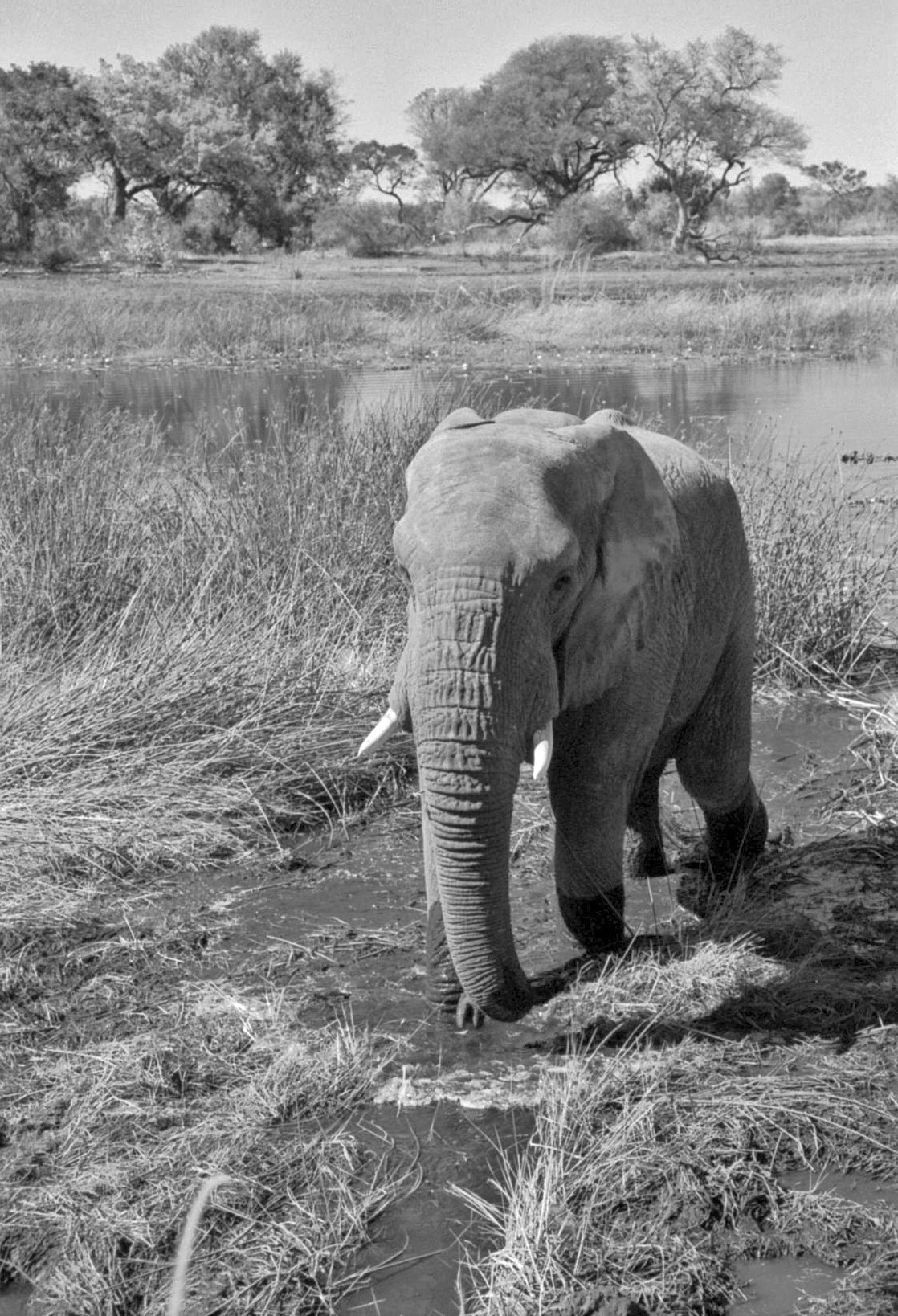
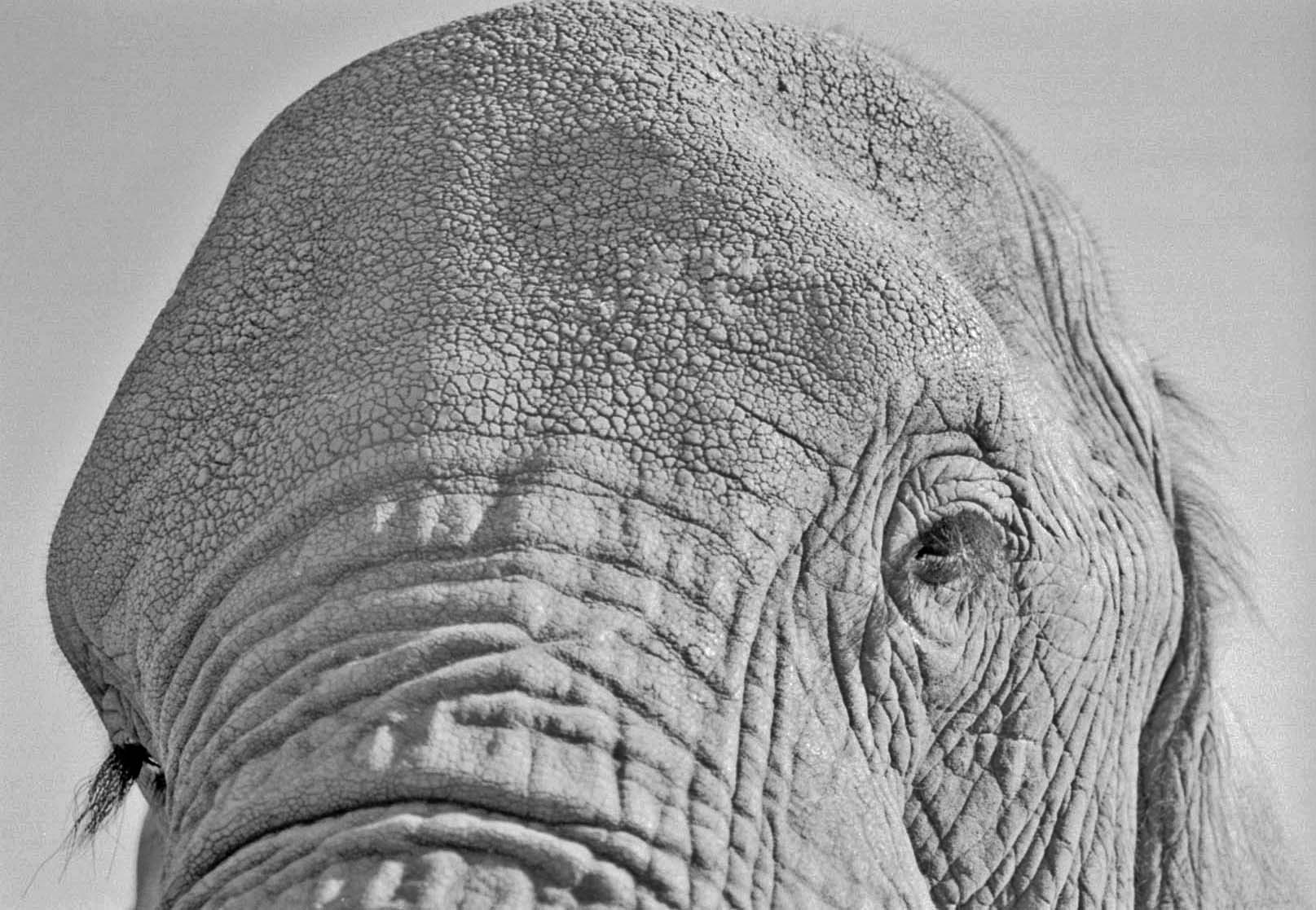
Savuti male b&wOnly a few yards from our Land Rover, a single-cylinder water pump alternately chugs and sputters, drawing from the water table beneath the sand, and sending spurts through a pipe to a square trough.  This supply of water keeps the bachelor elephants in Savuti area, as they wait for spring rains and the return of female breeding herds.

The steady sound of the pump, chug-sputter, chug-sputter, chug-sputter lulls my eyes closed.  They open, close, open half-lidded, close again.

 “Here he comes,” someone whispers and my eyes flick open as a huge bull strolls past.  I pick up my camera.

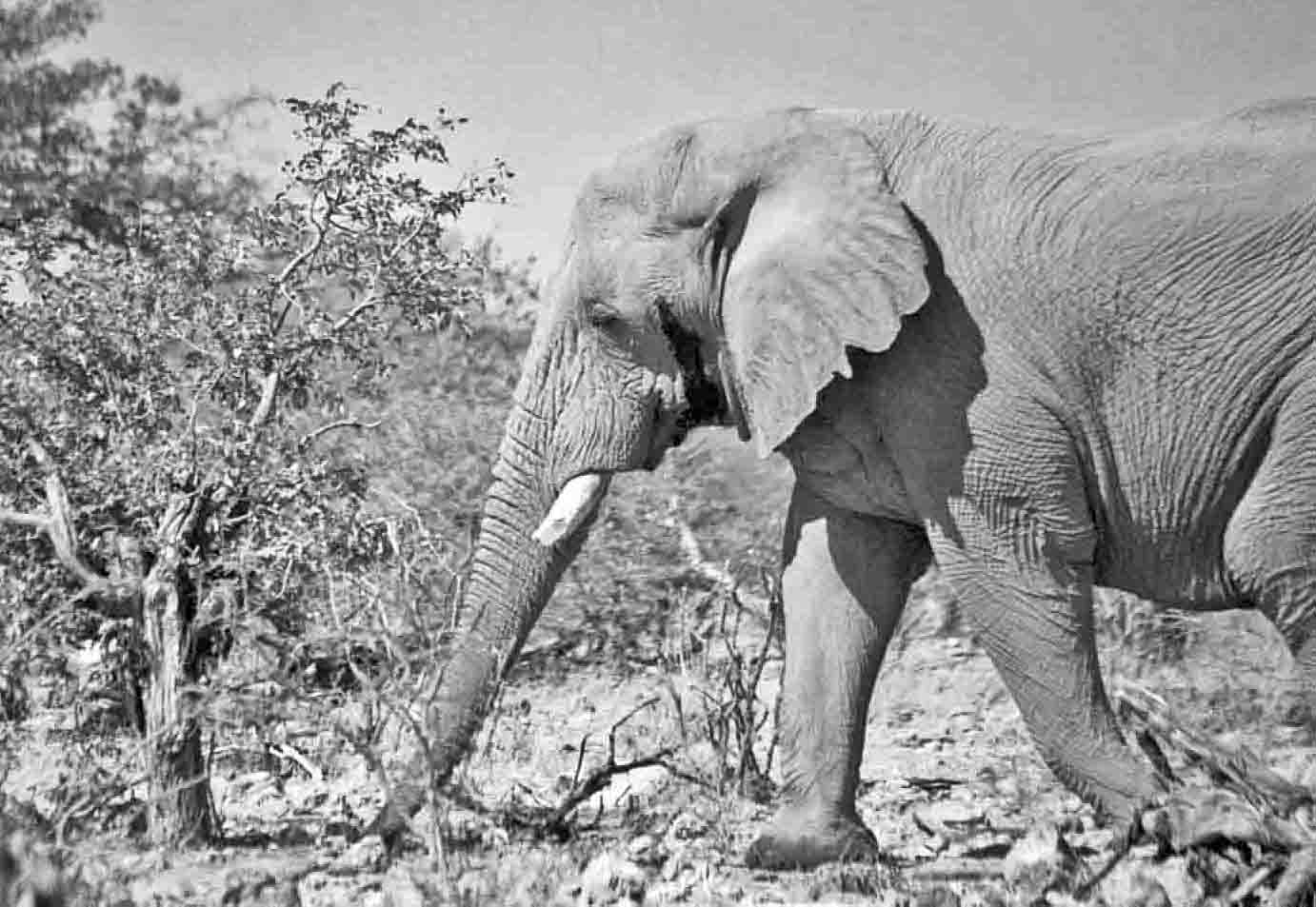
His enormous tusk splay out almost sideways.  I focus on his great head, nodding downward with each step, as he trudges past.  A thirsty pilgrim in a parched land, his trek to water is nearly finished.  He  heads straight to the square trough.  The clicking and whirring of our cameras doesn’t alter his gait.

Through the viewfinder I marvel at his tusk.  It is easily four feet long, stained and chipped on its end.  Because of its growth pattern – out, rather than down and up – his tusks make him a much wider elephant than he really is.

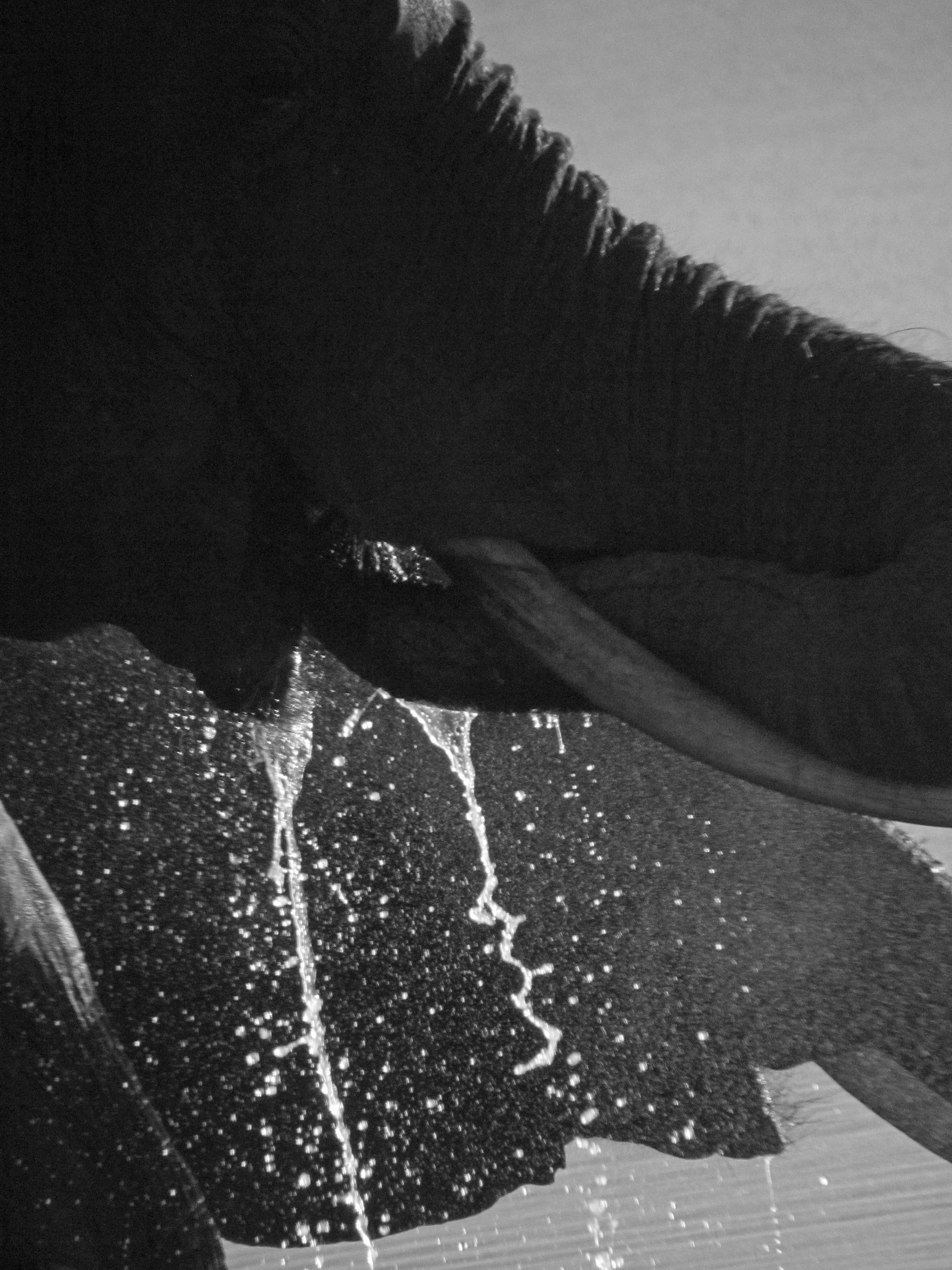
Mid-drink, he curls his trunk into his mouth; his head tilts back; his eyes close.  He makes gargling sounds as he drank.  Extending his trunk into the waterhole, he blows bubbles before curling his trunk again and again to hose several gallons down his throat.  With each swallow goes the taste of dung, samplings from all the animals that used this waterhole – zebra, wildebeest, warthog, ostrich, hyena and the occasional furtive flavor of lion.

I try to imagine the bouquet garni of this waterhole and how its myriad fragrances might seep into the crevices of an elephant’s mind, form pools of scent elephants recognize, year after year, the liquid memory of Africa.  Perhaps the old bull is memorizing the stories in this trough, paragraphs of taste and smell, twists of plot and character and fate.

Ellie asleep b&wHe returns to where we are parked, and stops close by.  His skin is the color of seasoned cast iron.  The waterline on his body rises just past his belly.  Spatters of mud stain his ears and back.  His forehead bulges and flutters audible sounds, if I had the ears for infrasound.

After several long minutes, his eyelids droop and his mouth slackens.  Under the hot sun he falls asleep, lulled perhaps by the narcotic of a long, slow drink.  The tip of his trunk coils like a magic rope on the ground.  He sleeps with his weight on three legs, resting a hind leg, occasionally rocking back on it as if he dreams of his trek.  Drool from his trunk slowly seeps into the sand.

I match my breathing with his, and drowse, sedated by the sun.

The giant beside us rumbles soft snores in his sleep, yet he is probably aware of the humans next to him, nodding their heads, also falling asleep.  Other bachelors scuff past him, on their way to and from the waterhole.

Tiny paws of wind skitter across my arms and keep me half-awake.  But for a moment, I almost enter his dreams.
Posted in Africa, Elephants, Jabu, Travel

Odd, How Fast We Re-civilize

An Excerpt from My Book:

In the late morning, dizzy from heat, I survey the far side of a large lagoon.  Bracketed with the dense foliage of knobthorns, leadwoods, rain trees and fever berries, this remnant left behind by the Okavango is ultramarine, inviting.  But the color is only an illusion, a reflection of the blowsy blue sky.  The water is actually steeped brown, rich with dung, dead snails, rotten vegetation, sediments, and decomposing bodies by the thousands: fish, spiders, ants, beetles – any creature unable to outrun last year’s flood.

Not far from here jungles of papyrus lean their feathery seed heads over the clear blue channels of the Okavango, tall stands that line the permanent footprint of the Delta.  The river is inching southward, breaking the boundary between water and desert.  Soon it will flush this lagoon, scouring out the sweet muck at its bottom to spread among grassy floodplains, and the desert will green.  With the river will come crocodiles and hippos and other denizens of its deep, running water.

Standing shoulder-to-shoulder on mats of trampled reeds, the elephants blow a concert of bubbles, bassoons under water.  They shower their spines, poke their trunks into the back of their throats and release gallons of water at a time.  As they remove their trunks some water spills from their mouths.  An odd mossy smell rises.

My mind wanders, wondering what it would be like to follow quicksilver fingers of water season after season, migration bred into my bones.  When the river reaches this part of the Delta, a new population of birds will arrive: Wattled cranes, Egyptian geese, Reed cormorants, Darters, Avocets, Black crakes, Red-knobbed coots, Southern pochards, Sacred ibis, Hamerkops and Saddle-billed storks.

Jabu sloshes up the embankment and heads for his ration of fresh alfalfa spread under nearby trees.  His feet and ankles are covered with mud.  He looks like he’s wearing socks.  His trunk is relaxed and curled slightly, to keep the tip of it out of the mud.  Although this is just a backwater of the Okavango, huge trees line the shore behind him.  No wonder elephants grew large in Africa: there was enough room and food to do so.

I slap dust from my pants and follow, as eager as he is to tuck into lunch.  I watch him stash a chunk of alfalfa between his tusk and the upper lip of his trunk, pick off mouthful after mouthful as if eating peanuts from a bag.  He smacks his lips as he eats.  When the grass is gone he drapes his trunk over his left tusk.  His eyes close and he dozes.

In a shady grove near the lagoon a table covered with a white linen cloth dazzles the tourists.  Fresh branches of mopane decorate the surface of the table; the leaves on each branch fold modestly like small olive table linens.  Knives rest across linen napkins on white china bread plates. Pepper grinders, water glasses, oil & vinegar decanters and wineglasses complete the illusion that we’ve stumbled into the al fresco dining room of an elegant restaurant.  Nodding at murmured compliments, the staff from Stanley’s hand out cold beer, which has been uppermost on many minds.

They’ve set up a buffet complete with chafing dishes.  White lace doilies edged with heavy colored beads protect the salads from flies.  It’s odd how fast we re-civilize.  All morning long the tourists had been mostly silent, filled with awe at walking next to elephants.  Now they sprawl in camp chairs and compare camera lenses.

A cake of soap sits in the fork of a bush next to a white basin on a folding wooden stand.  I use the murky water in the basin to lather my hands.  One of the camp staff holds a pitcher of clean water for rinsing.  The water in the basin turns even grayer with dirt.  I empty the basin and small puffs of dust rise from the force of the water hitting floury sand.

Then I too re-civilize, join the human conversation.

Posted in Elephants, Etosha, Travel, Writing

Infrasound: Looking for Love in All the Wrong Places

In 1984 whale researcher Katy Payne spent a week with eleven elephants at the Washington Park Zoo in Portland, Oregon, 170 miles south from my Pacific Northwest home.  An acoustic biologist with fifteen years of studying the long and complex calls of whales, she was curious as to the kinds of sounds elephants make.  She spent every waking hour at the zoo listening and watching the elephants’ behavior.  She noticed that certain keepers elicited a positive response from the elephants, an intangible “thrill” in the air, like the rolling vibrations of thunder right before you hear them.

On her way home to Cornell University, while she thought about her observations, the throbbing of the airplane reminded her of a pipe organ she once heard.  During a performance of Bach’s Passion According to St. Matthew, a shuddering filled the air as bass notes from the great pipes descended in a deep scale until sound disappeared – but the air still throbbed.  Those same, strong, vibrations-without-sound had filled the air around the elephants in Oregon.  Could they be communicating with infrasound, like whales?

Four months later, back at the zoo, Payne and fellow researcher Bill Langbauer set their recording equipment to its slowest speed.  They mapped the elephants’ movements and timed changes in their behavior with the recordings.  Working around the clock for an entire month, they recorded what sounded like snores, chirps, barks, rumbles and even moments of absolute silence.

Back at Cornell, the first tape Payne selected to review was during a time of silence, when there was a “thrill” in the air as a female elephant faced a concrete wall and a male elephant faced the same wall in an adjoining enclosure.  With the wall removed, the elephants would have been within three feet of each other.  Running the tape at ten times its normal speed, the researchers heard sounds emerge from silence – elephants carrying on an extensive conversation in infrasound, even when separated by concrete walls.

To test the theory, The Cornell research team rigged a double-blind experiment in Africa.  An observation tower near a waterhole at Etosha National Park in Namibia was outfitted with video cameras and microphones.  Miles from the waterhole, a mobile van roamed through the bush carrying broadcast speakers and tape recordings.  The timing, location and content of the broadcasts were unknown to the observers at the tower.

One hot, dry afternoon, two male elephants, Mohammed and Hannibal, picked their way through the white calcareous rocks around the waterhole and paused for a drink.  As soon as the two bulls arrived, the tower radioed the van.  Selected at random, infrasonic estrous calls of a female elephant from Kenya were broadcast to the two bachelors in Namibia.

A female elephant needs to advertise as far and as wide as she can, since she is receptive to males for just a few days every estrus cycle.  She repeats her calls over and over for up to forty-five minutes at a time.  The calls can be heard as far as two and a half miles away – over a range of nineteen square miles – but only by other elephants.

Just seconds after the sound was sent, Mohammed and Hannibal froze, spread their ears and lifted their heads – twisting them side-to-side like scanning radar.  Within two minutes the bulls set off.  Half an hour later the pair strode past the van, looking for love in all the wrong places.

Etosha Male, 1996, with streaming temporal gland, a sign of musth. Mohammed? Hannibal?


Posted in Africa, Doug, Elephants, Jabu, Morula, Thembi

Squh-week

Doug calls out, “Jabu here.”

Then he turns to Stacey.  “Time for a photo-op?”  I leave off drawing diagrams in the dust, stand up, dust off my pant cuffs, and join them.

Stacey fishes a disposable camera from the pocket of her shorts, “Do you mind?” and hands it to me.  I smile; she had a camera after all.

“Ears,” Doug says to Jabu in a conversational tone, in the same tone a mother might remind a teenager, “Dishes.”

But Jabu’s way ahead of him.  As soon as the camera came out he spread his ears and posed.

Stacey cuddles his trunk; I turn the camera horizontally in order to squeeze them into the frame.

“How many?’ I ask.  Practically the entire roll, it turns out.  Jabu with Stacey.  Jabu with Stacey & Doug.  Jabu and Doug.  Just Jabu.  Then Jabu with Stacey again.  It’s hard to fit all of Jabu into the frame of a point-and-shoot without Stacey appearing to be a mere speck.  I do a couple of close-ups.

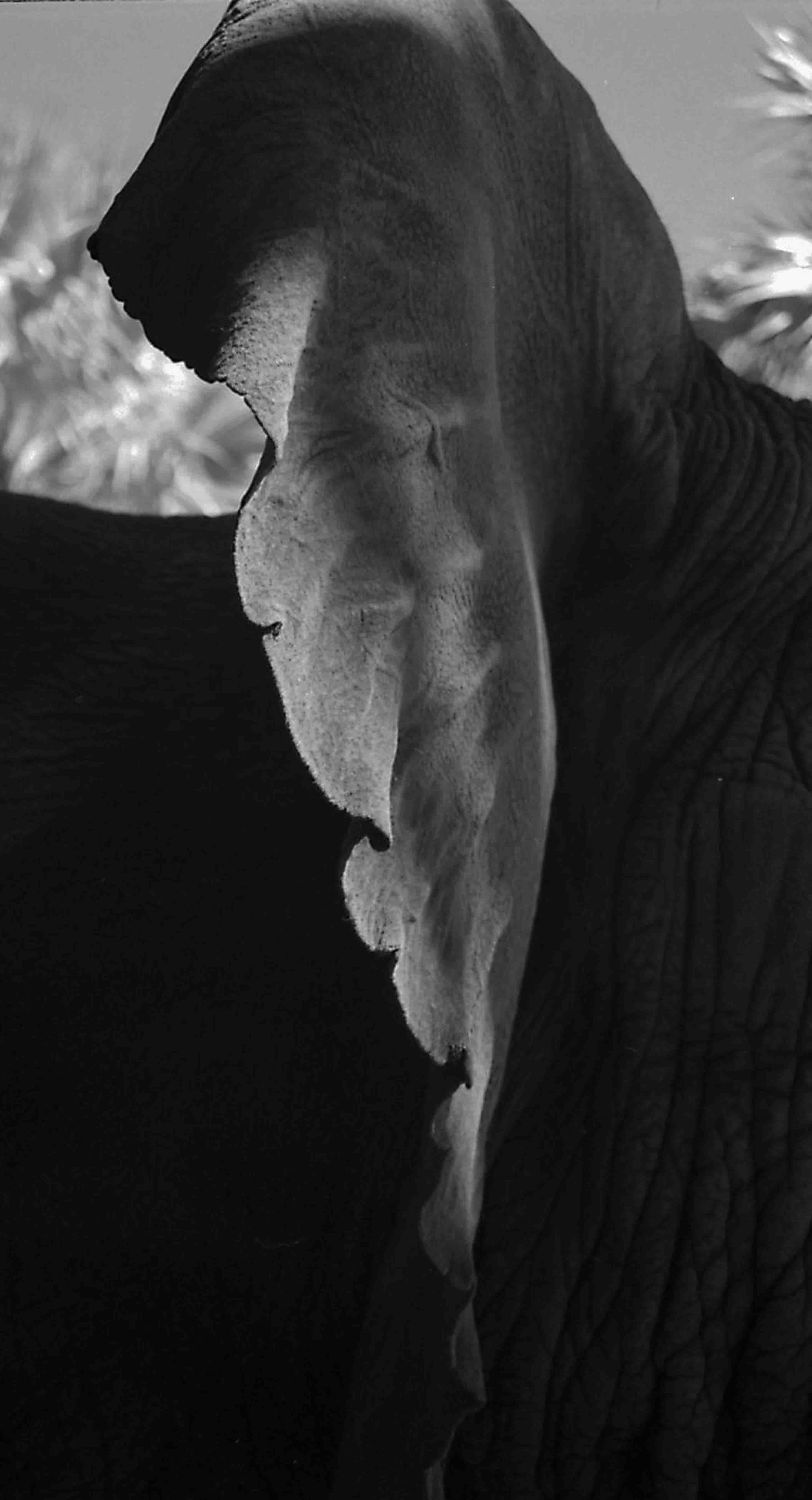
Behind me seedpods rattle their tiny gourds as Thembi swishes through the grass.  Her ears ripple as she walks, a wave going through them, top to bottom.  She’s giving up eating to find out what’s going on.

Stacey joins me.  I hand over her camera.

“Squhweeek, Jabu.”

Doug’s voice rises an octave between “Squh”  and “weeek.”

Trunk tip squeezed together, Jabu obliges, emitting a series of squeaks similar in sound to rubber tires leaving skid-marks on pavement.

“It’s an inhalation,” Doug comments.

Standing shoulder to shoulder with Jabu, Thembi joins in.  And over in the brush, with her back to us, Morula squeaks too.  Like a kid in a corner, she keeps on practicing.  Her squeaks sound more like a finger rubbed across a balloon.

“Talk.” Doug says to Jabu and Thembi.

First one “talks” and then the other.  They rumble, leaning back and forth, abdomens filling and emptying like bellows, sounds made by exhalations.

It’s a rhythmic conversation.  Jabu and Thembi’s low bass tones carry layer upon layer of vibrations.  I close my eyes and imagine giant, reverberating oboes.

Is there an under-current of conversation going on between them?  Silly humans.  They get so pleased over the littlest things.

Morula saunters over.  The tip of her trunk curls against her forehead, waves Hello.

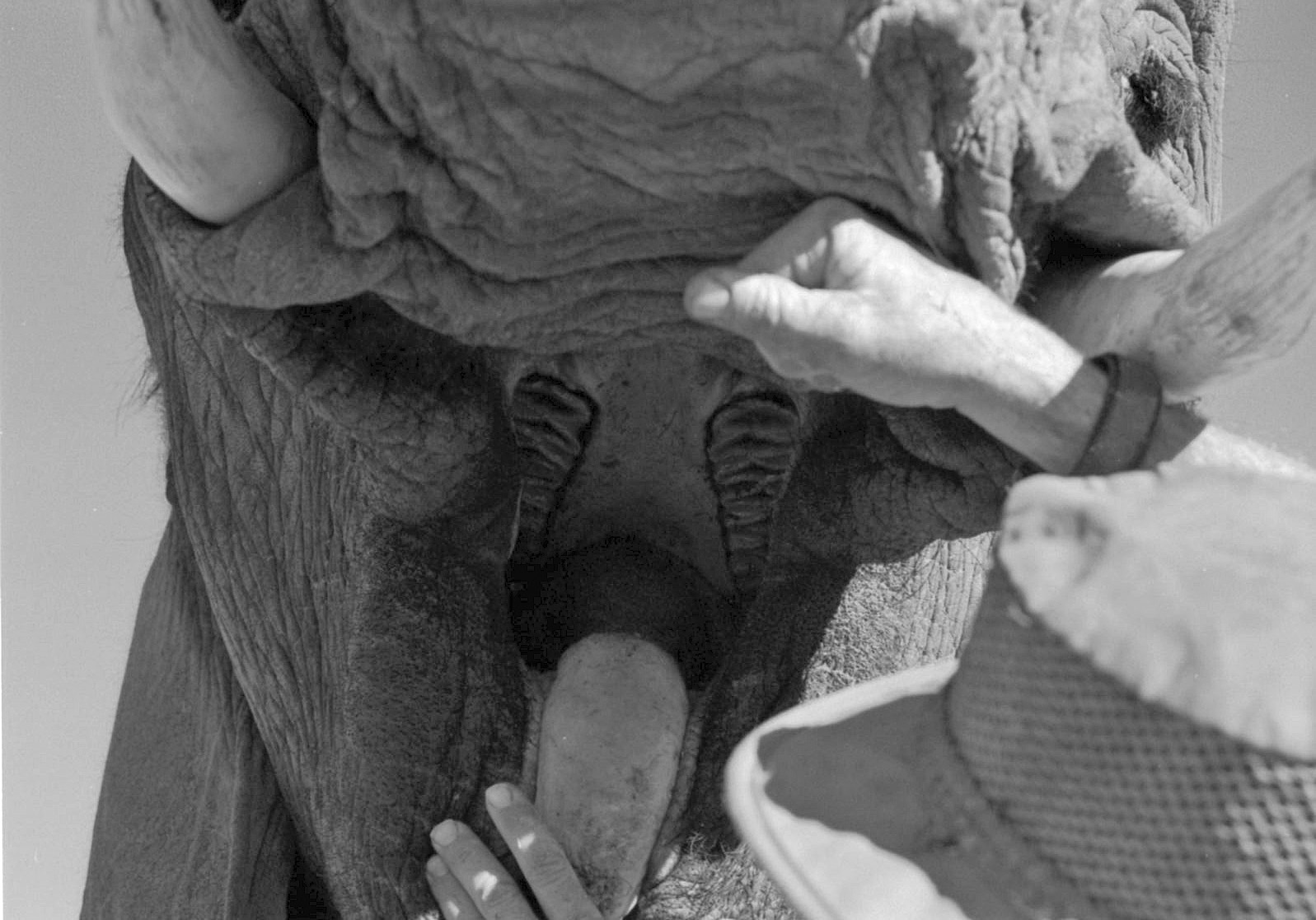
“Morula has something to show you, too” Doug says.  “Morula, open,”

First Stacey, standing on tiptoe, reaches in, and then I reach in to rub Morula’s tongue.  It’s much bigger than mine is, but feels pretty much the same – wet, soft, fleshy.  It’s flecked with bits of leaves.

There’s a common but erroneous belief throughout Asia that all elephants are tongue-tied.  It’s also believed that if the tip of their tongue were not tied down at the front of their mouths, each and every one of them could speak.

Morula pushes against Doug’s fingers with her strong tongue.

What if Morula could speak?  There’s not a single one of us who do not wish that the great beasts of this world could whisper into our ears the secret of life, could answer our questions in a language we might understand.

But would we want to hear what they have to say about us?

Something tickles the underbrush, a small rustle from a smaller body.  Insects buzz in the background, a white noise that echoes the beginnings of the universe, a biological chorus constantly singing.

 I listen as if I am a young species, as if my life depended on

Posted in Africa, Elephants, Morula

Singing Like Yma Sumac

Standing on a termite mound, face-to-trunk with an elephant, I place the palm of my hand against Morula’s fluttering forehead, a forehead as cool and rough as tree bark.  She’s burbling, a rumble that resonates like water gurgling down a hollow pipe.

She’s also making sounds I can feel, but not hear.  Right at the top of her trunk, where her bulging nasal passage enters her skull, her skin pulses beneath my hand, vibrations that reverberate in my chest cavity, drum against my heart.  Muscular ground swells of sound roll full and luxuriously out in the bush, bumping into hippos, giraffes, zebras, lions, hyenas, birds, snakes and tsetse flies.

But it is only elephants who raise their heads and listen.

Most of Morula’s vocalizations are rumbles, which fall partially or entirely in the infrasonic range of 5-30 Hz., throbbing, quaking air for which we humans have no auditory perception.  Such low-frequency rumbles usually have harmonics and overtones, both of which can be selectively emphasized.  As in whale song, each individual elephant has a signature sound, one like no other elephant – their voices as different from each other as our voices are different from each other.

Are you there?

And invisibly, from beyond an island of trees: Yes, I am here.

Speech makes us human, makes these marks on this page possible.  When we speak, our vocal chords vibrate with forced, small explosions of air from our lungs.  We shape words with our mouth and tongue.  Expelled from a chest full of wind, words float around us like little clouds, each one a separate exhalation, creating an atmosphere of meaning, thickening language one word after another.  Sounds unfold in time, in agreeable waves pulsing against our ears.  When we are lost and listening to a piece of pleasurable music, time even suspends itself.  Songs hang on our bones.

Standing on a termite mound, I close my eyes.  The fluttering beneath my hand goes on and on and on.

I open my eyes.  “MO-RU-LA,” I sing.

My voice, like hers, originates in my vocal chords.  But my vocal range is barely an octave, limping through the air at 220 Hz.  Morula’s range is tremendous, more than 10 octaves, from 5 Hz. To 9,000 Hz.

The most athletic human voice in history belonged to Yma Sumac, a Peruvian, who had a self-proclaimed range of five octaves and a recorded range of four and a half.  From B below low C to A above high C, from about 123 Hz. to 1760 Hz.  Sumac’s high range was the same frequency as an elephant’s trumpet.  This is a woman who could occasionally hit a triple-trill and whose voice could sound like an upright bass.

Morula would find her vocalizations a lot more fascinating than mine are.

Like all elephants, Morula is able to produce low frequency sounds just because she is big.  The larger the resonating chamber (think cello compared to violin), the lower the frequency of its sound.  Morula also has long and loose vocal chords and a flexible arrangement of bones attached to her tongue and larynx.  In addition to her loose voicebox she also has another special structure at the back of her throat called a pharyngeal pouch, which not only affects her low-frequency tones but also holds an emergency supply of water.

Morula can produce different results from the same basic rumble by holding her mouth open or shut, by an empty or full pharyngeal pouch, by flapping her ears rapidly or slowly, by holding her head high or low, or by the position of her trunk and the speed of air moving through it.  She can combine hundreds of variables to invent thousands of sounds.

Imagine a vocal instrument equal parts cello, double bass, violin, tuba and trumpet, one whose entire body is an expanding and contracting resonating chamber, one that can sing with a throat full of water and triple-trill a rumble, a roar, and infrasound, all in one 3-second call.

Yma Sumac would be horribly jealous.

Straight-armed, I lean against Morula’s forehead.  A soothing mantle of high-pitched insect noise drapes over my shoulders.

The fluttering beneath my hand has unexpected results.  A soft dry scrape makes me look around.  It’s Thembi’s ears whisking against her shoulders.  She’s standing behind me, on the opposite side of the termite mound.

Glancing from one large forehead to another, from one set of eyes and back, I have a feeling Morula and Thembi are waiting for me to do something.

Maybe something as simple as rumbling in return.

Morula's fluttering forehead.
Posted in Africa, Elephants, Morula, Travel

Biophony

An excerpt from my book

Whoosh-thwack . . . Whoosh-thwack . . .Whoosh-thwack. . . . As Morula’s ears hit her shoulder, they sound like heavy canvas sails snapping in a high wind.

Insects sizzle in the underbrush.  A bleating warbler cries out Help-me, Help-me, Help-me, Help-me!  The trickling call of a coucal drops like large beads into an empty wooden bucket:  Doo-doo-doo-doo-doo-doo . . . doo.  . . doo . . . doo. .   Francolins scatter into the underbrush, a tiny mob of cackling maniacs.

Standing on a termite mound, face-to-trunk with an elephant, I place the palm of my hand against her fluttering forehead, a forehead as cool and rough as tree bark.  Morula is burbling, a contented rumble that resonates like water gurgling down a hollow pipe.

She is also making sounds I can feel, but not hear.  Right at the top of her trunk, where her bulging nasal passage enters her skull, her skin pulses beneath my hand, vibrations that reverberate in my chest cavity, drum against my heart.  Muscular ground swells of sounds roll full and luxuriously out in the bush, bumping into hippos, giraffes, zebras, lions, hyenas, birds, snakes and tsetse flies.

But it is only elephants who raise their heads and listen.

Every desert, river, forest or sea on earth has a mix of sounds biological in origin – birds, mammals, fish – mingled with non-biological sounds – wind, rain, waves, or the blanketing silence of snow.  The symphony of a place is dependent upon night, day, weather, time of year and the creatures within it.  John Muir always said he could tell exactly where he was in the Sierra Nevadas just by the pine needle music.  Few of us are that familiar with our home ground.

Every animal’s voice has its own aural niche within its home ground.  When an ecosystem is altered, when trees are cut, ponds drained, soils covered with concrete, and structures built, the orchestra of the land and its chorus of animal voices are silenced.

Wild sounds disappear as fast as habitats disappear.

Bernie Krause, an American bio-accoustician, notes that 25% of the North American natural soundscapes in his archives are now extinct.  Habitats that no longer exist.  Sounds we will never hear again.  Silent summers, silent autumns, silent winters, silent springs.

In this part of the Delta, in this season, the soundscape around me is filled with dry cracklings.  With crickets who rasp their legs together and listen to each other with ears on their tibias.  With rattling grass.  With the scrape of our footsteps.  With the buzz of small flies seeking moisture at the corners of my eyes.

Those sounds will soon be joined with new animal voices once the Okavango River floods into waiting channels.  For Delta inhabitants, the river also serves as a unique measurement of time.  Rumor has it, Doug tells me, the river is two weeks away.

When it arrives, the symphony of the Delta changes.  The delicate tink-tink, tink-tink of reed frogs will join the rasp of crickets.  Hippos will jostle for elbowroom, grunting and burbling like a band of drowning tubas.  Wildebeest will question their daily survival from the jaws of lions with overlapped musings: Hmmmmh?/Hmmmh.   Hmmmmh?/Hmmmh.

And as fields of grass submerge in the returning river, ground hornbills will stride to and fro in front of the water’s many tongues.  Hornbills are satiny, Satan-y black birds, bigger than fattened geese, with inflated air sacs red as bleeding throats, and beaks like a pickaxes – executioners stalking mice and snakes in advance of the tide.  Their tympanic calls sound like thumbs rubbed across a kettle drum:    Hmmmmph . . . . . . hmph-hmph.   Hmmmmph . . . . . . hmph-hmph.

And intersecting each sound, in each season, the quaking air of elephant calls.

Bernie Krause created a new word for the soundscapes of animal voices: “Biophony” –  the combination of sounds which living organisms produce in their particular biome.  And for each biome, evolutionary complexity reverberates in the music of that particular place.  Millions of years condense into the current symphony I hear as I place my hand on an elephant’s forehead.  Wind rustles leaves, birds teer, insects zzzzzz, a palm weevil drones by and the skin under my palm flutters on and on.  Without the low bass tones of elephants, without their soft rumbling regards, the animal orchestra of the Delta would not be complete.

Soft, rumbling regards - Morula