Posted in Africa, Elephants, Morula

Singing Like Yma Sumac

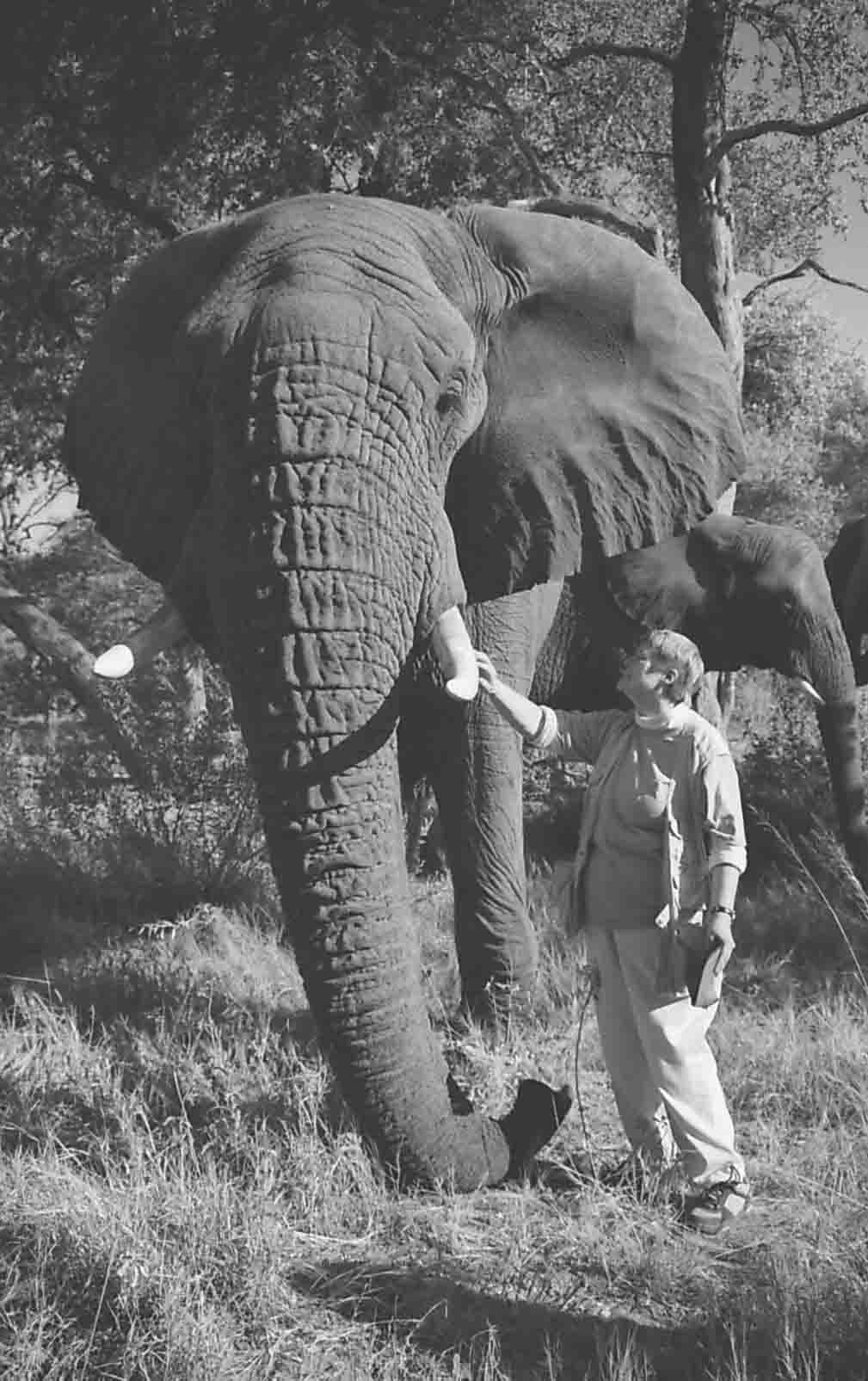
Standing on a termite mound, face-to-trunk with an elephant, I place the palm of my hand against Morula’s fluttering forehead, a forehead as cool and rough as tree bark.  She’s burbling, a rumble that resonates like water gurgling down a hollow pipe.

She’s also making sounds I can feel, but not hear.  Right at the top of her trunk, where her bulging nasal passage enters her skull, her skin pulses beneath my hand, vibrations that reverberate in my chest cavity, drum against my heart.  Muscular ground swells of sound roll full and luxuriously out in the bush, bumping into hippos, giraffes, zebras, lions, hyenas, birds, snakes and tsetse flies.

But it is only elephants who raise their heads and listen.

Most of Morula’s vocalizations are rumbles, which fall partially or entirely in the infrasonic range of 5-30 Hz., throbbing, quaking air for which we humans have no auditory perception.  Such low-frequency rumbles usually have harmonics and overtones, both of which can be selectively emphasized.  As in whale song, each individual elephant has a signature sound, one like no other elephant – their voices as different from each other as our voices are different from each other.

Are you there?

And invisibly, from beyond an island of trees: Yes, I am here.

Speech makes us human, makes these marks on this page possible.  When we speak, our vocal chords vibrate with forced, small explosions of air from our lungs.  We shape words with our mouth and tongue.  Expelled from a chest full of wind, words float around us like little clouds, each one a separate exhalation, creating an atmosphere of meaning, thickening language one word after another.  Sounds unfold in time, in agreeable waves pulsing against our ears.  When we are lost and listening to a piece of pleasurable music, time even suspends itself.  Songs hang on our bones.

Standing on a termite mound, I close my eyes.  The fluttering beneath my hand goes on and on and on.

I open my eyes.  “MO-RU-LA,” I sing.

My voice, like hers, originates in my vocal chords.  But my vocal range is barely an octave, limping through the air at 220 Hz.  Morula’s range is tremendous, more than 10 octaves, from 5 Hz. To 9,000 Hz.

The most athletic human voice in history belonged to Yma Sumac, a Peruvian, who had a self-proclaimed range of five octaves and a recorded range of four and a half.  From B below low C to A above high C, from about 123 Hz. to 1760 Hz.  Sumac’s high range was the same frequency as an elephant’s trumpet.  This is a woman who could occasionally hit a triple-trill and whose voice could sound like an upright bass.

Morula would find her vocalizations a lot more fascinating than mine are.

Like all elephants, Morula is able to produce low frequency sounds just because she is big.  The larger the resonating chamber (think cello compared to violin), the lower the frequency of its sound.  Morula also has long and loose vocal chords and a flexible arrangement of bones attached to her tongue and larynx.  In addition to her loose voicebox she also has another special structure at the back of her throat called a pharyngeal pouch, which not only affects her low-frequency tones but also holds an emergency supply of water.

Morula can produce different results from the same basic rumble by holding her mouth open or shut, by an empty or full pharyngeal pouch, by flapping her ears rapidly or slowly, by holding her head high or low, or by the position of her trunk and the speed of air moving through it.  She can combine hundreds of variables to invent thousands of sounds.

Imagine a vocal instrument equal parts cello, double bass, violin, tuba and trumpet, one whose entire body is an expanding and contracting resonating chamber, one that can sing with a throat full of water and triple-trill a rumble, a roar, and infrasound, all in one 3-second call.

Yma Sumac would be horribly jealous.

Straight-armed, I lean against Morula’s forehead.  A soothing mantle of high-pitched insect noise drapes over my shoulders.

The fluttering beneath my hand has unexpected results.  A soft dry scrape makes me look around.  It’s Thembi’s ears whisking against her shoulders.  She’s standing behind me, on the opposite side of the termite mound.

Glancing from one large forehead to another, from one set of eyes and back, I have a feeling Morula and Thembi are waiting for me to do something.

Maybe something as simple as rumbling in return.
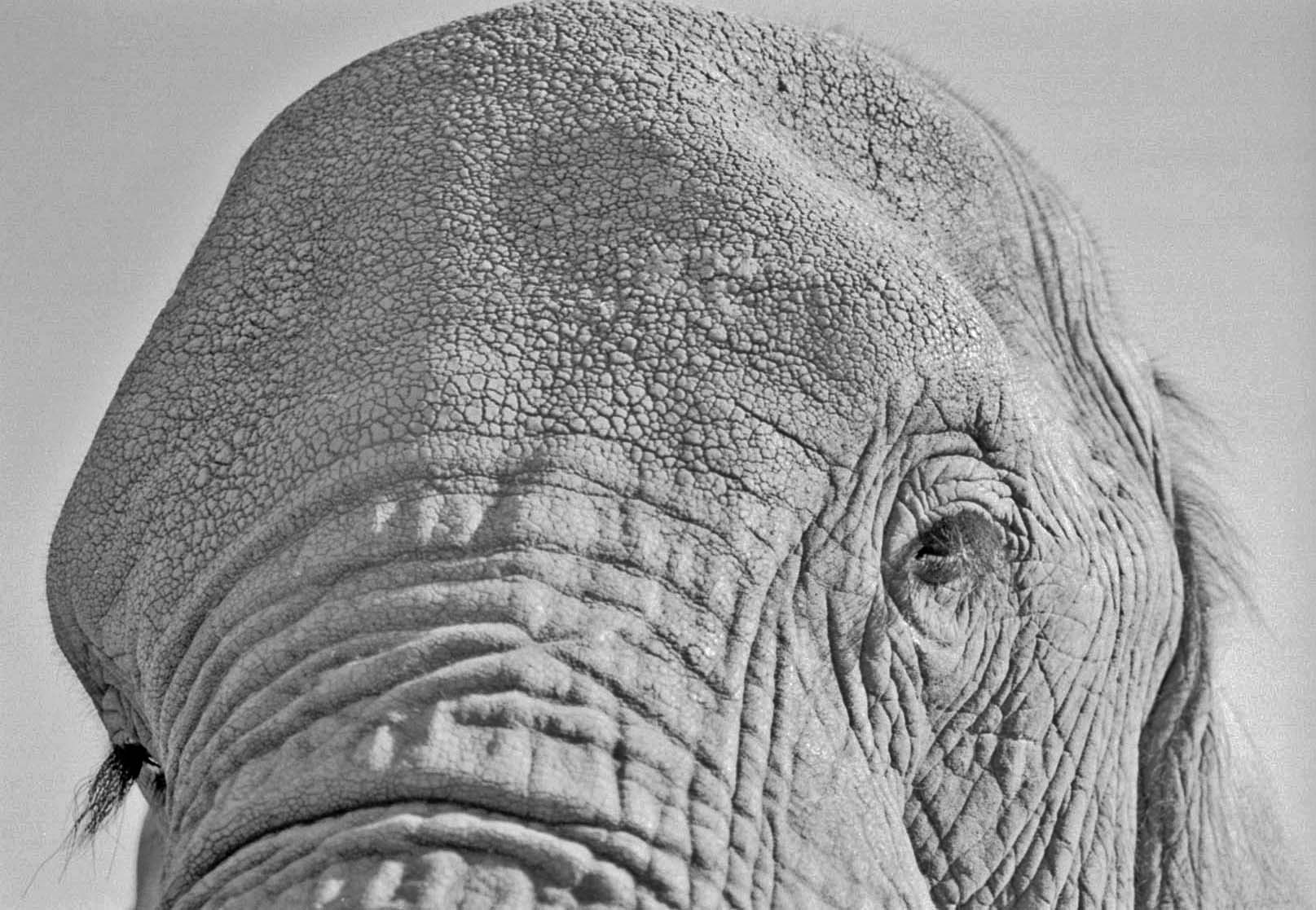
Morula's fluttering forehead.
Posted in Africa, Elephants, Jabu, Uncategorized

Heart

I’m reposting this piece in honor of the new year.  It occurred very early in my blog:

Heart shapes can be found in nature, if you’re lucky enough to spy one.  There’s a heart on Jabu’s trunk, a ridge of skin that feels like fine shoe leather.  One of his wrinkles pierces the lower third of this heart shape, from left to right, straight as an arrow.  His real heart hangs between his breastbone and ribs, a little to the left, just like mine does.  But instead of having a heart with a single point, an elephant’s heart has two points at its apex – so it’s the wrinkled outline of a human heart that Jabu carries on his trunk.


The length of Jabu’s real heart is about twenty-two inches, its width eighteen.  His heart weighs around forty-four pounds, almost the same as a medium-sized dog.  Still, it’s less than 1% of his body weight, a common proportion among large mammals and among humans.  My heart also weighs less than 1% of my body weight: about ten ounces.

The human heart is approximately five inches long, three-and-a-half inches wide and shaped like a pulsing cone.  It is the only muscle in my body that acts on its own – my heartbeat doesn’t need any messages from my brain.  The cells in my heart tissue involuntarily constrict, all together, all at once, over and over, a soft perpetual-motion machine.  Rip my heart from my body, chop it into pieces, immerse the pieces in a saline solution, and then give them a small jolt of electricity.  The remnants of my cardiac muscle will contract . . . contract . . .  contract – all on their own, sometimes for hours.

It’s designed to be strong, my heart.

In mammals, birds, and reptiles the heart has the same basic pump-like design, a design that has worked through eons – even cold-blooded dinosaurs had hearts.  A day or two after fertilization, embryos develop a pinpoint that pales, then brightens, pales, then brightens, the beginnings of a tiny pump practicing emptying, filling, emptying, refilling.  An old, old pattern.  The master timepiece.

There are four chambers in my heart: two auricles (“little ears”) and two ventricles (“little bellies”) – named by anatomists for the external parts of the body they resemble.  Spent, dark-red blood is collected in the right auricle, then dropped into the right ventricle, which constricts and pumps it out to the lungs to pick up oxygen.  Bright red again, full of oxygen, blood circulates back to the left auricle and from there drops into the left ventricle.  In the next twitch blood is delivered to every corner of my body.

The “little ears,” the auricles, make very little sound as they drain blood into the lower chambers of my heart, a distance of an inch or so.  It’s the ventricles, the “little bellies,” that boom as each contraction forces open heart valves and blood gushes up the aorta under pressure.  Lupp DUPP.  Lupp DUPP.  Lupp DUPP.  One beat smaller, one beat larger, flush after flush.

My right ventricle has walls thin as paper – it delivers blood only as far as the lungs.  If I could hold it up to the light I could see right through it.  The left side of my heart is the heavyweight lifter, pumping blood all the way to my toes, moving 150,000 tons of blood in my lifetime.

Jabu’s great artery, the aorta, takes off from the left ventricle of his heart, the same as mine does.  Named in the Middle Ages, aorta means, “to heave.”   It’s an artery more flexible and sturdier than any manmade pipe.  Jabu’s left ventricle pumps a continuous stream of blood up and out of his heart into the aorta, which then drops down into his chest and down each leg, where it branches and branches and branches all the way to his toes.  Each arterial branch has less space than the artery it came from, but the sum of  their volume is always greater than their mother artery.  The blood moves, but more and more slowly through smaller and smaller pipes, trickling into all corners of Jabu’s body, trickling through capillaries one cell thick.

Blood’s trip back to the heart is made through veins.  Millions of tiny venules drain into thousands of small veins, thousands drain to hundreds, hundreds to the one that empties back into the heart.  Veins are even more elastic than arteries, can hold variable quantities of blood, and serve as a reservoir for all that moving liquid.  At any one moment, 65% of my blood is contained in my veins.  It’s an ancient blueprint, this branching, this heartbeat, this coming and going, a blueprint brought to life in even the tiniest of creatures.

Blood has to be literally hoisted from Jabu’s toes.  Squeezed along by muscles wrapped around veins, pushed by valves in the veins, and sucked upward by the huge action of breathing, blood finally arrives in the vena cava, where it drops into the heart.  Jabu has two vena cavae, possibly because of the large amounts of blood that need to be moved.  The blood vessels of an African elephant reach lengths of twelve feet, a huge network of life.

Jabu’s body contains 120 gallons of blood, enough to fill an aquarium six feet long, two feet wide and two feet deep.  At one-and-a-half gallons, my puny amount of blood would barely fill a birdbath.

Blood is the body’s only liquid organ, five times denser than water.  It takes food and water in, removes waste and byproducts to the disposal areas of the body, the kidneys, lungs, and skin.  Blood irrigates all tissue, both feeds and cleanses.  It leaves the heart at one mile per hour and returns, laden with waste, at about half that speed.  Construction materials move along highways of blood, demolished materials return.  Blood is 20% solids and 80% water, carrying products of digestion, products made by the body, foreign intruders, the dust of stars, even cobalt from the original ocean of the earth where both of us, human and elephant, began our journeys.

We each have roughly one billion heartbeats for our lives.  Mouse, hummingbird, elephant, human, all the same.  Like us, elephants suffer cardiovascular disease, die of heart attacks and strokes.

Cardiac arrest: when the heart shudders and stops, when the light in the eyes flickers, fades and snuffs.

And when the heart quits beating, its resonance

Lupp DUPP     Lupp DUPP     Lupp DUPP

is gone.  The gurgle of digestion, all the silky, sturdy, slapping noises, the blood rush, gone.  The symphony of the body is finished.

For those of us left, that silence is almost too much to bear.

The heart on Jabu’s trunk
Posted in Africa, Doug, Elephants, Jabu, Sandi, Thembi, Writing

The Elephants Who Accepted Me as Part of Their Herd

An excerpt from my book:

Jabu, Morula and Thembi live in Botswana’s Okavango Delta.  I don’t need radio collars or binoculars or even 4-wheel drive vehicles to study them.  They are companions, who allow me to walk alongside them, close as an eyelash.  Adopted as orphans from culling operations by Doug and Sandi Groves, they spend their days as most wild elephants do: strolling and eating.  But they are also willing ambassadors between the elephant world and the human world.

Walk with me.  Stroll with three unfettered and unfenced elephants in a world where the thin-skinned sky is a bare reminder that the earth is covered with air, where clouds stampede as if chased by lions – a world  without asphalt, without cell phones, without that strange human notion of time.

I hope you enjoy and follow this blog.

Jabu & me