Posted in Africa, Elephants, Travel

Black Mamba in Toilet!

My friend Louis (lover of SNAKES!!) wants to know the story behind this photograph.  Okay Louis, this is just for you, crazy person that you are.
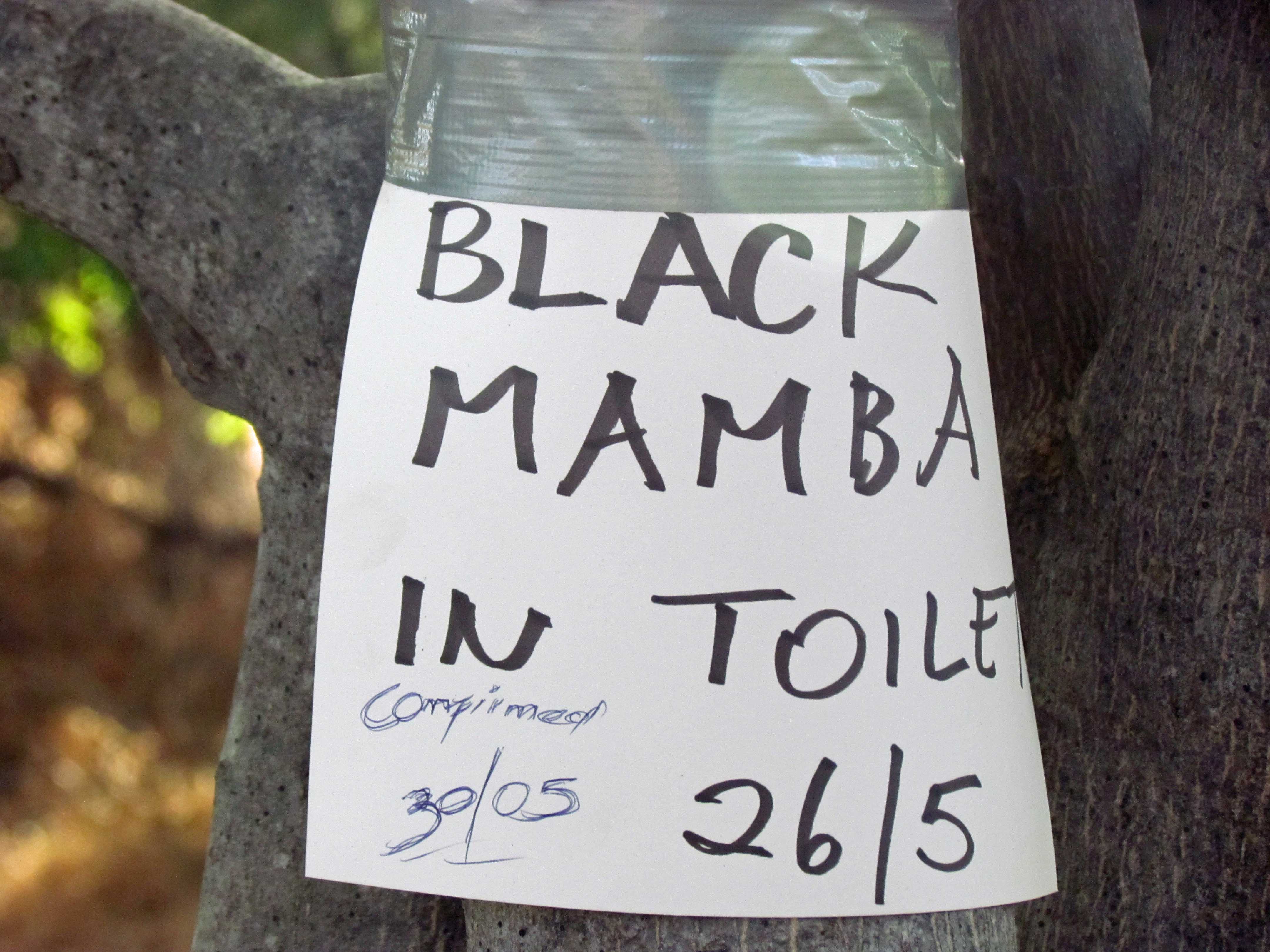
Dated 5/26/12, Reconfirmed 5/30/12!

But first, for those who are unfamiliar with black mambas, here’s a little background information:

Black mambas (Dendroaspis polytepsis) are the longest venomous snakes in Africa, measuring up to 14 ½ feet.  Mambas are not black – they’re more olive or greenish gray, with a narrow, elongated head the shape of a coffin.  It’s the inside of their mouths that are black – hence the name.  Mambas are also extremely aggressive and may actively attack without provocation.  I use the adverb “actively” with reason – a mamba can strike in all directions, even though a third of its body is raised above the ground, and it can chase you in that upright position at speeds up to 20 mph.  If you are bitten, your death will occur within 20-60 minutes.  An anti-venom for mamba bites exists, but it must be administered immediately, requiring 10-20 vials of solution.  But if you are struck in the face or neck (quite likely, since the head of the mamba chasing you is 4 feet off the ground), you will die in ten minutes. That black mouth will be the last thing you see.

On that cheery note, on with the story:

In the Moremi Game Reserve, east of the Okavango Delta, is an elevated platform overlooking a large hippo pool in a bend of the Khwai River.  Six of us, our guide OT (“just like Overtime!”) arrive in our Land Rover.

“What’s that?” I point.

It’s a large piece of stiff white paper taped with duct tape to a tree.  We climb out, read it, and immediately start swiveling our heads, trying to look in all directions at once.

“Anyone want to go look?” OT laughs.

The toilet, roughly the size of those cartoon outhouses with the crescent moons carved in their doors, is a cinder block building with a tin roof.  It’s about fifty feet from our Land Rover.  The painted green door on the toilet is ajar.

Certainly I’m not tempted to look inside.  After all, the second message was written just three days before our arrival by someone a lot more curious than I am about deadly snakes.  The mamba is most likely still in there.  Who wants to reconfirm a reconfirmation?   Mambas are territorial; they will always return to their lairs, although that’s usually in an abandoned termite mounds or a hollow tree, rarely, I’d bet extremely rarely, in a toilet.  A mamba is diurnal, active both night and day.  It could be sleeping in there.  Or not.

In my opinion, I’m already standing way too close to that toilet.  Trying to look both at the toilet and at everything else, I walk slowly backwards.  Mambas don’t like sudden movements.

Besides, I firmly believe, even though I haven’t seen it, that this toilet is not a Western ceramic throne, but a mere hole in the cement.  I’ve had enough experience with toilets-in-the-middle-of-nowhere to also believe that the area around the hole is likely none-too-clean.  That bush over there looks a better.  A few minutes later, after careful reconnoitering and quickly taking care of business, I can confirm that no mambas are lurking around it.

As I climb the steps to the viewing platform I look for mambas wrapped around posts.  On the creaky platform I look for mamba’s hidden in corners, or nestled into the thatch of the roof.  I look for mambas slithering across the branches of the trees that lean dangerously close to the rails.  A rustling noise among the branches spikes my heart rate to a gazillion, but it calms when I see it’s only a Burchell’s glossy starling, squawking for handouts.

Burchell’s starling

The view from the platform is marvelous.  A massive cloud hangs over the hippo pool and puffs of other clouds reflect in the tranquil water.  A dozen hippos rise and sink, burbling like submerged tubas.  Tracks in the grass are hippo paths, where the hippos come out of the pool at night to feed, foraging as far as three miles for sweet young shoots.

At the bottom of the platform a dozen water monitors, some six-feet long, slither into positions that defend his or her portion of the bank, using the hippo paths as small highways.  The smaller monitors end up with the worst spots, constantly harassed in slow-motion chases by the larger lizards.  As I watch their typical reptile behavior, I think it’s lucky for us that the age of dinosaurs ended a long time ago.
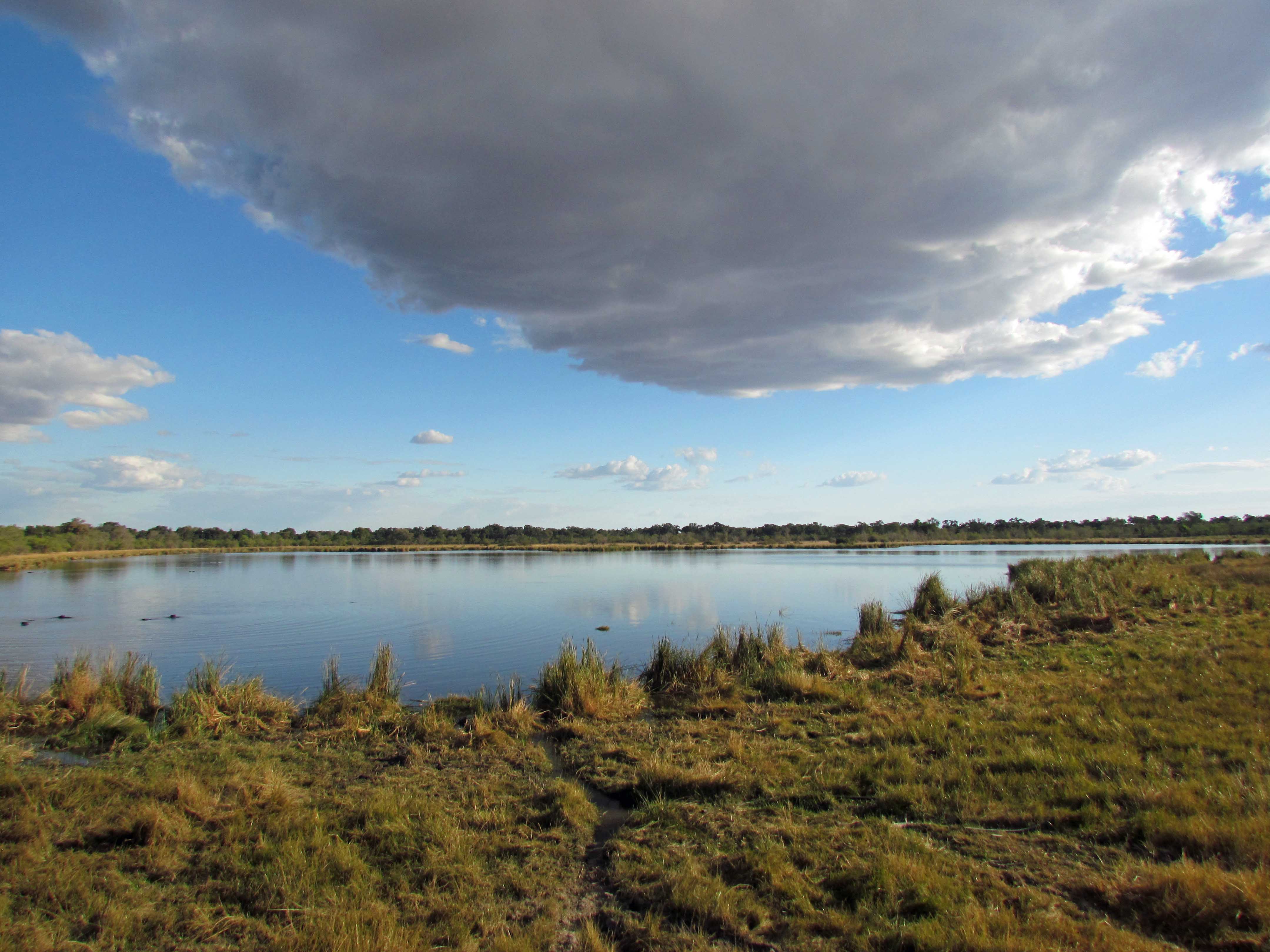
Khwai River


On the far side of the river, specks in the distance, a huge herd of elephants splashes along the edge of a reed bed.  After I check for mambas, I lean on the rail of the platform to steady my camera.  I use the digital zoom to take a picture, but it’s an extremely low-pixelated shot.  The elephants are in constant motion, appearing and disappearing in the reeds, so the photo turns out fairly blurry, but at least I have proof that those specks were really elephants.
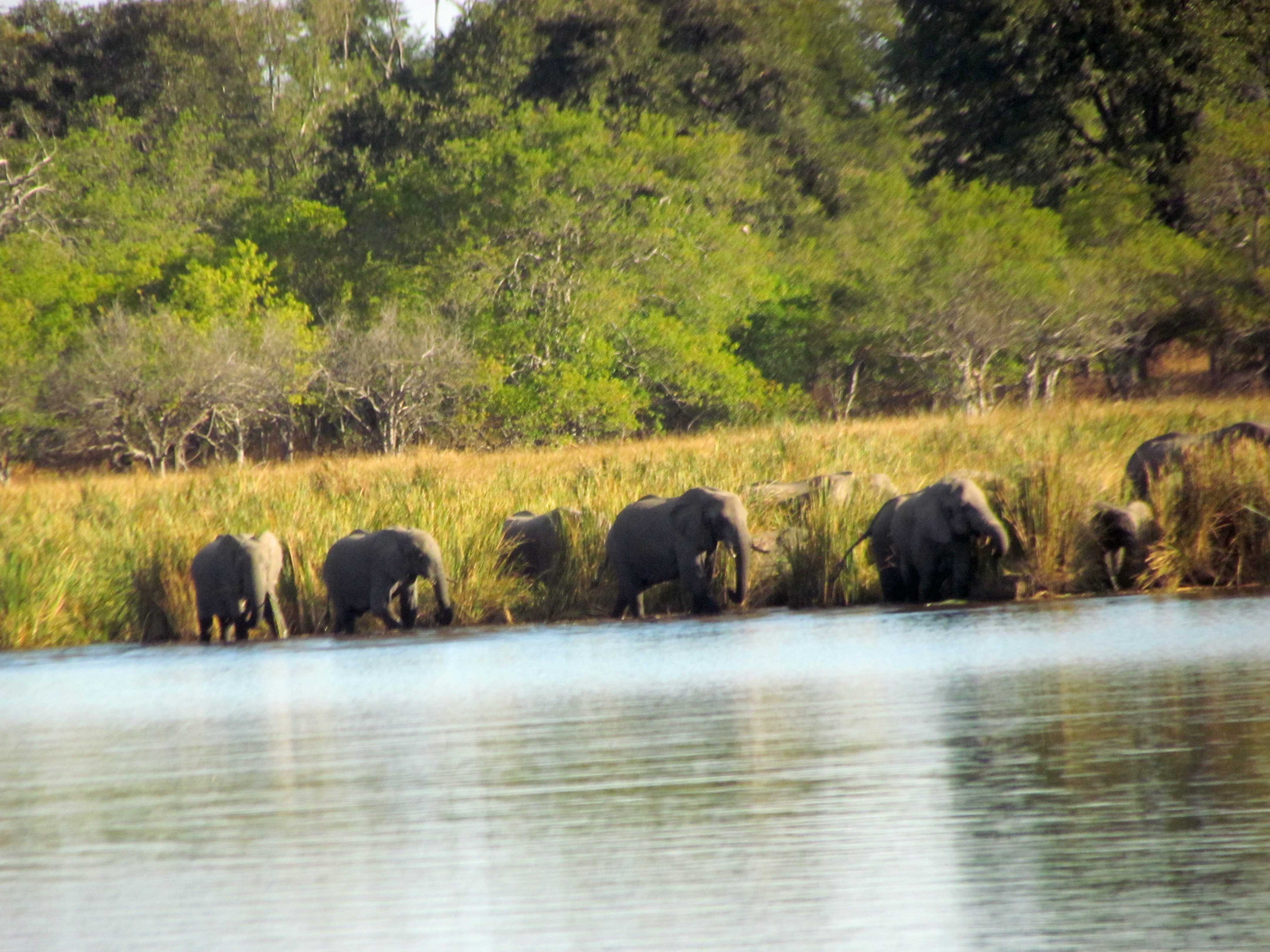
Elephants on the far bank

On the way down from the platform I look for mambas wrapped around support posts, coiled under steps, and hidden in the framework of the flooring.  I scan for slithery movements in the brush and wait for someone else to climb in the Land Rover before I do.  I doubt the mamba has exchanged one lair for another, but still, you never know . . .

So, Louis, the viewing platform has its own GPS coordinates. If YOU want to look at that mamba and reconfirm one more time that it’s really there, I can tell you exactly where to go!
Posted in Africa, Doug, Elephants, Jabu, Morula, Sandi, Thembi, Travel

What Happened Next

It Looked Harmless.


I know what will happen next.

I’ve already leaned too far forward on my right foot, anticipating the left will follow.  But the clog on that foot is mired in the Okavango muck, cemented in place, my balance irreversibly committed in the wrong direction.

What happens next is a slow-motion twist to my right, as I go down in thigh-high brown water and ooze, down into decayed leaf litter, down into a mat of decomposed anaerobic slime.

My right arm drops to cushion my fall and my left arm shoots up, holding my brand-new camera above my head – the camera purchased just for this trip to Africa.

I create primary and secondary waves as my hip and shoulder enter a backwater swamp of the Okavango.  The waves push against a small clump of reeds.  Elephant dung floats by.  A brackish, decayed scent rises.

The sun hasn’t moved more than a tick in the blue Botswana sky.

Just before The Fall

I come to rest against the reeds – all of my right side invisibly encased in muck.  But my left arm is dry, above the water, my camera clutched at the end of it like a trophy.

Sandi is already splashing in my direction.  She tugs on my dry arm.

“Let me help you up,” she offers.

“No, just take the camera.”

She places its strap around her neck.

I roll against the reeds and use both hands to push myself upright.  I reach down, and blindly find my shoe.  I need both hands to pry it out of the muck.

“I think I’m going to have to go barefoot,” and flinch at a secondary thought.  “I hope there aren’t any lead wood thorns.”  Two-inches long, strong as steel, straight as nails – they’d go right through the bottom of my feet.

“I’ll go first,” Sandi says.  Her sandals aren’t sticking in the ooze.

Oddly enough, the muck at the bottom of the swamp is soft as a pillow to my bare feet.  It wraps around my ankles and squishes up between my toes.  I place each foot carefully, not committing my weight until it’s safe to do so.

It takes forever to cross.  Doug and the elephants patiently wait for us on the opposite side.

When we reach the far bank I put my clogs back on.  Sandi hands me my camera.

“We’ll put your clothes in the washing machine tonight.”

“Washing machine?”

“We brought one into camp last year.”

“Really?  How’d you do that?”

“On the back of the hay truck.”

I look down at my pants and shirt, both mottled by muck.

A lot has changed in five years.

Posted in Africa, Doug, Elephants, Jabu, Morula, Sandi, Thembi, Travel

Transported into the Okavango Delta

As the Air Botswana flight descended into Maun, I looked out the window and gasped.  The Okavango floods had already reached the Thamalakane River on the outskirts of town!  Ponds, lagoons, lakes and meandering channels filled the landscape to the horizon.  The last time I visited, in 2007, Maun sat in the middle of a dusty desert.  Now blue waters surrounded it, sparkling in the sunlight.

In the terminal stood a small woman with a permanent smile, bright brown eyes and a “Mack Air” sign.  As Grace sorted scrums of passengers onto various flights out into the Delta she said, “Wait for me over there.”  Throughout a confusion of bags and jetlagged tourists, she never lost her smile.

I followed her to the Mack Air offices across the street from the terminal.  “Tea?” she queried.  Over the next several hours the office staff must have offered tea at least a dozen times – unfailingly polite through an amazing amount of chaos.  One of their charter aircraft had lost radio contact and they were sending messages every plane in the air over the Delta, hoping for a visual sighting.  Finally everyone heaved a huge sigh of relief when one of the ground crew reported that the airplane just landed in Maun.  But the relief was only temporary – the aircraft’s radio couldn’t be fixed.

Now the remaining available aircraft had to be scrambled into new flights.  “Tea?”  “No, thank you.”  One of Mack Air’s pilots wandered in.  “I can take the 206.”  And off he went to pick up tourists at one of the camps.  “Two airstrips flooded overnight,” one of the office staff informed me.  “Tea?”  “No, thank you.”  Grace smiled.

Another pilot wandered in, conferred with the office manager in a low voice, and wandered out.  “Tea?”  “No, thank you.”  Computer screens flooded with revised schedules.  The radio carried constant conversations between the office and pilots scattered over the Delta.  The office staff leaned into their screens, several chewing gum in that constant motion that concentration brings to jaw movement.  “Cheryl Merrill?” asked the receptionist, “Where is she?”

All eyes, except hers swiveled toward me.  “Oh,” she said, following their looks, her face flushing into a luminous red-brown.  She giggled into her hands as I waved to her.  “Don’t worry, we’ll find you a flight,” Grace said.  “It will take a while.  Tea?”

I wandered over to the wall with pilot pictures.  Mack Air is an independent charter company based in Maun, ferrying passengers and freight all over the Delta. The profiles of their eighteen pilots pretty much covered one wall.  Seven are originally from South Africa, three from Botswana, and the rest from countries as diverse as New Zealand and Mauritius.  One photograph stood out:  Hazel Esitile, who began flying for Mack Air in February of 2011.  She’s quoted as saying, “What a man can do, a woman can do too!”  I secretly began to hope Hazel will be my pilot.

But it was Paul, choosing bush flying “as my mid-life crisis,” who escorted me out to a Cessna 210 Centurion.  Trying for some chatty small talk, I remarked, “My husband used to own a 172.”  Paul squinted at me.  “Hate those.  Had to train in them.  No power.”  He opened the cabin door. “Want to sit up front?”

“Of course!”

I crawled over the pilot’s seat and buckled into the “copilot’s” seat, which is simply another passenger spot in small aircraft.

“It’s a little bumpy out there today,” Paul said.  “Did they tell you we’re flying to Gunn’s Camp?”

“No,” I said.

“They’re working on Stanley’s airstrip.  Somebody will pick you up.”

“Okay,” I said.

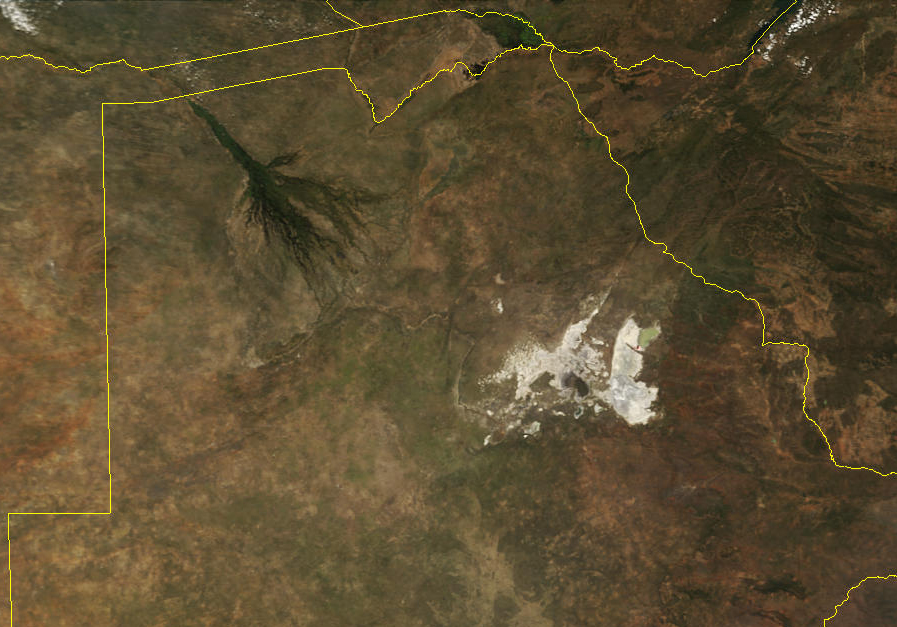
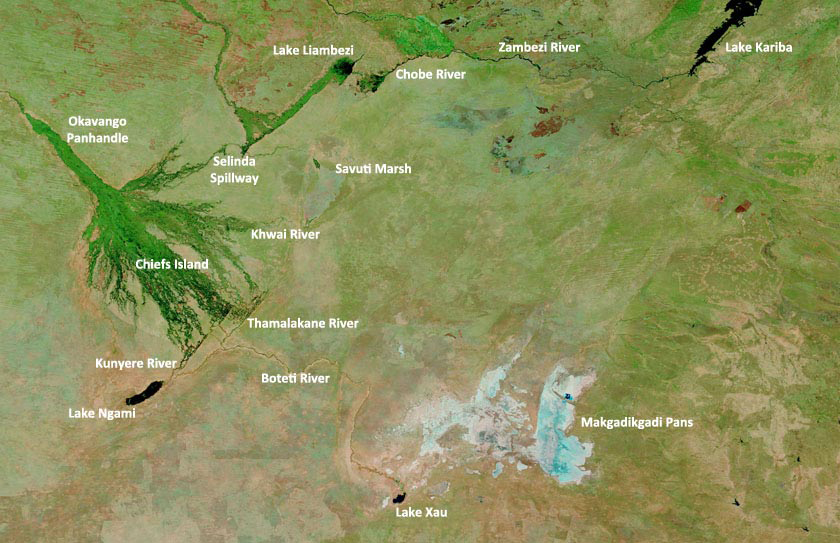
Small charter aircraft fly low and slow over the Delta – a perfect vantage point to inspect the current Okavango Flood.  In 2011, the Okavango reached record levels, pushed by increased rain in both the Delta and Angola (headwaters of the Okavango system) and large amounts of residual ground water from the 2009 and 2010 floods.  The “dry” cycle of the Delta lasted between 1985 and 2005; now it is assumed that the “wet” cycle will last another ten to twelve years.  Where extensive game drives were once possible, now boats take their place.  I marveled at how much land was underwater.

The difference from space:

A dry year in the Delta

A wet year.

For the first time in 29 years, the Savuti Channel was flooded, the Savuti Marsh swelled with birds and water seeped south into the desert pans.

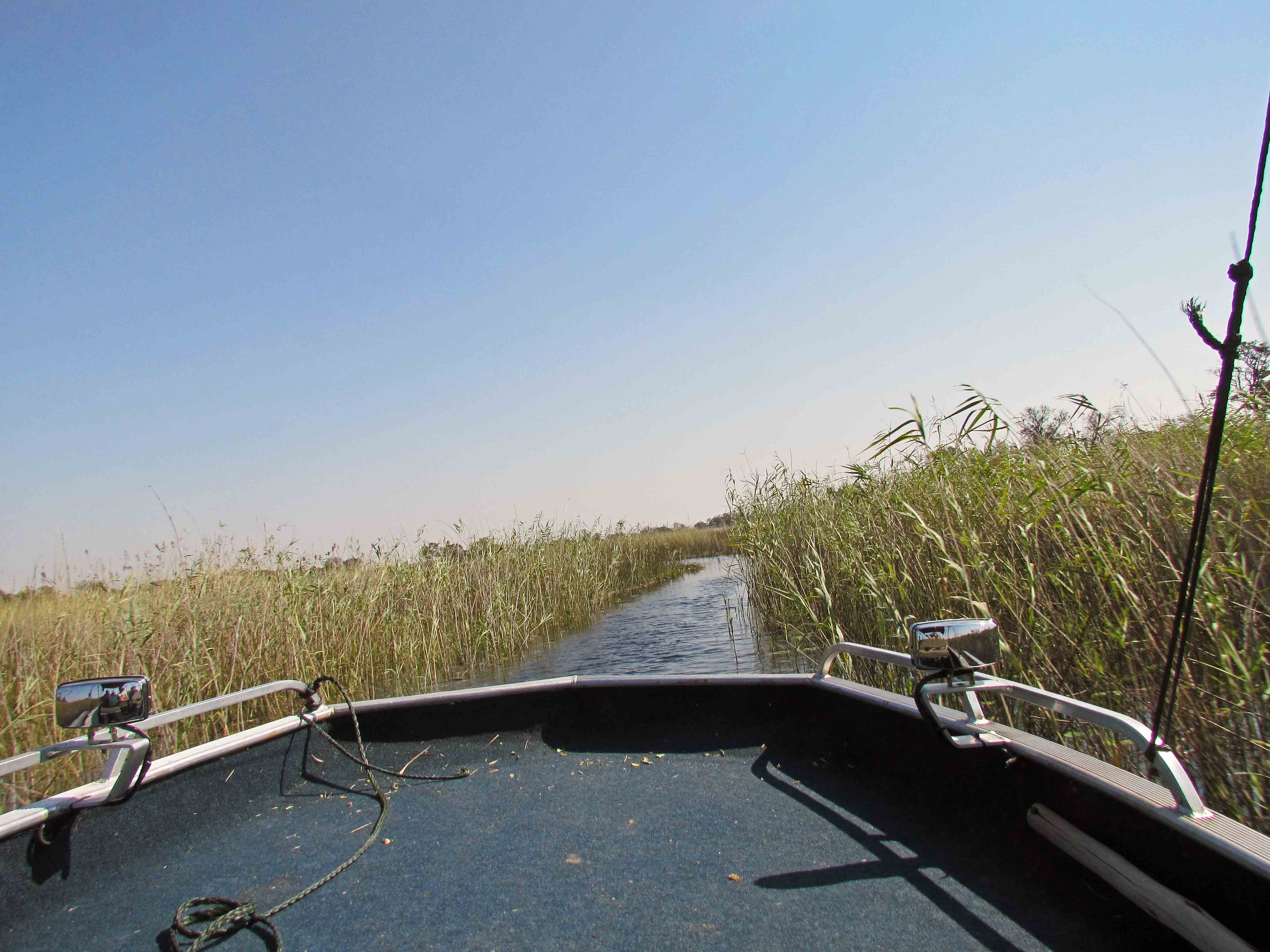
And so, rather than a 15-minute drive to Stanley’s from their airport, I took an hour-long trip down the Boro River and into meandering side channels that would have me instantly lost.

Reflected in two mirrors as we pushed through a side channel.

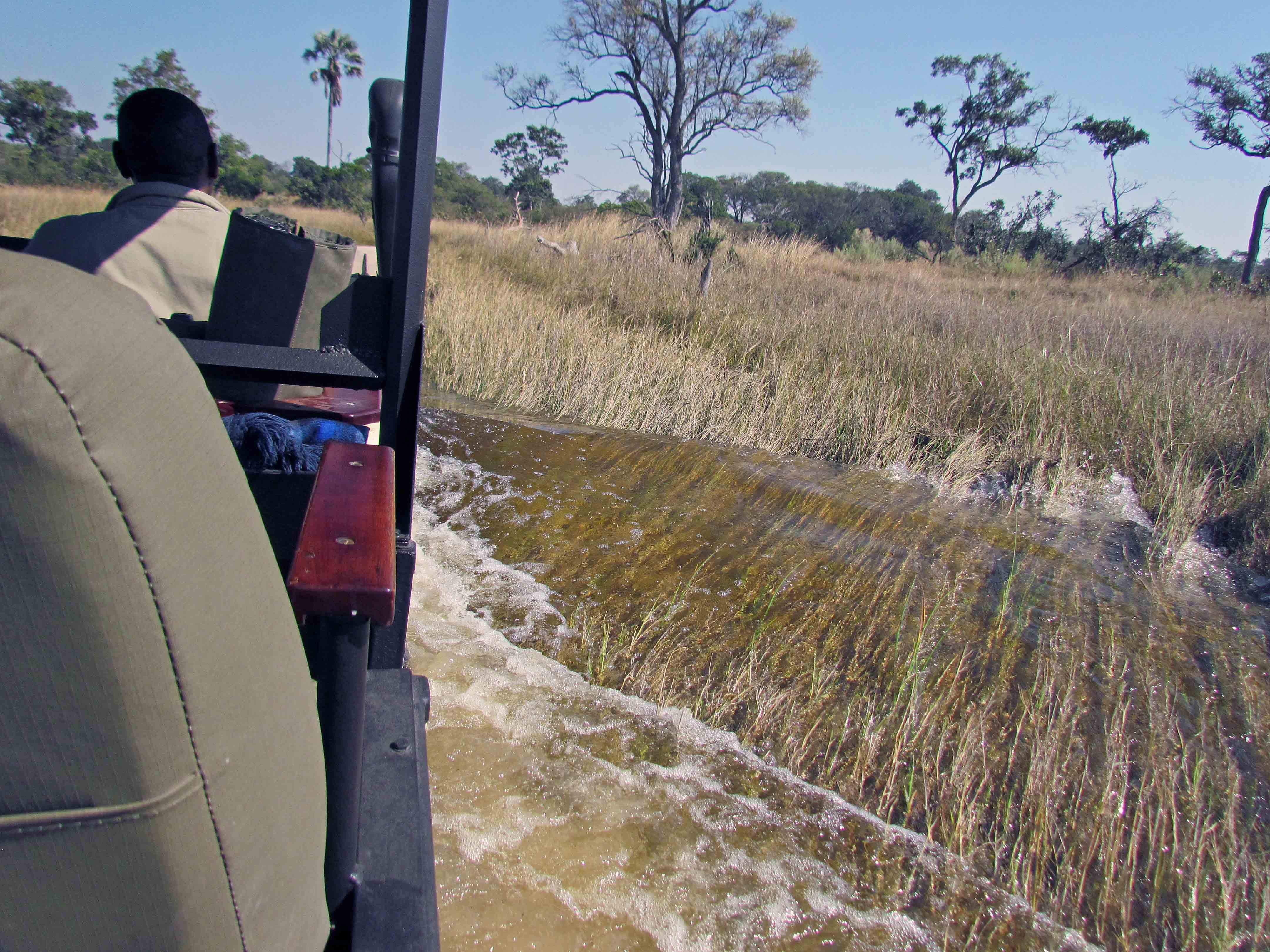
And, because all of Stanley’s vehicles were out on afternoon game drives, one vehicle at Baine’s (Stanley’s sister camp) was commandeered to transport me at Doug and Sandi’s place.  The flood had marooned the Groves’s vehicle in Maun.

We forded rivers that were once roads.

Making waves

Sandi met me at their kitchen shelter.  “Doug and the Trio are headed out to forage.  Want to join us or settle in?”

Are you kidding?  Eight hours after boarding an aircraft in Johannesburg, I was transported to this:

Sundown with Jabu and Thembi
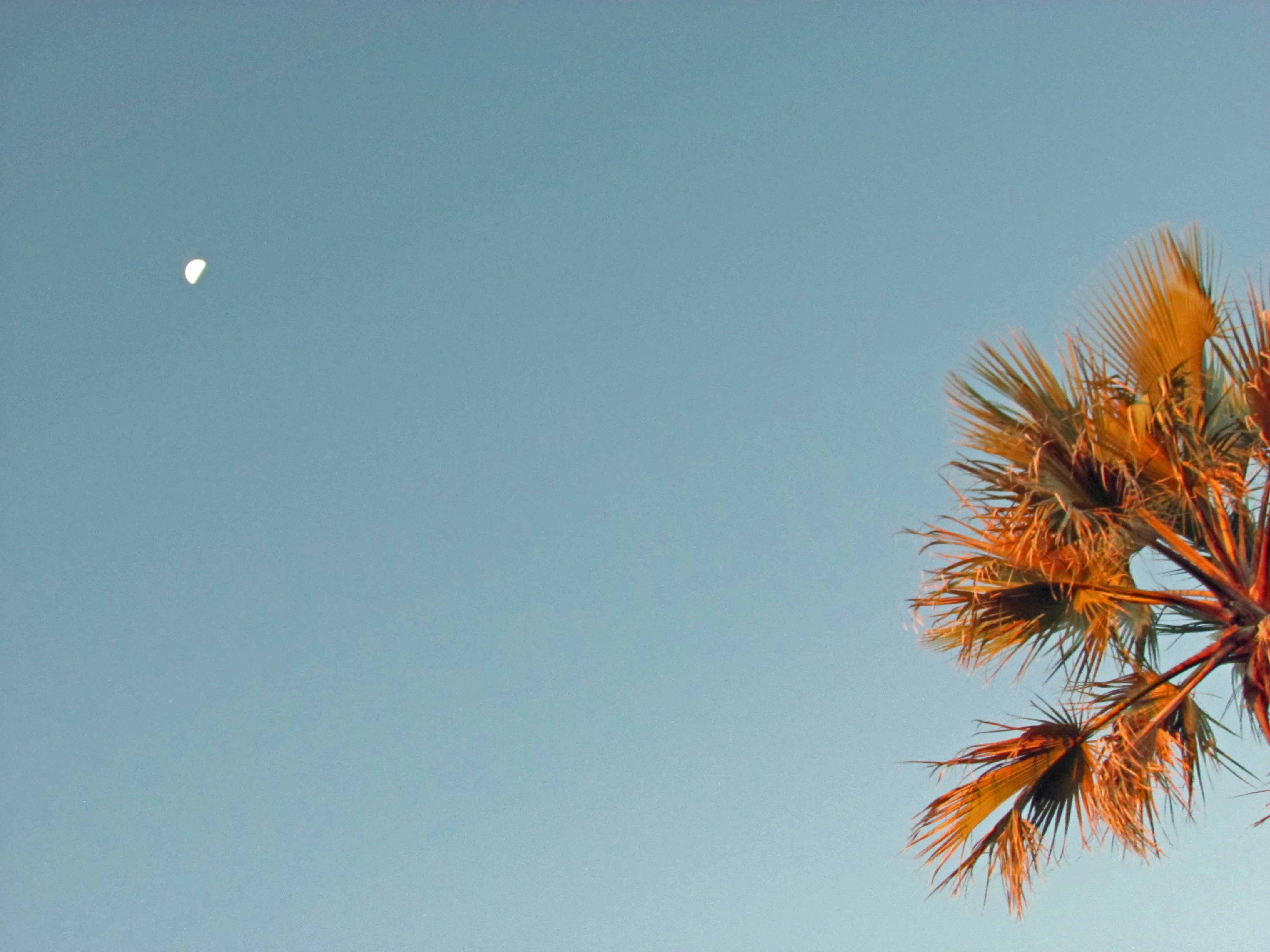
Half moon at sundown

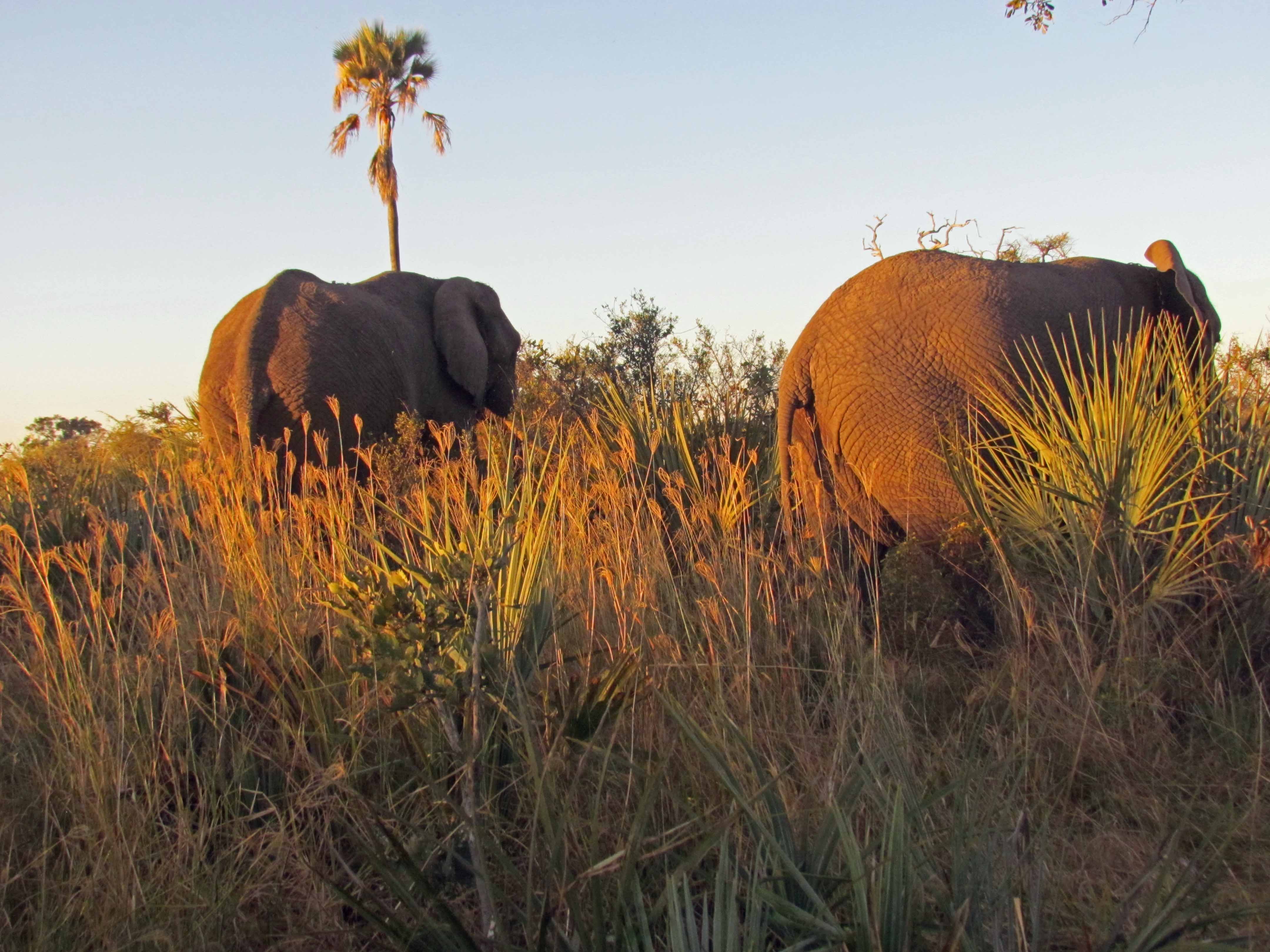
And several hours later, after dark, we walked back under a half moon.  I had forgotten my flashlight, but I could still follow three huge silhouettes against the stars.  I was back in Africa!

PS:  The NASA images above were taken by MODIS (or Moderate Resolution Imaging Spectroradiometer) – a key instrument aboard the Terra and Aqua satellites. According to NASA, “Terra’s orbit around the Earth passes from north to south across the equator in the morning, while Aqua passes south to north over the equator in the afternoon. Their orbits view the entire Earth’s surface every 1 to 2 days.  The data they gather will hopefully improve the understanding of global dynamics and processes occurring on the land, in the oceans, and in the lower atmosphere. MODIS plays a vital role in the development of global Earth models able to predict global change accurately enough to assist policy makers to make sound decisions concerning the protection of our environment.”  (Fingers crossed that they do.)

Posted in Africa, Lions, Travel

New Publication! Adventum Magazine

Adventum Magazine has just published my essay about tracking lions in South Africa!  You can read it digitally at: http://www.adventummagazine.com/issue3igital.html or follow the link on the side of this page.  (Spoiler alert:  we found them!)

Male lion, South Africa
Posted in Africa, Doug, Elephants, Hyenas, Jabu, Morula, Sandi, Thembi, Travel

Out of Africa!

Peek-a-boo with Jabu

So many tales to tell:  (1) the flooded Okavango Delta, water where there was sand last time I visited; (2) walking with elephants under starlight and a half moon (without a flashlight); (3) hyenas in the kitchen; (4) the closest I’ve ever gotten to a snake (!); (5) a leopard for my friend’s birthday present; (5) lions kill a baby hippo; (6) basic tents and luxurious chalets; (7) what not to do if you’re self-driving through the Moremi Game Reserve (hint: DO NOT rely on your GPS); (8) wild dogs, wild dogs and more wild dogs; (9) the rarest giraffes in the world; (10) hippos, hippos and more hippos; (11) a leopard hunts a male impala; (12) an absolutely wonderful stay with Sandi, Doug, Jabu, Morula and Thembi – and many, many more.  Stay tuned!

Posted in Africa, Doug, Elephants, Jabu, Morula, Sandi, Thembi, Travel

Goodbye, Hello

Jabu, Thembi, Doug, Sandi, Morula

In 2007, this was my last glimpse of Doug and Sandi, and their three incredible elephants.  Tomorrow I get on an airplane and begin a long two-day journey to return to the Okavango Delta in Botswana, to turn from “Goodbye,” to “Hello.”

Posted in Africa, Elephants, Extinction, Jabu

Ivory

Jabu’s tusk

Carved ivory thrones are mentioned in the Bible.  King Solomon had one, covered with gold.  Tutankhamen’s casket had a carved ivory headrest for his pillow.  Cicero wrote of Roman houses where ivory doors opened onto entire rooms covered with ivory tiles.  Gladiators had chariots made of ivory.

In the 1800s, in Africa, ton after ton of tusks were transported thousands of miles to Zanzibar and Khartoum, carried on the backs of slaves.  An estimated two million elephants were slaughtered from 1860 to 1882, their tusks fashioned into billiard balls and piano keys.

The decade between 1979 and 1989 was the deadliest ever for African elephants.  Over 691,000 died.  In a line, trunk to tail, enough elephants to cover the distance between Miami, Florida and New York City: 1120 miles.  Around 8800 tons of ivory was harvested in that decade.  The average weight of tusks traded in 1979 was 21 pounds.  Fifty-two elephants died for each ton of tusks.  By the mid-1980s the average weight had shrunk to just 11 pounds – and so more elephants, 100 of them, died per ton.

In just one decade, the elephant population of Africa was halved – from 1.3 million to 650,000.

In Amboseli National Park, in Tanzania, a recessive gene is becoming dominant, occurring in 50 years instead of thousands, selected by poachers.

Year after year tuskless elephants are born.

Posted in Extinction, Mammoths, Mastodons, Pleistocene

And Just Where Would We Put Them?

Theoretically, it is possible to reclaim extinct beings, to spin evolution backwards. To recreate a mammoth all you need are a few live mammoth cells, since each and every cell contains complete genetic information.  Red-furred segments of mammoth flesh are not uncommon discoveries in Siberia, usually found by sled dogs that eagerly gnaw on frozen haunches.  But cells die if stored above minus 94º Fahrenheit, even for short periods.  Still, the possibility of finding live cells does exist.  Paleontologists in Ohio have isolated 11,000-year-old bacteria from the stomach of a mastodon, the oldest living organisms ever found.

To recreate a mammoth, destroy the nucleus in the ovum of an Asian elephant.  Then inject live mammoth-cell DNA into the altered ovum and implant the artificial zygote into the uterus of an Asian elephant.  If the 22-month pregnancy is successful, you can expect the birth of a 100% mammoth baby.

Another method is to take mammoth sperm (selected to ensure female offspring), inject it into an elephant’s egg and wait 22 months for your mammophant, a half elephant, half mammoth calf.  Then wait until the hybrid is sixteen or so, breed it with more female-selected sperm, and in 3 generations of mammophants, say sixty years, the resulting pachyderm will be 90% mammoth with 16-foot tusks.  The obvious obstacle to this method is that hardly any non-degraded frozen mammoth cells exist, let along viable sperm.  And even if some were found, would two species separated by millions of years of evolution even be capable of producing offspring?

So let’s go back to the method that just might be successful.  Let’s find live mammoth DNA, or perhaps just replicate some of it, and join it with the ovum of an Asian elephant.  The resulting offspring would be a cloned mammoth.

Then what?

To get more mammoths you have to artificially construct more zygotes, which need more live mammoth cells, which would result in clones of clones –  unless you find a lot of live mammoth DNA from many different individuals.  And for such a project you need elephants as surrogate moms.  Endangered Asian elephants.  Even with a whole herd of resurrected mammoths, inbreeding could make the population nonviable.  Would a hyper-disease be resurrected too?  Could it jump to elephants?

And where would we put our newly minted species?  In zoos?  On reservations? In those isolated pockets we call National Parks?  While we’re at it, shouldn’t we resurrect some cavemen, too?  In Northern Siberia scientists are already attempting to create a mammoth ecosystem called Pleistocene Park.  Imagine the tickets they could sell to watch Neanderthals, our human cousins, hunting.

And where do we stop?  Do we bring back Saber-toothed Cats, Dire wolves and Giant Short-faced Bears? Do we re-create their habitats?  Lower the temperature of the earth four degrees in this time of global warming?  Bring back the Ice Ages?

Posted in Extinction, Mammoths, Mastodons, Pleistocene

The Last Mammoths on Earth

Around 1650 BCE (Before the Common Era), the last mammoth on earth died on Wrangel Island, a small outpost in the Chukchi Sea off northeastern Siberia.  In the same general period of time, the Shang Dynasty ruled China, the Thirteenth Dynasty began in Egypt, (it will be 300 more years before Tutankhamen is born), the Hittites sack Babylon and the world’s first wooden bridge was constructed on Lake Zurich.

Frequently ice-bound, Wrangel was visited by hunters before its mammoth population became extinct, evidenced by the various stone and ivory tools the hunters left behind.  Possibly a part of a vast Inuit trading culture, the hunters did what hunters do – feed their families.  They might, or might not, have known mammoths were becoming very scarce.  Large mammals such as reindeer and sea lions were their prey – why not the last mammoth left on earth?  Wrangel Island is now a sanctuary, a breeding ground for polar bears, with the highest density of dens in the world.

Most mammoth and mastodon populations became extinct during the transition from the Late Pleistocene (126,000 BCE to 12,000 BCE) to the Holocene, the age of modern man beginning at 12,000 BCE.  The word Holocene derives from the Greek words holos (whole or entire) and kainos (new) and the epoch encompasses all of the period from the last glaciations throughout the worldwide population growth of the human species and up to present day.  Animals and plants have not evolved much during the Holocene, but have undergone major shifts in their distributions, due to the effects of man.  It was also the period where the megafauna – mammoths, mastodons, giant bears and an entire range of predators – disappeared.

During the transition from the Pleistocene to the Holocene, the Stone Age came to an end with the advent of flint tool manufacturing, the first usage of advanced darts and harpoons, and the development of a modern toolkit including oil lamps, fish hooks, ropes, and eyed needles – all perfect inventions that indicate successful hunting-gathering techniques.  During this transitionary period, Neanderthals became extinct, clay figures were hardened in wood-fired ovens, the bow and arrow was invented, and cave painting appeared in Europe.  By 12,000 BCE, Asiatic peoples crossed from Asia to North America, entered South America as far as the Andes, and domesticated llamas.

Although climate change and human predation are considered the main causes for the extinction of the Pleistocene-Holocene megafauna, the spread of disease is also an extinction theory.  Scientists who believe that the catastrophic drop in mammoth and mastodon populations was due to a hyper-disease are studying frozen samples from the mammoths of Wrangel, hoping to find evidence of an Ebola-like virus in their DNA.   They theorize that the virus could have jumped from fleas to mammoths, which would account for an extinction rate that increased as humans spread across the planet.  (Rats, which carry fleas, caravanned right alongside us, as we propagated our way across the continents.)  To date, the DNA recovered from Wrangel is incomplete and fragmentary.

But climate change and overhunting are the two main theories for the Holocene extinctions.  During the last glaciations of the Pleistocene (19,000 to 20,000 BCE) most of the climate of the world was colder and drier.  Deserts expanded, sea level dropped, and rain forests were splintered by savannah.  Twelve thousand years ago, the last Ice Age ended.  The vast grasslands of Siberia froze under permafrost.  Trees marched north.  Humans moved into the more temperate regions, following game.  As habitat collapsed with the climate change, as mammoths and mastodons were confined to shrinking islands of refuge, they became easier to hunt.

Females and the young, the easiest and most numerous, died first.  And with the older females went the knowledge of where and when to migrate.  With fewer and fewer females, birthrates could not keep up with death rates.  Mammoths couldn’t pop up every spring like wildflowers. 

The longer it takes to find each elusive herd makes a difference on how long you stay and how much you overhunt it.  But even as places of refuge became further and further apart, it was still possible to find them.  And hunt again and again and again.

There’s a lot of return for killing mammoths, much more so than gathering grass seeds, which were the most abundant food item of the Pleistocene.  In the last twenty years tons of evidence has been unearthed, confirming the overhunting theory.  Below Krakow’s Spadzista Street in Poland, 8,000 bones of 73 individuals were found in a 40 x 40-foot square area, a mammoth mausoleum.  At a hunting campsite in Czechoslovakia, archeologists excavated more than a thousand mammoths.  In areas where wood was scarce, such as the Ukraine, shelter frameworks were constructed of mammoth bones, with skulls for foundations and interlocking tusks as arches.   One shelter, near Kiev, contained the bones of 95 mammoths.  And in Dent, Colorado, the bones of a dozen mammoths are clustered at the bottom of a cliff.  Scattered among them are stone spear points and large rocks.

Mammoths and mastodons survived through the Pleistocene and into the age of man.  Ten thousand years ago, North America resembled Africa, with huge migrating herds of elephant, camels, horses and antelope.  Following alongside the herds were Saber-toothed cats, Dire wolves, Miracinonx (the American cheetah that looked like an elongated cougar), Giant short-faced bears and American lions.  Then, in the blink of an evolutionary eye, within just eight thousand years, three-fourths of North America’s large mammals disappeared.

Posted in Africa, Elephants, Extinction, Mammoths, Mastodons, Morula

Mastodons, Mammoths & Morula

Against a chalk-blue sky, the smooth bare branches of a Motsheketsane tree interweave like a dancer’s arms caught in a multiple exposure.  The shade it provides is full of holes, lacy as a cobweb.  Embedded in the sand at its base are the hoof prints of zebras, from hooves exactly like those of unshod horses.

Morula and I seek what little shade there is underneath the tree.  I take a swig from my water bottle while she searches for leftover Motsheketsane seeds.  Using her trunk as a leaf blower, she corrals the ones she finds into a neat little pile whuff, whuff, whuff and transfers it into her mouth.

I pick one up.  The seed is oval and has ruffled wings that divide it into 5 horizontal planes.  It looks like a small paper lantern of a vaguely Oriental design.  I try to pocket one, but its wings crumble as my hand close around it.

My everywhere-mind wanders off by itself, meanderings of no practical use except, of course, to me.  Speculatively, I eye Morula, cloak her in long, ginger-colored, shaggy fur, shrink her ears, implant upturned, pitchfork tusks, and imagine her, well, tubbier, in a mastodon suit of hair.

She waves her trunk tip at me, neighborly, as if across a backyard fence: Hello.

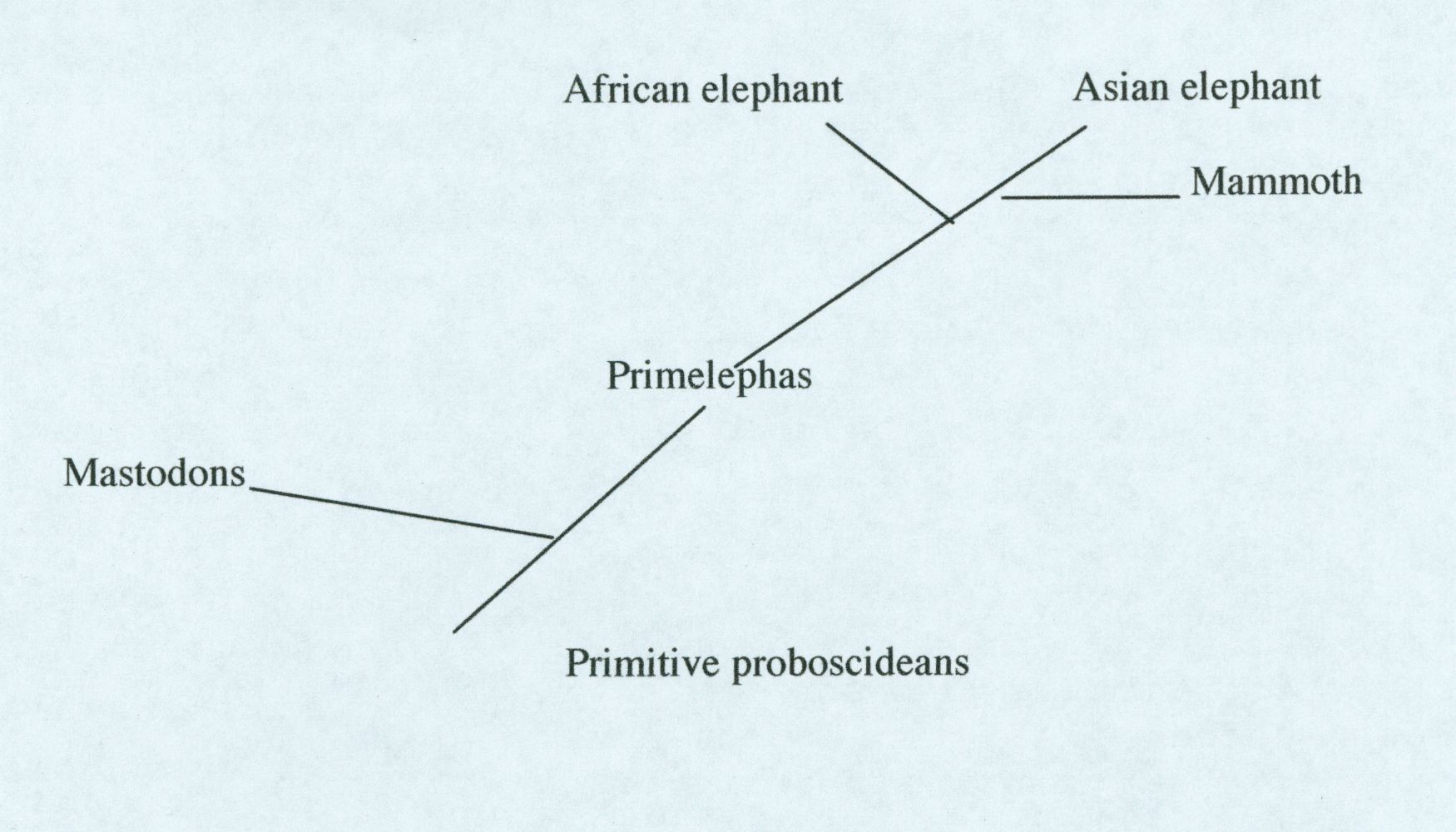
With its two fingers, the tip of her trunk could argue for a close relationship with mammoths.  But recent DNA research found direct genetic links only between Asian elephants and mammoths.  Morula’s family tree looks like this:

Mastodons branched from the proboscidean family tree 26 million years ago.  They became the first elephant cousins to leave Africa, the first to migrate through Asia and the first to arrive in North America, around 3.7 million years ago.  Mammoths followed, around 2.2 million years later.  Once in North America, the elephant cousins spread from Alaska to Central Mexico, from the Pacific to the Atlantic.  As you might expect of distant kin, mastodons and mammoths share many characteristics with surviving elephants.  They have the same basic body shape, a trunk and tusks.  But they also differ in many ways.

The most striking, of course, is that suit of hair.

Morula rubs her left haunch against the gnarly trunk of the Motsheketsane.  She has a relatively naked body – obviously a fur coat is useless under the brassy African sun.  Her body size, thick skin and subcutaneous fat all help to keep her warm when temperatures occasionally, very occasionally, dip below freezing.

If you shaved a mammoth, or a mastodon, parked it in a zoo, and sold tickets, most people would believe they’re seeing an elephant.  But if I put the three cousins on display side-by-side, almost anyone could tell the difference between them.

Of course, bringing to life two extinct species is an impossibility, unless, well . . .  .  I make things up.  Which is an acceptable thing to do as long as I confess that I’m doing it.

So I import to Africa two distinct species that never walked the continent: Mammut americanum (the American mastodon) and Mammuthus columbi (the Columbian mammoth).  Both lived exclusively in North America, where fourteen thousand years ago, they could be found, almost literally, in my backyard.

I position Morula between two cousins she will never meet – a mastodon to her right and a mammoth on her left.  Oddly enough, because everyone’s related, they don’t really look that much out of place.  Of course, this is all in my imagination, so anything is possible.

Columbia, the mammoth, is gigantic – at least four feet taller than Morula – with absolutely spectacular tusks.  Curving out, then inward, they nearly cross each other.  Even though I’m speculating about them, I don’t overdo their length.  At eight feet long, they’re only half the size of the longest mammoth tusks ever recorded.

As soon as she solidifies in my fantasy, Columbia lifts the tip of her trunk and takes a discreet sniff at Morula: Who’s this?

The top “finger” of her trunk is four inches long and the bottom “thumb” two inches – a bit longer than the fingers of Morula’s trunk tip.  Columbia’s could pluck out single petals from spring flowers or extract the newest, sweetest stems from the short grasses of the Pleistocene parklands.

She is completely cloaked in rich, russet fur, trunk and all, right down to her toes.  Her ears are oval-shaped and small, dainty really, about fifteen inches from top to bottom.  Since she lives near Pleistocene ice sheets, she has no need to dissipate heat through her ears.

She quickly loses interest in the smell of an unfamiliar elephant and strolls over to pick out dry blades from a field of African grass, leaving cratered footprints in the dust.  Except for their size, I can’t tell them apart from Morula’s.

Columbia wraps her trunk around a wad of grass, from right to left, and rips out a clump.  She stuffs the grass between elephant-like molars.  As she eats, I hear a phantom fart.  She lifts the small, triangular anal flap at the base of her short, stubby tail and drops a pile of dung, which looks exactly like Morula’s latest offerings.

I’m having way too much fun with my mammoth.

Conjuring Mammut americanum, the American mastodon, proves trickier.  I can’t quite bring him into focus.  Although entire frozen, mummified mammoth carcasses have been unearthed in Siberia – complete with tongues hanging out of their jaws – we know mastodons only by their bones.  So when I give Americanum a chestnut-colored shag – short and tangled hair on the top of his low-crowned head, thick and matted fur along his flank – I’m just agreeing with what’s been written elsewhere.  A shaggy fur coat is probably a safe bet, since Americanum ranged just south of the Pleistocene ice sheets, mingling with mammoths in the cold wet climate of North America.

Americanum is about the same height as the average African elephant.  His back, instead of sloping, like Columbia’s, or saddle-shaped, like Morula’s, is straight – he has no neck.  His skull is flatter and longer, without Columbia’s high-domed head or Morula’s rounded crest, and his jaws are elongated.  He actually has a chin.

I give my made-up mastodon huge tusks the same length as Columbia’s.  While her tusks curve out and then in, like an extravagant Bavarian moustache, his are a classic pitchfork shape.  One is a full six inches shorter than the other – Americanum is a lefty.  Laterality – right or left-handedness – is present in all proboscidean species.

Both mammoth and mastodon tusks grew to great lengths – a 16-foot mastodon tusk was found in Greece in 2007.  The record for African elephants is 11 feet.

Americanum’s tusks, like those of all his cousins, grew as tree rings grow, with varying rates for bad years, good years, summer, spring, winter, fall.  Just as African elephants do, he experienced musth after his late teens and began aggressively fighting with other males over receptive females.  Fighting caused battle scars to his tooth sockets, tusks and skull.  So, although Americanum is stocky, bulky and seemingly without much personality, he‘s not just some docile herbivore.  He’s a bull in the prime of his life.  Lucky for me, I didn’t conjure him up when his testosterone levels were elevated.

Americanum joins Columbia at a rainbush, but of course he takes no notice of her, nor she of him.  How can they?  They’re both just figments of my imagination.

He reaches into the bush, plucks a branch of dull green leaves, shoves it into his mouth and chews up and down, like I do, instead of forward and back, like Morula and Columbia.  Each ridge on Americanum’s small molars is shaped like a woman’s torso: two breasts with pointed nipple-like chewing surfaces and a valley between them.  He has only three to four ridges (sets of breasts) per molar. His common name, mastodon, is a combination of the Greek words for breast (mastos) and tooth (odõn.)

In contrast, the molars of Columbia and Morula are ridged plates: teeth that look like elongated dishes set to dry edgewise in a rack, each plate bonded to the next by enamel.  Their molars work like huge horizontal vegetable graters, grinding food back and forth across sharp, upright edges.  Morula’s teeth have ten ridges, while Columbia has twenty-seven, due to her exclusive diet of trees.

Doug shows me Morula’s molars.  “Open up,” he tells her.  She curls her trunk back over her head and he stretches to his tiptoes, pulls her lower gums wide with his hands.

Morula’s molars

“Very good, my girl.”

If there were dentists for elephants, Morula would be a patient patient.

Doug lets go of Morula’s lower jaw and she swings her trunk down but keeps her mouth     open.  He grabs a fistful of “elephant candy” and slides his arm into her mouth, all the way to his elbow.  As he lets go of the treat he rubs her tongue.  She rapidly flaps her ears.  “Elephants use their trunks to rub each other’s tongues.” Doug says.  “It’s kind of like a handshake.”

I re-conjure Morula’s elephant cousins and find them still eating – Columbia at the   rainbush, Americanum pulling up grass.  I watch them fondly; they are like old friends in new clothes.  But they are rapidly becoming distressed in the African heat.  They sway from side to side and flap their small ears like tiny surrender flags.   So even though I’ve fallen in love with these ghosts, with elephants who no longer exist, I come to my senses and banish them back to the past, where they are extinct once again.