Gray wave after gray wave surges out of the bush in small herds of twenty or less, first one group, now another, flooding the huge hollow that contains a waterhole. Dust rises in the air, a potent blend of manure, dried grass and sand. The backwash swells in our direction. Soon a sea of elephants surrounds us. We’re submerged in a roiling world of noise. Snorts, grumbles, trumpets, growling bellies and gargantuan belches resound. Some of the vibrations are too low to hear, but I feel them as they pass through my body, reverberate in my chest cavity, squeeze my heart. Eye after eye inspects us as eddies of elephants swirl past. An old world laps at the foot of our memories, extinguishes centuries of communal fires. The ropes that tether us loosen. We slip away from the familiar shore and set off towards unimaginable ways of being. We look around with wild hearts. We have become part of the herd.
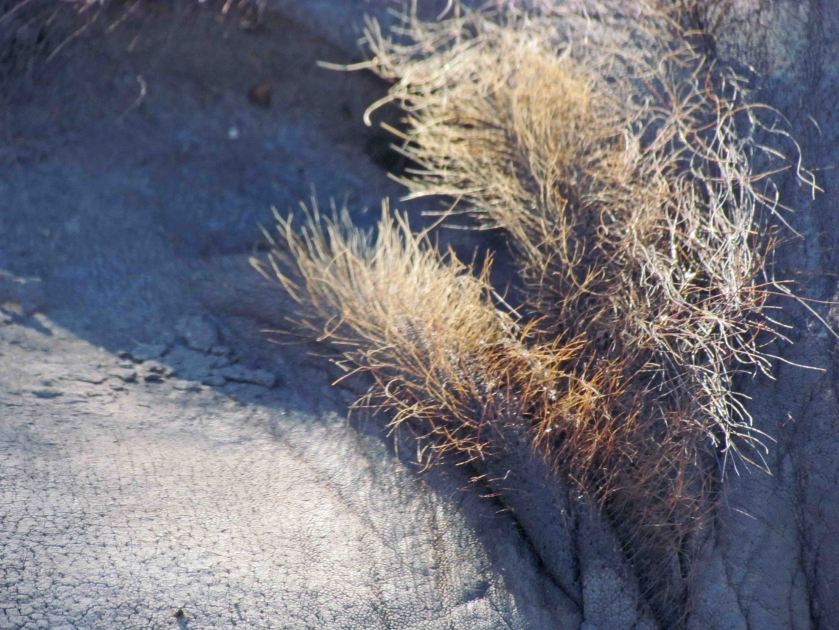
Morula’s luxuriant ear hair catches the sunlight. Flakes of mud cake the opening of her ear.
Just as in humans, an elephant’s ear hair grows longer and longer throughout its life. Hers is cinnamon-colored, has black roots, and is six inches long. It reminds me of the color of a lion’s mane.
When I reach up, the patch of hair feels like the underbelly of a longhaired cat.
First, for those who are unfamiliar with black mambas, here’s a little background information:
Black mambas (Dendroaspis polytepsis) are the longest venomous snakes in Africa, measuring up to 14 ½ feet. Mambas are not black – they’re more olive or greenish gray, with a narrow, elongated head the shape of a coffin. It’s the inside of their mouths that are black – hence the name. Mambas are also extremely aggressive and may actively attack without provocation. I use the adverb “actively” with reason – a mamba can strike in all directions, even though a third of its body is raised above the ground, and it can chase you in that upright position at speeds up to 20 mph. If you are bitten, your death will occur within 20-60 minutes. An anti-venom for mamba bites exists, but it must be administered immediately, requiring 10-20 vials of solution. But if you are struck in the face or neck (quite likely, since the head of the mamba chasing you is 4 feet off the ground), you will die in ten minutes. That black mouth will be the last thing you see.
On that cheery note, on with the story:
In the Moremi Game Reserve, east of the Okavango Delta, is an elevated platform overlooking a large hippo pool in a bend of the Khwai River. Six of us, our guide OT (“just like Overtime!”) arrive in our Land Rover.
“What’s that?” I point.
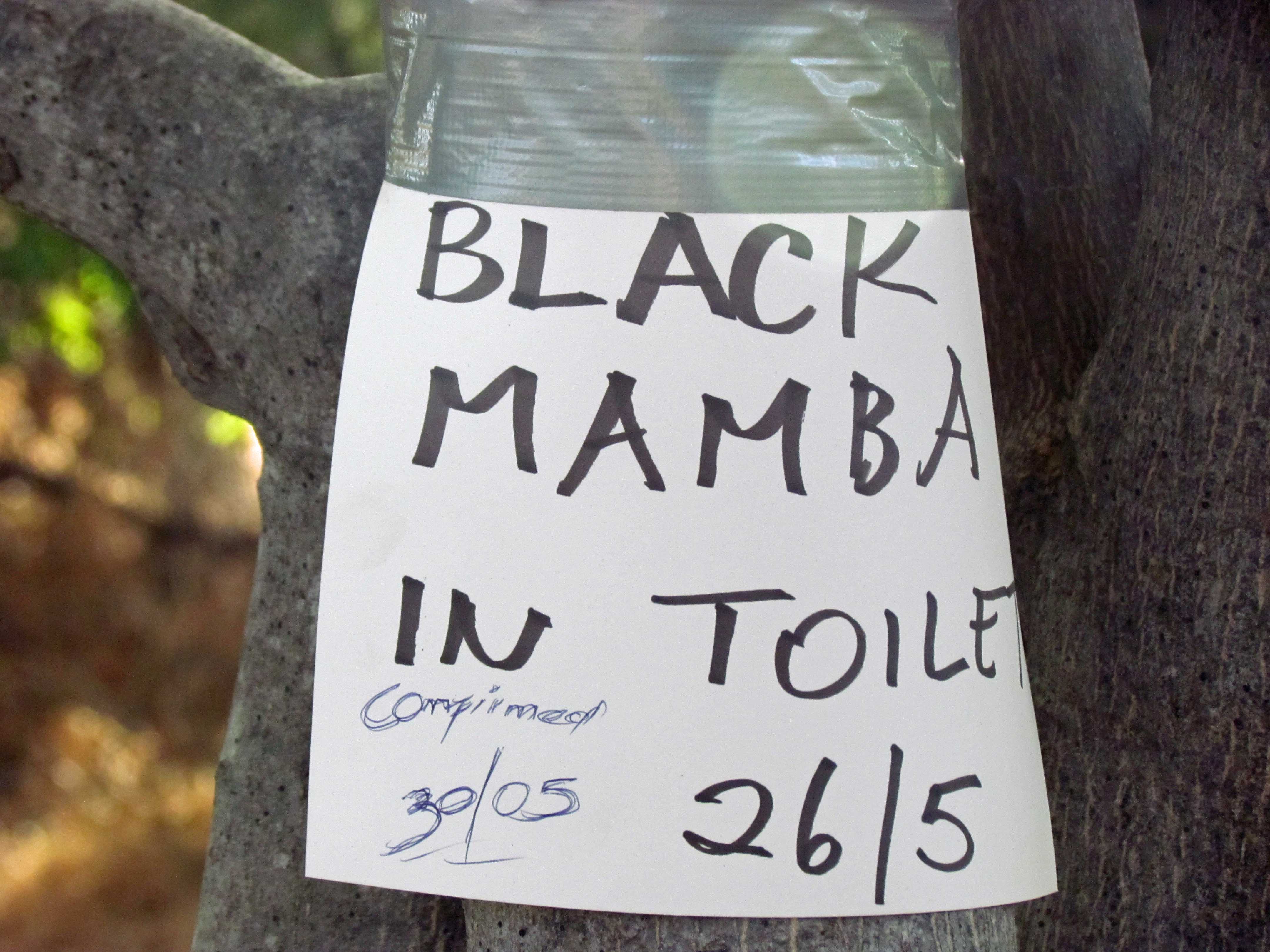
It’s a large piece of stiff white paper taped with duct tape to a tree. We climb out, read it, and immediately start swiveling our heads, trying to look in all directions at once.
“Anyone want to go look?” OT laughs.
The toilet, roughly the size of those cartoon outhouses with the crescent moons carved in their doors, is a cinder block building with a tin roof. It’s about fifty feet from our Land Rover. The painted green door on the toilet is ajar.
Certainly I’m not tempted to look inside. After all, the second message (“Confirmed 30/5”) was written just three days before our arrival by someone a lot more curious than I am about deadly snakes. The mamba is most likely still in there. Who wants to reconfirm a reconfirmation? Mambas are territorial; they will always return to their lairs, although that’s usually in an abandoned termite mounds or a hollow tree, rarely, I’d bet extremely rarely, in a toilet. A mamba is diurnal, active both night and day. It could be sleeping in there. Or not.
In my opinion, I’m already standing way too close to that toilet. Trying to look both at the toilet and at everything else, I walk slowly backwards. Mambas don’t like sudden movements.
Besides, I firmly believe, even though I haven’t seen it, that this toilet is not a Western ceramic throne, but a mere hole in the cement. I’ve had enough experience with toilets-in-the-middle-of-nowhere to also believe that the area around the hole is likely none-too-clean. That bush over there looks a better. A few minutes later, after careful reconnoitering and quickly taking care of business, I can confirm that no mambas are lurking around it.
As I climb the steps to the viewing platform I look for mambas wrapped around posts. On the creaky platform I look for mamba’s hidden in corners, or nestled into the thatch of the roof. I look for mambas slithering across the branches of the trees that lean dangerously close to the rails. A rustling noise among the branches spikes my heart rate to a gazillion, but it calms when I see it’s only a Burchell’s glossy starling, squawking for handouts.
Burchell’s starling
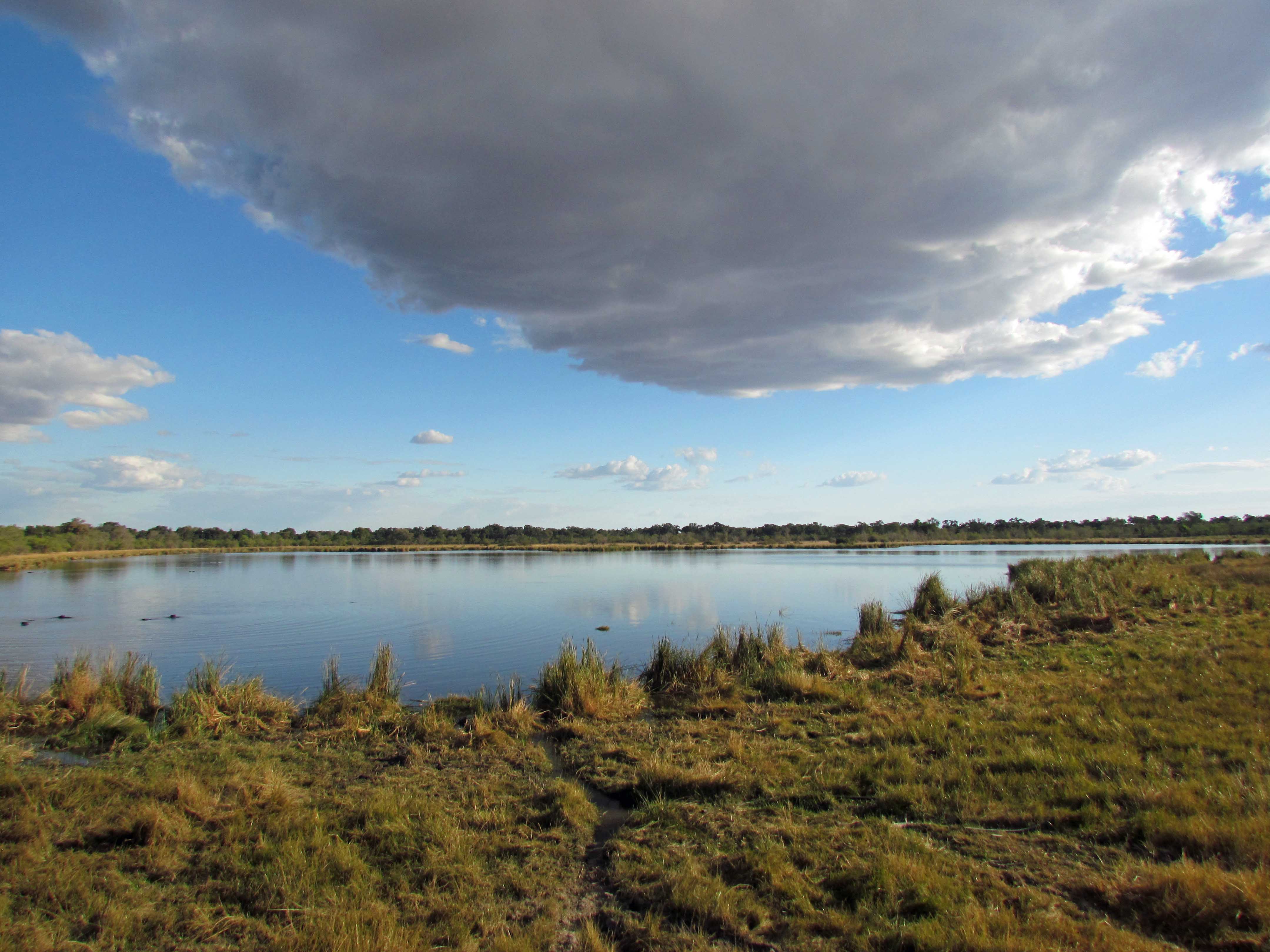
The view from the platform is wonderful. A massive cloud hangs over the hippo pool and puffs of other clouds reflect in the tranquil water. A dozen hippos rise and sink, burbling like submerged tubas. Tracks in the grass are hippo paths, where the hippos come out of the pool at night to feed, foraging as far as three miles for sweet young shoots.
At the bottom of the platform a dozen water monitors, some six-feet long, slither into positions that defend his or her portion of the bank, using the hippo paths as small highways. The smaller monitors end up with the worst spots, constantly harassed in slow-motion chases by the larger lizards. As I watch their typical reptile behavior, I think it’s lucky for us that the age of dinosaurs ended a long time ago.
Khwai River
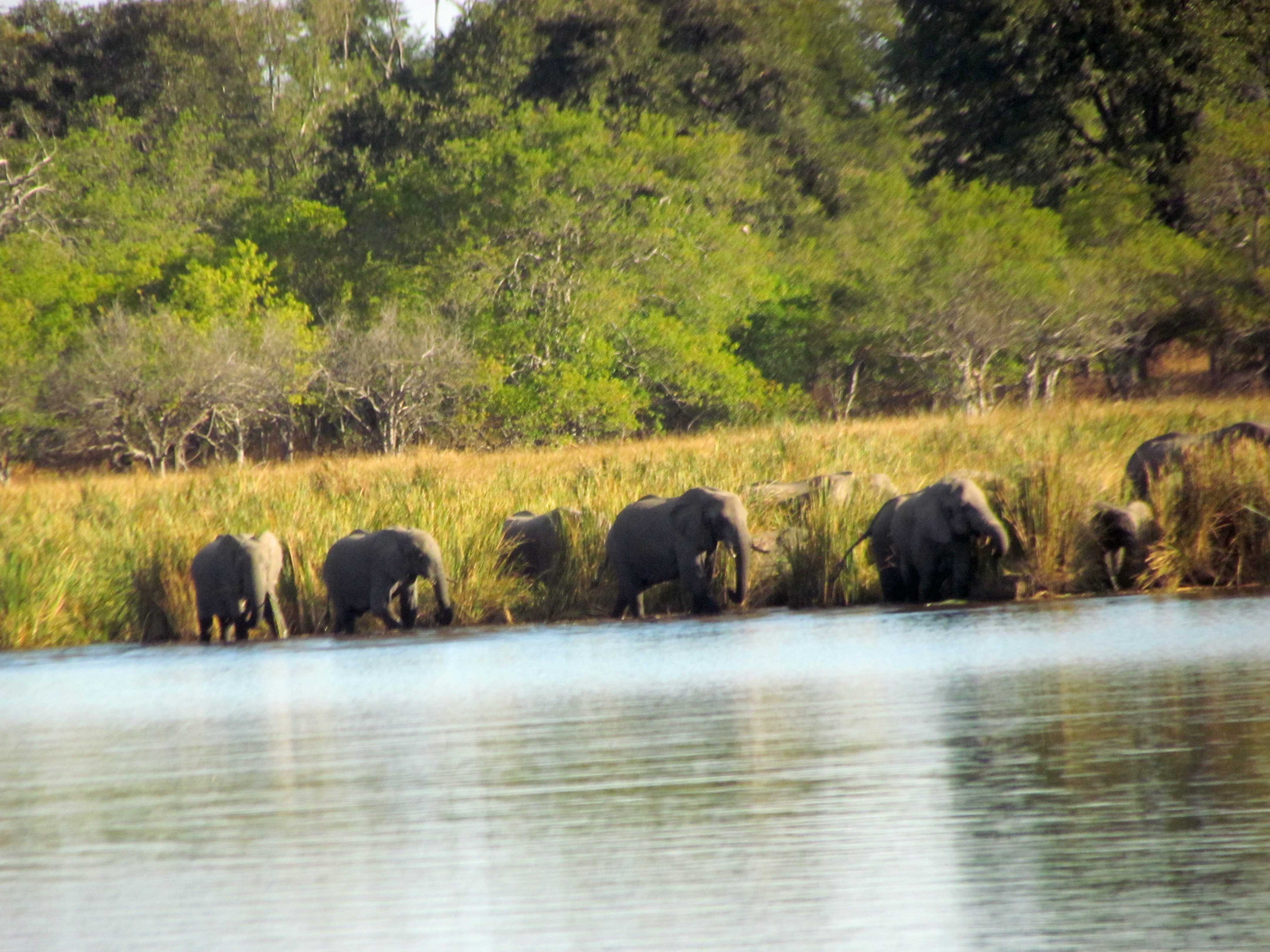
On the far side of the river, specks in the distance, a huge herd of elephants splashes along the edge of a reed bed. After I check for mambas, I lean on the rail of the platform to steady my camera. I use the digital zoom to take a picture, already knowing it will be an extremely low-pixelated shot. The elephants are in constant motion, appearing and disappearing in the reeds, so the photo turns out fairly blurry, but at least I have proof that those specks were really elephants.
Elephants on the far bank
On the way down from the platform I look for mambas wrapped around support posts, coiled under steps, and hidden in the framework of the flooring. I scan for slithery movements in the brush and wait for someone else to climb in the Land Rover before I do. I doubt the mamba has exchanged one lair for another, but still, you never know . . .
The viewing platform has its own GPS coordinates. So if anyone wants to look at that mamba and reconfirm one more time that it’s really there, I can tell you exactly where to go!
Here are the first few pages of my manuscript, Larger than Life: Eye to Eye with Elephants. Having read this much, would you go on reading the rest of the book? I’d love to have feedback. Thanks!
photograph by Cheryl Merrill
There is nothing like him on earth. His head alone is more immense than an entire gorilla.
Jabu is one hundred times larger than I am. His trunk is larger than I am. A single leg is larger than I am.
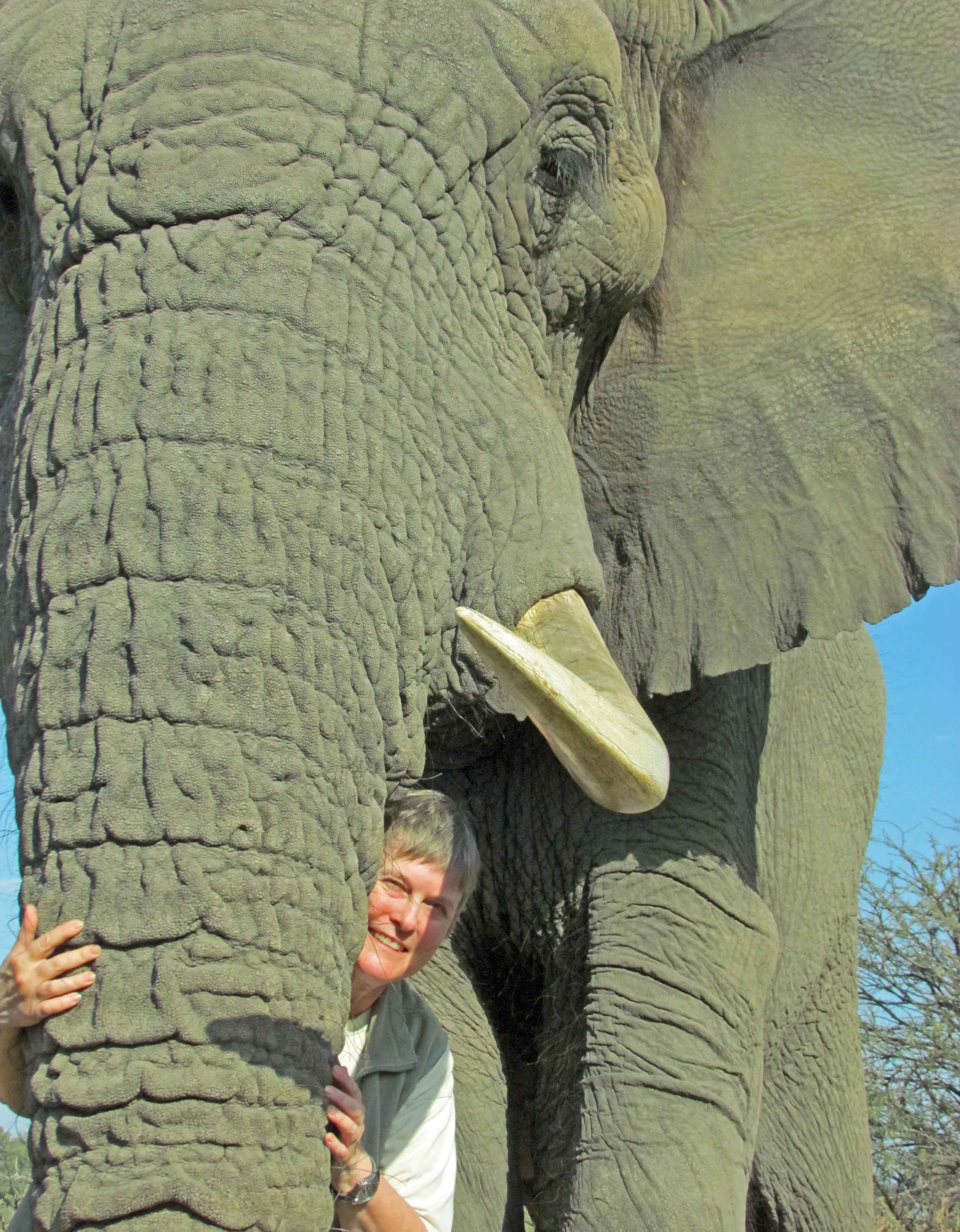
He rests his trunk on the ground and the tip of it lifts, opens, inhales my scent. I reach out and run my fingers along his warm tusk.
Do you recognize me, Jabu, do you?
* * * * *
The pilot lets me sit up front. As his clattering Cessna lifts straight into the sun, we pass a line of small aircraft and a block-and-brick terminal only slightly larger than the Air Botswana 727 parked next to it. We leave behind a flattened land where the tallest structure is a water tower, where the olive-green scrub spreads as far as can be seen, and where footsteps have no echoes in a country mantled by sand.
We gain altitude and Maun slides under us. The last town before venturing into Botswana’s Okavango Delta, Maun is an odd frontier mix of trading companies, outfitters, curio shops, supermarkets, cattle in the streets, and an airstrip long enough for daily international flights.
We fly higher. Haphazard, barely paved roads meander to round stockades – bomas, fenced by thornbush. Each boma contains a hut plastered with mud and roofed with straw, or a small square cinderblock covered by rusty corrugated metal. Only a few corral a cow or a goat. Behind us the last buildings disappear into a curtain of shimmering haze. Maun melts into the desert.
The shadow of our Cessna passes over thin dirt tracks, which lose their way and vanish. A waterhole appears, an orphan left behind by last year’s flood. Another comes into sight, and then another. Etched into the sand by countless hooves, game trails wander through the dry landscape, headed to those life-giving pockets of water. Few animals follow the trails in the heat of the glaring sun. A small herd of zebra. A single giraffe.
Suspended above what could be considered a great emptiness, I remember the map I studied a week ago. Printed alongside the log of GPS coordinates for airstrips – some of them makeshift, many little used – I read another list of handy notations. “Tourist road, 4×4 required . . .Top road extremely sandy, takes very long.” Eighty percent of Botswana is covered by sand, some of it a thousand feet deep, but the airstrip where we’ll land is barely above water.
Swollen by November rains, the Okavango River floods south from Angola, arrives in Botswana in May or June, fans out, and then stops when it bumps into a barrier of fault lines near Maun. Landlocked, the river penetrates deeply into the Delta before it dies in the Kalahari sands. Not a single drop reaches the sea.
As the river pushes south, it creates, in the midst of a vast desert, an oasis – a floodplain the size of Massachusetts containing an ark-full of animals. Dependent upon the rainfall in Angola, the river swells or shrinks. In the dry season, it leaves behind ponds no bigger than puddles, abandoned lagoons that shrink into brackish swamps, and waterholes reflecting a cornflower blue sky.
Last week I reviewed the latest satellite photograph of the Delta – four skinny channels with several webs of water between them. The river is beginning to flood. The photograph reminded me of a duck’s giant footprint pressed into the sands of southern Africa. I located my destination, a dry spot between two of the bird’s toes.
Twenty minutes after leaving Maun, the pilot pushes in the throttle and the Cessna’s clatter mutes. We drop lower. A thousand waterholes are a thousand mirrors signaling the sun. Lower still, the mirrors turn back into waterholes, some of them connected in long braids of water.
Right before we land on a strip of dirt, we glimpse a cheetah sprinting for cover. With that single spotted blur, my life divides once again between home and Africa.
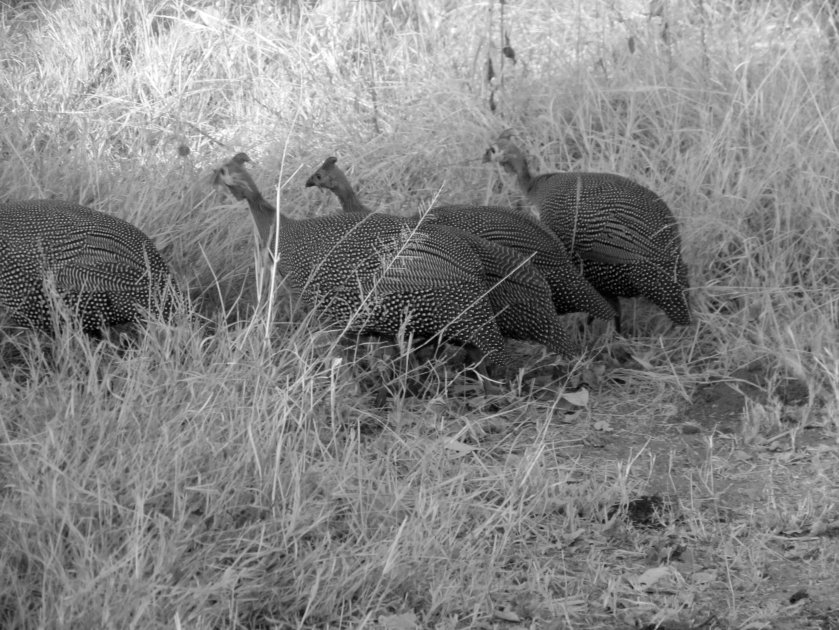
As we make our way down the two-rut road, a mob of Helmeted guineafowl runs ahead of us. They dart from one side of the road to the other, a bunch of silly old biddies, with shrunken featherless heads, thick bodies covered in spotted dark gray plumage and large rumps that bounce when they run. Blue jowls on their necks flap back and forth under their beaks. They never once consider flying to get out of our path.
The guineafowl call excitedly to each other as we flush them: Keck, keck, keck, keck, keck, keck, KECK!!!!!!! Eventually they dash to the side of the road and disappear into the bush.
Ignoring them, the elephant in front of us steadily treads down the right rut of the road. His pace is unhurried, measured, constant. A shoulder lifts, a leg straightens, accepts weight, and the foot splays out. A back leg moves forward, toenails scraping sand, straightens, accepts weight, and the foot splays out. A creature bigger than most monuments is on the move.
If you missed it the first time, my radio interview will be broadcast again this evening, Tuesday, November 10th, from 10-11 p.m., P.S.T., United States. Heres the live feed link: https://kptz.org
I’ll be speaking on our local radio station, KPTZ 91.9, on Friday, Nov. 6th, at 1:30 p.m. Pacific Standard Time, U.S. and answering questions about all things elephant. For my friends all over the world, you can live-stream by clicking on the link below, and send in email questions. Plus we’ll be broadcasting examples of elephant sounds. See you then!
As I walk to my tent at the edge of camp, my vision is elemental, full of shapes without fine details. Shifting slabs of moon-glow keep rearranging trees as if they are pieces on a giant pearled chessboard, their trunks whitewashed the color of ash.
I enter my tent, zip it shut, and switch on the lamp. The electricity comes from batteries charged by solar panels on the other side of camp, carried by a line buried several inches below the sand. Not long after, I turn off the light and crawl into bed.
I roll on my back and blindly stare at the black canvas ceiling of my tent, looking back at the bright moments of the day. But then an unexpected memory darkens the darkness.
In 1996, on my first trip to Africa, I was in a carload of tourists rounding a corner on a sandy road in an area of Zimbabwe where elephants were recently massacred for their tusks. We rounded the corner and stopped – face-to-face with a huge matriarch.
Richly repulsive, an unnatural, confined scent rose from us – odors of food on our clothes and in our hair; flowers washed in alcohol dabbed behind our ears; dead skins around our waists and on our feet; grease, oil and exhaust from our vehicle.
With her trunk shaped into a “J,” the elephant sampled the waves of scent emanating from us, and then tossed our smell away with an emphatic flick. Unnerved by our overpowering human stench, a miasma with a deadly history, she turned and fled, while the half-shadow of dust that marked her exit collapsed to the ground.
The air around me tightens. Canvas walls crowd in, closer, and then closer.
What if our days were measured in scents rather than minutes? What if we could tell the difference between a friend and a murderer with just one sniff?
An excerpt from my book, Larger than Life: Living in the Shadows of Elephants
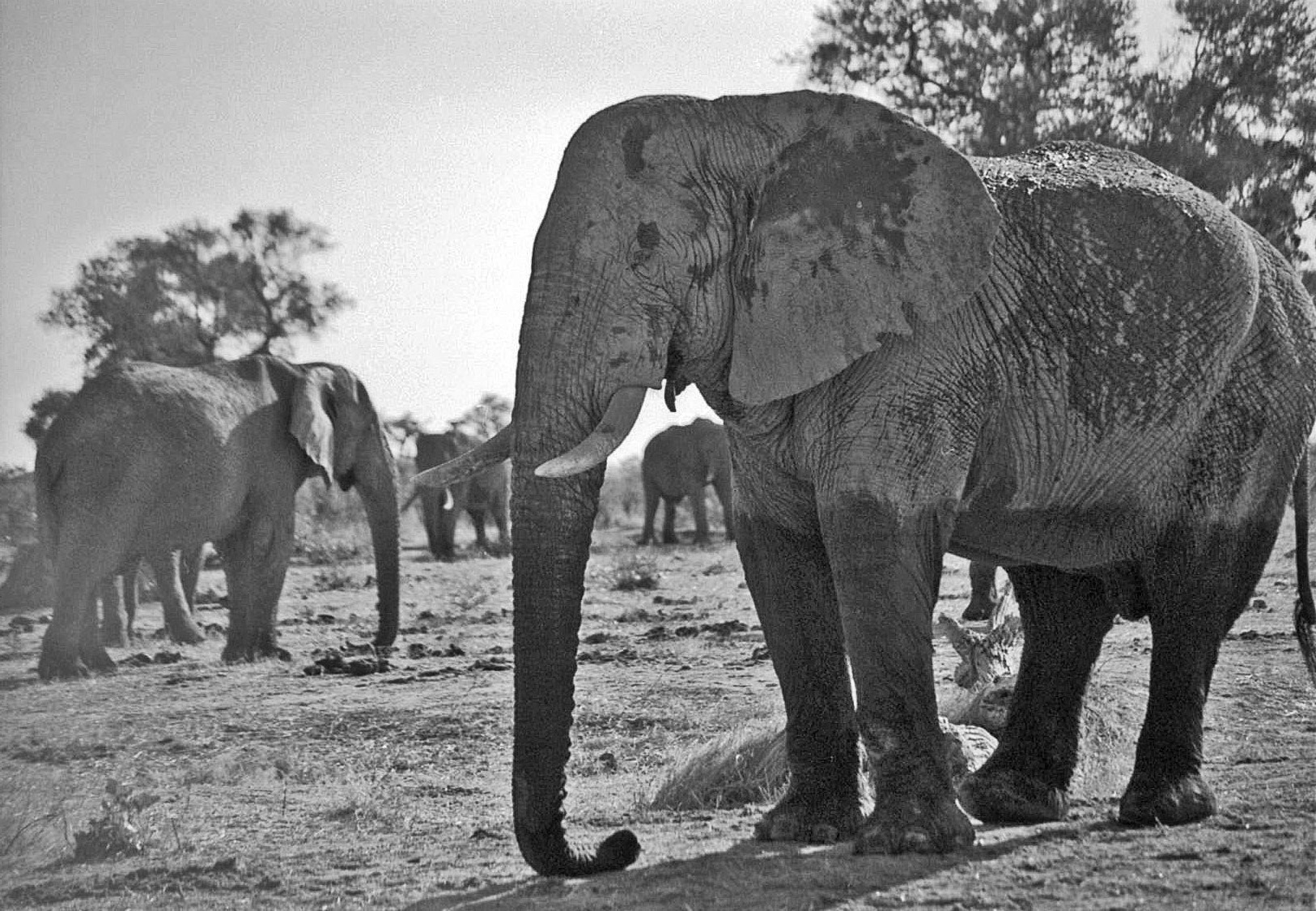
My eyes tired from a day spent looking into the sun, I drowsed in a Land Rover beside a waterhole in Chobe National Park. Only a few yards from our vehicle, a single-cylinder pump drew from the water table beneath the sands and sent spurts through a pipe to a square concrete trough. The bachelor elephants of Savuti congregated around the trough as they waited for spring rains and the return of female breeding herds.
The steady sound of the pump, chugga-sputter, chugga-sputter, chugga-sputter, lulled my eyes closed. They opened, closed, opened half-lidded, closed again.
“Here he comes,” someone whispered and my eyes flicked open as a huge bull strolled past. I picked up my camera.
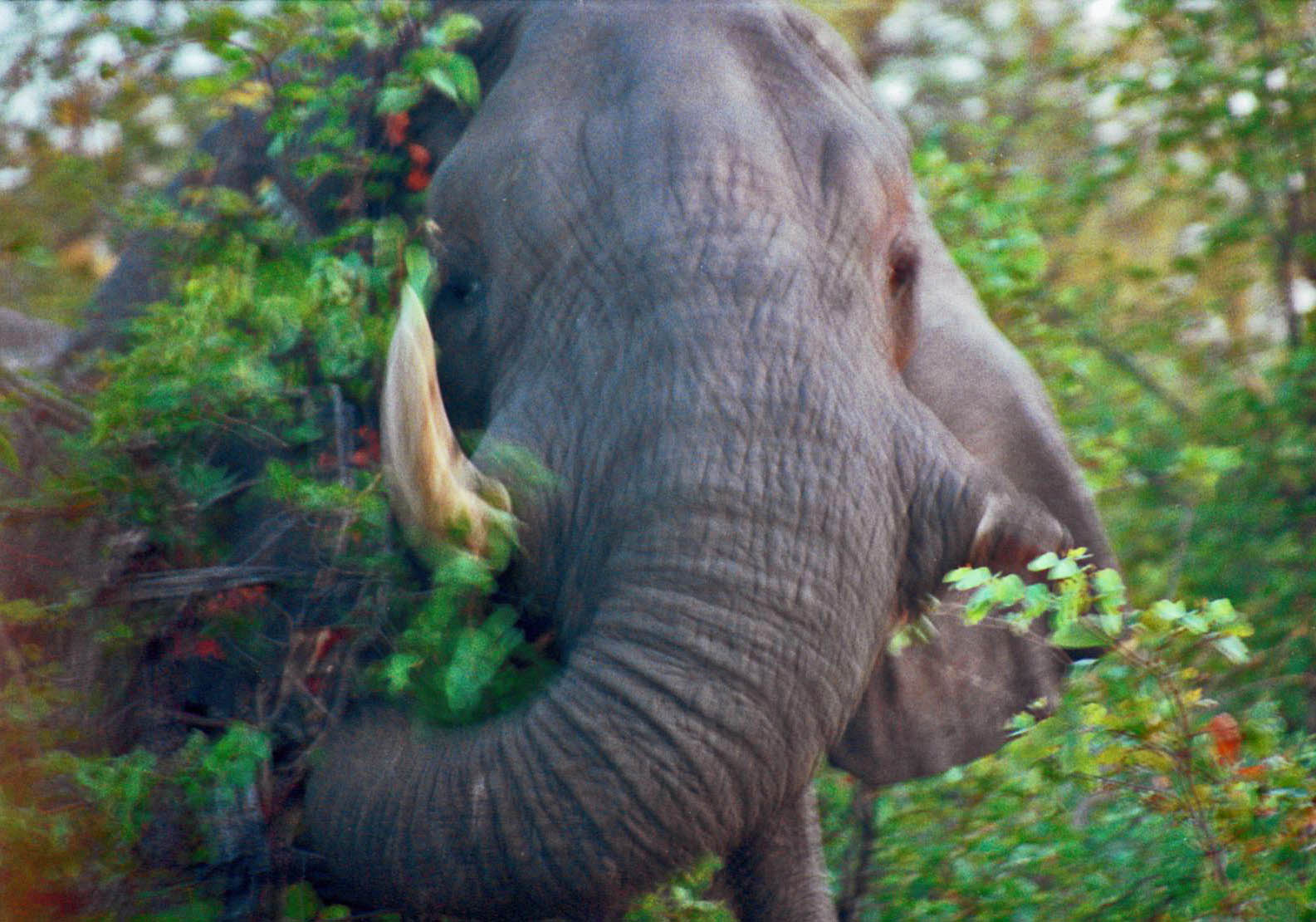
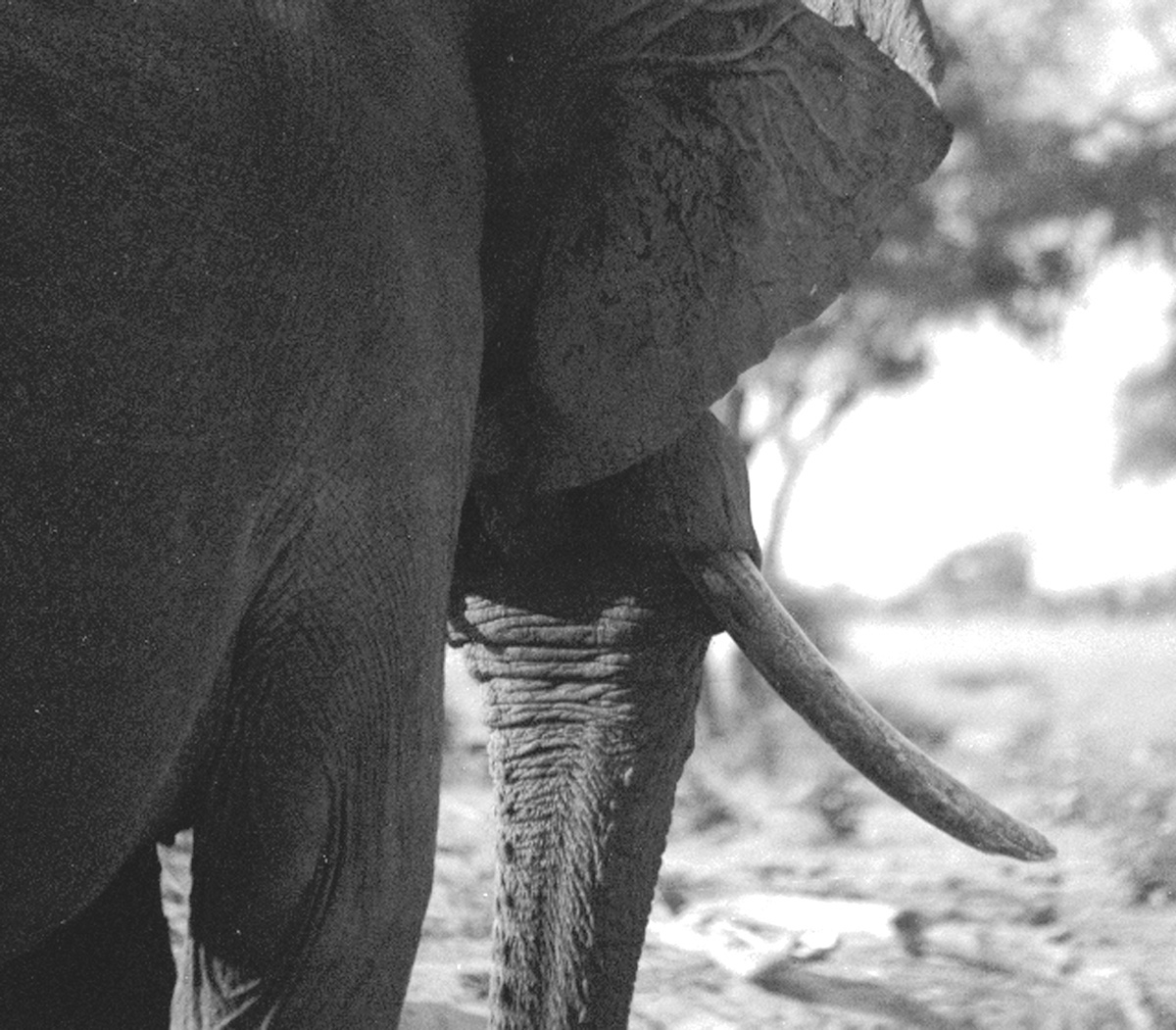
His enormous tusk splayed out almost sideways. I focused on his great head, nodding downward with each step, as he trudged past. A thirsty pilgrim in a parched land, his trek to water was nearly finished. The clicking and whirring of our cameras didn’t alter his gait.
photograph by Cheryl Merrill
Through the viewfinder I marveled at his tusk. It was easily four feet long, stained and chipped on its end. Because of the growth pattern of his tusks – out, rather than down and up – he seemed a much wider elephant than he really was.
Mid-drink, he curled his trunk into his mouth; head tilted back, eyes closed. Extending his trunk into the waterhole, he blew bubbles before curling his trunk again and again to hose several gallons at a time down his throat. With each swallow went samplings from all the animals that drank here – zebra, wildebeest, warthog, ostrich, hyena and the occasional furtive flavor of lion.
I tried to imagine the bouquet garni of the waterhole and how its myriad fragrances might seep into the crevices of an elephant’s mind, form pools of scent they recognize, year after year, the liquid memory of Africa. Perhaps that old bull was memorizing the stories in that trough, paragraphs of taste and smell, twists of plot and character and fate.
He retraced his steps to where we were parked, and stopped close by. His skin was the color of seasoned cast iron. The waterline on his body rose just past his belly. Spatters of mud stained his ears and back.
photograph by Cheryl Merrill
After several long minutes, his eyelids drooped and his mouth slackened. Under the hot sun he fell asleep, lulled perhaps by the narcotic of a long, slow drink. The tip of his trunk coiled like a magic rope on the ground. He slept with his weight on three legs, resting a hind leg, occasionally rocking back on it as if he dreamed of his trek. Drool from his trunk slowly seeped into the sand.
I matched my breathing with his, and drowsed once again, sedated by the sun.
The giant beside us rumbled soft snores in his sleep. Other elephants shuffled by quietly on their way to and from the waterhole, as if they didn’t want to wake us.
I’ll be gone for awhile, but here’s a very lovely elephant to watch over you. Our house sitter isn’t “into” elephants, but I promise to try and reply to comments while I’m on the road.






 ABOUT ELEPHANTS