Posted in Africa, Doug, Elephants, Jabu, Morula, Sandi, Thembi, Travel

Mammals Are Called Mammals Becuz. . .

As promised, I’m re-visiting the third most popular blog post of my blog in 2014:  an excerpt from my book, Larger than Life: Living in the Shadows of Elephants.


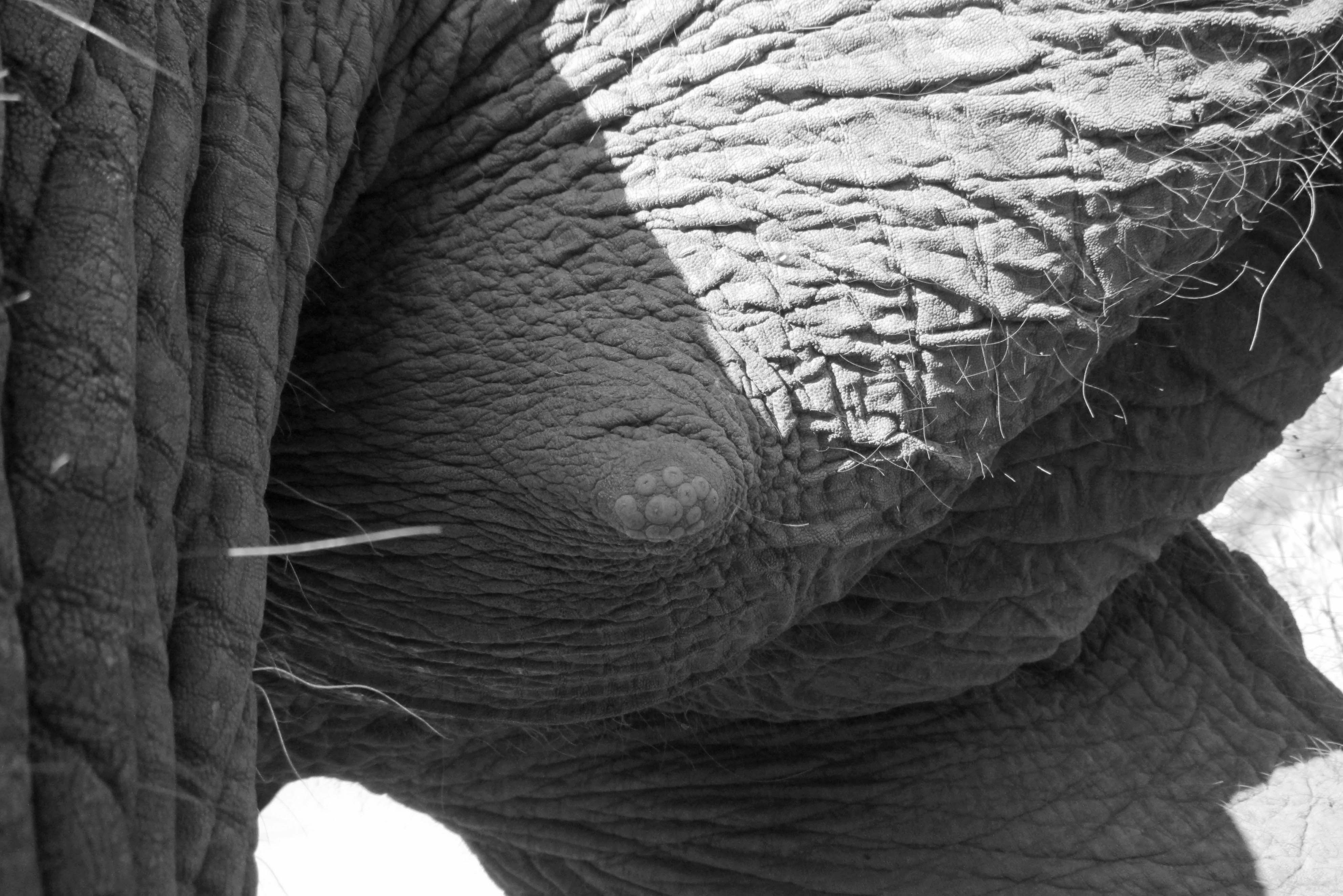
Doug gets my full attention when he proclaims to his guests, “Thembi has a great set of knockers.”

“Thembi, leg.”

She obliges by bending her left front leg at the knee and raising it, exposing a clear view of her breast.  “See?  Elephant mammary glands are located on the chest, like humans.”
A Great Set of Knockers

I lean over Doug’s shoulder and look at two gray breasts with permanently erect nipples.  They’re about the size of a medium cantaloupe and, like human breasts, slightly globular, due to the pull of gravity.

“Alllllll-right, Thembi.”  As her foot touches the ground, she flaps her ears and her trunk snorfles around his feet.

“If you reach in like this,” Doug demonstrates, “you can feel them.”

Steadying myself with one hand on Thembi’s leg, I reach in and cup her breast with the other hand.  The skin of her breast is as soft as an old, creased leather bag.  Her nipple, as one might expect, is harder than the flesh around it.

Thembi emits a low, murmuring rumble.

“Oh you like that, do you, Thembi girl?”  Doug chuckles.

I quickly withdraw my hand and step away from her side.

“Anyone else want to try?” asks Doug.

Out of the seven of us, several people look away, several look down.  No one ventures forward.  I can’t tell if everyone is embarrassed or just reticent.  Feeling up an elephant may not be quite what they had in mind.  It certainly wasn’t what I had in mind.

“Well, OK.  Mammals are called mammals because . . . . ?”

One of the guests ventures, “Mammary glands?”

“Right.”  Doug continues his lecture: “Like all mammals, Thembi’s lactiferous ducts terminate in her nipples.  They point out a bit, while Morula’s nipples point down.  Thembi gets a bit of stimulation while she walks, don’t you, Thembi girl?”

Some of the guests look mildly scandalized, while others giggle and whisper to each other.

Doug rubs Thembi’s leg, which generates another snorfle.

Female elephants don’t have a row of teats, like cats or dogs.  They don’t lie on their sides, suckling a litter.  Elephant calves nurse standing up, with their small trunks flipped over an eye like a wayward curl.

All mammal breasts are modified sweat glands.  Some mammal breasts are located in the groin and some on the chest.  The breasts between Thembi’s front legs are in the same location mine would be if I walked around on all fours.  Her breasts weigh about four pounds each, .1% of her body weight.  Human breasts weigh .08% of total body weight, dogs 2%, rats 9%.

Do all mammals have larger breast size to body weight than humans?  I pull out my notebook to write down that question, but then decided I really don’t care, and put the notebook away.

“Is she pregnant?” asks the woman behind me.

Although Thembi possesses relatively trim tonnage in comparison to the other two elephants, she is significantly rounder – huge thighs, huge belly, a Rubenesque sort of girl with a really long nose – and very full breasts, unusually large for a non-pregnant elephant.

“We don’t think so,” Doug replies.  “We had her hormone levels tested about six months ago, and they were normal.  She’s an enthusiastic eater, so she might be a tad rotund because of that.  She might be incubating a surprise, but we doubt it.”

Sandi laughs. “That’s because she’s a bit of a flirt with the wild boys around here, but when things get serious she becomes quite horrified and scoots on home.”

Another one of the guests pipes up: “Has Jabu ever tried mating with her?”

“Yes, he’s tried,” Sandi replies, “But we’ve never yet seen him achieve intromission.”

Heads nod thoughtfully.  I can see intromission has thrown them a bit.  It’s not a word commonly used to describe sexual penetration, but I think most of the guests have a general idea of what it might mean.  Several of their heads swivel to gaze at Jabu, ripping apart a nearby bush.  Since he’s such a big boy, why couldn’t he just have his own way?

“Thembi doesn’t really favor him,” says Sandi, as if she’s reading minds.

“What if she had a calf?”

There’s not one second of hesitancy to Sandi’s reply: “Oh, we’d keep it.  It wouldn’t be easy, though.  Thembi’s never been in a breeding herd and has no clue about birth.  And she’s rather stuck on herself, you know.  We don’t think she’d be a good mother.  But if it happened, we’d make it work.”

Even though it’s not likely that Jabu and Thembi will become pachyderm parents, I can easily imagine Thembi as a pregnant princess, mood swings, food cravings and all.  As if to prove my point, she regally sweeps through a stand of grass, a princess on a mission.  She breaks off a few branches from a small thornbush, stuffs them against her back molars and chews with her mouth open.

Thembi has never been with an extended herd of mothers and sisters and aunts and hasn’t had the opportunity to learn the complex behaviors required to be a mother.  She’s never learned that newborn calves stay in physical contact ninety-nine percent of the time, either below or beside their mothers.  Although calves will begin to forage by nine months, they continue to suckle for about four years.  Elephants in zoos will quite frequently shun newborn calves.  So I can just about predict Thembi’s reaction to a calf:  What IS this thing following me around?

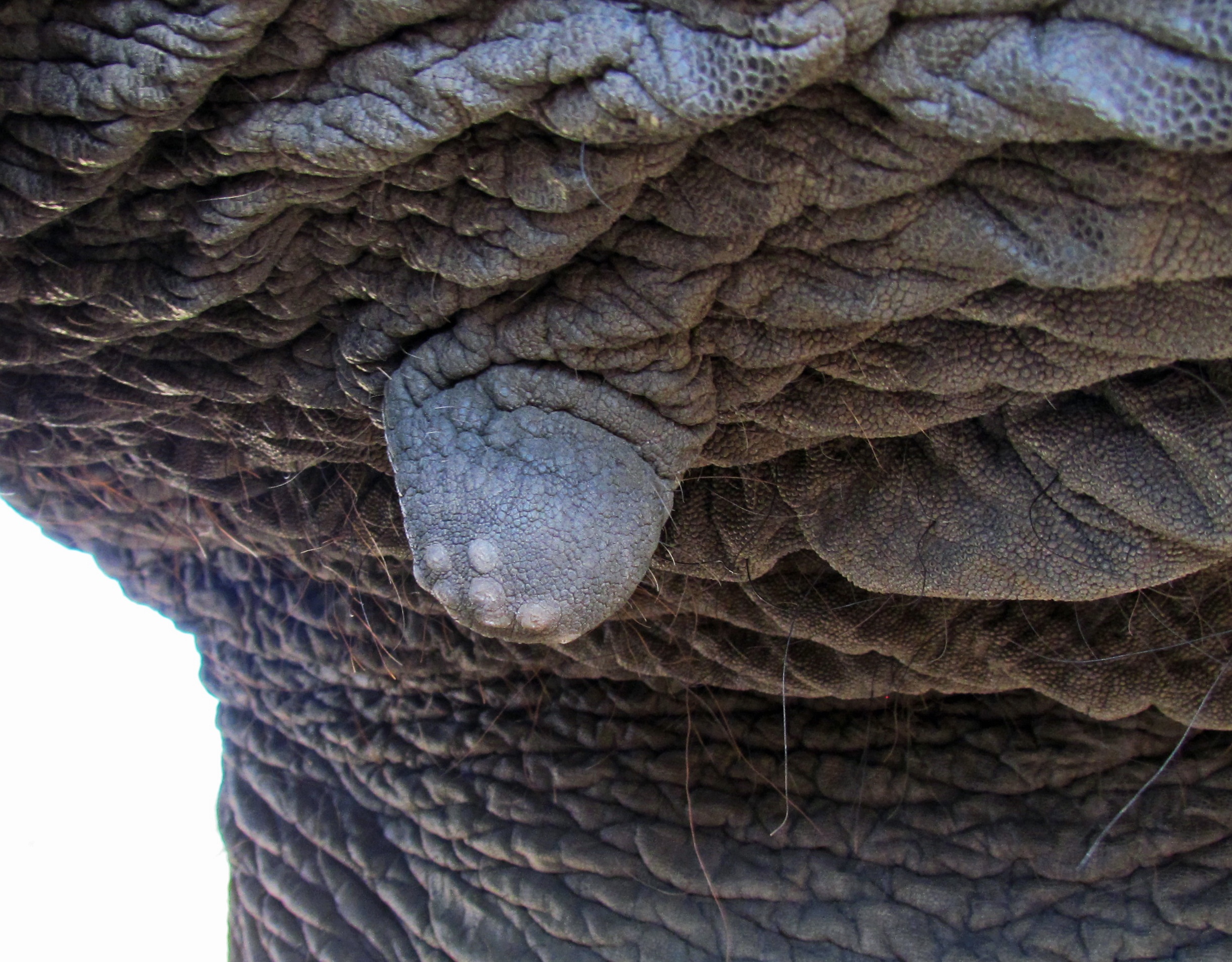
I glance over at Jabu.  He has nipples, too.  Guy nipples, nozzle-like nipples, surrounded with sparse hair.
A Guy Nipple

All mammals have three distinct features: hair, three middle ear bones, and mammary glands.  Even whales, dolphins, porpoises and manatees have hair, usually on their snouts or next to blowholes.  Elephants and manatees shared a common ancestor fifty-six million years ago, but the nipples of female manatees are now under their flippers, in their armpits.

A question comes from the back of the tourist group.  “What about Morula?”

Dear, Old Maid Morula.  The wallflower with big ears, large liquid eyes and a knobby forehead.

“If an elephant doesn’t breed by the age of twenty-five, they are unlikely to,” Sandi replies.  “Morula is already the ripe old age of thirty.”

Female elephants typically become active at a quite young age, around thirteen.  They can conceive as early as ten years old and possibly have 12-15 offspring by the time they are fifty.  Female calves will stay with the herd the rest of their lives.

Male elephants take a bit longer to mature and become sexually active around the age of twenty-nine.

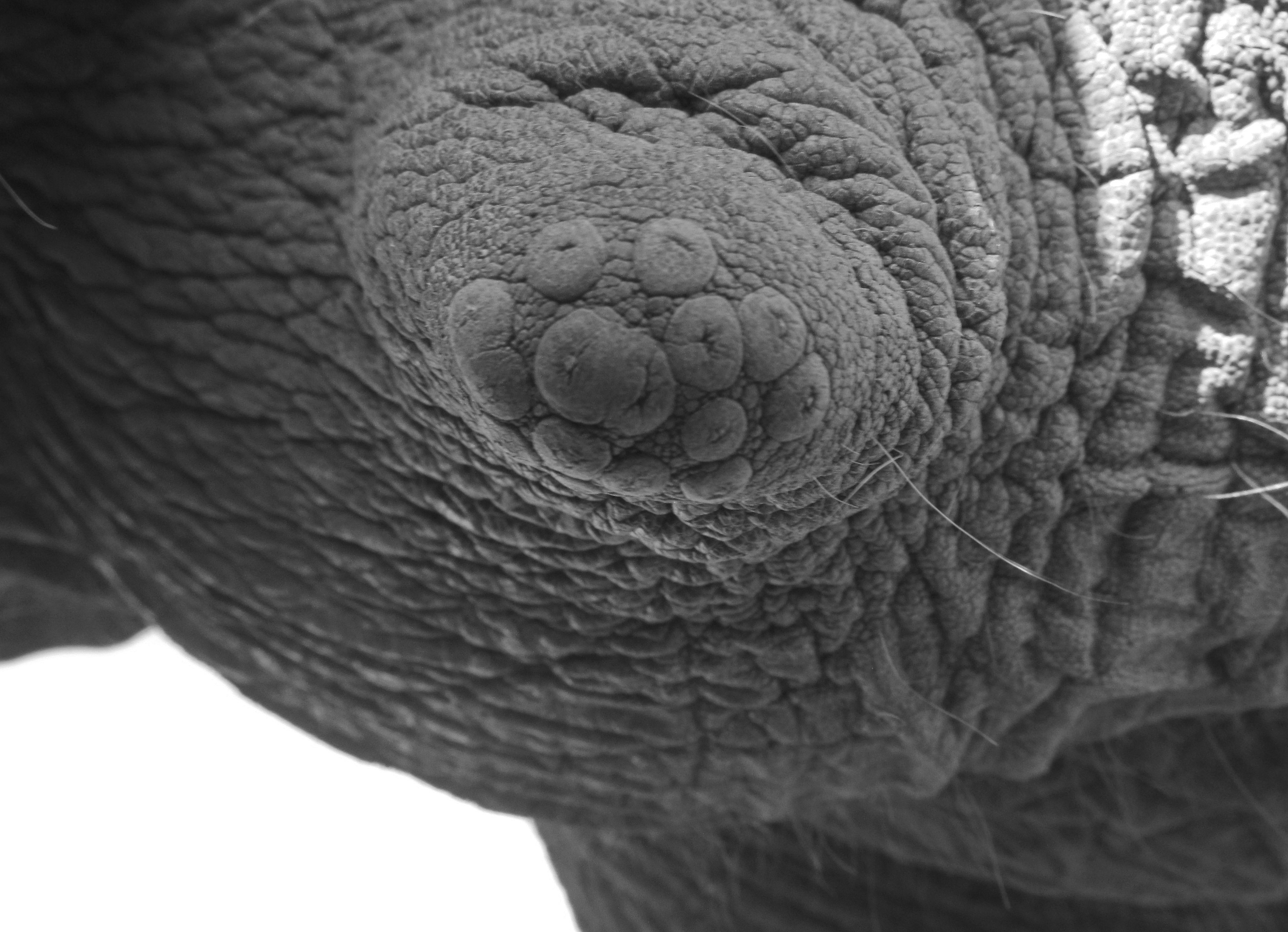
Morula has missed the boat.  But I’ll bet she’d make a great aunty.  She stands close by, slowly opening and closing her great ears, patiently watching.
One of the Lactating Class

When he first developed his classification system, Swedish botanist and zoologist Carl Linnaeus originally called mammals Quadrupedia, after the name Aristotle gave them.  Later he became actively opposed to wet-nursing practices in the 1750s and wrote a book on the benefits of breast-feeding your own child.  As a political act, he reclassified Quadrupedia to Mammalia in later editions of his most famous work, Systema Naturae, defining mammals as a lactating class within the Animalia kingdom, a classification that has lasted to this day – all because women of nobility in Linnaeus’s time thought breastfeeding would ruin their figures.

Certainly that’s one thing Thembi doesn’t have to worry about.

Posted in Africa, Elephants, Nature, Photography, Travel

2014 Elephants in Review

It’s always interesting to look at statistics and try to tease out what’s behind them.  My most popular blog posts were (1) Miles per Pound of Trees (elephant farts), (2) Black Mamba in the Toilet (self-explanatory) and (3) Mammals are Called Mammals Because . . . (elephant nipples).  You can see where this is going.  All I can hope is that those folks using their search engines for snakes in the toilet, elephant farts and elephant nipples are surprised and educated along the way.  For those of you with piqued prurient interest, I’ll repost them this month while I’m working on tightening up my elephant manuscript.  Thanks to the many followers – you know who you are.

Here’s an excerpt:

The concert hall at the Sydney Opera House holds 2,700 people. This blog was viewed about 15,000 times in 2014. If it were a concert at Sydney Opera House, it would take about 6 sold-out performances for that many people to see it.

Click here to see the complete report.

Posted in Africa, Nature, Photography, Travel

Hyenas


Photograph by Cheryl Merrill

an excerpt from my book:

The first time I stayed with Doug and Sandi, Stanley’s Camp manager met me in the lounge, handed me a cold beer and pointed to the banks of a nearby lagoon.

“Last year hyenas dragged our sofa out there and ripped it apart.”

The leather sofa never had a chance. A pack of frenzied hyenas can devour a four- hundred-pound zebra in less than half an hour, eating its bones, skull, hair and horns, even its hooves, leaving only a smear of blood on the ground. With a bite pressure of over a thousand pounds, hyenas pulverize and swallow enough bone their scat is chalk-white.

They will chase, kill and eat almost anything that moves: zebras, wildebeests, warthogs, rodents, hares, snakes, baby crocodiles, turtles, lizards, birds, caterpillars, termites, and every species of antelope in Africa. They will eat things that don’t move – such as dung – or flesh so putrefied and full of maggots it’s the consistency of cottage cheese. They will filch and eat anything not locked up: boots, toothpaste, shaving cream, underwear, soap, even bottles of hot sauce. What’s glass to a creature that can eat a zebra’s hoof?

At Stanley’s the hyenas climbed a set of wooden steps into the dining lounge in the dead of night, shoved aside several tables and chairs, pulled the sofa down the steps and dragged it the length of a football field, depositing it at the lagoon. They ate its leather and left a gnawed wooden frame.

I asked the manager, “Why the sofa?”

“Just the oil from human hands.” He rubbed a palm across the sofa’s replacement. It’s leather, too. This sofa must also be doomed.

“There’s a den near the main road,” he added. “A game drive’s going out soon, if you want to go.”

We parked near the entrance of the den, motor off. The guide cautioned us to be very quiet. After a few minutes, a lone Spotted Hyena tentatively emerged. She had the slouched profile typical of hyenas: massive head, thick neck, and shoulders tapering to small hindquarters – a hybrid creature’s odd profile, half fearsome predator, half coward.

The second largest carnivore in Africa (after the lion), and the most numerous of the large predators, the Spotted Hyena is both opportunistic and aggressive. A single adult, weighing at most one hundred and forty pounds, is capable of taking down a six-hundred-pound wildebeest. Although hyenas kill ninety-five percent of what they eat, they steal at every opportunity, chasing leopards, lions and cheetahs from their own kills. Everything a hyena eats is digested within twenty-four hours. Even the sofa.

Grinning her famous false smile, the hyena sat on the bare slope near the entrance of the den and turned black, empty eyes toward us. Her ruff and the tip of her brushy tail had a reddish tinge, but the rest of her coat was a dingy, grayish-tan. Her round ears and bear-like muzzle were lined with black. Spots on a hyena appear when they’re a year old and then fade over time. The irregular splotches on this female’s fur were still sharp, so she’s most likely a subordinate younger sister to the clan’s dominant female.

Less than a moment after the babysitter sat down, unspotted black fuzz-balls erupted behind her. Each time she took a pup down into the den, another escaped and then another. The grinning, panting, anxious nanny seemed to be having a nervous breakdown. I would have considered the pups cute, except for the hyena’s awful reputation.

Yesterday evening, when I mentioned the sofa to Sandi, she told me that in 2000 hyenas had killed an eleven-year-old American boy at the Xakanaxa (Kah-khan-a-kah) Campground, thirty miles northeast of here. Despite the young age of her son, his mother allowed him to sleep by himself. Apparently he left the zipper of his tent open, hoping to photograph the hyenas circling their campsite earlier in the evening. According to some accounts, he may have even brought food into his tent.

Awakened by shrieks and crazed laughter, their guide saw a huge female hyena dragging the boy into the bush.   People from nearby campsites helped locate the decapitated body, drove away the hyenas and guarded the boy’s remains until daylight.

One rescuer reported hitting the dominant female hyena – identifiable by the scar on her forehead – with his Maglite flashlight. “Guns aren’t allowed in the game park . . . so I hit the hyena on the head, and then she let go of the body and ran off.”

In the parks and game reserves of Africa, you never, never sleep with your food or leave the zipper open on your tent – if they’re around, hyenas will walk right in. At Doug and Sandi’s kitchen shelter anything even remotely edible is secured in heavy metal lockers or inside a propane-powered refrigerator. Over at Stanley’s, food is kept behind the heavy doors of a wood-frame kitchen. Watchmen now patrol the camp after dark.

But I bet someday hyenas will manage to steal the new sofa. They faithfully patrol the camps, too.

Photograph by Cheryl Merrill
Posted in Africa, Elephants, Jabu, Nature, Photography, Uncategorized

Heart

An excerpt from my book, first posted in 2012:

Heart shapes can be found in nature, if you’re lucky enough to spy one.  There’s a heart on Jabu’s trunk, a ridge of skin that feels like fine shoe leather.  One of his wrinkles pierces the lower third of this heart shape, from left to right, straight as an arrow.  His real heart hangs between his breastbone and ribs, a little to the left, just like mine does.  But instead of having a heart with a single point, an elephant’s heart has two points at its apex – so it’s the wrinkled outline of a human heart that Jabu carries on his trunk.


The length of Jabu’s real heart is about twenty-two inches, its width eighteen.  His heart weighs around forty-four pounds, almost the same as a medium-sized dog.  Still, it’s less than 1% of his body weight, a common proportion among large mammals and among humans.  My heart also weighs less than 1% of my body weight: about ten ounces.

The human heart is approximately five inches long, three-and-a-half inches wide and shaped like a pulsing cone.  It is the only muscle in my body that acts on its own – my heartbeat doesn’t need any messages from my brain.  The cells in my heart tissue involuntarily constrict, all together, all at once, over and over, a soft perpetual-motion machine.  Rip my heart from my body, chop it into pieces, immerse the pieces in a saline solution, and then give them a small jolt of electricity.  The remnants of my cardiac muscle will contract . . . contract . . .  contract – all on their own, sometimes for hours.

It’s designed to be strong, my heart.

In mammals, birds, and reptiles the heart has the same basic pump-like design, a design that has worked through eons – even cold-blooded dinosaurs had hearts.  A day or two after fertilization, embryos develop a pinpoint that pales, then brightens, pales, then brightens, the beginnings of a tiny pump practicing emptying, filling, emptying, refilling.  An old, old pattern.  The master timepiece.

There are four chambers in my heart: two auricles (“little ears”) and two ventricles (“little bellies”) – named by anatomists for the external parts of the body they resemble.  Spent, dark-red blood is collected in the right auricle, then dropped into the right ventricle, which constricts and pumps it out to the lungs to pick up oxygen.  Bright red again, full of oxygen, blood circulates back to the left auricle and from there drops into the left ventricle.  In the next twitch blood is delivered to every corner of my body.

The “little ears,” the auricles, make very little sound as they drain blood into the lower chambers of my heart, a distance of an inch or so.  It’s the ventricles, the “little bellies,” that boom as each contraction forces open heart valves and blood gushes up the aorta under pressure.  Lupp DUPP.  Lupp DUPP.  Lupp DUPP.  One beat smaller, one beat larger, flush after flush.

My right ventricle has walls thin as paper – it delivers blood only as far as the lungs.  If I could hold it up to the light I could see right through it.  The left side of my heart is the heavyweight lifter, pumping blood all the way to my toes, moving 150,000 tons of blood in my lifetime.

Jabu’s great artery, the aorta, takes off from the left ventricle of his heart, the same as mine does.  Named in the Middle Ages, aorta means, “to heave.”   It’s an artery more flexible and sturdier than any manmade pipe.  Jabu’s left ventricle pumps a continuous stream of blood up and out of his heart into the aorta, which then drops down into his chest and down each leg, where it branches and branches and branches all the way to his toes.  Each arterial branch has less space than the artery it came from, but the sum of  their volume is always greater than their mother artery.  The blood moves, but more and more slowly through smaller and smaller pipes, trickling into all corners of Jabu’s body, trickling through capillaries one cell thick.

Blood’s trip back to the heart is made through veins.  Millions of tiny venules drain into thousands of small veins, thousands drain to hundreds, hundreds to the one that empties back into the heart.  Veins are even more elastic than arteries, can hold variable quantities of blood, and serve as a reservoir for all that moving liquid.  At any one moment, 65% of my blood is contained in my veins.  It’s an ancient blueprint, this branching, this heartbeat, this coming and going, a blueprint brought to life in even the tiniest of creatures.

Blood has to be literally hoisted from Jabu’s toes.  Squeezed along by muscles wrapped around veins, pushed by valves in the veins, and sucked upward by the huge action of breathing, blood finally arrives in the vena cava, where it drops into the heart.  Jabu has two vena cavae, possibly because of the large amounts of blood that need to be moved.  The blood vessels of an African elephant reach lengths of twelve feet, a huge network of life.

Jabu’s body contains 120 gallons of blood, enough to fill an aquarium six feet long, two feet wide and two feet deep.  At one-and-a-half gallons, my puny amount of blood would barely fill a birdbath.

Blood is the body’s only liquid organ, five times denser than water.  It takes food and water in, removes waste and byproducts to the disposal areas of the body, the kidneys, lungs, and skin.  Blood irrigates all tissue, both feeds and cleanses.  It leaves the heart at one mile per hour and returns, laden with waste, at about half that speed.  Construction materials move along highways of blood, demolished materials return.  Blood is 20% solids and 80% water, carrying products of digestion, products made by the body, foreign intruders, the dust of stars, even cobalt from the original ocean of the earth where both of us, human and elephant, began our journeys.

We each have roughly one billion heartbeats for our lives.  Mouse, hummingbird, elephant, human, all the same.  Like us, elephants suffer cardiovascular disease, die of heart attacks and strokes.

Cardiac arrest: when the heart shudders and stops, when the light in the eyes flickers, fades and snuffs.

And when the heart quits beating, its resonance

Lupp DUPP     Lupp DUPP     Lupp DUPP

is gone.  The gurgle of digestion, all the silky, sturdy, slapping noises, the blood rush, gone.  The symphony of the body is finished.

For those of us left, that silence is almost too much to bear.

The heart on Jabu’s trunk
Posted in Africa, Elephants, Nature, Photography

Elephant Infrasound, Part Two

photograph by Cheryl Merrill

I almost know infrasound.

No more than a mile from my home huge freighters push through the deep, cold waters of Puget Sound. On flat black nights the thump-thump of their propellers travels through water, through air, churns into my bed, my bones, and the lowest threshold of my hearing. Born in the bellies and boilers of machines, the mechanical throb carries along rotating shafts that turn the metal blades of propellers, which slice through water like a dull knife hacking flesh: whummmp. ..whummmp…..whummmp.

Everything makes a sound when vibrations travel through a conducting medium, although we may not be able to hear it.

As Morula scuffs dirt, waves of air particles wash out in all directions. They reach my ear and vibrate my eardrum, which excites the three small bones of my middle ear: the hammer, anvil and stirrup. When the last little bone, the stirrup, takes up the vibration, it presses against fluid in my inner ear and creates a tiny sea of waves that tickle the hairs inside the spiral of my cochlea. The tickled hairs trigger auditory nerve cells that shoot electric signals to my brain.

Air, water and electricity in such a small space.

Large without, Morula’s ears are also large within. The bones of her inner ear are massive compared to mine. The combined weight of her hammer, anvil and stirrup totals just over a pound, compared to mine at two ounces. Her ear canal is eight inches long and her eardrum is about one and a half square inches. Maybe this doesn’t seem very big, but my eardrum is thinner than this paper and only one third of an inch square. You would need two hundred and fifty of my eardrums to create a stack an inch high.

Hum with your mouth closed. Now place your hands over your ears and hum again. The vibrations bypass your eardrums and are transmitted through your skull. Wavelengths tingle along your jaw line. Your bones are rattling.

Sounds are louder with a bigger collecting surface. Cup your hands behind your ears and listen as if you were an elephant.

Posted in Africa, Elephants, Nature, Photography

Elephant Infrasound, Part One

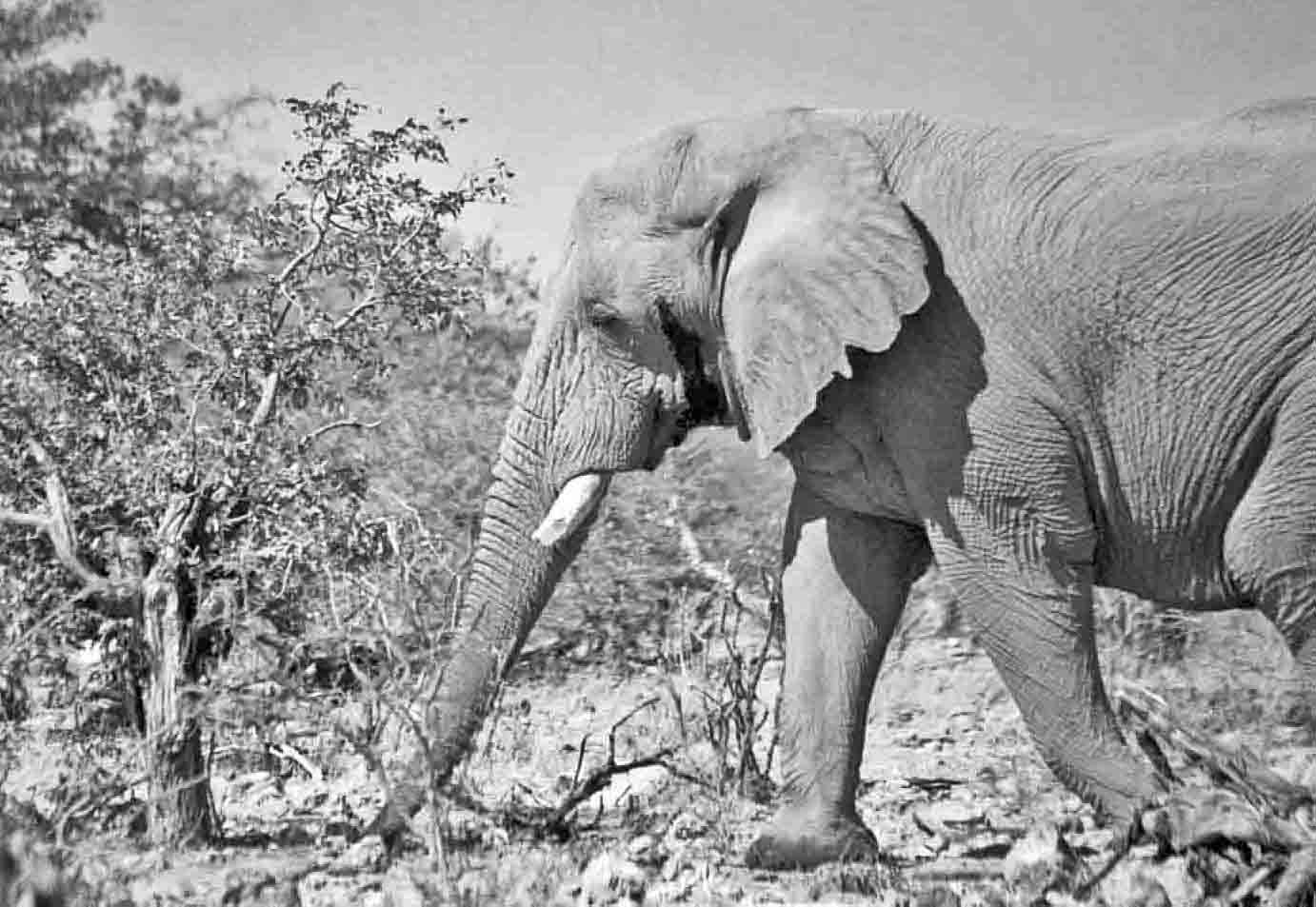
Etosha Male photograph by Cheryl Merrill
Etosha Male
photograph by Cheryl Merrill

An excerpt from my book:

In 1984 whale researcher Katy Payne spent a week with eleven elephants at the Washington Park Zoo in Portland, Oregon, 170 miles south from my Pacific Northwest home. An acoustic biologist with fifteen years of experience studying the long and complex calls of whales, she was curious as to the kinds of sounds elephants make. Every waking hour of that week she listened and watched the elephants’ behavior at the zoo. She noticed that certain keepers elicited a positive response from the elephants, an intangible “thrill” in the air, like the rolling vibrations of thunder right before you hear them.

On her way back to Cornell University, while she thought about her observations, the throbbing of the airplane reminded her of a pipe organ she once heard. During a performance of Bach’s Passion According to St. Matthew, a shuddering filled the air as bass notes from the great pipes descended in a deep scale until sound disappeared – but the air still throbbed. Those same, strong, vibrations-without-sound had filled the air around the elephants in Oregon. Could they be communicating with infrasound, like whales?

Four months later, back at the zoo, Payne and fellow researcher Bill Langbauer set their recording equipment to its slowest speed. They mapped the elephants’ movements and timed changes in their behavior with the recordings. Working around the clock for an entire month, they recorded what sounded like snores, chirps, barks, rumbles and even moments of absolute silence.

Back at Cornell, the first tape Payne selected to review was during a time of silence, when there was a “thrill” in the air as a female elephant faced a concrete wall and a male elephant faced the same wall in an adjoining enclosure. The elephants were just three feet apart, but completely separated. Running the tape at ten times its normal speed, the researchers heard sounds emerge from silence – elephants carrying on an extensive conversation in infrasound, even when they couldn’t see each other.

To test this new theory of elephant communication, The Cornell research team rigged a double-blind experiment in Africa. An observation tower near a waterhole at Etosha National Park in Namibia was outfitted with video cameras and microphones. Miles from the waterhole, a mobile van roamed through the bush outfitted with broadcast speakers and tape recordings. The timing, location and content of the broadcasts were unknown to the observers at the tower.

One hot, dry afternoon, two male elephants, Mohammed and Hannibal, picked their way through the white calcareous rocks around the waterhole and paused for a drink. As soon as the two bulls arrived, the tower radioed the van. Selected at random, infrasonic estrous calls of a female elephant from Kenya were broadcast to the two bachelors in Namibia.

A female elephant needs to advertise as far and as wide as she can, since she is receptive to males for just a few days every estrus cycle. She repeats her calls over and over for up to forty-five minutes at a time. The calls can be heard for nineteen square miles – but only by other elephants.

Just seconds after the sound was sent, Mohammed and Hannibal froze, spread their ears and lifted their heads – twisting them side-to-side like scanning radar. Within two minutes the bulls set off. Half an hour later the pair strode past the van, looking for love in all the wrong places.

Posted in Africa, Nature, Photography, Travel

Whoooosh-Thwack! Whooooosh-Thwack!

photograph by Cheryl Merrill

A selection from my book in progress:

As she walks, Morula’s ears slap flatly against her shoulders, Whoooosh, thwack . . . Whoooosh, thwack . . . Whooosh, thwack . . . Elephant air-conditioning.

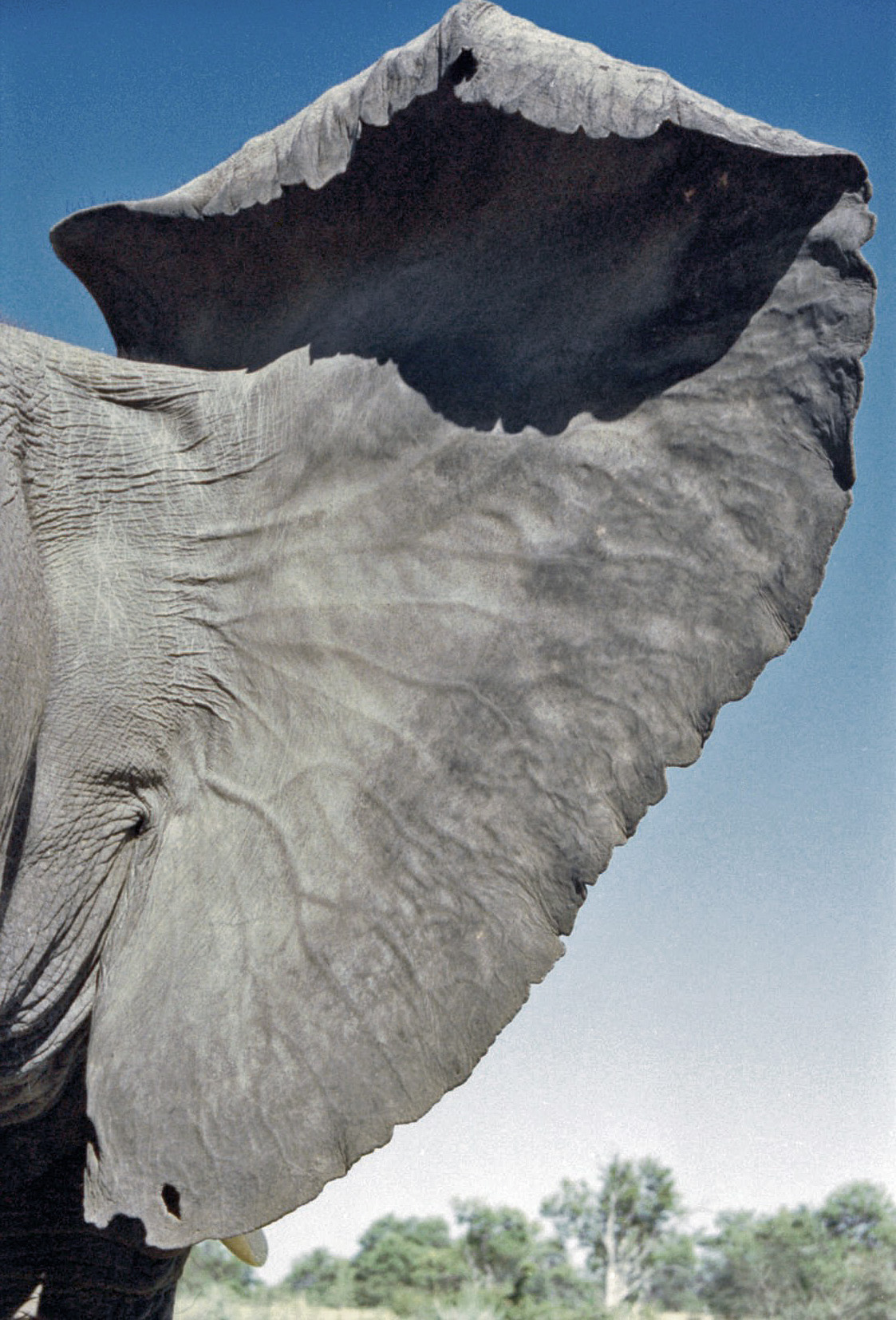
Morula produces enough heat to warm a small house. She is also pachy-dermed, thick-skinned. Some of her blood vessels are as deep as one-and-a-half inches under her skin’s surface. Since she doesn’t have sweat glands, her ears act like giant heat exchangers, regulating her body temperature. As air moves over the huge network of swollen arteries covering each ear, Morula’s blood cools as much as nine degrees before it returns to her body. When spread open, her ears increase her body size by roughly twenty square feet, a huge area for the process of thermoregulation.

Whooosh, thwack . . . Whooosh, thwack . . . Whooosh, thwack . . .

I take a photograph of her ear in mid-flap. Where Morula’s ear attaches to her shoulder, wrinkles give way to swollen arteries pumping five gallons of blood per minute across the surface of her ears. The pattern of those arteries is as unique as a fingerprint and often used to identify individual elephants.

Whooosh, thwack . . . Whooosh, thwack . . . Whooosh, thwack . . .

The breeze she creates dies before it reaches me. I take off my cap and fan my own neck.

My teeny, itsy ears are built somewhat the same as hers are, with an upper rim of cartilage and a fleshy, lower lobe. But I don’t have an auriculo-occipitalis, an ear muscle the size of a weightlifter’s bicep. I can’t flap my ears. I can’t even wiggle them.

Posted in Elephants, Nature, Photography, Travel

Trunk

photograph by Cheryl Merrill

Funky jazzy trombone trunk.       Snaking snorkeling vacuuming trunk.       Showerhead.       Backhoe.       Slinky.       Shimmying sucking swigging trunk.       Empty pipe.       Water gun.       Periscope.       Plucking siphoning tenacious trunk.       Kazoo.       Tweezers.       Tentacle.       Affectionate handshaking pickpocket trunk.       Python.       Air hose.       Question mark.       Whistling snorting sneezing trunk.


Breathtaking trunk.


Posted in Africa, Elephants, Nature, Photography

If We Could Imagine Such a Thing


photograph by Cheryl Merrill


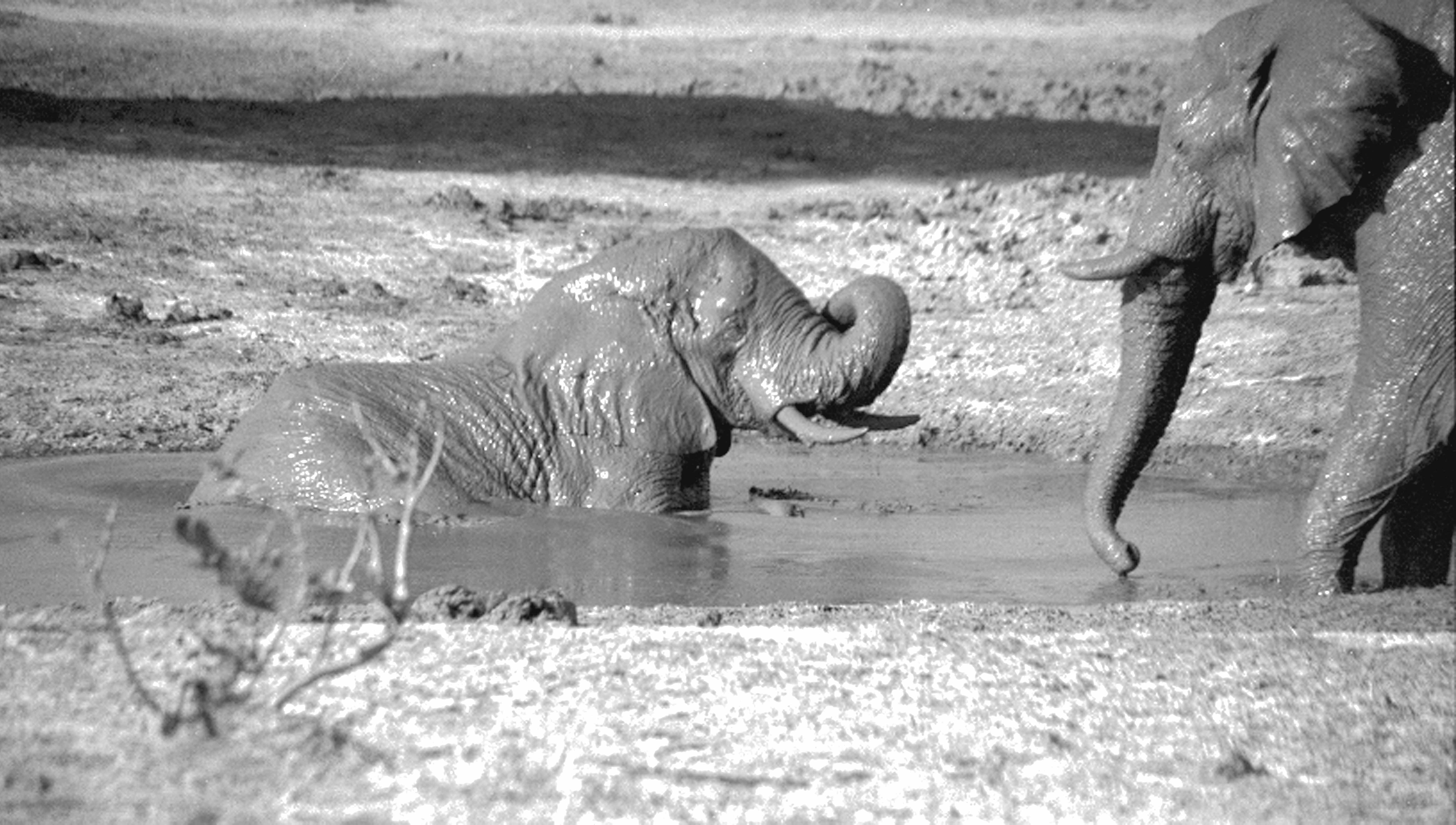
It’s a mucky, slimy, gloppy mud. The young elephant snorkels on his side, the tip of his trunk swiveling above the surface, as he slides towards another bull. His days are filled with heat and dust.

This feels good, his body language says, this feels really good.

If we could imagine ourselves weighing four tons, and think of gravity’s effect on those four tons, then maybe we could imagine wallowing in such mud, pushing and shoving like giant sumo wrestlers, reveling and rolling in the sheer pleasure of this warm gunk. We would inhale a slimy trunkful of ooze, squirt it like a watergun in any direction, even at each other. We would rub our eyes clear with a curled fist at the end of our trunks. We would arise glistening and bright as a metallic statue; we would be cooled, refreshed. . . .

if we could imagine such a thing.

Posted in Africa, Elephants, Nature, Photography

Where Clouds Stampede as if Chased by Lions

photograph by Cheryl Merrill


an excerpt from my forthcoming book:

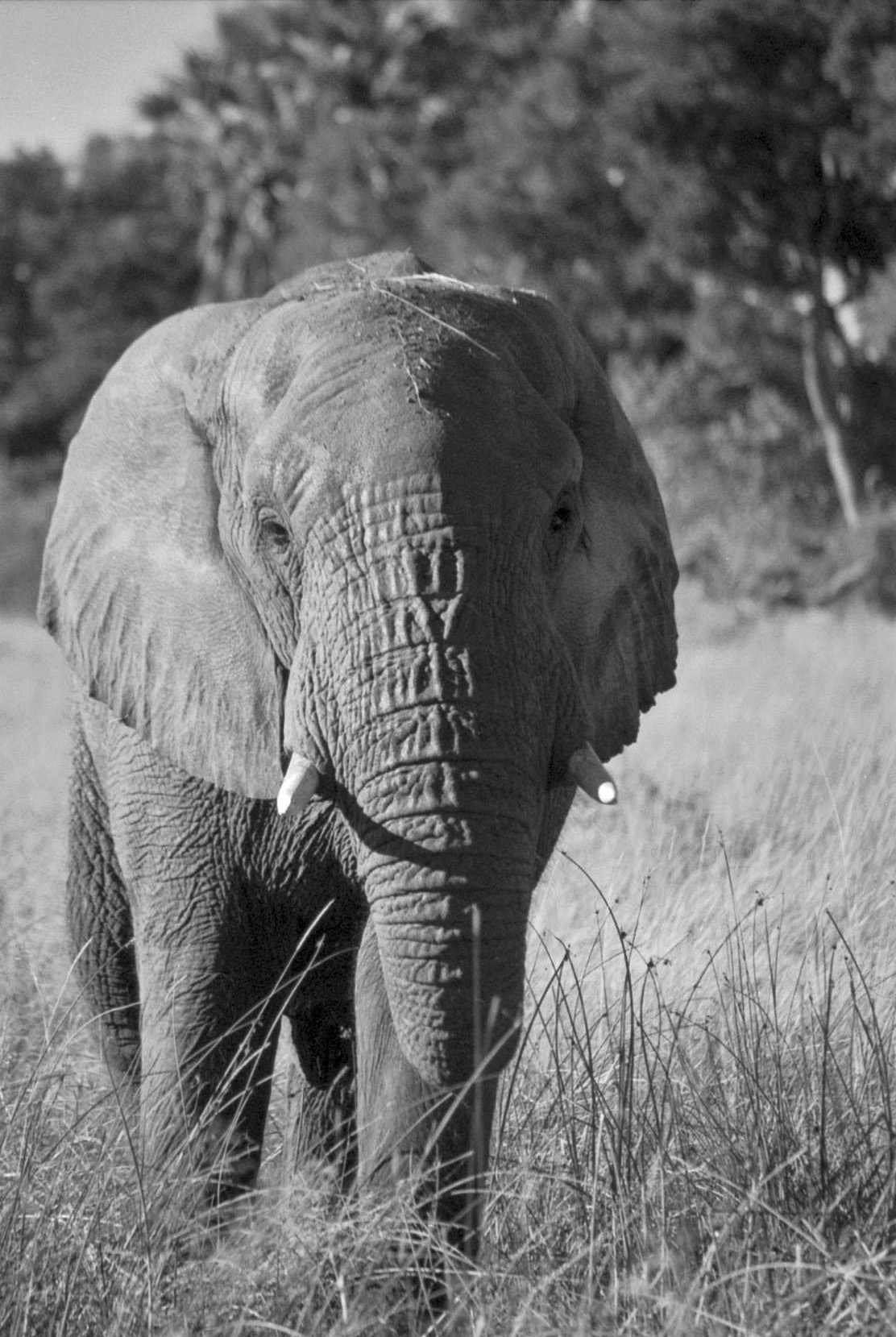
I look into a face like mine, a face with a mouth, a nose, two ears and two eyes, recognizable as a face.

Her eyes, like mine, are protected by bony sockets and eyelashes and eyelids and tears. Her eyes, like mine, sit high on her skull and light the darkness within.

The face that is like mine looks back at me.

Four-inch eyelashes cast shadows down her cheeks. She blinks and her lashes sweep against her skin like small brooms.

Each of the more than 200 lashes of my eye is shed every 3 to 5 months. Has anyone ever done research on the shed rate of elephant eyelashes?

I could.

I could stand here forever looking into the oak burls of her eyes.

Only one and a half inches in length, her eyes are just a little larger than mine are, but small in relation to her body size. A zebra’s eye is bigger. So are those of an impala or an ostrich.

I focus the lens of my camera on her oak-colored iris.

Peering through this window into the cavern of her mind, I remember she sees the world mostly in yellows and blues. Where the thin-skinned sky is a bare reminder that the earth is covered with air, where clouds stampede as if chased by lions, she treads through a harsh, dry landscape washed with the colors of waves.

I put a blue filter over the camera lens, then a yellow one. She turns aquamarine. Following in her wake, I begin to swim, serenely breasting an ocean of grass. She snaps a branch from a dark green shrub, chomps, munches, drifts closer. Her slow motions make perfect sense underwater.

As she floats by, undertones of blue and gray shimmer against her flanks, reflections of seaweed and kelp. I follow, sub-aquatic, at the bottom of air. Carried by the current of my imagination, I am about to tumble downstream.

Then the breeze kicks up again, feels as if it comes all the way up from the Kalahari, feels red, feels gritty, feels dry as a hundred-year-old skeleton left in the desert. It sucks every bit of moisture from under me and lands me, beached and gasping.

I lower my camera. Red invades green and the world yellows.