
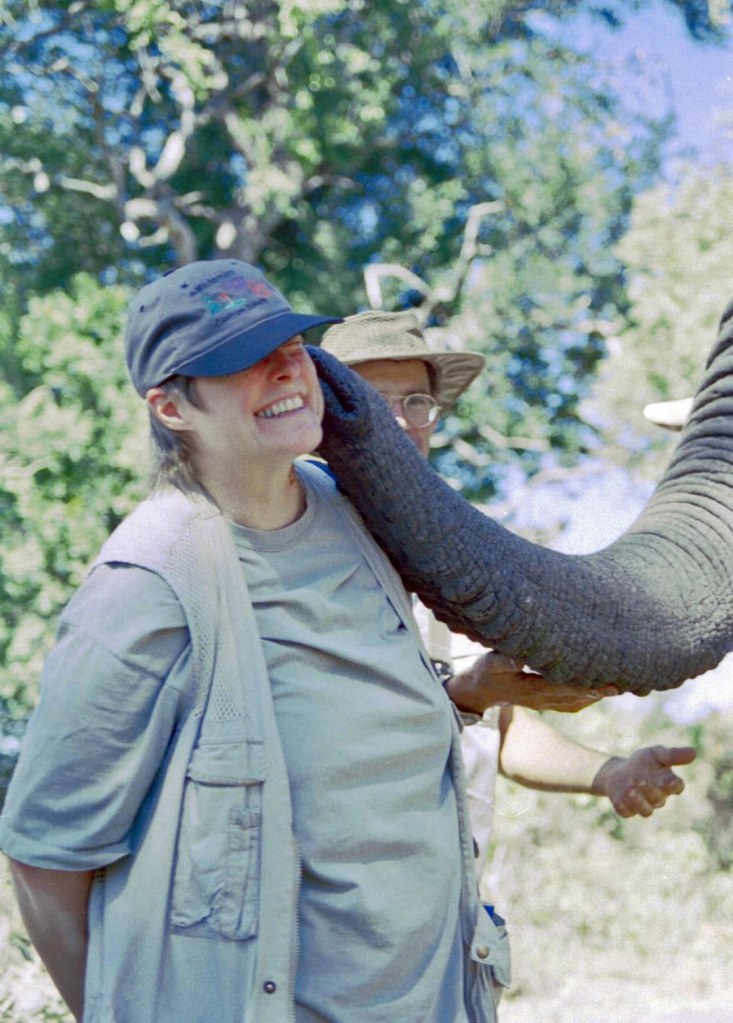
If you missed it the first time, my radio interview will be broadcast again this evening, Tuesday, November 10th, from 10-11 p.m., P.S.T., United States. Heres the live feed link: https://kptz.org
If you missed it the first time, my radio interview will be broadcast again this evening, Tuesday, November 10th, from 10-11 p.m., P.S.T., United States. Heres the live feed link: https://kptz.org
I’ll be speaking on our local radio station, KPTZ 91.9, on Friday, Nov. 6th, at 1:30 p.m. Pacific Standard Time, U.S. and answering questions about all things elephant. For my friends all over the world, you can live-stream by clicking on the link below, and send in email questions. Plus we’ll be broadcasting examples of elephant sounds. See you then!
You can click here to listen!

For most of the morning a group of female giraffes has followed closely behind us. Whenever we stop, they stop, too, and the spotted derricks of their necks swivel in all directions to get a better look at us. At the end of each neck, a head is cocked sideways: the universal body language that says, “Huh?”
As the giraffes become more relaxed in our presence, they feed more closely and don’t look up at us quite as often.
I stop and take a photograph, of a graceful giraffe with an oxpecker on her neck, as she bends down to browse.
Red-billed oxpeckers use their bills to comb through the fur of large mammals both wild and domestic for ticks and bloodsucking flies, clinging to their hosts with sharp claws. They also feed on earwax and dandruff, and have been observed opening small wounds, as well as enhancing existing wounds, in order to feed on blood. Oxpecker courtship and copulation occurs on their hosts while they ride along, and they cushion their nests with hair from their host.
Living together in the animal kingdom.
As I walk to my tent at the edge of camp, my vision is elemental, full of shapes without fine details. Shifting slabs of moon-glow keep rearranging trees as if they are pieces on a giant pearled chessboard, their trunks whitewashed the color of ash.
I enter my tent, zip it shut, and switch on the lamp. The electricity comes from batteries charged by solar panels on the other side of camp, carried by a line buried several inches below the sand. Not long after, I turn off the light and crawl into bed.
I roll on my back and blindly stare at the black canvas ceiling of my tent, looking back at the bright moments of the day. But then an unexpected memory darkens the darkness.
In 1996, on my first trip to Africa, I was in a carload of tourists rounding a corner on a sandy road in an area of Zimbabwe where elephants were recently massacred for their tusks. We rounded the corner and stopped – face-to-face with a huge matriarch.
Richly repulsive, an unnatural, confined scent rose from us – odors of food on our clothes and in our hair; flowers washed in alcohol dabbed behind our ears; dead skins around our waists and on our feet; grease, oil and exhaust from our vehicle.
With her trunk shaped into a “J,” the elephant sampled the waves of scent emanating from us, and then tossed our smell away with an emphatic flick. Unnerved by our overpowering human stench, a miasma with a deadly history, she turned and fled, while the half-shadow of dust that marked her exit collapsed to the ground.
The air around me tightens. Canvas walls crowd in, closer, and then closer.
What if our days were measured in scents rather than minutes? What if we could tell the difference between a friend and a murderer with just one sniff?
An excerpt from my book, Larger than Life: Living in the Shadows of Elephants
My eyes tired from a day spent looking into the sun, I drowsed in a Land Rover beside a waterhole in Chobe National Park. Only a few yards from our vehicle, a single-cylinder pump drew from the water table beneath the sands and sent spurts through a pipe to a square concrete trough. The bachelor elephants of Savuti congregated around the trough as they waited for spring rains and the return of female breeding herds.
The steady sound of the pump, chugga-sputter, chugga-sputter, chugga-sputter, lulled my eyes closed. They opened, closed, opened half-lidded, closed again.
“Here he comes,” someone whispered and my eyes flicked open as a huge bull strolled past. I picked up my camera.
His enormous tusk splayed out almost sideways. I focused on his great head, nodding downward with each step, as he trudged past. A thirsty pilgrim in a parched land, his trek to water was nearly finished. The clicking and whirring of our cameras didn’t alter his gait.
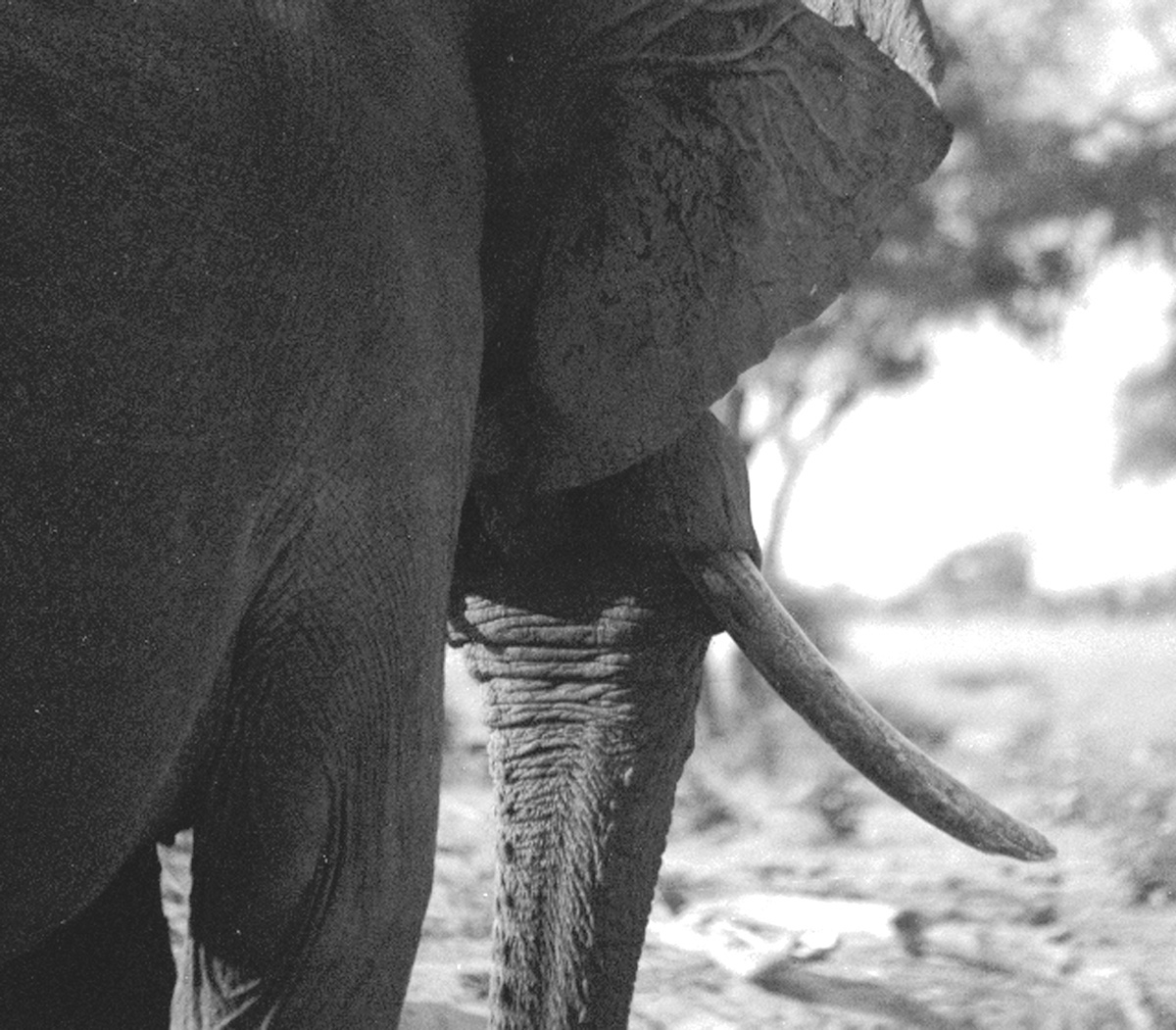
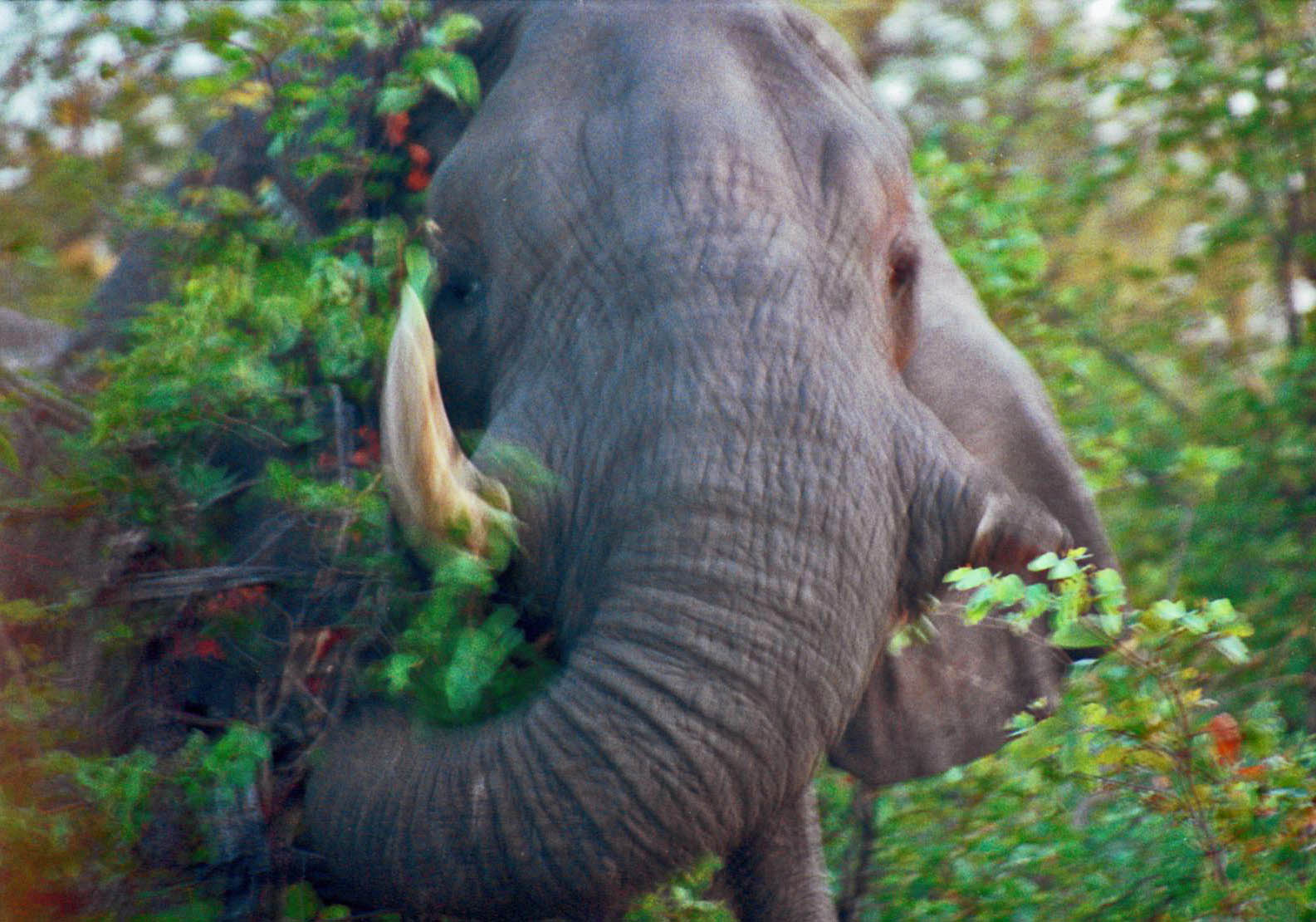
Through the viewfinder I marveled at his tusk. It was easily four feet long, stained and chipped on its end. Because of the growth pattern of his tusks – out, rather than down and up – he seemed a much wider elephant than he really was.
Mid-drink, he curled his trunk into his mouth; head tilted back, eyes closed. Extending his trunk into the waterhole, he blew bubbles before curling his trunk again and again to hose several gallons at a time down his throat. With each swallow went samplings from all the animals that drank here – zebra, wildebeest, warthog, ostrich, hyena and the occasional furtive flavor of lion.
I tried to imagine the bouquet garni of the waterhole and how its myriad fragrances might seep into the crevices of an elephant’s mind, form pools of scent they recognize, year after year, the liquid memory of Africa. Perhaps that old bull was memorizing the stories in that trough, paragraphs of taste and smell, twists of plot and character and fate.
He retraced his steps to where we were parked, and stopped close by. His skin was the color of seasoned cast iron. The waterline on his body rose just past his belly. Spatters of mud stained his ears and back.
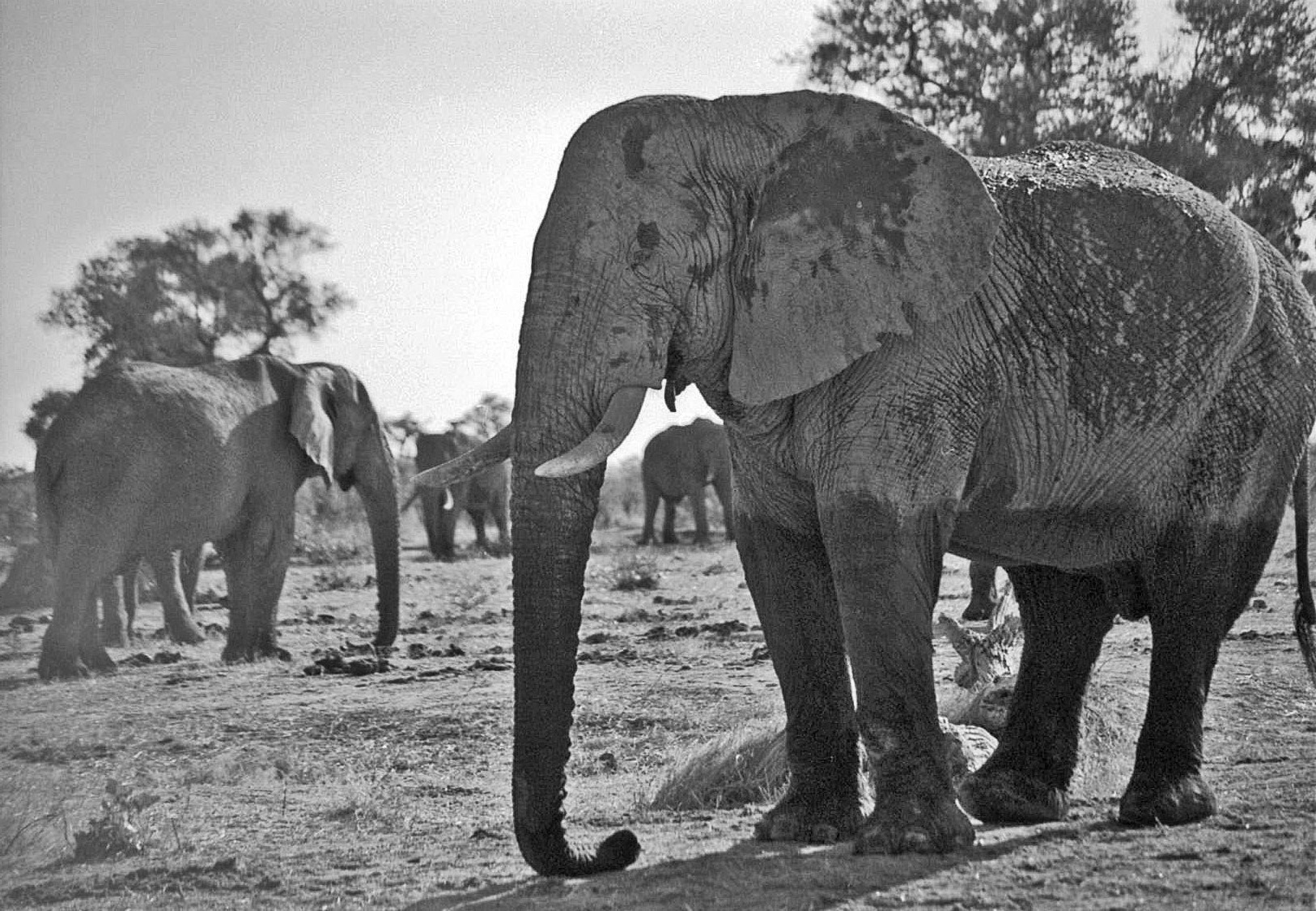
After several long minutes, his eyelids drooped and his mouth slackened. Under the hot sun he fell asleep, lulled perhaps by the narcotic of a long, slow drink. The tip of his trunk coiled like a magic rope on the ground. He slept with his weight on three legs, resting a hind leg, occasionally rocking back on it as if he dreamed of his trek. Drool from his trunk slowly seeped into the sand.
I matched my breathing with his, and drowsed once again, sedated by the sun.
The giant beside us rumbled soft snores in his sleep. Other elephants shuffled by quietly on their way to and from the waterhole, as if they didn’t want to wake us.
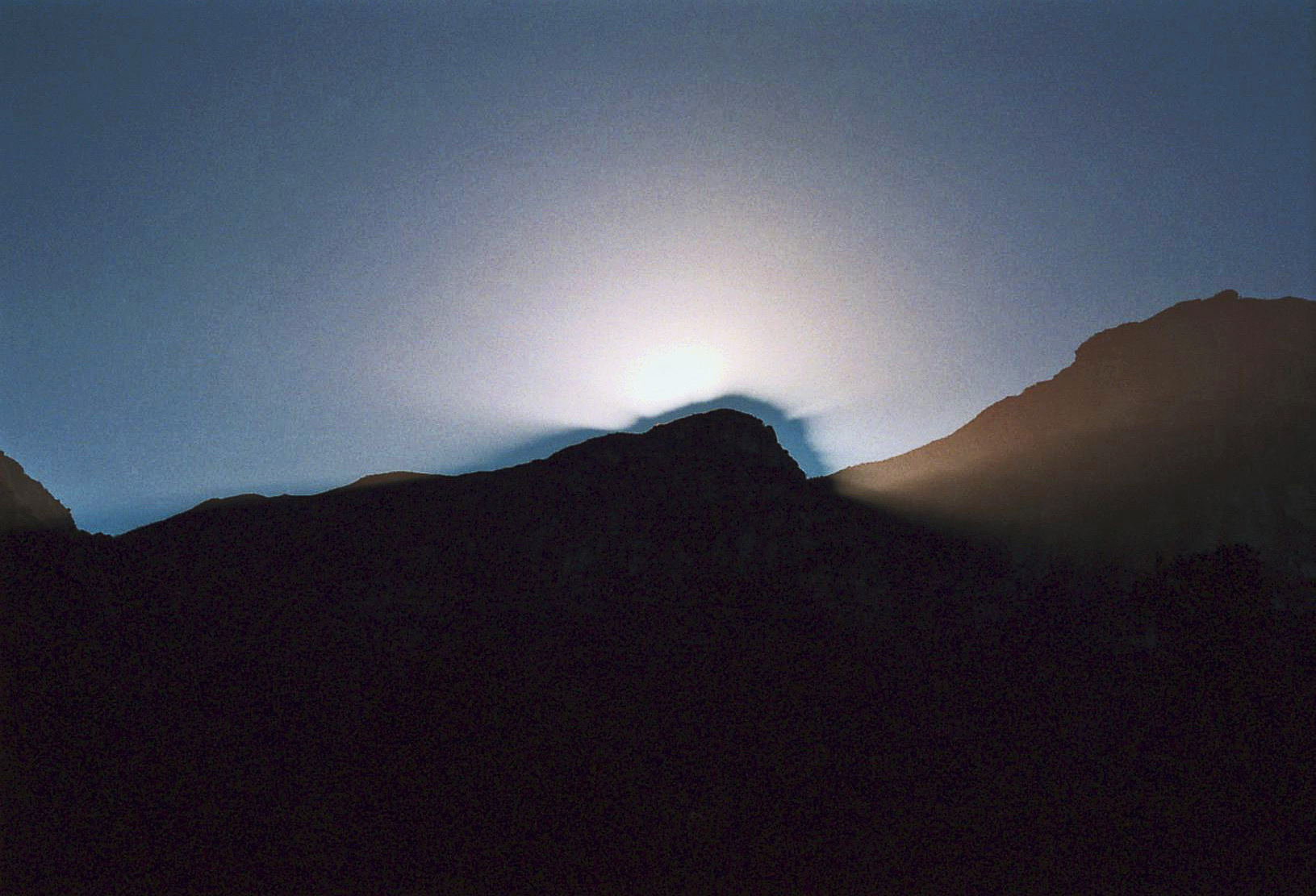
An excerpt from my book: Larger than Life, Living in the Shadows of Elephants
We wake up together, the birds and I. The sound of rustling tissue paper surrounds my tent – footfalls of francolins crushing bits of dry leaves. Small as quail and stooped as old men, the birds flip leaf litter with their beaks, searching for beetles, cackling to themselves.
I stretch stiff muscles – amazed I slept at all. During the night the roar of a lion woke me several times as he passed by. I learned on my first trip to Africa that contrary to myth, and even though they roared with great regularity each night, lions really don’t consider tents as flimsy wraps for tasty humans. Now all I hear are foraging birds.
I pull on a sweater, unzip the tent flaps, and take a single step outside. Alarmed, the francolins squawk loudly and scatter into the bush. I inhale deeply. The crisp air carries just a hint of sage and smoke, along with the slight scent of a dusty barnyard. On my way to the kitchen shelter, leaves crackle underfoot.
The sun rises – radiating spokes on her crown like the Statue of Liberty – rises into an immense lemon sky that almost turns green before it turns blue. Next to the shelter bare, wood-muscular branches on the Jackalberry tree blaze with light.
I’ll be gone for awhile, but here’s a very lovely elephant to watch over you. Our house sitter isn’t “into” elephants, but I promise to try and reply to comments while I’m on the road.


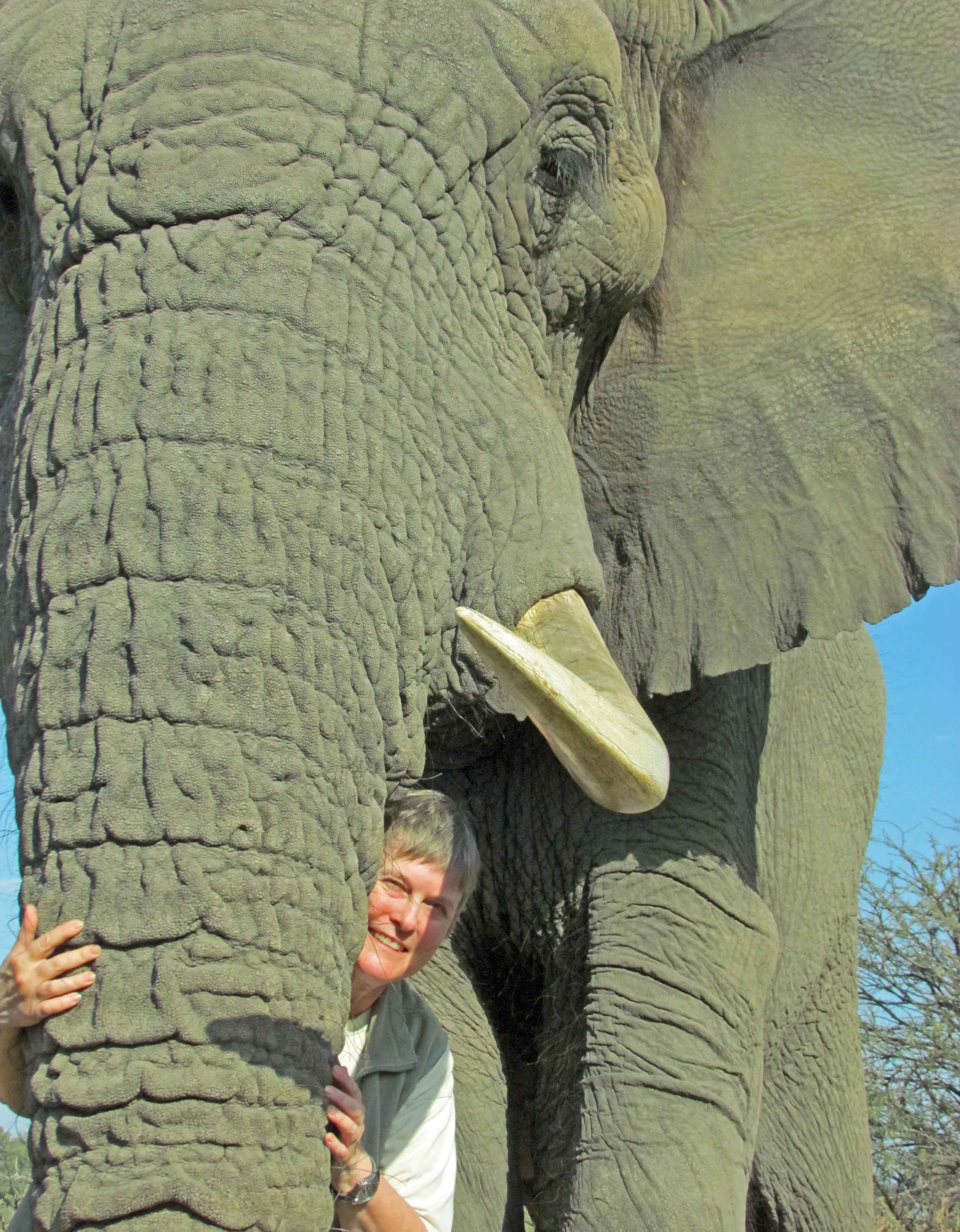
Jabu’s trunk tip investigates my right boot. Its scent swirls up two seven-foot-long nostrils – nostrils surrounded by nerves, arteries, veins and a staggering array of longitudinal and transverse muscles, the world’s biggest, longest and certainly most flexible olfactory organ.
A trunk is the most useful appendage that ever evolved. Imagine having an arm in place of your nose, an arm long enough to reach to the top of a tree and pluck a single leaf from its crown. Imagine having a nose that could rip, tear, excavate, whack, and blow bubbles. You could steal with your nose, suck on it, or swat, poke and siphon with your nose. You could take a shower, scratch your back, or whistle with it. You could even arm wrestle with your nose.
The seven-foot septum that divides Jabu’s nostrils is made of muscle, not cartilage. It becomes cartilage where his trunk attaches to his skull above his eyes. Thick layers of skin and muscle protect his trunk. It’s impossible for him to break his boneless nose, even when he uses it like a battering ram.
He picks up a wizened palm nut.
I ask Sandi, “How many of the fruits can he hold in his trunk?”
“Would you like a photo of that?” She takes some of the fruit already on the ground and puts them one, by one in the tip of Jabu’s trunk. “Jabu, good boy, Jabu, one more.”
Three, it turns out, but carefully placed so he can still breathe.
“Good, my boy, goooood. Okay Jabu!” Sandi tells him, and he spits out the fruits Whoooof! all at once.
Then he picks them up and gently tosses them, one by one, back to her.
When I was a teenager, I spent summers reading the National Geographics stored in my grandmother’s attic. I disappeared from those dull, never-ending days into a world full of gorillas and man-eating lions, of exotic peoples dressed only in feathers, of crocodiles and snakes and fish that could eat me. From old black-and-white photographs I conjured a fantastical place that mixed the jungles and deserts and continents of the world and labeled it Africa!
In 1996, fresh off a 747, I smelled the air of southern Africa for the first time: soft and warm as clean sheets drying in the sun, mixed with a whiff of smoke and sweet mulch, the mineral scent of sand, hot fur and the dry and dusty trees. I was absolutely convinced I had breathed this scent before, as if my body remembered Africa as the birthplace of my species.
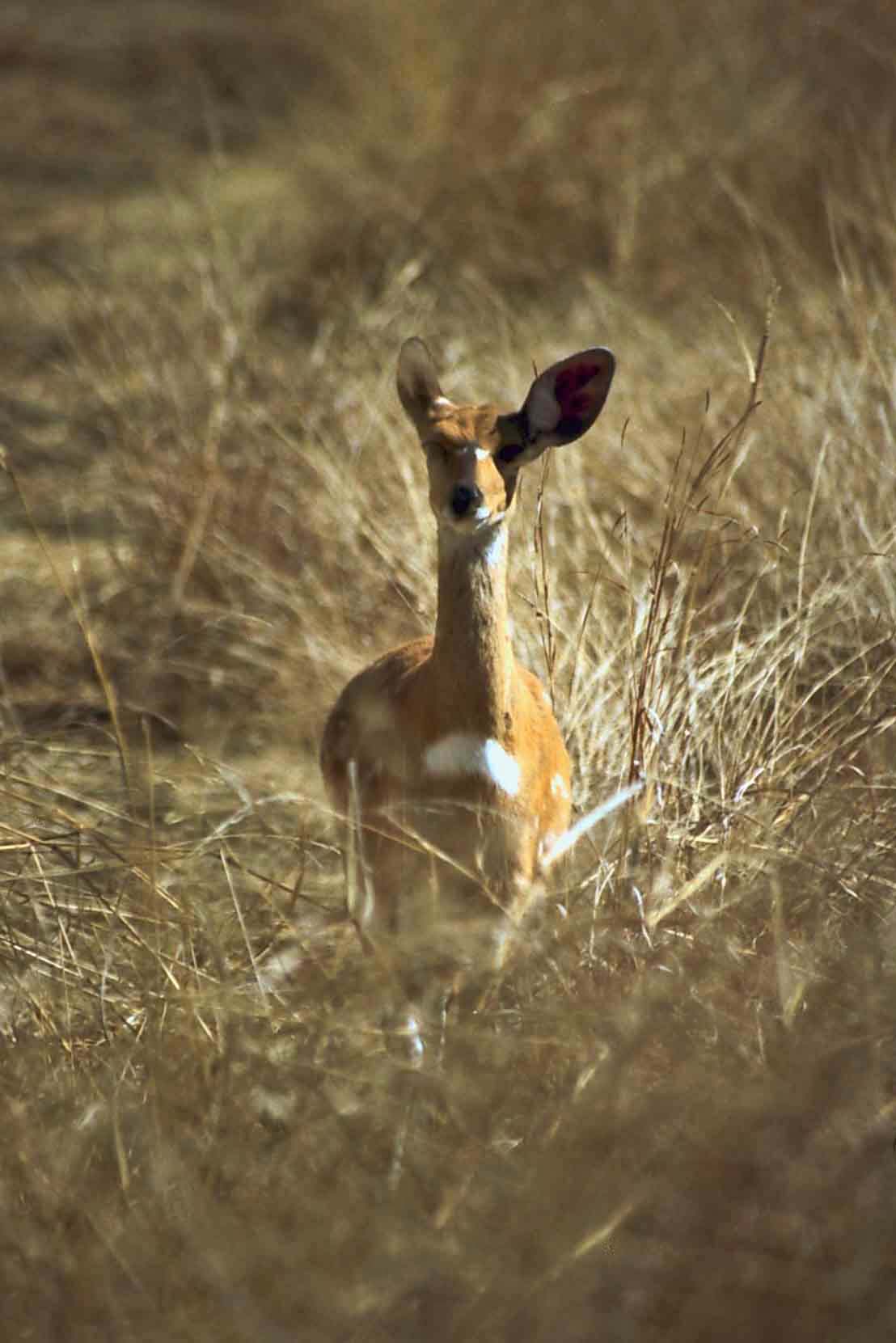
This is the first photo I took of wildlife in Africa: a bushbuck in the small park that surrounds Victoria Falls, on the Zimbabwe side. And in the five trips I’ve taken since then, I’ve never seen another bushbuck. That’s Africa: never the same day twice.
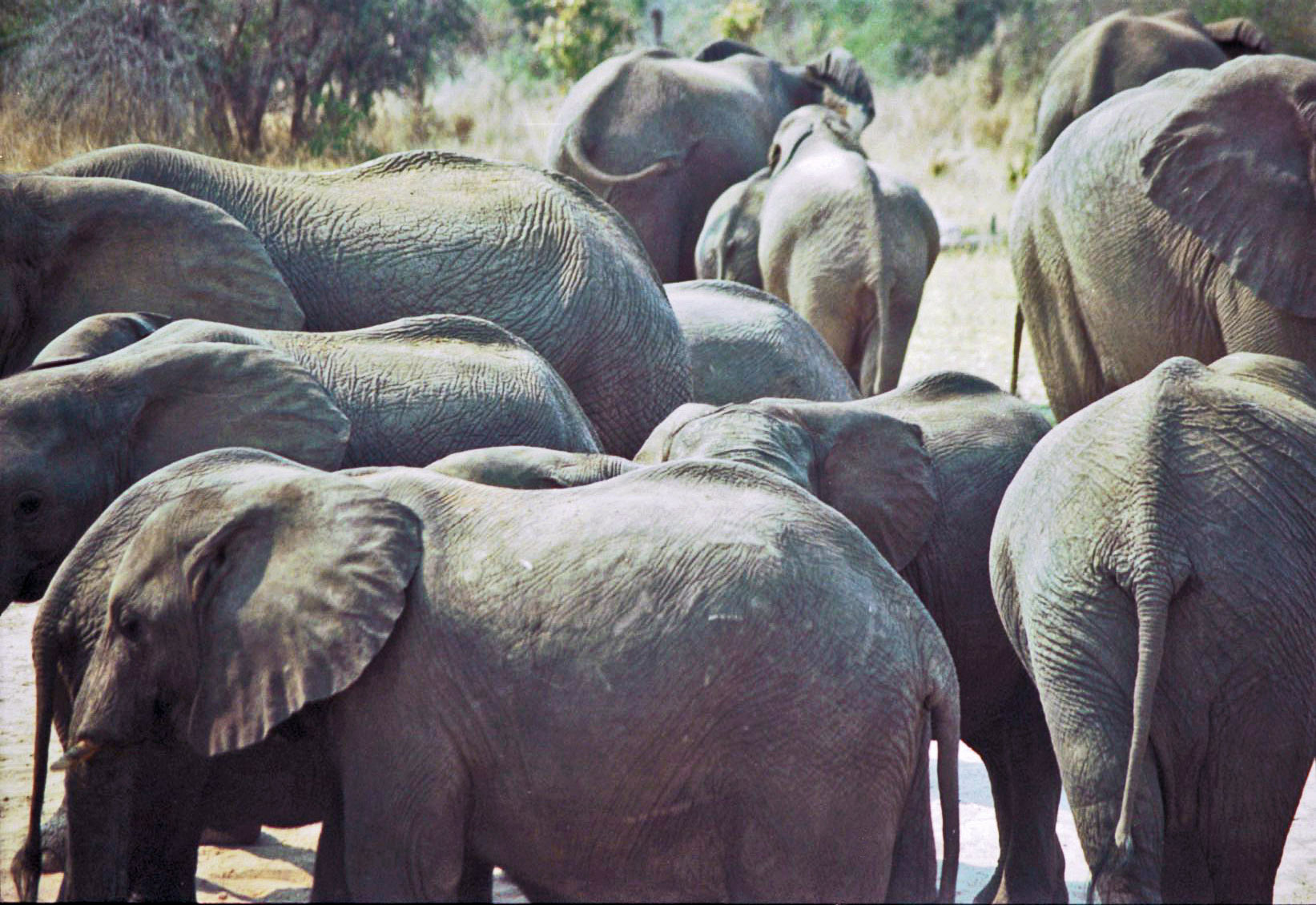
How many are left? With no real protection, with rampant corruption, with a continuous conduit to China, I wonder how many in this scrum are still alive. The thing I love most about this photograph are skin textures: wrinkles and rubs and stains contrasting with the smooth skin on their ears.
 ABOUT ELEPHANTS