The sound of water splashing draws us away from camp. We leave behind dinner preparations and walk out into the sunset, our feet soft in the sand. My boots kick up dust the color and texture of crumbled parchment.
Musty, bacterial, moist as a swamp cooler, the evening air condenses into cold pools. Shreds of scent blossom. I inhale freshened earth, the damp beginnings of night.
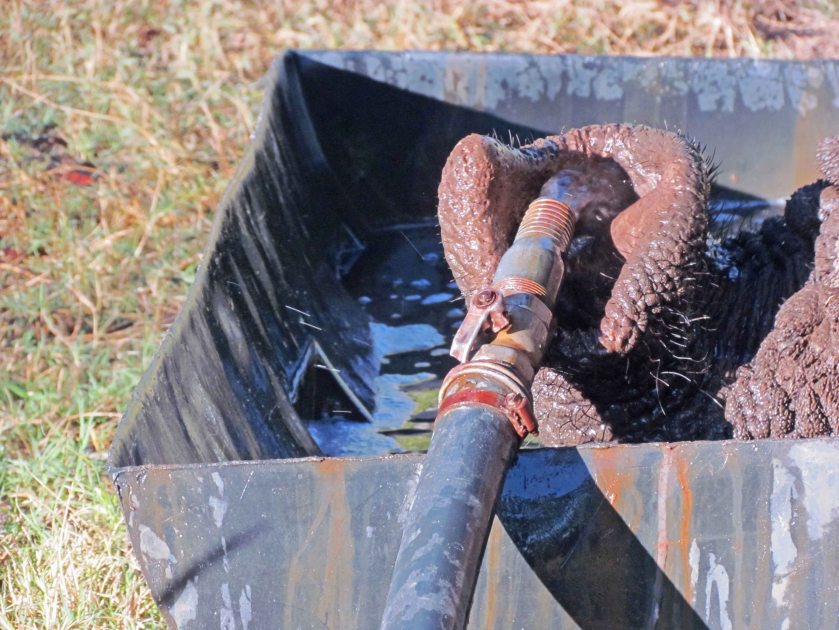
We find the elephants in a lengthening night shadow, drinking from a metal trough. Trunks curled, heads tipped back, eyes closed – they siphon water from the trough into their mouths. The sound they make as they siphon mimics the sound of rain in gutters, only the water is going up, not down.
Three elephant trunks reach toward us, sniffing the shadowed, violet air. Jabu thonks the end of his trunk against the ground, as if testing a cantaloupe for ripeness. Then he places the tip of his trunk directly under the hose gushing into the trough. Thembi curls her trunk tight enough to be nearly round, like a tire. Morula waves a medium-sized Hello.
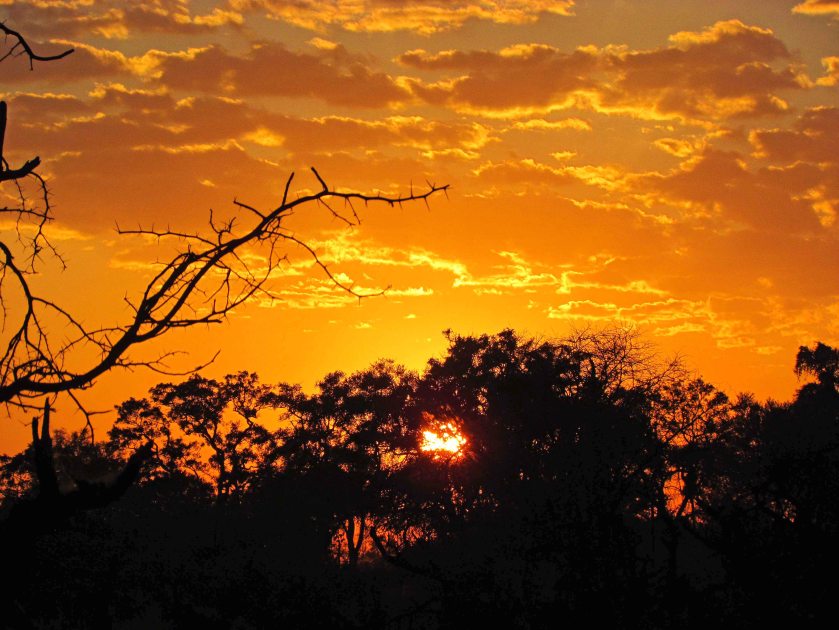
The honey-colored evening deepens to gold, then orange, shot through with veins of red, a saffron sunset. The elephants become a shade of rusty rose.
On our walk back to camp the last of the sun catches the top of a fan palm as the purple shadow of the earth spreads across the sky. The rim of the earth becomes the rim of the moon as it rises.
The elephants cross a dry lagoon abandoned by the Okavango River after last year’s flood. Enticed by a nearby tidbit, Thembi stops, sniffs at a bush willow, and daintily picks a single leaf to taste-test it. Morula and Jabu join in, not so daintily, ripping entire branches from the bush. Deft as magicians, they use the tips of their trunks to strip the soft leaves, as if conjuring playing cards from a stacked deck.
Jabu crams a wad of leaves into his mouth. He drags one foot and stirs up a gauzy curtain of powdered insects, ash, crumbled grass and dust. From his belly up, Jabu is all the colors of mud; from his belly down, seen through the dust, he’s a bit hazier, like an old, old photograph.
Gray wave after gray wave surges out of the bush in small herds of twenty or less, first one group, now another, flooding the huge hollow that contains a waterhole. Dust rises in the air, a potent blend of manure, dried grass and sand. The backwash swells in our direction. Soon a sea of elephants surrounds us. We’re submerged in a roiling world of noise. Snorts, grumbles, trumpets, growling bellies and gargantuan belches resound. Some of the vibrations are too low to hear, but I feel them as they pass through my body, reverberate in my chest cavity, squeeze my heart. Eye after eye inspects us as eddies of elephants swirl past. An old world laps at the foot of our memories, extinguishes centuries of communal fires. The ropes that tether us loosen. We slip away from the familiar shore and set off towards unimaginable ways of being. We look around with wild hearts. We have become part of the herd.
The sky turns orange and the clouds turn yellow. Sunsets like this one have hung in galleries for centuries. A slight breeze rises – the lungs of the earth inhaling warmth, exhaling coolness. The breeze brings a faintly watery smell, even though the sun still warms the tops of trees. Beneath the trees, in cool green-black shadows, night begins, spreading a transitory stillness that will soon fill with the Invisibles – hyenas, leopards, lions – beginning their nightly rounds.
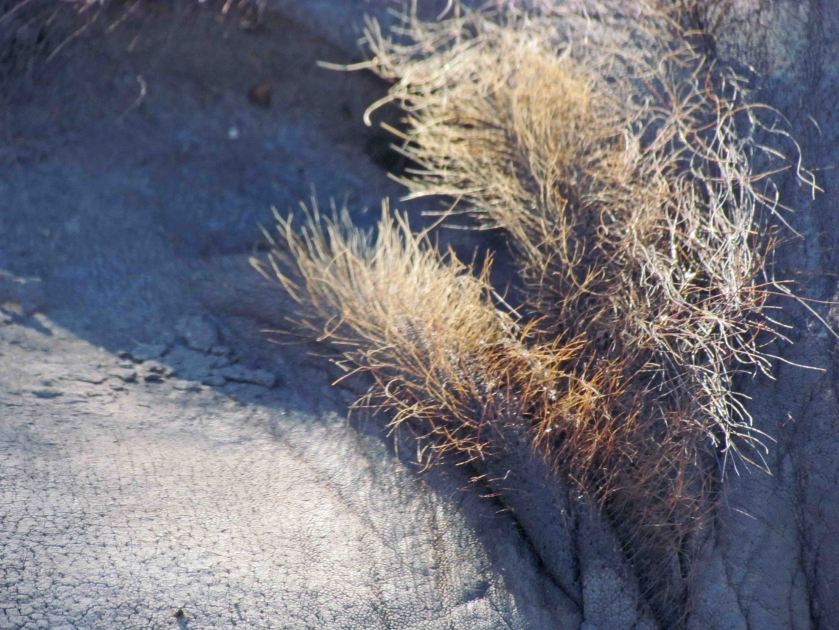
Morula’s luxuriant ear hair catches the sunlight. Flakes of mud cake the opening of her ear.
Just as in humans, an elephant’s ear hair grows longer and longer throughout its life. Hers is cinnamon-colored, has black roots, and is six inches long. It reminds me of the color of a lion’s mane.
When I reach up, the patch of hair feels like the underbelly of a longhaired cat.
First, for those who are unfamiliar with black mambas, here’s a little background information:
Black mambas (Dendroaspis polytepsis) are the longest venomous snakes in Africa, measuring up to 14 ½ feet. Mambas are not black – they’re more olive or greenish gray, with a narrow, elongated head the shape of a coffin. It’s the inside of their mouths that are black – hence the name. Mambas are also extremely aggressive and may actively attack without provocation. I use the adverb “actively” with reason – a mamba can strike in all directions, even though a third of its body is raised above the ground, and it can chase you in that upright position at speeds up to 20 mph. If you are bitten, your death will occur within 20-60 minutes. An anti-venom for mamba bites exists, but it must be administered immediately, requiring 10-20 vials of solution. But if you are struck in the face or neck (quite likely, since the head of the mamba chasing you is 4 feet off the ground), you will die in ten minutes. That black mouth will be the last thing you see.
On that cheery note, on with the story:
In the Moremi Game Reserve, east of the Okavango Delta, is an elevated platform overlooking a large hippo pool in a bend of the Khwai River. Six of us, our guide OT (“just like Overtime!”) arrive in our Land Rover.
“What’s that?” I point.
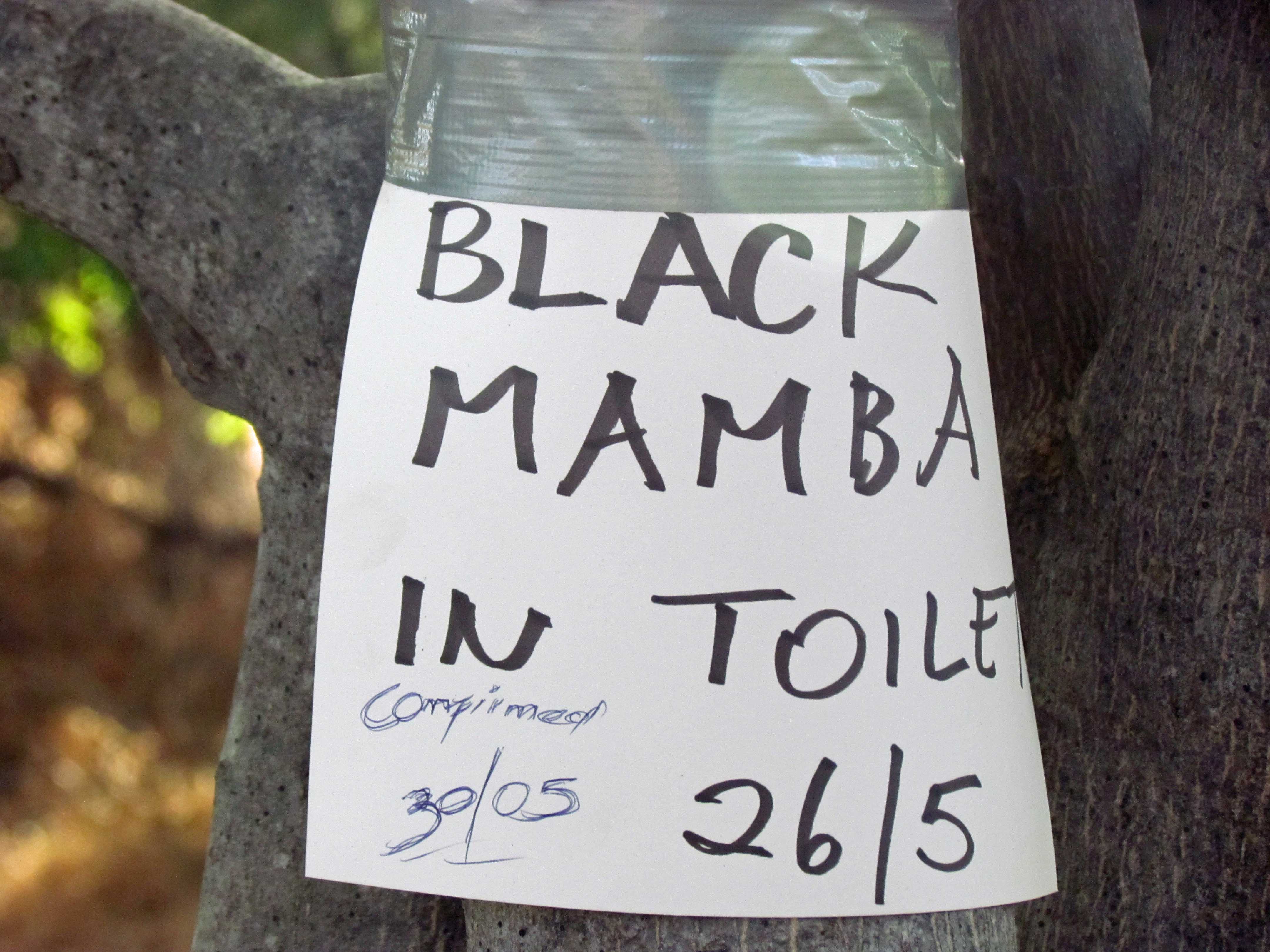
It’s a large piece of stiff white paper taped with duct tape to a tree. We climb out, read it, and immediately start swiveling our heads, trying to look in all directions at once.
“Anyone want to go look?” OT laughs.
The toilet, roughly the size of those cartoon outhouses with the crescent moons carved in their doors, is a cinder block building with a tin roof. It’s about fifty feet from our Land Rover. The painted green door on the toilet is ajar.
Certainly I’m not tempted to look inside. After all, the second message (“Confirmed 30/5”) was written just three days before our arrival by someone a lot more curious than I am about deadly snakes. The mamba is most likely still in there. Who wants to reconfirm a reconfirmation? Mambas are territorial; they will always return to their lairs, although that’s usually in an abandoned termite mounds or a hollow tree, rarely, I’d bet extremely rarely, in a toilet. A mamba is diurnal, active both night and day. It could be sleeping in there. Or not.
In my opinion, I’m already standing way too close to that toilet. Trying to look both at the toilet and at everything else, I walk slowly backwards. Mambas don’t like sudden movements.
Besides, I firmly believe, even though I haven’t seen it, that this toilet is not a Western ceramic throne, but a mere hole in the cement. I’ve had enough experience with toilets-in-the-middle-of-nowhere to also believe that the area around the hole is likely none-too-clean. That bush over there looks a better. A few minutes later, after careful reconnoitering and quickly taking care of business, I can confirm that no mambas are lurking around it.
As I climb the steps to the viewing platform I look for mambas wrapped around posts. On the creaky platform I look for mamba’s hidden in corners, or nestled into the thatch of the roof. I look for mambas slithering across the branches of the trees that lean dangerously close to the rails. A rustling noise among the branches spikes my heart rate to a gazillion, but it calms when I see it’s only a Burchell’s glossy starling, squawking for handouts.
Burchell’s starling
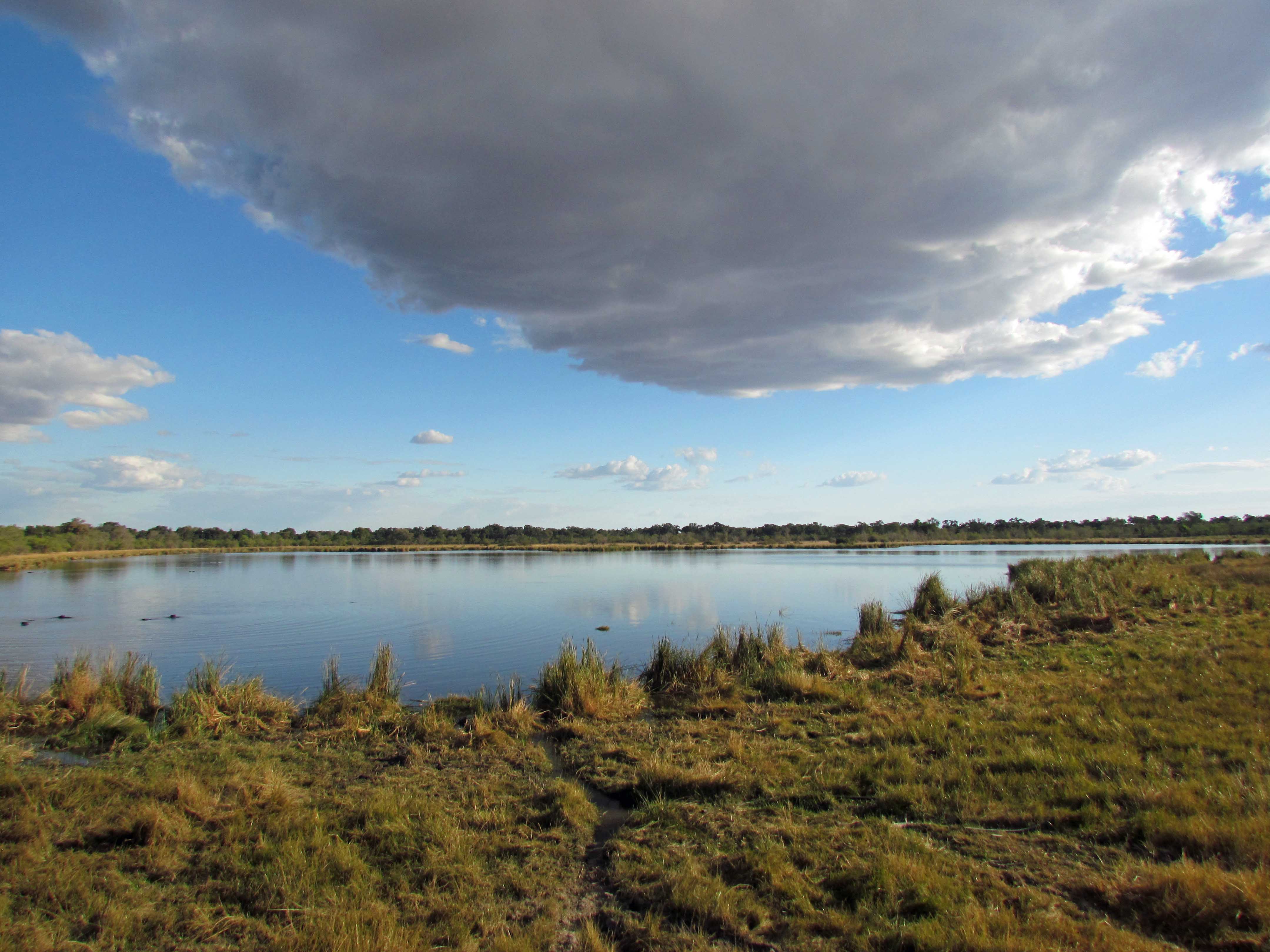
The view from the platform is wonderful. A massive cloud hangs over the hippo pool and puffs of other clouds reflect in the tranquil water. A dozen hippos rise and sink, burbling like submerged tubas. Tracks in the grass are hippo paths, where the hippos come out of the pool at night to feed, foraging as far as three miles for sweet young shoots.
At the bottom of the platform a dozen water monitors, some six-feet long, slither into positions that defend his or her portion of the bank, using the hippo paths as small highways. The smaller monitors end up with the worst spots, constantly harassed in slow-motion chases by the larger lizards. As I watch their typical reptile behavior, I think it’s lucky for us that the age of dinosaurs ended a long time ago.
Khwai River
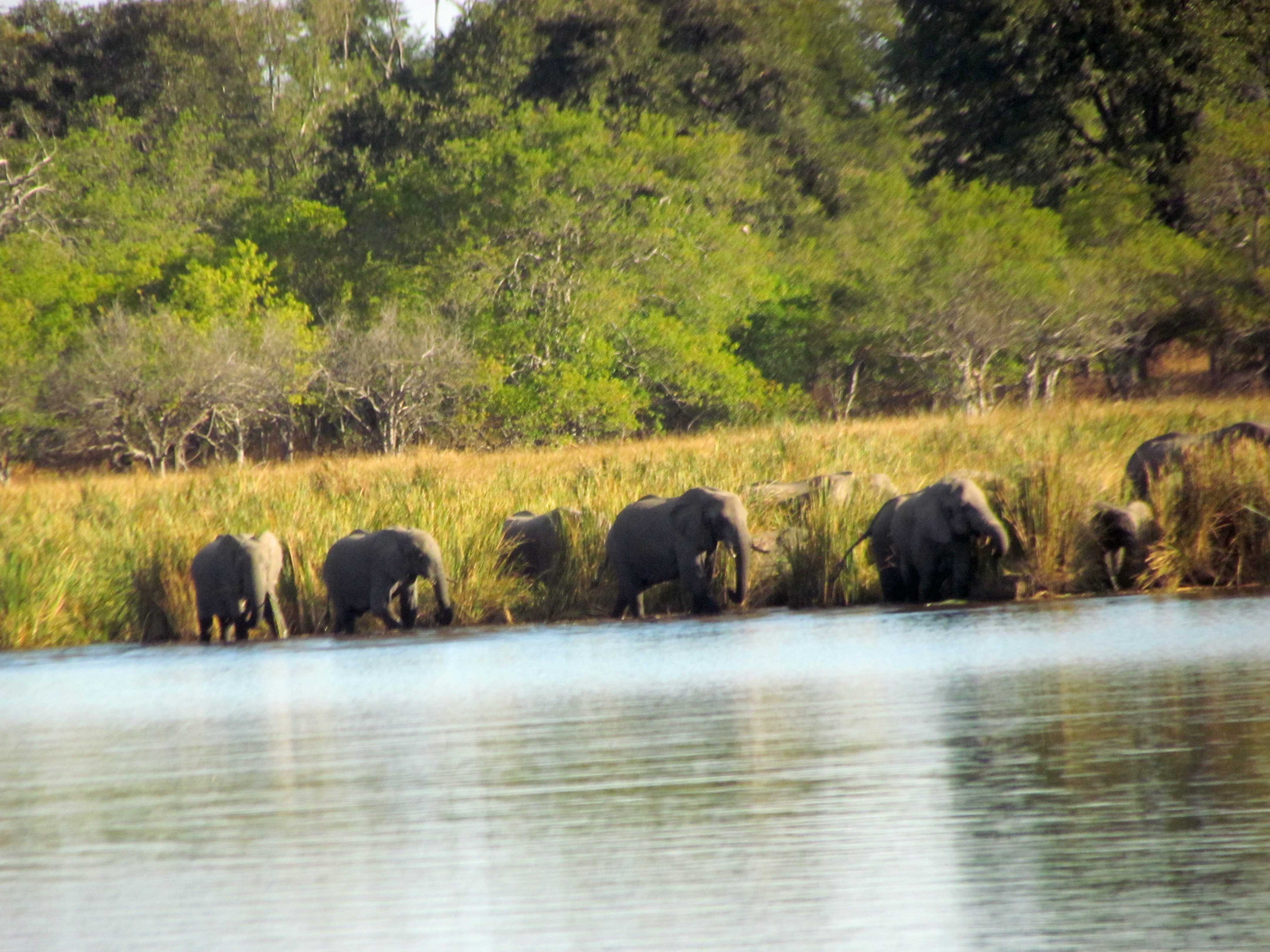
On the far side of the river, specks in the distance, a huge herd of elephants splashes along the edge of a reed bed. After I check for mambas, I lean on the rail of the platform to steady my camera. I use the digital zoom to take a picture, already knowing it will be an extremely low-pixelated shot. The elephants are in constant motion, appearing and disappearing in the reeds, so the photo turns out fairly blurry, but at least I have proof that those specks were really elephants.
Elephants on the far bank
On the way down from the platform I look for mambas wrapped around support posts, coiled under steps, and hidden in the framework of the flooring. I scan for slithery movements in the brush and wait for someone else to climb in the Land Rover before I do. I doubt the mamba has exchanged one lair for another, but still, you never know . . .
The viewing platform has its own GPS coordinates. So if anyone wants to look at that mamba and reconfirm one more time that it’s really there, I can tell you exactly where to go!
No other creatures of the savannah sleep as deeply or as soundly as lions, but after all, lions are the main reason for not sleeping soundly, so this is not surprising. – Elizabeth Marshall Thomas, The Old Way
We’re in a diesel Land Rover, a lovely old relic of earlier safari days thirty, maybe even forty, years ago. It shudders loudly when we stop. Yet they don’t wake up.
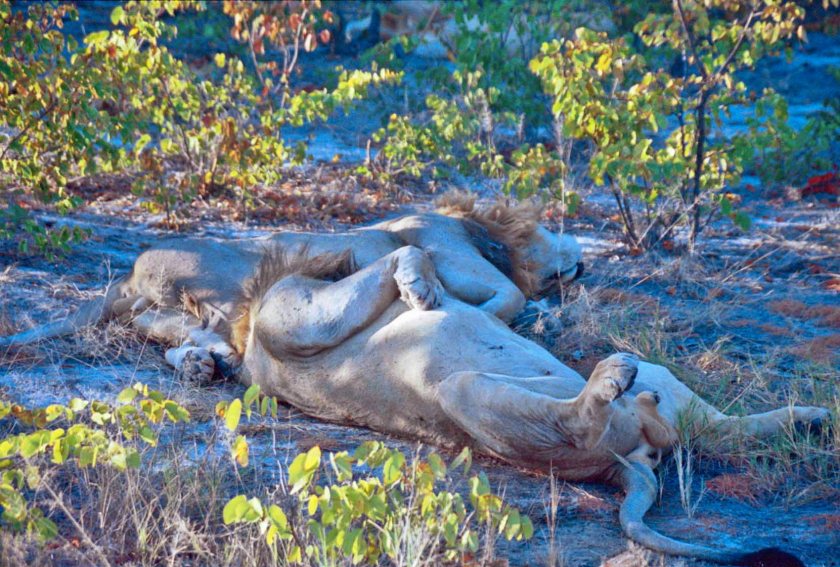
Two male lions sprawl in a cool swath of sand shaded by a thick clump of mopane. Blotches of pale blue rest upon tawny bodies like cloud shadows. It’s late afternoon and the sun is softening into that round light that blurs the edges of things.
After our ears clear of the clatter from the Land Rover, the wary silence whispers in a leaf twitch, in the movement of the sun across the sky. It’s the kind of silence that follows a lion’s roar. Even the birds are hiding.
The lions sleep on their sides. They haven’t eaten lately; their loose hides wrinkle against the ground. Without opening his eyes, the closest rolls onto his back. A small spot of sunlight outlines his high ribcage, deepens his navel.
Odd to think of him as a placental mammal, like humans. Odd to think of our inheritance from the Old Days, when we were afoot with cats. We were armed then with spears and rocks and our ability to make ourselves seem larger than we were, brandishing blazing torches, standing upright together, throwing and screaming.
Lions rarely sleep at night. It is the time of greatest vulnerability for most, and it would be so for us, too, if we were alone, without fire or companionship. But now we are encaged in the old Land Rover, gazing down without fear at two lions asleep on the blue-dappled sand.
There is something else watching. Lying deep in the mopane, camouflaged by leaves, a lioness stares at us. Her eyes are unwavering, ringed in black, with a white patch under each one. Long minutes later she loses interest in us and yawns, revealing the black edges of her gums, a baby-pink tongue, sharp white fangs, and one tooth broken. She looks over at the males.
photograph by Cheryl Merrill
They sleep on. The closest male has the abandoned flung body of a napping child. No, not a child. Not with hard-muscled shoulders and those ripping claws.
Between splayed legs his balls droop in their bags. We notice a tick crawling across one of them, wild creature upon wild creature. Small attacking large. As the tick tickles his scrotum, the tip of the lion’s penis emerges from its furred sheath, begins to drip. His right hind paw lifts and twitches.
On the far side of a large swath of golden grass the air shimmers, full of birds. As if by some sort of avian telepathy, Red-billed queleas rise and fall in curling waves, with wing-beats that sound like distant surf. Wave after wave washes across the clearing in front of us. It’s impossible to distinguish individual birds among the swell and tumble. Dust rises, perfumed by millions of feathers, hundreds of birds, each bird no bigger than my thumb. The flock settles into a tree. The branches of the tree droop as if suddenly laden with snow, then spring back up as the birds roll on.
Here are the first few pages of my manuscript, Larger than Life: Eye to Eye with Elephants. Having read this much, would you go on reading the rest of the book? I’d love to have feedback. Thanks!
photograph by Cheryl Merrill
There is nothing like him on earth. His head alone is more immense than an entire gorilla.
Jabu is one hundred times larger than I am. His trunk is larger than I am. A single leg is larger than I am.
He rests his trunk on the ground and the tip of it lifts, opens, inhales my scent. I reach out and run my fingers along his warm tusk.
Do you recognize me, Jabu, do you?
* * * * *
The pilot lets me sit up front. As his clattering Cessna lifts straight into the sun, we pass a line of small aircraft and a block-and-brick terminal only slightly larger than the Air Botswana 727 parked next to it. We leave behind a flattened land where the tallest structure is a water tower, where the olive-green scrub spreads as far as can be seen, and where footsteps have no echoes in a country mantled by sand.
We gain altitude and Maun slides under us. The last town before venturing into Botswana’s Okavango Delta, Maun is an odd frontier mix of trading companies, outfitters, curio shops, supermarkets, cattle in the streets, and an airstrip long enough for daily international flights.
We fly higher. Haphazard, barely paved roads meander to round stockades – bomas, fenced by thornbush. Each boma contains a hut plastered with mud and roofed with straw, or a small square cinderblock covered by rusty corrugated metal. Only a few corral a cow or a goat. Behind us the last buildings disappear into a curtain of shimmering haze. Maun melts into the desert.
The shadow of our Cessna passes over thin dirt tracks, which lose their way and vanish. A waterhole appears, an orphan left behind by last year’s flood. Another comes into sight, and then another. Etched into the sand by countless hooves, game trails wander through the dry landscape, headed to those life-giving pockets of water. Few animals follow the trails in the heat of the glaring sun. A small herd of zebra. A single giraffe.
Suspended above what could be considered a great emptiness, I remember the map I studied a week ago. Printed alongside the log of GPS coordinates for airstrips – some of them makeshift, many little used – I read another list of handy notations. “Tourist road, 4×4 required . . .Top road extremely sandy, takes very long.” Eighty percent of Botswana is covered by sand, some of it a thousand feet deep, but the airstrip where we’ll land is barely above water.
Swollen by November rains, the Okavango River floods south from Angola, arrives in Botswana in May or June, fans out, and then stops when it bumps into a barrier of fault lines near Maun. Landlocked, the river penetrates deeply into the Delta before it dies in the Kalahari sands. Not a single drop reaches the sea.
As the river pushes south, it creates, in the midst of a vast desert, an oasis – a floodplain the size of Massachusetts containing an ark-full of animals. Dependent upon the rainfall in Angola, the river swells or shrinks. In the dry season, it leaves behind ponds no bigger than puddles, abandoned lagoons that shrink into brackish swamps, and waterholes reflecting a cornflower blue sky.
Last week I reviewed the latest satellite photograph of the Delta – four skinny channels with several webs of water between them. The river is beginning to flood. The photograph reminded me of a duck’s giant footprint pressed into the sands of southern Africa. I located my destination, a dry spot between two of the bird’s toes.
Twenty minutes after leaving Maun, the pilot pushes in the throttle and the Cessna’s clatter mutes. We drop lower. A thousand waterholes are a thousand mirrors signaling the sun. Lower still, the mirrors turn back into waterholes, some of them connected in long braids of water.
Right before we land on a strip of dirt, we glimpse a cheetah sprinting for cover. With that single spotted blur, my life divides once again between home and Africa.
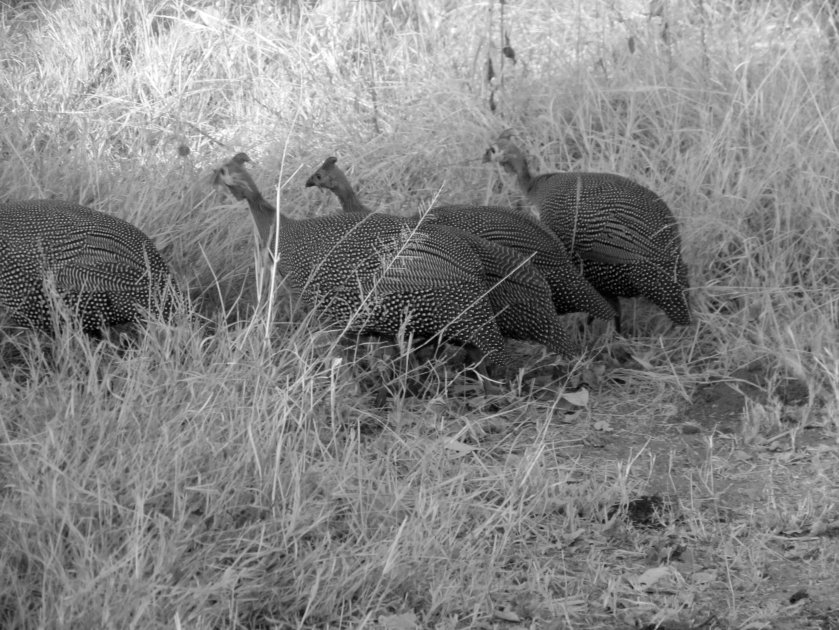
As we make our way down the two-rut road, a mob of Helmeted guineafowl runs ahead of us. They dart from one side of the road to the other, a bunch of silly old biddies, with shrunken featherless heads, thick bodies covered in spotted dark gray plumage and large rumps that bounce when they run. Blue jowls on their necks flap back and forth under their beaks. They never once consider flying to get out of our path.
The guineafowl call excitedly to each other as we flush them: Keck, keck, keck, keck, keck, keck, KECK!!!!!!! Eventually they dash to the side of the road and disappear into the bush.
Ignoring them, the elephant in front of us steadily treads down the right rut of the road. His pace is unhurried, measured, constant. A shoulder lifts, a leg straightens, accepts weight, and the foot splays out. A back leg moves forward, toenails scraping sand, straightens, accepts weight, and the foot splays out. A creature bigger than most monuments is on the move.








 ABOUT ELEPHANTS