Posted in Africa, Elephants, Jabu, Nature, Photography, Uncategorized

Heart

An excerpt from my book, first posted in 2012:

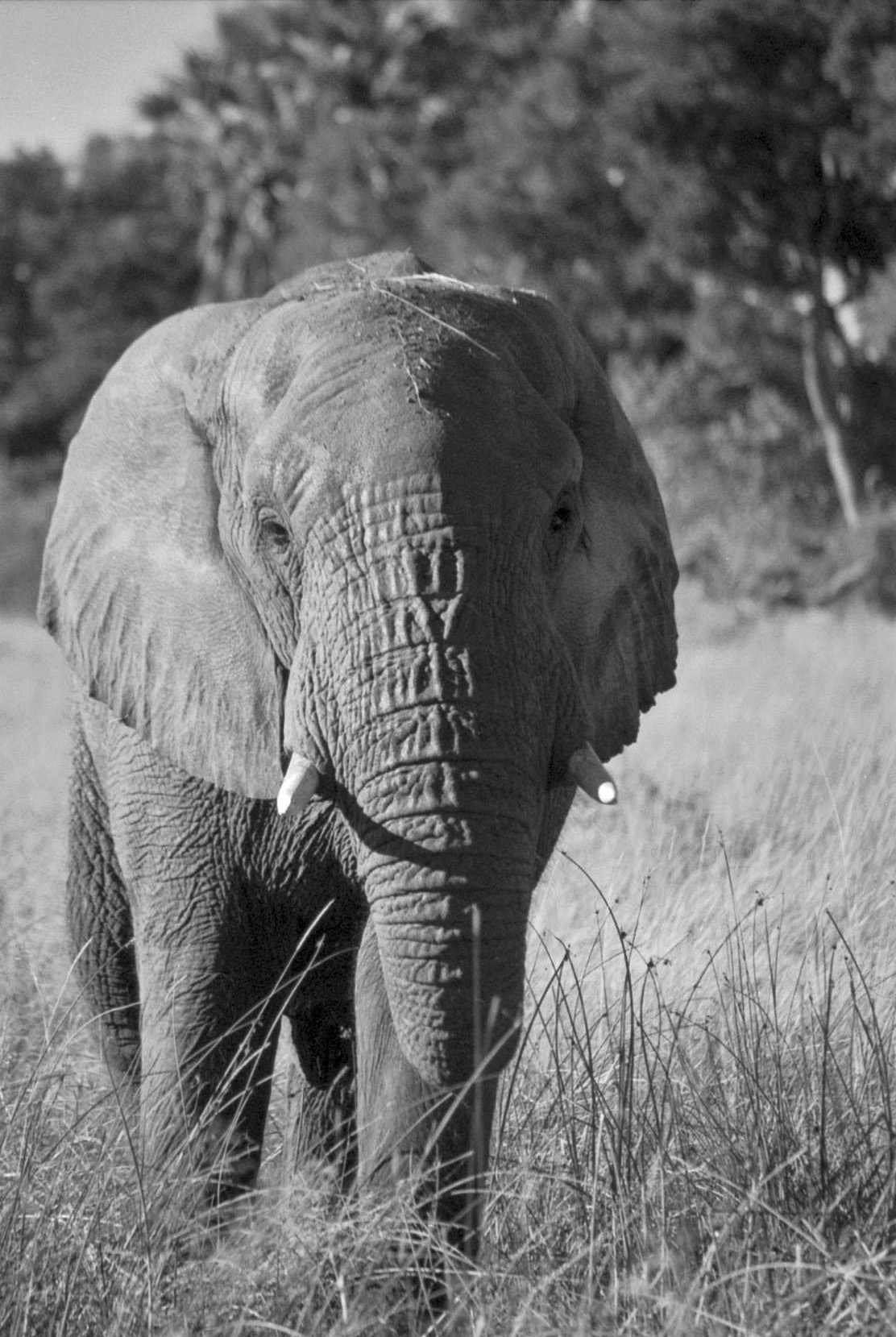
Heart shapes can be found in nature, if you’re lucky enough to spy one.  There’s a heart on Jabu’s trunk, a ridge of skin that feels like fine shoe leather.  One of his wrinkles pierces the lower third of this heart shape, from left to right, straight as an arrow.  His real heart hangs between his breastbone and ribs, a little to the left, just like mine does.  But instead of having a heart with a single point, an elephant’s heart has two points at its apex – so it’s the wrinkled outline of a human heart that Jabu carries on his trunk.

The length of Jabu’s real heart is about twenty-two inches, its width eighteen.  His heart weighs around forty-four pounds, almost the same as a medium-sized dog.  Still, it’s less than 1% of his body weight, a common proportion among large mammals and among humans.  My heart also weighs less than 1% of my body weight: about ten ounces.

The human heart is approximately five inches long, three-and-a-half inches wide and shaped like a pulsing cone.  It is the only muscle in my body that acts on its own – my heartbeat doesn’t need any messages from my brain.  The cells in my heart tissue involuntarily constrict, all together, all at once, over and over, a soft perpetual-motion machine.  Rip my heart from my body, chop it into pieces, immerse the pieces in a saline solution, and then give them a small jolt of electricity.  The remnants of my cardiac muscle will contract . . . contract . . .  contract – all on their own, sometimes for hours.

It’s designed to be strong, my heart.

In mammals, birds, and reptiles the heart has the same basic pump-like design, a design that has worked through eons – even cold-blooded dinosaurs had hearts.  A day or two after fertilization, embryos develop a pinpoint that pales, then brightens, pales, then brightens, the beginnings of a tiny pump practicing emptying, filling, emptying, refilling.  An old, old pattern.  The master timepiece.

There are four chambers in my heart: two auricles (“little ears”) and two ventricles (“little bellies”) – named by anatomists for the external parts of the body they resemble.  Spent, dark-red blood is collected in the right auricle, then dropped into the right ventricle, which constricts and pumps it out to the lungs to pick up oxygen.  Bright red again, full of oxygen, blood circulates back to the left auricle and from there drops into the left ventricle.  In the next twitch blood is delivered to every corner of my body.

The “little ears,” the auricles, make very little sound as they drain blood into the lower chambers of my heart, a distance of an inch or so.  It’s the ventricles, the “little bellies,” that boom as each contraction forces open heart valves and blood gushes up the aorta under pressure.  Lupp DUPP.  Lupp DUPP.  Lupp DUPP.  One beat smaller, one beat larger, flush after flush.

My right ventricle has walls thin as paper – it delivers blood only as far as the lungs.  If I could hold it up to the light I could see right through it.  The left side of my heart is the heavyweight lifter, pumping blood all the way to my toes, moving 150,000 tons of blood in my lifetime.

Jabu’s great artery, the aorta, takes off from the left ventricle of his heart, the same as mine does.  Named in the Middle Ages, aorta means, “to heave.”   It’s an artery more flexible and sturdier than any manmade pipe.  Jabu’s left ventricle pumps a continuous stream of blood up and out of his heart into the aorta, which then drops down into his chest and down each leg, where it branches and branches and branches all the way to his toes.  Each arterial branch has less space than the artery it came from, but the sum of  their volume is always greater than their mother artery.  The blood moves, but more and more slowly through smaller and smaller pipes, trickling into all corners of Jabu’s body, trickling through capillaries one cell thick.

Blood’s trip back to the heart is made through veins.  Millions of tiny venules drain into thousands of small veins, thousands drain to hundreds, hundreds to the one that empties back into the heart.  Veins are even more elastic than arteries, can hold variable quantities of blood, and serve as a reservoir for all that moving liquid.  At any one moment, 65% of my blood is contained in my veins.  It’s an ancient blueprint, this branching, this heartbeat, this coming and going, a blueprint brought to life in even the tiniest of creatures.

Blood has to be literally hoisted from Jabu’s toes.  Squeezed along by muscles wrapped around veins, pushed by valves in the veins, and sucked upward by the huge action of breathing, blood finally arrives in the vena cava, where it drops into the heart.  Jabu has two vena cavae, possibly because of the large amounts of blood that need to be moved.  The blood vessels of an African elephant reach lengths of twelve feet, a huge network of life.

Jabu’s body contains 120 gallons of blood, enough to fill an aquarium six feet long, two feet wide and two feet deep.  At one-and-a-half gallons, my puny amount of blood would barely fill a birdbath.

Blood is the body’s only liquid organ, five times denser than water.  It takes food and water in, removes waste and byproducts to the disposal areas of the body, the kidneys, lungs, and skin.  Blood irrigates all tissue, both feeds and cleanses.  It leaves the heart at one mile per hour and returns, laden with waste, at about half that speed.  Construction materials move along highways of blood, demolished materials return.  Blood is 20% solids and 80% water, carrying products of digestion, products made by the body, foreign intruders, the dust of stars, even cobalt from the original ocean of the earth where both of us, human and elephant, began our journeys.

We each have roughly one billion heartbeats for our lives.  Mouse, hummingbird, elephant, human, all the same.  Like us, elephants suffer cardiovascular disease, die of heart attacks and strokes.

Cardiac arrest: when the heart shudders and stops, when the light in the eyes flickers, fades and snuffs.

And when the heart quits beating, its resonance

Lupp DUPP     Lupp DUPP     Lupp DUPP

is gone.  The gurgle of digestion, all the silky, sturdy, slapping noises, the blood rush, gone.  The symphony of the body is finished.

For those of us left, that silence is almost too much to bear.

The heart on Jabu’s trunk
Posted in Africa, Elephants, Nature, Photography

Elephant Infrasound, Part Two

photograph by Cheryl Merrill

I almost know infrasound.

No more than a mile from my home huge freighters push through the deep, cold waters of Puget Sound. On flat black nights the thump-thump of their propellers travels through water, through air, churns into my bed, my bones, and the lowest threshold of my hearing. Born in the bellies and boilers of machines, the mechanical throb carries along rotating shafts that turn the metal blades of propellers, which slice through water like a dull knife hacking flesh: whummmp. ..whummmp…..whummmp.

Everything makes a sound when vibrations travel through a conducting medium, although we may not be able to hear it.

As Morula scuffs dirt, waves of air particles wash out in all directions. They reach my ear and vibrate my eardrum, which excites the three small bones of my middle ear: the hammer, anvil and stirrup. When the last little bone, the stirrup, takes up the vibration, it presses against fluid in my inner ear and creates a tiny sea of waves that tickle the hairs inside the spiral of my cochlea. The tickled hairs trigger auditory nerve cells that shoot electric signals to my brain.

Air, water and electricity in such a small space.

Large without, Morula’s ears are also large within. The bones of her inner ear are massive compared to mine. The combined weight of her hammer, anvil and stirrup totals just over a pound, compared to mine at two ounces. Her ear canal is eight inches long and her eardrum is about one and a half square inches. Maybe this doesn’t seem very big, but my eardrum is thinner than this paper and only one third of an inch square. You would need two hundred and fifty of my eardrums to create a stack an inch high.

Hum with your mouth closed. Now place your hands over your ears and hum again. The vibrations bypass your eardrums and are transmitted through your skull. Wavelengths tingle along your jaw line. Your bones are rattling.

Sounds are louder with a bigger collecting surface. Cup your hands behind your ears and listen as if you were an elephant.

Posted in Africa, Nature, Photography, Travel

Whoooosh-Thwack! Whooooosh-Thwack!

photograph by Cheryl Merrill

A selection from my book in progress:

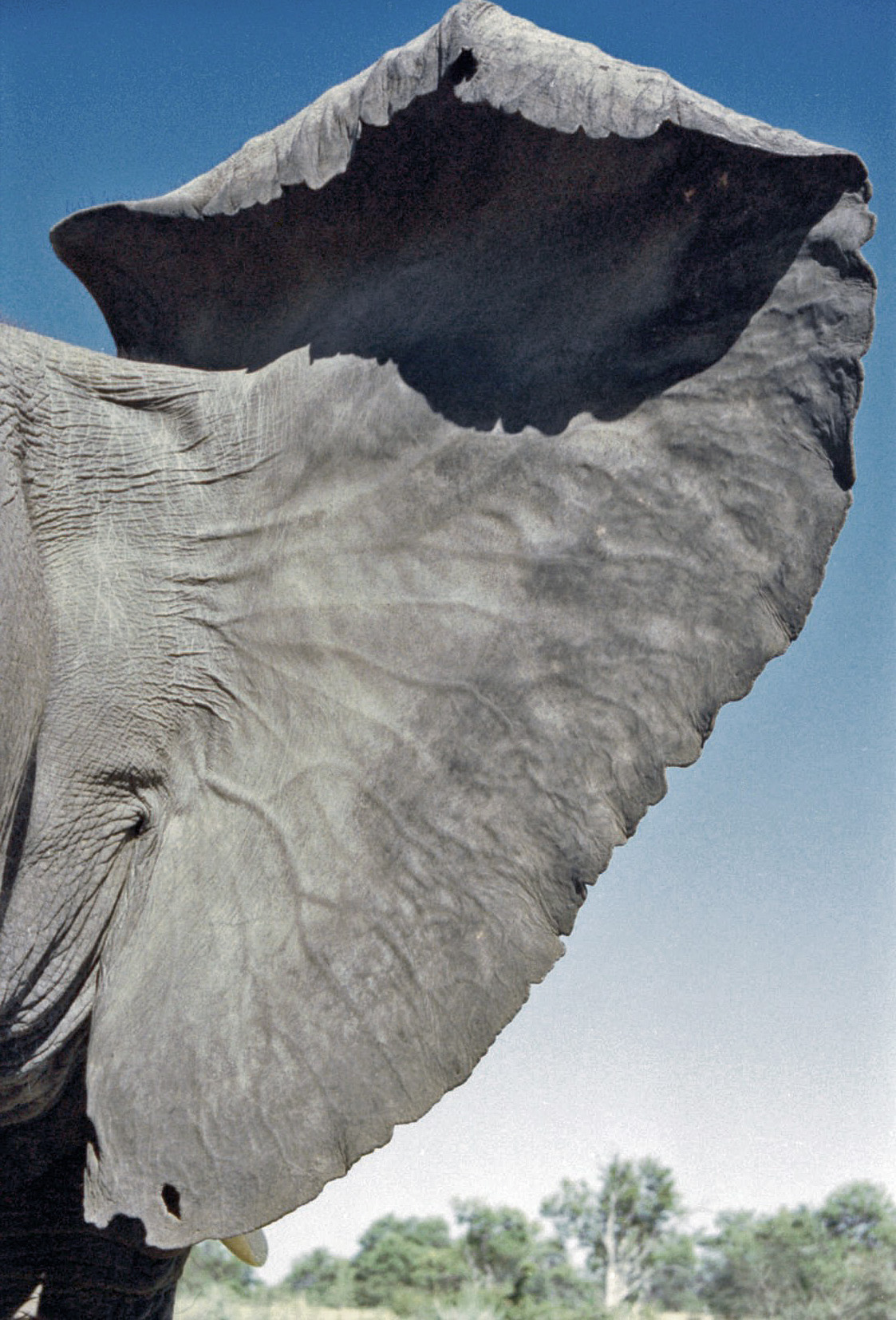
As she walks, Morula’s ears slap flatly against her shoulders, Whoooosh, thwack . . . Whoooosh, thwack . . . Whooosh, thwack . . . Elephant air-conditioning.

Morula produces enough heat to warm a small house. She is also pachy-dermed, thick-skinned. Some of her blood vessels are as deep as one-and-a-half inches under her skin’s surface. Since she doesn’t have sweat glands, her ears act like giant heat exchangers, regulating her body temperature. As air moves over the huge network of swollen arteries covering each ear, Morula’s blood cools as much as nine degrees before it returns to her body. When spread open, her ears increase her body size by roughly twenty square feet, a huge area for the process of thermoregulation.

Whooosh, thwack . . . Whooosh, thwack . . . Whooosh, thwack . . .

I take a photograph of her ear in mid-flap. Where Morula’s ear attaches to her shoulder, wrinkles give way to swollen arteries pumping five gallons of blood per minute across the surface of her ears. The pattern of those arteries is as unique as a fingerprint and often used to identify individual elephants.

Whooosh, thwack . . . Whooosh, thwack . . . Whooosh, thwack . . .

The breeze she creates dies before it reaches me. I take off my cap and fan my own neck.

My teeny, itsy ears are built somewhat the same as hers are, with an upper rim of cartilage and a fleshy, lower lobe. But I don’t have an auriculo-occipitalis, an ear muscle the size of a weightlifter’s bicep. I can’t flap my ears. I can’t even wiggle them.

Posted in Elephants, Nature, Photography, Travel

Trunk

photograph by Cheryl Merrill

Funky jazzy trombone trunk.       Snaking snorkeling vacuuming trunk.       Showerhead.       Backhoe.       Slinky.       Shimmying sucking swigging trunk.       Empty pipe.       Water gun.       Periscope.       Plucking siphoning tenacious trunk.       Kazoo.       Tweezers.       Tentacle.       Affectionate handshaking pickpocket trunk.       Python.       Air hose.       Question mark.       Whistling snorting sneezing trunk.


Breathtaking trunk.


Posted in Africa, Elephants, Nature, Photography

If We Could Imagine Such a Thing


photograph by Cheryl Merrill


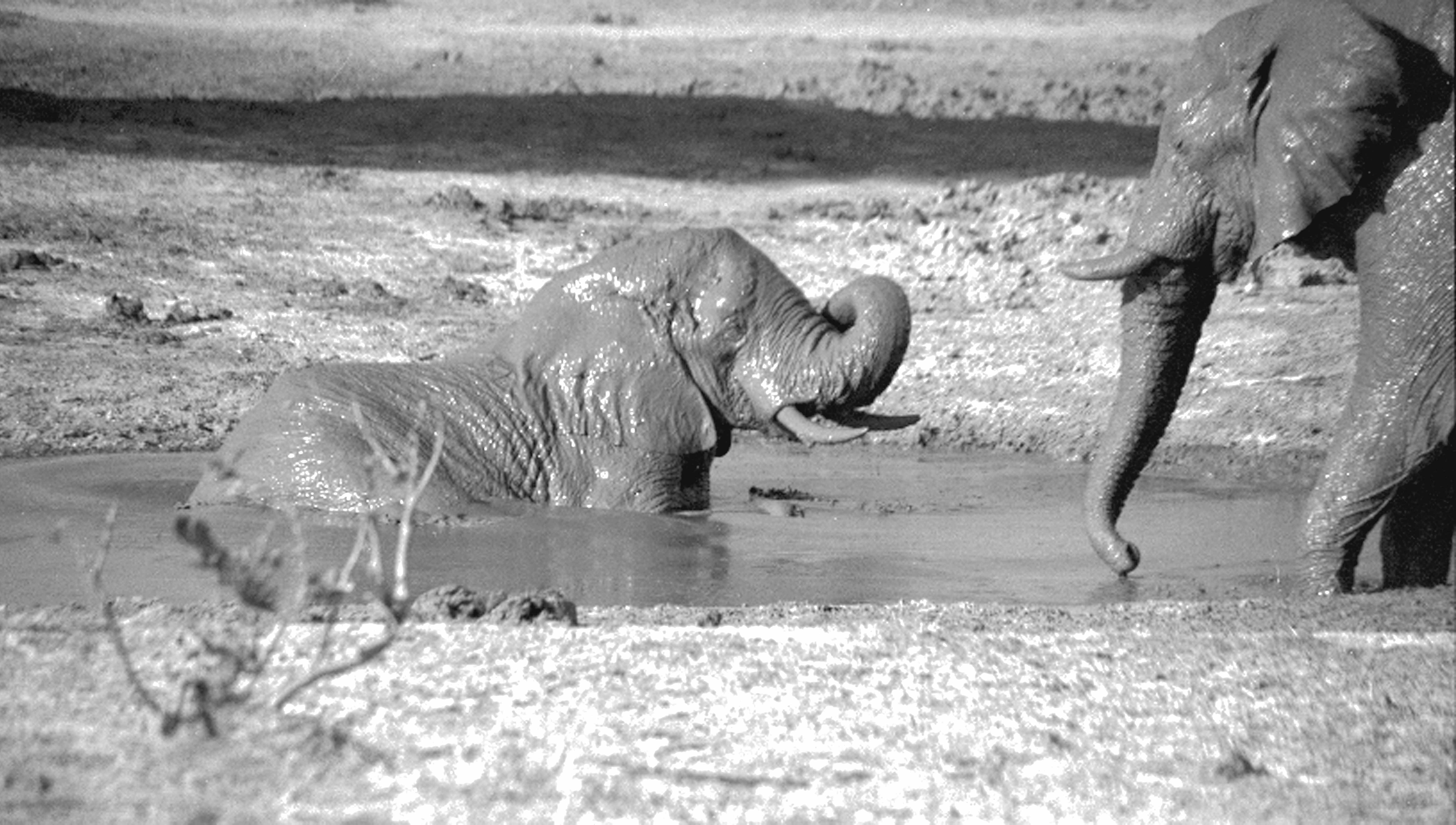
It’s a mucky, slimy, gloppy mud. The young elephant snorkels on his side, the tip of his trunk swiveling above the surface, as he slides towards another bull. His days are filled with heat and dust.

This feels good, his body language says, this feels really good.

If we could imagine ourselves weighing four tons, and think of gravity’s effect on those four tons, then maybe we could imagine wallowing in such mud, pushing and shoving like giant sumo wrestlers, reveling and rolling in the sheer pleasure of this warm gunk. We would inhale a slimy trunkful of ooze, squirt it like a watergun in any direction, even at each other. We would rub our eyes clear with a curled fist at the end of our trunks. We would arise glistening and bright as a metallic statue; we would be cooled, refreshed. . . .

if we could imagine such a thing.

Posted in Africa, Nature, Photography

The Backbone of the Night

Edge of Darkness

I sit on my heels next to a high-burning fire and rock back and forth, toe to heel, toward the fire and away from it.  Leaning in, I cup the palms of my hands to its heat.  Tongues of flame lick blackened lips of wood as if they want to tell my fortune with hot, strange words.

In Botswana, this close to the equator, there are twelve hours of daylight and twelve hours of darkness.  The earth rolls into night at 1,000 miles a minute – thirty minutes from sundown to dark.  No long sunsets technicolored by particles of pollution, no lingering light due to the earth’s tilt, no instant barrage of street lamps.

My night is lit only by flame and stars.

The fire spits an ember into the sand near the toes of my boots where it flares and dies.

Above my head a brilliant swath of the Milky Way spanned a vault of sky already crowded with stars.  Stars wheel toward dawn, the second hand on a clock face, the only clock that measures eons of time.

The beginning and the end are up there, somewhere.

The people of the Kalahari call the Milky Way “The Backbone of the Night.”  They believe it keeps the sky from crashing down on their heads.  If I squint hard enough, long enough, the Milky Way knits itself into what might look like pieces of solid bone.

Each time I look up it births even more new stars.

Most of our Old Stories must have originated like this, at night, around a hand-warming fire.

The fire burns down to single chips of orange.  My hands make a small lid over the last of its heat.

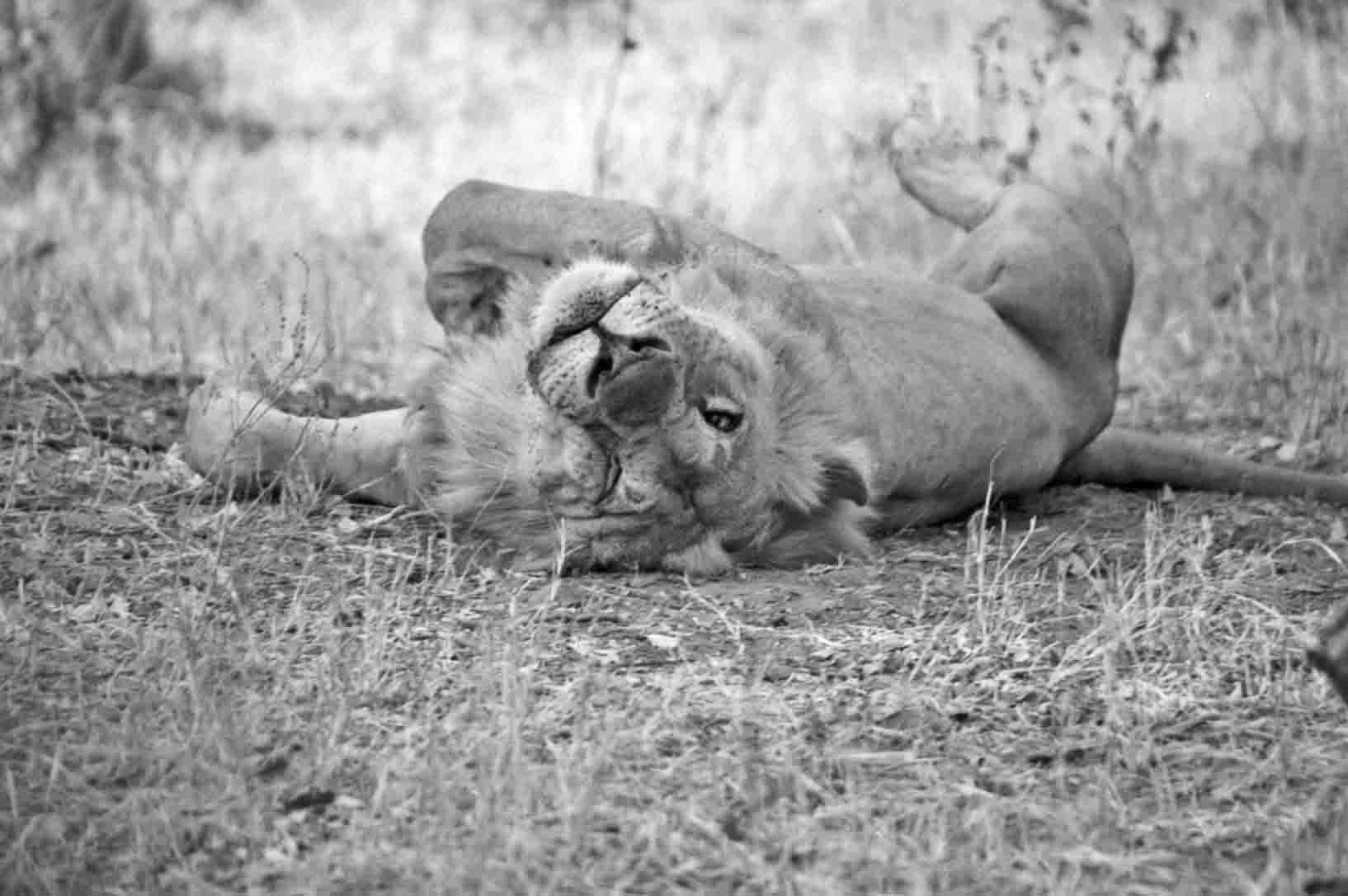
I walk down the path to my tent.  Soft night shadows loom around the circle of my flashlight.  At the tent’s threshold, I switch it off.  I trace the outlines of gods in the constellations overhead.  I see Orion doing a slow cartwheel, his left hand already touching the horizon.  Leo naps on his back, the way most lions sleep.  Scorpio thrusts one claw into the leaves of a fan palm.  Buried deep in the Milky Way, a jewel box of stars contains the tiny, tilted Southern Cross.

Moonlight rains through mesh openings of the tent’s windows, spatters my blanket with shifting, delicate squares.  Sleep comes quickly, like an African nightfall.  My dreams fill with elephants as the backbone of the night arches over me and holds up the entire sky.


(an excerpt from my book-in-progress, Larger than Life: Living in the Shadows of Elephants)


Posted in Africa, Nature, Travel

A Thunder of Hippos

An excerpt from my book-in-progress:

Whenever I leave for Africa I’m always, invariably asked, “Aren’t you afraid?”

“Of what?”

“Snakes. Alligators. Lions.”

“Well,” I usually reply, “there are no alligators in Africa. Only crocodiles.”

“So crocodiles, whatever.”

Once, in Tanzania, I saw a submerged crocodile lunge up amid four wildebeest faster than they, or I, could blink. I don’t know how, but he missed all of them as they leapt in four different directions. I’ve never taken a bathing suit to Africa. Didn’t seem like a great idea on my first trip and less so on subsequent ones.

Lions? Well, lions will consider me prey if I act like prey. Look! Breakfast! And it’s fat and slow!

The possibility of actually encountering a lion is pretty rare. There are only about 20,000 lions left in Africa, down from 200,000 in 1975. Until 2007 Botswana allowed 50 lions to be hunted per year. By the time a hunting ban was enacted many of the male trophies were just two or three years old – requiring hair extensions woven into their manes before they were mounted on a hunter’s wall.

B&W male lion

Snakes? There are a lot of snakes in Africa. Black mambas. Vipers. Cobras. Pythons. Boomslangs. Puff adders.   In the Okavango Delta I could encounter Egyptian cobras or a puff adder or an African rock python or a black mamba or perhaps even a shy boomslang. I could, but I haven’t. In all the times I’ve been to Africa, I’ve never seen a snake. Bad luck, I guess, because each of these snakes, in their own way, is fascinating, and I really wouldn’t mind seeing one of them.

The deadliest animal in Africa is not a snake nor a crocodile nor a lion – it’s the hippo, those oddly comic, rotund herbivores that Walt Disney put in tutus. Hippos kill more people in Africa than any other animal: several hundred per year. In contrast, sharks kill only around ten people per year, worldwide.

Hippos don’t even eat the people they kill. They emerge at night from ponds and rivers to spend all night eating grass. Their beady, sherry-colored eyes don’t see well, but their sense of smell is acute. Males defend territory, females their calves. They can outrun you, and you never know what might set them off.

In 2002, I was on a game drive with six people in an open-sided Landcruiser. Laid-back hippo blimps floated in a nearby pond. One of the hippos grunted, burbling like a submerged tuba.

A herd of hippos is known as a “thunder” – possibly a reference to their size, but more likely because of the noises they make. When a group of hippos get going, their combined grunts sound like rolling thunder. But these hippos were relatively quiet. They rose and sank, twirled their ears, exhaled wetly through their nostrils.

It was that magic half-hour before sunset when the light is golden and incredible – perfect for photographs. A short distance away a male grazed on flowers. I raised my camera.

Without warning, the hippo opened his mouth in a threat gesture, displaying his long, razor-sharp canines. A second later, he charged, head swinging side to side like a giant sledgehammer, running directly for us at a surprisingly clip, intent on slamming into our vehicle. Since a hippo’s top speed is around twenty miles per hour, he was closing fast. All I could see through my camera lens were those massive incisors, as the autofocus kept singing out zzzzt zzzt, zzzzzt zzzt.

Charging hippo b&w

Luckily, the engine of our vehicle started without a cough and the hippo just missed the back bumper. He continued on into the bush for thirty yards before stopping to wonder where we had gone.

Posted in Africa, Elephants, Nature, Photography

The Oldest Human Footprints in the World

An excerpt from my book in progress:

Morula

After Morula finishes browsing, I follow her down one of the unmapped, two-track, lightly traveled, nameless roads of the Okavango Delta.

Zik! Zik! Zik-zik! A masked weaver hops through the brush beside us. White clouds above our heads twirl like cotton candy across the sky. The track we’re following parts a shallow lake of grass and climbs out on an island of trees. A game trail crosses the road. Morula swivels her trunk to one side, then the other, at the intersection where the grass is beaten down.

In dun-colored sand as finely ground as cake flour, Morula’s prints barely register. I can’t see a single puff from the impact of her feet. With each step, she leaves behind outlines of small moons. We cross the recent, delicate hoof prints of impala and the moons obliterate them.

photo by Cheryl Merrill

My boot prints, inside the crater of her footprints, look like exclamation points, the heel separate from the rest of my sole.

The oldest human footprints in the world are 1500 miles north of here, at Laetoli, in Tanzania. Found in 1976, the 3.5 million-year-old footprints are not far from the Olduvai Gorge, where the Leakey family discovered the first hominids. Although the Laetoli hominids are Australopithecines and not Homo sapiens, they are part of our family tree, a relationship comparable to that of mammoths and elephants.

Fossil footprints are not uncommon, especially near ancient riverbeds. But the Laetoli footprints were created when a nearby volcano erupted, covering the ground with a slurry of volcanic ash somewhat the consistency of concrete. Once excavated, the site was found to have over 9,500 impressions, mostly made by rabbits. In order of decreasing abundance, tracks were also found of guinea fowl, hyena, antelope, rhinoceros, giraffe, buffalo, elephant, horse, small carnivores, monkeys, pigs and ostriches. Just one short, 80-foot section was made by hominids.

Their footprints – that of a man, a woman and a small child – tell us much about our ancestry. For in that trackway is a hesitation, as if one of the hominids thought about turning left. Perhaps it was the moment before an earthquake, when the ground was no longer solid beneath their feet. Or perhaps one of them considered turning around, going back.

I stop and look over my shoulder, in the same way my human ancestor did. All of Africa stretches out behind me – overlapped boot prints and footprints leading backward into her hot, crowded maze of life. It was Africa who designed us to walk upright across her landscapes. Because of Africa, I know the ground better than I know trees.

In the distance, across a golden backwater of high grass, stand a family of giraffes. They are motionless, watching us cross between islands of bush. The spotted derricks of their necks swivel in all directions to get a better look at us. At the end of each neck a head is cocked sideways: the universal body language that says, “Huh?” But once we stop to look, they turn away and head for cover, except for one curious female who continues to watch us.

photo by Cheryl Merrill

Tramping along in Morula’s wake, I’m beginning to get the hang of all this walking and browsing – less sweating, less reliance on my water bottle.   I’m beginning to wish I could do this every day of my life.


Posted in Africa, Elephants, Nature, Photography

Year of the Elephant: Swamp Lessons

A baby elephant crosses a small swamp, guided by Mom.  And of course she got a chance to stop and play in it, too.  A beautiful afternoon in Zambia, 2012.

Baby ellie swamp

Posted in Africa, Elephants, Nature, Photography, Travel

Year of the Elephant: Vegetarians

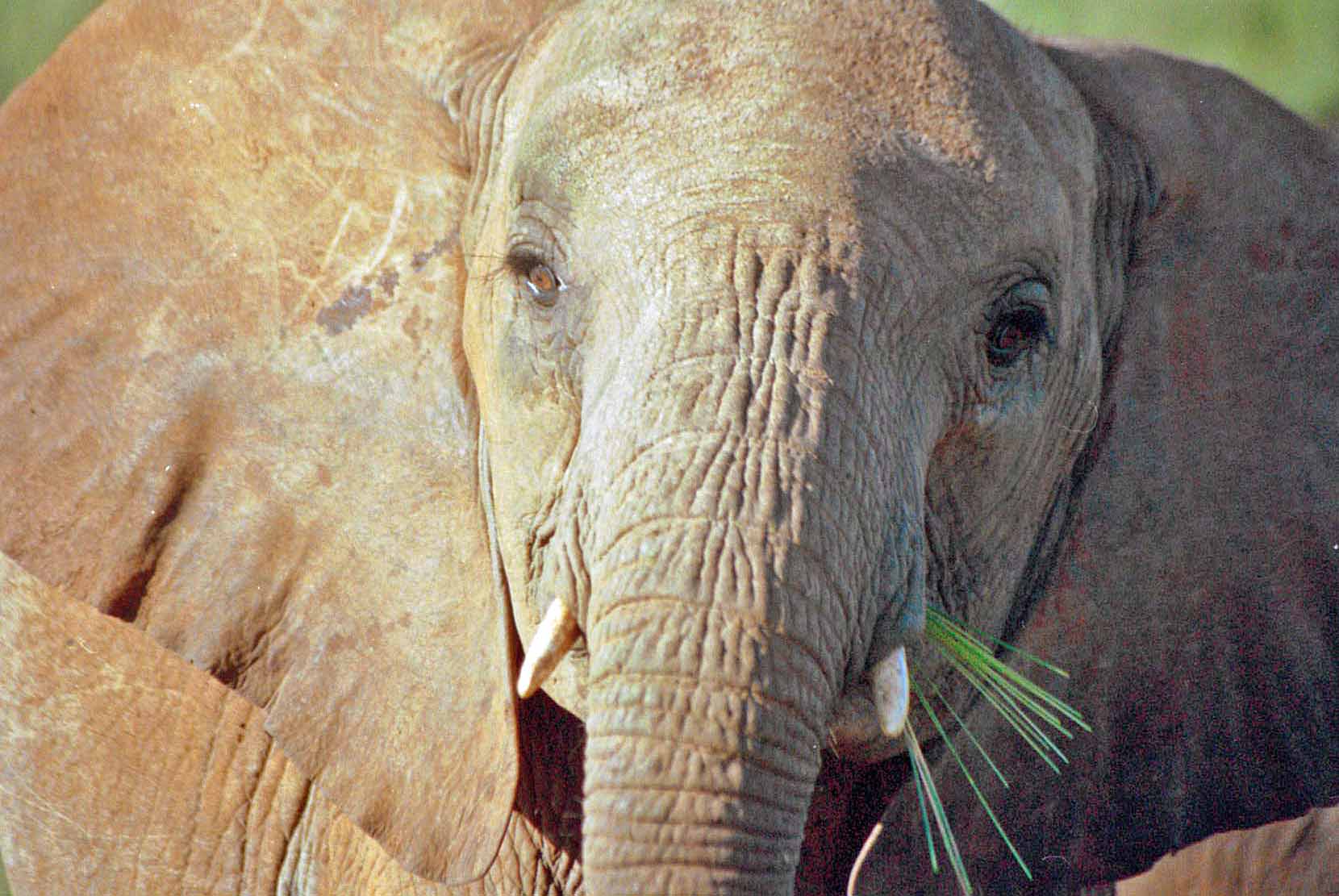
Cow elephant, Samburu, Kenya

It takes a lot of foliage to sustain an elephant.  Depending on its sex and size, elephants eat four to seven percent of its body weight each day – four hundred to six hundred pounds of vegetation.  And sometimes they take offense if you disturb their meal.

(Currently, the Samburu area of Kenya is experiencing its highest level of poaching in 14 years.  I hope this young cow has survived.)