Posted in Africa, Elephants, Extinction, Jabu, Nature, Nonfiction, Photography, Travel, Writing

Ivory, Part One

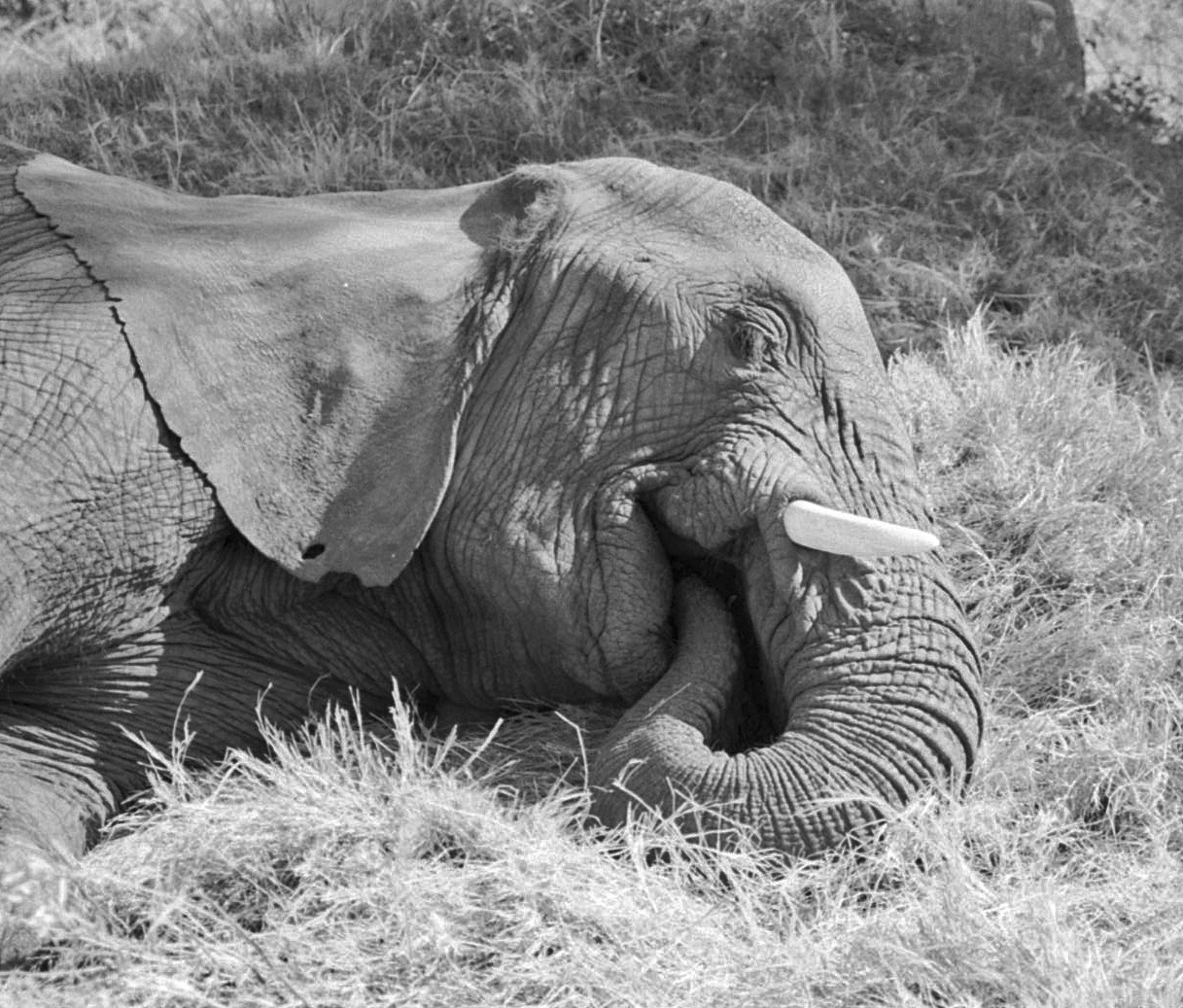
Jabu's tusk
An African elephant’s tusk

Carved ivory thrones are mentioned in the Bible.  King Solomon had one, covered with gold.  Tutankhamen’s casket had a carved ivory headrest for his pillow.  Cicero wrote of Roman houses where ivory doors opened onto entire rooms covered with ivory tiles.  Gladiators had chariots made of ivory.

In the 1800s, in Africa, ton after ton of tusks were transported thousands of miles to Zanzibar and Khartoum, carried on the backs of slaves.  By the 1980s, more than 300 elephants a day were slaughtered for their ivory, nearly 100,000 per year.

In Amboseli National Park, in Tanzania, a recessive gene is becoming dominant, occurring in 50 years instead of thousands, selected by poachers.

Year after year tuskless elephants are born.

Both male and female African elephants grow tusks – the largest upper incisors on this planet.  Tusks are defined as long teeth protruding beyond the mouth growing usually, but not always, in pairs.  Most tusks are enlarged canines, such as those of warthogs, wild boars, hippopotamus and walruses.  Enlarged canines in the myriad species of cats and dogs are called fangs.

Elephants and narwhal whales have incisor tusks.  The narwhal’s single tusk is a left front incisor that grows in a straight spiral.  Found mostly in males, narwhal tusks are believed to be the origin of unicorn legends.  Oddly enough, narwhals with two tusks are usually female.

By the time Jabu is sixty, his tusks could theoretically reach a length of 18 to 20 feet.  But in reality – if he does reach sixty – they will be much shorter, due to the wear and tear of everyday use.

Tusks on bull elephants can weigh seven times that of those on cows.  The biggest pair of tusks on record weighed 460 pounds, taken from an old bull killed in 1897 near Mount Kilimanjaro in Kenya.

The longest tusks ever found came from an elephant shot in the Congo in 1907.  Its right tusk was 11.4 feet long; it’s left tusk 11 feet.

Such extraordinarily enormous tusks are a genetic trait, much the same as red hair is a genetic trait.  Over the centuries poachers and hunters have always targeted male elephants with the largest tusks.  As a result, the trait has disappeared from most elephant populations.

The same outcome would occur if redheads were systematically eliminated within family groups.   As their genes died out, the redheads among us would become extinct.
Posted in Africa, Elephants, Nature, Nonfiction, Photography, Travel

Underwater

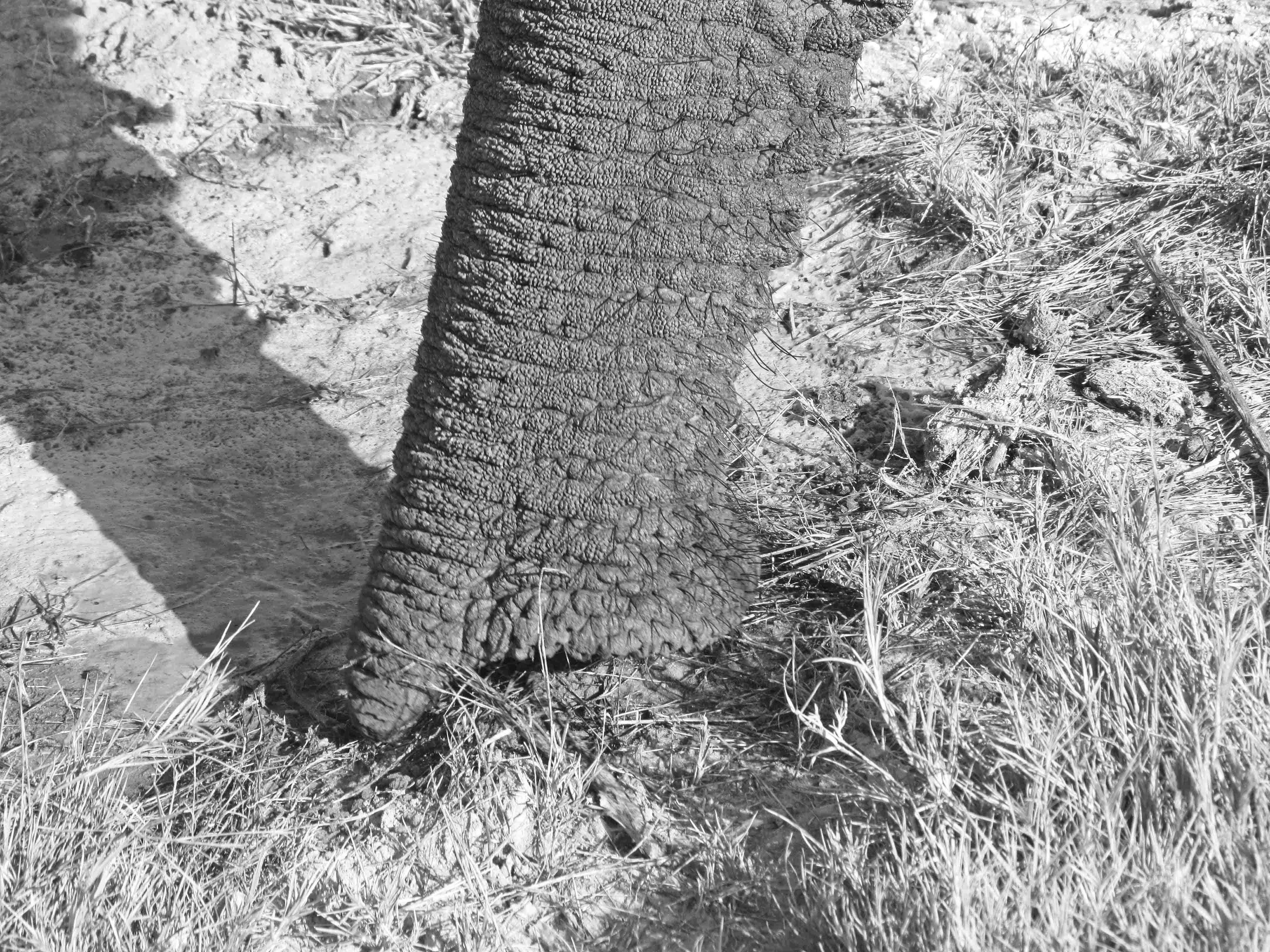
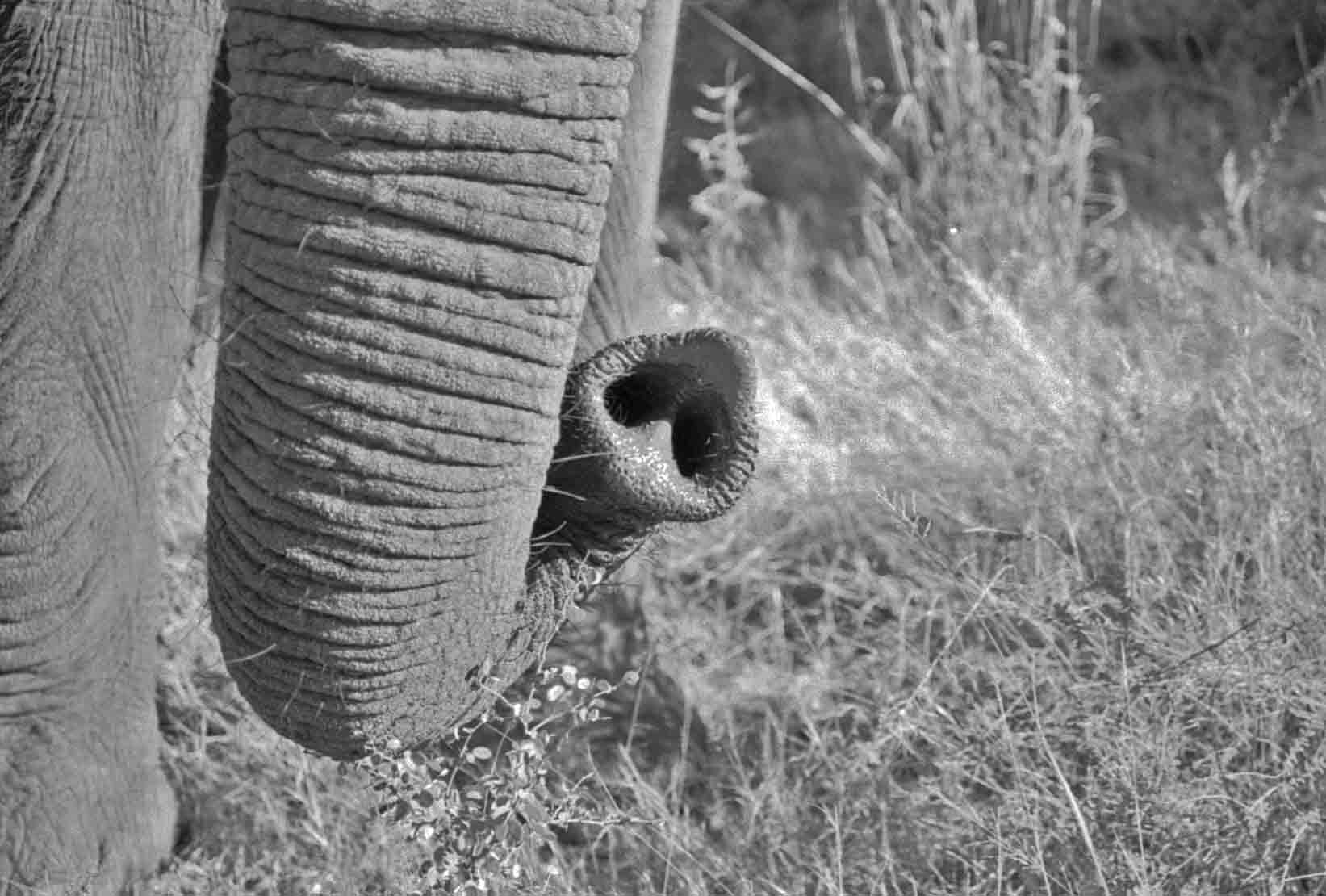
Trunk tip 2b&wAwash in a sea of scent, Jabu curls his trunk and samples wave after wave of odors breaking at his feet.  Redolent tides wash in, wash out, a floating realm populated with aromatic citizens.  Schools of scents cluster at his feet, swimming through the grass at the bottom of an ocean of air.

Sixty percent of his brain is dedicated to smell.  Jabu can distinguish between a million or more separate odors in the daily news that floats by on warm currents.  Just a few molecules bring him history and current events: stories of who was here, who is there, how long they stayed and in which direction they went.  Jabu can detect fellow elephants ten miles away.

He reaches out and flattens the tip of his trunk over a wet spot in the sand.  Eyes half closed, he stands completely still, as if lost in memory, his brain sorting through the various scents tumbling up his trunk.  He samples the air thoughtfully, as if listening to a quiet conversation, as if storing it, word by word, in those huge frontal lobes of his.

Flehmen flat trunkI remember that elephants see the world in yellows and blues, like color-blind humans.  I fasten a yellow filter over my camera lens, then a blue one.  Jabu turns aquamarine.  From far, far away, he snaps a branch from a shrub the color of kelp, chomps, munches, drifts closer.  His slow motions make perfect sense underwater.

I wade into a lagoon of grass.  Ankles, knees, waist, chest, neck.  Some of the grass stalks bob over my head.  My hands, my body, my thoughts, move slowly.

Immersed, my ears fill with a pure hum.  The sound of my passage whispers in seashell voices.

As Jabu drifts by, undertones of blue and gray shimmer against his flanks, reflections of seaweed and kelp.  I follow, sub-aquatic, at the bottom of air.  Carried by the current of my imagination, I am about to tumble downstream. Jabu aslant b&w

Then the breeze kicks up, feels as if it comes all the way from the bottom of the Kalahari, feels red, feels gritty, feels dry as a hundred-year-old skeleton left in the desert.  It sucks every bit of moisture from under me and lands me beached and gasping.

I lower my camera.  Red invades yellow and the world greens.

Posted in Africa, Elephants, Nonfiction, Photography, Travel, Writing

A Sea of Elephants

sea of elephants

Gray wave after gray wave surges out of the bush in small herds of twenty or less, first one group, now another, flooding the huge hollow that contains a waterhole.  Dust rises in the air, a potent blend of manure, dried grass and sand.  The backwash swells in our direction.  Soon a sea of elephants surrounds us.  We’re submerged in a roiling world of noise.  Snorts, grumbles, trumpets, growling bellies and gargantuan belches resound.  Some of the vibrations are too low to hear, but I feel them as they pass through my body, reverberate in my chest cavity, squeeze my heart.  Eye after eye inspects us as eddies of elephants swirl past.  An old world laps at the foot of our memories, extinguishes centuries of communal fires.  The ropes that tether us loosen.  We slip away from the familiar shore and set off towards unimaginable ways of being.  We look around with wild hearts.  We have become part of the herd.

Posted in Africa, Doug, Elephants, Nature, Nonfiction, Photography, Sandi, Travel, Writing

Fish Eagles/Bald Eagles/Fish Eagles/Bald Eagles

An excerpt from my book:

After a long morning walking with tourists we stumble into a shady grove near a lagoon and into the illusion of an al fresco dining room in an elegant restaurant. Fresh branches of mopane decorate the surface of a table covered with a white linen cloth.  The leaves on each mopane branch fold modestly like small olive origami decorations.  Knives rest across white linen napkins on white china bread plates.  The staff from Stanley’s have set up a buffet complete with chafing dishes.  White lace doilies edged with heavy colored beads protect the salads from flies.  Pepper grinders, oil & vinegar decanters water glasses and wineglasses complete the setting.  Nodding at murmured compliments, the bartender hands out cold beer, which has been uppermost on many minds.Al fresco restaurant b&w

It’s odd how fast we re-civilize.  All morning long the tourists had been mostly silent, filled with awe at walking next to elephants.  Now they sprawl in camp chairs and compare camera lenses.

A cake of soap sits in the fork of a bush next to a white basin on a folding wooden stand.  I use the murky water in the basin to lather my hands.  One of the camp staff holds a pitcher of clean water for rinsing.  The water in the basin turns even grayer with dirt.  I empty the basin and small puffs of dust rise from the force of the water hitting floury sand.

Then I too re-civilize, join the human conversation.

While Sandi minds the elephants, Doug mounds his plate with food.  He has that unique gift of talking and eating at the same time, consuming enormous amounts of food and speaking in short bursts.  Each time he answers a question he sets his fork down and regretfully watches where he places it.

“Look!”

Our heads swivel and our eyes follow a finger pointing skyward.

Locked together, talon-to-talon, fish eagles plummet toward earth in their mating dance, twirling in passionate grip with each other, taut bodies wheeling faster and faster towards earth, picking up suicidal speed.

The eagles break off a second before hitting the ground and swoop up to roost in trees opposite each other.  They scream back and forth, flinging their heads over their shoulders.  The female’s voice is lower, counter-point to the male’s shriek.

One of the camp staff shakes his head.  “I have never seen that before.”

Beaut fish eagle illus b&wLike the bald eagles of North America, fish eagles have chestnut bodies, long yellow beaks, yellow feet, pure-white heads, white tails and chests, although their bibs are larger.

They have the same habits: they mate for life and build huge stick nests in trees, nests twelve feet wide and ten feet deep.  They dwell in the same habitats: rivers, lakes, creeks, lagoons, estuaries, and man-made reservoirs.  Both carry fresh fish caught near the surface in their grasping talons, carry the fish headfirst for lesser wind resistance, one claw behind the other, surfing, riding a fish through the air.

The eagles are a reminder that in only five more days I will be going home.  Home, where I once witnessed bald eagles teaching their young how to snatch crows out of the air.  Where bald eagles row fish ashore, using their wings as oars when the fish are too large to hoist aloft.


Home.  Here.  Home.  Here.  Home.  Here.


Where I live and where I am.  That dual place inside me, moment and memory, locked together, spiraling, spiraling, just like these fish eagles, feather tip to feather tip, talon to talon.  Mind spinning, I want to hold onto a tree with fierce feet, cry out, return to the ground, stay here.  Learn from birds, from clouds, from rain.


Posted in Africa, Elephants, Nature, Nonfiction, Photography, Travel, Writing

Miles per Pound of Trees

Diamond on forehead 2An excerpt from my book in progress:

Thembi, she of the evenly matched ears, long-lashed eyes, and diamond-shaped scar on the bridge of her nose, farts as she walks.  Big, burbling farts.

All the trees, grasses and leaves Thembi eats gather in her 10-gallon stomach, which is pretty much just a holding area.  From her stomach, roughage travels into her small intestine and then on into her large intestine.  Joining the two intestines is a junction called a cecum, where digestion actually takes place.  Her cecum is filled with billions of microbes, just like most mammals, including us.  The microbes break down the cellulose of leaves and trees into soluble carbohydrates Thembi can digest, but the process also gives her enough methane gas to power a car 20 miles each day.

I wonder, as I walk behind her, just how one could harness this gassy natural resource.  I live at the edge of a small town.  Twenty miles would more than cover my daily errands.  I imagine exhaust fumes smelling like fermenting grass.  I imagine driving down highways inhaling the scent of mulched trees.

I wonder, as I walk behind her, why I think of such things.

Percolating along, Thembi lifts her tail and farts again.  It’s a stupendous displacement of air.  In this just-right light, I can actually see this fart.  It looks like heat waves blasting from the back of a jet engine.

One advantage of Thembi’s size is food efficiency, miles per pound of trees.  An elephant eats four to seven percent of its body weight each day – four hundred to six hundred pounds of vegetation.  Mice eat a twenty-five percent of their weight daily and hummingbirds two times their own weight, or two hundred percent.  If hummingbirds ate trees, the forests of the world would already be gone.  Pound for pound, Thembi needs far less food than rodents or birds.  And with her size comes another advantage over smaller creatures – a longer life span.

We humans, with our penchant for measurements, have conjured up a precise formula for figuring out things like longer life spans.  The formula is called quarter-power-scaling.  A cat is about 100 times more massive than a mouse.  To calculate the cat’s age, take the square root of 100, which is ten, and then the square root of 10, which is 3.2.  The lifespan of a mouse is around 800 days, or just over two years.  Multiply 800 by 3.2.  The result is 2,560 days, or seven years, the average lifespan of a cat.

However, if a cat’s metabolic rate was 100 times faster than that of the mouse, all cats everywhere would spontaneously combust into feline fireballs.  Oddly enough, heart rate, the engine that drives the cat to chase the mouse, scales to the same formula, but in the opposite direction, to the minus quarter-power.  The resting heart rate for a mouse is 500 beats per minute.  Divide that by 3.2 and you have the average heart rate for a cat, around 156 beats per minute.

An elephant’s resting heart rate is a placid thirty-five beats per minute and a bit higher, around forty, when excited.  While the jittery mouse lives just over two years,  an elephant lives around sixty-five years, certainly long enough to power my car for the rest of my life.


Posted in Africa, Elephants, Nature, Nonfiction, Photography, Travel, Writing

The Most Useful Appendage Ever Evolved

Since I have a huge cold and can’t think, I’m re-blogging this post from early in 2012.

An excerpt from my book-in-progress:

Morula plucks a branch from one of her favorite snacks, a bush-willow.  She holds the stem in her teeth, wraps her trunk from right to left around the branch, and sheers off leaves, top-to-bottom with a single swipe.  She drops the branch and transfers the leaves from the curl of her trunk into her mouth.

Morula is right-trunked, as I am right-handed, preferring to grab and wrap from the right.  Thembi is also right-trunked, but Jabu’s a lefty.

One of the ways to determine an elephant’s dominant tendencies is to inspect the underside of its trunk for green stains on either the right side or the left.  But before you do this, make sure you know the elephant and, more importantly, the elephant knows you.

Morula peels and discards branch after branch.  Shredded bushes mark her path.  She pauses next to a candle-pod acacia, easily recognizable by its upright seedpods.  It reminds me of a giant leafy candelabrum, holding a hundred or more candles in ruffled tiers.  Sharp curved thorns protect each pod.  Morula strips the acacia of a branch, then puts it in her mouth and eats it, thorns, pods and all.

She sidles close to Doug and curls her trunk against her forehead.

“Those round bumps on her forehead might be an old skin infection,” Doug tells me, “but we really don’t know.”

Morula waves hello

A light breeze feathers the hair in her ears as she stands slightly sideways and nods the tipof her trunk in a tiny Hello. . .   Ribbed muscles cross the underside of her trunk.  Bristles stick out like the legs of a giant centipede.

There is no other living creature on this planet that has a trunk.  If elephants were already extinct, which brave paleontologist would go out on a limb and reconstruct the trunk just from evidence of bony nostrils high on the skull?  Who could imagine a nose dangling close to the ground where scents abound?  A nose with the ability to pick up a single straw, rip a tree out by its roots, bench-press 600 pounds and untie your shoelaces without you ever noticing?

“Stand here,” Doug commands me.

I obey, my back to an elephant lineup.

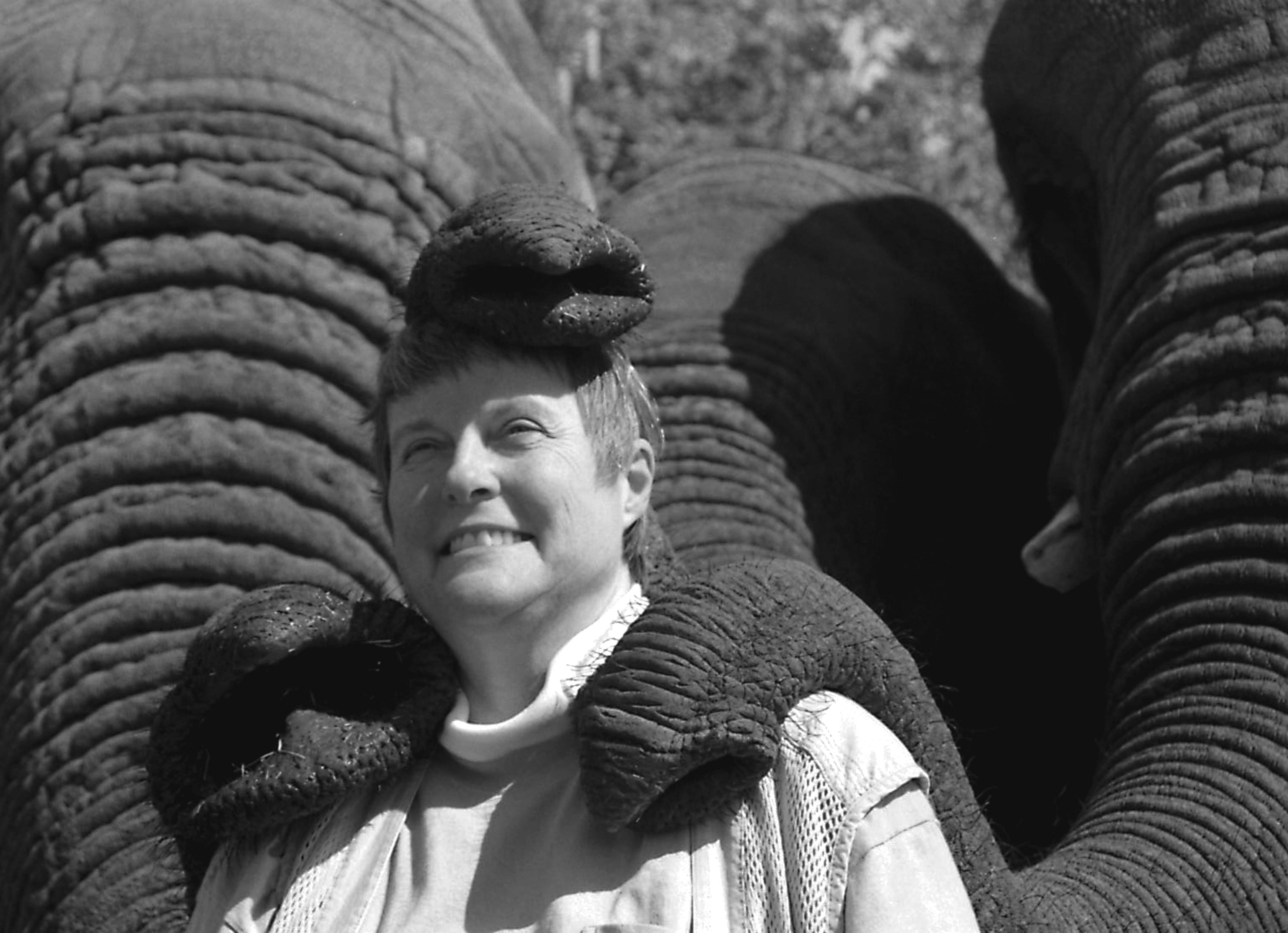
With a little guidance from Doug, Thembi gently places the tip of her trunk on top of my head.  It feels like a big beanbag up there, but one that’s warm, wiggly, drooling and breathing.

As Thembi rubs nose slime into my hair, Doug places Jabu’s trunk tip on my right shoulder and then Morula’s on my left.

Jabu has trouble keeping his trunk balanced on such a narrow ledge.  He constantly fidgets and pokes my cheek with his bristles.  Morula’s trunk drapes over my shoulder like a slack hose with a dripping nozzle.  Her runny nose continuously drains to clear out inhaled dust – the common condition of all elephant trunks.

When I look down and to the left, I have a close-up view of the two “fingers” on her trunk.  Her top finger is more pointed than the one on the bottom.  The shape of it reminds me of a hooded cobra.  But perhaps that’s because I think of Morula’s trunk as thinner and “snakier” than Jabu’s spectacular snout.

Which is getting heavier by the moment.  With the peripheral vision in my right eye, I see two nostrils dotted with grains of moist sand, nostrils more flesh-colored than gray.  Each opening is nearly as wide as the “O” of my mouth.

All three trunk tips, I can attest, are not just sheer weights.  They sniff, snorf, squirm, wiggle, inhale and exhale.  They create an atmosphere of elephant breath around my head.

Doug lowers my camera and pronounces, “Allll-right.”

The weights disappear.  For a few steps I am oddly light, as if walking on the surface of the moon.

Posted in Africa, Elephants, Nature, Nonfiction, Photography, Travel, Zoos

A Pedestrian Afternoon

Plump, babbling, feather-brained guinea fowl run ahead of us in silly mobs.  Perched atop impossibly skinny blue necks, their noggins look professionally shrunk by headhunters.  The morning air is hot, dusty, and soft as windblown sheets.

A faint sizzle above my head makes me look up.  A pointed dart in the shape of a cross moves steadily across the pale blue sky, spawns a cloud of ice behind itself for a hundred miles or more.   Its contrail broadens from a sharp point into a wide cottony smudge.  One of the astronauts reported from space that contrails could be seen over all parts of the world, often radiating from major airports like the spokes on a wheel.

Morula and I mosey along at the rear of the herd, one foot in front of the other, each footstep connected to the next one.

I place my boot inside Morula’s huge footprint.  The brand name of my boots is imprinted within the outline of my soles; a clever advertisement made with each step.  My boots make deeper impressions than Morula’s feet because each one of my steps applies more pressure per square inch.  All my weight transfers to my feet, my two small points of contact with the earth.  Morula’s weight spreads over four large footpads the size of a medium pizza pan.

One week ago, looking down from a jet that took me across Tanzania, I was surprised to see crater after crater, giant ancient footprints, leading to Kilma-ngaro, the Maasai words for “hill of water.”  At 19,340 feet, Kilimanjaro is the highest peak in Africa and one of its oldest volcanic cones, providing water to the rivers of the Masa Mara.

Some of the cratered footprints leading to Kilimanjaro were shaped like the sharp tracks of zebras.  Others were so worn down they were completely covered with vegetation, visible only from the air.  The sequence of volcanic craters looked as if Kilimanjaro itself had marched up the eastern fault line of the Great Rift Valley, which is sort of what volcanoes do, given millions of years to do it.

From the air, I could see webs of roads and trails near the ancient craters – some leading up to their rims, some circling around them.  Many of these paths are generations old, harmonious with the landscape, paths that flow around obstacles and toward places of safety and browse.  Compacted by many feet, they are safe passages across treacherous quagmires that could swallow you and me.  Some of them make so much sense to the feet that they can be followed in the dark.  In Kenya, the old highway from Nairobi to Nakuru was once an ancient elephant route, zigzagging down to the Rift Valley floor.

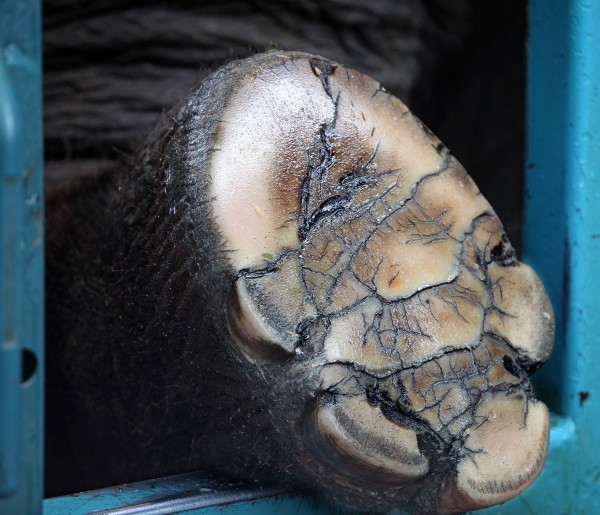
Earlier in the afternoon, the elephants stopped to browse.  I took a photograph of Morula resting against an eroded termite mound and noticed the bottoms of her feet were as cracked as dried mud puddles.  They mirrored the ground upon which she walks.Morula's cracked footpads

Morula has four toes on her front feet and three on her hind feet.  They grow at a rate that might be expected from an animal that walks twenty to thirty miles a day.  In captivity, an elephant’s nails must be constantly trimmed, often on a daily basis; otherwise they become infected and ingrown.

Incarcerated elephants also have problems with the pads on their feet.  Without wide-ranging activity the pads thicken and grow hard and must frequently be pared down.  Otherwise their feet begin to resemble shoes with worn heels.  The displacement of their gait will cause joint problems later on.

Steve Ringman, The Seattle Times

Tramping along in Morula’s wake, I’m beginning to get the hang of all this walking and browsing – less sweating, less reliance on my water bottle.   I’m beginning to wish I could do this every day of my life.

There’s a lot of languid movement packed into the word: “browse.”  Days and weeks and years of walking.  Walking and stopping.  Walking and stopping.  Walking in one elephant’s lifetime the equivalent of 5 times around the circumference of the earth.

Morula’s round print, side-by-side with my boot print, tell a story of companionship, of human and elephant as equals.   Our direction is not purposeful or hurried or even random.  We take this path day after day, a normal occurrence.  It’s a way of life.

Imagine that.  A way of life.

Posted in Africa, Elephants, Nature, Nonfiction, Photography, Travel

Toenail Sun

Morula Sucking Trunk

An Excerpt from my Book:

Morula drowses, lying on her side, falling asleep in the sun.  She catches the tip of her trunk in her mouth, as Doug rubs the bottom of her front foot.  Her eyes droop and her mouth slackens with pleasure.

As Doug continues to rub, the tip of her trunk slips from her mouth.  Her eyes nearly close.  She drools a bit.

I kneel down next to her.

Morula’s legs are folded together, bent at the ankle and knee, the same way I fold my wrists and elbows together in sleep.  She’s strangely voluptuous, even Rubenesque, with her rounded belly and nipple peaking out from underneath her right leg.  Her ear drapes like a leather cloak over her shoulder.  From this angle it’s easy to see how her right tusk pierces her upper lip.

People often mistake an elephant’s ankle joint for a knee, since it seems far away from the foot, but the locations of her ankle, knee and shoulder are clear from the way her legs are bent.

Except for their gray color, Morula’s toenails look pretty much the same as mine do, only bigger and thicker.  Human and elephant nails are made of tough, insoluble keratin, a semi-transparent protein that is the major component of hair, hooves, horns and quills.

Morula’s toenails grow at a rate that might be expected from an animal that walks twenty or thirty miles a day.  They are also highly polished from walking through sand.  In captivity, an elephant’s nails must be constantly trimmed, often on a daily basis; otherwise they become infected and ingrown.  And without the opportunity to walk long distances, the pads on the feet of incarcerated elephants thicken and grow hard, and must be frequently pared down.  If they’re not, the displacement of their gait will cause joint problems later on.

I take a photograph of the sun mirrored on Morula’s highly polished nail.


Morula's toenail b&w

Posted in Africa, Elephants, Nature, Photography, Travel, Writing

Windows of the Soul

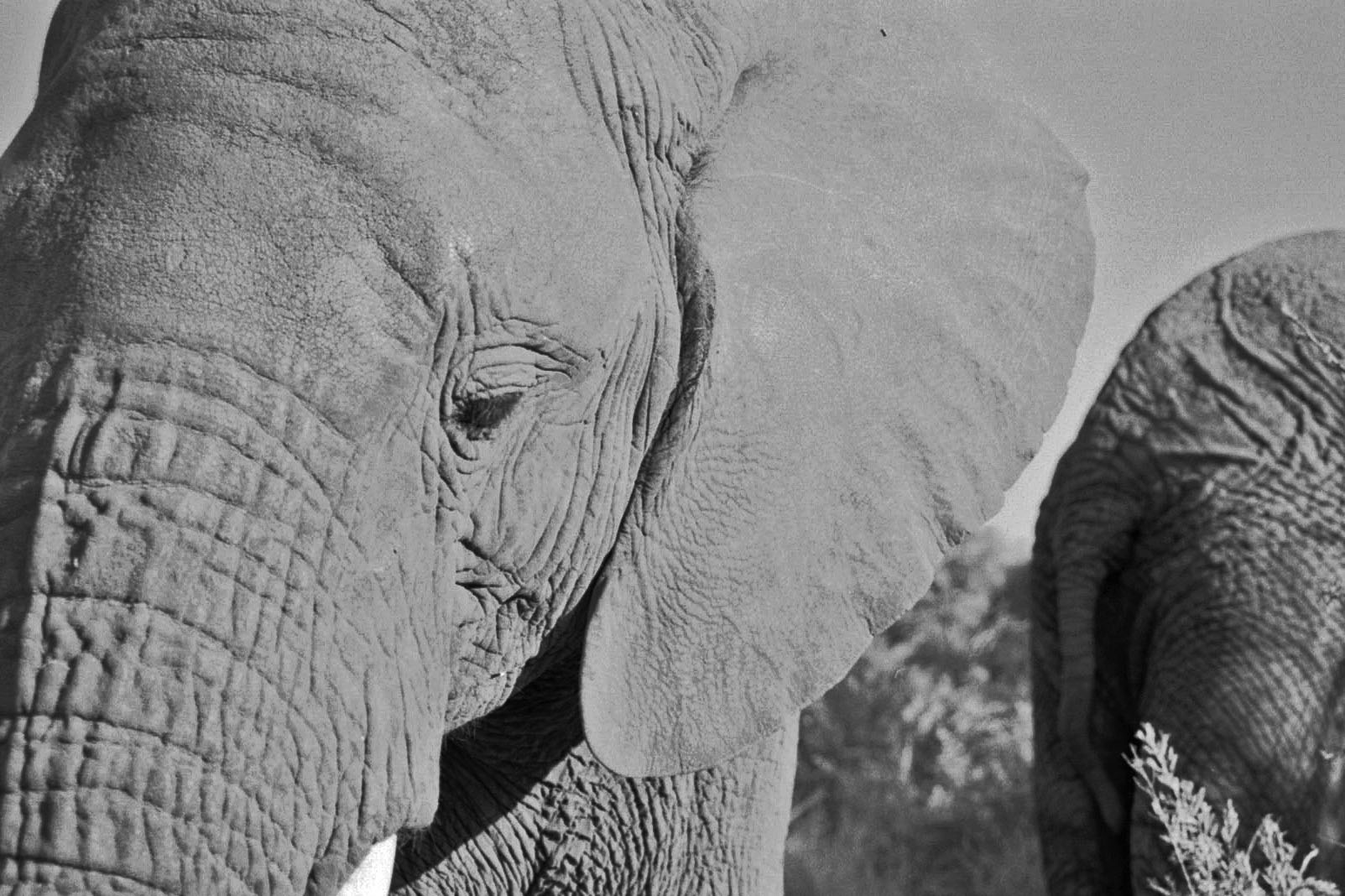
Jabu's eyeLike us, like all mammals, an elephant’s eye has one large lens, its aperture always open, except for a blink, or in sleep.  Like us, like all mammals, Jabu’s round iris controls the amount of light that enters his pupil.  Like us, the lens of his eye focuses light images on his retinas, where they are converted into chemical and electrical impulses, and conveyed along the optic nerve directly into his brain.

The iris is the only muscle of our bodies not colored a shade of red.  It contains pigment instead.  The density of that pigment colors our eyes from brown to blue, mostly shades of brown for elephants, although a blue-eyed calf was photographed this year in South Africa.

Iris is the Greek word for rainbow.  When light refracts through countless prisms of rain, it produces that arched scatter of reds, greens, blues and violets that we call rainbows.  But what we see is only half the story.  Rainbows are perfect circles cut in two by the horizon.  It’s only possible to see a complete circular rainbow if you are in an aircraft and the sun is high enough behind you.  A round rainbow is named a “glory.”  A halo for the earth.

How did the Greeks know rainbows are round?

Hurtling towards earth at 186,282 miles per second, light from the sun is carried by subatomic particles called photons, which vibrate up and down in perpendicular motion to the direction of the advancing light waves, passing along their energy to the retinas of our eyes.  Photons are both the medium and the message, carrying waves like water carries waves, invisible surf lapping against the islands of my eyes.  The cells in my eyes, in Jabu’s eyes, are precisely one photon wide.

I blink, he blinks, photon by photon we gaze into each other’s souls.

Posted in Africa, Elephants, Nature, Nonfiction, Photography, Travel, Writing

Deja Vu

Jabu & the tree b&w


It’s an ancient feeling, this memory of a moment I’ve never had before, this exact smell of scuffed dust, this slant of light, the slightly spicy taste of sand, the warm brush of sunrays across my cheeks, the squint my eyes adopt as if they’ve always looked into the African sun.  It’s the way my bones melt, the acceptance in my mind and nerves that tells me not to run when a monster materializes from a clump of brush and moves to an arm’s length, breathing so quietly I wonder if it’s sleepwalking, I wonder if I’m sleepwalking, because everything that is happening, this monster, this place, my fog of serenity, must be made from dreams.

The monster moves closer.

A familiar monster.  One with a shape.  One with a name.

His eye, a huge topaz oval, stares down at me.  He’s motionless, concentrating.  I can’t even hear him breathing.

Like us, like all mammals, an elephant’s eye has one large lens, its aperture always open, except for a blink, or in sleep.  Like us, like all mammals, Jabu’s round iris controls the amount of light that enters his pupil.  And like us, the lens of his eye focuses light images on his retinas, where they convert into chemical and electrical impulses and whisk along the optic nerve directly to his brain.

What would it be like to think without words and recognize shapes without names?

Both of us, human and elephant, witness only a small portion of what is out there to be seen.  Francolins, mambas, tsessebees, zebras and lions – everything that crawls, swims or walks – witness the world in ways I cannot even imagine.

Even in the womb the eye of a fetus moves through its amniotic dreams.  Does it dream about the glories of a life to come?

“Hello,” I whisper.


The light from his eye just now reaches mine.