
A popular series of photographs on my Facebook page, I’m sharing them now with my WordPress friends:

A popular series of photographs on my Facebook page, I’m sharing them now with my WordPress friends:
As promised, I’m re-visiting the third most popular blog post of my blog in 2014: an excerpt from my book, Larger than Life: Living in the Shadows of Elephants.
Doug gets my full attention when he proclaims to his guests, “Thembi has a great set of knockers.”
“Thembi, leg.”
She obliges by bending her left front leg at the knee and raising it, exposing a clear view of her breast. “See? Elephant mammary glands are located on the chest, like humans.”
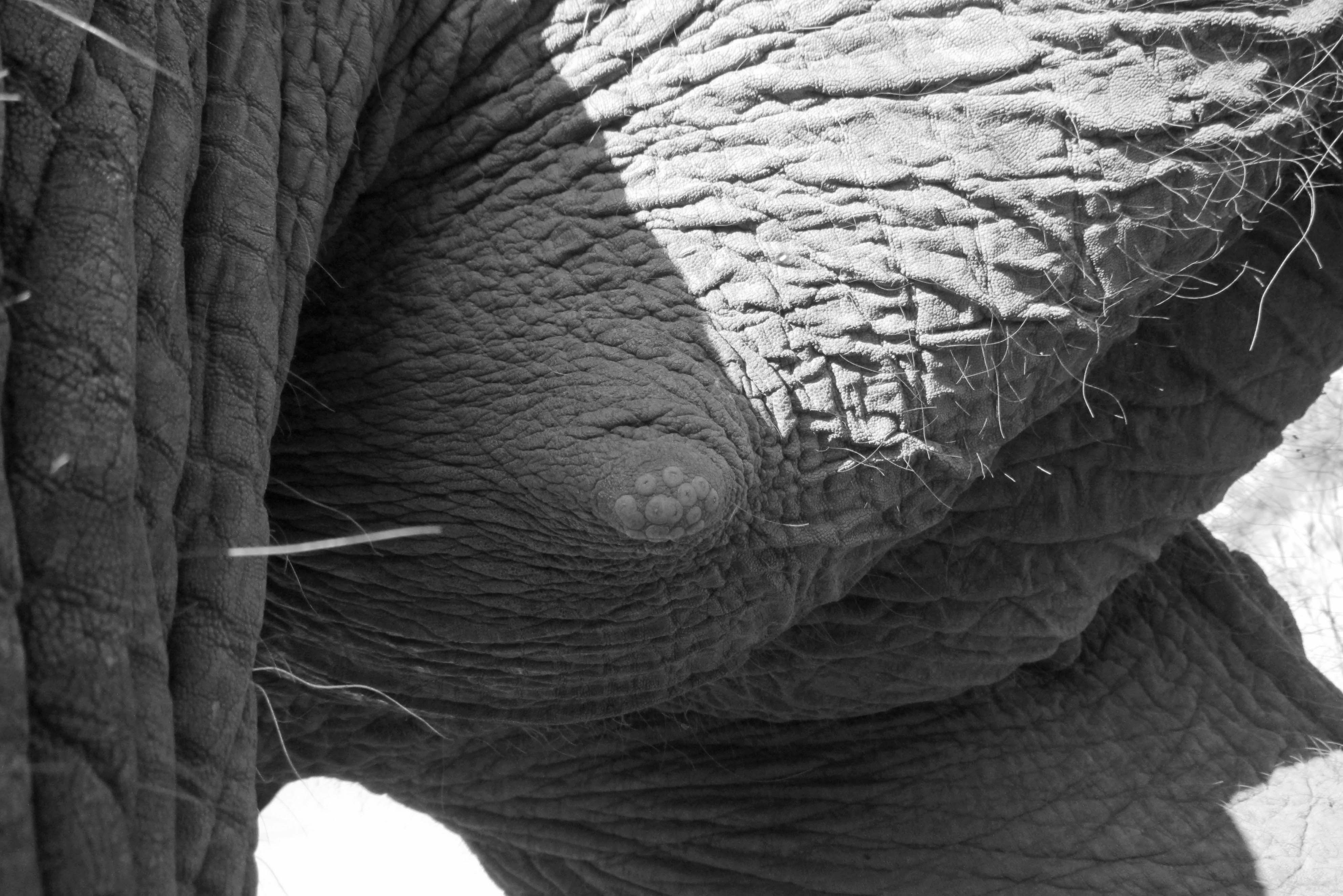
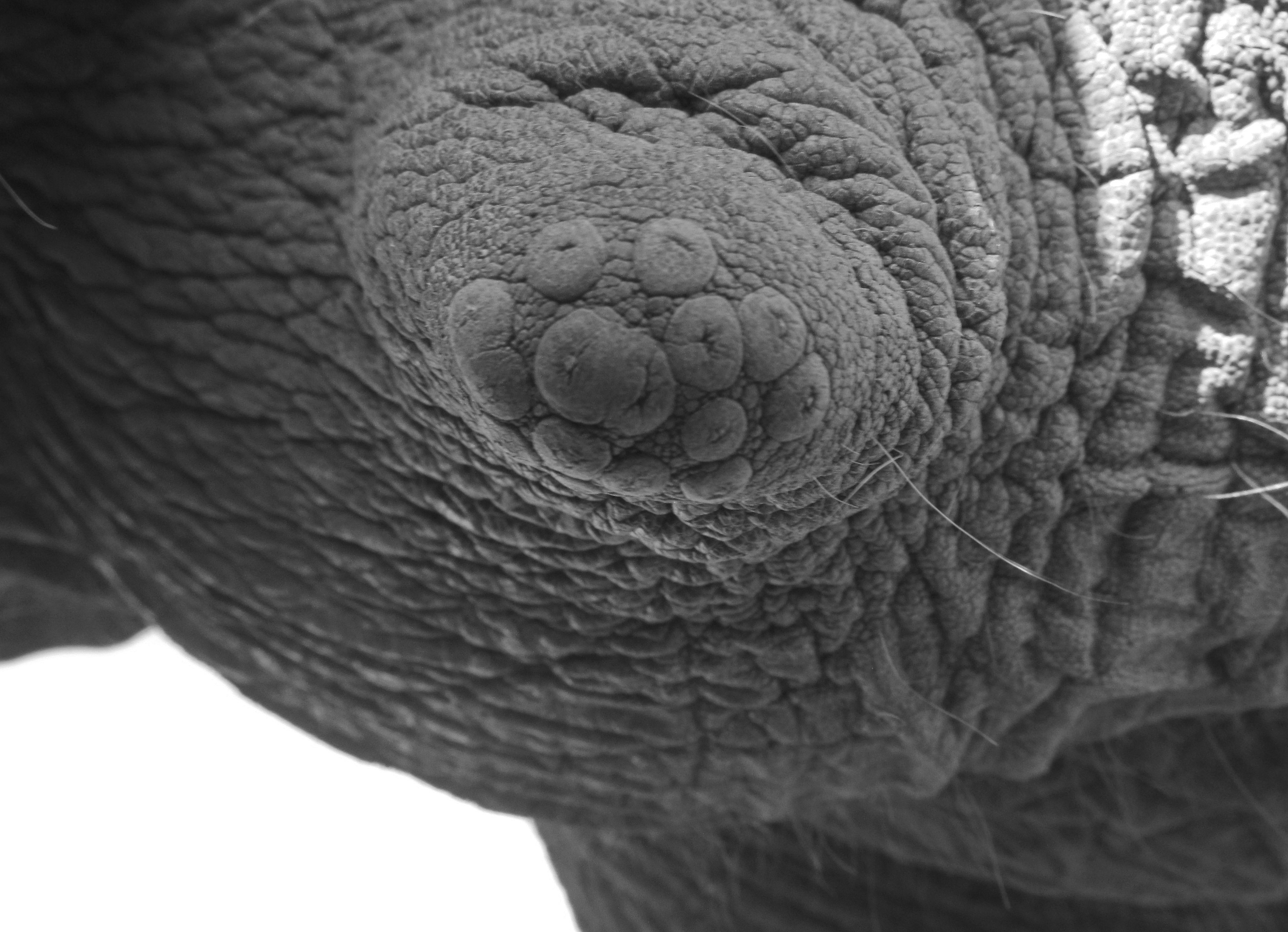
I lean over Doug’s shoulder and look at two gray breasts with permanently erect nipples. They’re about the size of a medium cantaloupe and, like human breasts, slightly globular, due to the pull of gravity.
“Alllllll-right, Thembi.” As her foot touches the ground, she flaps her ears and her trunk snorfles around his feet.
“If you reach in like this,” Doug demonstrates, “you can feel them.”
Steadying myself with one hand on Thembi’s leg, I reach in and cup her breast with the other hand. The skin of her breast is as soft as an old, creased leather bag. Her nipple, as one might expect, is harder than the flesh around it.
Thembi emits a low, murmuring rumble.
“Oh you like that, do you, Thembi girl?” Doug chuckles.
I quickly withdraw my hand and step away from her side.
“Anyone else want to try?” asks Doug.
Out of the seven of us, several people look away, several look down. No one ventures forward. I can’t tell if everyone is embarrassed or just reticent. Feeling up an elephant may not be quite what they had in mind. It certainly wasn’t what I had in mind.
“Well, OK. Mammals are called mammals because . . . . ?”
One of the guests ventures, “Mammary glands?”
“Right.” Doug continues his lecture: “Like all mammals, Thembi’s lactiferous ducts terminate in her nipples. They point out a bit, while Morula’s nipples point down. Thembi gets a bit of stimulation while she walks, don’t you, Thembi girl?”
Some of the guests look mildly scandalized, while others giggle and whisper to each other.
Doug rubs Thembi’s leg, which generates another snorfle.
Female elephants don’t have a row of teats, like cats or dogs. They don’t lie on their sides, suckling a litter. Elephant calves nurse standing up, with their small trunks flipped over an eye like a wayward curl.
All mammal breasts are modified sweat glands. Some mammal breasts are located in the groin and some on the chest. The breasts between Thembi’s front legs are in the same location mine would be if I walked around on all fours. Her breasts weigh about four pounds each, .1% of her body weight. Human breasts weigh .08% of total body weight, dogs 2%, rats 9%.
Do all mammals have larger breast size to body weight than humans? I pull out my notebook to write down that question, but then decided I really don’t care, and put the notebook away.
“Is she pregnant?” asks the woman behind me.
Although Thembi possesses relatively trim tonnage in comparison to the other two elephants, she is significantly rounder – huge thighs, huge belly, a Rubenesque sort of girl with a really long nose – and very full breasts, unusually large for a non-pregnant elephant.
“We don’t think so,” Doug replies. “We had her hormone levels tested about six months ago, and they were normal. She’s an enthusiastic eater, so she might be a tad rotund because of that. She might be incubating a surprise, but we doubt it.”
Sandi laughs. “That’s because she’s a bit of a flirt with the wild boys around here, but when things get serious she becomes quite horrified and scoots on home.”
Another one of the guests pipes up: “Has Jabu ever tried mating with her?”
“Yes, he’s tried,” Sandi replies, “But we’ve never yet seen him achieve intromission.”
Heads nod thoughtfully. I can see intromission has thrown them a bit. It’s not a word commonly used to describe sexual penetration, but I think most of the guests have a general idea of what it might mean. Several of their heads swivel to gaze at Jabu, ripping apart a nearby bush. Since he’s such a big boy, why couldn’t he just have his own way?
“Thembi doesn’t really favor him,” says Sandi, as if she’s reading minds.
“What if she had a calf?”
There’s not one second of hesitancy to Sandi’s reply: “Oh, we’d keep it. It wouldn’t be easy, though. Thembi’s never been in a breeding herd and has no clue about birth. And she’s rather stuck on herself, you know. We don’t think she’d be a good mother. But if it happened, we’d make it work.”
Even though it’s not likely that Jabu and Thembi will become pachyderm parents, I can easily imagine Thembi as a pregnant princess, mood swings, food cravings and all. As if to prove my point, she regally sweeps through a stand of grass, a princess on a mission. She breaks off a few branches from a small thornbush, stuffs them against her back molars and chews with her mouth open.
Thembi has never been with an extended herd of mothers and sisters and aunts and hasn’t had the opportunity to learn the complex behaviors required to be a mother. She’s never learned that newborn calves stay in physical contact ninety-nine percent of the time, either below or beside their mothers. Although calves will begin to forage by nine months, they continue to suckle for about four years. Elephants in zoos will quite frequently shun newborn calves. So I can just about predict Thembi’s reaction to a calf: What IS this thing following me around?
I glance over at Jabu. He has nipples, too. Guy nipples, nozzle-like nipples, surrounded with sparse hair.
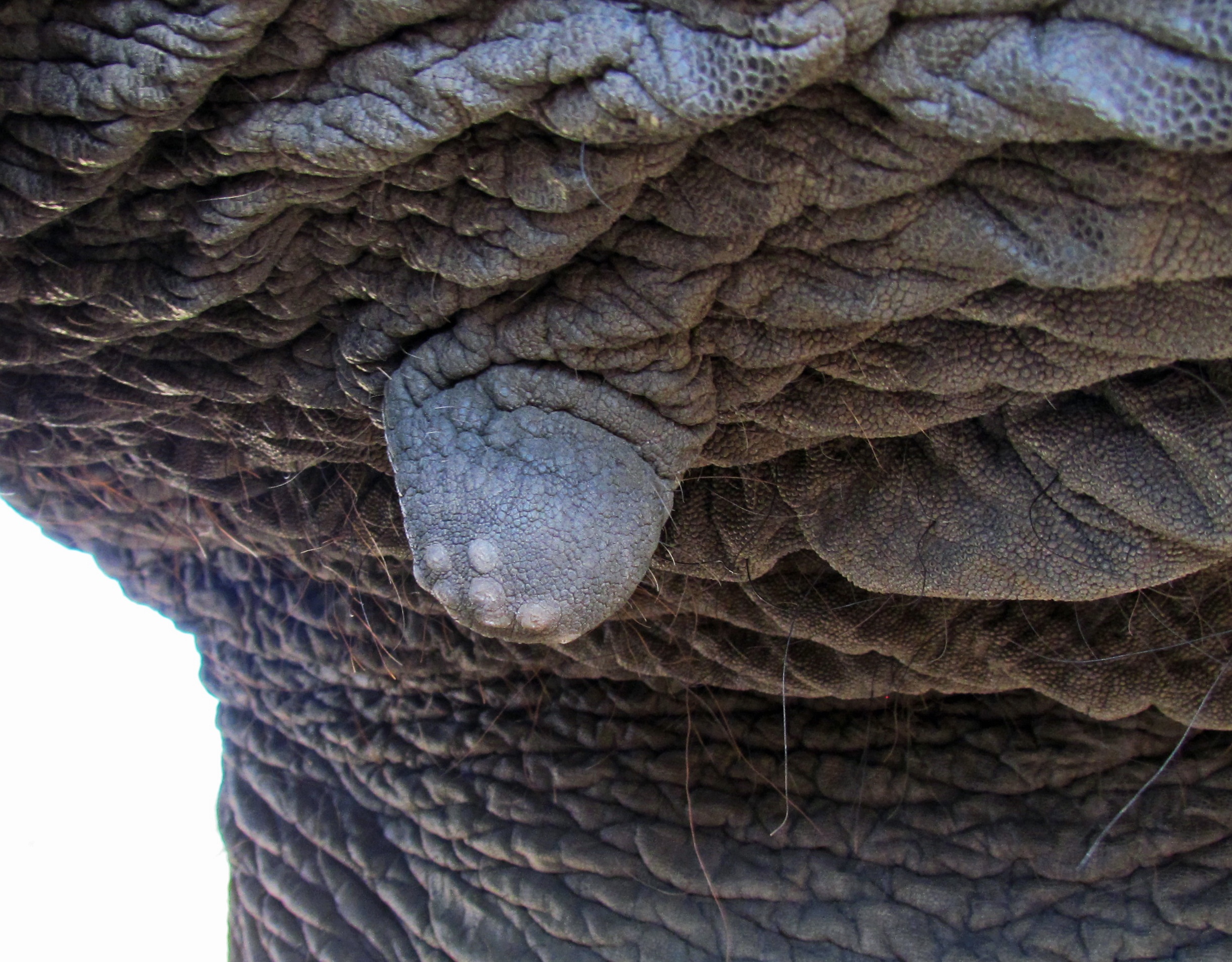
All mammals have three distinct features: hair, three middle ear bones, and mammary glands. Even whales, dolphins, porpoises and manatees have hair, usually on their snouts or next to blowholes. Elephants and manatees shared a common ancestor fifty-six million years ago, but the nipples of female manatees are now under their flippers, in their armpits.
A question comes from the back of the tourist group. “What about Morula?”
Dear, Old Maid Morula. The wallflower with big ears, large liquid eyes and a knobby forehead.
“If an elephant doesn’t breed by the age of twenty-five, they are unlikely to,” Sandi replies. “Morula is already the ripe old age of thirty.”
Female elephants typically become active at a quite young age, around thirteen. They can conceive as early as ten years old and possibly have 12-15 offspring by the time they are fifty. Female calves will stay with the herd the rest of their lives.
Male elephants take a bit longer to mature and become sexually active around the age of twenty-nine.
Morula has missed the boat. But I’ll bet she’d make a great aunty. She stands close by, slowly opening and closing her great ears, patiently watching.
When he first developed his classification system, Swedish botanist and zoologist Carl Linnaeus originally called mammals Quadrupedia, after the name Aristotle gave them. Later he became actively opposed to wet-nursing practices in the 1750s and wrote a book on the benefits of breast-feeding your own child. As a political act, he reclassified Quadrupedia to Mammalia in later editions of his most famous work, Systema Naturae, defining mammals as a lactating class within the Animalia kingdom, a classification that has lasted to this day – all because women of nobility in Linnaeus’s time thought breastfeeding would ruin their figures.
Certainly that’s one thing Thembi doesn’t have to worry about.
It’s always interesting to look at statistics and try to tease out what’s behind them. My most popular blog posts were (1) Miles per Pound of Trees (elephant farts), (2) Black Mamba in the Toilet (self-explanatory) and (3) Mammals are Called Mammals Because . . . (elephant nipples). You can see where this is going. All I can hope is that those folks using their search engines for snakes in the toilet, elephant farts and elephant nipples are surprised and educated along the way. For those of you with piqued prurient interest, I’ll repost them this month while I’m working on tightening up my elephant manuscript. Thanks to the many followers – you know who you are.

Here’s an excerpt:
The concert hall at the Sydney Opera House holds 2,700 people. This blog was viewed about 15,000 times in 2014. If it were a concert at Sydney Opera House, it would take about 6 sold-out performances for that many people to see it.

After posting about hyenas last week, I received a message from a Facebook friend about our similar experiences. Adrian and Ellen Kingi (from New Zealand) were managers at Stanley’s Camp from 2006-2007. I met them in 2007 and was delighted to reconnect with Ellen this year. (Unfortunately, Adrian died from leukemia in April). I asked Ellen if I could use her messages as a follow-up post.
“Loved reading this excerpt. During our term of management at Stanley’s from 2006 to 2007 I became fascinated with hyenas. Despite their ugly reputation I had huge respect for them, for their physical size and power as you described, but also for their social structure and the way the packs interacted. There was a den about 200 meters away from camp and on an evening off our favorite pastime was to take a vehicle, nose out quietly into the entrance of the den, turn off the engine and sit quietly to watch the pups play and harass their babysitter while mother was out hunting. Babies were very young, still black as pitch with very first signs of color only just starting to appear on eyebrows and chest. Tolerance and love of nanny was beautiful to witness.
When we arrived at Stanley’s there was a damaged sofa stored in our management house that had been attacked in the lodge you described. Don’t know whether this was the second sofa out whether the attacks had gone on and on and this may have been yet another!!! Anyway, a replacement for this one duly arrived, and we challenged ourselves to guess how long it would stay untouched. A week later, one seat cushion was gone. Next night, the second. And not long after the two back cushions. After that, guardrails were erected around the perimeter of the lodge deck and barriers propped up at the tops of the stairs each night. The barriers had to be remodeled when the hyenas learned they could be dragged away to give them access to the dining chairs.
Adrian was so frustrated, but he could have been a dreadful statistic when he woke to an almighty bang one night about 2 am, thought it was a hyena attacking the latest new sofa, and so went to investigate. He found SEVEN hyenas on the deck. He had a large stick with him and had the presence of mind to slam it so hard on the deck that the animals didn’t have time to even think of attacking him and took off. Adrian realized his foolishness and returned shaking.
My closest encounter with hyenas was in the Stanley’s kitchen. After dinner one evening I was stepping out of the kitchen door after checking that the rubbish bins were inside. As I put my foot out the door the front feet of a large hyena stepped up towards me as she was deciding to try her luck for some easy food. I reacted with loud shout and jump, and she raced away. They did get into the kitchen one night when door wasn’t properly secured. The mess was incredible next morning.
It was so funny reading your post and thinking we had experienced exactly the same things. Dining chairs eventually became non=leather models, but I wonder how many leather sofas became hyena fodder, and whether they too were changed to another medium. It was a major lesson for Adrian, and to think it could have been any other animal roaming around the camp at that hour of the morning that could have taken him out. Shudder!!!!!”
Many thanks to Ellen for letting me share her experiences at Stanley’s.

an excerpt from my book:
The first time I stayed with Doug and Sandi, Stanley’s Camp manager met me in the lounge, handed me a cold beer and pointed to the banks of a nearby lagoon.
“Last year hyenas dragged our sofa out there and ripped it apart.”
The leather sofa never had a chance. A pack of frenzied hyenas can devour a four- hundred-pound zebra in less than half an hour, eating its bones, skull, hair and horns, even its hooves, leaving only a smear of blood on the ground. With a bite pressure of over a thousand pounds, hyenas pulverize and swallow enough bone their scat is chalk-white.
They will chase, kill and eat almost anything that moves: zebras, wildebeests, warthogs, rodents, hares, snakes, baby crocodiles, turtles, lizards, birds, caterpillars, termites, and every species of antelope in Africa. They will eat things that don’t move – such as dung – or flesh so putrefied and full of maggots it’s the consistency of cottage cheese. They will filch and eat anything not locked up: boots, toothpaste, shaving cream, underwear, soap, even bottles of hot sauce. What’s glass to a creature that can eat a zebra’s hoof?
At Stanley’s the hyenas climbed a set of wooden steps into the dining lounge in the dead of night, shoved aside several tables and chairs, pulled the sofa down the steps and dragged it the length of a football field, depositing it at the lagoon. They ate its leather and left a gnawed wooden frame.
I asked the manager, “Why the sofa?”
“Just the oil from human hands.” He rubbed a palm across the sofa’s replacement. It’s leather, too. This sofa must also be doomed.
“There’s a den near the main road,” he added. “A game drive’s going out soon, if you want to go.”
We parked near the entrance of the den, motor off. The guide cautioned us to be very quiet. After a few minutes, a lone Spotted Hyena tentatively emerged. She had the slouched profile typical of hyenas: massive head, thick neck, and shoulders tapering to small hindquarters – a hybrid creature’s odd profile, half fearsome predator, half coward.
The second largest carnivore in Africa (after the lion), and the most numerous of the large predators, the Spotted Hyena is both opportunistic and aggressive. A single adult, weighing at most one hundred and forty pounds, is capable of taking down a six-hundred-pound wildebeest. Although hyenas kill ninety-five percent of what they eat, they steal at every opportunity, chasing leopards, lions and cheetahs from their own kills. Everything a hyena eats is digested within twenty-four hours. Even the sofa.
Grinning her famous false smile, the hyena sat on the bare slope near the entrance of the den and turned black, empty eyes toward us. Her ruff and the tip of her brushy tail had a reddish tinge, but the rest of her coat was a dingy, grayish-tan. Her round ears and bear-like muzzle were lined with black. Spots on a hyena appear when they’re a year old and then fade over time. The irregular splotches on this female’s fur were still sharp, so she’s most likely a subordinate younger sister to the clan’s dominant female.
Less than a moment after the babysitter sat down, unspotted black fuzz-balls erupted behind her. Each time she took a pup down into the den, another escaped and then another. The grinning, panting, anxious nanny seemed to be having a nervous breakdown. I would have considered the pups cute, except for the hyena’s awful reputation.
Yesterday evening, when I mentioned the sofa to Sandi, she told me that in 2000 hyenas had killed an eleven-year-old American boy at the Xakanaxa (Kah-khan-a-kah) Campground, thirty miles northeast of here. Despite the young age of her son, his mother allowed him to sleep by himself. Apparently he left the zipper of his tent open, hoping to photograph the hyenas circling their campsite earlier in the evening. According to some accounts, he may have even brought food into his tent.
Awakened by shrieks and crazed laughter, their guide saw a huge female hyena dragging the boy into the bush. People from nearby campsites helped locate the decapitated body, drove away the hyenas and guarded the boy’s remains until daylight.
One rescuer reported hitting the dominant female hyena – identifiable by the scar on her forehead – with his Maglite flashlight. “Guns aren’t allowed in the game park . . . so I hit the hyena on the head, and then she let go of the body and ran off.”
In the parks and game reserves of Africa, you never, never sleep with your food or leave the zipper open on your tent – if they’re around, hyenas will walk right in. At Doug and Sandi’s kitchen shelter anything even remotely edible is secured in heavy metal lockers or inside a propane-powered refrigerator. Over at Stanley’s, food is kept behind the heavy doors of a wood-frame kitchen. Watchmen now patrol the camp after dark.
But I bet someday hyenas will manage to steal the new sofa. They faithfully patrol the camps, too.


A selection from my book in progress:
As she walks, Morula’s ears slap flatly against her shoulders, Whoooosh, thwack . . . Whoooosh, thwack . . . Whooosh, thwack . . . Elephant air-conditioning.
Morula produces enough heat to warm a small house. She is also pachy-dermed, thick-skinned. Some of her blood vessels are as deep as one-and-a-half inches under her skin’s surface. Since she doesn’t have sweat glands, her ears act like giant heat exchangers, regulating her body temperature. As air moves over the huge network of swollen arteries covering each ear, Morula’s blood cools as much as nine degrees before it returns to her body. When spread open, her ears increase her body size by roughly twenty square feet, a huge area for the process of thermoregulation.
Whooosh, thwack . . . Whooosh, thwack . . . Whooosh, thwack . . .
I take a photograph of her ear in mid-flap. Where Morula’s ear attaches to her shoulder, wrinkles give way to swollen arteries pumping five gallons of blood per minute across the surface of her ears. The pattern of those arteries is as unique as a fingerprint and often used to identify individual elephants.
Whooosh, thwack . . . Whooosh, thwack . . . Whooosh, thwack . . .
The breeze she creates dies before it reaches me. I take off my cap and fan my own neck.
My teeny, itsy ears are built somewhat the same as hers are, with an upper rim of cartilage and a fleshy, lower lobe. But I don’t have an auriculo-occipitalis, an ear muscle the size of a weightlifter’s bicep. I can’t flap my ears. I can’t even wiggle them.

Funky jazzy trombone trunk. Snaking snorkeling vacuuming trunk. Showerhead. Backhoe. Slinky. Shimmying sucking swigging trunk. Empty pipe. Water gun. Periscope. Plucking siphoning tenacious trunk. Kazoo. Tweezers. Tentacle. Affectionate handshaking pickpocket trunk. Python. Air hose. Question mark. Whistling snorting sneezing trunk.
Breathtaking trunk.
For several months of each year Keikagile (Kee-ka-HEE-lay) has elephants in her backyard. Entire herds of elephants. Lions, zebras, crocodiles, hippos, hyenas, and other wild denizens of Africa surround her home. But it’s the elephants she most fears, for they can destroy her entire farm in just one night.
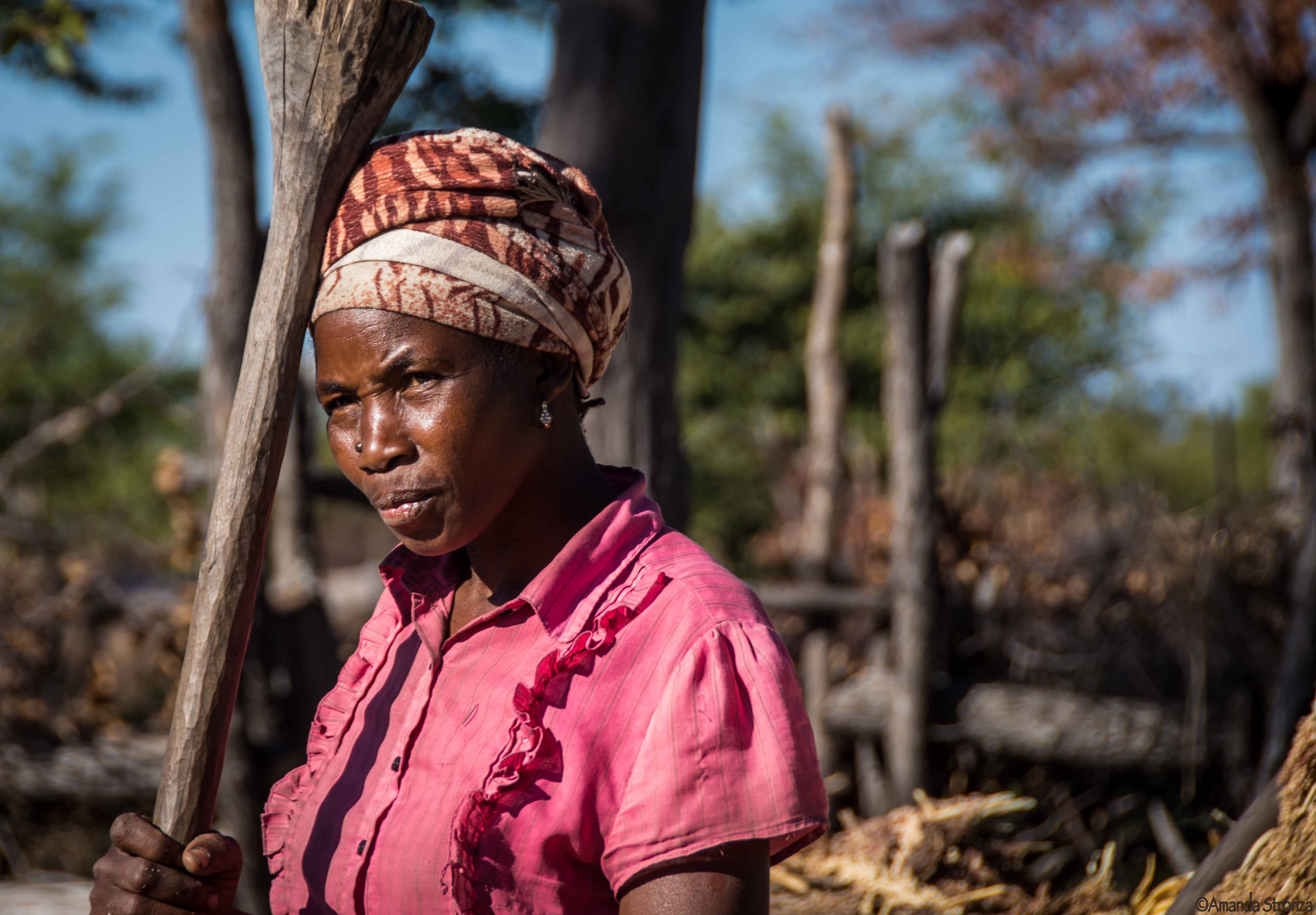
Keikagile lives in the Okavango Delta of northern Botswana, in an area of roughly 3,500 square miles (9,000 km2) where 15,000 elephants roam freely and 15,000 people plant fields, herd livestock, and walk to and from school. Between April and June, elephants move southward from drying pans near Namibia to the permanent waters found in the Delta. And as they follow their ancient migration routes, the herds often stop to forage in the fields planted closest to those paths. When seasonal rains return in November, the elephants return north along the same routes.

Keikagile’s fields are less than a mile (1.2 km) from one of the largest and most frequently used elephant pathways. Her farm is twice as likely to be raided as those further away, a risk that could happen twice a year, as the elephants migrate to and from the waters of the Delta. (Note the man in the background of this photograph and the power lines.)
Keikagile’s crops are mostly pearl millet, maize (corn) and Bambara ground nuts. Pearl millet has been grown in Africa since prehistoric times. It has a slightly nutty taste, can be cooked like brown rice and ground into flour for flatbreads. It’s high in antioxidants and magnesium. Dried ground maize can be cooked into porridge or a dish called bogobe, made by putting sorghum, maize or millet flour into boiling water, stirring the mixture into a soft paste, and then cooking it slowly. Sometimes the sorghum or maize is fermented, and milk and sugar added. Bambara ground nuts ripen, like peanuts, below ground. They are high in protein (an important food source for people who cannot afford animal protein) and can be eaten roasted, salted or boiled, similar to beans. Most importantly, the plant improves the soil with nitrogen fixation.
Pearl millet grows well in soils with high salinity and is a highly drought-tolerant crop. The Bambara ground nut grows best in sandy soils and is resistant to high temperatures. Maize, the most difficult to grow in a semi-arid climate, is preferred by farmers. The three plants can be grown together, mixed into the same space, in a practice called intercropping, which maximizes space and creates biodiversity.

As a subsistence farmer and a single mother, Keikagile feeds and provides for her three children. In the past, the yields from her fields were barely enough to support her family. And the threat of catastrophic damage to her livelihood by elephants is an annual worry for her.
EcoExist (Ecoexist) hopes to change that. Partnering with local farmers, EcoExist (EcoExist Facebook)is a five-year program aimed at reducing human/elephant conflicts in the Okavango Delta. Read about the dual efforts of Keikagile and EcoExist in Part Two, The Elephant in Her Backyard.
An excerpt from my book-in-progress:
Whenever I leave for Africa I’m always, invariably asked, “Aren’t you afraid?”
“Of what?”
“Snakes. Alligators. Lions.”
“Well,” I usually reply, “there are no alligators in Africa. Only crocodiles.”
“So crocodiles, whatever.”
Once, in Tanzania, I saw a submerged crocodile lunge up amid four wildebeest faster than they, or I, could blink. I don’t know how, but he missed all of them as they leapt in four different directions. I’ve never taken a bathing suit to Africa. Didn’t seem like a great idea on my first trip and less so on subsequent ones.
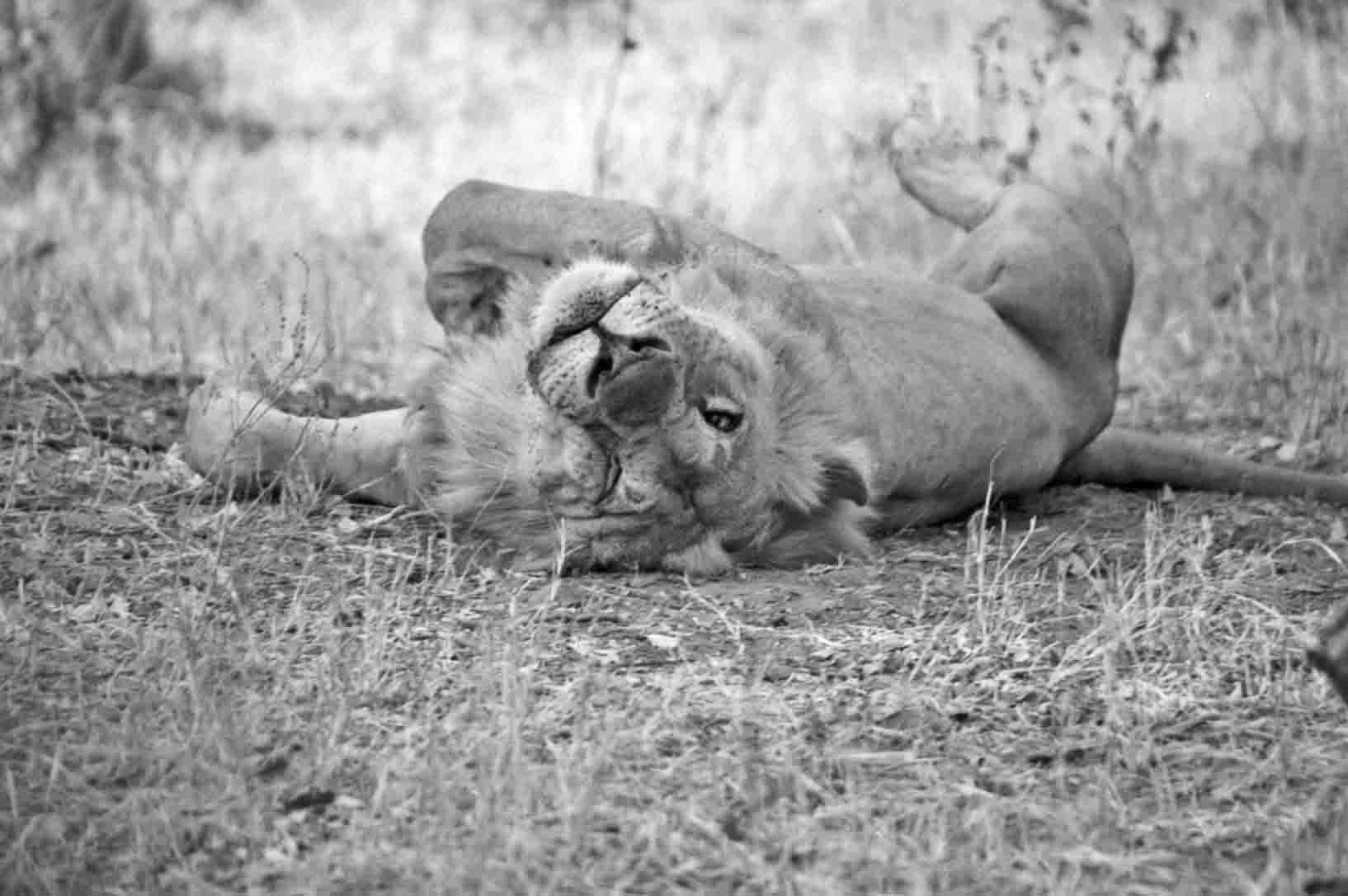
Lions? Well, lions will consider me prey if I act like prey. Look! Breakfast! And it’s fat and slow!
The possibility of actually encountering a lion is pretty rare. There are only about 20,000 lions left in Africa, down from 200,000 in 1975. Until 2007 Botswana allowed 50 lions to be hunted per year. By the time a hunting ban was enacted many of the male trophies were just two or three years old – requiring hair extensions woven into their manes before they were mounted on a hunter’s wall.
Snakes? There are a lot of snakes in Africa. Black mambas. Vipers. Cobras. Pythons. Boomslangs. Puff adders. In the Okavango Delta I could encounter Egyptian cobras or a puff adder or an African rock python or a black mamba or perhaps even a shy boomslang. I could, but I haven’t. In all the times I’ve been to Africa, I’ve never seen a snake. Bad luck, I guess, because each of these snakes, in their own way, is fascinating, and I really wouldn’t mind seeing one of them.
The deadliest animal in Africa is not a snake nor a crocodile nor a lion – it’s the hippo, those oddly comic, rotund herbivores that Walt Disney put in tutus. Hippos kill more people in Africa than any other animal: several hundred per year. In contrast, sharks kill only around ten people per year, worldwide.
Hippos don’t even eat the people they kill. They emerge at night from ponds and rivers to spend all night eating grass. Their beady, sherry-colored eyes don’t see well, but their sense of smell is acute. Males defend territory, females their calves. They can outrun you, and you never know what might set them off.
In 2002, I was on a game drive with six people in an open-sided Landcruiser. Laid-back hippo blimps floated in a nearby pond. One of the hippos grunted, burbling like a submerged tuba.
A herd of hippos is known as a “thunder” – possibly a reference to their size, but more likely because of the noises they make. When a group of hippos get going, their combined grunts sound like rolling thunder. But these hippos were relatively quiet. They rose and sank, twirled their ears, exhaled wetly through their nostrils.
It was that magic half-hour before sunset when the light is golden and incredible – perfect for photographs. A short distance away a male grazed on flowers. I raised my camera.
Without warning, the hippo opened his mouth in a threat gesture, displaying his long, razor-sharp canines. A second later, he charged, head swinging side to side like a giant sledgehammer, running directly for us at a surprisingly clip, intent on slamming into our vehicle. Since a hippo’s top speed is around twenty miles per hour, he was closing fast. All I could see through my camera lens were those massive incisors, as the autofocus kept singing out zzzzt zzzt, zzzzzt zzzt.

Luckily, the engine of our vehicle started without a cough and the hippo just missed the back bumper. He continued on into the bush for thirty yards before stopping to wonder where we had gone.
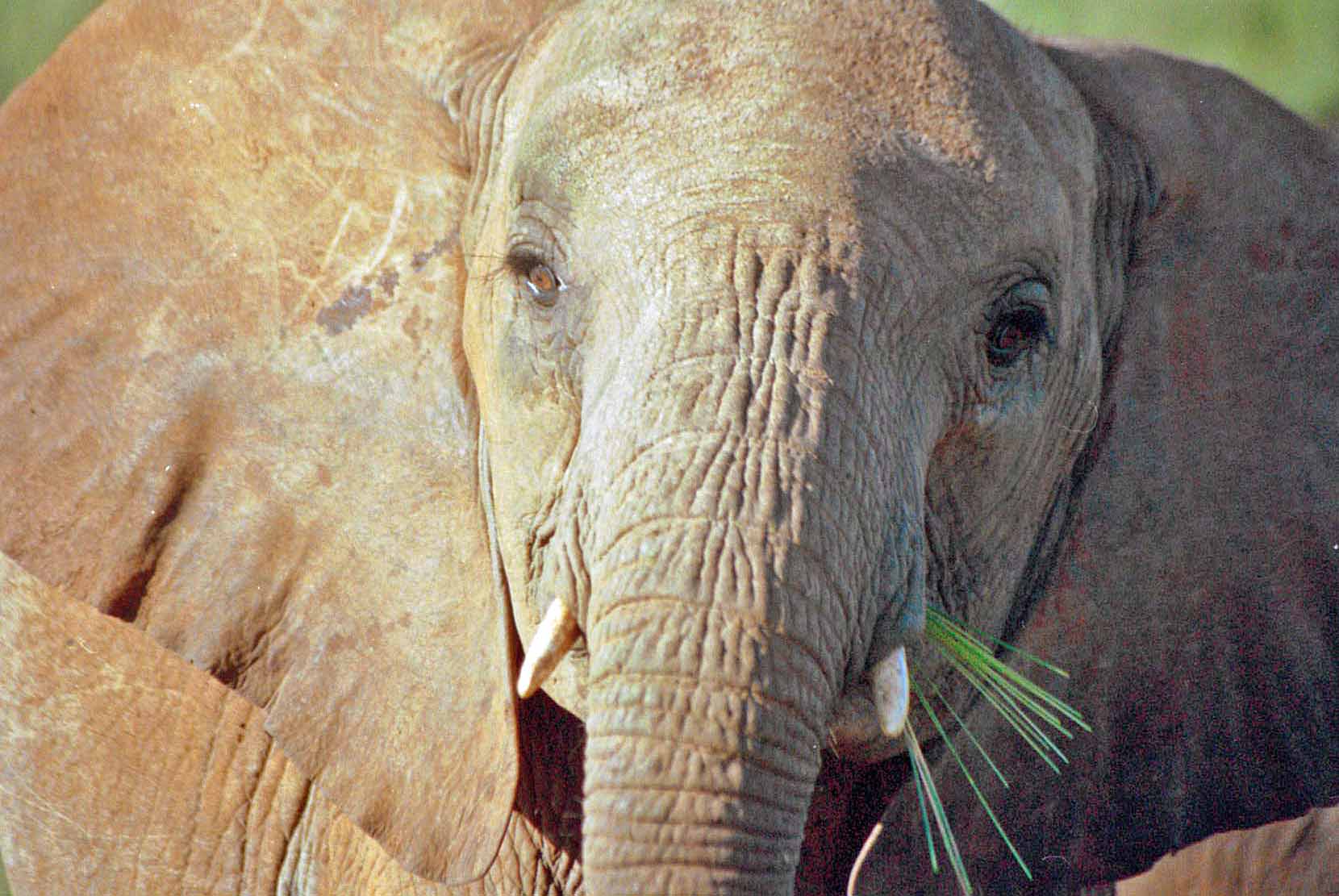
It takes a lot of foliage to sustain an elephant. Depending on its sex and size, elephants eat four to seven percent of its body weight each day – four hundred to six hundred pounds of vegetation. And sometimes they take offense if you disturb their meal.
(Currently, the Samburu area of Kenya is experiencing its highest level of poaching in 14 years. I hope this young cow has survived.)
 ABOUT ELEPHANTS