Posted in Africa, Lions, Nature, Nonfiction, Photography, Travel, Writing

The King of Beasts

No other creatures of the savannah sleep as deeply or as soundly as lions, but after all, lions are the main reason for not sleeping soundly, so this is not surprising. – Elizabeth Marshall Thomas, The Old Way


We’re in a diesel Land Rover, a lovely old relic of earlier safari days thirty, maybe even forty, years ago. It shudders loudly when we stop. Yet they don’t wake up.

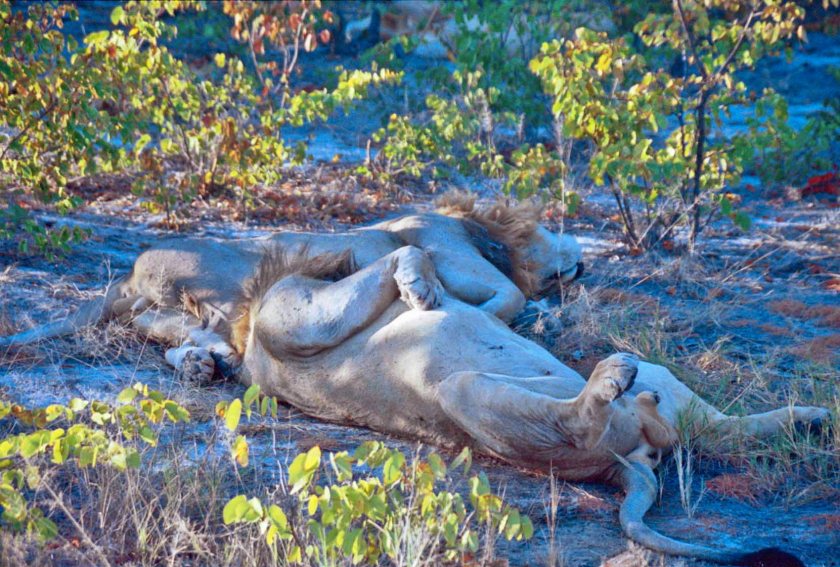
Two male lions sprawl in a cool swath of sand shaded by a thick clump of mopane. Blotches of pale blue rest upon tawny bodies like cloud shadows. It’s late afternoon and the sun is softening into that round light that blurs the edges of things.

After our ears clear of the clatter from the Land Rover, the wary silence whispers in a leaf twitch, in the movement of the sun across the sky. It’s the kind of silence that follows a lion’s roar. Even the birds are hiding.

The lions sleep on their sides. They haven’t eaten lately; their loose hides wrinkle against the ground. Without opening his eyes, the closest rolls onto his back. A small spot of sunlight outlines his high ribcage, deepens his navel.

Odd to think of him as a placental mammal, like humans. Odd to think of our inheritance from the Old Days, when we were afoot with cats. We were armed then with spears and rocks and our ability to make ourselves seem larger than we were, brandishing blazing torches, standing upright together, throwing and screaming.

Lions rarely sleep at night. It is the time of greatest vulnerability for most, and it would be so for us, too, if we were alone, without fire or companionship. But now we are encaged in the old Land Rover, gazing down without fear at two lions asleep on the blue-dappled sand.

There is something else watching. Lying deep in the mopane, camouflaged by leaves, a lioness stares at us. Her eyes are unwavering, ringed in black, with a white patch under each one. Long minutes later she loses interest in us and yawns, revealing the black edges of her gums, a baby-pink tongue, sharp white fangs, and one tooth broken. She looks over at the males.

photograph by Cheryl Merrill

They sleep on. The closest male has the abandoned flung body of a napping child. No, not a child. Not with hard-muscled shoulders and those ripping claws.

Between splayed legs his balls droop in their bags. We notice a tick crawling across one of them, wild creature upon wild creature. Small attacking large. As the tick tickles his scrotum, the tip of the lion’s penis emerges from its furred sheath, begins to drip. His right hind paw lifts and twitches.

Now we know his dreams.
photograph by Cheryl Merrill
Posted in Elephants, Mammoths, Nonfiction, Pleistocene, Sacred, Writing

Cave Walls

Rouffignal - The Cave of a Hundred Mammoths, France
Rouffignal – The Cave of a Hundred Mammoths, France


There is comfort in keeping what is sacred inside us not as a secret, but as a prayer.

  • Terry Tempest Williams, When Women Were Birds


There are certain things that can only be learned from a different perspective.

Pushing aside the darkness, a tiny, flickering lamp in hand, our ancestors crawled into the caves of Europe to paint the animals important to them. Still alive on those walls, mammoths with high, domed foreheads and a hump over their shoulders face two-legged stick hunters. Their humps held fat reserves, making them coveted prey, and dangerous prey make great stories.

Caves are potent, resonant underworlds. Tallow lamps held in a hand cast a low-level light, shadow each curve of the rock wall, suggesting a hump over there, the curve of an antler here.  With red, brown and yellow soils dampened by egg white, blood, animal fat or plant juices, our ancestors recorded the vocabulary of the hunt on wall after wall. They made their brushes of hair and their sponges of moss or leaves. They inhaled the dampness of the earth that receives all, both those who eat and those who are eaten.

Escape, exhaustion, success, death, galloping bison and herds of antelope, squared jaws of lions, the arched necks of horses, and outlines of cave bears – painted by generation after generation of artists, who left their signatures in an outline of a hand or a couple of dots, who left only stick representations of themselves.

After etching the outline of a mammoth on rock and storing its spirit forever in darkness, the crawl back to light perhaps gave the world a new appearance – as if it could be conquered, controlled, illuminated, literally brought alive by an artist. Life stories painted under the ribs of the earth. Hidden knowledge. The past the present the future recorded on rocks deep in caves.

Was the crawling to light a prayer?

We are the progeny of ancestors who lived with, hunted and ate the great ones. We are the result of their lives intertwined with those they knew in the belly of the earth.

I carry in my veins a longing for turquoise-blue glaciers, a blood-red night sky and breath I can see as I breathe. Ancient memories flicker across my mind, casting shadows against cave walls. I press my hand against rock, blow pigment between my fingers. This is my signature. Look, I was once here. See how your hand fits into the outline of mine? See these hairy elephants? They were here then, too.

Imagine the smell of air freshly born from retreating glaciers, a sky cleared by melting snow. Imagine the scent of an earth newly thawed. Out there, just like you painted, a mammoth driven by a hunt has fallen over a cliff and bellows arrive in waves.

Our palm prints on cave walls, carvings on bone, the exposure of light on glass plates full of chemicals, digital cameras, electrons arranged in display across computer screens, voices tumbling through the air – is it the destiny of the human race to remember and record? Is that our place on earth?

There is a cave of light from our eye to our brain; but it is the corners of our eyes that perceive the most light; the corners of our minds where we begin to understand.

Cave of the Hands, Argentina
Posted in Africa, Nature, Nonfiction, Photography, Travel

Symbiosis

photograph by Cheryl Merrill


For most of the morning a group of female giraffes has followed closely behind us. Whenever we stop, they stop, too, and the spotted derricks of their necks swivel in all directions to get a better look at us. At the end of each neck, a head is cocked sideways: the universal body language that says, “Huh?”

As the giraffes become more relaxed in our presence, they feed more closely and don’t look up at us quite as often.

I stop and take a photograph, of a graceful giraffe with an oxpecker on her neck, as she bends down to browse.

Red-billed oxpeckers use their bills to comb through the fur of large mammals both wild and domestic for ticks and bloodsucking flies, clinging to their hosts with sharp claws. They also feed on earwax and dandruff, and have been observed opening small wounds, as well as enhancing existing wounds, in order to feed on blood. Oxpecker courtship and copulation occurs on their hosts while they ride along, and they cushion their nests with hair from their host.

Living together in the animal kingdom.

Posted in Africa, Elephants, Nature, Nonfiction, Photography

What If?


photograph by Cheryl Merrill

As I walk to my tent at the edge of camp, my vision is elemental, full of shapes without fine details. Shifting slabs of moon-glow keep rearranging trees as if they are pieces on a giant pearled chessboard, their trunks whitewashed the color of ash.

I enter my tent, zip it shut, and switch on the lamp. The electricity comes from batteries charged by solar panels on the other side of camp, carried by a line buried several inches below the sand. Not long after, I turn off the light and crawl into bed.

I roll on my back and blindly stare at the black canvas ceiling of my tent, looking back at the bright moments of the day. But then an unexpected memory darkens the darkness.

In 1996, on my first trip to Africa, I was in a carload of tourists rounding a corner on a sandy road in an area of Zimbabwe where elephants were recently massacred for their tusks. We rounded the corner and stopped – face-to-face with a huge matriarch.

Richly repulsive, an unnatural, confined scent rose from us – odors of food on our clothes and in our hair; flowers washed in alcohol dabbed behind our ears; dead skins around our waists and on our feet; grease, oil and exhaust from our vehicle.

With her trunk shaped into a “J,” the elephant sampled the waves of scent emanating from us, and then tossed our smell away with an emphatic flick. Unnerved by our overpowering human stench, a miasma with a deadly history, she turned and fled, while the half-shadow of dust that marked her exit collapsed to the ground.

The air around me tightens. Canvas walls crowd in, closer, and then closer.

What if our days were measured in scents rather than minutes? What if we could tell the difference between a friend and a murderer with just one sniff?


Posted in Africa, Elephants, Nature, Nonfiction, Photography

An Afternoon Nap

An excerpt from my book, Larger than Life: Living in the Shadows of Elephants

My eyes tired from a day spent looking into the sun,  I drowsed in a Land Rover beside a waterhole in Chobe National Park. Only a few yards from our vehicle, a single-cylinder pump drew from the water table beneath the sands and sent spurts through a pipe to a square concrete trough. The bachelor elephants of Savuti congregated around the trough as they waited for spring rains and the return of female breeding herds.

The steady sound of the pump, chugga-sputter, chugga-sputter, chugga-sputter, lulled my eyes closed. They opened, closed, opened half-lidded, closed again.

“Here he comes,” someone whispered and my eyes flicked open as a huge bull strolled past. I picked up my camera.

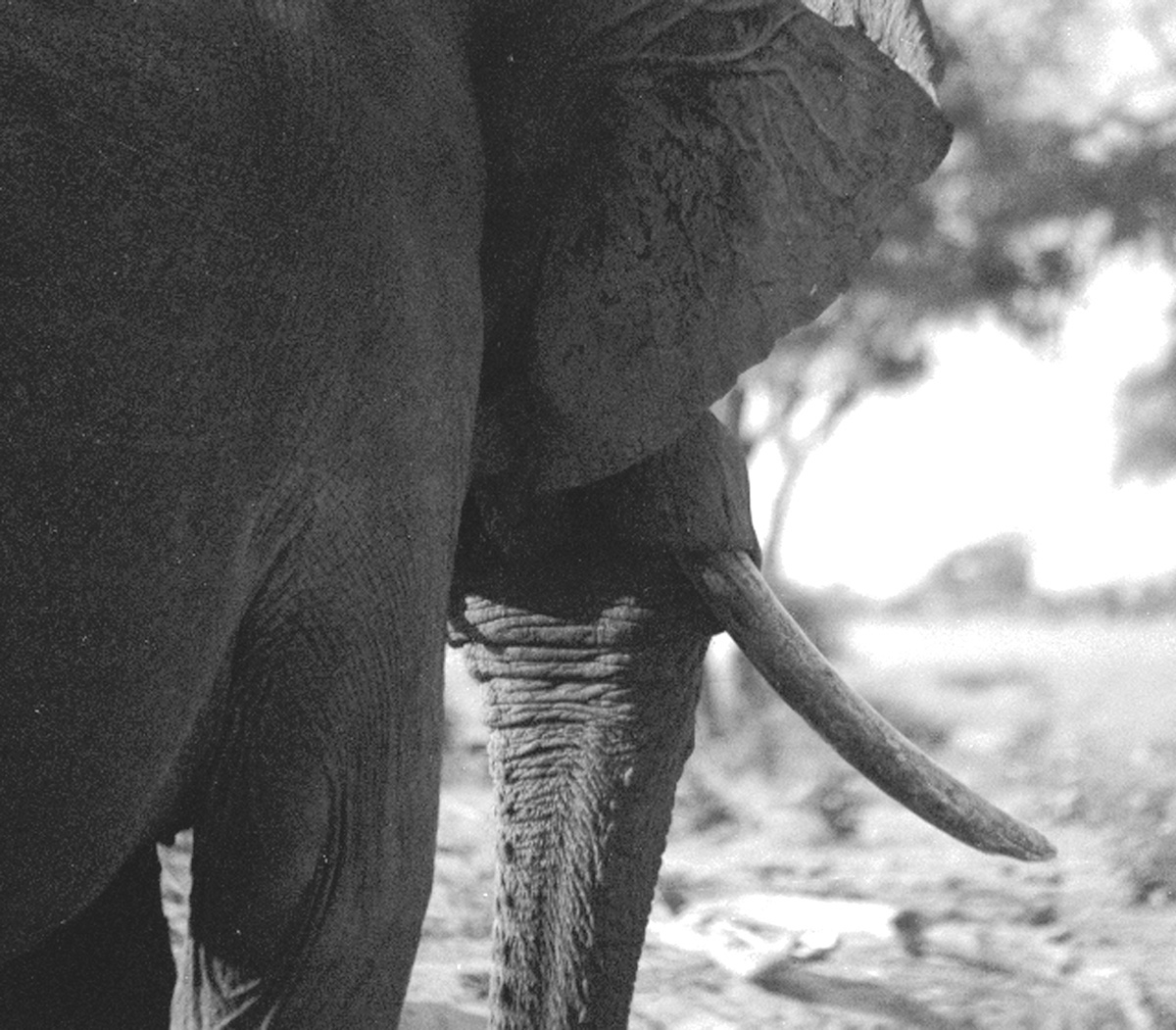
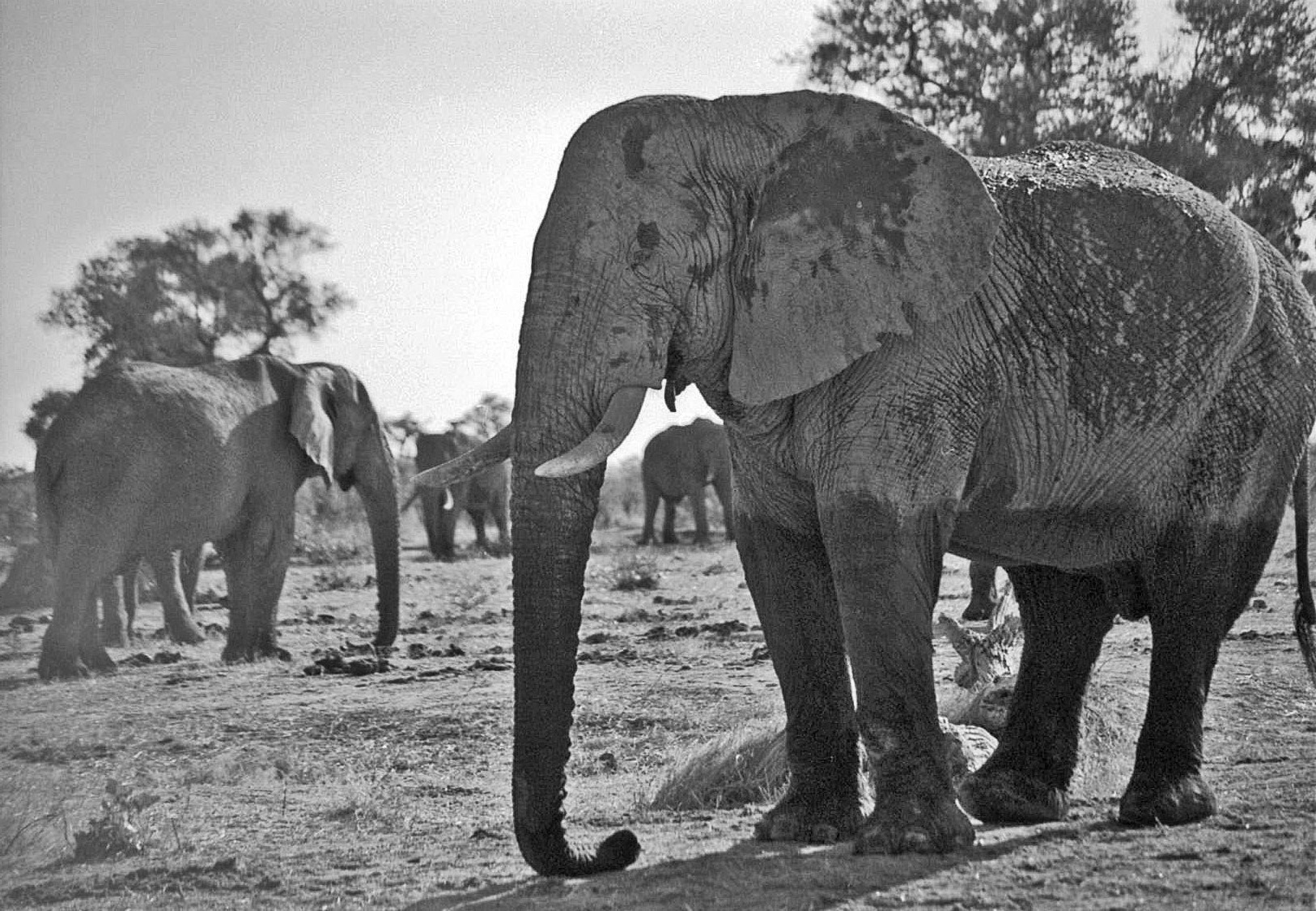
His enormous tusk splayed out almost sideways. I focused on his great head, nodding downward with each step, as he trudged past. A thirsty pilgrim in a parched land, his trek to water was nearly finished. The clicking and whirring of our cameras didn’t alter his gait.

Savuti male b&w
photograph by Cheryl Merrill


Through the viewfinder I marveled at his tusk. It was easily four feet long, stained and chipped on its end. Because of the growth pattern of his tusks – out, rather than down and up – he seemed a much wider elephant than he really was.

Mid-drink, he curled his trunk into his mouth; head tilted back, eyes closed. Extending his trunk into the waterhole, he blew bubbles before curling his trunk again and again to hose several gallons at a time down his throat. With each swallow went samplings from all the animals that drank here – zebra, wildebeest, warthog, ostrich, hyena and the occasional furtive flavor of lion.

I tried to imagine the bouquet garni of the waterhole and how its myriad fragrances might seep into the crevices of an elephant’s mind, form pools of scent they recognize, year after year, the liquid memory of Africa. Perhaps that old bull was memorizing the stories in that trough, paragraphs of taste and smell, twists of plot and character and fate.

He retraced his steps to where we were parked, and stopped close by. His skin was the color of seasoned cast iron. The waterline on his body rose just past his belly. Spatters of mud stained his ears and back.

Ellie asleep b&w
photograph by Cheryl Merrill


After several long minutes, his eyelids drooped and his mouth slackened. Under the hot sun he fell asleep, lulled perhaps by the narcotic of a long, slow drink. The tip of his trunk coiled like a magic rope on the ground. He slept with his weight on three legs, resting a hind leg, occasionally rocking back on it as if he dreamed of his trek. Drool from his trunk slowly seeped into the sand.

I matched my breathing with his, and drowsed once again, sedated by the sun.

The giant beside us rumbled soft snores in his sleep. Other elephants shuffled by quietly on their way to and from the waterhole, as if they didn’t want to wake us.

Posted in Africa, Elephants, Nature, Nonfiction, Photography, Travel, Writing

Your Daily Elephant: An Excerpt from my Book

photograph by Cheryl Merrill

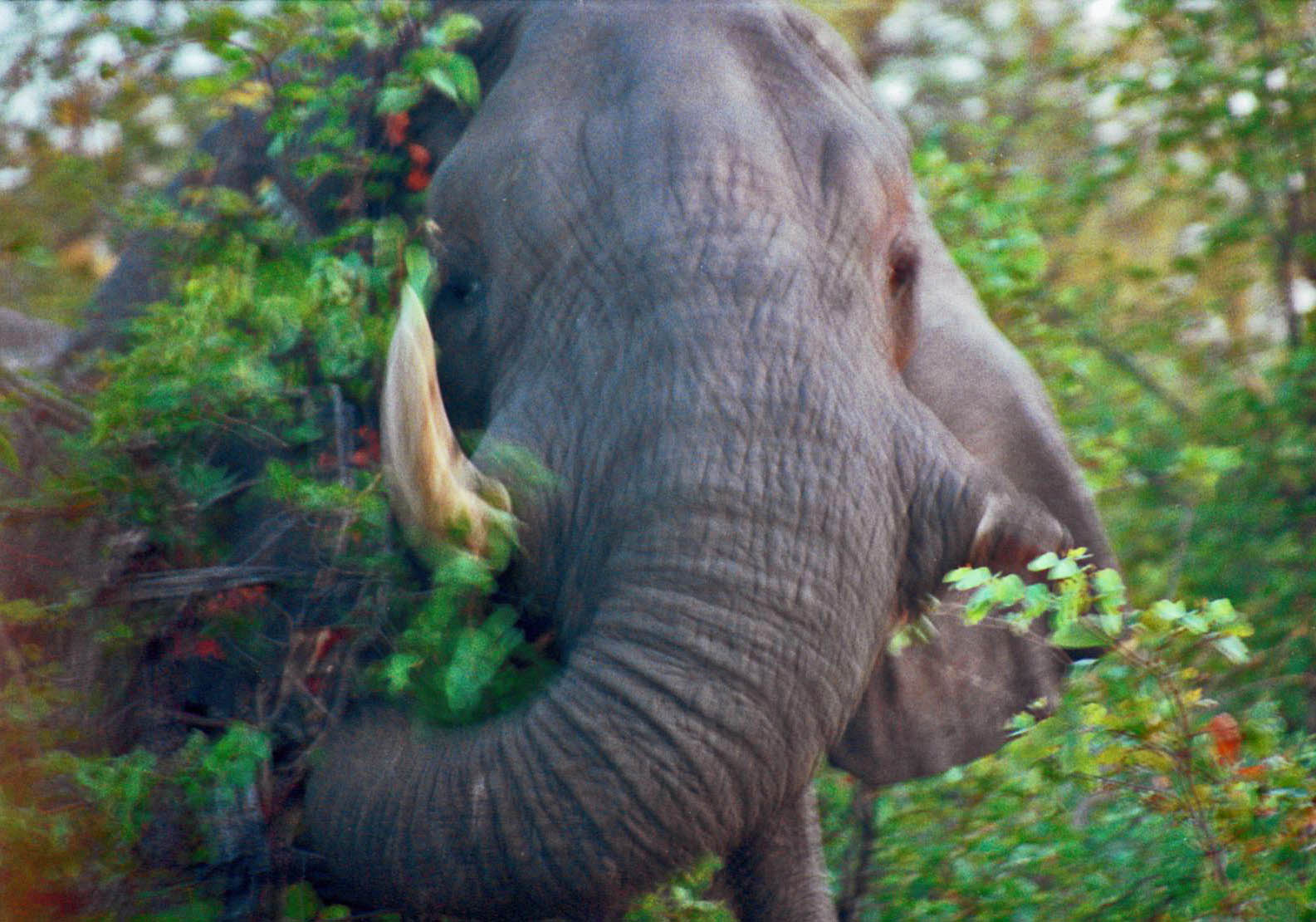
Morula stands square on, keeping her eyes upon me. Her cobbled forehead broadens from her nose upward in a triangular shape. The top of a tree is visible over her right shoulder, as if she has a giant nosegay tucked behind her ear. Short bristles like an old man’s buzz cut outline the top of her head.

Because of the way she’s standing, ears flattened against her shoulders, Morula seems slim, her skull almost hollow. The tip of her trunk flops over itself in a loose coil and points down like a curved arrow. It begins to twitch in an irregular rhythm. I take the lens cap from my camera and glimpse a tiny reflection of myself in its mirror. Is this what she sees – another one of those small humans, with its odd upright stature?   Does she see details: my hat, my camera, my idiotic grin?

I take a goofy photograph of Morula – it will look like she’s bored and playing with the only thing at hand – her trunk.

Posted in Africa, Elephants, Nature, Nonfiction, Photography, Travel

Your Daily Elephant: Molars

Both male and female African elephants grow tusks – the largest upper incisors on this planet. Their tusks grow every which way: up and curved, or down and straight, up and straight, or down and curved – the variations are endless. Some tusks are thin; others fat. Some are short and puny; others long and magnificent.

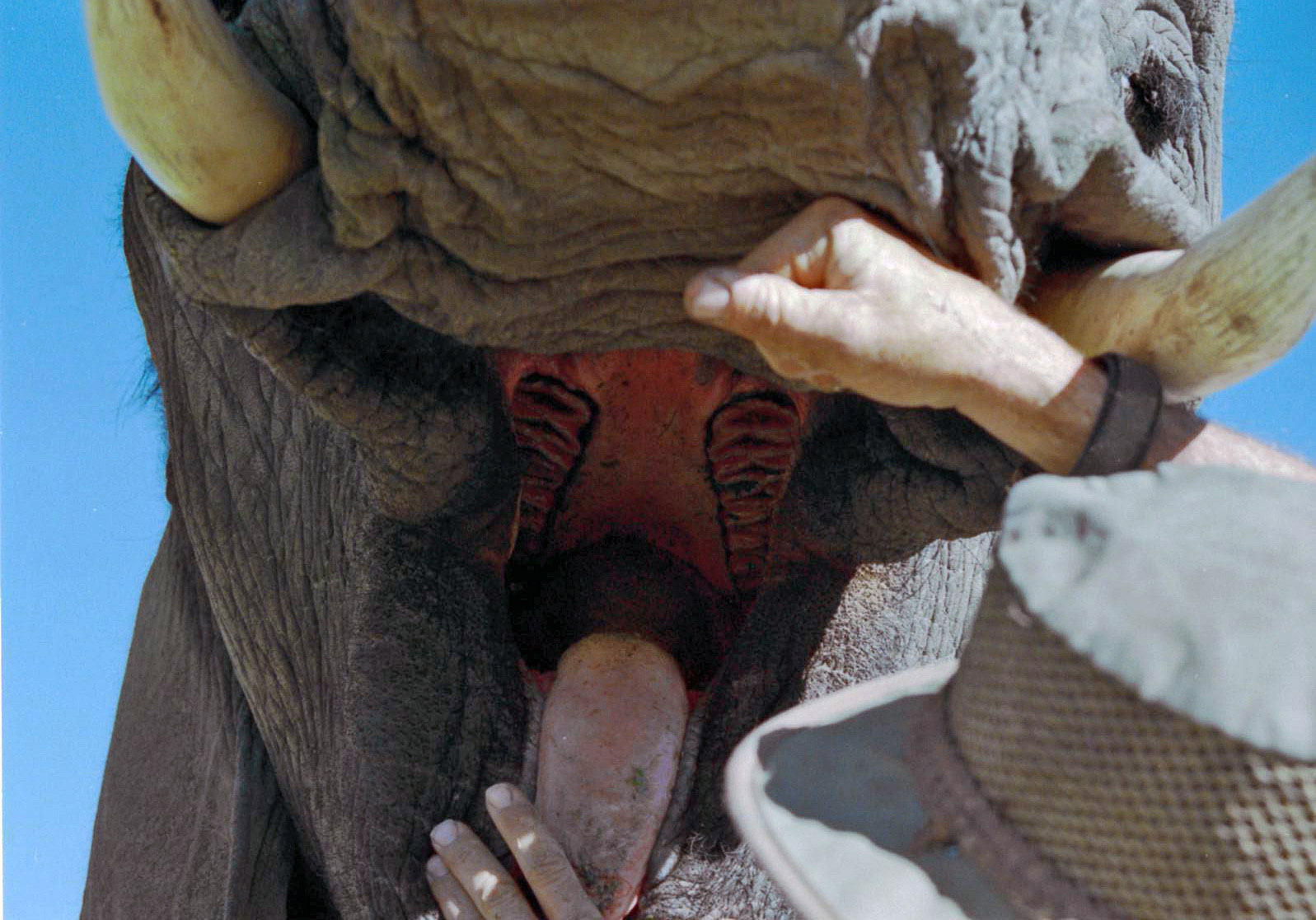
All elephants have only two types of teeth – tusks and molars. Four molars, two above and two below, are present throughout an elephant’s life.

photograph by Cheryl Merrill

An elephant’s molars look like dishes set to dry edgewise on a rack, bonded together by enamel. Vertical ridges in each molar function like giant vegetable graters as the elephants move their jaws forward and back, rather than side-to-side like a cow. Molars grow up to a foot long, with a maximum of ten ridges, and weight eleven pounds apiece – perfect for grinding up trees.

They push forward throughout an elephant’s life, becoming part of a conveyer belt of teeth. Fragments of molars crumble off in pieces as they wear down near the front of the mouth and either fall out or are swallowed. Throughout an elephant’s lifetime, twenty-four molars in six sets will grow in their mouths, but just two tusks. Only ten percent of aging elephants grow a seventh set of molars.


photograph by Cheryl Merrill
Posted in Africa, Elephants, Nonfiction, Photography, Travel

Your Daily Elephant

is actually in this finished manuscript.   Now I’ll be looking for an agent.

It's Done!


Posted in Elephants, Nonfiction, Photography, Writing

The Circus

photograph by Cheryl Merrill

It’s a catchy tune, one that loops round and round inside our heads. The announcer takes center ring, resplendent under a spotlight in top hat and tails. “LADIEZZZ AND GENTLEMEN! BOYS AND GIRLS OF ALL AGES! WELCOME TO THE GREATEST SHOW ON EARTH!

And indeed it is. Here comes the parade of animals, prancing horses, muzzled bears, tigers roaring in their cages on wheels. Here come the elephants in pink tutus, performing night after night to that same inescapable rhythm which now marches into our ears.

There’s exhilaration tumbling inside us as the great beasts circle center ring. We have tamed them; they obey our commands and kneel before us. We oooo and aahh and clap at these exotic creatures from far-off places. We laugh at the clowns and at ourselves. Each and every one of us wants to run away and join the circus, relief from our humdrum lives.

When we exit the canvas tent our imaginations deflate a little, but our wish to master the world does not. We go home and try to teach new tricks to cats curled in our armchairs.

Buddhists believe a person would do well to model themselves after the elephant. Not the ones in pink tutus circling and circling to the same song, for they are most like us, made over in our own image.   We should instead metamorphose into great gray patient beings standing naked in our own skins under the stars and the sun. Perhaps then we could rejoin the world of fellow beings, relearn ancient rhythms. Perhaps then we would know what they know.


Posted in Africa, Elephants, Nature, Nonfiction, Photography, Writing

Vision

There is a cold way of seeing that clips wings and stifles our words into faint echoes.  But there is also a way of seeing where the eye can be like a mouth, swallowing color, taking in the entire world with one choking gulp.

A rabbit has a 360º field of vision, so that it might gauge the distance between itself and its attacker.  Humans have front-facing, binocular vision.  It’s hard for us to look at where we have been and where we are going, impossible to see both the stars and the ground at once.

An elephant’s vision is front facing, binocular, but an elephant also has a large blind spot caused by its nose.  Place both hands between your eyes in the manner of prayer and you will see what I mean.

It is said that elephants will stare at a full moon; do they also see the stars?

What would it be like to think without words and recognize shapes without names?

There is a cave of light from our eye to our brain.  But it is the corners of our eyes that perceive the most light; the corners of our minds where we begin to understand.

photograph by Cheryl Merrill