Under a sun-bleached sky that is no longer blue, dry coughing barks from black-backed jackals lope in from our left . . . Wraack, wraack, wraack. . . Black-backs are scavengers, more aggressive than other types of jackals, occupying the same ecological niche in Africa as coyotes do in North America. Unlike coyotes, black-backed jackals do not howl. They often steal meat within the reach of a lion’s paw – although their main diet consists of insects, lizards, snakes, rodents, birds and ripe fruit.
Up ahead Morula slaps her ears flatly against her shoulders.
Elephant air-conditioning for a creature that produces enough heat to warm a small house.
Elephants are pachy-dermed, “thick-skinned.” Some of Morula’s blood vessels are buried as deep as one-and-a-half inches under the surface of her skin. Since she doesn’t have sweat glands, her ears act like giant heat exchangers, regulating her body temperature. As her ears open, her body size increases by roughly twenty square feet, a huge area for thermoregulation. Air moving over the swollen arteries of each ear cools her blood as much as nine degrees before it returns to her body.
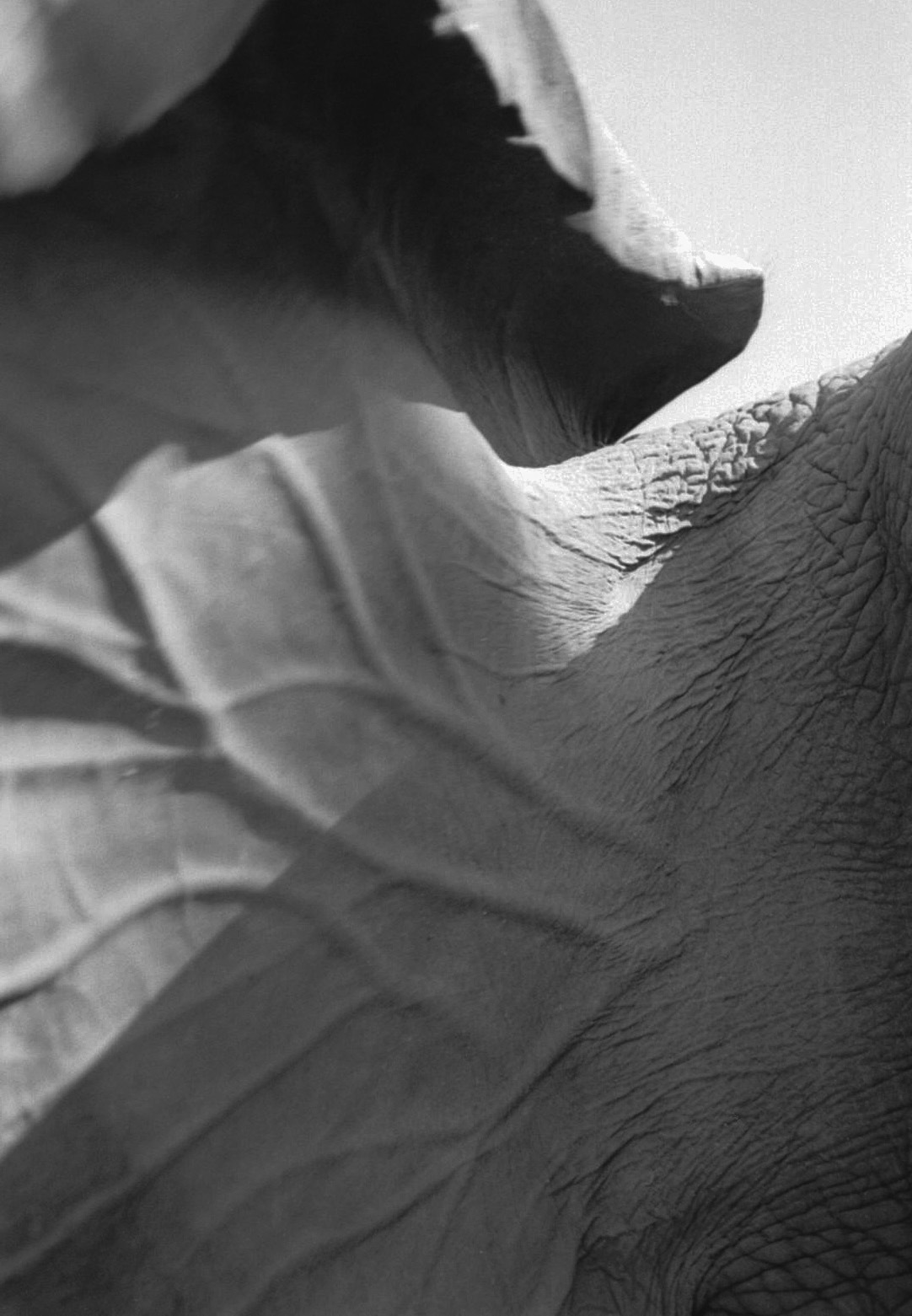
I take a photograph of her ear in mid-flap. Where Morula’s ear attaches to her shoulder, wrinkles give way to he swollen vessels pumping five gallons of blood per minute across the surface of her ears. The pattern of those arteries is as unique as a fingerprint, and often used for identifying individual elephants.
The breeze she creates dies before it reaches me. I take off my cap and fan my own neck.
My teeny, itsy ears are built somewhat the same as hers are, with an upper rim of cartilage and a fleshy, lower lobe. But I don’t have an auriculo-occipitalis, an ear muscle the size of a weightlifter’s bicep. I can’t flap my ears. I can’t even wiggle them.
Morula plucks a branch from one of her favorite snacks, a bush-willow. She holds the stem in her teeth, wraps her trunk from right to left around the branch, and sheers off leaves, top-to-bottom with a single swipe. She drops the branch and transfers mashed leaves from the curl of her trunk into her mouth.
Morula is right-trunked, as I am right-handed, preferring to grab and wrap from the right. Thembi is also right-trunked, but Jabu’s a lefty. One of the ways to determine an elephant’s dominant tendencies is to inspect the underside of its trunk for green stains on either the right side or the left.
But before you do this, make sure you know the elephant and, more importantly, the elephant knows you.
Morula sidles close to Doug and curls her trunk against her forehead.
“Those round bumps on her forehead might be an old skin infection,” Doug tells me, “but we really don’t know.”
A light breeze feathers the hair in her ears as she stands slightly sideways and nods the tip of her trunk in a tiny Hello. . . Ribbed muscles cross the underside of her trunk. Bristles stick out like the legs of a giant centipede.
Morula waves "Hello."
I squint against the sun, s—t—r—e—t—c—h and yawn. Back-to-back ten-hour jet flights across two hemispheres in a 48-hour-period are taking their toll. From Seattle to Amsterdam, Amsterdam to Johannesburg, and a four-hour flight from Johannesburg to Maun. My body thinks it’s 2 a.m.
The tip of Jabu’s trunk traces an arc from my toes to my heels, and back to my toes again. Did I pick up essences of jet fuel on my boots yesterday when I crossed the tarmac at Johannesburg? Can he smell the rubber floorboards of the Cessna 206 that brought me here? Or does the scent on my boots go further back, to the dandelions in my lawn half a world away?
Satisfied with my toes, Jabu starts to pat me down, sampling scents from the rest of my body almost thoughtfully. He expels air after each sampling, like a wine connoisseur clearing his palate. Of course, the smelliest parts of my body are the most interesting.
Ah, fuff, sweat, mixed with fuff armpits, and fuff, crotch. His trunk dangles over my hair, re-coifing it with a large and final Fuffff! Jabu is treating me the way he would scrutinize another elephant, determining who I am, where I’ve been and fuff what I did while I was there.
The tip of his trunk hovers in front of my face, wet with mucous, dotted with sand, nostril hairs visible.
He blows into my face, gently. I blow back, gently. We exchange breath, distillations of our own personal atmospheres, particle-swarms of changed, exchanged air, brewed though all the cells of our bodies.
Tip of Jabu's trunk
My lungs fill with the fragrance of crushed leaves, with saproots and spearmint-scented bark, all lightly fermented. I think of the stagnant air that surrounds my daily life, air that is conditioned, filtered, deodorized, air that is bland. Elephant’s breath is said to cure headaches. And it just might, if I had one.
Jabu’s trunk tip investigates my right boot over and over again. The scent that fascinates him tumbles up two seven-foot-long nostrils – nostrils surrounded by nerves, arteries, veins and a staggering array of longitudinal and transverse muscles, the world’s biggest, longest and certainly most flexible nose.
A trunk is the most useful appendage that ever evolved. Imagine having an arm in place of your nose, an arm long enough to reach to the top of a tree, and pluck a single leaf from its crown. Imagine having a nose with which you could rip, tear, excavate, whack, and blow bubbles with. You could steal with your nose, suck on it, squeal, swat, poke and siphon with your nose. You could take a shower with it. Scratch your back with it. Whistle with it. You could even arm wrestle with your nose.
There is no other living creature on this planet that has a trunk. If elephants were already extinct, which brave paleontologist would go out on a limb and reconstruct the trunk just from evidence of bony nostrils high on the skull? Who could imagine a nose dangling close to the ground where scents abound? Who could imagine a nose with the ability to pick up a single straw, rip a tree out by its roots, bench-press 600 pounds and untie your shoelaces without you ever noticing?
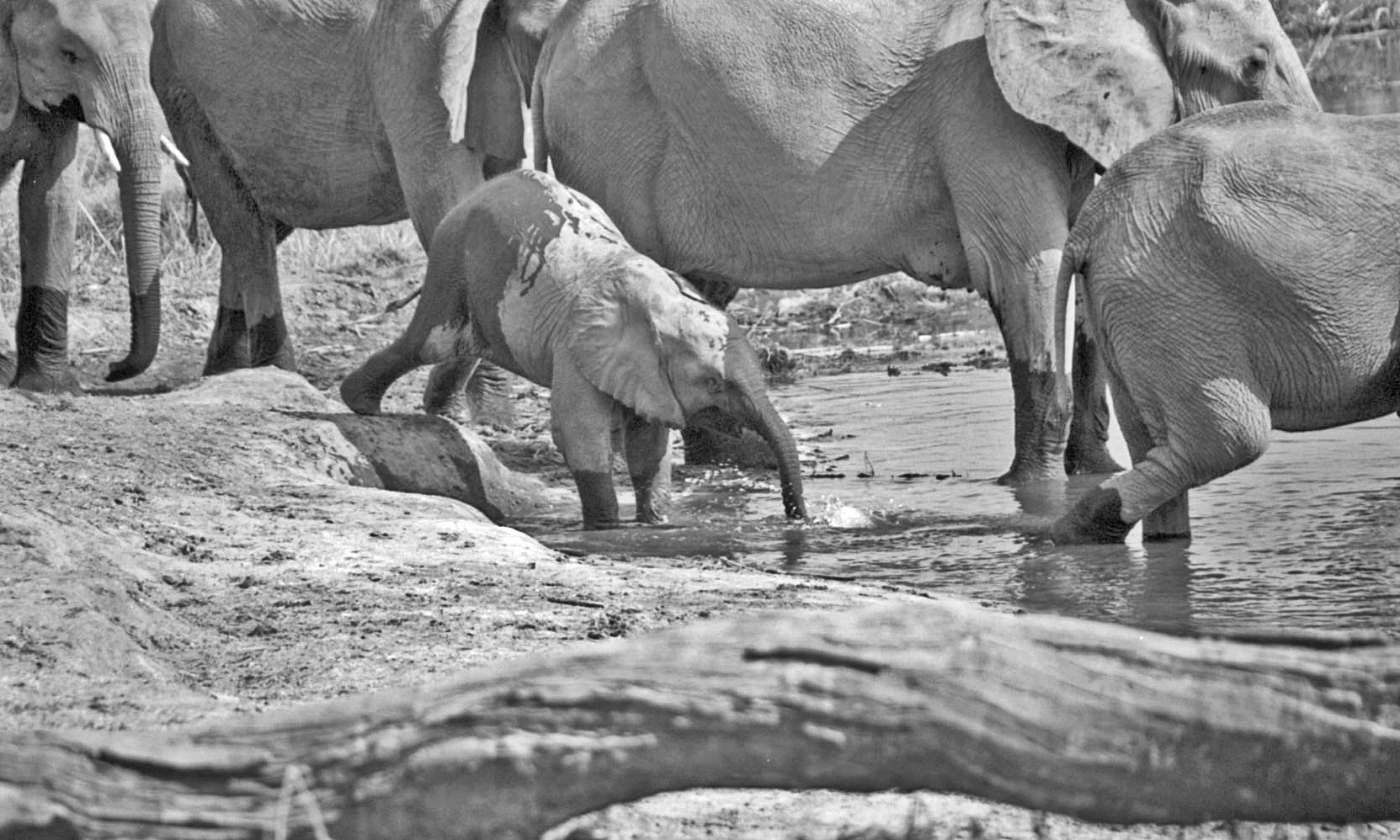
During a visit to Botswana’s Chobe National Park in 1999, I spent part of an afternoon belly laughing at a baby elephant learning to use her trunk. First, she flopped it over her ear as she nursed, a rubbery, 10-inch nuisance dangling like a wayward curl among the bristles on the top of her head. Then, finished with lunch, she began twirling her trunk lariat-style up and down, up and down, a cowgirl learning her ropes. Tiring of that, she flung it away over her left shoulder and was absolutely amazed when it boomeranged back. Stock still, cross-eyed, she tried to puzzle out this remarkable toy and waved it up and down as if it was a hankie. As the members of her family drank, she leaned into the river and blew bubbles with her new plaything.
Blowing bubbles
Finally, she sidled over to her mother and knelt under Mom’s belly. Her knee landed squarely on her trunk. When she squealed in pain, her mother reached under and gave her a reassuring pat.
It takes six to eight months to begin to learn how to twirl your trunk, two years for it to grow all the way down to the ground. And even longer to separate out all those entrancing Fuff! scents.
Under a sun-bleached sky that is no longer blue, dry coughing barks from black-backed jackals lope in from our left . . . Wraack, wraack, wraack. . . Black-backs are scavengers, more aggressive than other types of jackals, and occupy the same ecological niche in Africa as coyotes do in North America. They are bold enough to steal meat within the reach of a lion’s paw – although their main diet consists of insects, lizards, snakes, rodents, birds and ripe fruit. Unlike coyotes, black-backed jackals do not howl.
Up ahead of us Morula slaps her ears flatly against her shoulders.
Elephant air-conditioning, for a creature that produces enough heat to warm a small house. Elephants are pachy-dermed, thick-skinned. Some of Morula’s blood vessels are buried as deep as one-and-a-half inches under her skin. Since she doesn’t have sweat glands, her ears act like giant heat exchangers, regulating her body temperature. As her ears open, her body size increases by roughly one-fifth and her ears provide a huge area for thermoregulation. The air moving over swollen arteries on the surface of each ear cools her blood as much as nine degrees before it returns to her body.
The veins in Morula's ear
I take a photograph of her ear in mid-flap. Where Morula’s ear attaches to her shoulder, wrinkles give way to rising rivers of blood, pumping five gallons per minute across the surface of her ears. The pattern of arteries on an elephant’s ear is as unique as a fingerprint, and often used for identification.
The breeze she creates dies before it reaches me. I take off my cap and fan my own neck.
My teeny, itsy ears are built somewhat the same as hers are, with an upper rim of cartilage and a fleshy, lower lobe. But I don’t have an auriculo-occipitalis, an ear muscle the size of a weightlifter’s bicep. I can’t flap my ears. I can’t even wiggle them.
In the late morning heat Morula’s ears are in constant motion.
Ears of African elephants resemble huge maps of Africa. Ears of Asian elephants flop forward at the top and hang like small, wrinkled outlines of India. Morula’s ears fold backward, giving them a smooth, tidy appearance, a map pressed flat. Although the ears of all elephants have a similar construction – cartilage covered by a thin layer of skin – Morula’s ears are roughly three times larger than those of her Asian kin. African elephants have the biggest external ears of all mammals, perhaps the biggest of all time. Each one weighs approximately one hundred pounds.
And no two elephant ears are the same. As pliable and soft as worn canvas, the leading edge of an elephant’s ear is often caught and torn on branches or by the tusks of other elephants. In Kenya I watched an adolescent flare her ear and trace its outline with her trunk like a matador holding out her cape. Backlit by sunlight, three perfectly round holes on its border reminded me of diamond studs. Nearby, a huge bull posed for my gulping camera as I shot an entire roll of film in less than two minutes. Only later, with the film developed and the prints in my hands, did I notice the edges of his ears were as scalloped as an old lace tablecloth.
Jabu sidles up to Morula to investigate the thorn branch in her mouth. Sandi intercepts him and reaches into her bag of treats.
“Jabu, be nice to Morula,” she says.
Jabu holds out his trunk, cups his treat and puts a handful of pellets into his mouth. While he’s busy, Sandi reaches back into her bag and transfers treats to the inside curl of Morula’s trunk. Morula fans her ears, her perfect maps of Africa, and continues munching on her thorn branch. She finishes the branch before eating her treats.
Last night Stanley’s Camp radioed Doug to inform him a guest had purchased the activity option of joining us on a foraging trek. In partnership with Doug and Sandi, the hosts at Stanley’s offer their guests the experience of a lifetime – an opportunity to walk for several hours through the bush with three unfenced and unfettered elephants, culminating in a picnic lunch at the end of the trek.
As we walk along the dusty road to the rendezvous point for Stanley’s guests, Doug tells me we will meet up with Stacey from New York City.
Rather than submitting to elephant-back safari rides, Jabu, Morula and Thembi provide one-on-one interactions with guests like Stacey, a unique chance to learn how elephants behave in the wild from elephants who accept humans as part of their herd.
The posh tents at Stanley’s Camp are located in a private concession at the southern tip of Chief’s Island, four hundred square miles of dry land in the vast wetlands of the inner Delta. Private concessions in Botswana lease exclusive tourism use of wildlife areas from community trusts, providing both jobs and taxes. A committee elected from the six villages within the community trust area NG32 leases 406 square miles to Stanley’s parent company, Sanctuary Retreats.
Exclusive use means exclusive sightings of game – no flocks of vehicles following a single lion. It also gives Jabu, Thembi, Morula – and their local wild cousins – a daily life without a huge human presence. Only one sandy pass-through road connects concession to concession. It is lightly traveled, used mainly by the occasional researcher or for overland supply trucks. Most tourists fly in.
Our rendezvous point with Stacey is an island of bush. In the surrounding lagoon of grass a few stalks shiver and crosshatch as a mouse or grasshopper nibbles at their stems. Otherwise, the lagoon is perfectly still. The island is a good hiding place for elephants. Sandi and I will step out to the road when we hear a vehicle coming.
As we wait for Stacey, Doug asks me, “Have you ever seen an elephant’s nictitating membrane?”
No, I haven’t. Not many chances to do that, where I live.
“Steady Morula.” He puts both hands up by her left eye and uses them to hold it open. An opaque membrane slides from the corner of her eye toward the front of her face, toward her trunk.
“It helps protect the eye from sand,” Doug says, “or when she sticks her face in a bush.”
Morula stands perfectly still.
Such trust, I think. I hate it when a doctor holds my eye open, shines a bright light into it and causes tears to course down my cheek.
Morula’s tears are oilier than mine are, produced by a gland in the nictitating membrane and from a modified sebaceous gland located in her eyelids. Human tears originate from large lachrymal glands located behind our eyebrows which discharge when irritated or when we are emotional. When our tear ducts (actually drains) are overwhelmed, tears spill from the corners of our eyes.
Doug releases Morula’s eyelids. She blinks several times, then knuckles her eye with the tip of her trunk curled as tight as a fist. As she rubs a dark smudge, a triangle of tears, spreads like a delta from the corner of her eye.
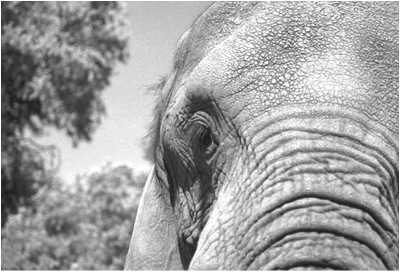
Morula and I stand together, watchers watching, measuring each other. Steadfast, she looks down her nose at me. I gaze upward into an iris of liquid oak with sun flecks and shadows in it.
I remember the camera hanging from my neck and lift it. I feel the earth breathing, the air turning older; each moment caught, then left behind.
Morula stands around fidgeting, if an elephant can be said to fidget. She lifts her right leg and swings her foot. Puts it down, backs up two steps. Lifts her leg and swings her foot again.
Sandi is quick to notice.
“Morula, here,“ Sandi commands and Morula complies, touching Sandi’s leg with her trunk. I join them.
Sandi has the calm face of a mother with large, exuberant children. Her eyes have white creases at their corners from squinting into the sun. She wears a huge, floppy cloth hat with a brim longer in back than in front. It’s black under the brim and light green on top.
“How many commands do they understand?” I ask.
“Verbal? About a hundred. And that’s limited only by our imagination, not theirs.”
Morula leans in like an eager teenager.
She’s a little too close for Sandi’s liking. “Morula, over and back.” Sandi taps on Morula’s leg. Morula backs up a step. “Over and back.” Morula is carefully responsive. When you’re as big as she is, every movement has consequence. Each step backward is slow, deliberate, and precisely placed.
Once Sandi has her positioned, she gestures to me. I step forward and place a hand on Morula’s trunk. Studded with sparse bristles, her trunk feels like a stiff old brush. I look up.
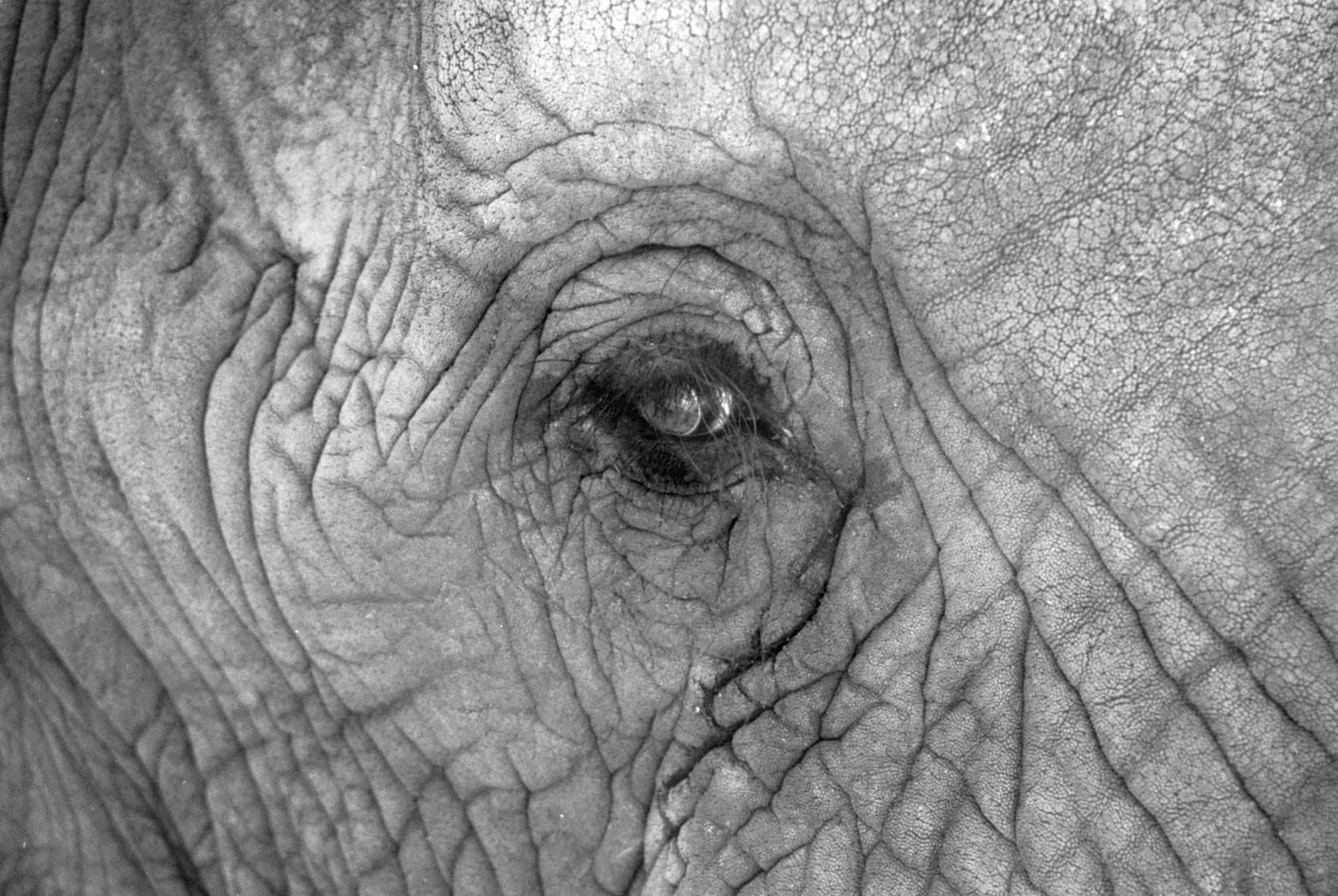
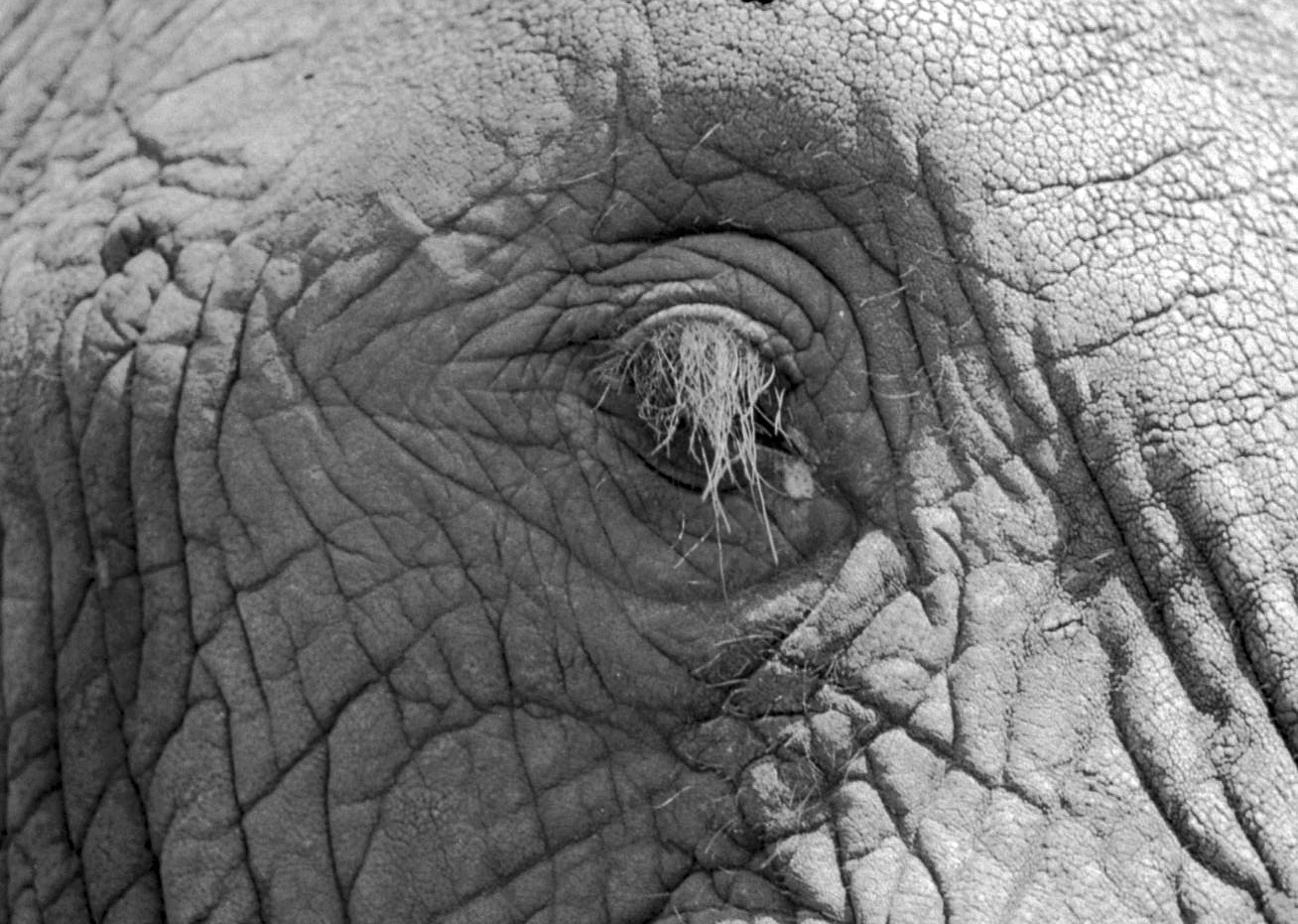
Three-inch lashes cast shadows down Morula’s cheeks. She blinks and her lashes sweep against her skin like small brooms. A bit of matter is clustered in the corner of her lower eyelid.
Morula's eye
Each of the more than 200 lashes around my eye is shed every 3 to 5 months. Has anyone ever done research on the shed rate of elephant eyelashes?
I could.
I could stand here forever looking into the oak burls of her eyes.
The sun rises with spokes on her head like the Statue of Liberty. She rises into an immense lemon sky that almost turns green before it turns blue. She ignites the tops of trees with her torch. Bare, wood-muscular branches of a jackal-berry tree stretch above my head, tips ablaze with light. Crisp and clear, the air tastes of damp sage mixed with cold sand.
Doug sets down his coffee cup and leaves to fetch the elephants. Skirting a tree-line filled with purple shadows, he crosses an open field of grass.
Sandi and I wait, our hands wrapped around steaming cups.
Half an hour later Doug returns. Jabu, Thembi and Morula are right behind him.
Sandi whispers, “Let’s go, Jabu,” and he turns away to follows her down the dusty road in front of camp.
Plain-Jane Morula is next to saunter past, her broad, honest face etched with a network of creases and wrinkles, the tip of her trunk canted in my direction. Thembi lags behind, with Doug at her side, but soon catches up to Jabu, picking up a stick like he does, stashing it between her trunk and tusk like he does, dropping it just as soon as he does.
The order in which they assemble never varies. First Jabu, then Morula, and finally Thembi. Yet, when we set off on our morning walks, it is always Morula, the oldest, who brings up the rear.
We mosey away from camp at a slow ramble, all in a line – Doug and Sandi, three elephants, and me.
Yesterday I traveled by jet. Today I fall into place behind an elephant. My mind is having a hard time keeping up with a change greater than eight time zones and two hemispheres.
I’m clumsy in this new world. The old discarded one of concrete and cell phones trails me like a lost dog. I kick at it, but it circles back to nip at my heels. It just won’t leave me alone.
Tufts of grass nods gently in the wind of our passing. Isolated clumps of finger grass wave six-digit tassels at us. The fingers of a slight breeze hold my hair up to the sun.
Morula stops, turns, and takes a single step toward me. Somehow she doubles in size.
Morula
My heart leaps, captive within its ribs, desperate to flee. I know Morula is not wild, not truly. I know she has spent half her life with Doug and Sandi. Nevertheless, I’m paralyzed. I forget how to breathe. Everyone else is up near the front of the herd, as far away as another continent.
Morula stands in half-profile, stares at me with one nut-brown eye. A feathery tuft of hair sticks out from her ear canal. Her mottled forehead glistens like cracked mud.
Slowly she blinks her eyes, flaps her ears, and a lifetime later swings around to overtake Thembi. I exhale as they entwine trunks.
Cicadas chirr, stirring up the morning. I stare down at huge round footprints in the dust. I look up; the elephants are receding. Last in line, I’ve been left behind.
Wait for me! shouts every cell in my brain, as I scramble to catch up with the herd, take my allotted slot in the order of march.
As if the night air has muscle, it flexes, then strengthens, when a bulky umber apparition condenses out of darkness. Doug moves away from Thembi as another elephant backs blindly toward us, lifting first the sole of one foot and then another for our inspection, carefully feeling her way. It is an oblong moment, stretched by suspense.
“No, no, Morula,” Doug says, and then turns to me. “It’s the way elephants greet each other, but I’m trying to get her to greet us face-to-face.”
Enchanted by the thought Morula might consider me a fellow elephant, I have no qualms about putting the flat of my palm against her trunk.
Her skin contracts like a giant slinky under my hand. I gently rub up and down, up and down. The nerves at the tips of my fingers tingle.
Astonishing warmth.
Crumbles of mud.
Bristling hair.
Morula
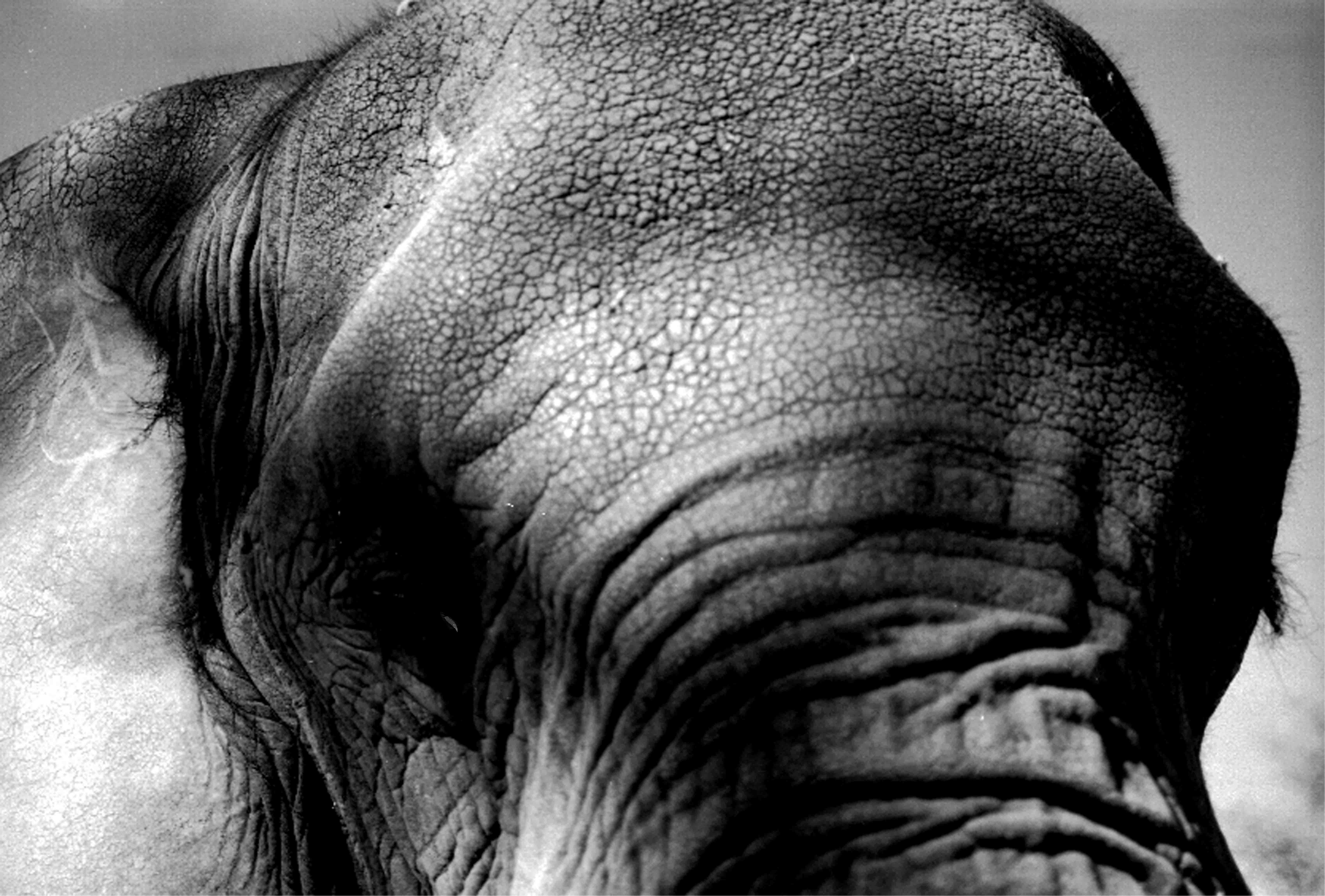
The massive dome of her head blocks the stars. Her forehead is cobbled; my eyes follow its boulevard up to the night sky.
She exhales. A gentle rumble flows past my fingers and stirs the dust at my feet. In the distance a hyena slouches through its whoop. Then it is quiet again and the stars lean in to listen to her breathing.
Morula stands square on. Her cobbled forehead broadens from her nose upward in a triangular shape. Her eyes are nearly hidden, tucked behind the curve of her forehead. She raises her head to focus on me. She’s motionless, concentrating. I can’t even hear her breathing.
I have this odd feeling that she wants me to like her as much as I want her to like me.
I take the lens cap from my camera and glimpse a tiny reflection of myself in its mirror. Is this what she sees – another one of those small humans, with its odd aura of scents? Does she see details: my hat, my camera, my idiotic grin?
Morula
The top of a tree is visible over her right shoulder, as if she has a giant corsage tucked behind her ear. Short bristles like an old man’s buzz cut outline the top of her head.
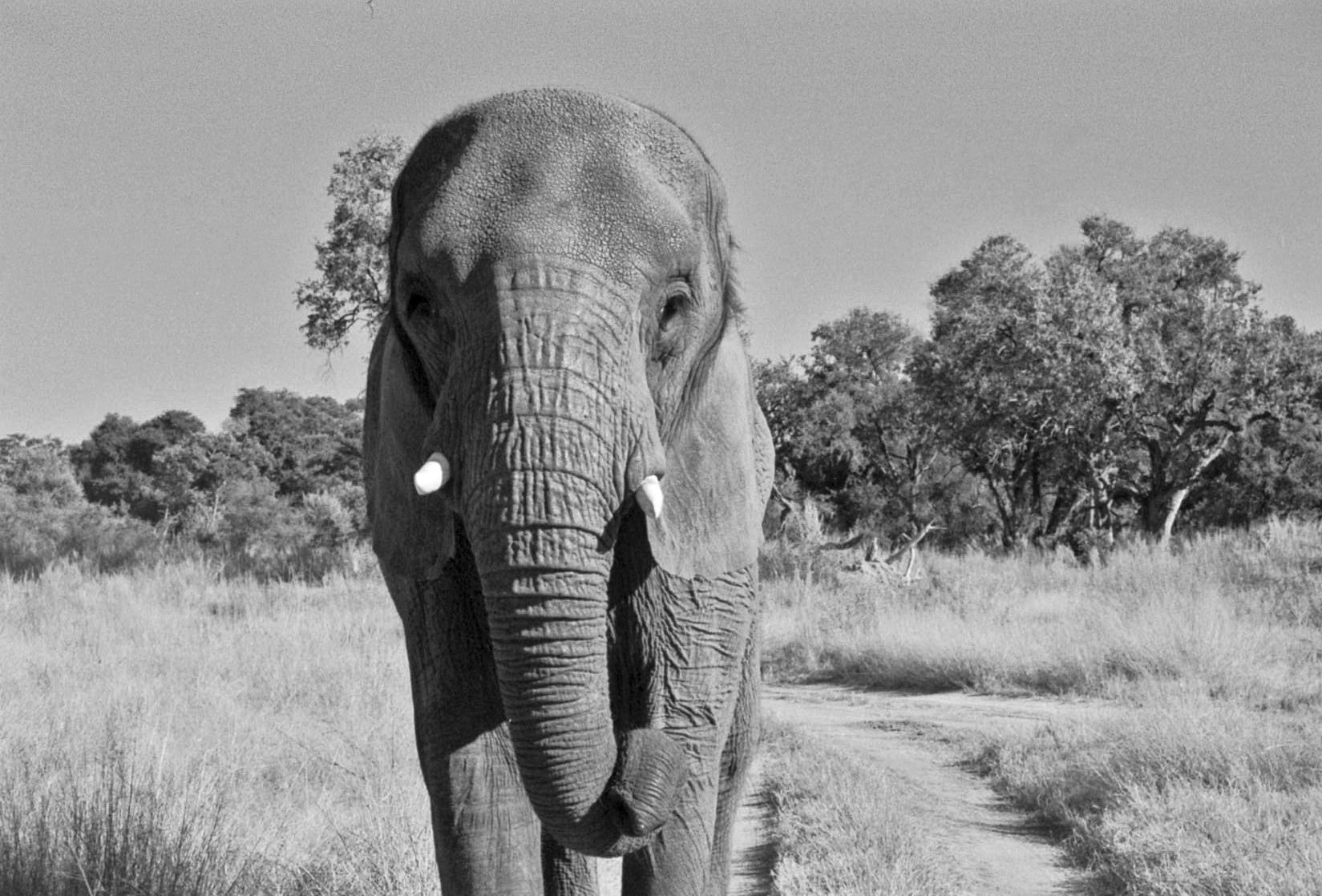
Because of the way she’s standing, ears flattened against her shoulders, Morula seems slim, her skull almost hollowed. The tip of her trunk flops over itself in a loose coil and points straight down like a curved arrow. It begins to twitch in an irregular rhythm. I take a goofy photograph of Morula – like she’s bored and playing with the only thing at hand – her trunk.
Behind us, around us, for 360 degrees, the Botswana landscape surrounds us. And neither one of us pays it a bit of attention.





 ABOUT ELEPHANTS