Posted in Africa, Nature, Travel

A Thunder of Hippos

An excerpt from my book-in-progress:

Whenever I leave for Africa I’m always, invariably asked, “Aren’t you afraid?”

“Of what?”

“Snakes. Alligators. Lions.”

“Well,” I usually reply, “there are no alligators in Africa. Only crocodiles.”

“So crocodiles, whatever.”

Once, in Tanzania, I saw a submerged crocodile lunge up amid four wildebeest faster than they, or I, could blink. I don’t know how, but he missed all of them as they leapt in four different directions. I’ve never taken a bathing suit to Africa. Didn’t seem like a great idea on my first trip and less so on subsequent ones.

Lions? Well, lions will consider me prey if I act like prey. Look! Breakfast! And it’s fat and slow!

The possibility of actually encountering a lion is pretty rare. There are only about 20,000 lions left in Africa, down from 200,000 in 1975. Until 2007 Botswana allowed 50 lions to be hunted per year. By the time a hunting ban was enacted many of the male trophies were just two or three years old – requiring hair extensions woven into their manes before they were mounted on a hunter’s wall.
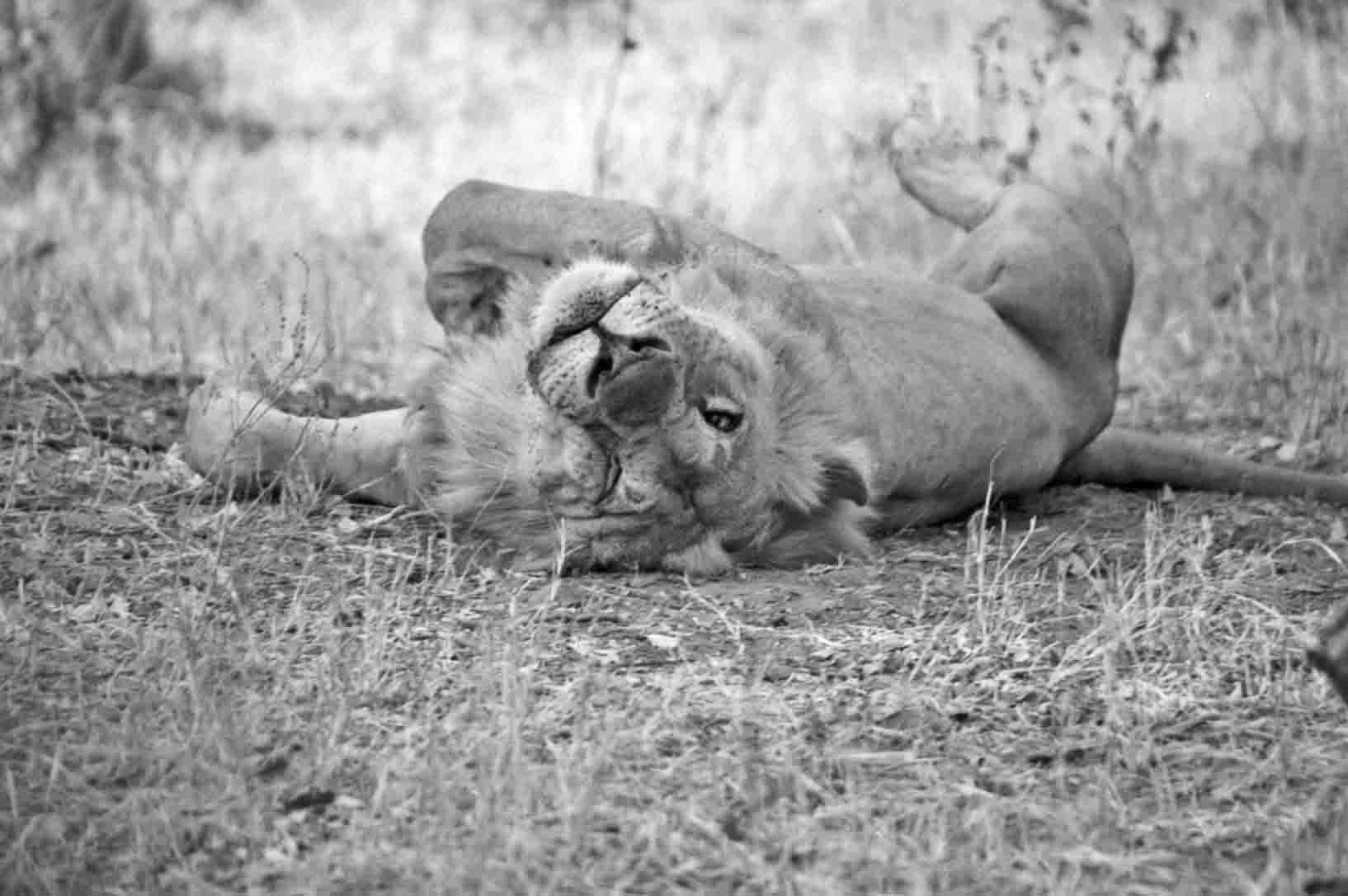
B&W male lion

Snakes? There are a lot of snakes in Africa. Black mambas. Vipers. Cobras. Pythons. Boomslangs. Puff adders.   In the Okavango Delta I could encounter Egyptian cobras or a puff adder or an African rock python or a black mamba or perhaps even a shy boomslang. I could, but I haven’t. In all the times I’ve been to Africa, I’ve never seen a snake. Bad luck, I guess, because each of these snakes, in their own way, is fascinating, and I really wouldn’t mind seeing one of them.

The deadliest animal in Africa is not a snake nor a crocodile nor a lion – it’s the hippo, those oddly comic, rotund herbivores that Walt Disney put in tutus. Hippos kill more people in Africa than any other animal: several hundred per year. In contrast, sharks kill only around ten people per year, worldwide.

Hippos don’t even eat the people they kill. They emerge at night from ponds and rivers to spend all night eating grass. Their beady, sherry-colored eyes don’t see well, but their sense of smell is acute. Males defend territory, females their calves. They can outrun you, and you never know what might set them off.

In 2002, I was on a game drive with six people in an open-sided Landcruiser. Laid-back hippo blimps floated in a nearby pond. One of the hippos grunted, burbling like a submerged tuba.

A herd of hippos is known as a “thunder” – possibly a reference to their size, but more likely because of the noises they make. When a group of hippos get going, their combined grunts sound like rolling thunder. But these hippos were relatively quiet. They rose and sank, twirled their ears, exhaled wetly through their nostrils.

It was that magic half-hour before sunset when the light is golden and incredible – perfect for photographs. A short distance away a male grazed on flowers. I raised my camera.

Without warning, the hippo opened his mouth in a threat gesture, displaying his long, razor-sharp canines. A second later, he charged, head swinging side to side like a giant sledgehammer, running directly for us at a surprisingly clip, intent on slamming into our vehicle. Since a hippo’s top speed is around twenty miles per hour, he was closing fast. All I could see through my camera lens were those massive incisors, as the autofocus kept singing out zzzzt zzzt, zzzzzt zzzt.

Charging hippo b&w

Luckily, the engine of our vehicle started without a cough and the hippo just missed the back bumper. He continued on into the bush for thirty yards before stopping to wonder where we had gone.
Posted in Africa, Elephants, Nature, Photography

The Oldest Human Footprints in the World

An excerpt from my book in progress:

Morula

After Morula finishes browsing, I follow her down one of the unmapped, two-track, lightly traveled, nameless roads of the Okavango Delta.

Zik! Zik! Zik-zik! A masked weaver hops through the brush beside us. White clouds above our heads twirl like cotton candy across the sky. The track we’re following parts a shallow lake of grass and climbs out on an island of trees. A game trail crosses the road. Morula swivels her trunk to one side, then the other, at the intersection where the grass is beaten down.

In dun-colored sand as finely ground as cake flour, Morula’s prints barely register. I can’t see a single puff from the impact of her feet. With each step, she leaves behind outlines of small moons. We cross the recent, delicate hoof prints of impala and the moons obliterate them.

photo by Cheryl Merrill

My boot prints, inside the crater of her footprints, look like exclamation points, the heel separate from the rest of my sole.

The oldest human footprints in the world are 1500 miles north of here, at Laetoli, in Tanzania. Found in 1976, the 3.5 million-year-old footprints are not far from the Olduvai Gorge, where the Leakey family discovered the first hominids. Although the Laetoli hominids are Australopithecines and not Homo sapiens, they are part of our family tree, a relationship comparable to that of mammoths and elephants.

Fossil footprints are not uncommon, especially near ancient riverbeds. But the Laetoli footprints were created when a nearby volcano erupted, covering the ground with a slurry of volcanic ash somewhat the consistency of concrete. Once excavated, the site was found to have over 9,500 impressions, mostly made by rabbits. In order of decreasing abundance, tracks were also found of guinea fowl, hyena, antelope, rhinoceros, giraffe, buffalo, elephant, horse, small carnivores, monkeys, pigs and ostriches. Just one short, 80-foot section was made by hominids.

Their footprints – that of a man, a woman and a small child – tell us much about our ancestry. For in that trackway is a hesitation, as if one of the hominids thought about turning left. Perhaps it was the moment before an earthquake, when the ground was no longer solid beneath their feet. Or perhaps one of them considered turning around, going back.

I stop and look over my shoulder, in the same way my human ancestor did. All of Africa stretches out behind me – overlapped boot prints and footprints leading backward into her hot, crowded maze of life. It was Africa who designed us to walk upright across her landscapes. Because of Africa, I know the ground better than I know trees.

In the distance, across a golden backwater of high grass, stand a family of giraffes. They are motionless, watching us cross between islands of bush. The spotted derricks of their necks swivel in all directions to get a better look at us. At the end of each neck a head is cocked sideways: the universal body language that says, “Huh?” But once we stop to look, they turn away and head for cover, except for one curious female who continues to watch us.

photo by Cheryl Merrill

Tramping along in Morula’s wake, I’m beginning to get the hang of all this walking and browsing – less sweating, less reliance on my water bottle.   I’m beginning to wish I could do this every day of my life.


Posted in Africa, Elephants, Nature, Photography

Year of the Elephant: Swamp Lessons

A baby elephant crosses a small swamp, guided by Mom.  And of course she got a chance to stop and play in it, too.  A beautiful afternoon in Zambia, 2012.

Baby ellie swamp

Posted in Africa, Elephants, Nature, Photography

Let Freedom Ring

Free to Roam
Free to Roam

“For the animal shall not be measured by man. In a world older and more complete than ours they move finished and complete, gifted with extensions of the senses we have lost or never attained, living by voices we shall never hear. They are not brethren, they are not underlings; they are other nations caught with ourselves in the net of life and time, fellow prisoners of the splendor and travail of the earth.” – Henry Beston

And should we not, therefore, allow our fellow prisoners the freedoms to which our nation, our populace aspires?  Life.  Liberty.  The pursuit of Happiness – which I interpret as a life well lived.

Posted in Africa, Elephants, Nature, Photography, Travel

Year of the Elephant: Vegetarians

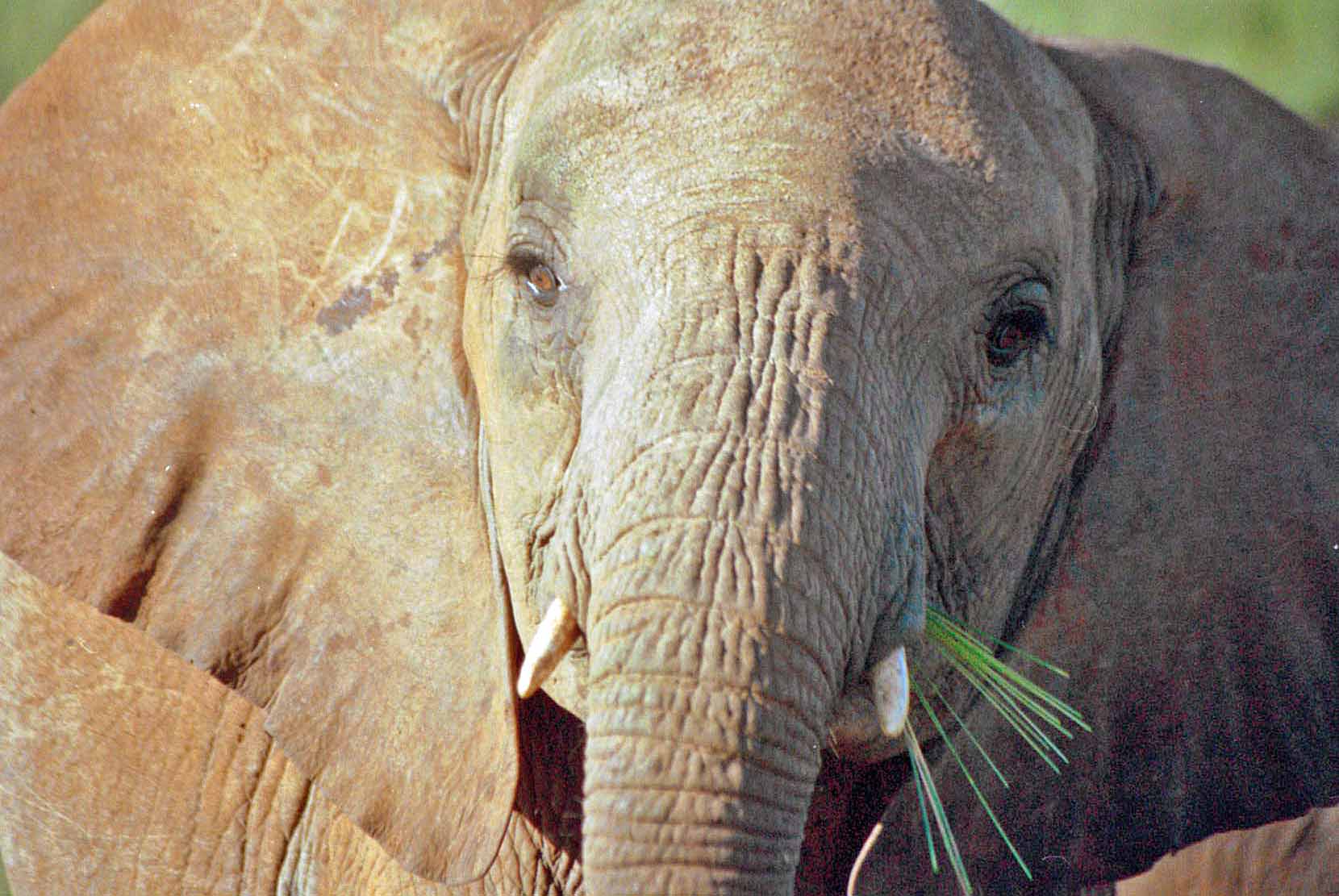
Cow elephant, Samburu, Kenya

It takes a lot of foliage to sustain an elephant.  Depending on its sex and size, elephants eat four to seven percent of its body weight each day – four hundred to six hundred pounds of vegetation.  And sometimes they take offense if you disturb their meal.

(Currently, the Samburu area of Kenya is experiencing its highest level of poaching in 14 years.  I hope this young cow has survived.)

Posted in Africa, Elephants, Extinction, Nature, Photography

Year of the Elephant: Camouflage

Year of the Elephant continues a series on the lives of elephants in today’s world.

Jabu in the trees 2

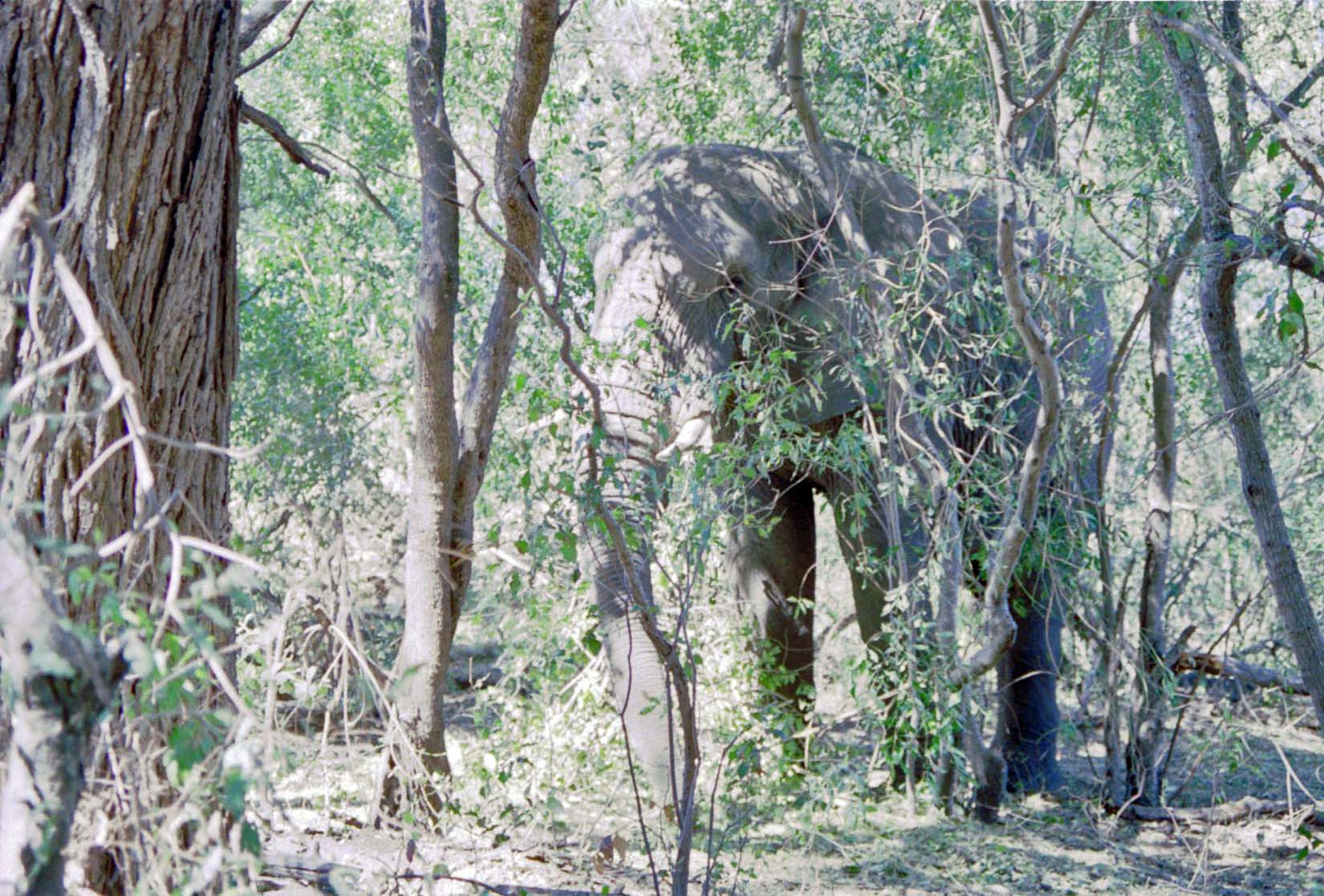
Camouflage is the art of hiding in plain sight.  Of standing perfectly still, keeping silent.  Elephants know how to do this.  It’s a necessary skill.


Posted in Africa, Elephants, Extinction, Nature, Photography

Morning in Africa: Year of the Elephant

Taking a break from the Ivory Timeline and beginning a new series to heighten awareness of how elephants live.  If poaching is not stopped, elephants will become extinct in our lifetimes.

Morning in Africa

“I never knew a morning in Africa when I woke up and was not happy.”  Earnest Hemingway

Posted in Africa, Elephants, Extinction, Jabu, Nature, Nonfiction, Photography, Travel, Writing

Ivory, Part One

Jabu's tusk
An African elephant’s tusk

Carved ivory thrones are mentioned in the Bible.  King Solomon had one, covered with gold.  Tutankhamen’s casket had a carved ivory headrest for his pillow.  Cicero wrote of Roman houses where ivory doors opened onto entire rooms covered with ivory tiles.  Gladiators had chariots made of ivory.

In the 1800s, in Africa, ton after ton of tusks were transported thousands of miles to Zanzibar and Khartoum, carried on the backs of slaves.  By the 1980s, more than 300 elephants a day were slaughtered for their ivory, nearly 100,000 per year.

In Amboseli National Park, in Tanzania, a recessive gene is becoming dominant, occurring in 50 years instead of thousands, selected by poachers.

Year after year tuskless elephants are born.

Both male and female African elephants grow tusks – the largest upper incisors on this planet.  Tusks are defined as long teeth protruding beyond the mouth growing usually, but not always, in pairs.  Most tusks are enlarged canines, such as those of warthogs, wild boars, hippopotamus and walruses.  Enlarged canines in the myriad species of cats and dogs are called fangs.

Elephants and narwhal whales have incisor tusks.  The narwhal’s single tusk is a left front incisor that grows in a straight spiral.  Found mostly in males, narwhal tusks are believed to be the origin of unicorn legends.  Oddly enough, narwhals with two tusks are usually female.

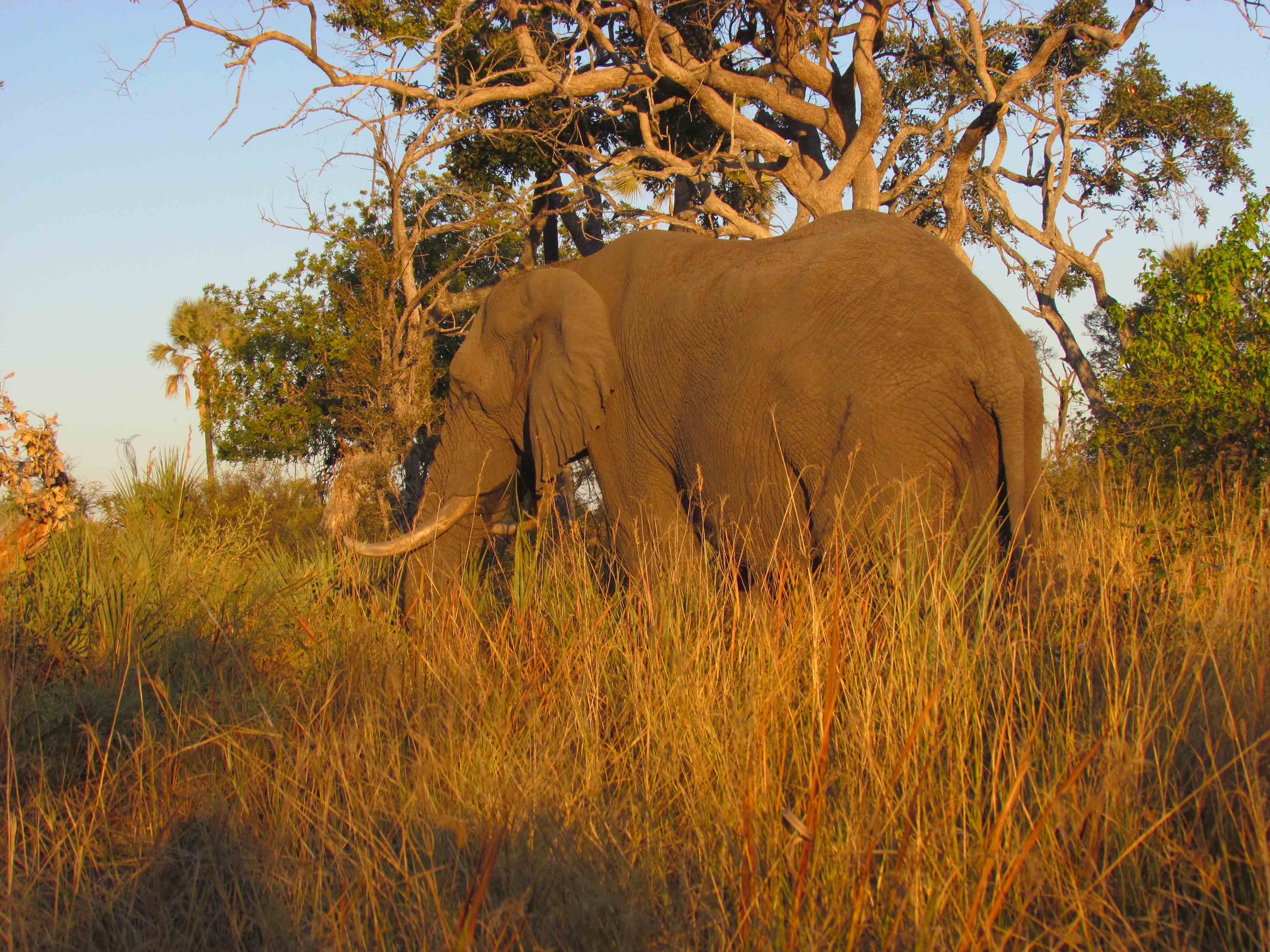
By the time Jabu is sixty, his tusks could theoretically reach a length of 18 to 20 feet.  But in reality – if he does reach sixty – they will be much shorter, due to the wear and tear of everyday use.

Tusks on bull elephants can weigh seven times that of those on cows.  The biggest pair of tusks on record weighed 460 pounds, taken from an old bull killed in 1897 near Mount Kilimanjaro in Kenya.

The longest tusks ever found came from an elephant shot in the Congo in 1907.  Its right tusk was 11.4 feet long; it’s left tusk 11 feet.

Such extraordinarily enormous tusks are a genetic trait, much the same as red hair is a genetic trait.  Over the centuries poachers and hunters have always targeted male elephants with the largest tusks.  As a result, the trait has disappeared from most elephant populations.

The same outcome would occur if redheads were systematically eliminated within family groups.   As their genes died out, the redheads among us would become extinct.

Posted in Africa, Elephants, Nature, Nonfiction, Photography, Travel

Underwater

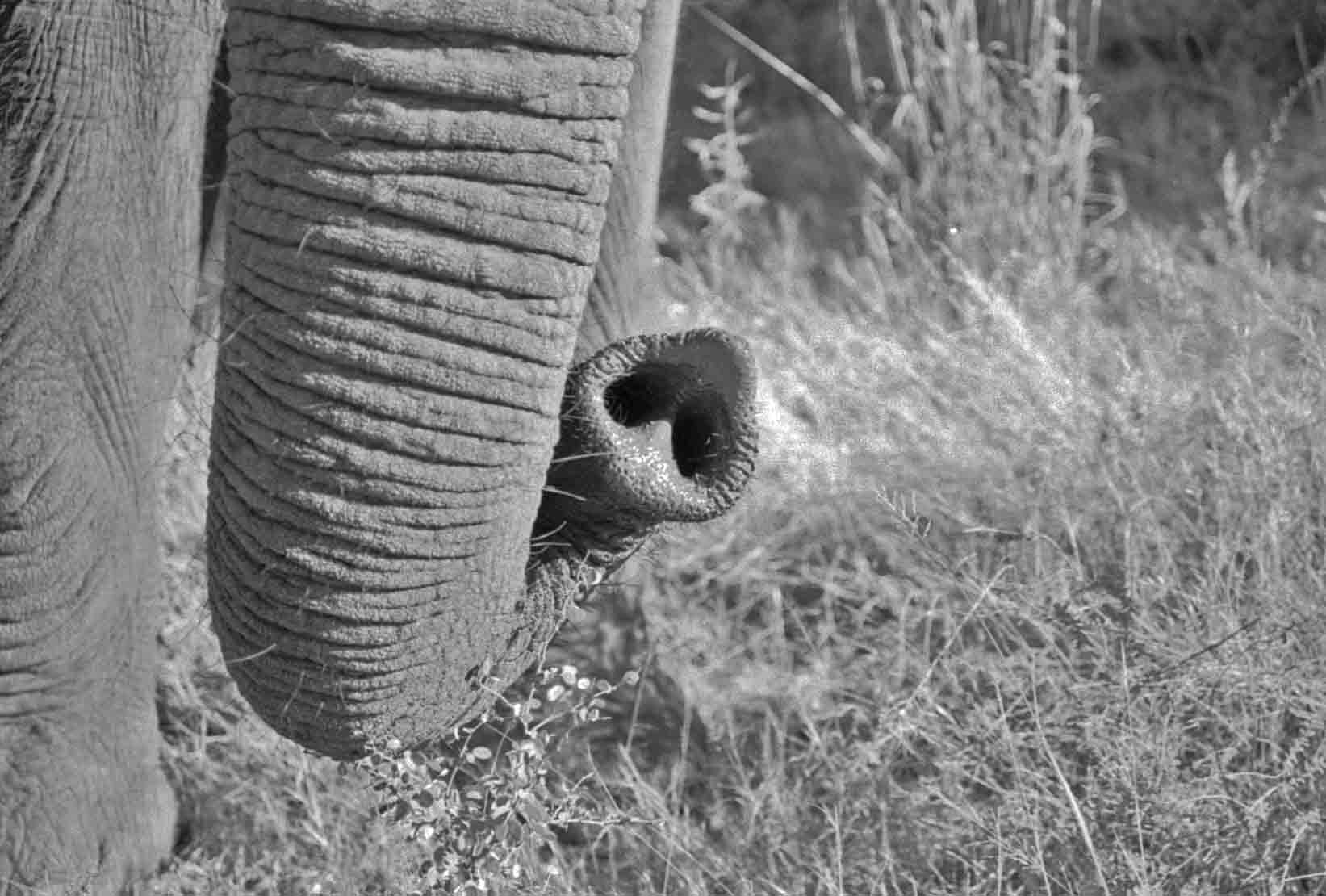
Trunk tip 2b&wAwash in a sea of scent, Jabu curls his trunk and samples wave after wave of odors breaking at his feet.  Redolent tides wash in, wash out, a floating realm populated with aromatic citizens.  Schools of scents cluster at his feet, swimming through the grass at the bottom of an ocean of air.

Sixty percent of his brain is dedicated to smell.  Jabu can distinguish between a million or more separate odors in the daily news that floats by on warm currents.  Just a few molecules bring him history and current events: stories of who was here, who is there, how long they stayed and in which direction they went.  Jabu can detect fellow elephants ten miles away.

He reaches out and flattens the tip of his trunk over a wet spot in the sand.  Eyes half closed, he stands completely still, as if lost in memory, his brain sorting through the various scents tumbling up his trunk.  He samples the air thoughtfully, as if listening to a quiet conversation, as if storing it, word by word, in those huge frontal lobes of his.

Flehmen flat trunkI remember that elephants see the world in yellows and blues, like color-blind humans.  I fasten a yellow filter over my camera lens, then a blue one.  Jabu turns aquamarine.  From far, far away, he snaps a branch from a shrub the color of kelp, chomps, munches, drifts closer.  His slow motions make perfect sense underwater.

I wade into a lagoon of grass.  Ankles, knees, waist, chest, neck.  Some of the grass stalks bob over my head.  My hands, my body, my thoughts, move slowly.

Immersed, my ears fill with a pure hum.  The sound of my passage whispers in seashell voices.

As Jabu drifts by, undertones of blue and gray shimmer against his flanks, reflections of seaweed and kelp.  I follow, sub-aquatic, at the bottom of air.  Carried by the current of my imagination, I am about to tumble downstream. Jabu aslant b&w

Then the breeze kicks up, feels as if it comes all the way from the bottom of the Kalahari, feels red, feels gritty, feels dry as a hundred-year-old skeleton left in the desert.  It sucks every bit of moisture from under me and lands me beached and gasping.

I lower my camera.  Red invades yellow and the world greens.

Posted in Africa, Elephants, Nonfiction, Photography, Travel, Writing

A Sea of Elephants

sea of elephants

Gray wave after gray wave surges out of the bush in small herds of twenty or less, first one group, now another, flooding the huge hollow that contains a waterhole.  Dust rises in the air, a potent blend of manure, dried grass and sand.  The backwash swells in our direction.  Soon a sea of elephants surrounds us.  We’re submerged in a roiling world of noise.  Snorts, grumbles, trumpets, growling bellies and gargantuan belches resound.  Some of the vibrations are too low to hear, but I feel them as they pass through my body, reverberate in my chest cavity, squeeze my heart.  Eye after eye inspects us as eddies of elephants swirl past.  An old world laps at the foot of our memories, extinguishes centuries of communal fires.  The ropes that tether us loosen.  We slip away from the familiar shore and set off towards unimaginable ways of being.  We look around with wild hearts.  We have become part of the herd.