I write about elephants. I write about other things, too.
Author: Cheryl Merrill
Cheryl Merrill’s essays have been published in Fourth Genre, Pilgrimage, Brevity, Seems, South Loop Review, Ghoti, Alaska Quarterly Review, Adventum and Isotope. “Singing Like Yma Sumac” was selected for the Best of Brevity 2005 and Creative Nonfiction #27. It was also included in the anthology Short Takes: Model Essays for Composition, 10th Edition. Another essay, “Trunk,” was chosen for Special Mention in Pushcart 2008.
She is currently working on a book about elephants: Larger than Life: Living in the Shadows of Elephants.
Only a few yards from our Land Rover, a single-cylinder water pump alternately chugs and sputters, drawing from the water table beneath the sand, and sending spurts through a pipe to a square trough. This supply of water keeps the bachelor elephants in Savuti area, as they wait for spring rains and the return of female breeding herds.
The steady sound of the pump, chug-sputter, chug-sputter, chug-sputter lulls my eyes closed. They open, close, open half-lidded, close again.
“Here he comes,” someone whispers and my eyes flick open as a huge bull strolls past. I pick up my camera.
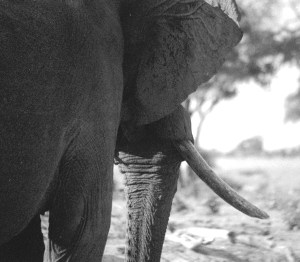
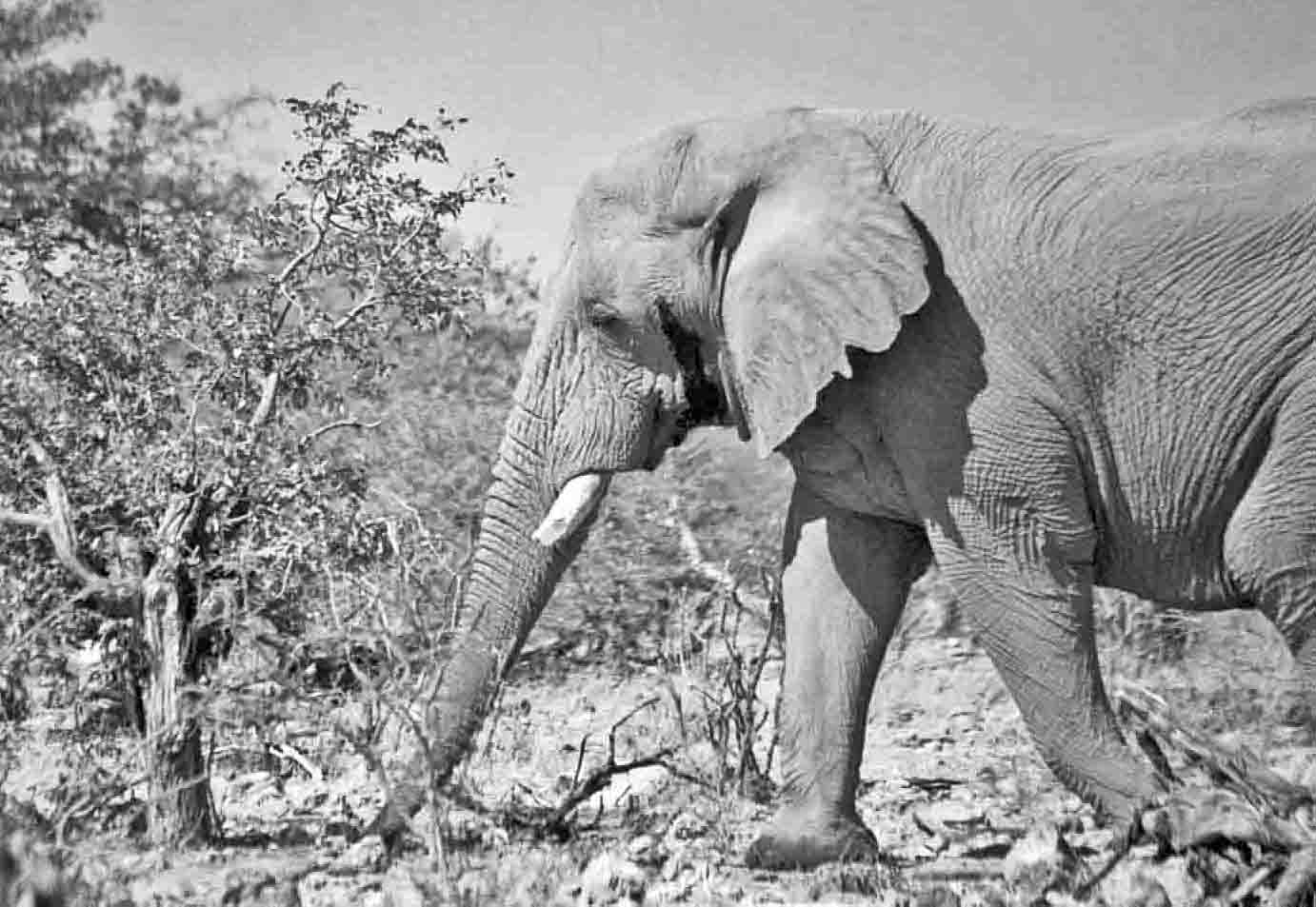
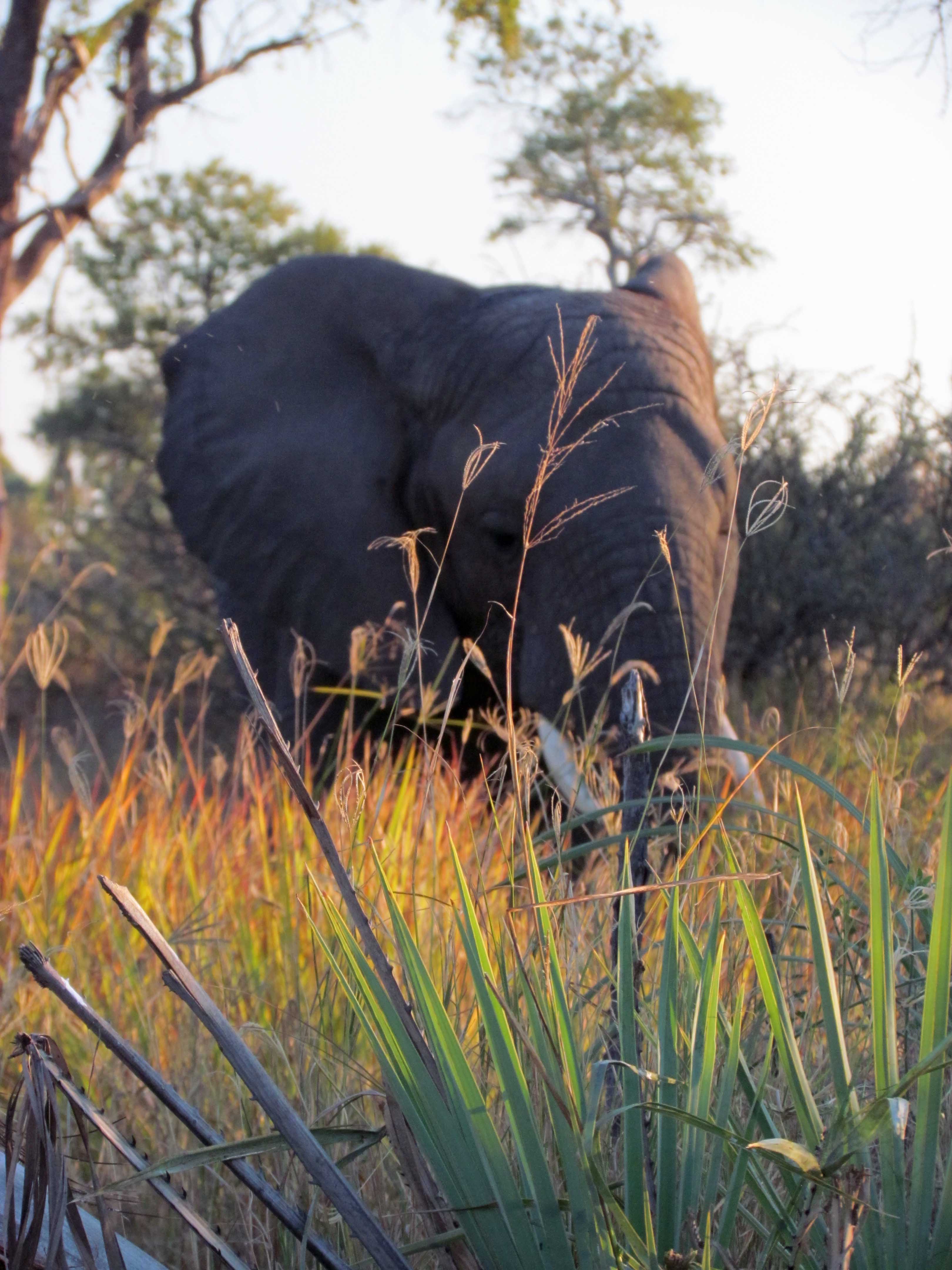
His enormous tusk splay out almost sideways. I focus on his great head, nodding downward with each step, as he trudges past. A thirsty pilgrim in a parched land, his trek to water is nearly finished. He heads straight to the square trough. The clicking and whirring of our cameras doesn’t alter his gait.
Through the viewfinder I marvel at his tusk. It is easily four feet long, stained and chipped on its end. Because of its growth pattern – out, rather than down and up – his tusks make him a much wider elephant than he really is.
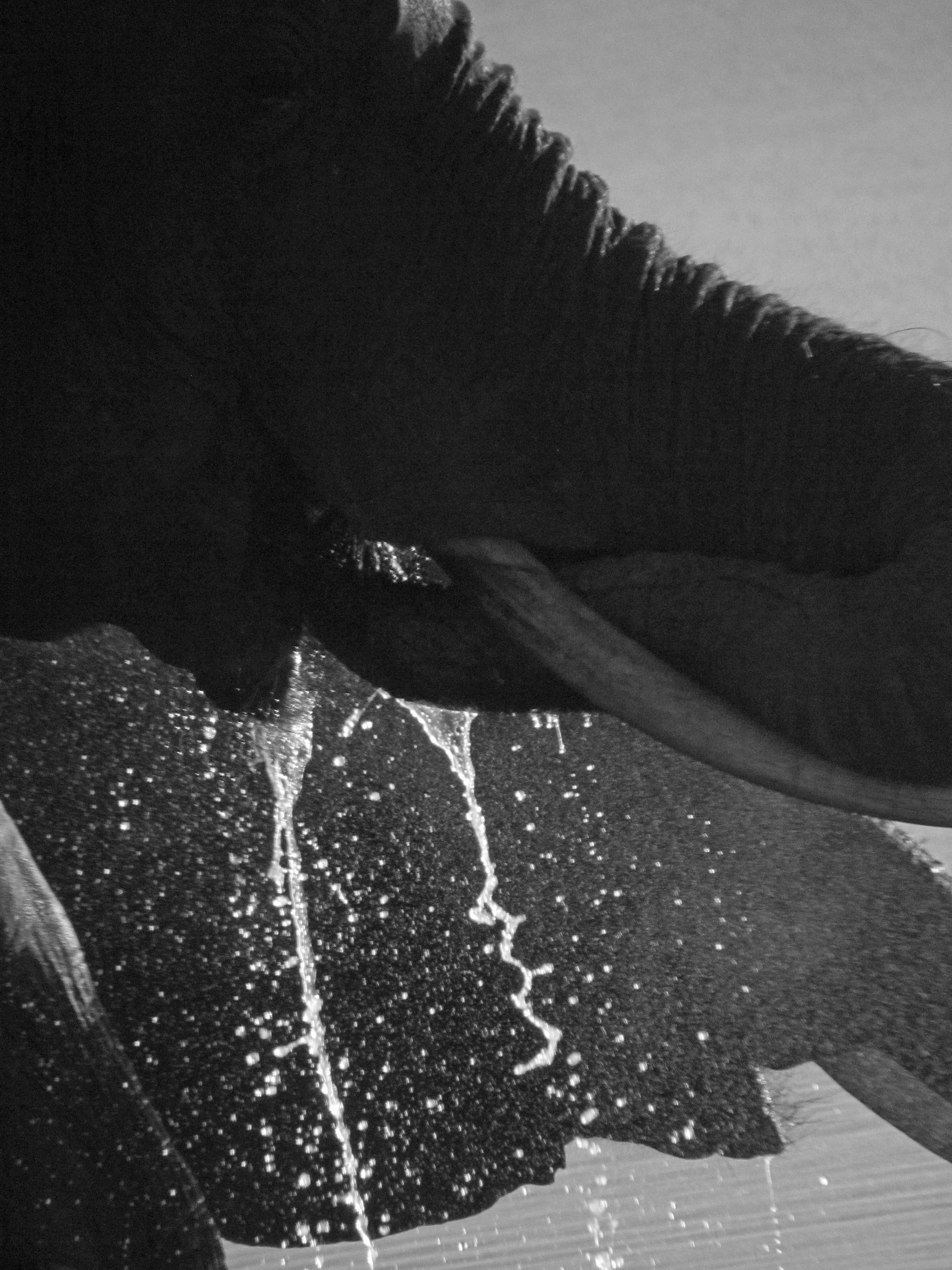
Mid-drink, he curls his trunk into his mouth; his head tilts back; his eyes close. He makes gargling sounds as he drank. Extending his trunk into the waterhole, he blows bubbles before curling his trunk again and again to hose several gallons down his throat. With each swallow goes the taste of dung, samplings from all the animals that used this waterhole – zebra, wildebeest, warthog, ostrich, hyena and the occasional furtive flavor of lion.
I try to imagine the bouquet garni of this waterhole and how its myriad fragrances might seep into the crevices of an elephant’s mind, form pools of scent elephants recognize, year after year, the liquid memory of Africa. Perhaps the old bull is memorizing the stories in this trough, paragraphs of taste and smell, twists of plot and character and fate.
He returns to where we are parked, and stops close by. His skin is the color of seasoned cast iron. The waterline on his body rises just past his belly. Spatters of mud stain his ears and back. His forehead bulges and flutters audible sounds, if I had the ears for infrasound.
After several long minutes, his eyelids droop and his mouth slackens. Under the hot sun he falls asleep, lulled perhaps by the narcotic of a long, slow drink. The tip of his trunk coils like a magic rope on the ground. He sleeps with his weight on three legs, resting a hind leg, occasionally rocking back on it as if he dreams of his trek. Drool from his trunk slowly seeps into the sand.
I match my breathing with his, and drowse, sedated by the sun.
The giant beside us rumbles soft snores in his sleep, yet he is probably aware of the humans next to him, nodding their heads, also falling asleep. Other bachelors scuff past him, on their way to and from the waterhole.
Tiny paws of wind skitter across my arms and keep me half-awake. But for a moment, I almost enter his dreams.
Several months ago, Sheila Bender, friend and fellow writer, interviewed me for her radio show, “In Conversation: Discussions on Writing and the Writing Life.” The show will air Tuesday, Nov. 27th at noon PST and Thursday, Nov. 29th at 6 p.m, PST. It can be heard streaming from our local radio station at http://www.kptz.org. I talk about elephants and why I decided to write about them. I hope you get a chance to hear it.
In writing Larger than Life: Living in the Shadows of Elephants, I tried to answer two questions – what is it like to live with elephants, and, what is it like to live? For me, writing is living. I write everywhere, all the time, tucking pieces of paper into pockets, jotting down notes under the covers, with a flashlight on. I write on the backs of envelopes, I write in the margins of manuscripts, I write in notebooks, notepads and ipads. I write because reading is just one of the pleasures caused by words, even though words by themselves are drops of human magic, sprinkled against death and darkness. I write to grave rob my own language, excavating tombs of words and phrases, looking for riches, for golden ideas buried in underworlds of common dust.
Every writer tells old stories in order to see anew. All humans take the same journey from life to death, though our paths are never the same. We begin as an explosion of infinite possibilities and then, for the rest of our lives, fall back upon ourselves, grabbing at some of those possibilities during our fall. Our trajectory, which touched the very rim of life, descends toward the center, ending at zero, at what some see as a portal and others see as finality. Falling, always falling towards the center of ourselves, the huge unknown universe within, our journeys are all the same.
I write to tell about my journey, my story, and it all comes together in just one place, my writing room.
As you listen to this interview, you can also see where I write.
In the late morning, dizzy from heat, I survey the far side of a large lagoon. Bracketed with the dense foliage of knobthorns, leadwoods, rain trees and fever berries, this remnant left behind by the Okavango is ultramarine, inviting. But the color is only an illusion, a reflection of the blowsy blue sky. The water is actually steeped brown, rich with dung, dead snails, rotten vegetation, sediments, and decomposing bodies by the thousands: fish, spiders, ants, beetles – any creature unable to outrun last year’s flood.
Not far from here jungles of papyrus lean their feathery seed heads over the clear blue channels of the Okavango, tall stands that line the permanent footprint of the Delta. The river is inching southward, breaking the boundary between water and desert. Soon it will flush this lagoon, scouring out the sweet muck at its bottom to spread among grassy floodplains, and the desert will green. With the river will come crocodiles and hippos and other denizens of its deep, running water.
Standing shoulder-to-shoulder on mats of trampled reeds, the elephants blow a concert of bubbles, bassoons under water. They shower their spines, poke their trunks into the back of their throats and release gallons of water at a time. As they remove their trunks some water spills from their mouths. An odd mossy smell rises.
My mind wanders, wondering what it would be like to follow quicksilver fingers of water season after season, migration bred into my bones. When the river reaches this part of the Delta, a new population of birds will arrive: Wattled cranes, Egyptian geese, Reed cormorants, Darters, Avocets, Black crakes, Red-knobbed coots, Southern pochards, Sacred ibis, Hamerkops and Saddle-billed storks.
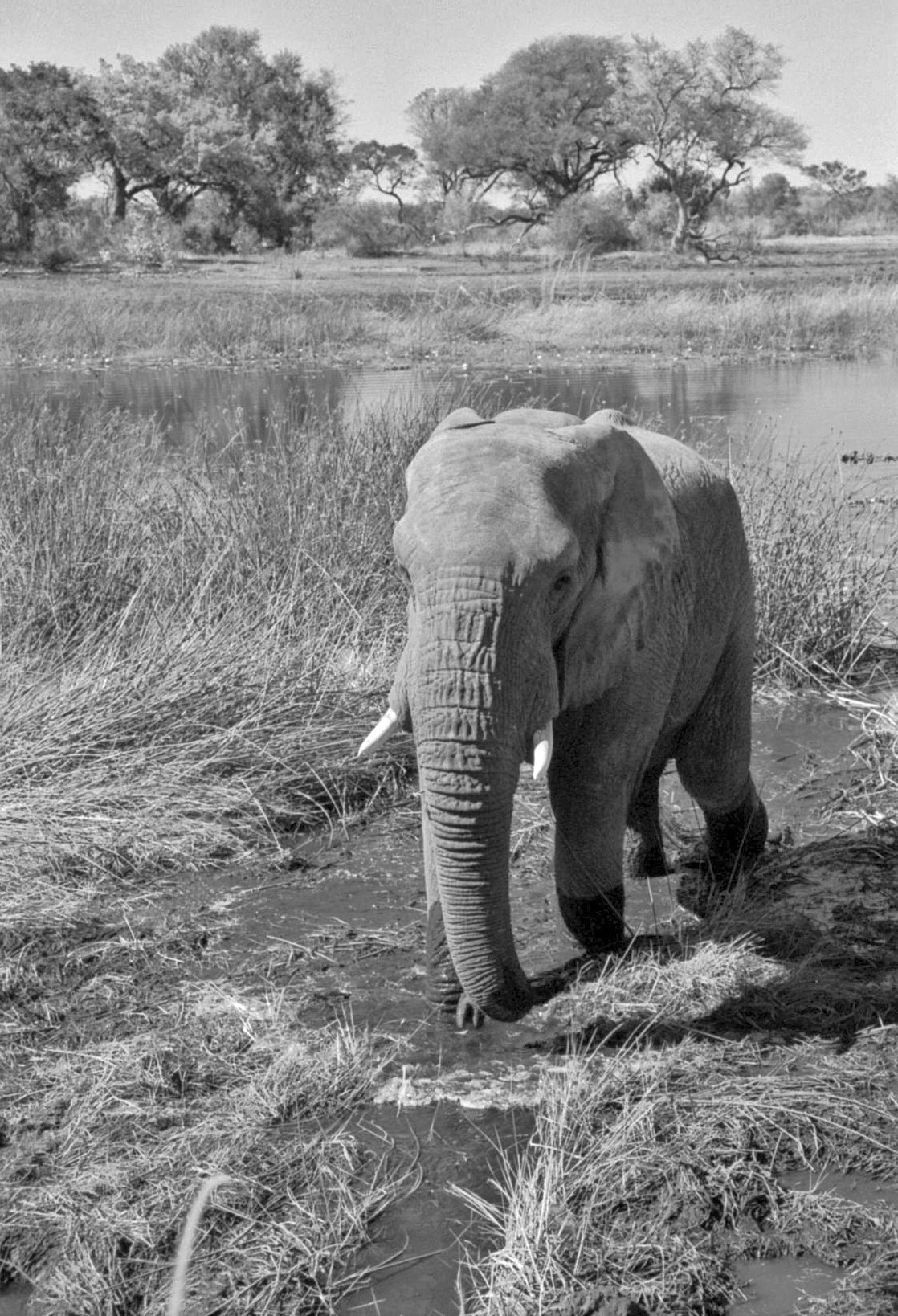
Jabu sloshes up the embankment and heads for his ration of fresh alfalfa spread under nearby trees. His feet and ankles are covered with mud. He looks like he’s wearing socks. His trunk is relaxed and curled slightly, to keep the tip of it out of the mud. Although this is just a backwater of the Okavango, huge trees line the shore behind him. No wonder elephants grew large in Africa: there was enough room and food to do so.
I slap dust from my pants and follow, as eager as he is to tuck into lunch. I watch him stash a chunk of alfalfa between his tusk and the upper lip of his trunk, pick off mouthful after mouthful as if eating peanuts from a bag. He smacks his lips as he eats. When the grass is gone he drapes his trunk over his left tusk. His eyes close and he dozes.
In a shady grove near the lagoon a table covered with a white linen cloth dazzles the tourists. Fresh branches of mopane decorate the surface of the table; the leaves on each branch fold modestly like small olive table linens. Knives rest across linen napkins on white china bread plates. Pepper grinders, water glasses, oil & vinegar decanters and wineglasses complete the illusion that we’ve stumbled into the al fresco dining room of an elegant restaurant. Nodding at murmured compliments, the staff from Stanley’s hand out cold beer, which has been uppermost on many minds.
They’ve set up a buffet complete with chafing dishes. White lace doilies edged with heavy colored beads protect the salads from flies. It’s odd how fast we re-civilize. All morning long the tourists had been mostly silent, filled with awe at walking next to elephants. Now they sprawl in camp chairs and compare camera lenses.
A cake of soap sits in the fork of a bush next to a white basin on a folding wooden stand. I use the murky water in the basin to lather my hands. One of the camp staff holds a pitcher of clean water for rinsing. The water in the basin turns even grayer with dirt. I empty the basin and small puffs of dust rise from the force of the water hitting floury sand.
Then I too re-civilize, join the human conversation.
Our honey-colored morning is airbrushed with dust as we scuff our way toward a mid-day meal. The road we’re following, just two ruts in the sand, has a center grown up in grass. It’s as tall as the undercarriage of a passing vehicle, but a lot shorter than the undercarriage of passing elephants. Paved roads don’t exist in this part of the Okavango Delta; spring floods would only wash them away.
Off in the distance zebras nod as they plod past a line of trees. Yes, this is the right way; Yes, this is the right way.
They are nature’s bar codes, no two alike.
In his book, Origin of Species, Darwin speculated on whether a zebra was a white horse with black stripes or a black horse with white stripes. He compiled examples of the occasional striping on all horses, arguing that a trait from a distant common ancestor, white on black, is brought to full fruition in the zebra. His examples revealed that some zebras are born with white dots and blotches, incomplete stripes on a black background, Morse code instead of bar code, natural proof that a zebra is a black horse with white stripes. The white is lack of pigmentation.
So – here’s the question that pops into my mind as I watch the zebras: do zebra foals imprint on the black stripes of their mothers or on the white stripes? The accepted belief puts money on the black pattern. But isn’t that the human response, the bar code response?
One fine Delta morning, walking along behind Morula, I stumble over a pile of dried dung. An elephant defecates fifteen to seventeen times per day, up to 250 pounds of droppings. If Morula used the same spot each time, as pigs do for their privies, the resultant tally of her daily dump would be taller and heavier than I am. Luckily, elephants leave their leavings wherever they happen to be. Luckily, this pile of dung wasn’t a fresh one. But the one next to it is.
Fresh!
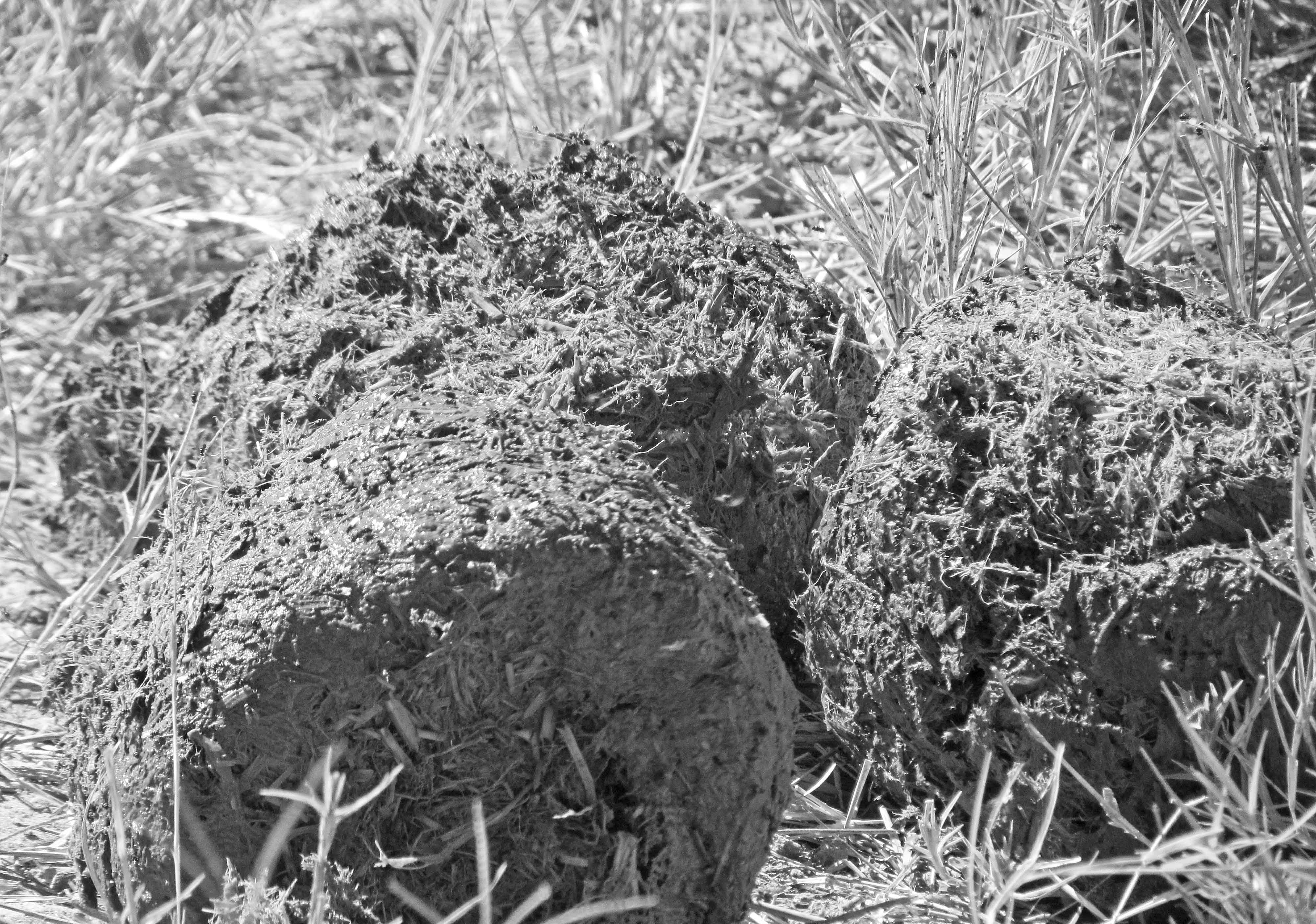
I kneel down and take a closer look at Morula’s fragrant pile of feces. Since she’s a vegetarian, it smells more of compost than rot. Crosshatched with undigested twigs, this wet pile contains quite a few seeds. Thirty species of African trees rely on an elephant’s intestine. Passing untouched through the gut, their seeds emerge in the feces, instantly fertilized.
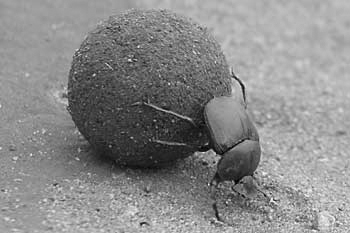
I bend closer. Tiny grooves in the sand mark where dung beetles have already rolled off balls of dung. Even tinier footprints dot each groove. With its hind legs, a dung beetle can propel a ball of dung 1,041 times its own body weight – equivalent to me, lying on my back, trying to push around Morula with my feet.
One study found 22,000 dung beetles on a single elephant plop. Dung beetles enrich the soil, prevent the spread of parasites and disease, and provide food for their young, night and day, day and night – finding their way around at night by polarized moonlight.
A dung beetle barrel rolls past my ear and lands on top of Morula’s output. Tightly rolled bits of it are already making off into the grass, propelled by industrious hind legs. As the male rolls his ball of dung, a female rides on top. She will lay her egg on it once the ball is buried. In less than an hour, most of this pile will be gone, entombed in tiny birthing chambers, each ball of dung containing a few seeds and a single egg. When the beetle larva hatches from the egg, it has all of the food and water it will need until it is able to function on its own.
There are 1800 species of dung beetles in southern Africa – 1800 tribes of sanitary engineers cleaning things up. Worldwide, the dung beetle family includes 5,000 species. In the United States there are 90 species. Ranchers love them – an established population of dung beetles can clear out a cow pasture in thirty-six hours. Australians import African dung beetles to augment their native population and are experimenting with them in big cities to rid sidewalks and streets of dog droppings. In East Africa, dung beetles work their way through eighty percent of the leavings left behind by the mass migrations on the Serengeti. Without dung beetles all of Africa would be covered with, well, you know.
In 1984 whale researcher Katy Payne spent a week with eleven elephants at the Washington Park Zoo in Portland, Oregon, 170 miles south from my Pacific Northwest home. An acoustic biologist with fifteen years of studying the long and complex calls of whales, she was curious as to the kinds of sounds elephants make. She spent every waking hour at the zoo listening and watching the elephants’ behavior. She noticed that certain keepers elicited a positive response from the elephants, an intangible “thrill” in the air, like the rolling vibrations of thunder right before you hear them.
On her way home to Cornell University, while she thought about her observations, the throbbing of the airplane reminded her of a pipe organ she once heard. During a performance of Bach’s Passion According to St. Matthew, a shuddering filled the air as bass notes from the great pipes descended in a deep scale until sound disappeared – but the air still throbbed. Those same, strong, vibrations-without-sound had filled the air around the elephants in Oregon. Could they be communicating with infrasound, like whales?
Four months later, back at the zoo, Payne and fellow researcher Bill Langbauer set their recording equipment to its slowest speed. They mapped the elephants’ movements and timed changes in their behavior with the recordings. Working around the clock for an entire month, they recorded what sounded like snores, chirps, barks, rumbles and even moments of absolute silence.
Back at Cornell, the first tape Payne selected to review was during a time of silence, when there was a “thrill” in the air as a female elephant faced a concrete wall and a male elephant faced the same wall in an adjoining enclosure. With the wall removed, the elephants would have been within three feet of each other. Running the tape at ten times its normal speed, the researchers heard sounds emerge from silence – elephants carrying on an extensive conversation in infrasound, even when separated by concrete walls.
To test the theory, The Cornell research team rigged a double-blind experiment in Africa. An observation tower near a waterhole at Etosha National Park in Namibia was outfitted with video cameras and microphones. Miles from the waterhole, a mobile van roamed through the bush carrying broadcast speakers and tape recordings. The timing, location and content of the broadcasts were unknown to the observers at the tower.
One hot, dry afternoon, two male elephants, Mohammed and Hannibal, picked their way through the white calcareous rocks around the waterhole and paused for a drink. As soon as the two bulls arrived, the tower radioed the van. Selected at random, infrasonic estrous calls of a female elephant from Kenya were broadcast to the two bachelors in Namibia.
A female elephant needs to advertise as far and as wide as she can, since she is receptive to males for just a few days every estrus cycle. She repeats her calls over and over for up to forty-five minutes at a time. The calls can be heard as far as two and a half miles away – over a range of nineteen square miles – but only by other elephants.
Just seconds after the sound was sent, Mohammed and Hannibal froze, spread their ears and lifted their heads – twisting them side-to-side like scanning radar. Within two minutes the bulls set off. Half an hour later the pair strode past the van, looking for love in all the wrong places.
Etosha Male, 1996, with streaming temporal gland, a sign of musth. Mohammed? Hannibal?
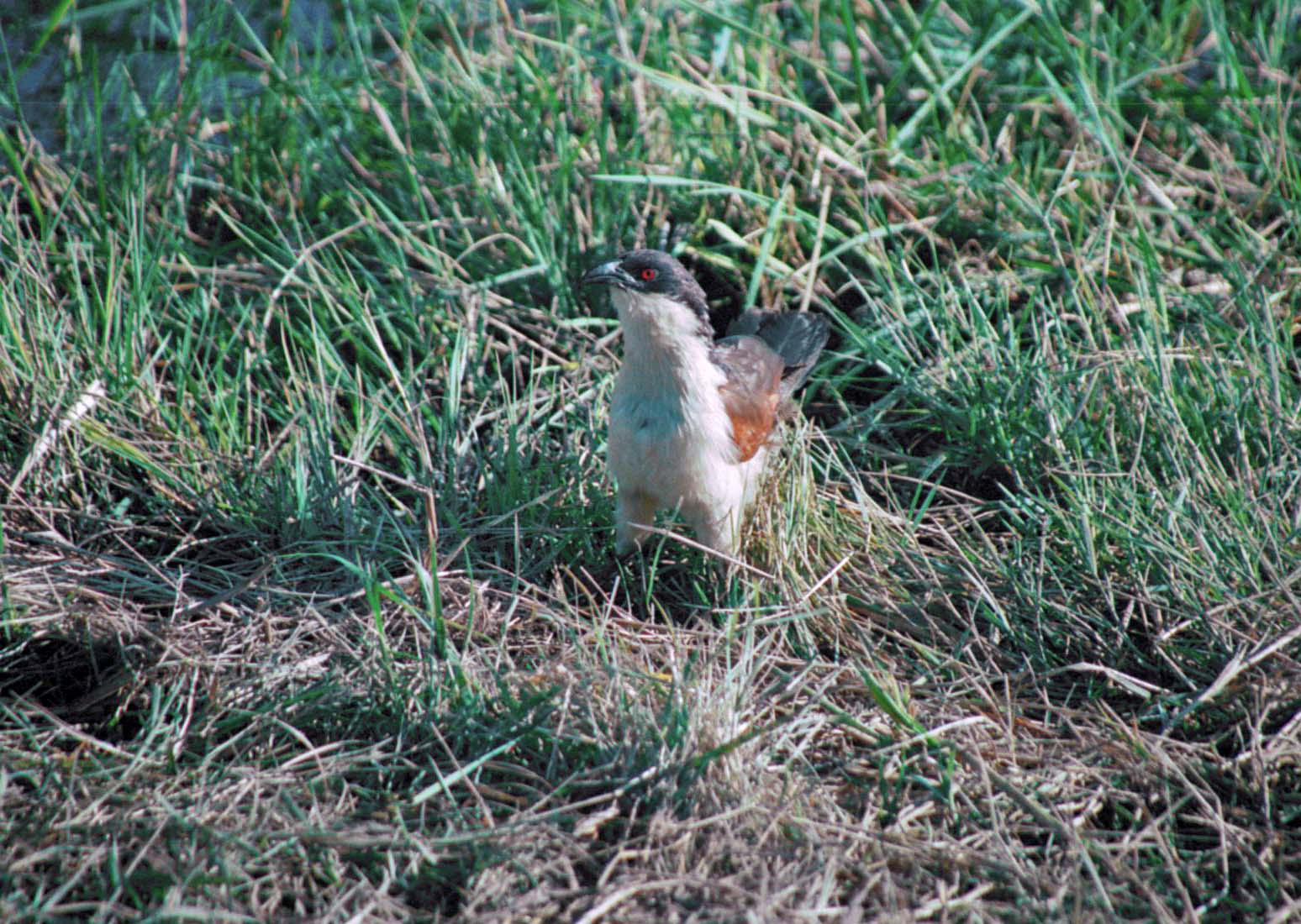
Wetlands are highly productive ecosystems – an interweaving of myriad plant and animal species that defies an easy analysis. The previous four times I came to the Okavango Delta were in “dry” years when water tables were low and the floods barely reached as far as Stanley’s Camp. I saw two, maybe three Burchell’s coucal (Centropus burchellii. ) Now they’re everywhere – rising from the grass to look for snails, frogs and toads, new opportunities for these predators with fierce red eyes. Interestingly, it is mostly the male who incubates the eggs. At dusk, as the elephants head back from their evening forage, I often hear the liquid song of a coucal: Doooo, doo-doo-doo-doo, doo – the sound of water dripping into a wooden bucket, or pan-pipes rapidly descending a scale.
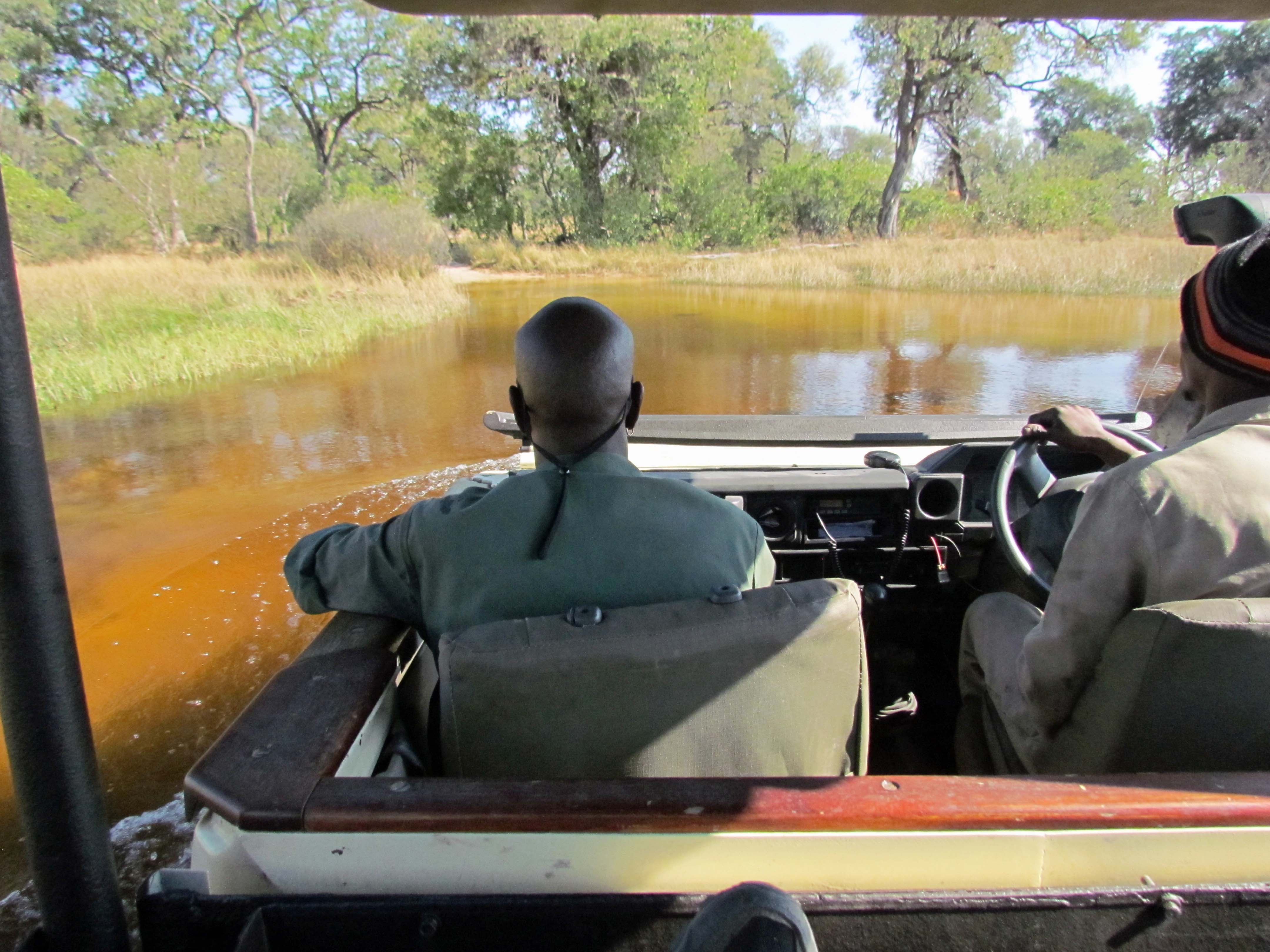
Water is rare and precious in Botswana – so much so that the pula, the equivalent monetary unit as the dollar, is the same word used for rain. The lack of water leaves much of Botswana’s desert areas uninhabitable. Paradoxically, so do the floods, two months downstream from the rains in Angola. The fickle nature of the Okavango’s channels defy permanent infrastructure, such as paved roads. Often vehicles become immersed up to their floorboards.
Each time I follow the elephants to another section of flooded road I’m both delighted and chagrined. Delighted at the number of secret waterways – so numerous, so new, that no one can memorize them over the length of a year. Chagrined, because I will need to wade. My pants are already stained by decayed plant muck. All of this water, and I cannot drink a drop of it. Thankfully, the pipes at Doug and Sandi’s camp tap well water.
Some of this year’s road-channels are deep enough for mokoro, canoe highways, but not deep enough yet for crocodiles and hippos. Bits of plants tumble along in slow clear currents down previous roads; water lilies and reeds fill entire channels, remind me of paintings by Monet.
Even elephants can get lost behind huge stands of palm and grass.
Then he turns to Stacey. “Time for a photo-op?” I leave off drawing diagrams in the dust, stand up, dust off my pant cuffs, and join them.
Stacey fishes a disposable camera from the pocket of her shorts, “Do you mind?” and hands it to me. I smile; she had a camera after all.
“Ears,” Doug says to Jabu in a conversational tone, in the same tone a mother might remind a teenager, “Dishes.”
But Jabu’s way ahead of him. As soon as the camera came out he spread his ears and posed.
Stacey cuddles his trunk; I turn the camera horizontally in order to squeeze them into the frame.
“How many?’ I ask. Practically the entire roll, it turns out. Jabu with Stacey. Jabu with Stacey & Doug. Jabu and Doug. Just Jabu. Then Jabu with Stacey again. It’s hard to fit all of Jabu into the frame of a point-and-shoot without Stacey appearing to be a mere speck. I do a couple of close-ups.
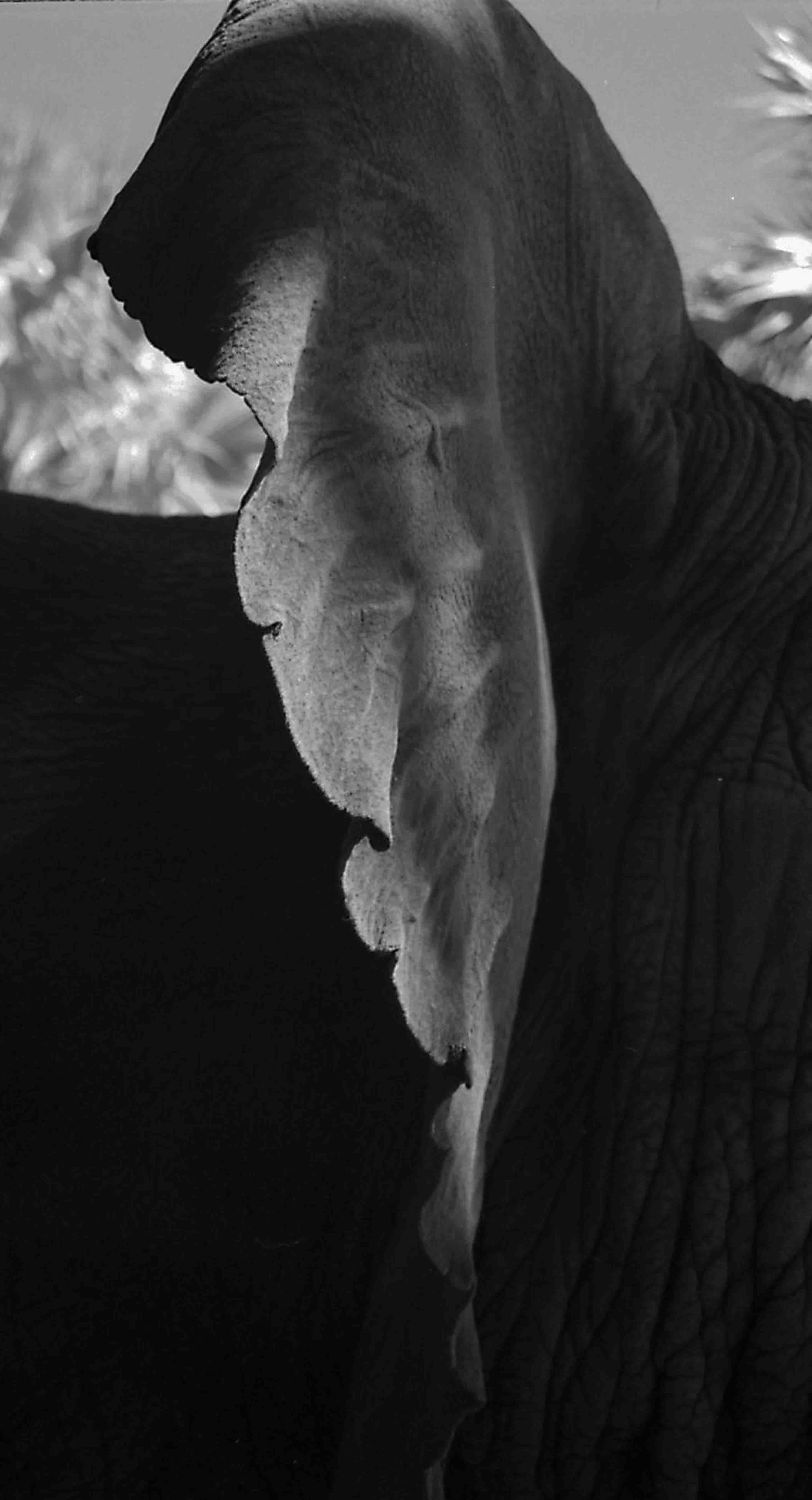
Behind me seedpods rattle their tiny gourds as Thembi swishes through the grass. Her ears ripple as she walks, a wave going through them, top to bottom. She’s giving up eating to find out what’s going on.
Stacey joins me. I hand over her camera.
“Squhweeek, Jabu.”
Doug’s voice rises an octave between “Squh” and “weeek.”
Trunk tip squeezed together, Jabu obliges, emitting a series of squeaks similar in sound to rubber tires leaving skid-marks on pavement.
“It’s an inhalation,” Doug comments.
Standing shoulder to shoulder with Jabu, Thembi joins in. And over in the brush, with her back to us, Morula squeaks too. Like a kid in a corner, she keeps on practicing. Her squeaks sound more like a finger rubbed across a balloon.
“Talk.” Doug says to Jabu and Thembi.
First one “talks” and then the other. They rumble, leaning back and forth, abdomens filling and emptying like bellows, sounds made by exhalations.
It’s a rhythmic conversation. Jabu and Thembi’s low bass tones carry layer upon layer of vibrations. I close my eyes and imagine giant, reverberating oboes.
Is there an under-current of conversation going on between them? Silly humans. They get so pleased over the littlest things.
Morula saunters over. The tip of her trunk curls against her forehead, waves Hello.
“Morula has something to show you, too” Doug says. “Morula, open,”
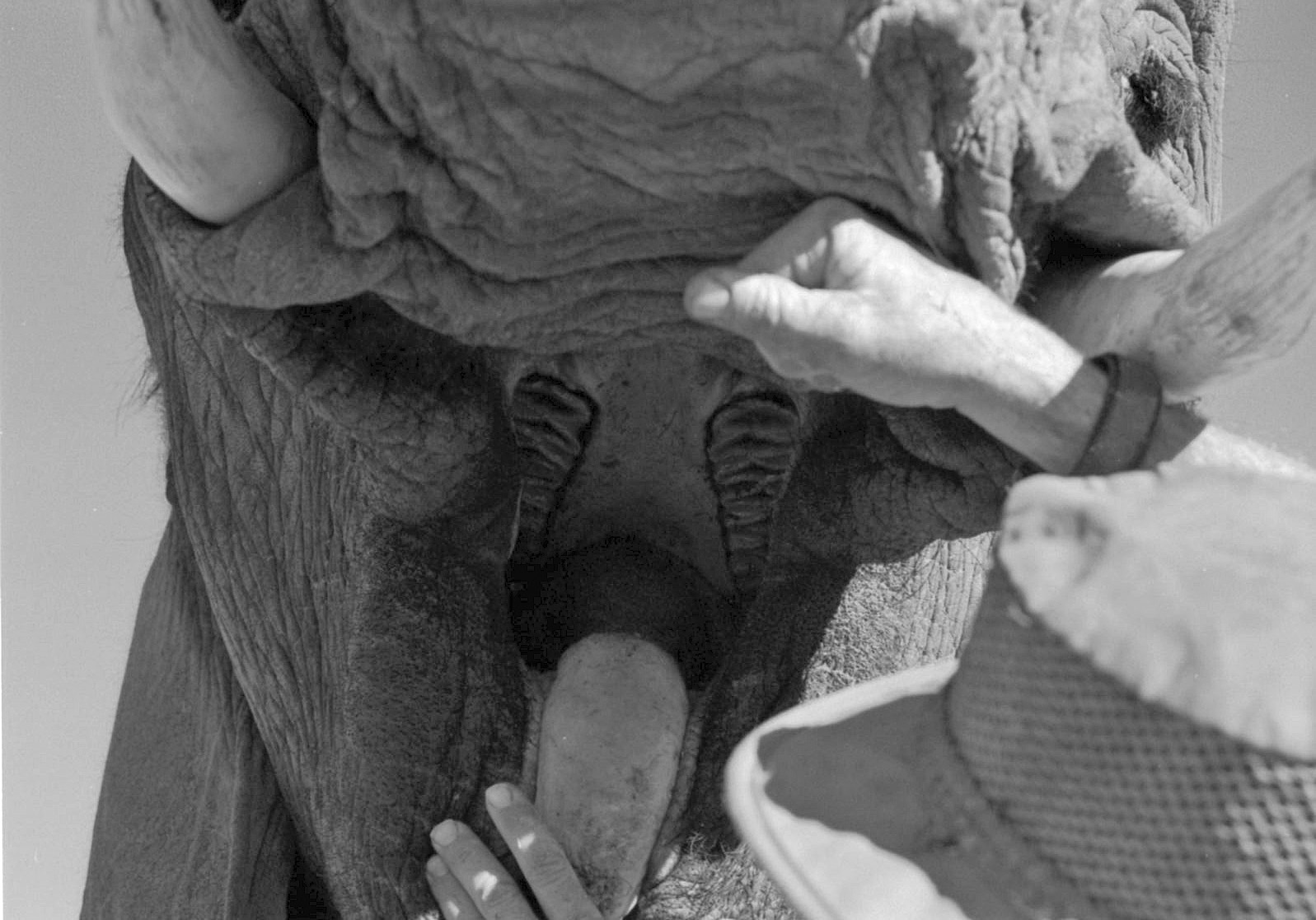
First Stacey, standing on tiptoe, reaches in, and then I reach in to rub Morula’s tongue. It’s much bigger than mine is, but feels pretty much the same – wet, soft, fleshy. It’s flecked with bits of leaves.
There’s a common but erroneous belief throughout Asia that all elephants are tongue-tied. It’s also believed that if the tip of their tongue were not tied down at the front of their mouths, each and every one of them could speak.
Morula pushes against Doug’s fingers with her strong tongue.
What if Morula could speak? There’s not a single one of us who do not wish that the great beasts of this world could whisper into our ears the secret of life, could answer our questions in a language we might understand.
But would we want to hear what they have to say about us?
Something tickles the underbrush, a small rustle from a smaller body. Insects buzz in the background, a white noise that echoes the beginnings of the universe, a biological chorus constantly singing.
I listen as if I am a young species, as if my life depended on
Doug gets my full attention when he proclaims to his guests, “Thembi has a great set of knockers.”
“Thembi, leg.”
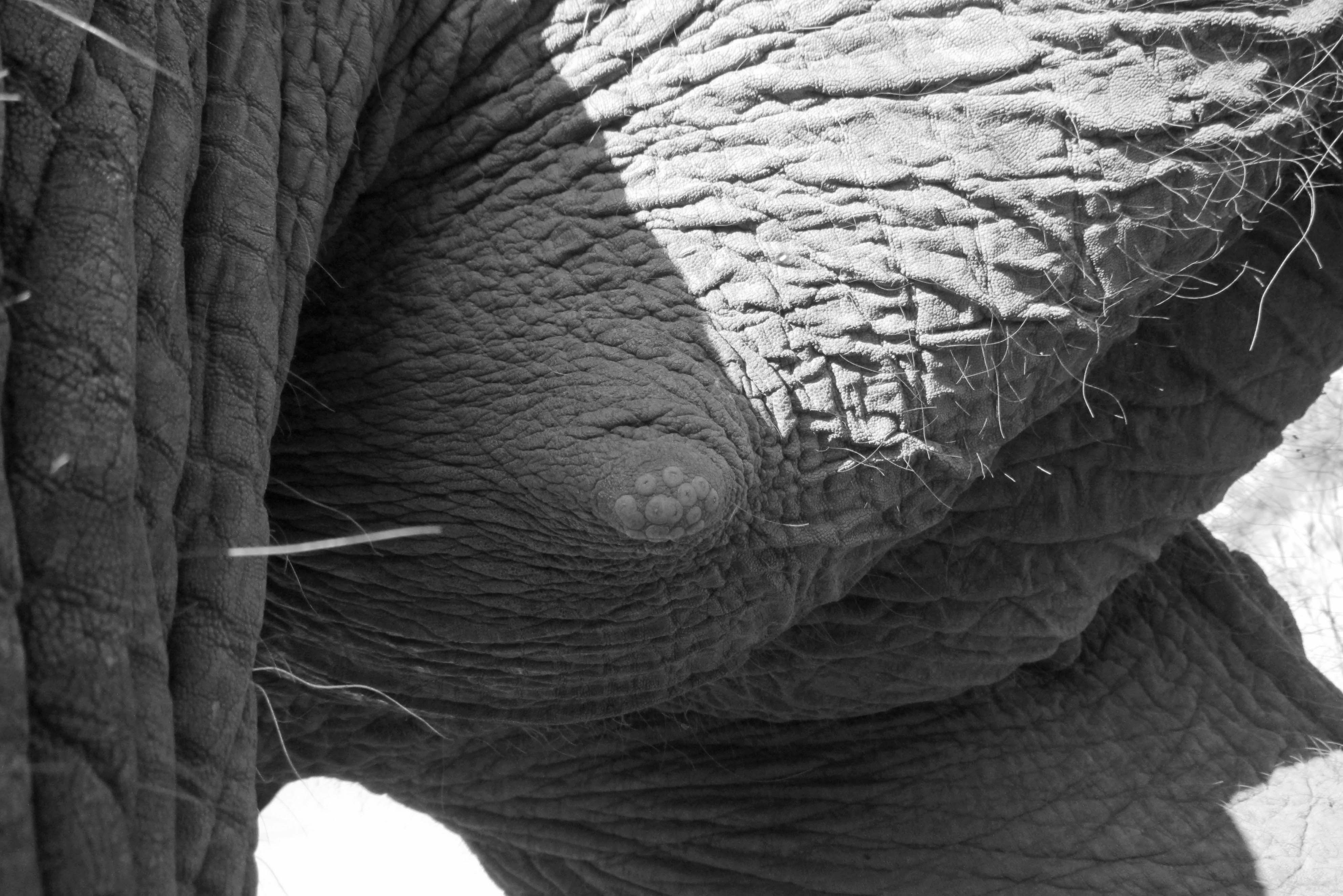
She obliges by bending her left front leg at the knee and raising it, exposing a clear view of her breast. “See? Elephant mammary glands are located on the chest, like humans.”
A Great Set of Knockers
I lean over Doug’s shoulder and look at two gray breasts with permanently erect nipples. They’re about the size of a medium cantaloupe and, like human breasts, slightly globular, due to the pull of gravity.
“Alllllll-right, Thembi.” As her foot touches the ground, she flaps her ears and her trunk snorfles around his feet.
“If you reach in like this,” Doug demonstrates, “you can feel them.”
Steadying myself with one hand on Thembi’s leg, I reach in and cup her breast with the other hand. The skin of her breast is as soft as an old, creased leather bag. Her nipple, as one might expect, is harder than the flesh around it.
Thembi emits a low, murmuring rumble.
“Oh you like that, do you, Thembi girl?” Doug chuckles.
I quickly withdraw my hand and step away from her side.
“Anyone else want to try?” asks Doug.
Out of the seven of us, several people look away, several look down. No one ventures forward. I can’t tell if everyone is embarrassed or just reticent. Feeling up an elephant may not be quite what they had in mind. It certainly wasn’t what I had in mind.
“Well, OK. Mammals are called mammals because . . . . ?”
One of the guests ventures, “Mammary glands?”
“Right.” Doug continues his lecture: “Like all mammals, Thembi’s lactiferous ducts terminate in her nipples. They point out a bit, while Morula’s nipples point down. Thembi gets a bit of stimulation while she walks, don’t you, Thembi girl?”
Some of the guests look mildly scandalized, while others giggle and whisper to each other.
Doug rubs Thembi’s leg, which generates another snorfle.
Female elephants don’t have a row of teats, like cats or dogs. They don’t lie on their sides, suckling a litter. Elephant calves nurse standing up, with their small trunks flipped over an eye like a wayward curl.
All mammal breasts are modified sweat glands. Some mammal breasts are located in the groin and some on the chest. The breasts between Thembi’s front legs are in the same location mine would be if I walked around on all fours. Her breasts weigh about four pounds each, .1% of her body weight. Human breasts weigh .08% of total body weight, dogs 2%, rats 9%.
Do all mammals have larger breast size to body weight than humans? I pull out my notebook to write down that question, but then decided I really don’t care, and put the notebook away.
“Is she pregnant?” asks the woman behind me.
Although Thembi possesses relatively trim tonnage in comparison to the other two elephants, she is significantly rounder – huge thighs, huge belly, a Rubenesque sort of girl with a really long nose – and very full breasts, unusually large for a non-pregnant elephant.
“We don’t think so,” Doug replies. “We had her hormone levels tested about six months ago, and they were normal. She’s an enthusiastic eater, so she might be a tad rotund because of that. She might be incubating a surprise, but we doubt it.”
Sandi laughs. “That’s because she’s a bit of a flirt with the wild boys around here, but when things get serious she becomes quite horrified and scoots on home.”
Another one of the guests pipes up: “Has Jabu ever tried mating with her?”
“Yes, he’s tried,” Sandi replies, “But we’ve never yet seen him achieve intromission.”
Heads nod thoughtfully. I can see intromission has thrown them a bit. It’s not a word commonly used to describe sexual penetration, but I think most of the guests have a general idea of what it might mean. Several of their heads swivel to gaze at Jabu, ripping apart a nearby bush. Since he’s such a big boy, why couldn’t he just have his own way?
“Thembi doesn’t really favor him,” says Sandi, as if she’s reading minds.
“What if she had a calf?”
There’s not one second of hesitancy to Sandi’s reply: “Oh, we’d keep it. It wouldn’t be easy, though. Thembi’s never been in a breeding herd and has no clue about birth. And she’s rather stuck on herself, you know. We don’t think she’d be a good mother. But if it happened, we’d make it work.”
Even though it’s not likely that Jabu and Thembi will become pachyderm parents, I can easily imagine Thembi as a pregnant princess, mood swings, food cravings and all. As if to prove my point, she regally sweeps through a stand of grass, a princess on a mission. She breaks off a few branches from a small thornbush, stuffs them against her back molars and chews with her mouth open.
Thembi has never been with an extended herd of mothers and sisters and aunts and hasn’t had the opportunity to learn the complex behaviors required to be a mother. She’s never learned that newborn calves stay in physical contact ninety-nine percent of the time, either below or beside their mothers. Although calves will begin to forage by nine months, they continue to suckle for about four years. Elephants in zoos will quite frequently shun newborn calves. So I can just about predict Thembi’s reaction to a calf: What IS this thing following me around?
I glance over at Jabu. He has nipples, too. Guy nipples, nozzle-like nipples, surrounded with sparse hair.
A Guy Nipple
All mammals have three distinct features: hair, three middle ear bones, and mammary glands. Even whales, dolphins, porpoises and manatees have hair, usually on their snouts or next to blowholes. Elephants and manatees shared a common ancestor fifty-six million years ago, but the nipples of female manatees are now under their flippers, in their armpits.
A question comes from the back of the tourist group. “What about Morula?”
Dear, Old Maid Morula. The wallflower with big ears, large liquid eyes and a knobby forehead.
“If an elephant doesn’t breed by the age of twenty-five, they are unlikely to,” Sandi replies. “Morula is already the ripe old age of thirty.”
Female elephants typically become active at a quite young age, around thirteen. They can conceive as early as ten years old and possibly have 12-15 offspring by the time they are fifty. Female calves will stay with the herd the rest of their lives.
Male elephants take a bit longer to mature and become sexually active around the age of twenty-nine.
Morula has missed the boat. But I’ll bet she’d make a great aunty. She stands close by, slowly opening and closing her great ears, patiently watching.
One of the Lactating Class
When he first developed his classification system, Swedish botanist and zoologist Carl Linnaeus originally called mammals Quadrupedia, after the name Aristotle gave them. Later he became actively opposed to wet-nursing practices in the 1750s and wrote a book on the benefits of breast-feeding your own child. As a political act, he reclassified Quadrupedia to Mammalia in later editions of his most famous work, Systema Naturae, defining mammals as a lactating class within the Animalia kingdom, a classification that has lasted to this day – all because women of nobility in Linnaeus’s time thought breastfeeding would ruin their figures.
Certainly that’s one thing Thembi doesn’t have to worry about.
My friend Louis (lover of SNAKES!!) wants to know the story behind this photograph. Okay Louis, this is just for you, crazy person that you are.
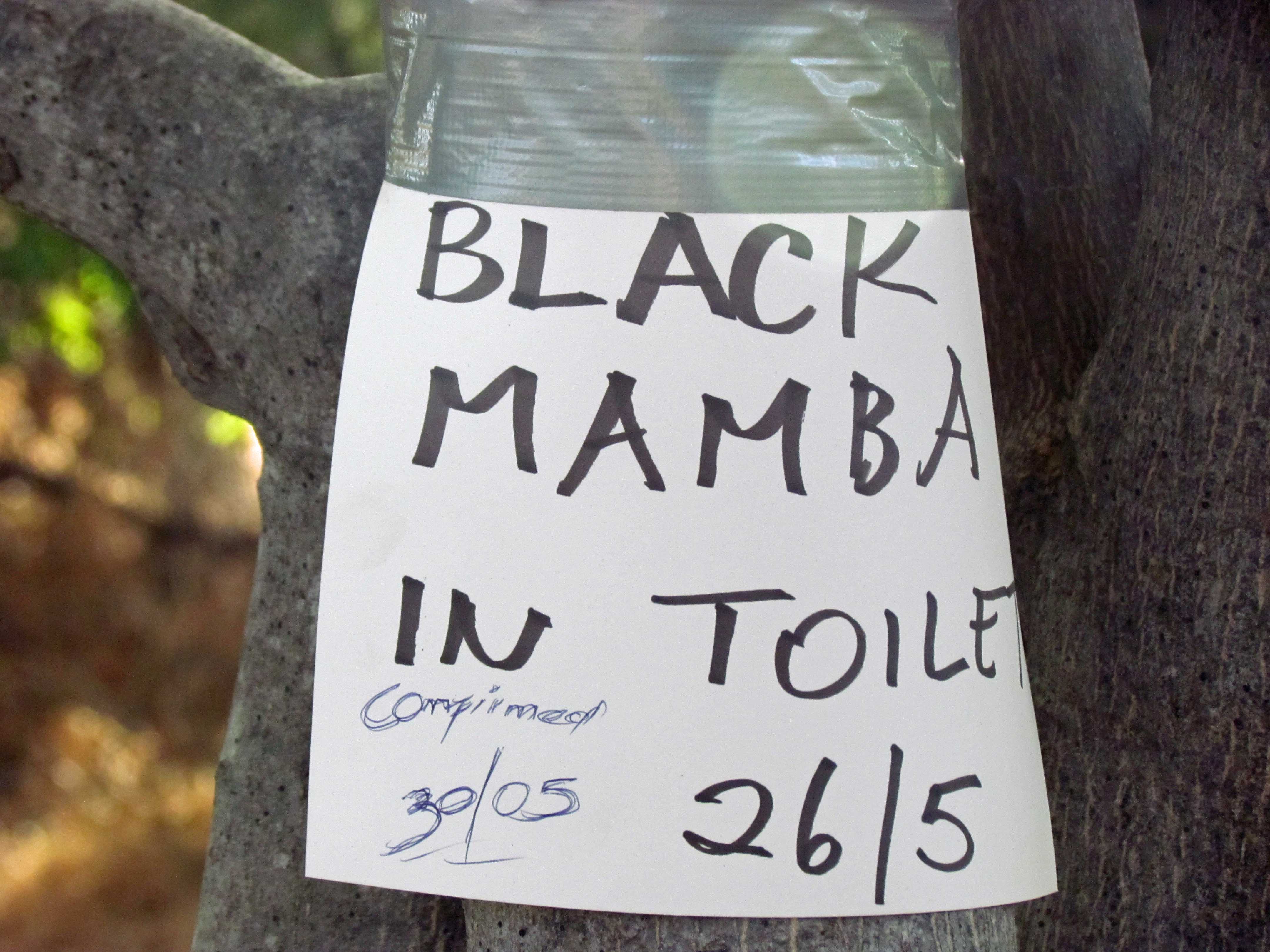
Dated 5/26/12, Reconfirmed 5/30/12!
But first, for those who are unfamiliar with black mambas, here’s a little background information:
Black mambas (Dendroaspis polytepsis) are the longest venomous snakes in Africa, measuring up to 14 ½ feet. Mambas are not black – they’re more olive or greenish gray, with a narrow, elongated head the shape of a coffin. It’s the inside of their mouths that are black – hence the name. Mambas are also extremely aggressive and may actively attack without provocation. I use the adverb “actively” with reason – a mamba can strike in all directions, even though a third of its body is raised above the ground, and it can chase you in that upright position at speeds up to 20 mph. If you are bitten, your death will occur within 20-60 minutes. An anti-venom for mamba bites exists, but it must be administered immediately, requiring 10-20 vials of solution. But if you are struck in the face or neck (quite likely, since the head of the mamba chasing you is 4 feet off the ground), you will die in ten minutes. That black mouth will be the last thing you see.
On that cheery note, on with the story:
In the Moremi Game Reserve, east of the Okavango Delta, is an elevated platform overlooking a large hippo pool in a bend of the Khwai River. Six of us, our guide OT (“just like Overtime!”) arrive in our Land Rover.
“What’s that?” I point.
It’s a large piece of stiff white paper taped with duct tape to a tree. We climb out, read it, and immediately start swiveling our heads, trying to look in all directions at once.
“Anyone want to go look?” OT laughs.
The toilet, roughly the size of those cartoon outhouses with the crescent moons carved in their doors, is a cinder block building with a tin roof. It’s about fifty feet from our Land Rover. The painted green door on the toilet is ajar.
Certainly I’m not tempted to look inside. After all, the second message was written just three days before our arrival by someone a lot more curious than I am about deadly snakes. The mamba is most likely still in there. Who wants to reconfirm a reconfirmation? Mambas are territorial; they will always return to their lairs, although that’s usually in an abandoned termite mounds or a hollow tree, rarely, I’d bet extremely rarely, in a toilet. A mamba is diurnal, active both night and day. It could be sleeping in there. Or not.
In my opinion, I’m already standing way too close to that toilet. Trying to look both at the toilet and at everything else, I walk slowly backwards. Mambas don’t like sudden movements.
Besides, I firmly believe, even though I haven’t seen it, that this toilet is not a Western ceramic throne, but a mere hole in the cement. I’ve had enough experience with toilets-in-the-middle-of-nowhere to also believe that the area around the hole is likely none-too-clean. That bush over there looks a better. A few minutes later, after careful reconnoitering and quickly taking care of business, I can confirm that no mambas are lurking around it.
As I climb the steps to the viewing platform I look for mambas wrapped around posts. On the creaky platform I look for mamba’s hidden in corners, or nestled into the thatch of the roof. I look for mambas slithering across the branches of the trees that lean dangerously close to the rails. A rustling noise among the branches spikes my heart rate to a gazillion, but it calms when I see it’s only a Burchell’s glossy starling, squawking for handouts.
Burchell’s starling
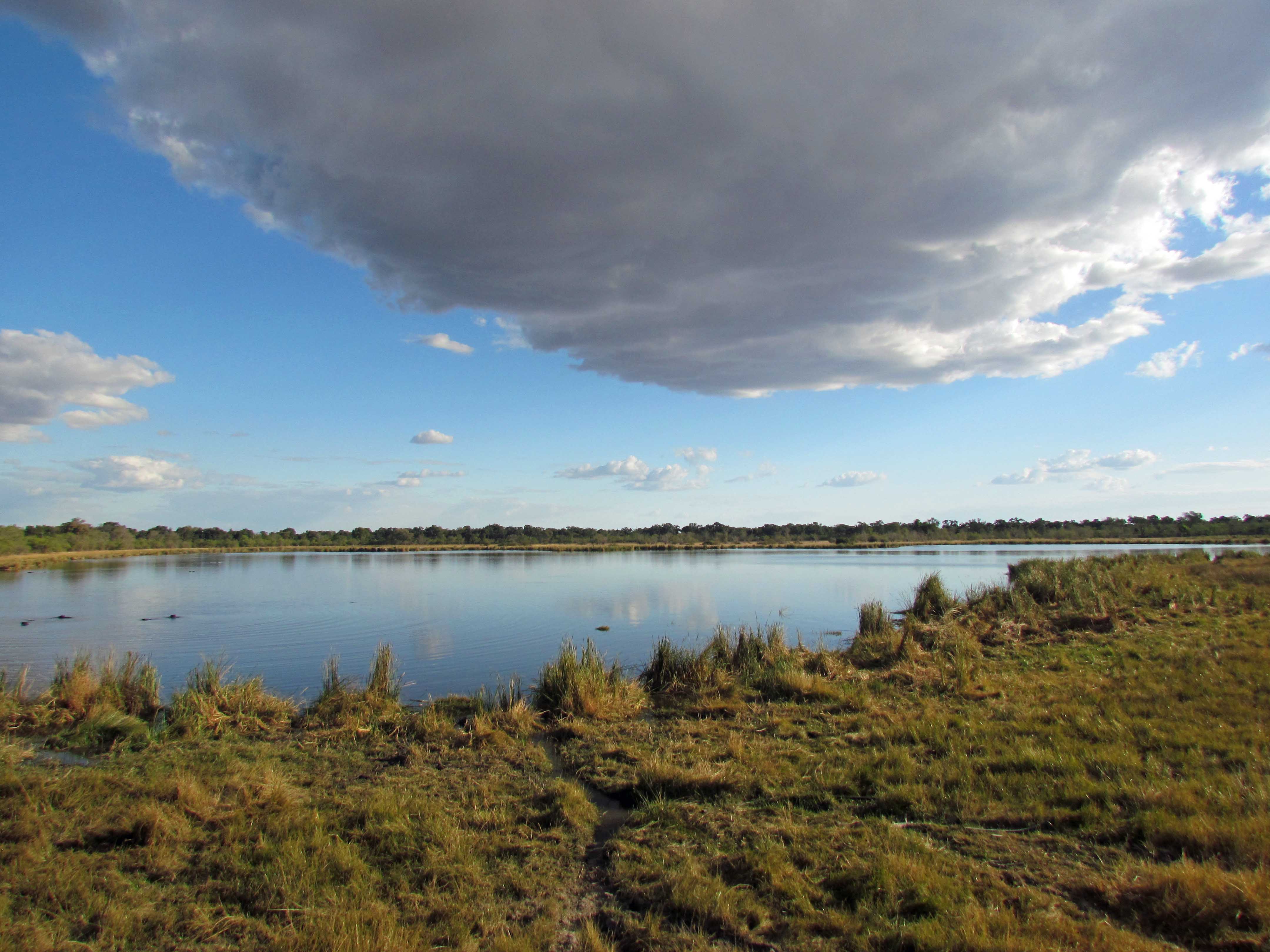
The view from the platform is marvelous. A massive cloud hangs over the hippo pool and puffs of other clouds reflect in the tranquil water. A dozen hippos rise and sink, burbling like submerged tubas. Tracks in the grass are hippo paths, where the hippos come out of the pool at night to feed, foraging as far as three miles for sweet young shoots.
At the bottom of the platform a dozen water monitors, some six-feet long, slither into positions that defend his or her portion of the bank, using the hippo paths as small highways. The smaller monitors end up with the worst spots, constantly harassed in slow-motion chases by the larger lizards. As I watch their typical reptile behavior, I think it’s lucky for us that the age of dinosaurs ended a long time ago.
Khwai River
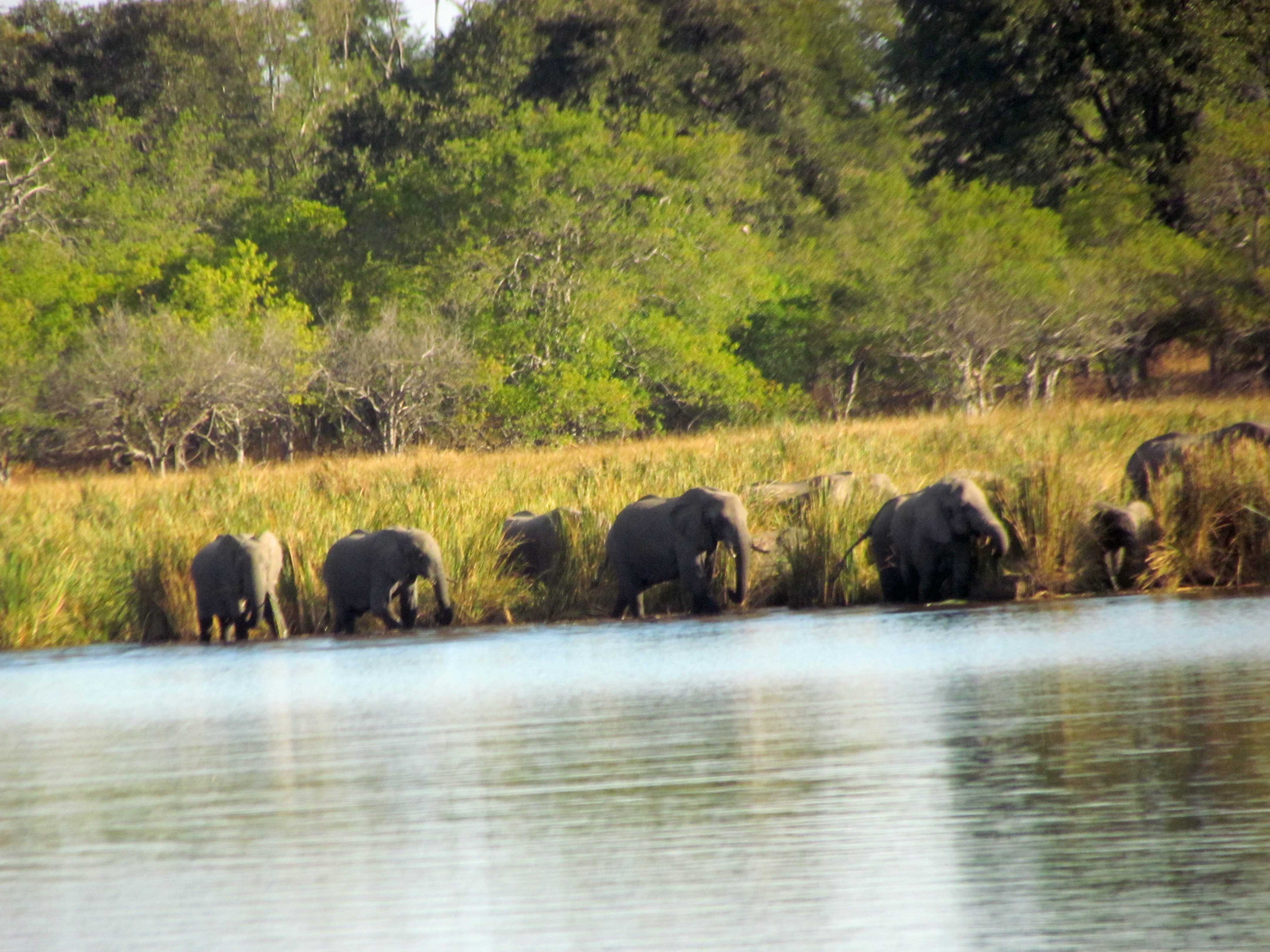
On the far side of the river, specks in the distance, a huge herd of elephants splashes along the edge of a reed bed. After I check for mambas, I lean on the rail of the platform to steady my camera. I use the digital zoom to take a picture, but it’s an extremely low-pixelated shot. The elephants are in constant motion, appearing and disappearing in the reeds, so the photo turns out fairly blurry, but at least I have proof that those specks were really elephants.
Elephants on the far bank
On the way down from the platform I look for mambas wrapped around support posts, coiled under steps, and hidden in the framework of the flooring. I scan for slithery movements in the brush and wait for someone else to climb in the Land Rover before I do. I doubt the mamba has exchanged one lair for another, but still, you never know . . .
So, Louis, the viewing platform has its own GPS coordinates. If YOU want to look at that mamba and reconfirm one more time that it’s really there, I can tell you exactly where to go!

 Only a few yards from our Land Rover, a single-cylinder water pump alternately chugs and sputters, drawing from the water table beneath the sand, and sending spurts through a pipe to a square trough. This supply of water keeps the bachelor elephants in Savuti area, as they wait for spring rains and the return of female breeding herds.
 He returns to where we are parked, and stops close by. His skin is the color of seasoned cast iron. The waterline on his body rises just past his belly. Spatters of mud stain his ears and back. His forehead bulges and flutters audible sounds, if I had the ears for infrasound.





 ABOUT ELEPHANTS