Vervet monkeys chatter to each other as they jump along the branches of a Sausage tree over my head. I look up. The monkeys peer down through the tree’s large, leathery leaves. Small bits of dead flowers rain down. Brown eyes in the middle of narrow black faces stare back at me.
They wouldn’t, would they?
Last night, without any aid from the monkeys, the tree dropped a bomb next to my tent. At two feet long, six inches in diameter, and weighing nine pounds, one of the fruits dangling deli-style from the Sausage tree made quite an impressive WHUMMP! when it hit the sand. I wonder about the motives of the potential bombardiers overhead.
Light-gray thin bodies dart from branch to branch. The monkeys stop and stare, stop and stare. The bombardiers look as if they wear black oxygen masks and gray flight coats with white ruffs.
More bits of flowers and leaves rain down.
photograph by Cheryl Merrill
Livingston camped beneath a Sausage Tree right before he discovered Victoria Falls. What if its fruit had bonked him in the head? Stanley might have searched in vain for the famous explorer and never uttered, “Livingston, I presume?”
And what would have happened if that relentless experimenter, Isaac Newton, had been beaned with a sausage fruit instead of an apple? Would we still have the theory of gravity?
I bet that we would. After recovering from a concussion, Newton would have gone right ahead and figured out his equations. After all, this was the guy who stabbed his eye with a needle just to see what would happen.
The Vervet monkeys tire of watching me and settle higher in the tree. Thanks to the restraint of my overhead companions, I’m able to continue on without incident.
Found mostly in seasonally arid areas, baobabs grow very slowly as they age, except for first years of its life, when a baobab grows relatively quickly. A tree planted in Kruger National Park in South Africa grew 65 feet tall with an eleven-foot diameter in just 38 years. In contrast, an older tree described by Livingstone in 1858 grew only two feet in circumference in 110 years. Despite their early exuberance, baobabs can be cultivated as bonsai trees.
Young baobabs have only single leaves per stem. Without their crooked branches and five-leafed stems, they are difficult to recognize. Kalahari Bushmen believe the trees appear fully-grown, planted upside down by the gods, with the tree’s roots in the air. They also believe spirits inhabit the baobab’s large, waxy-white flowers, and if anyone has the audacity to pick one, they will be eaten by a lion. The flowers open just before dark, produce copious amounts of nectar and last for only 24 hours. Their heavy, carrion-like scent attracts nocturnal insects and bats, such as the Epaulleted fruit bat. The Kalahari Bushmen are right: the smell of a freshly-picked baobab flower behind your ear would make you bait for lions drawn to the carrion scent.
Older baobabs have a tendency to rot out their heartwood, but completely heal around the hollowed trunk. Rats and reptiles frequently invade them and African honeybees often establish hives in crevices of a baobab. Native to central and southern Africa the bees are actually a subspecies of the Western honeybee. A single sting from an African bee is no more venomous than a single European or American bee sting, but African honeybees respond more quickly when disturbed and send out three to four times as many workers in response to a threat. They also pursue an intruder for a greater distance from the hive – thus their reputation as “killer” bees.”
Physically unable to break open a beehive, the Honeyguide has developed a symbiotic relationship with humans, letting another species take the risk of being swarmed. A Honeyguide indicates the presence of a hive by continuously dive-bombing nearby, all the while uttering monotonous, squirrel-like chirps. Alerted by the Honeyguide, intrepid Kalahari Bushmen pound pegs into the soft bark of baobabs to climb the tree, lull the bees with smoke and obtain a sweet reward for taking that risk. Bushmen always leave honey for the birds, for if they should fail to do so, the Honeyguide will one day lead them to a lion, instead of a hive.
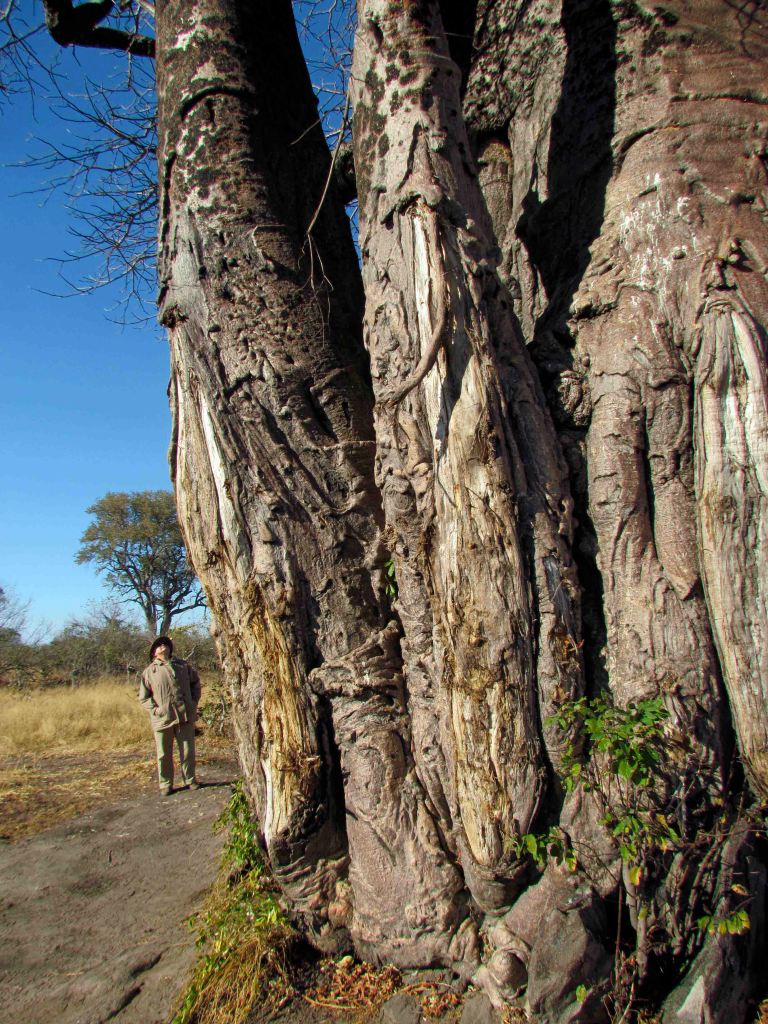
“Pachycaul” is a scientific term used to describe a variety of thick-stemmed plants with few branches. “Pachy” is Greek for “large” and “caul” is Latin for “trunk.” Pachyderm is a term for describing large, thick-skinned animals such as elephants. In times of drought, elephants strip the bark of the baobab and eat the spongy wood underneath, estimated to contain 40-70% water – which classifies the baobab as the world’s largest succulent. An individual baobab can store up to 32,000 gallons of water. When pachyderms meet pachycauls, it is the baobab that suffers. Sometimes, during these times of drought, elephants will completely gird a tree, leaving it standing as if on its own pedestal, and yet the baobab will still survive.
Weighted with water, baobabs barely move in the wind. Even a mild frost will kill a baobab, so they are never found at elevations over 3,000 feet. The tree is also sensitive to both flood and extended periods of drought. In Madagascar, a sugar mill diverted water onto land containing baobabs, which subsequently stood in water year-round. The trees began to rot and topple over until the land was drained and the remaining 313 baobabs upon it were declared part of a conservancy area. A highway constructed near the Nomslang Baobab in South Africa brought thousands of visitors to marvel at its size. Unfortunately, their feet trampled the earth beneath it into hardpan, making the ground impervious to rainwater and the famous baobab died. Baobabs melt into a huge, fibrous mass within a few months after their death, leaving behind mounds of stinking pulp and a pit filled with a rotting taproot. Soft spots around dead baobabs also indicate locations of its root system, which may radiate just below the surface for 300 to 1300 feet.
Some species of plants and trees emit chemical signals when under attack. I wonder if the baobab talks to its long-lived kin as it dies. Baobabs live up to two thousand years, 730,000 revolutions of daylight and darkness. Perhaps its chemical whisper is Patience, perhaps it is Eternity, perhaps it is Dream.
The most comprehensive book ever written about baobabs is The Baobabs: Pachycauls of Africa, Madagascar & Australia, Gerald Wilkins and Pat Lowe
In 1998, the Disney Corporation opened the Animal Kingdom Park in Florida. It is, in essence, a 500-acre zoo, containing 1,700 animals representing 250 species, from Abdim’s storks to African zebras. In the center of the park is a 145-foot-tall, 50-foot-wide sculpture of a baobab, representing the Tree of Life from the Disney film, TheLionKing. Much larger than any known baobab, the sculpture is molded around a refitted oil platform. Its trunk is carved with 325 animals and contains a theater with 430 seats. Fixed to its branches are 103,000 leaves dyed five shades of green, made of kynar, a flexible fluoropolymer resin.
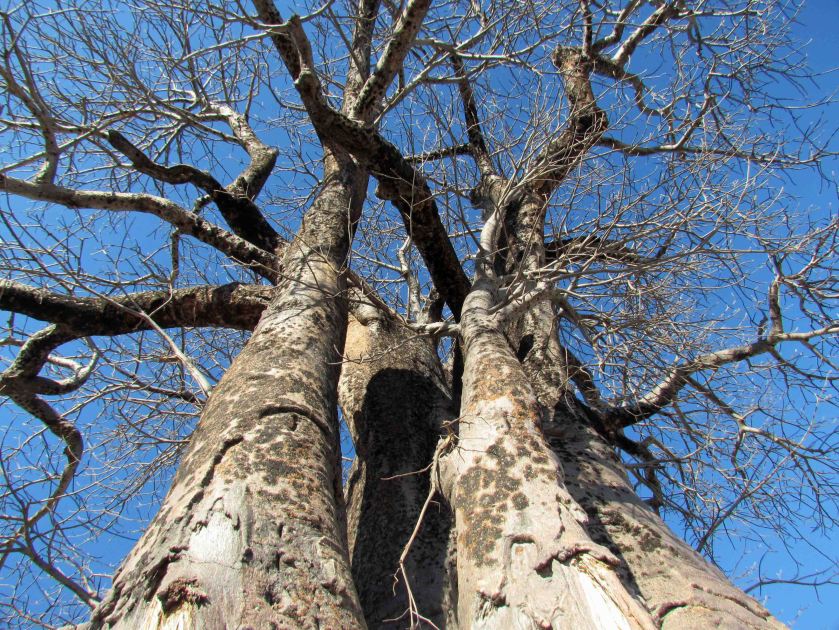
Eight species of living baobabs exist: six in the dry deciduous forests of Madagascar, one in Australia and one which grows in West, East and Southern Africa. Baobabs on the Arabian Peninsula are the result of human settlements. All baobabs are deciduous. Nude limbs, entangled as a root system, seem to search for moisture from the sky. Kalahari Bushmen believe the trees appear fully-grown, planted upside down by the gods, with the tree’s roots in the air. They also believe spirits inhabit the baobab’s large, waxy-white flowers, and if anyone has the audacity to pick one, they will be eaten by a lion.
Hollow baobabs have a long history of creative uses by humans. During World War II, a baobab in Namibia was fitted with a toilet. The toilet is still there, but the tree has grown around the door, which no longer opens. On the lower Zambezi River, the Kayila Lodge has an operational toilet tree, used more for photo opportunities than necessity. And on a private farm in Sunland, South Africa, an enormous baobab contains a wine cellar and bar, complete with draft beer, a dartboard, stools, and a wooden bench along the wall. This tree is possibly the oldest baobab in existence – it has been radiocarbon-dated to the end of the Stone Age, around six thousand years ago.
In Kasane, Botswana, a baobab was used as women’s prison in the early twentieth century. Incarceration with potential rat and reptile cellmates might make any criminal think twice. Although that baobab died in 1967, an offshoot now grows next to the remains of the jail. Throughout Africa, hollow baobabs have served various purposes – as hiding places during tribal warfare, as shops, storage shelters, barns, chapels, burial sites, post offices, even a bus stop.
Almost every part of the baobab is edible. Fresh leaves are eaten as spinach and condiments. The shoots from germinating seeds taste like asparagus. Bulbs from its roots make porridge. Fluid extracted from the bark of the baobab is used to dilute milk. The ash from a burnt tree is a good substitute for salt. Pulp and seeds of its fruit contain potassium acid tartrate as well as citric acid, an effective substitute for cream of tartar, and resulting in the Afrikaans name “Kremetartboom.” Early settlers also used fruit pulp in place of yeast and added baobab leaves to speed up the fermentation process in winemaking. The fruit pulp has the highest known concentration of Vitamin C. It makes a slightly acidic, but refreshing drink when mixed with water. Baobab seeds have the same protein value as domestic nuts and can also be roasted and ground into a substitute for coffee.
The baobab is often called “the Monkey-bread tree,” because baboons and monkeys eagerly consume its fruits. Nearly all four-legged browsers eat the baobab’s fallen leaves and flowers. The flowers open just before dark, produce copious amounts of nectar and last for only 24 hours. Their heavy, carrion-like scent attracts nocturnal insects and bats, such as Peter’s Epaulleted Fruit Bat. In times of drought, elephants strip the bark of the baobab and eat the spongy wood underneath, estimated to contain 40-70% water – classifying the baobab as the world’s largest succulent. An individual baobab can store up to 32,000 gallons of water and weigh 266,880 pounds – or one hundred and twenty-one tons. A bull elephant weighs up to 16,000 pounds or seven tons. If you stacked elephants one upon the other, it would take seventeen or eighteen elephants to equal the weight (if not the mass) of the water stored in a large baobab.
The name baobab derives from North African Arabic, bu-hibab, “fruit of many seeds.” Within life spans that reach six thousand years, the baobab nourishes countless species, takes in tons of carbon dioxide and releases equal amounts of oxygen. Used and re-used, a baobab cycles and recycles, measures seasons by dropping its leaves, measures centuries by the blur of life beneath its limbs, unaware of that strange human notion of time.


 ABOUT ELEPHANTS