Posted in Elephants, Writing

On the Air! Radio Interview About Writing and the Writing Life

Several months ago, Sheila Bender, friend and fellow writer, interviewed me for her radio show, “In Conversation: Discussions on Writing and the Writing Life.”  The show will air Tuesday, Nov. 27th at noon PST and Thursday, Nov. 29th at 6 p.m, PST.  It can be heard streaming from our local radio station at http://www.kptz.org.  I talk about elephants and why I decided to write about them.  I hope you get a chance to hear it.

In writing Larger than Life: Living in the Shadows of Elephants, I tried to answer two questions – what is it like to live with elephants, and, what is it like to live?  For me, writing is living.  I write everywhere, all the time, tucking pieces of paper into pockets, jotting down notes under the covers, with a flashlight on.  I write on the backs of envelopes, I write in the margins of manuscripts, I write in notebooks, notepads and ipads.  I write because reading is just one of the pleasures caused by words, even though words by themselves are drops of human magic, sprinkled against death and darkness.  I write to grave rob my own language, excavating tombs of words and phrases, looking for riches, for golden ideas buried in underworlds of common dust.

Every writer tells old stories in order to see anew.  All humans take the same journey from life to death, though our paths are never the same.  We begin as an explosion of infinite possibilities and then, for the rest of our lives, fall back upon ourselves, grabbing at some of those possibilities during our fall.  Our trajectory, which touched the very rim of life, descends toward the center, ending at zero, at what some see as a portal and others see as finality.  Falling, always falling towards the center of ourselves, the huge unknown universe within, our journeys are all the same.

I write to tell about my journey, my story, and it all comes together in just one place, my writing room.

As you listen to this interview, you can also see where I write.

One side of the room I write in.
And the other
Posted in Africa, Elephants, Jabu, Travel

Odd, How Fast We Re-civilize

An Excerpt from My Book:

In the late morning, dizzy from heat, I survey the far side of a large lagoon.  Bracketed with the dense foliage of knobthorns, leadwoods, rain trees and fever berries, this remnant left behind by the Okavango is ultramarine, inviting.  But the color is only an illusion, a reflection of the blowsy blue sky.  The water is actually steeped brown, rich with dung, dead snails, rotten vegetation, sediments, and decomposing bodies by the thousands: fish, spiders, ants, beetles – any creature unable to outrun last year’s flood.

Not far from here jungles of papyrus lean their feathery seed heads over the clear blue channels of the Okavango, tall stands that line the permanent footprint of the Delta.  The river is inching southward, breaking the boundary between water and desert.  Soon it will flush this lagoon, scouring out the sweet muck at its bottom to spread among grassy floodplains, and the desert will green.  With the river will come crocodiles and hippos and other denizens of its deep, running water.

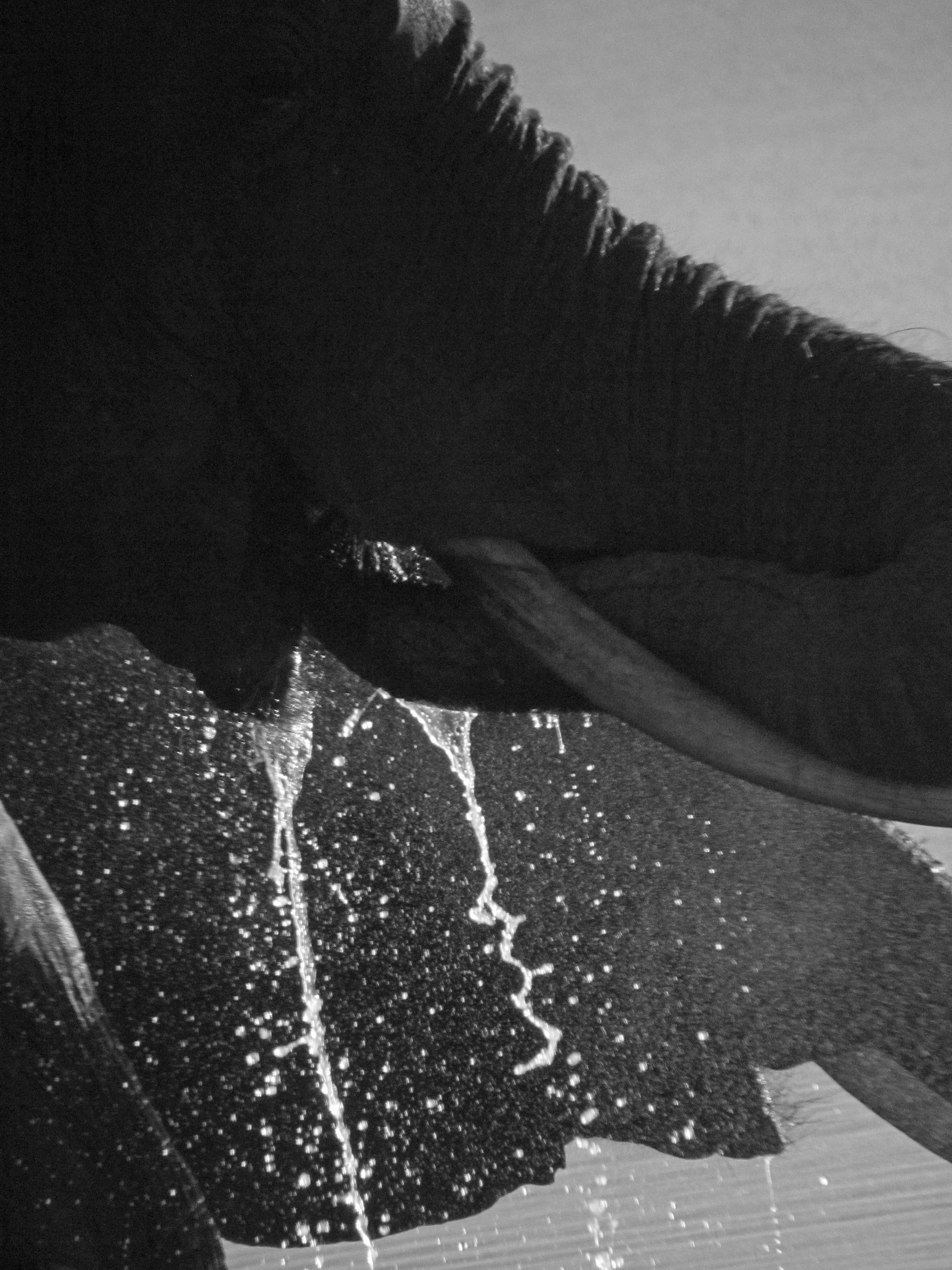
Standing shoulder-to-shoulder on mats of trampled reeds, the elephants blow a concert of bubbles, bassoons under water.  They shower their spines, poke their trunks into the back of their throats and release gallons of water at a time.  As they remove their trunks some water spills from their mouths.  An odd mossy smell rises.

My mind wanders, wondering what it would be like to follow quicksilver fingers of water season after season, migration bred into my bones.  When the river reaches this part of the Delta, a new population of birds will arrive: Wattled cranes, Egyptian geese, Reed cormorants, Darters, Avocets, Black crakes, Red-knobbed coots, Southern pochards, Sacred ibis, Hamerkops and Saddle-billed storks.

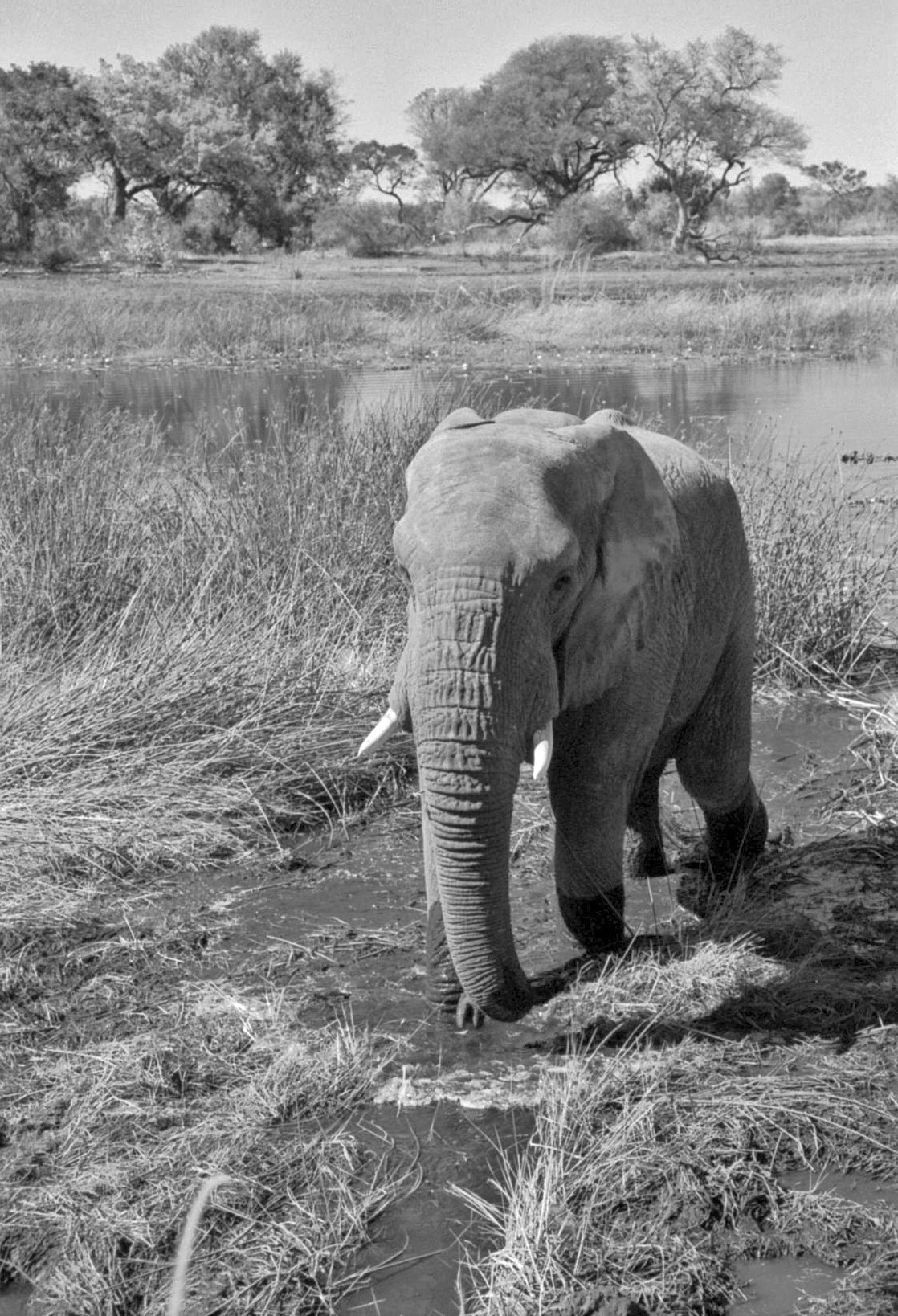
Jabu sloshes up the embankment and heads for his ration of fresh alfalfa spread under nearby trees.  His feet and ankles are covered with mud.  He looks like he’s wearing socks.  His trunk is relaxed and curled slightly, to keep the tip of it out of the mud.  Although this is just a backwater of the Okavango, huge trees line the shore behind him.  No wonder elephants grew large in Africa: there was enough room and food to do so.

I slap dust from my pants and follow, as eager as he is to tuck into lunch.  I watch him stash a chunk of alfalfa between his tusk and the upper lip of his trunk, pick off mouthful after mouthful as if eating peanuts from a bag.  He smacks his lips as he eats.  When the grass is gone he drapes his trunk over his left tusk.  His eyes close and he dozes.

In a shady grove near the lagoon a table covered with a white linen cloth dazzles the tourists.  Fresh branches of mopane decorate the surface of the table; the leaves on each branch fold modestly like small olive table linens.  Knives rest across linen napkins on white china bread plates. Pepper grinders, water glasses, oil & vinegar decanters and wineglasses complete the illusion that we’ve stumbled into the al fresco dining room of an elegant restaurant.  Nodding at murmured compliments, the staff from Stanley’s hand out cold beer, which has been uppermost on many minds.

They’ve set up a buffet complete with chafing dishes.  White lace doilies edged with heavy colored beads protect the salads from flies.  It’s odd how fast we re-civilize.  All morning long the tourists had been mostly silent, filled with awe at walking next to elephants.  Now they sprawl in camp chairs and compare camera lenses.

A cake of soap sits in the fork of a bush next to a white basin on a folding wooden stand.  I use the murky water in the basin to lather my hands.  One of the camp staff holds a pitcher of clean water for rinsing.  The water in the basin turns even grayer with dirt.  I empty the basin and small puffs of dust rise from the force of the water hitting floury sand.

Then I too re-civilize, join the human conversation.

Posted in Africa, Travel

Nature’s Bar Codes

An Excerpt from my book:

Our honey-colored morning is airbrushed with dust as we scuff our way toward a mid-day meal.  The road we’re following, just two ruts in the sand, has a center grown up in grass.  It’s as tall as the undercarriage of a passing vehicle, but a lot shorter than the undercarriage of passing elephants.  Paved roads don’t exist in this part of the Okavango Delta; spring floods would only wash them away.

Off in the distance zebras nod as they plod past a line of trees.  Yes, this is the right way; Yes, this is the right way.

They are nature’s bar codes, no two alike.

In his book, Origin of Species, Darwin speculated on whether a zebra was a white horse with black stripes or a black horse with white stripes.  He compiled examples of the occasional striping on all horses, arguing that a trait from a distant common ancestor, white on black, is brought to full fruition in the zebra.  His examples revealed that some zebras are born with white dots and blotches, incomplete stripes on a black background, Morse code instead of bar code, natural proof that a zebra is a black horse with white stripes.  The white is lack of pigmentation.

So  – here’s the question that pops into my mind as I watch the zebras: do zebra foals imprint on the black stripes of their mothers or on the white stripes?  The accepted belief puts money on the black pattern.  But isn’t that the human response, the bar code response?

Not one of us knows what a zebra knows.