Posted in Africa, Elephants, Morula, Travel

Dung Beetles

An excerpt from my book:

One fine Delta morning, walking along behind Morula, I stumble over a pile of dried dung.  An elephant defecates fifteen to seventeen times per day, up to 250 pounds of droppings.  If Morula used the same spot each time, as pigs do for their privies, the resultant tally of her daily dump would be taller and heavier than I am.  Luckily, elephants leave their leavings wherever they happen to be.  Luckily, this pile of dung wasn’t a fresh one.  But the one next to it is.
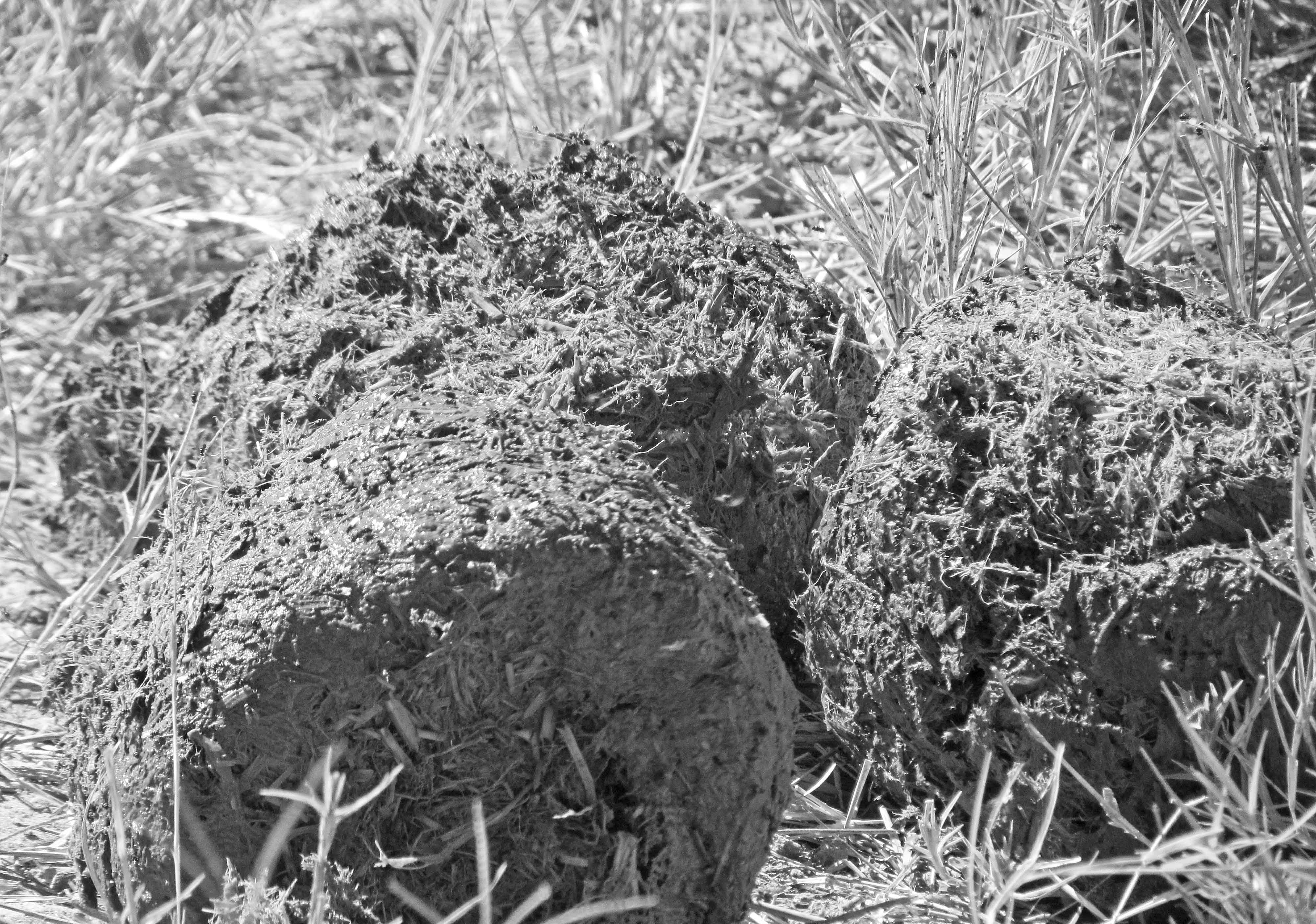
Fresh!

I kneel down and take a closer look at Morula’s fragrant pile of feces.  Since she’s a vegetarian, it smells more of compost than rot.  Crosshatched with undigested twigs, this wet pile contains quite a few seeds.  Thirty species of African trees rely on an elephant’s intestine.  Passing untouched through the gut, their seeds emerge in the feces, instantly fertilized.

I bend closer.  Tiny grooves in the sand mark where dung beetles have already rolled off balls of dung.  Even tinier footprints dot each groove.  With its hind legs, a dung beetle can propel a ball of dung 1,041 times its own body weight – equivalent to me, lying on my back, trying to push around Morula with my feet.

One study found 22,000 dung beetles on a single elephant plop.  Dung beetles enrich the soil, prevent the spread of parasites and disease, and provide food for their young, night and day, day and night – finding their way around at night by polarized moonlight.

A dung beetle barrel rolls past my ear and lands on top of Morula’s output.  Tightly rolled bits of it are already making off into the grass, propelled by industrious hind legs.  As the male rolls his ball of dung, a female rides on top.  She will lay her egg on it once the ball is buried.  In less than an hour, most of this pile will be gone, entombed in tiny birthing chambers, each ball of dung containing a few seeds and a single egg.  When the beetle larva hatches from the egg, it has all of the food and water it will need until it is able to function on its own.

There are 1800 species of dung beetles in southern Africa  – 1800 tribes of sanitary engineers cleaning things up.  Worldwide, the dung beetle family includes 5,000 species.  In the United States there are 90 species.  Ranchers love them – an established population of dung beetles can clear out a cow pasture in thirty-six hours.  Australians import African dung beetles to augment their native population and are experimenting with them in big cities to rid sidewalks and streets of dog droppings.  In East Africa, dung beetles work their way through eighty percent of the leavings left behind by the mass migrations on the Serengeti.  Without dung beetles all of Africa would be covered with, well, you know.
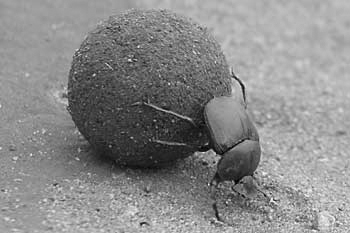
A Sanitation Engineer on the job
Posted in Elephants, Etosha, Travel, Writing

Infrasound: Looking for Love in All the Wrong Places

In 1984 whale researcher Katy Payne spent a week with eleven elephants at the Washington Park Zoo in Portland, Oregon, 170 miles south from my Pacific Northwest home.  An acoustic biologist with fifteen years of studying the long and complex calls of whales, she was curious as to the kinds of sounds elephants make.  She spent every waking hour at the zoo listening and watching the elephants’ behavior.  She noticed that certain keepers elicited a positive response from the elephants, an intangible “thrill” in the air, like the rolling vibrations of thunder right before you hear them.

On her way home to Cornell University, while she thought about her observations, the throbbing of the airplane reminded her of a pipe organ she once heard.  During a performance of Bach’s Passion According to St. Matthew, a shuddering filled the air as bass notes from the great pipes descended in a deep scale until sound disappeared – but the air still throbbed.  Those same, strong, vibrations-without-sound had filled the air around the elephants in Oregon.  Could they be communicating with infrasound, like whales?

Four months later, back at the zoo, Payne and fellow researcher Bill Langbauer set their recording equipment to its slowest speed.  They mapped the elephants’ movements and timed changes in their behavior with the recordings.  Working around the clock for an entire month, they recorded what sounded like snores, chirps, barks, rumbles and even moments of absolute silence.

Back at Cornell, the first tape Payne selected to review was during a time of silence, when there was a “thrill” in the air as a female elephant faced a concrete wall and a male elephant faced the same wall in an adjoining enclosure.  With the wall removed, the elephants would have been within three feet of each other.  Running the tape at ten times its normal speed, the researchers heard sounds emerge from silence – elephants carrying on an extensive conversation in infrasound, even when separated by concrete walls.

To test the theory, The Cornell research team rigged a double-blind experiment in Africa.  An observation tower near a waterhole at Etosha National Park in Namibia was outfitted with video cameras and microphones.  Miles from the waterhole, a mobile van roamed through the bush carrying broadcast speakers and tape recordings.  The timing, location and content of the broadcasts were unknown to the observers at the tower.

One hot, dry afternoon, two male elephants, Mohammed and Hannibal, picked their way through the white calcareous rocks around the waterhole and paused for a drink.  As soon as the two bulls arrived, the tower radioed the van.  Selected at random, infrasonic estrous calls of a female elephant from Kenya were broadcast to the two bachelors in Namibia.

A female elephant needs to advertise as far and as wide as she can, since she is receptive to males for just a few days every estrus cycle.  She repeats her calls over and over for up to forty-five minutes at a time.  The calls can be heard as far as two and a half miles away – over a range of nineteen square miles – but only by other elephants.

Just seconds after the sound was sent, Mohammed and Hannibal froze, spread their ears and lifted their heads – twisting them side-to-side like scanning radar.  Within two minutes the bulls set off.  Half an hour later the pair strode past the van, looking for love in all the wrong places.

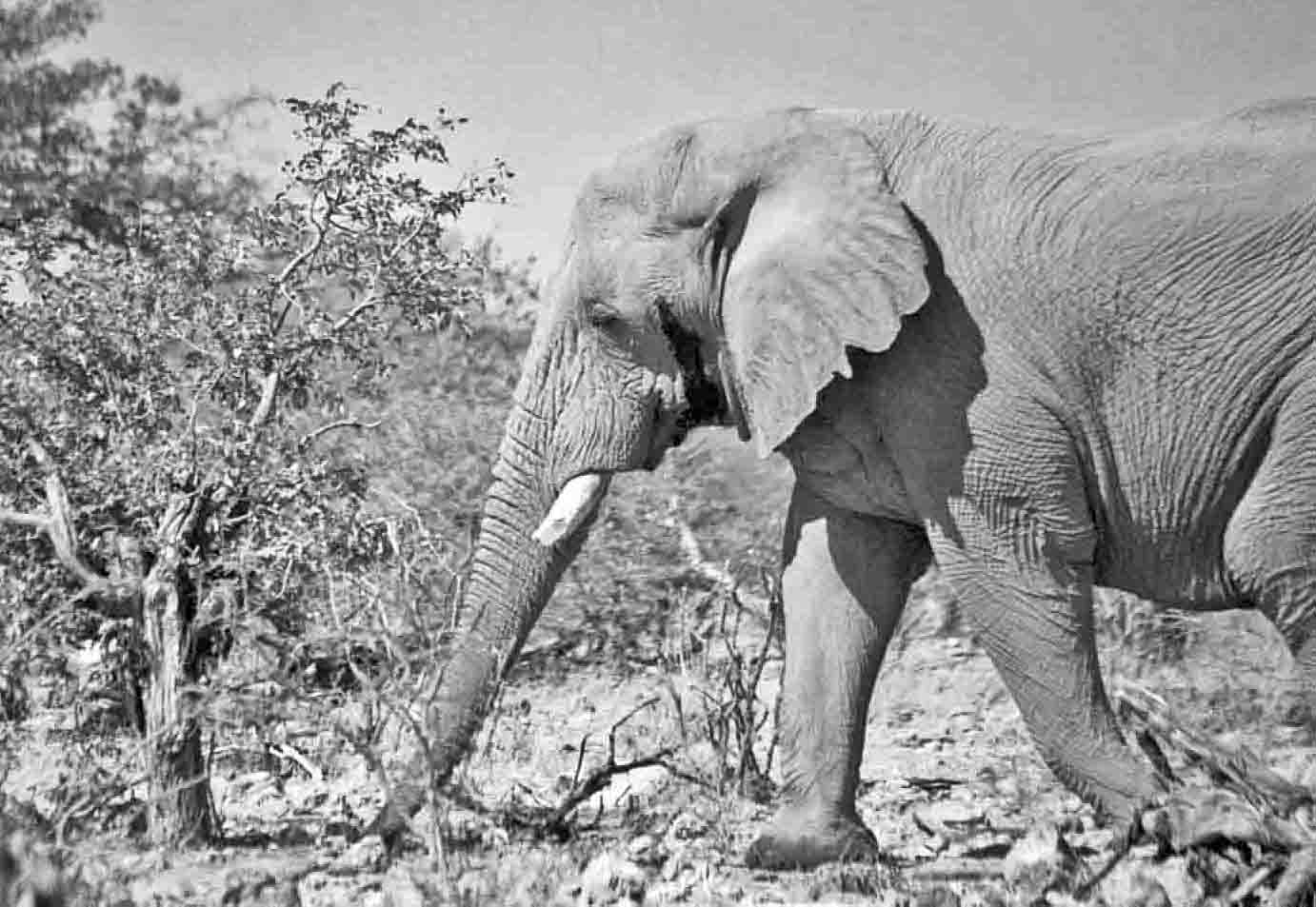
Etosha Male, 1996, with streaming temporal gland, a sign of musth. Mohammed? Hannibal?


Posted in Africa, Elephants, Thembi, Travel

Pula, Pula Everywhere, and Not a Drop to Drink

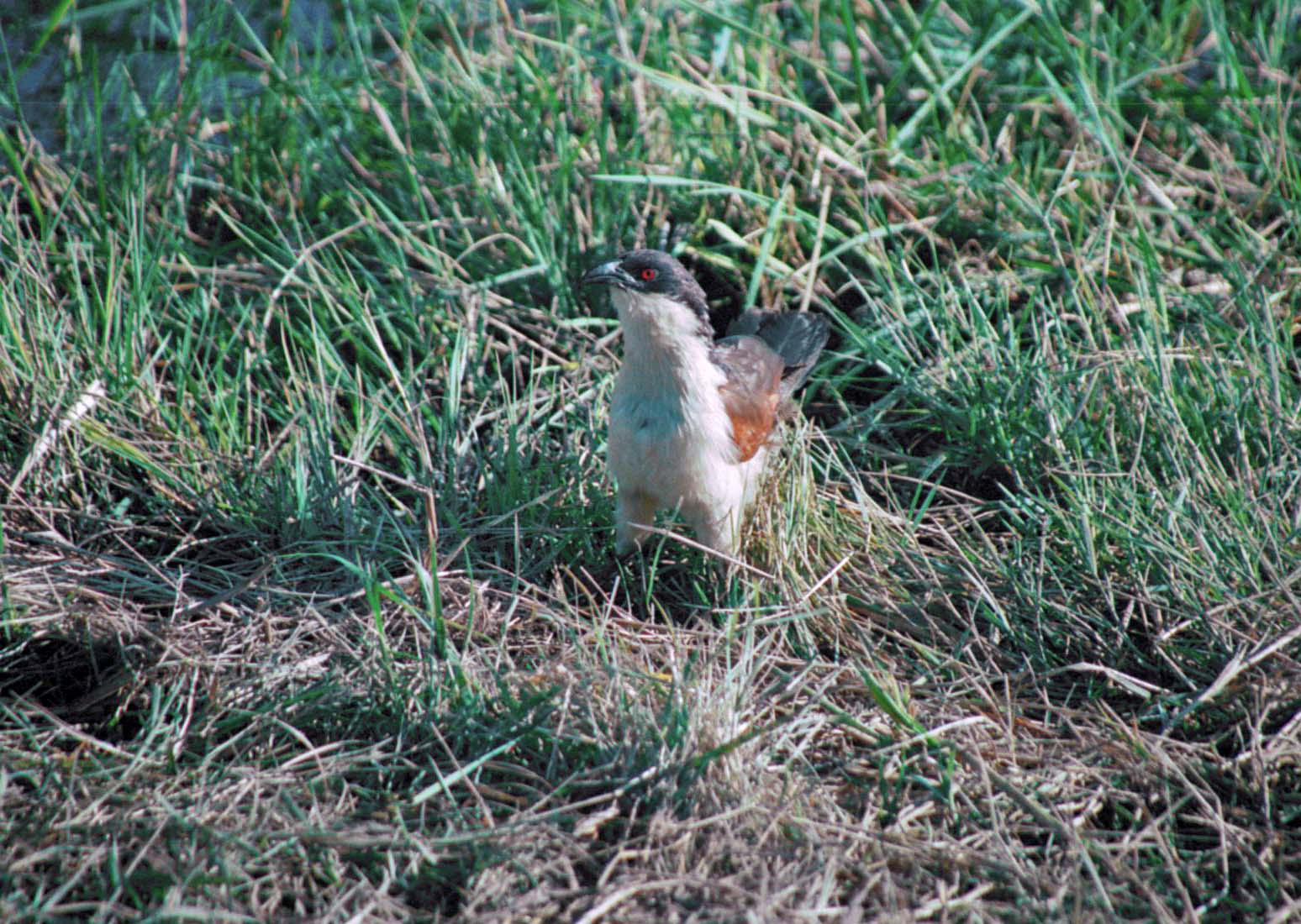
Wetlands are highly productive ecosystems – an interweaving of myriad plant and animal species that defies an easy analysis.  The previous four times I came to the Okavango Delta were in “dry” years when water tables were low and the floods barely reached as far as Stanley’s Camp.  I saw two, maybe three Burchell’s coucal (Centropus burchellii. ) Now they’re everywhere – rising from the grass to look for snails, frogs and toads, new opportunities for these predators with fierce red eyes.  Interestingly, it is mostly the male who incubates the eggs.  At dusk, as the elephants head back from their evening forage, I often hear the liquid song of a coucal:  Doooo, doo-doo-doo-doo, doo – the sound of water dripping into a wooden bucket, or pan-pipes rapidly descending a scale.

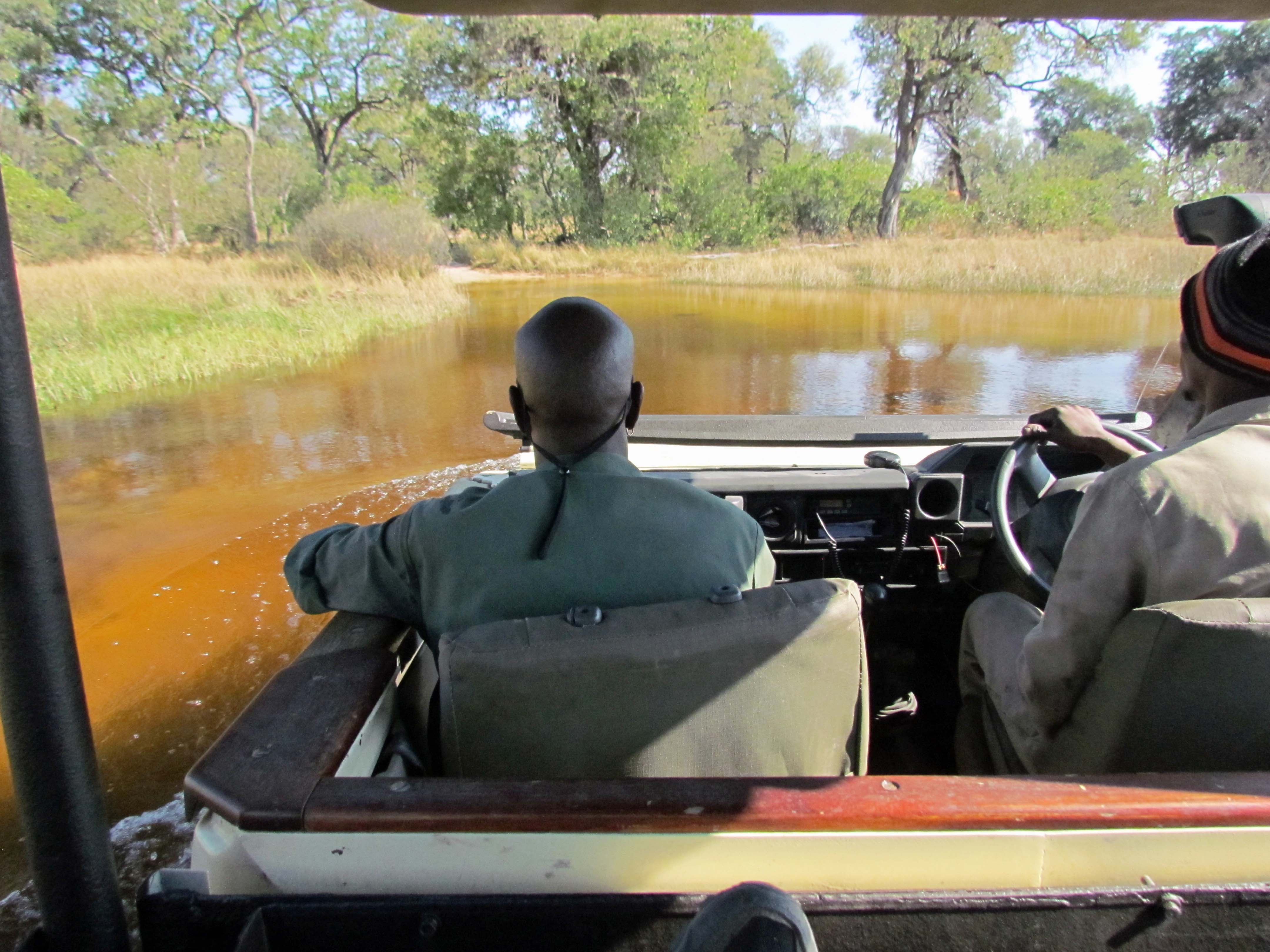
 Water is rare and precious in Botswana – so much so that the pula, the equivalent monetary unit as the dollar, is the same word used for rain.  The lack of water leaves much of Botswana’s desert areas uninhabitable.  Paradoxically, so do the floods, two months downstream from the rains in Angola.  The fickle nature of the Okavango’s channels defy permanent infrastructure, such as paved roads.  Often vehicles become immersed up to their floorboards.

 Each time I follow the elephants to another section of flooded road I’m both delighted and chagrined.  Delighted at the number of secret waterways – so numerous, so new, that no one can memorize them over the length of a year.  Chagrined, because I will need to wade.  My pants are already stained by decayed plant muck.  All of this water, and I cannot drink a drop of it.  Thankfully, the pipes at Doug and Sandi’s camp tap well water.

Some of this year’s road-channels are deep enough for mokoro, canoe highways, but not deep enough yet for crocodiles and hippos.  Bits of plants tumble along in slow clear currents down previous roads; water lilies and reeds fill entire channels, remind me of paintings by Monet.

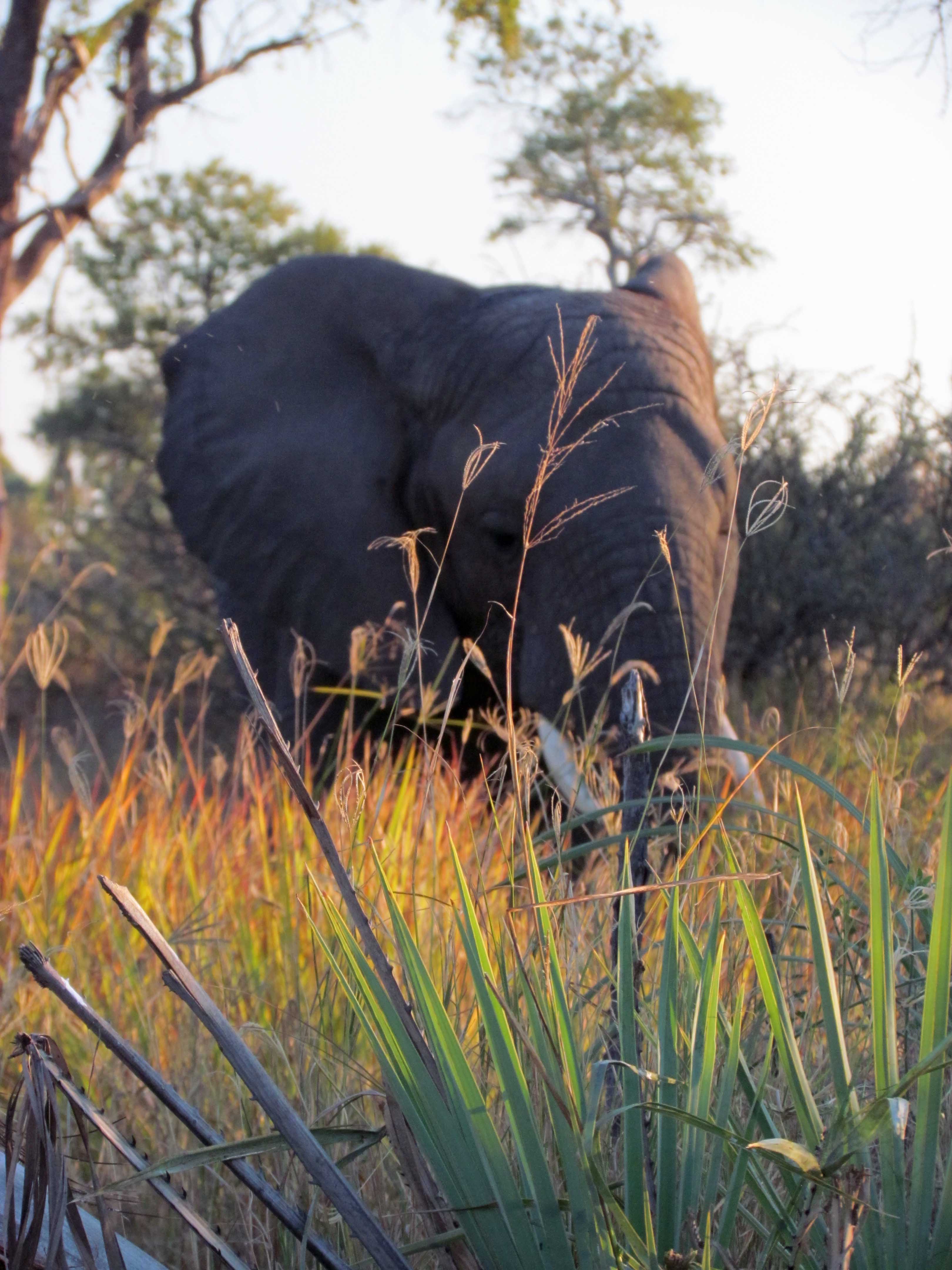
Even elephants can get lost behind huge stands of palm and grass.

Thembi