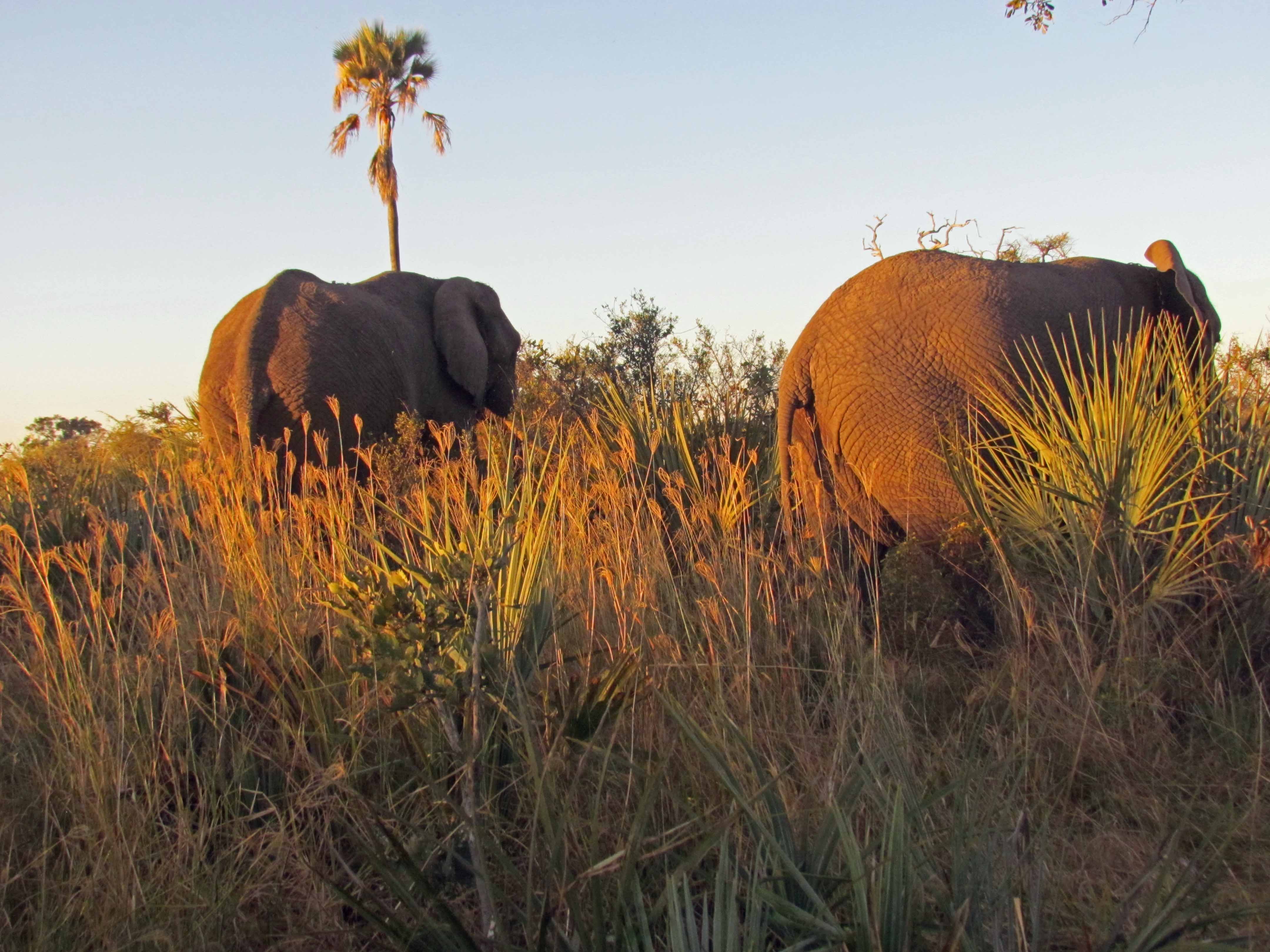
Posted in Africa, Elephants, Travel

Black Mamba in Toilet!

My friend Louis (lover of SNAKES!!) wants to know the story behind this photograph.  Okay Louis, this is just for you, crazy person that you are.
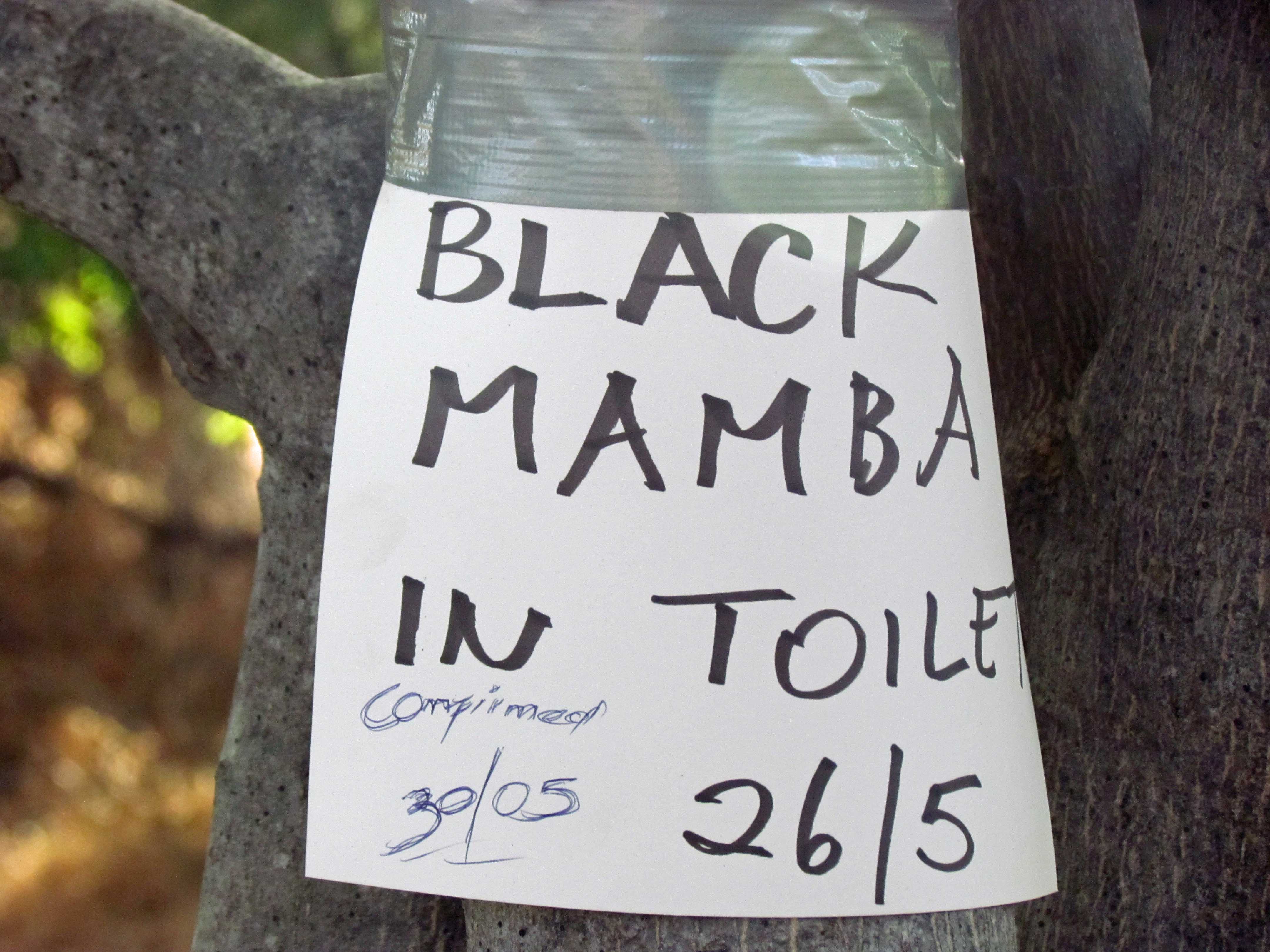
Dated 5/26/12, Reconfirmed 5/30/12!

But first, for those who are unfamiliar with black mambas, here’s a little background information:

Black mambas (Dendroaspis polytepsis) are the longest venomous snakes in Africa, measuring up to 14 ½ feet.  Mambas are not black – they’re more olive or greenish gray, with a narrow, elongated head the shape of a coffin.  It’s the inside of their mouths that are black – hence the name.  Mambas are also extremely aggressive and may actively attack without provocation.  I use the adverb “actively” with reason – a mamba can strike in all directions, even though a third of its body is raised above the ground, and it can chase you in that upright position at speeds up to 20 mph.  If you are bitten, your death will occur within 20-60 minutes.  An anti-venom for mamba bites exists, but it must be administered immediately, requiring 10-20 vials of solution.  But if you are struck in the face or neck (quite likely, since the head of the mamba chasing you is 4 feet off the ground), you will die in ten minutes. That black mouth will be the last thing you see.

On that cheery note, on with the story:

In the Moremi Game Reserve, east of the Okavango Delta, is an elevated platform overlooking a large hippo pool in a bend of the Khwai River.  Six of us, our guide OT (“just like Overtime!”) arrive in our Land Rover.

“What’s that?” I point.

It’s a large piece of stiff white paper taped with duct tape to a tree.  We climb out, read it, and immediately start swiveling our heads, trying to look in all directions at once.

“Anyone want to go look?” OT laughs.

The toilet, roughly the size of those cartoon outhouses with the crescent moons carved in their doors, is a cinder block building with a tin roof.  It’s about fifty feet from our Land Rover.  The painted green door on the toilet is ajar.

Certainly I’m not tempted to look inside.  After all, the second message was written just three days before our arrival by someone a lot more curious than I am about deadly snakes.  The mamba is most likely still in there.  Who wants to reconfirm a reconfirmation?   Mambas are territorial; they will always return to their lairs, although that’s usually in an abandoned termite mounds or a hollow tree, rarely, I’d bet extremely rarely, in a toilet.  A mamba is diurnal, active both night and day.  It could be sleeping in there.  Or not.

In my opinion, I’m already standing way too close to that toilet.  Trying to look both at the toilet and at everything else, I walk slowly backwards.  Mambas don’t like sudden movements.

Besides, I firmly believe, even though I haven’t seen it, that this toilet is not a Western ceramic throne, but a mere hole in the cement.  I’ve had enough experience with toilets-in-the-middle-of-nowhere to also believe that the area around the hole is likely none-too-clean.  That bush over there looks a better.  A few minutes later, after careful reconnoitering and quickly taking care of business, I can confirm that no mambas are lurking around it.

As I climb the steps to the viewing platform I look for mambas wrapped around posts.  On the creaky platform I look for mamba’s hidden in corners, or nestled into the thatch of the roof.  I look for mambas slithering across the branches of the trees that lean dangerously close to the rails.  A rustling noise among the branches spikes my heart rate to a gazillion, but it calms when I see it’s only a Burchell’s glossy starling, squawking for handouts.

Burchell’s starling

The view from the platform is marvelous.  A massive cloud hangs over the hippo pool and puffs of other clouds reflect in the tranquil water.  A dozen hippos rise and sink, burbling like submerged tubas.  Tracks in the grass are hippo paths, where the hippos come out of the pool at night to feed, foraging as far as three miles for sweet young shoots.

At the bottom of the platform a dozen water monitors, some six-feet long, slither into positions that defend his or her portion of the bank, using the hippo paths as small highways.  The smaller monitors end up with the worst spots, constantly harassed in slow-motion chases by the larger lizards.  As I watch their typical reptile behavior, I think it’s lucky for us that the age of dinosaurs ended a long time ago.
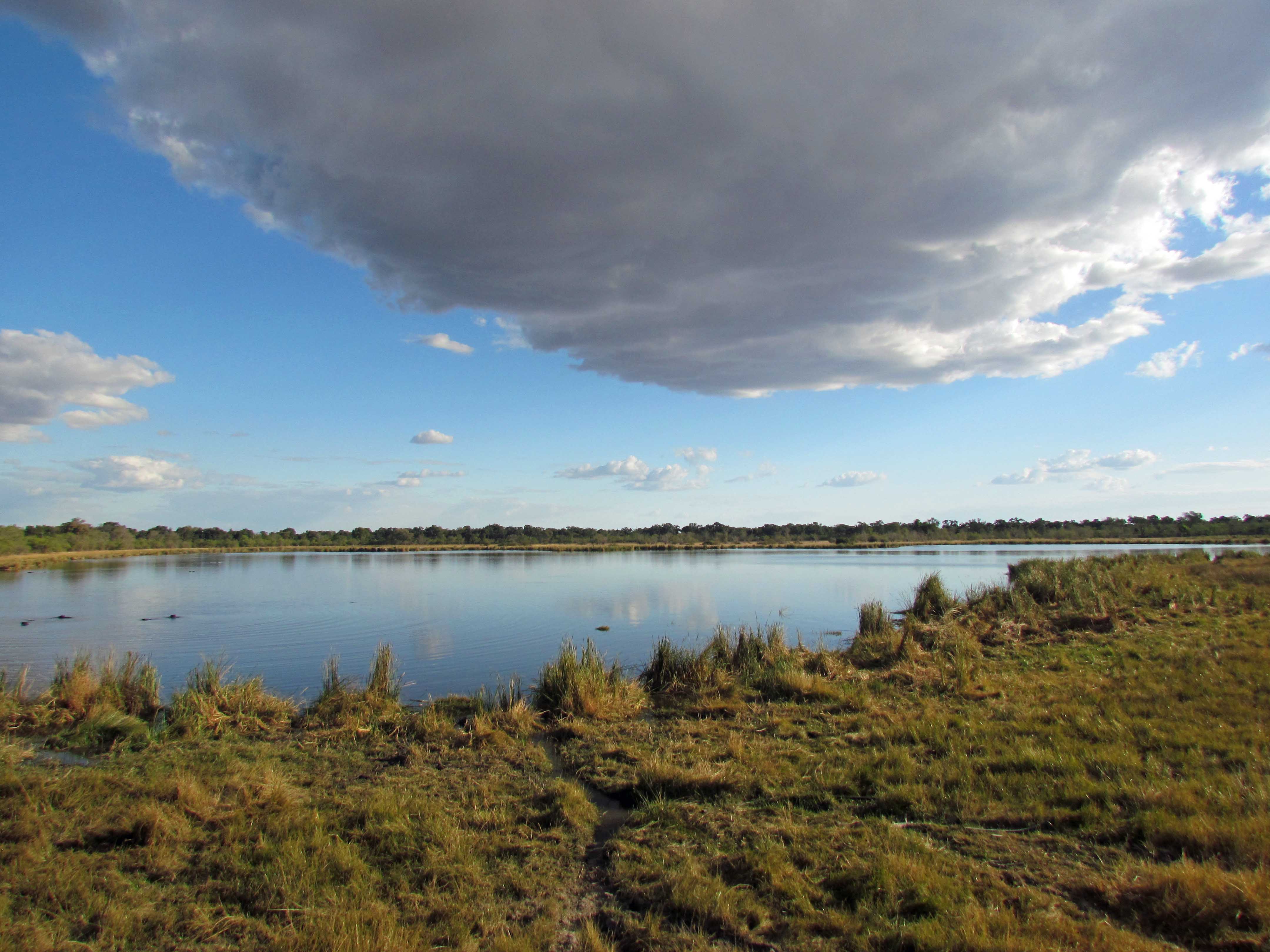
Khwai River


On the far side of the river, specks in the distance, a huge herd of elephants splashes along the edge of a reed bed.  After I check for mambas, I lean on the rail of the platform to steady my camera.  I use the digital zoom to take a picture, but it’s an extremely low-pixelated shot.  The elephants are in constant motion, appearing and disappearing in the reeds, so the photo turns out fairly blurry, but at least I have proof that those specks were really elephants.
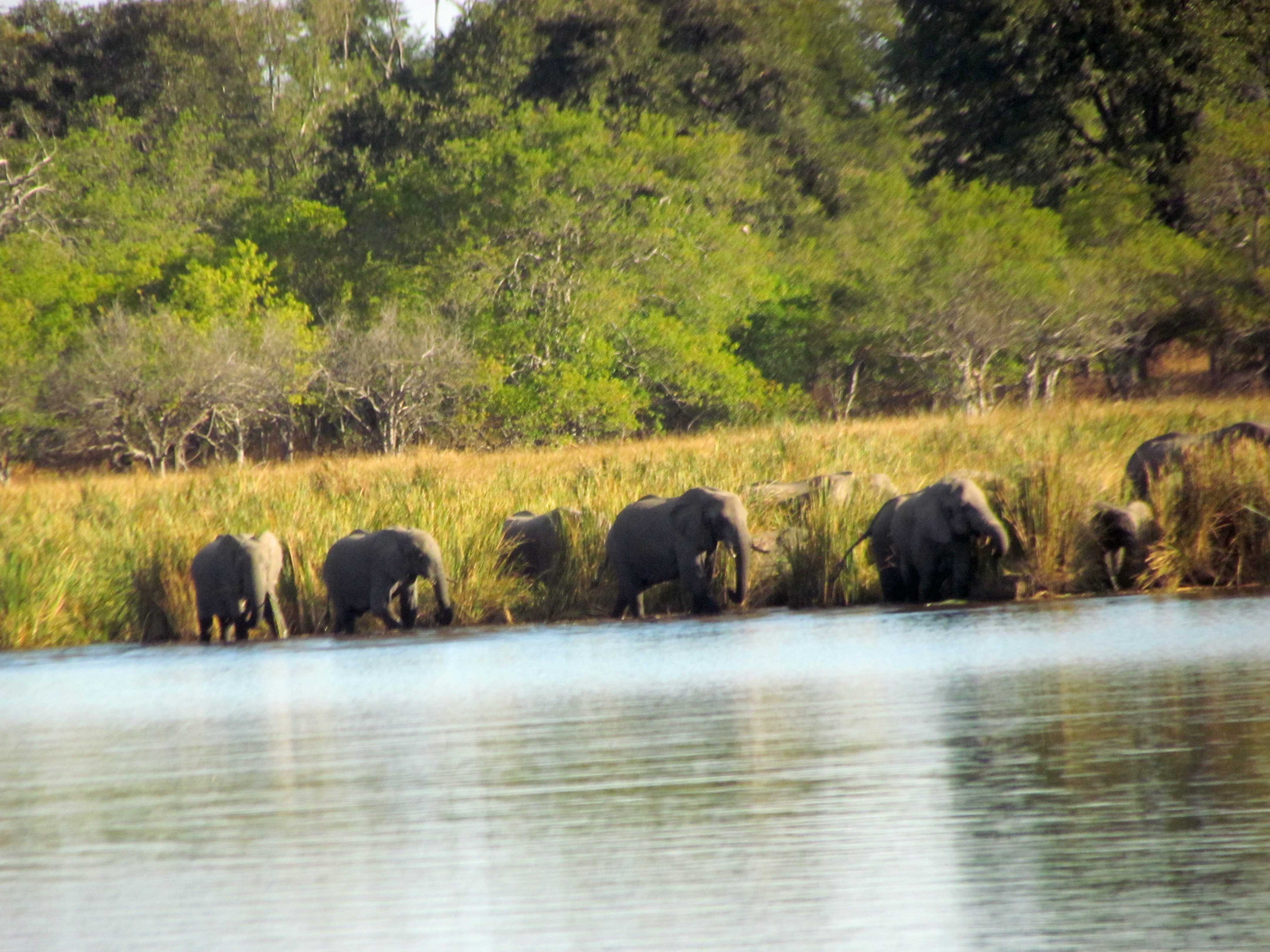
Elephants on the far bank

On the way down from the platform I look for mambas wrapped around support posts, coiled under steps, and hidden in the framework of the flooring.  I scan for slithery movements in the brush and wait for someone else to climb in the Land Rover before I do.  I doubt the mamba has exchanged one lair for another, but still, you never know . . .

So, Louis, the viewing platform has its own GPS coordinates. If YOU want to look at that mamba and reconfirm one more time that it’s really there, I can tell you exactly where to go!
Posted in Africa, Doug, Elephants, Jabu, Morula, Sandi, Thembi, Travel

What Happened Next

It Looked Harmless.


I know what will happen next.

I’ve already leaned too far forward on my right foot, anticipating the left will follow.  But the clog on that foot is mired in the Okavango muck, cemented in place, my balance irreversibly committed in the wrong direction.

What happens next is a slow-motion twist to my right, as I go down in thigh-high brown water and ooze, down into decayed leaf litter, down into a mat of decomposed anaerobic slime.

My right arm drops to cushion my fall and my left arm shoots up, holding my brand-new camera above my head – the camera purchased just for this trip to Africa.

I create primary and secondary waves as my hip and shoulder enter a backwater swamp of the Okavango.  The waves push against a small clump of reeds.  Elephant dung floats by.  A brackish, decayed scent rises.

The sun hasn’t moved more than a tick in the blue Botswana sky.

Just before The Fall

I come to rest against the reeds – all of my right side invisibly encased in muck.  But my left arm is dry, above the water, my camera clutched at the end of it like a trophy.

Sandi is already splashing in my direction.  She tugs on my dry arm.

“Let me help you up,” she offers.

“No, just take the camera.”

She places its strap around her neck.

I roll against the reeds and use both hands to push myself upright.  I reach down, and blindly find my shoe.  I need both hands to pry it out of the muck.

“I think I’m going to have to go barefoot,” and flinch at a secondary thought.  “I hope there aren’t any lead wood thorns.”  Two-inches long, strong as steel, straight as nails – they’d go right through the bottom of my feet.

“I’ll go first,” Sandi says.  Her sandals aren’t sticking in the ooze.

Oddly enough, the muck at the bottom of the swamp is soft as a pillow to my bare feet.  It wraps around my ankles and squishes up between my toes.  I place each foot carefully, not committing my weight until it’s safe to do so.

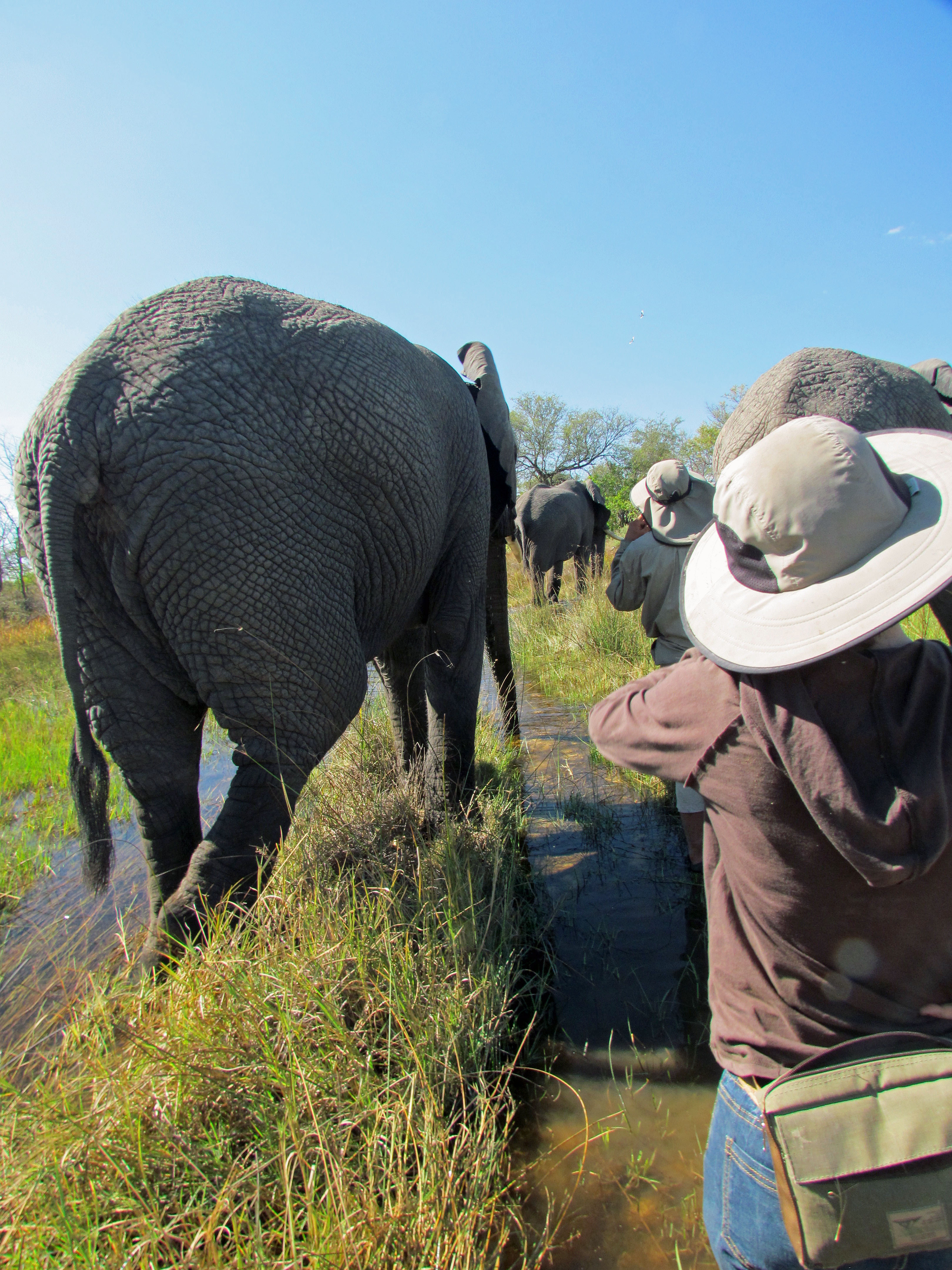
It takes forever to cross.  Doug and the elephants patiently wait for us on the opposite side.

When we reach the far bank I put my clogs back on.  Sandi hands me my camera.

“We’ll put your clothes in the washing machine tonight.”

“Washing machine?”

“We brought one into camp last year.”

“Really?  How’d you do that?”

“On the back of the hay truck.”

I look down at my pants and shirt, both mottled by muck.

A lot has changed in five years.

Posted in Africa, Doug, Elephants, Jabu, Morula, Sandi, Thembi, Travel

Transported into the Okavango Delta

As the Air Botswana flight descended into Maun, I looked out the window and gasped.  The Okavango floods had already reached the Thamalakane River on the outskirts of town!  Ponds, lagoons, lakes and meandering channels filled the landscape to the horizon.  The last time I visited, in 2007, Maun sat in the middle of a dusty desert.  Now blue waters surrounded it, sparkling in the sunlight.

In the terminal stood a small woman with a permanent smile, bright brown eyes and a “Mack Air” sign.  As Grace sorted scrums of passengers onto various flights out into the Delta she said, “Wait for me over there.”  Throughout a confusion of bags and jetlagged tourists, she never lost her smile.

I followed her to the Mack Air offices across the street from the terminal.  “Tea?” she queried.  Over the next several hours the office staff must have offered tea at least a dozen times – unfailingly polite through an amazing amount of chaos.  One of their charter aircraft had lost radio contact and they were sending messages every plane in the air over the Delta, hoping for a visual sighting.  Finally everyone heaved a huge sigh of relief when one of the ground crew reported that the airplane just landed in Maun.  But the relief was only temporary – the aircraft’s radio couldn’t be fixed.

Now the remaining available aircraft had to be scrambled into new flights.  “Tea?”  “No, thank you.”  One of Mack Air’s pilots wandered in.  “I can take the 206.”  And off he went to pick up tourists at one of the camps.  “Two airstrips flooded overnight,” one of the office staff informed me.  “Tea?”  “No, thank you.”  Grace smiled.

Another pilot wandered in, conferred with the office manager in a low voice, and wandered out.  “Tea?”  “No, thank you.”  Computer screens flooded with revised schedules.  The radio carried constant conversations between the office and pilots scattered over the Delta.  The office staff leaned into their screens, several chewing gum in that constant motion that concentration brings to jaw movement.  “Cheryl Merrill?” asked the receptionist, “Where is she?”

All eyes, except hers swiveled toward me.  “Oh,” she said, following their looks, her face flushing into a luminous red-brown.  She giggled into her hands as I waved to her.  “Don’t worry, we’ll find you a flight,” Grace said.  “It will take a while.  Tea?”

I wandered over to the wall with pilot pictures.  Mack Air is an independent charter company based in Maun, ferrying passengers and freight all over the Delta. The profiles of their eighteen pilots pretty much covered one wall.  Seven are originally from South Africa, three from Botswana, and the rest from countries as diverse as New Zealand and Mauritius.  One photograph stood out:  Hazel Esitile, who began flying for Mack Air in February of 2011.  She’s quoted as saying, “What a man can do, a woman can do too!”  I secretly began to hope Hazel will be my pilot.

But it was Paul, choosing bush flying “as my mid-life crisis,” who escorted me out to a Cessna 210 Centurion.  Trying for some chatty small talk, I remarked, “My husband used to own a 172.”  Paul squinted at me.  “Hate those.  Had to train in them.  No power.”  He opened the cabin door. “Want to sit up front?”

“Of course!”

I crawled over the pilot’s seat and buckled into the “copilot’s” seat, which is simply another passenger spot in small aircraft.

“It’s a little bumpy out there today,” Paul said.  “Did they tell you we’re flying to Gunn’s Camp?”

“No,” I said.

“They’re working on Stanley’s airstrip.  Somebody will pick you up.”

“Okay,” I said.

Small charter aircraft fly low and slow over the Delta – a perfect vantage point to inspect the current Okavango Flood.  In 2011, the Okavango reached record levels, pushed by increased rain in both the Delta and Angola (headwaters of the Okavango system) and large amounts of residual ground water from the 2009 and 2010 floods.  The “dry” cycle of the Delta lasted between 1985 and 2005; now it is assumed that the “wet” cycle will last another ten to twelve years.  Where extensive game drives were once possible, now boats take their place.  I marveled at how much land was underwater.

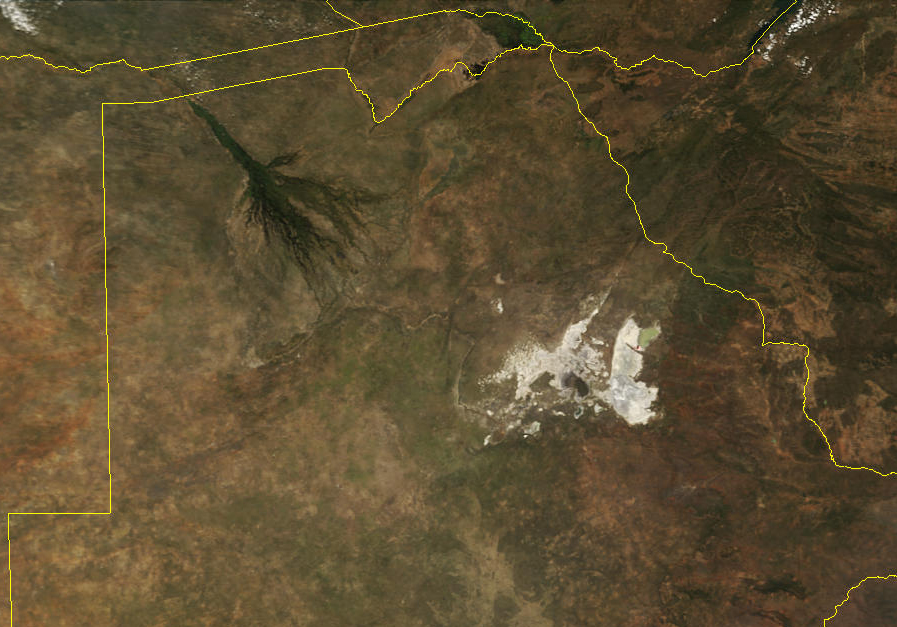
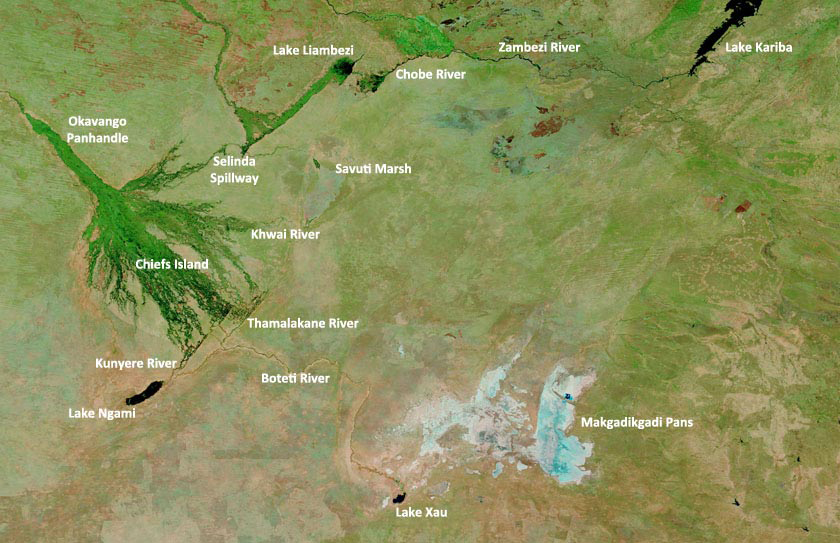
The difference from space:

A dry year in the Delta

A wet year.

For the first time in 29 years, the Savuti Channel was flooded, the Savuti Marsh swelled with birds and water seeped south into the desert pans.

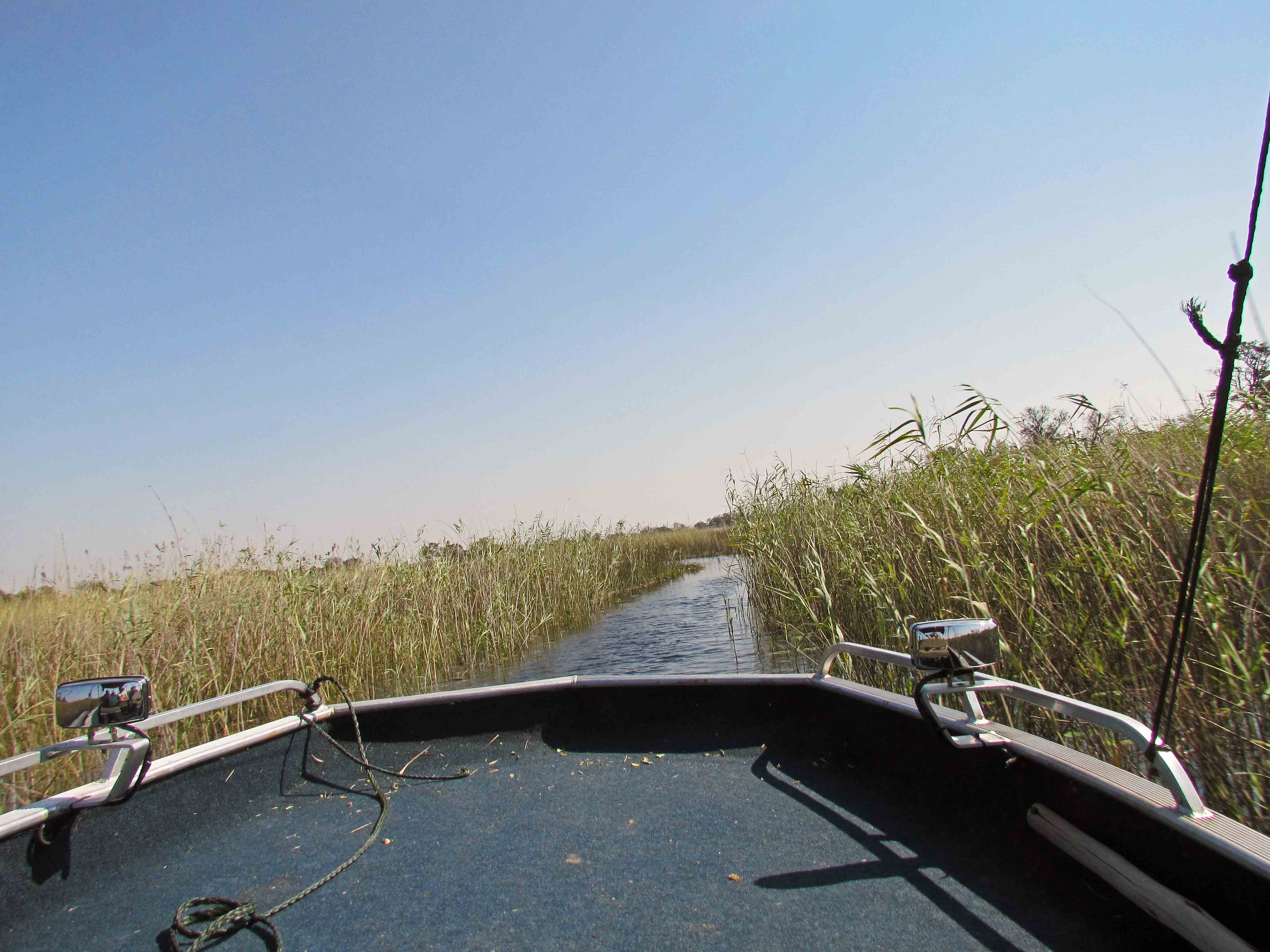
And so, rather than a 15-minute drive to Stanley’s from their airport, I took an hour-long trip down the Boro River and into meandering side channels that would have me instantly lost.

Reflected in two mirrors as we pushed through a side channel.

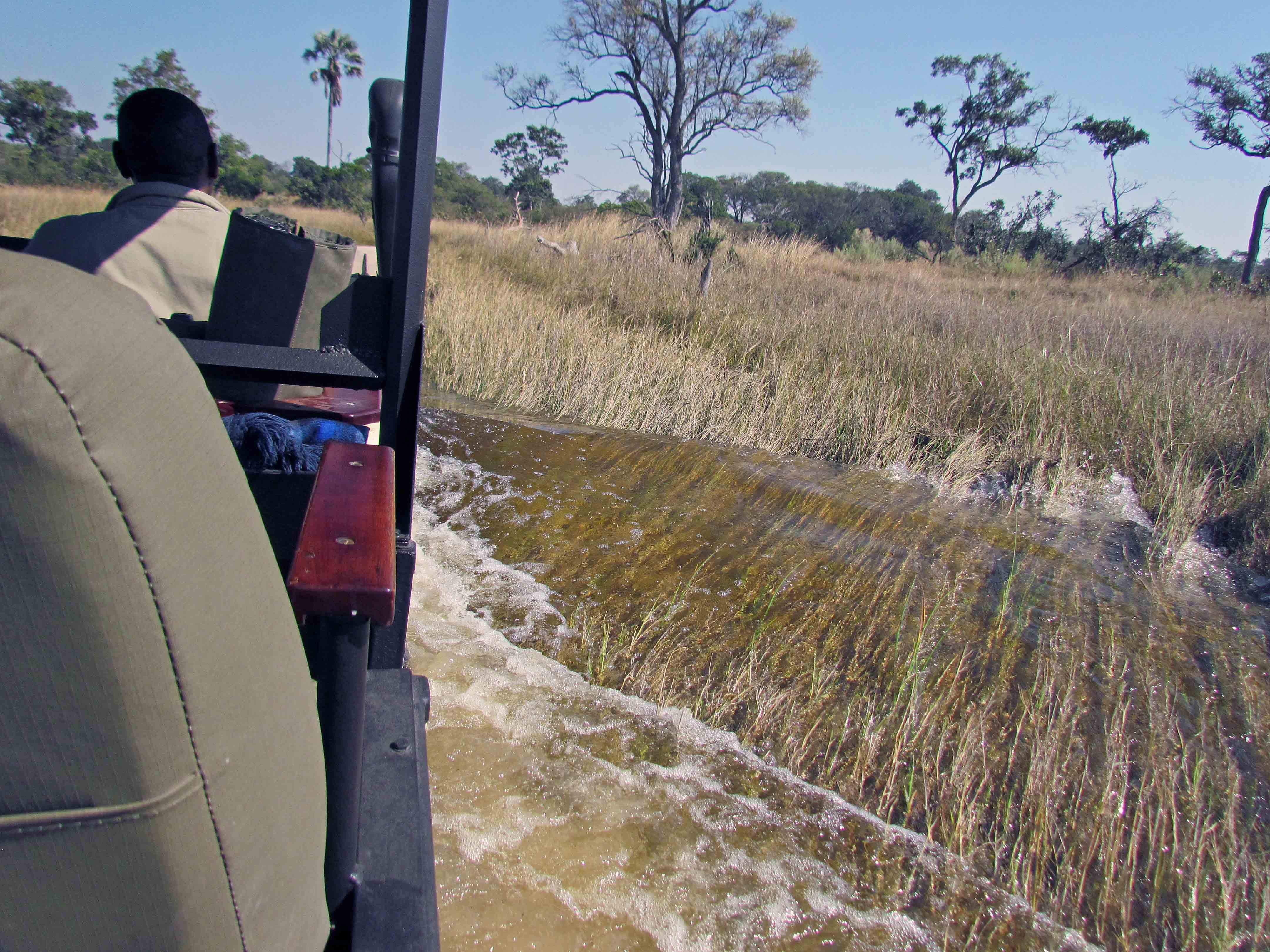
And, because all of Stanley’s vehicles were out on afternoon game drives, one vehicle at Baine’s (Stanley’s sister camp) was commandeered to transport me at Doug and Sandi’s place.  The flood had marooned the Groves’s vehicle in Maun.

We forded rivers that were once roads.

Making waves

Sandi met me at their kitchen shelter.  “Doug and the Trio are headed out to forage.  Want to join us or settle in?”

Are you kidding?  Eight hours after boarding an aircraft in Johannesburg, I was transported to this:

Sundown with Jabu and Thembi
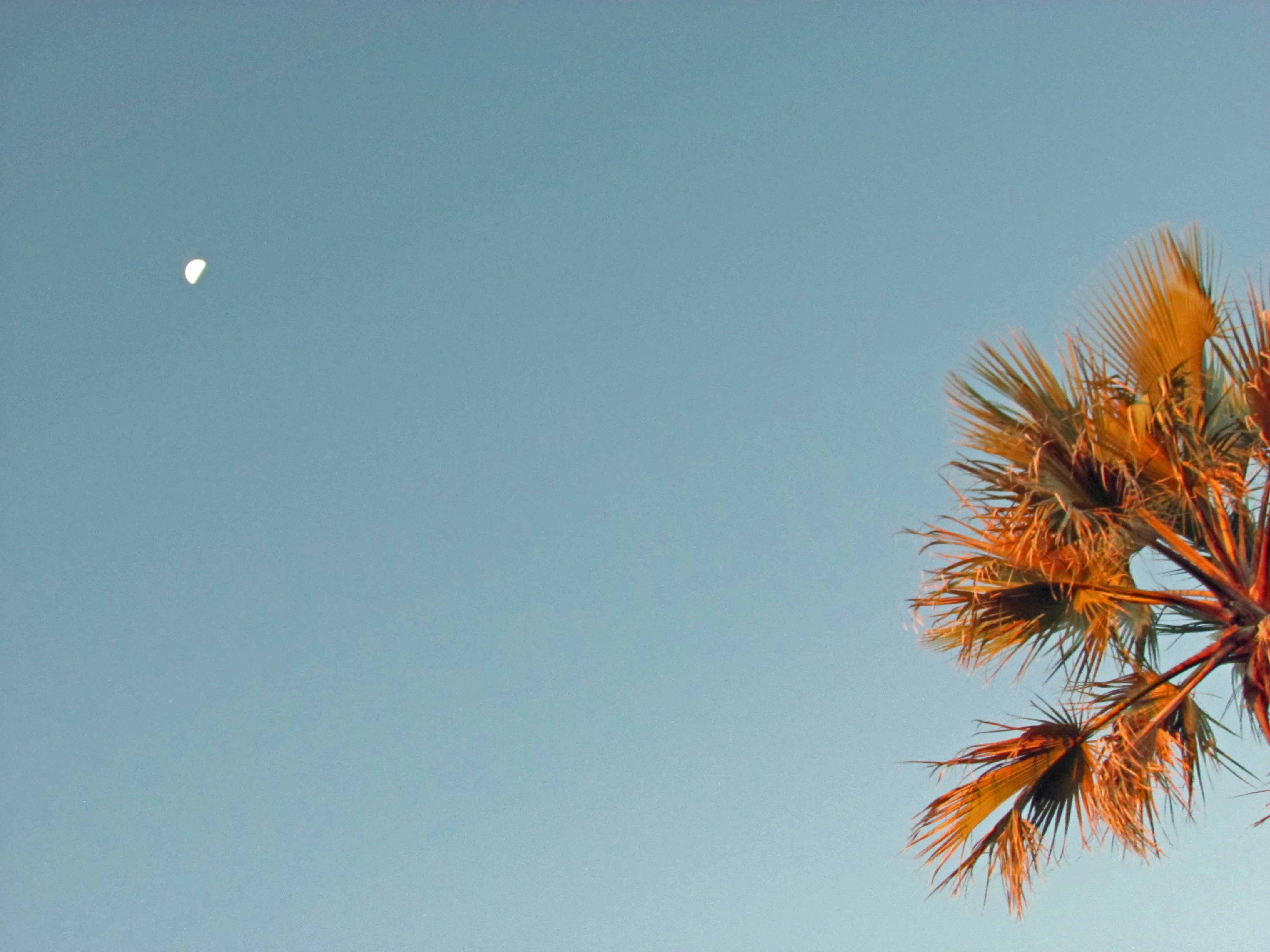
Half moon at sundown

And several hours later, after dark, we walked back under a half moon.  I had forgotten my flashlight, but I could still follow three huge silhouettes against the stars.  I was back in Africa!

PS:  The NASA images above were taken by MODIS (or Moderate Resolution Imaging Spectroradiometer) – a key instrument aboard the Terra and Aqua satellites. According to NASA, “Terra’s orbit around the Earth passes from north to south across the equator in the morning, while Aqua passes south to north over the equator in the afternoon. Their orbits view the entire Earth’s surface every 1 to 2 days.  The data they gather will hopefully improve the understanding of global dynamics and processes occurring on the land, in the oceans, and in the lower atmosphere. MODIS plays a vital role in the development of global Earth models able to predict global change accurately enough to assist policy makers to make sound decisions concerning the protection of our environment.”  (Fingers crossed that they do.)

Posted in Africa, Lions, Travel

New Publication! Adventum Magazine

Adventum Magazine has just published my essay about tracking lions in South Africa!  You can read it digitally at: http://www.adventummagazine.com/issue3igital.html or follow the link on the side of this page.  (Spoiler alert:  we found them!)

Male lion, South Africa