Under a sun-bleached sky that is no longer blue, dry coughing barks from black-backed jackals lope in from our left . . . Wraack, wraack, wraack. . . Black-backs are scavengers, more aggressive than other types of jackals, occupying the same ecological niche in Africa as coyotes do in North America. Unlike coyotes, black-backed jackals do not howl. They often steal meat within the reach of a lion’s paw – although their main diet consists of insects, lizards, snakes, rodents, birds and ripe fruit.
Up ahead Morula slaps her ears flatly against her shoulders.
Elephant air-conditioning for a creature that produces enough heat to warm a small house.
Elephants are pachy-dermed, “thick-skinned.” Some of Morula’s blood vessels are buried as deep as one-and-a-half inches under the surface of her skin. Since she doesn’t have sweat glands, her ears act like giant heat exchangers, regulating her body temperature. As her ears open, her body size increases by roughly twenty square feet, a huge area for thermoregulation. Air moving over the swollen arteries of each ear cools her blood as much as nine degrees before it returns to her body.
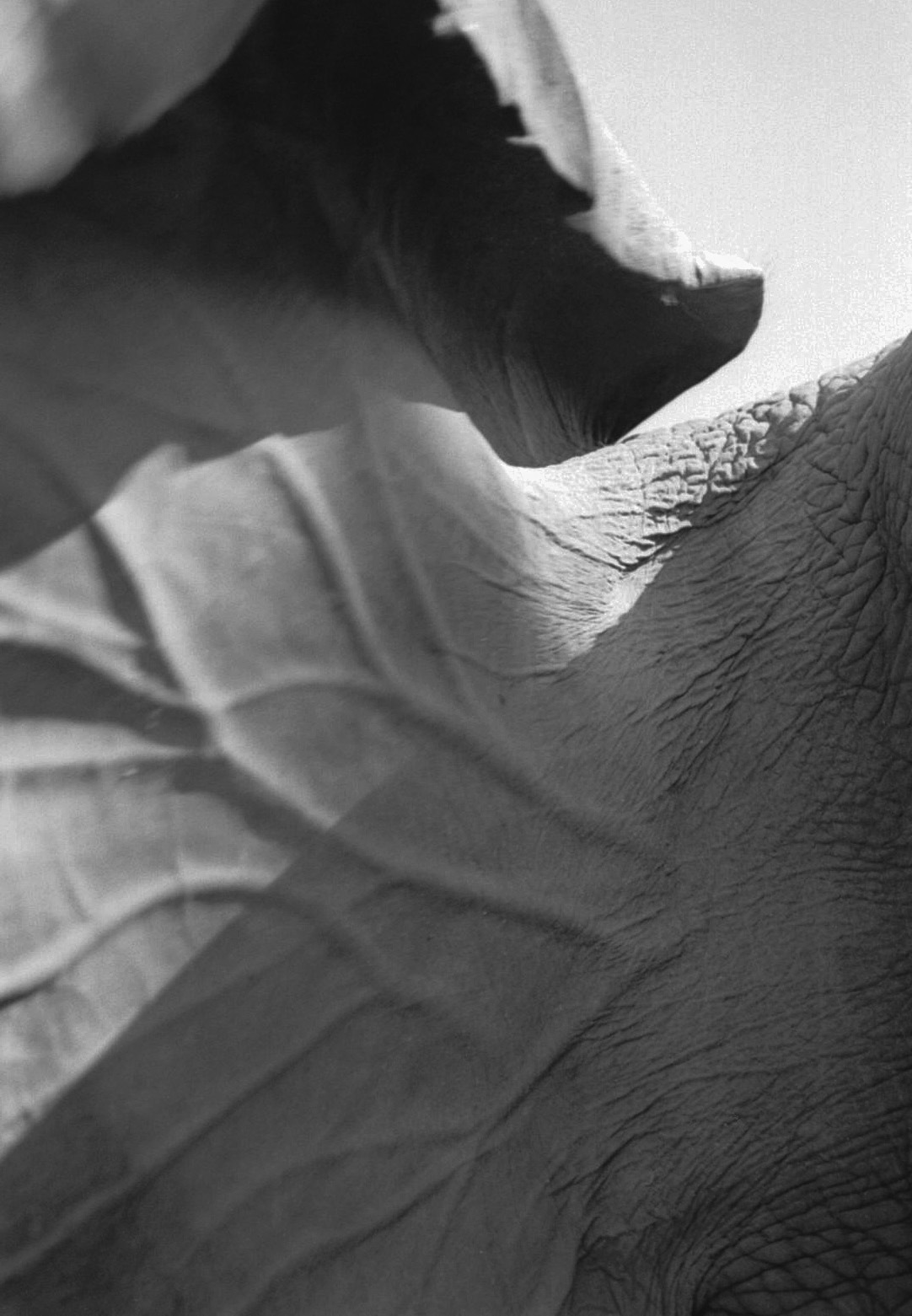
I take a photograph of her ear in mid-flap. Where Morula’s ear attaches to her shoulder, wrinkles give way to he swollen vessels pumping five gallons of blood per minute across the surface of her ears. The pattern of those arteries is as unique as a fingerprint, and often used for identifying individual elephants.
The breeze she creates dies before it reaches me. I take off my cap and fan my own neck.
My teeny, itsy ears are built somewhat the same as hers are, with an upper rim of cartilage and a fleshy, lower lobe. But I don’t have an auriculo-occipitalis, an ear muscle the size of a weightlifter’s bicep. I can’t flap my ears. I can’t even wiggle them.
I zip shut my tent, first the inner mesh, then the heavy outer canvas flap, fastening the zippers all the way to their ends – a precaution against unwanted visitors such as scorpions, snakes or the thieving hyenas of Stanley’s Camp. Two days ago, in the late evening, I waited for Doug while the camp’s manager kept me company. He handed me a cold Tusker and pointed to the banks of a nearby lagoon. “Hyenas drug our leather sofa out there and ripped it apart.”
The sofa never had a chance. A pack of frenzied hyenas can devour a four- hundred-pound zebra in less than half an hour, eating everything: bones, skull, hair, even hooves – leaving only a smear of blood on the ground. With a bite pressure of over a thousand pounds, hyenas pulverize and swallow enough bone their feces turn chalk-white. They will filch anything not locked up: boots, toothpaste, shaving cream, underwear, soap, even bottles of hot sauce. What’s glass to a creature that can eat a zebra’s hoof? In the case of the sofa, they ate the leather and left a gnawed wooden frame.
“Why the sofa?” I asked the manager. I imagined the scenario: in the dead of night the hyenas climb a set of wooden steps into the dining lounge, shove aside several tables and chairs, pull the sofa from the lounge down the steps and drag it the length of a football field to deposit it at the lagoon.
“Just the oil from human hands.” He rubbed a palm across the sofa’s replacement. It too is leather. I tried not to think of it as also doomed.
A well-known hyena den is very near the main road to Stanley’s Camp. Since I had some time before Doug arrived in his 3F, one of the guides drove me over to the den just at dusk.
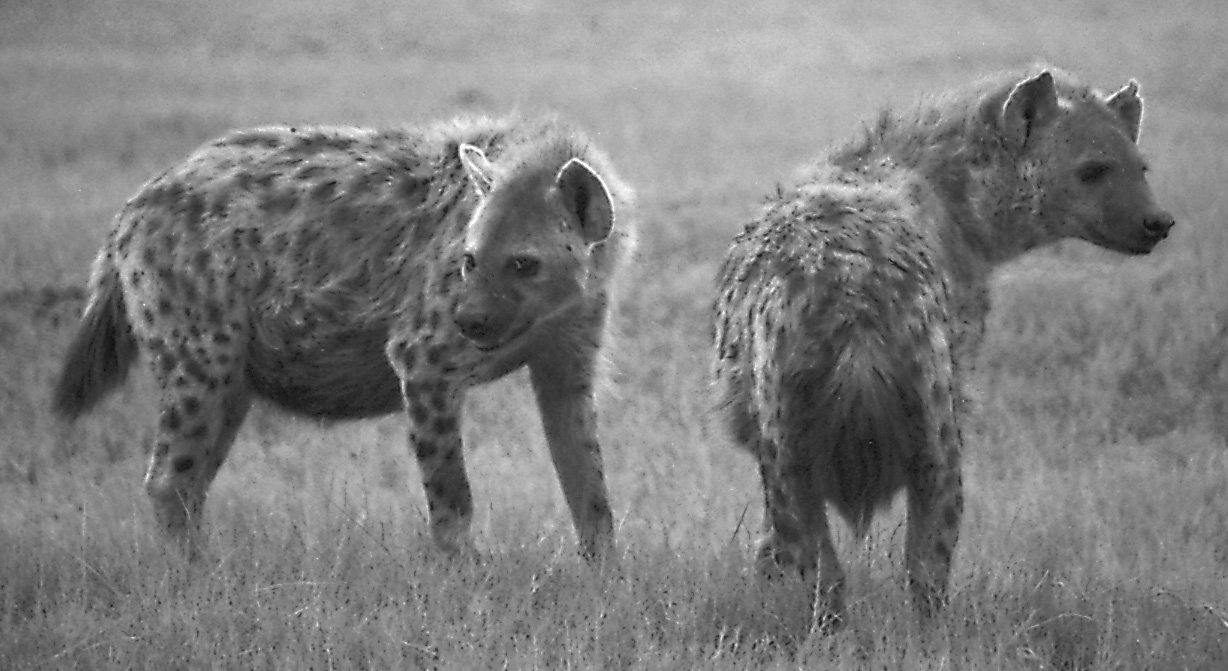
As we sat quietly, motor off, a lone Spotted Hyena tentatively emerged from the den. She had the usual hyena slouched profile: massive head and shoulders tapering to small, tucked-in hindquarters – a hybrid creature: half fearsome predator, half coward. The second largest carnivore in Africa, (after the lion), the Spotted Hyena is larger than her Brown Hyena cousins. Her family is more aggressive, too – a single adult, weighing at the most 140 pounds, is capable of hunting and killing a bull wildebeest of 600 pounds. Although hyenas kill ninety-five percent of what they eat, they also loot the kills of leopards, lions and cheetahs at every opportunity. Lions can’t digest hair and bones, but hyenas are happy to do that for them.
Grinning her famous false smile, the hyena sat at the entrance of the den and turned her black, empty eyes toward us.
Less than a moment after, black fuzzballs erupted behind her. As she returned each pup to the den’s entrance, another escaped and then another. The grinning, panting, anxious nanny seemed to be having a nervous breakdown. I would have considered the pups cute, except for the hyena’s awful reputation.
Last night, when I mentioned the sofa, Sandi told me that hyenas had killed an eleven-year-old American boy several years ago at the Xakanaxa (Kah-khan-a-kah) Campground, thirty miles northeast of here. Despite the young age of her son, the mother allowed him to sleep by himself. Awakened by crazed laughter, the guide saw a huge female hyena dragging the boy’s partially eaten body into the bush. Guides from nearby camps helped locate what was left of the decapitated body, driving away the hyenas and guarding it until daylight. For two years afterwards, his mother haunted the streets of Maun and the area around Xakanaxa, carrying her son’s ashes, looking for clues as to how he died. Did he leave his tent unzipped? Did he have food in his tent?
In the parks and game reserves of Africa, you never, never sleep with your food. At Doug and Sandi’s kitchen shelter anything even remotely edible is secured in heavy metal lockers or inside a propane-powered refrigerator. Over at Stanley’s, food is kept behind the heavy doors of a wood-frame kitchen. Watchmen patrol the camp.
Last night I double-zipped myself into my tent – first the heavy outer canvas flap, then the inner mesh. Hyenas are opportunistic and would walk right in if my tent were open. Hyenas hunt in packs and mostly at night, so I was grateful to find an enamel chamber pot on my side of the zipper.
My tent
This morning, I emptied the pot into the “African long-drop” located near my tent. The “long-drop” is a plastic commode fitted over a hole in the ground that’s about five feet deep. No walls, no roof, no door – just the surrounding bush, a hole in the ground and me.
Next to the commode a small shovel sticks upright into a pile of ash. I raise the lid, empty the chamber pot, and shovel in ash and close the lid. No smell, no flies. I much prefer African long-drops to American outhouses.
I rinse the pot from the spigot outside my tent, throw the water out into the brush, stash the pot back inside the tent, wash my hands in a basin under the spigot, toss that water, replace the basin, stash the soap back inside my tent, and zip it shut. No hyena’s gonna scatter my stuff all over Africa.
Morula plucks a branch from one of her favorite snacks, a bush-willow. She holds the stem in her teeth, wraps her trunk from right to left around the branch, and sheers off leaves, top-to-bottom with a single swipe. She drops the branch and transfers mashed leaves from the curl of her trunk into her mouth.
Morula is right-trunked, as I am right-handed, preferring to grab and wrap from the right. Thembi is also right-trunked, but Jabu’s a lefty. One of the ways to determine an elephant’s dominant tendencies is to inspect the underside of its trunk for green stains on either the right side or the left.
But before you do this, make sure you know the elephant and, more importantly, the elephant knows you.
Morula sidles close to Doug and curls her trunk against her forehead.
“Those round bumps on her forehead might be an old skin infection,” Doug tells me, “but we really don’t know.”
A light breeze feathers the hair in her ears as she stands slightly sideways and nods the tip of her trunk in a tiny Hello. . . Ribbed muscles cross the underside of her trunk. Bristles stick out like the legs of a giant centipede.
Morula waves "Hello."
I squint against the sun, s—t—r—e—t—c—h and yawn. Back-to-back ten-hour jet flights across two hemispheres in a 48-hour-period are taking their toll. From Seattle to Amsterdam, Amsterdam to Johannesburg, and a four-hour flight from Johannesburg to Maun. My body thinks it’s 2 a.m.
The tip of Jabu’s trunk traces an arc from my toes to my heels, and back to my toes again. Did I pick up essences of jet fuel on my boots yesterday when I crossed the tarmac at Johannesburg? Can he smell the rubber floorboards of the Cessna 206 that brought me here? Or does the scent on my boots go further back, to the dandelions in my lawn half a world away?
Satisfied with my toes, Jabu starts to pat me down, sampling scents from the rest of my body almost thoughtfully. He expels air after each sampling, like a wine connoisseur clearing his palate. Of course, the smelliest parts of my body are the most interesting.
Ah, fuff, sweat, mixed with fuff armpits, and fuff, crotch. His trunk dangles over my hair, re-coifing it with a large and final Fuffff! Jabu is treating me the way he would scrutinize another elephant, determining who I am, where I’ve been and fuff what I did while I was there.
The tip of his trunk hovers in front of my face, wet with mucous, dotted with sand, nostril hairs visible.
He blows into my face, gently. I blow back, gently. We exchange breath, distillations of our own personal atmospheres, particle-swarms of changed, exchanged air, brewed though all the cells of our bodies.
Tip of Jabu's trunk
My lungs fill with the fragrance of crushed leaves, with saproots and spearmint-scented bark, all lightly fermented. I think of the stagnant air that surrounds my daily life, air that is conditioned, filtered, deodorized, air that is bland. Elephant’s breath is said to cure headaches. And it just might, if I had one.
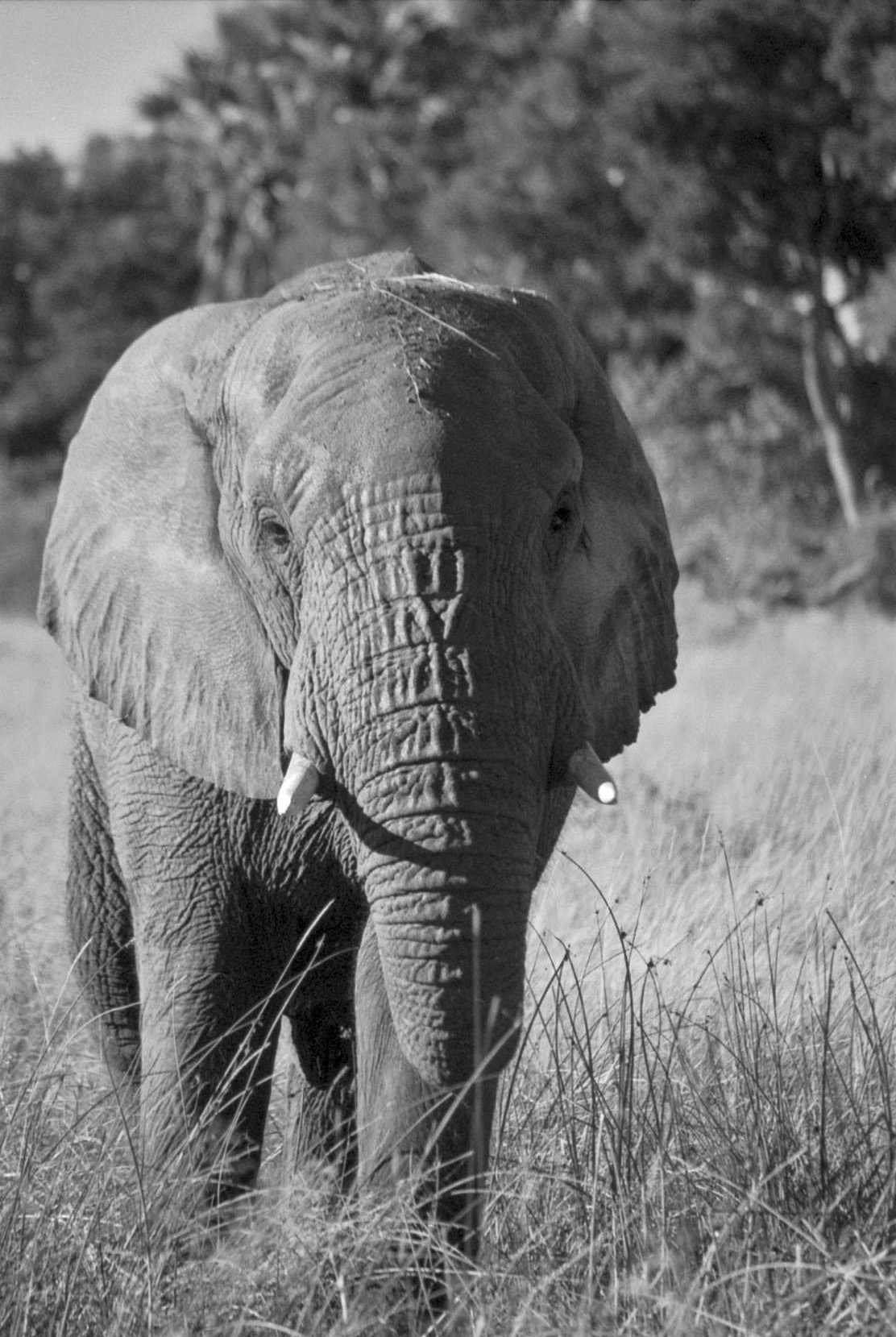
Jabu’s trunk tip investigates my right boot over and over again. The scent that fascinates him tumbles up two seven-foot-long nostrils – nostrils surrounded by nerves, arteries, veins and a staggering array of longitudinal and transverse muscles, the world’s biggest, longest and certainly most flexible nose.
A trunk is the most useful appendage that ever evolved. Imagine having an arm in place of your nose, an arm long enough to reach to the top of a tree, and pluck a single leaf from its crown. Imagine having a nose with which you could rip, tear, excavate, whack, and blow bubbles with. You could steal with your nose, suck on it, squeal, swat, poke and siphon with your nose. You could take a shower with it. Scratch your back with it. Whistle with it. You could even arm wrestle with your nose.
There is no other living creature on this planet that has a trunk. If elephants were already extinct, which brave paleontologist would go out on a limb and reconstruct the trunk just from evidence of bony nostrils high on the skull? Who could imagine a nose dangling close to the ground where scents abound? Who could imagine a nose with the ability to pick up a single straw, rip a tree out by its roots, bench-press 600 pounds and untie your shoelaces without you ever noticing?
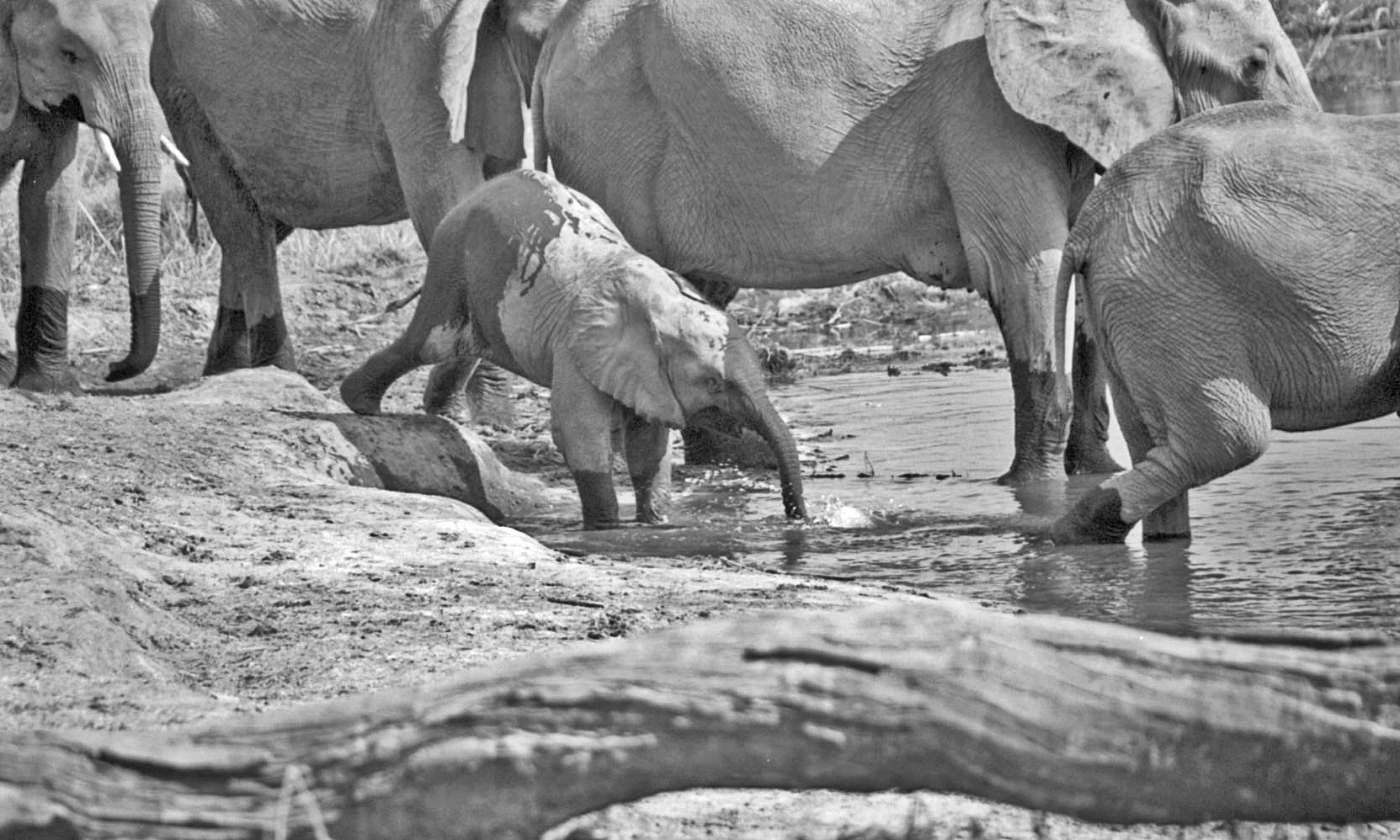
During a visit to Botswana’s Chobe National Park in 1999, I spent part of an afternoon belly laughing at a baby elephant learning to use her trunk. First, she flopped it over her ear as she nursed, a rubbery, 10-inch nuisance dangling like a wayward curl among the bristles on the top of her head. Then, finished with lunch, she began twirling her trunk lariat-style up and down, up and down, a cowgirl learning her ropes. Tiring of that, she flung it away over her left shoulder and was absolutely amazed when it boomeranged back. Stock still, cross-eyed, she tried to puzzle out this remarkable toy and waved it up and down as if it was a hankie. As the members of her family drank, she leaned into the river and blew bubbles with her new plaything.
Blowing bubbles
Finally, she sidled over to her mother and knelt under Mom’s belly. Her knee landed squarely on her trunk. When she squealed in pain, her mother reached under and gave her a reassuring pat.
It takes six to eight months to begin to learn how to twirl your trunk, two years for it to grow all the way down to the ground. And even longer to separate out all those entrancing Fuff! scents.
I’m reposting this piece in honor of the new year. It occurred very early in my blog:
Heart shapes can be found in nature, if you’re lucky enough to spy one. There’s a heart on Jabu’s trunk, a ridge of skin that feels like fine shoe leather. One of his wrinkles pierces the lower third of this heart shape, from left to right, straight as an arrow. His real heart hangs between his breastbone and ribs, a little to the left, just like mine does. But instead of having a heart with a single point, an elephant’s heart has two points at its apex – so it’s the wrinkled outline of a human heart that Jabu carries on his trunk.
The length of Jabu’s real heart is about twenty-two inches, its width eighteen. His heart weighs around forty-four pounds, almost the same as a medium-sized dog. Still, it’s less than 1% of his body weight, a common proportion among large mammals and among humans. My heart also weighs less than 1% of my body weight: about ten ounces.
The human heart is approximately five inches long, three-and-a-half inches wide and shaped like a pulsing cone. It is the only muscle in my body that acts on its own – my heartbeat doesn’t need any messages from my brain. The cells in my heart tissue involuntarily constrict, all together, all at once, over and over, a soft perpetual-motion machine. Rip my heart from my body, chop it into pieces, immerse the pieces in a saline solution, and then give them a small jolt of electricity. The remnants of my cardiac muscle will contract . . . contract . . . contract – all on their own, sometimes for hours.
It’s designed to be strong, my heart.
In mammals, birds, and reptiles the heart has the same basic pump-like design, a design that has worked through eons – even cold-blooded dinosaurs had hearts. A day or two after fertilization, embryos develop a pinpoint that pales, then brightens, pales, then brightens, the beginnings of a tiny pump practicing emptying, filling, emptying, refilling. An old, old pattern. The master timepiece.
There are four chambers in my heart: two auricles (“little ears”) and two ventricles (“little bellies”) – named by anatomists for the external parts of the body they resemble. Spent, dark-red blood is collected in the right auricle, then dropped into the right ventricle, which constricts and pumps it out to the lungs to pick up oxygen. Bright red again, full of oxygen, blood circulates back to the left auricle and from there drops into the left ventricle. In the next twitch blood is delivered to every corner of my body.
The “little ears,” the auricles, make very little sound as they drain blood into the lower chambers of my heart, a distance of an inch or so. It’s the ventricles, the “little bellies,” that boom as each contraction forces open heart valves and blood gushes up the aorta under pressure. Lupp DUPP. Lupp DUPP. Lupp DUPP. One beat smaller, one beat larger, flush after flush.
My right ventricle has walls thin as paper – it delivers blood only as far as the lungs. If I could hold it up to the light I could see right through it. The left side of my heart is the heavyweight lifter, pumping blood all the way to my toes, moving 150,000 tons of blood in my lifetime.
Jabu’s great artery, the aorta, takes off from the left ventricle of his heart, the same as mine does. Named in the Middle Ages, aorta means, “to heave.” It’s an artery more flexible and sturdier than any manmade pipe. Jabu’s left ventricle pumps a continuous stream of blood up and out of his heart into the aorta, which then drops down into his chest and down each leg, where it branches and branches and branches all the way to his toes. Each arterial branch has less space than the artery it came from, but the sum of their volume is always greater than their mother artery. The blood moves, but more and more slowly through smaller and smaller pipes, trickling into all corners of Jabu’s body, trickling through capillaries one cell thick.
Blood’s trip back to the heart is made through veins. Millions of tiny venules drain into thousands of small veins, thousands drain to hundreds, hundreds to the one that empties back into the heart. Veins are even more elastic than arteries, can hold variable quantities of blood, and serve as a reservoir for all that moving liquid. At any one moment, 65% of my blood is contained in my veins. It’s an ancient blueprint, this branching, this heartbeat, this coming and going, a blueprint brought to life in even the tiniest of creatures.
Blood has to be literally hoisted from Jabu’s toes. Squeezed along by muscles wrapped around veins, pushed by valves in the veins, and sucked upward by the huge action of breathing, blood finally arrives in the vena cava, where it drops into the heart. Jabu has two vena cavae, possibly because of the large amounts of blood that need to be moved.The blood vessels of an African elephant reach lengths of twelve feet, a huge network of life.
Jabu’s body contains 120 gallons of blood, enough to fill an aquarium six feet long, two feet wide and two feet deep. At one-and-a-half gallons, my puny amount of blood would barely fill a birdbath.
Blood is the body’s only liquid organ, five times denser than water. It takes food and water in, removes waste and byproducts to the disposal areas of the body, the kidneys, lungs, and skin. Blood irrigates all tissue, both feeds and cleanses. It leaves the heart at one mile per hour and returns, laden with waste, at about half that speed. Construction materials move along highways of blood, demolished materials return. Blood is 20% solids and 80% water, carrying products of digestion, products made by the body, foreign intruders, the dust of stars, even cobalt from the original ocean of the earth where both of us, human and elephant, began our journeys.
We each have roughly one billion heartbeats for our lives. Mouse, hummingbird, elephant, human, all the same. Like us, elephants suffer cardiovascular disease, die of heart attacks and strokes.
Cardiac arrest: when the heart shudders and stops, when the light in the eyes flickers, fades and snuffs.
And when the heart quits beating, its resonance
Lupp DUPP Lupp DUPP Lupp DUPP
is gone. The gurgle of digestion, all the silky, sturdy, slapping noises, the blood rush, gone. The symphony of the body is finished.
For those of us left, that silence is almost too much to bear.
Under a sun-bleached sky that is no longer blue, dry coughing barks from black-backed jackals lope in from our left . . . Wraack, wraack, wraack. . . Black-backs are scavengers, more aggressive than other types of jackals, and occupy the same ecological niche in Africa as coyotes do in North America. They are bold enough to steal meat within the reach of a lion’s paw – although their main diet consists of insects, lizards, snakes, rodents, birds and ripe fruit. Unlike coyotes, black-backed jackals do not howl.
Up ahead of us Morula slaps her ears flatly against her shoulders.
Elephant air-conditioning, for a creature that produces enough heat to warm a small house. Elephants are pachy-dermed, thick-skinned. Some of Morula’s blood vessels are buried as deep as one-and-a-half inches under her skin. Since she doesn’t have sweat glands, her ears act like giant heat exchangers, regulating her body temperature. As her ears open, her body size increases by roughly one-fifth and her ears provide a huge area for thermoregulation. The air moving over swollen arteries on the surface of each ear cools her blood as much as nine degrees before it returns to her body.
The veins in Morula's ear
I take a photograph of her ear in mid-flap. Where Morula’s ear attaches to her shoulder, wrinkles give way to rising rivers of blood, pumping five gallons per minute across the surface of her ears. The pattern of arteries on an elephant’s ear is as unique as a fingerprint, and often used for identification.
The breeze she creates dies before it reaches me. I take off my cap and fan my own neck.
My teeny, itsy ears are built somewhat the same as hers are, with an upper rim of cartilage and a fleshy, lower lobe. But I don’t have an auriculo-occipitalis, an ear muscle the size of a weightlifter’s bicep. I can’t flap my ears. I can’t even wiggle them.
In the late morning heat Morula’s ears are in constant motion.
Ears of African elephants resemble huge maps of Africa. Ears of Asian elephants flop forward at the top and hang like small, wrinkled outlines of India. Morula’s ears fold backward, giving them a smooth, tidy appearance, a map pressed flat. Although the ears of all elephants have a similar construction – cartilage covered by a thin layer of skin – Morula’s ears are roughly three times larger than those of her Asian kin. African elephants have the biggest external ears of all mammals, perhaps the biggest of all time. Each one weighs approximately one hundred pounds.
And no two elephant ears are the same. As pliable and soft as worn canvas, the leading edge of an elephant’s ear is often caught and torn on branches or by the tusks of other elephants. In Kenya I watched an adolescent flare her ear and trace its outline with her trunk like a matador holding out her cape. Backlit by sunlight, three perfectly round holes on its border reminded me of diamond studs. Nearby, a huge bull posed for my gulping camera as I shot an entire roll of film in less than two minutes. Only later, with the film developed and the prints in my hands, did I notice the edges of his ears were as scalloped as an old lace tablecloth.
Jabu sidles up to Morula to investigate the thorn branch in her mouth. Sandi intercepts him and reaches into her bag of treats.
“Jabu, be nice to Morula,” she says.
Jabu holds out his trunk, cups his treat and puts a handful of pellets into his mouth. While he’s busy, Sandi reaches back into her bag and transfers treats to the inside curl of Morula’s trunk. Morula fans her ears, her perfect maps of Africa, and continues munching on her thorn branch. She finishes the branch before eating her treats.





 ABOUT ELEPHANTS
